Strain Improvement
Dr. Rachana Choudhary
Department of Microbiology
Shri Shankaracharya Mahavidyalaya , Junwani Bhilai
Synopsis
Introduction
Methods of strain improvement
Mutation (Replica plate technique)
Recombination
Conjugation
Parasexual cycle
Protoplast fusion
Recombinant DNA Technique Production of recombinant protein- Humulin
 Modifications in metabolic pathway by metabolic engineering
 Superbug Strain Selection
Conclusion
Introduction
 A Strain is a population of organisms that descends
from a single organism .
 A highly efficient strain must be used
 To get high yield of desirable product.
 To make fermentation process more economical.
 This can be achieved by Strain improvement.
 Strain Improvement is” use of any scientific technique
that allow the isolation of culture exhibiting a desired
phenotype.”
Example:
•Penicillium notatum, grown under static condition
yielded low Concentration of penicillin. In 1943, a
strain of P. chrysogenum was isolated- NRRL1951.
This strain was improved Which now gives 55 folds
higher Penicillin yields than original.
Methods of Strain Improvement
•The potential productivity of organism is
controlled by its genome .Strain improvement
can be achieved by :
1.Mutation .
2.Recombination .
3.Recombinant DNA Technology.
1. Mutation
• It is any heritable change in the nucleotide sequence of a gene.
• Gene codes for protein- so any alteration in gene causes
product modification.
• Mutation may be spontaneous or induced.
• Induced mutation require mutagens.
• Patterns for induced mutation:
a) Minor mutation
b) Major mutation
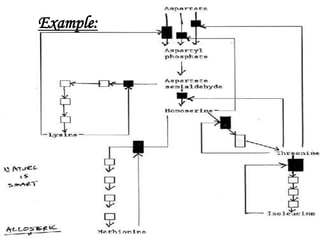
• Example: A mutant strain of Corynebacterium glutamicum
can excrete about 75 grams of lysine per liter in the medium
based on glucose and minerals.
Example:
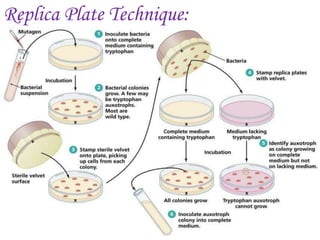
Replica Plate Technique:
2.Recombination
• Recombination is any process which helps to generate
new combinations of genes that were originally present
in different individuals.
• Recombination is accomplished by transferring all or a
part of DNA to the recepient culture from donar
culture.
• It includes:
a. Conjugation
b. Parasexual cycle
c. Protoplast fusion.
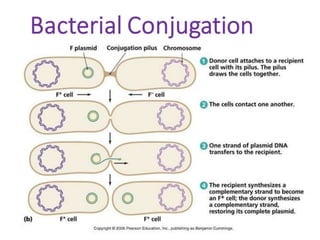
a. Conjugation
 It is a sexual process of DNA transfer.
 Direct contact occurs between bacteria.
 Formation of conjugation bridge.
 A part of chromosome or the whole plasmid may be
transferred from this bridge.
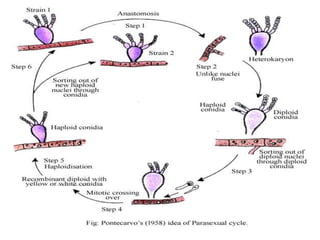
b. Parasexual cycle
• Nuclear fusion and gene segregation could take place
outside or in the absence of sexual organs – the process
known as parasexual cycle.
Steps includes:
• Production of diploid nuclei
in hetetokaryotic haploid
mycelium.
• Abnormal mitosis.
• Haplodization.
c. Protoplast fusion
• Protoplasts are the cell devoid of their cell wall. They
may regenerate their cell wall and are capable of growth
as normal cell.
• During fusion , two or more protoplast come in contact
and adhere with on another either spontaneously or in
presence of chemicals (induced fusion). The protoplasts
can fuse by two ways,
(1) Chemical fusion (NaNO3 , Ca++ ions , PEG)
(2) Electro – fusion
Protoplast fusion
Examples:
 Intraspecific fusion of Bradyrhizobium japonicum
strains resulting in isolates capable of forming of 50%
more nodules than parental strains.
 Intraspecific and interspecific fusion with Sinorhizobium
fredii exhibited increased nitrogenase activity.
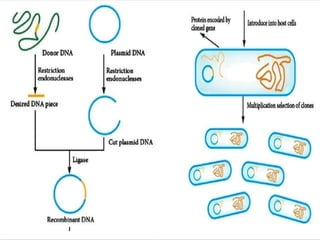
3.Recombinant DNA Technology
• A recombinant DNA molecule is produced by joining
together two or more segments usually originating from
different organisms.
• Achieved by using specific enzymes-restriction
endonuclease and ligase.
• This technique is used to achieve
– Production of recombinant proteins
– Modification of organism’s metabolic pattern for
production of new, modified or more quantity of metabolites
Recombinant DNA Technique Used for
High Yield of Human Insulin.
• chain, and 21 of which comprise a second chain.
• The two chains are linked by a disulfide Insulin is a
small, simple protein.
• It consists of 51 amino acid, 30 of which constitute
one polypeptide bond.
The genetic code for insulin is
found in the DNA at the top
of the short arm of the
eleventh chromosome. It
contains 153 nitrogen bases
(63 in the A chain and 90 in
the B chain).
This is the gene of interest
(GOI).
A vector is required in which
this GOI is to be inserted.
In this way recombinant
DNA is produced.
The Vector (Gram negative E. coli).
 A strain of the common bacterium,
Escherichia coli (E. coli) , an inhabitant of the
human digestive tract, is the 'factory' used in
the genetic engineering of insulin.
Figure showing recombination of genes:
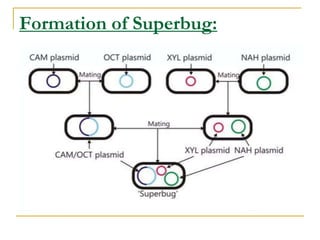
Superbug
 This superbug was created by introducing plasmids from
different strains of Pseudomonas into a single cell.
 This unique bacterial strain, the product of genetic
engineering, is called a "superbug".
 It contains plasmid:
 CAM
 OCT
 NAH
 XYL
Strain Selection
 The selection of stable strain.
 The selection of strains resistant to infection.
 The selection of non foaming strain.
 The selection of strains which are resistant to the
components in the medium.
 The selection of morphologically favourable strains.
 The selection of strains which are tolerant of low oxygen
tension.
Formation of Superbug:
Advantages
 Large scale production of vaccine, enzyme growth factor
and blood clotting factors
 In the field of microbiology Improve the microbes
productivity and characteristics .
 Treatment of genetic disease like SCID by government
technology production of medically useful biological like
biological substance like insulin.
Conclusion
 There are a wide range of techniques that can be utilised
with proper strategy to improve a microbial strain for
overproducing industrial products.
References:
 Industrial fermentation , , 1999– By A.H.Patel
 Fermentation Technology – By Stanbury
 Biotechnology – By B.D.Singh
 General Microbiology – By Prescott
Microbial  Fermentation(Strain Improvement)

Microbial Fermentation(Strain Improvement)

  • 1.
    Strain Improvement Dr. RachanaChoudhary Department of Microbiology Shri Shankaracharya Mahavidyalaya , Junwani Bhilai
  • 2.
    Synopsis Introduction Methods of strainimprovement Mutation (Replica plate technique) Recombination Conjugation Parasexual cycle Protoplast fusion Recombinant DNA Technique Production of recombinant protein- Humulin  Modifications in metabolic pathway by metabolic engineering  Superbug Strain Selection Conclusion
  • 3.
    Introduction  A Strainis a population of organisms that descends from a single organism .  A highly efficient strain must be used  To get high yield of desirable product.  To make fermentation process more economical.  This can be achieved by Strain improvement.  Strain Improvement is” use of any scientific technique that allow the isolation of culture exhibiting a desired phenotype.”
  • 4.
    Example: •Penicillium notatum, grownunder static condition yielded low Concentration of penicillin. In 1943, a strain of P. chrysogenum was isolated- NRRL1951. This strain was improved Which now gives 55 folds higher Penicillin yields than original.
  • 5.
    Methods of StrainImprovement •The potential productivity of organism is controlled by its genome .Strain improvement can be achieved by : 1.Mutation . 2.Recombination . 3.Recombinant DNA Technology.
  • 6.
    1. Mutation • Itis any heritable change in the nucleotide sequence of a gene. • Gene codes for protein- so any alteration in gene causes product modification. • Mutation may be spontaneous or induced. • Induced mutation require mutagens. • Patterns for induced mutation: a) Minor mutation b) Major mutation • Example: A mutant strain of Corynebacterium glutamicum can excrete about 75 grams of lysine per liter in the medium based on glucose and minerals.
  • 7.
  • 8.
  • 9.
    2.Recombination • Recombination isany process which helps to generate new combinations of genes that were originally present in different individuals. • Recombination is accomplished by transferring all or a part of DNA to the recepient culture from donar culture. • It includes: a. Conjugation b. Parasexual cycle c. Protoplast fusion.
  • 10.
    a. Conjugation  Itis a sexual process of DNA transfer.  Direct contact occurs between bacteria.  Formation of conjugation bridge.  A part of chromosome or the whole plasmid may be transferred from this bridge.
  • 12.
    b. Parasexual cycle •Nuclear fusion and gene segregation could take place outside or in the absence of sexual organs – the process known as parasexual cycle. Steps includes: • Production of diploid nuclei in hetetokaryotic haploid mycelium. • Abnormal mitosis. • Haplodization.
  • 14.
    c. Protoplast fusion •Protoplasts are the cell devoid of their cell wall. They may regenerate their cell wall and are capable of growth as normal cell. • During fusion , two or more protoplast come in contact and adhere with on another either spontaneously or in presence of chemicals (induced fusion). The protoplasts can fuse by two ways, (1) Chemical fusion (NaNO3 , Ca++ ions , PEG) (2) Electro – fusion
  • 15.
  • 16.
    Examples:  Intraspecific fusionof Bradyrhizobium japonicum strains resulting in isolates capable of forming of 50% more nodules than parental strains.  Intraspecific and interspecific fusion with Sinorhizobium fredii exhibited increased nitrogenase activity.
  • 17.
    3.Recombinant DNA Technology •A recombinant DNA molecule is produced by joining together two or more segments usually originating from different organisms. • Achieved by using specific enzymes-restriction endonuclease and ligase. • This technique is used to achieve – Production of recombinant proteins – Modification of organism’s metabolic pattern for production of new, modified or more quantity of metabolites
  • 19.
    Recombinant DNA TechniqueUsed for High Yield of Human Insulin. • chain, and 21 of which comprise a second chain. • The two chains are linked by a disulfide Insulin is a small, simple protein. • It consists of 51 amino acid, 30 of which constitute one polypeptide bond.
  • 20.
    The genetic codefor insulin is found in the DNA at the top of the short arm of the eleventh chromosome. It contains 153 nitrogen bases (63 in the A chain and 90 in the B chain). This is the gene of interest (GOI). A vector is required in which this GOI is to be inserted. In this way recombinant DNA is produced.
  • 21.
    The Vector (Gramnegative E. coli).  A strain of the common bacterium, Escherichia coli (E. coli) , an inhabitant of the human digestive tract, is the 'factory' used in the genetic engineering of insulin.
  • 22.
  • 23.
    Superbug  This superbugwas created by introducing plasmids from different strains of Pseudomonas into a single cell.  This unique bacterial strain, the product of genetic engineering, is called a "superbug".  It contains plasmid:  CAM  OCT  NAH  XYL
  • 24.
    Strain Selection  Theselection of stable strain.  The selection of strains resistant to infection.  The selection of non foaming strain.  The selection of strains which are resistant to the components in the medium.  The selection of morphologically favourable strains.  The selection of strains which are tolerant of low oxygen tension.
  • 25.
  • 26.
    Advantages  Large scaleproduction of vaccine, enzyme growth factor and blood clotting factors  In the field of microbiology Improve the microbes productivity and characteristics .  Treatment of genetic disease like SCID by government technology production of medically useful biological like biological substance like insulin.
  • 27.
    Conclusion  There area wide range of techniques that can be utilised with proper strategy to improve a microbial strain for overproducing industrial products.
  • 28.
    References:  Industrial fermentation, , 1999– By A.H.Patel  Fermentation Technology – By Stanbury  Biotechnology – By B.D.Singh  General Microbiology – By Prescott