Antigen
Substances that canbe recognized by the surface antibody (B cells) or by the TCR when associated
with MHC molecules
Immunogenicity VS Antigenicity
Immunogenicity – ability to induce an antibody and/or cell-mediated immune response
Antigenicity – ability to combine with the final products of the response (antibodies and/or T cell
receptor) NOTE: Most immunogenic molecules are also antigenic
3.
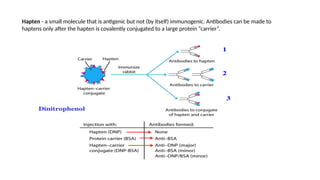
Hapten - asmall molecule that is antigenic but not (by itself) immunogenic. Antibodies can be made to
haptens only after the hapten is covalently conjugated to a large protein “carrier”.
4.
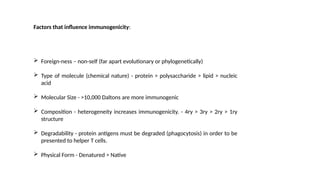
Foreign-ness –non-self (far apart evolutionary or phylogenetically)
Type of molecule (chemical nature) - protein > polysaccharide > lipid > nucleic
acid
Molecular Size - >10,000 Daltons are more immunogenic
Composition - heterogeneity increases immunogenicity. - 4ry > 3ry > 2ry > 1ry
structure
Degradability - protein antigens must be degraded (phagocytosis) in order to be
presented to helper T cells.
Physical Form - Denatured > Native
Factors that influence immunogenicity:
5.
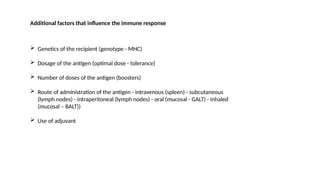
Genetics ofthe recipient (genotype - MHC)
Dosage of the antigen (optimal dose - tolerance)
Number of doses of the antigen (boosters)
Route of administration of the antigen - intravenous (spleen) - subcutaneous
(lymph nodes) - intraperitoneal (lymph nodes) - oral (mucosal - GALT) - inhaled
(mucosal – BALT))
Use of adjuvant
Additional factors that influence the immune response
6.
The region ofan antigen that binds to a T cell receptor or a B cell receptor (antibody).
Since an epitope is the part of the antigen that binds to the B cell or T cell receptor, it is the part that
determines the antigenicity of the antigen - thus the term “antigenic determinant”. -T and B cells
recognize different epitopes on an antigen
Epitope or Antigenic Determinant
7.
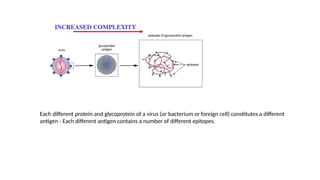
Each different proteinand glycoprotein of a virus (or bacterium or foreign cell) constitutes a different
antigen - Each different antigen contains a number of different epitopes.
8.
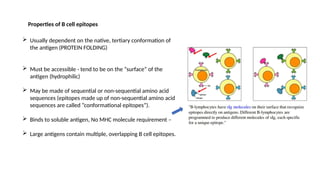
Usually dependenton the native, tertiary conformation of
the antigen (PROTEIN FOLDING)
Must be accessible - tend to be on the “surface” of the
antigen (hydrophilic)
May be made of sequential or non-sequential amino acid
sequences (epitopes made up of non-sequential amino acid
sequences are called “conformational epitopes”).
Binds to soluble antigen, No MHC molecule requirement –
Large antigens contain multiple, overlapping B cell epitopes.
Properties of B cell epitopes
9.
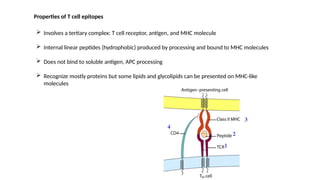
Involves atertiary complex: T cell receptor, antigen, and MHC molecule
Internal linear peptides (hydrophobic) produced by processing and bound to MHC molecules
Does not bind to soluble antigen, APC processing
Recognize mostly proteins but some lipids and glycolipids can be presented on MHC-like
molecules
Properties of T cell epitopes