Genome Organization in Prokaryotes
Prepared By-
Dr. Sangeeta Das
Assistant Professor
Department of Botany
Bahona College, Jorhat
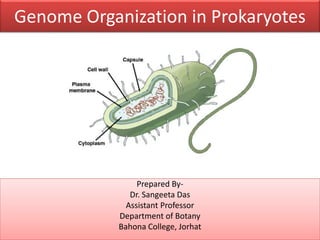
Bacteria are very small unicellular organisms that
do not contain nuclear envelope, mitochondria,
endoplasmic reticulum, mitotic apparatus and
nucleolus etc., and divide by fission.
Bacteria have a rigid cell wall which surrounds their
cytoplasmic membrane.
Their cytoplasm contains ribosomes. mesosomes
and several granular inclusions.
About 1/5 of the cell volume is occupied by DNA,
the genetic material.
Genome Organization in Prokaryotes
Prokaryotes are composed of eubacteria (including
E. coli) and archaebacteria.
They have single circular DNA molecule called
bacterial chromosome.
DNA molecule is extremely long, as such is
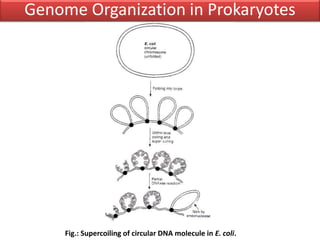
compacted by a process called supercoiling.
This process is facilitated by enzymes called
topoisomerases. They introduce additional turns
into the DNA double helix causing the DNA strand
to wind up on itself.
Genome Organization in Prokaryotes
Topoisomerases act by breaking the DNA
polynucleotide and relating the two ends relative to
each other. The enzyme then rejoins the ends by a
process called positive supercoiling.
It also removes coiling in a process called negative
supercoiling by creating a turn in the opposite
direction.
Prokaryotes possess a nucleoid, a darker central
area containing DNA and proteins revealed by
electron microscopy and an outer area called
cytoplasm.
Genome Organization in Prokaryotes
Some of the proteins isolated from the nucleoid
resemble the histone proteins (found in eukaryotic
chromosomes) which may help in packaging DNA
into compact structure.
The length of prokaryotic chromosomes relative to
the cell dimension means that replication and
partitioning of the DNA molecules during cell
division is a difficult task.
Genome Organization in Prokaryotes
Fig.: Supercoiling of circular DNA molecule in E. coli.
Almost all genes are present in bacterial
chromosome.
A few are present as small circular DNA molecules
called plasmids.
E. coli has about 4300 genes carried by a
chromosomal DNA molecule of 4.6 million base
pairs.
Some genes are arranged as families called operons
that encode proteins with related functions and are
regulated in a coordinated way.
Prokaryotic Genes

Genome organization in prokaryotes

  • 1.
    Genome Organization inProkaryotes Prepared By- Dr. Sangeeta Das Assistant Professor Department of Botany Bahona College, Jorhat
  • 2.
    Bacteria are verysmall unicellular organisms that do not contain nuclear envelope, mitochondria, endoplasmic reticulum, mitotic apparatus and nucleolus etc., and divide by fission. Bacteria have a rigid cell wall which surrounds their cytoplasmic membrane. Their cytoplasm contains ribosomes. mesosomes and several granular inclusions. About 1/5 of the cell volume is occupied by DNA, the genetic material. Genome Organization in Prokaryotes
  • 3.
    Prokaryotes are composedof eubacteria (including E. coli) and archaebacteria. They have single circular DNA molecule called bacterial chromosome. DNA molecule is extremely long, as such is compacted by a process called supercoiling. This process is facilitated by enzymes called topoisomerases. They introduce additional turns into the DNA double helix causing the DNA strand to wind up on itself. Genome Organization in Prokaryotes
  • 4.
    Topoisomerases act bybreaking the DNA polynucleotide and relating the two ends relative to each other. The enzyme then rejoins the ends by a process called positive supercoiling. It also removes coiling in a process called negative supercoiling by creating a turn in the opposite direction. Prokaryotes possess a nucleoid, a darker central area containing DNA and proteins revealed by electron microscopy and an outer area called cytoplasm. Genome Organization in Prokaryotes
  • 5.
    Some of theproteins isolated from the nucleoid resemble the histone proteins (found in eukaryotic chromosomes) which may help in packaging DNA into compact structure. The length of prokaryotic chromosomes relative to the cell dimension means that replication and partitioning of the DNA molecules during cell division is a difficult task. Genome Organization in Prokaryotes
  • 6.
    Genome Organization inProkaryotes Fig.: Supercoiling of circular DNA molecule in E. coli.
  • 7.
    Almost all genesare present in bacterial chromosome. A few are present as small circular DNA molecules called plasmids. E. coli has about 4300 genes carried by a chromosomal DNA molecule of 4.6 million base pairs. Some genes are arranged as families called operons that encode proteins with related functions and are regulated in a coordinated way. Prokaryotic Genes