MRS. PRAVEEN GARG
VITS COLLEGE, SATNA
INTRODUCTION
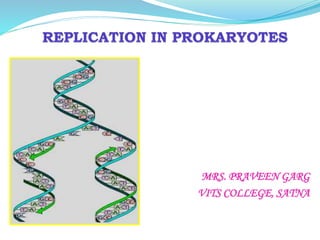
 DNA is replicate by using a semi-conservative method that results
in the formation of double-stranded DNA with one parental strand
and a new daughter strand.
 DNA Replication is a process in which each strand
of DNA molecule act as template for the synthesis of its
complementary strands.
 Newly synthesized DNA strands transferred into two different
daughter cells.
 Replication occurs before a cell divides to ensure that both cells
receive an exact copy of the parent’s genetic material.
 Replication process studied in modal organism E.coli.
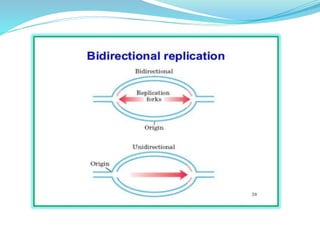
 Replication is bi-directional process and originates at a
single origin of replication (OriC) site occur in DNA.
DNA replication process complete in three steps:
1) INITIATION
2) ELONGATION
3) TERMINATION
INITIATION
 In E.coli the process of replication is initiated from the origin of
replication. The origin of replication in E.coli is called as oriC.
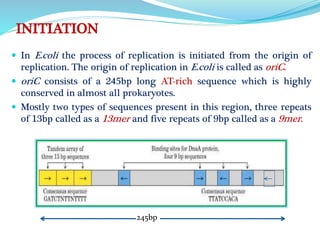
 oriC consists of a 245bp long AT-rich sequence which is highly
conserved in almost all prokaryotes.
 Mostly two types of sequences present in this region, three repeats
of 13bp called as a 13mer and five repeats of 9bp called as a 9mer.
245bp
E.Coli oriC Replication Site
Prokaryotic Replication Proteins
 A few proteins play an important role in DNA replication:
 DnaA– It recognizes oriC sequences for initiation of
replication.
 DanB– Unwinds DNA double helix. It is actually work as a
helicase.
 DnaC– At the origin of replication it helps helicase (DnaB) to
recognize the site for its action.
 DnaG– It is actually act as a primase. It synthesizes new RNA
primer.
 DNA gyrase– It is a DNA topoisomerase II which helps in the
unwinding of DNA.
 DNA pol I - Removes RNA primer and replaces it with newly
synthesized DNA.
 DNA pol III - Main enzyme that adds nucleotides in the 5′-3′
direction.
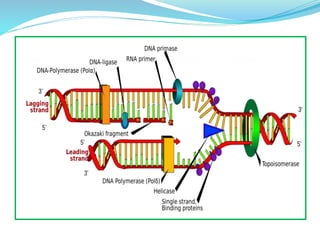
 Helicase - Opens the DNA helix by breaking hydrogen bonds
between the nitrogenous bases. (Dna B)
 Ligase - Seals the gaps between the Okazaki fragments to
create one continuous DNA strand.
 Primase - Synthesizes RNA primers needed to start replication.
 Sliding Clamp - Helps to hold the DNA polymerase in place
when nucleotides are being added.
 Topoisomerase - Helps relieve the strain on DNA when
unwinding by causing breaks, and then resealing the DNA
 Single-strand binding proteins (SSB) - Binds to single-stranded
DNA to prevent DNA from rewinding back.
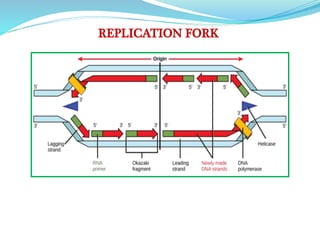
REPLICATION FORK
 Here as the oriC is recognized, the opening of the DNA strand
creates a replication fork. The replication fork is a Y shaped
structure and it is important because it facilitates polymerase to
work properly.
 As the chromosome of bacteria is circular, two different replication
forks are developed in two different directions and it runs towards
each other.
 When helicase unwinds DNA, SSB proteins bind the single strand
near helicase. The single-stranded binding protein binds to the
single strand of DNA and protects it from rejoining.
 SSB is a tetrameric structure that protects the DNA and facilitates
the helicase activity constantly.
 It also prevents single-stranded DNA from the attack of nuclease.
As the helicase Starts unwinding, polymerase starts adding
nucleotide in the elongation stage.
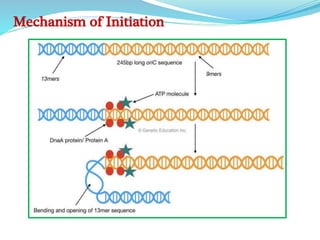
Mechanism of Initiation
 Protein A (Dna A protein) with ATP, binds to the 9mer sequences
of oriC. This binding allows the opening of 13mer sequences
of oriC by bending the DNA.
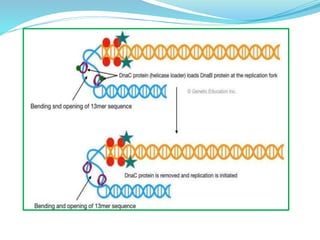
 DnaB proteins bind to 13mer repeats which are recognized by
DnaC. Once DnaB is settled on oriC (at 13mer) the DnaC protein
will be released.
 DnaB helps in the unwinding of DNA and generates two single-
stranded DNA molecules, one with 5’-P end and another with 3’-OH
end. Helicase uses ATP as an energy source for the unwinding of
DNA.
 The activity of helicase (Dna B) generates tension on the
remaining double strand of DNA.
 DNA Gyrase helps in the unwinding of DNA and releases the
tension on the DNA strand by negative supercoiling. Tensioned or
supercoiled DNA decreases the rate of replication.
ELONGATION
 Before the start of elongation, primase synthesized short 10bp
long RNA primer. The DNA polymerase can not able to add
nucleotide without an RNA primer. It provides a start site as a free
3’-OH group for the polymerase to work.
 The elongation is a step in which the DNA synthesis is initiated.
once the dsDNA becomes single-stranded, the polymerase settles
on the junction of DNA-RNA primer.
 The first DNA polymerase is isolated by Arthur Kornberg, in 1959
and he was the first person who synthesized the first DNA
molecule in vitro.
Three different types of DNA polymerase helps in prokaryotic
DNA replication.
 DNA polymerase I: removes RNA primer by exonuclease activity
and proofreads the DNA
 DNA polymerase II: DNA repair function. The DNA polymerase II
mainly involved in the DNA repair pathway.
 DNA polymerase III: Adds nucleotide from 5’ to 3’ direction.
 Once a primosome complex is created (primosome complex is a
primer – Helicase complex) polymerase recognized it and starts the
polymerization process at the leading strand.
 The process of replication progressed from 3’ to 5’ direction while
the polymerase III adds nucleotide from 5’ to 3’ direction.
The activity of DNA polymerase:
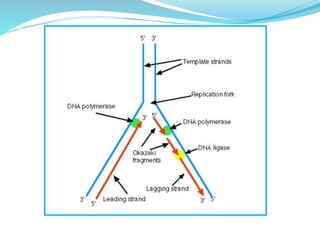
 Two DNA polymerase synthesized both leading stand as well as
lagging stand at once. It is possible with the help of two subunits
of DNA polymerase III.
 Both subunits have different properties as one is specific for
leading strand synthesis and one is specific for lagging strand
synthesis.
 Two sliding clamps and a polymerase clamp loader help
polymerase to settle on each DNA strand. The clamp loader
places the sliding clamp on to the DNA. The sliding clamp holds
DNA properly and prevents them from floating off.
Leading strand synthesis:
 A 3’- OH end of single-stranded DNA is called a leading stand.
Primer is first bound to this end, after the recognization of primer
binding site, as the helicase moves, polymerase III adds
nucleotides from 5’ to 3’ direction on growing leading strand.
 During the process of replication 1000 nucleotides are added per
second.
 The leading strand DNA synthesis is very straightforward. It starts
at primosome and continuously adds nucleotides until the
termination sequences.
 Termination sequences are unique conserved sequences which
are recognized by polymerase as the end of replication.
Lagging strand DNA synthesis:
 The lagging strand of DNA has the 5’-P open end, hence the
polymerase cannot synthesize new DNA from this direction.
 The lagging strand DNA synthesis is a little different from the
leading strand. Here primase synthesizes multiple primers.
 The lagging strand is synthesized in short DNA fragments called
as Okazaki fragments.
 Subsequently, each new primer is added after 1000
nucleotide. After the synthesis of Okazaki fragment, the sliding
clamp is removed.
 Once again, the new primer is synthesized by primase and binds
to DNA, the clamp is further loaded by sliding clamp loader and
the synthesis of new Okazaki fragment begins.
TERMINATION
 After the synthesis of leading and lagging strand, the polymerase
is detached from the site of replication.
 In the termination step, firstly, the multiple primers at lagging
strand are cleaved by RNase H and removed by DNA polymerase
I. It also fills the gap between two Okazaki fragments by the
addition of nucleotides.
 Furthermore, DNA polymerase proofreads the sequence for
avoiding error in replication.
 Finally, the enzyme DNA ligase fills the gap (creates a
phosphodiester bond between Okazaki fragments and newly
added nucleotides).
 At the last stage of termination, two replication fork meets at
terminator recognizing sequences, called as a Ter.
Ter sequences with TUS protein create a complex which arrests the
replication fork and prevent them to escape.
At this complex, the process of replication is completed and all other
proteins and enzymes leave this site.
Only DNA topoisomerase II remains in action, it cuts both strands,
dissociates Ter-TUS complex and two different circular DNA is
generated.
The process of DNA replication can be summarized as follows:
 DNA unwinds at the origin of replication.
 Helicase opens up the DNA strands and form replication forks,
these are extended bidirectionally.
 Single-strand binding proteins bind the DNA around the
replication fork to prevent rewinding of the DNA.
 Topoisomerase binds at the region ahead of the replication fork
to prevent supercoiling.
 Primase synthesizes RNA primers complementary to the DNA
strand.
 DNA polymerase III starts adding nucleotides to the 3′-OH end
of the primer.
 Elongation of both the lagging and the leading strand
continues.
 RNA primers are removed by exonuclease activity.
 Gaps are filled by DNA pol I by adding dNTPs.
 The gap between the two DNA fragments is sealed by DNA
ligase, which helps in the formation of phosphodiester bonds.
THANK YOU

Replication in prokaryotes

  • 1.
    MRS. PRAVEEN GARG VITSCOLLEGE, SATNA
  • 2.
    INTRODUCTION  DNA isreplicate by using a semi-conservative method that results in the formation of double-stranded DNA with one parental strand and a new daughter strand.  DNA Replication is a process in which each strand of DNA molecule act as template for the synthesis of its complementary strands.  Newly synthesized DNA strands transferred into two different daughter cells.  Replication occurs before a cell divides to ensure that both cells receive an exact copy of the parent’s genetic material.  Replication process studied in modal organism E.coli.  Replication is bi-directional process and originates at a single origin of replication (OriC) site occur in DNA.
  • 3.
    DNA replication processcomplete in three steps: 1) INITIATION 2) ELONGATION 3) TERMINATION
  • 4.
    INITIATION  In E.colithe process of replication is initiated from the origin of replication. The origin of replication in E.coli is called as oriC.  oriC consists of a 245bp long AT-rich sequence which is highly conserved in almost all prokaryotes.  Mostly two types of sequences present in this region, three repeats of 13bp called as a 13mer and five repeats of 9bp called as a 9mer. 245bp
  • 5.
  • 6.
    Prokaryotic Replication Proteins A few proteins play an important role in DNA replication:  DnaA– It recognizes oriC sequences for initiation of replication.  DanB– Unwinds DNA double helix. It is actually work as a helicase.  DnaC– At the origin of replication it helps helicase (DnaB) to recognize the site for its action.  DnaG– It is actually act as a primase. It synthesizes new RNA primer.  DNA gyrase– It is a DNA topoisomerase II which helps in the unwinding of DNA.
  • 7.
     DNA polI - Removes RNA primer and replaces it with newly synthesized DNA.  DNA pol III - Main enzyme that adds nucleotides in the 5′-3′ direction.  Helicase - Opens the DNA helix by breaking hydrogen bonds between the nitrogenous bases. (Dna B)  Ligase - Seals the gaps between the Okazaki fragments to create one continuous DNA strand.  Primase - Synthesizes RNA primers needed to start replication.  Sliding Clamp - Helps to hold the DNA polymerase in place when nucleotides are being added.  Topoisomerase - Helps relieve the strain on DNA when unwinding by causing breaks, and then resealing the DNA  Single-strand binding proteins (SSB) - Binds to single-stranded DNA to prevent DNA from rewinding back.
  • 9.
  • 10.
     Here asthe oriC is recognized, the opening of the DNA strand creates a replication fork. The replication fork is a Y shaped structure and it is important because it facilitates polymerase to work properly.  As the chromosome of bacteria is circular, two different replication forks are developed in two different directions and it runs towards each other.  When helicase unwinds DNA, SSB proteins bind the single strand near helicase. The single-stranded binding protein binds to the single strand of DNA and protects it from rejoining.  SSB is a tetrameric structure that protects the DNA and facilitates the helicase activity constantly.  It also prevents single-stranded DNA from the attack of nuclease. As the helicase Starts unwinding, polymerase starts adding nucleotide in the elongation stage.
  • 11.
  • 13.
     Protein A(Dna A protein) with ATP, binds to the 9mer sequences of oriC. This binding allows the opening of 13mer sequences of oriC by bending the DNA.  DnaB proteins bind to 13mer repeats which are recognized by DnaC. Once DnaB is settled on oriC (at 13mer) the DnaC protein will be released.  DnaB helps in the unwinding of DNA and generates two single- stranded DNA molecules, one with 5’-P end and another with 3’-OH end. Helicase uses ATP as an energy source for the unwinding of DNA.  The activity of helicase (Dna B) generates tension on the remaining double strand of DNA.  DNA Gyrase helps in the unwinding of DNA and releases the tension on the DNA strand by negative supercoiling. Tensioned or supercoiled DNA decreases the rate of replication.
  • 16.
    ELONGATION  Before thestart of elongation, primase synthesized short 10bp long RNA primer. The DNA polymerase can not able to add nucleotide without an RNA primer. It provides a start site as a free 3’-OH group for the polymerase to work.  The elongation is a step in which the DNA synthesis is initiated. once the dsDNA becomes single-stranded, the polymerase settles on the junction of DNA-RNA primer.  The first DNA polymerase is isolated by Arthur Kornberg, in 1959 and he was the first person who synthesized the first DNA molecule in vitro.
  • 17.
    Three different typesof DNA polymerase helps in prokaryotic DNA replication.  DNA polymerase I: removes RNA primer by exonuclease activity and proofreads the DNA  DNA polymerase II: DNA repair function. The DNA polymerase II mainly involved in the DNA repair pathway.  DNA polymerase III: Adds nucleotide from 5’ to 3’ direction.  Once a primosome complex is created (primosome complex is a primer – Helicase complex) polymerase recognized it and starts the polymerization process at the leading strand.  The process of replication progressed from 3’ to 5’ direction while the polymerase III adds nucleotide from 5’ to 3’ direction.
  • 18.
    The activity ofDNA polymerase:  Two DNA polymerase synthesized both leading stand as well as lagging stand at once. It is possible with the help of two subunits of DNA polymerase III.  Both subunits have different properties as one is specific for leading strand synthesis and one is specific for lagging strand synthesis.  Two sliding clamps and a polymerase clamp loader help polymerase to settle on each DNA strand. The clamp loader places the sliding clamp on to the DNA. The sliding clamp holds DNA properly and prevents them from floating off.
  • 19.
    Leading strand synthesis: A 3’- OH end of single-stranded DNA is called a leading stand. Primer is first bound to this end, after the recognization of primer binding site, as the helicase moves, polymerase III adds nucleotides from 5’ to 3’ direction on growing leading strand.  During the process of replication 1000 nucleotides are added per second.  The leading strand DNA synthesis is very straightforward. It starts at primosome and continuously adds nucleotides until the termination sequences.  Termination sequences are unique conserved sequences which are recognized by polymerase as the end of replication.
  • 20.
    Lagging strand DNAsynthesis:  The lagging strand of DNA has the 5’-P open end, hence the polymerase cannot synthesize new DNA from this direction.  The lagging strand DNA synthesis is a little different from the leading strand. Here primase synthesizes multiple primers.  The lagging strand is synthesized in short DNA fragments called as Okazaki fragments.  Subsequently, each new primer is added after 1000 nucleotide. After the synthesis of Okazaki fragment, the sliding clamp is removed.  Once again, the new primer is synthesized by primase and binds to DNA, the clamp is further loaded by sliding clamp loader and the synthesis of new Okazaki fragment begins.
  • 21.
    TERMINATION  After thesynthesis of leading and lagging strand, the polymerase is detached from the site of replication.  In the termination step, firstly, the multiple primers at lagging strand are cleaved by RNase H and removed by DNA polymerase I. It also fills the gap between two Okazaki fragments by the addition of nucleotides.  Furthermore, DNA polymerase proofreads the sequence for avoiding error in replication.  Finally, the enzyme DNA ligase fills the gap (creates a phosphodiester bond between Okazaki fragments and newly added nucleotides).  At the last stage of termination, two replication fork meets at terminator recognizing sequences, called as a Ter.
  • 22.
    Ter sequences withTUS protein create a complex which arrests the replication fork and prevent them to escape. At this complex, the process of replication is completed and all other proteins and enzymes leave this site. Only DNA topoisomerase II remains in action, it cuts both strands, dissociates Ter-TUS complex and two different circular DNA is generated.
  • 23.
    The process ofDNA replication can be summarized as follows:  DNA unwinds at the origin of replication.  Helicase opens up the DNA strands and form replication forks, these are extended bidirectionally.  Single-strand binding proteins bind the DNA around the replication fork to prevent rewinding of the DNA.  Topoisomerase binds at the region ahead of the replication fork to prevent supercoiling.  Primase synthesizes RNA primers complementary to the DNA strand.
  • 24.
     DNA polymeraseIII starts adding nucleotides to the 3′-OH end of the primer.  Elongation of both the lagging and the leading strand continues.  RNA primers are removed by exonuclease activity.  Gaps are filled by DNA pol I by adding dNTPs.  The gap between the two DNA fragments is sealed by DNA ligase, which helps in the formation of phosphodiester bonds.
  • 25.