Dr. Rachana Choudhary
Department of Microbiology
Shri Shankaracharya Mahavidyalaya Junwani Bhilai
ATOMIC ABSORPTION SPECTROSCOPY
CONTENT
• INTRODUCTION
• PRINCIPLE
• INSTRUMENTATION
• ADVANTAGE AND DISADVANTAGE
• APPLICATION
• REFERENCE
INTRODUCTION
• A. Walsh in 1955,fisrtly introduced the AAS.
• AAS determines the presence of Metals in liquid
sample.metal include Fe, Cu, Al, Ca, Zn, Cd and
many more.
• AAS is the most powerful instrumental technique
for the quantitative and qualitative determination
of trace metals in liquids.
• AAS is a technique for determining the
concentration of a particular metal element in a
sample.
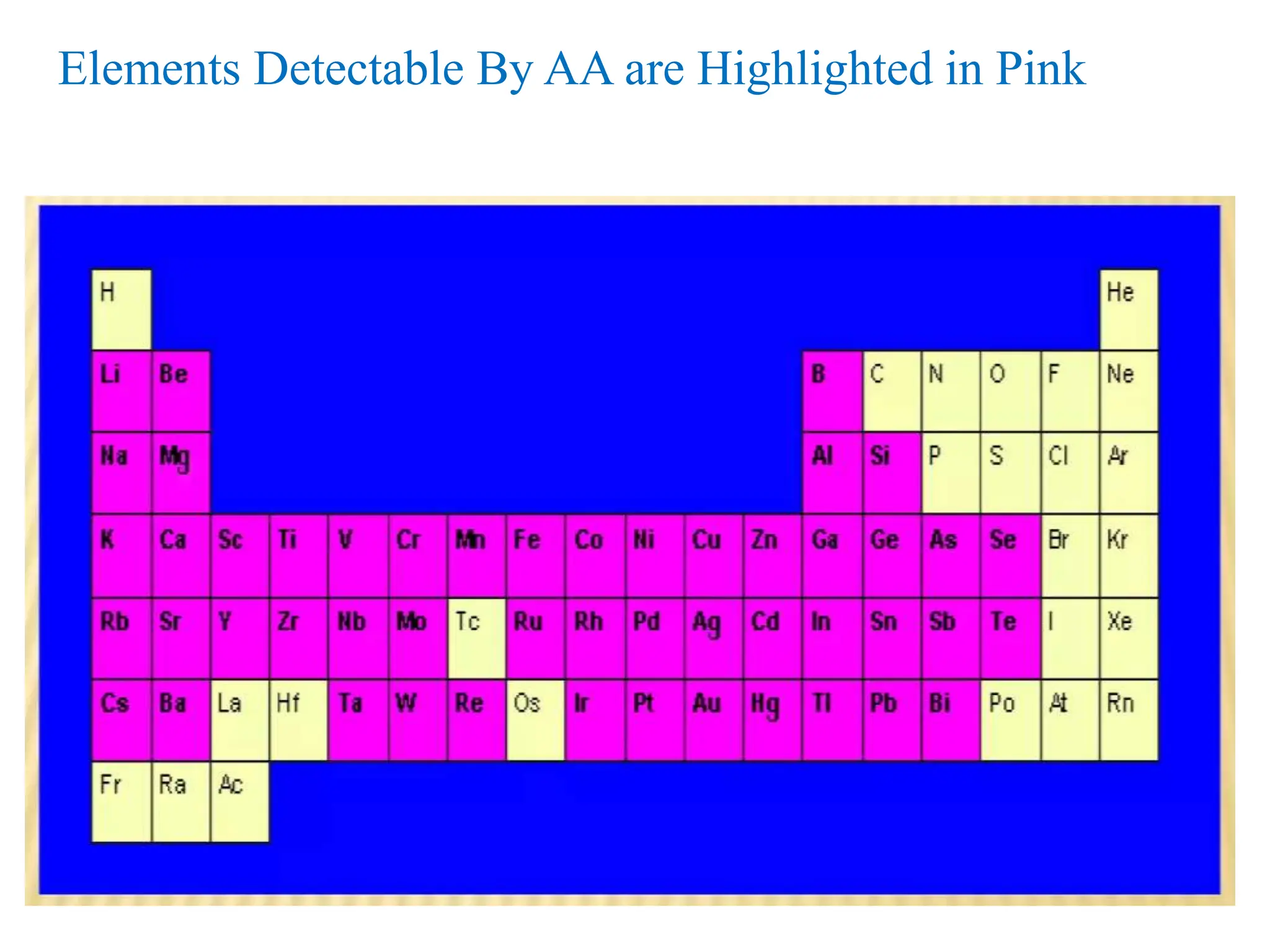
Elements Detectable By AA are Highlighted in Pink
PRINCIPLE:-
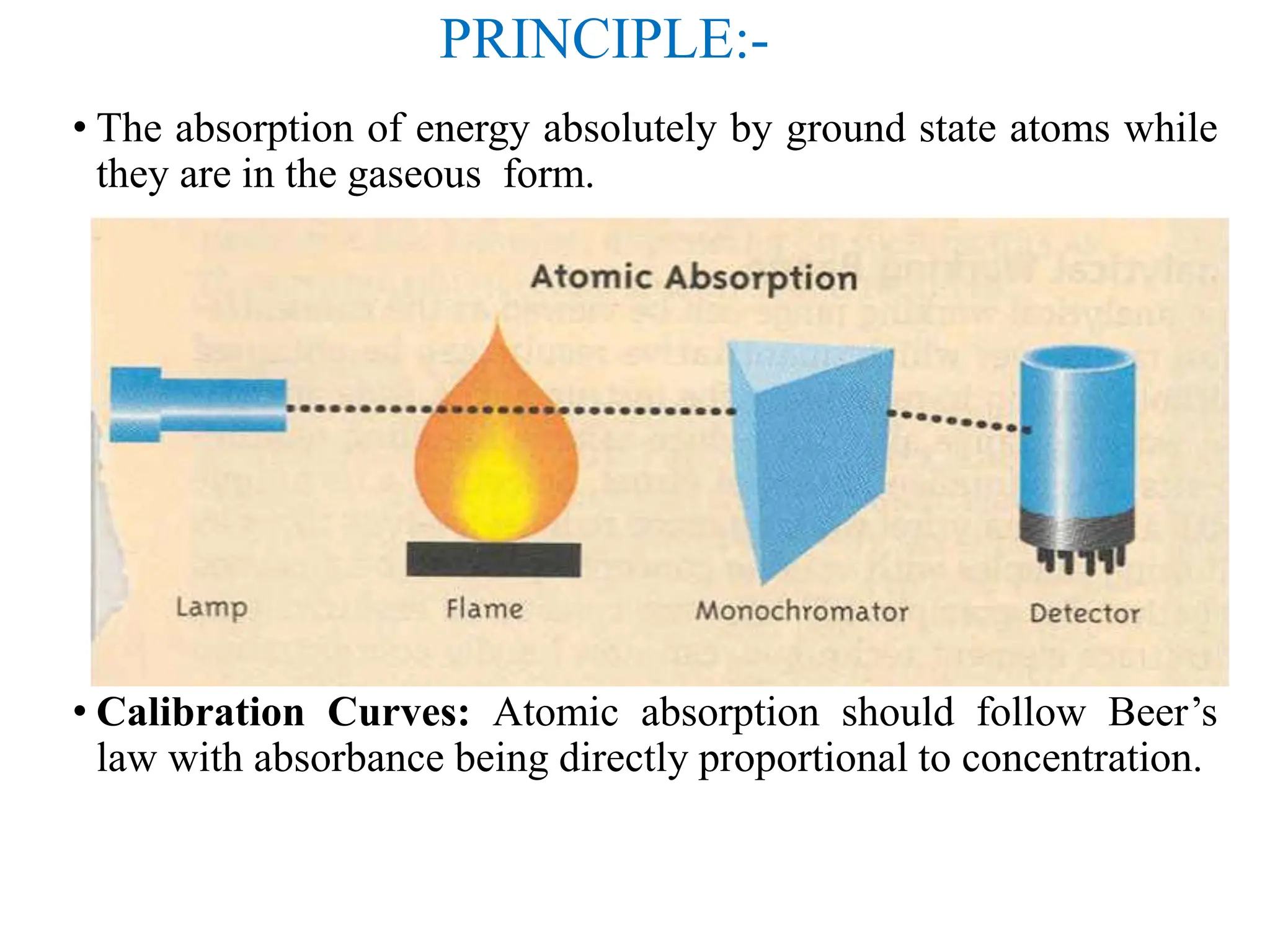
• The absorption of energy absolutely by ground state atoms while
they are in the gaseous form.
• Calibration Curves: Atomic absorption should follow Beer’s
law with absorbance being directly proportional to concentration.
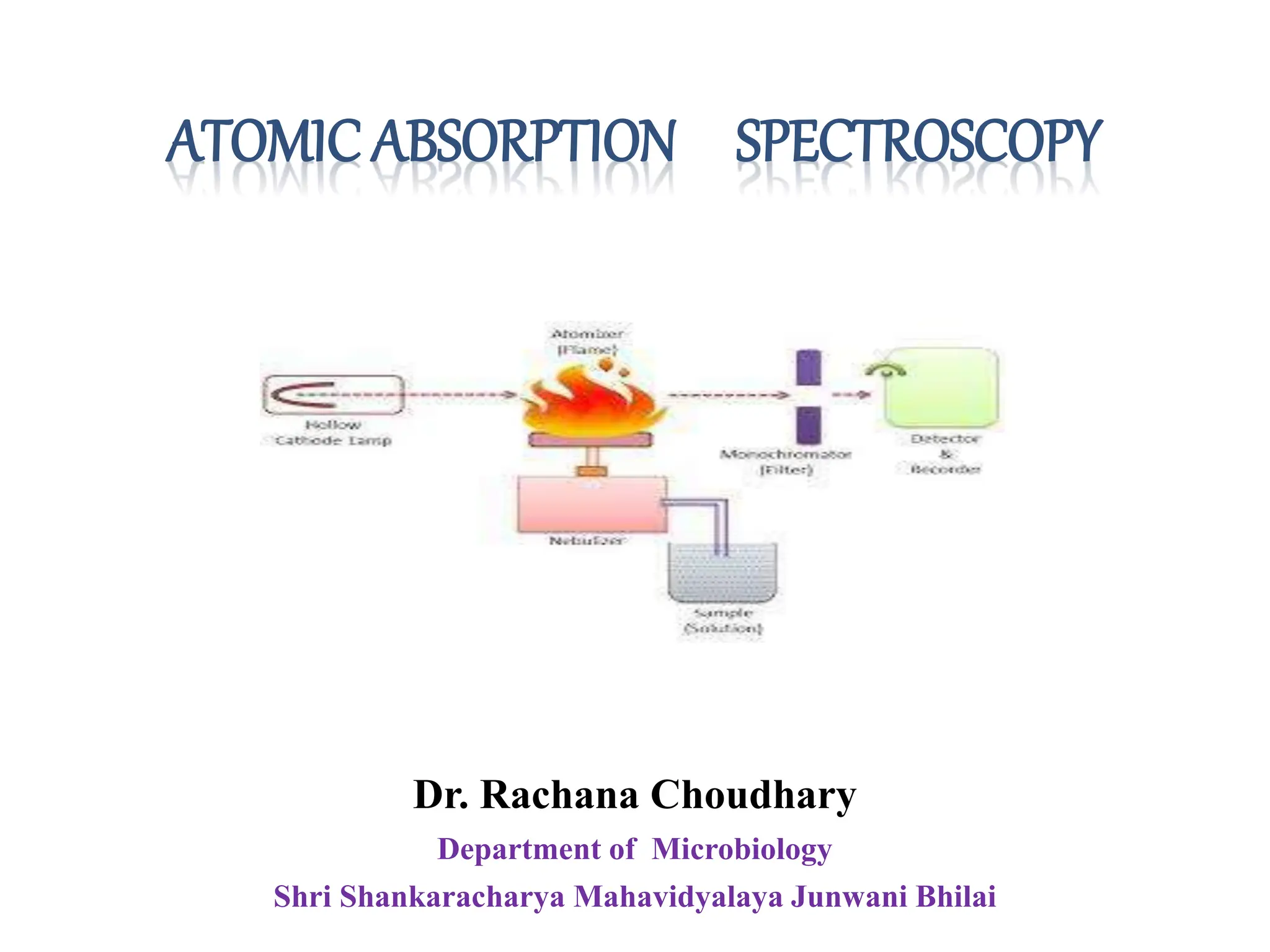
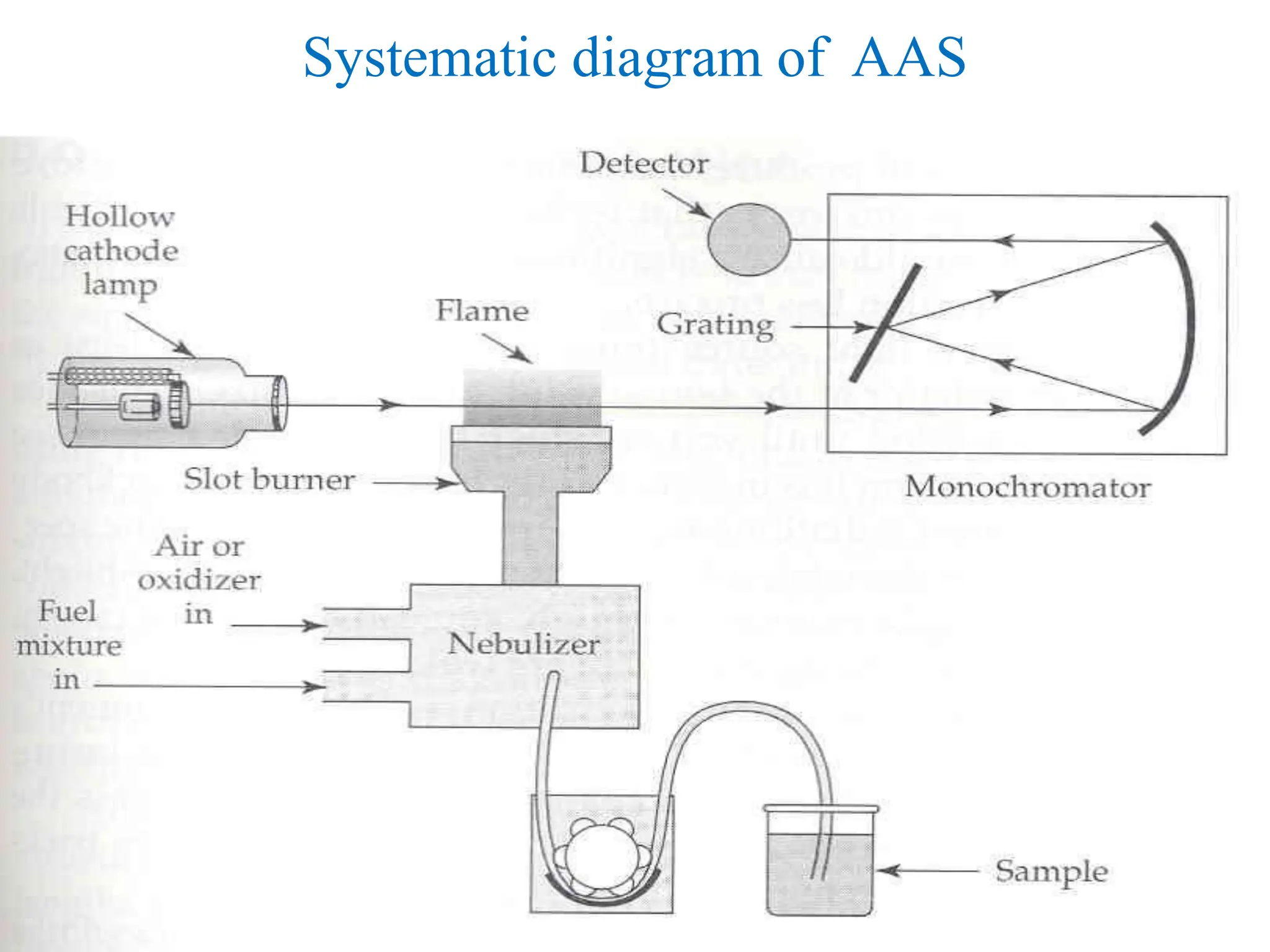
Systematic diagram of AAS
Flame
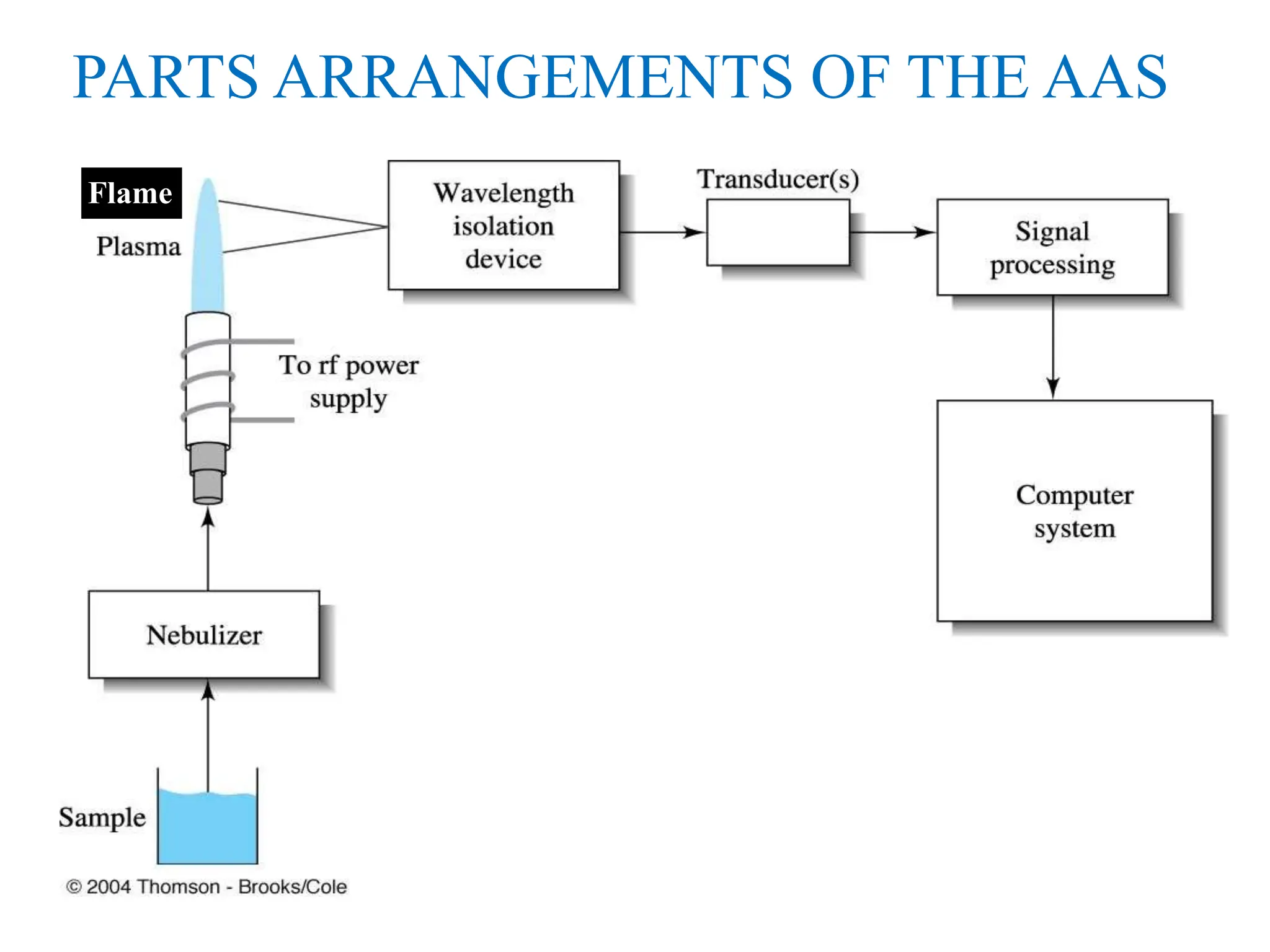
PARTS ARRANGEMENTS OF THE AAS
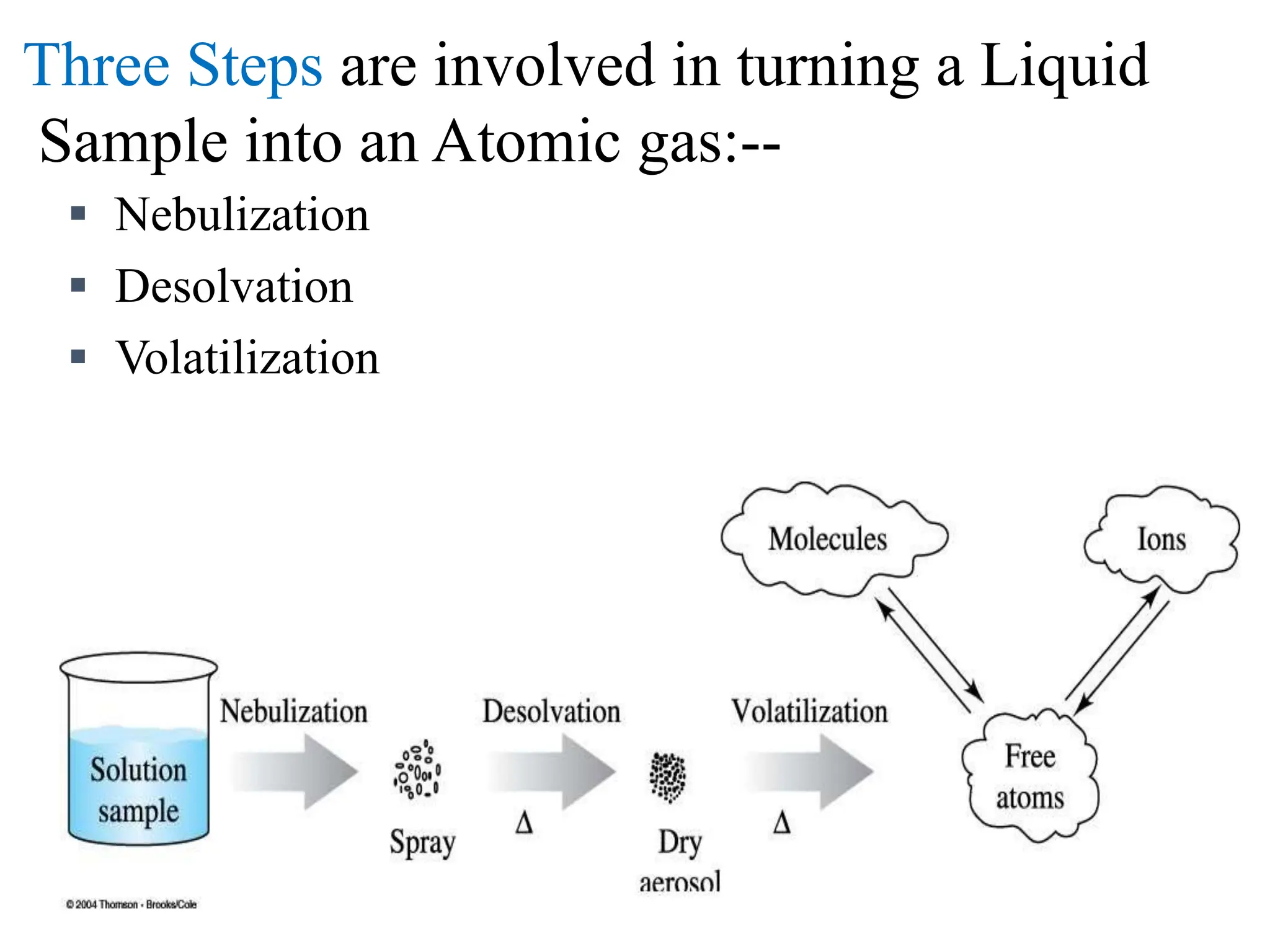
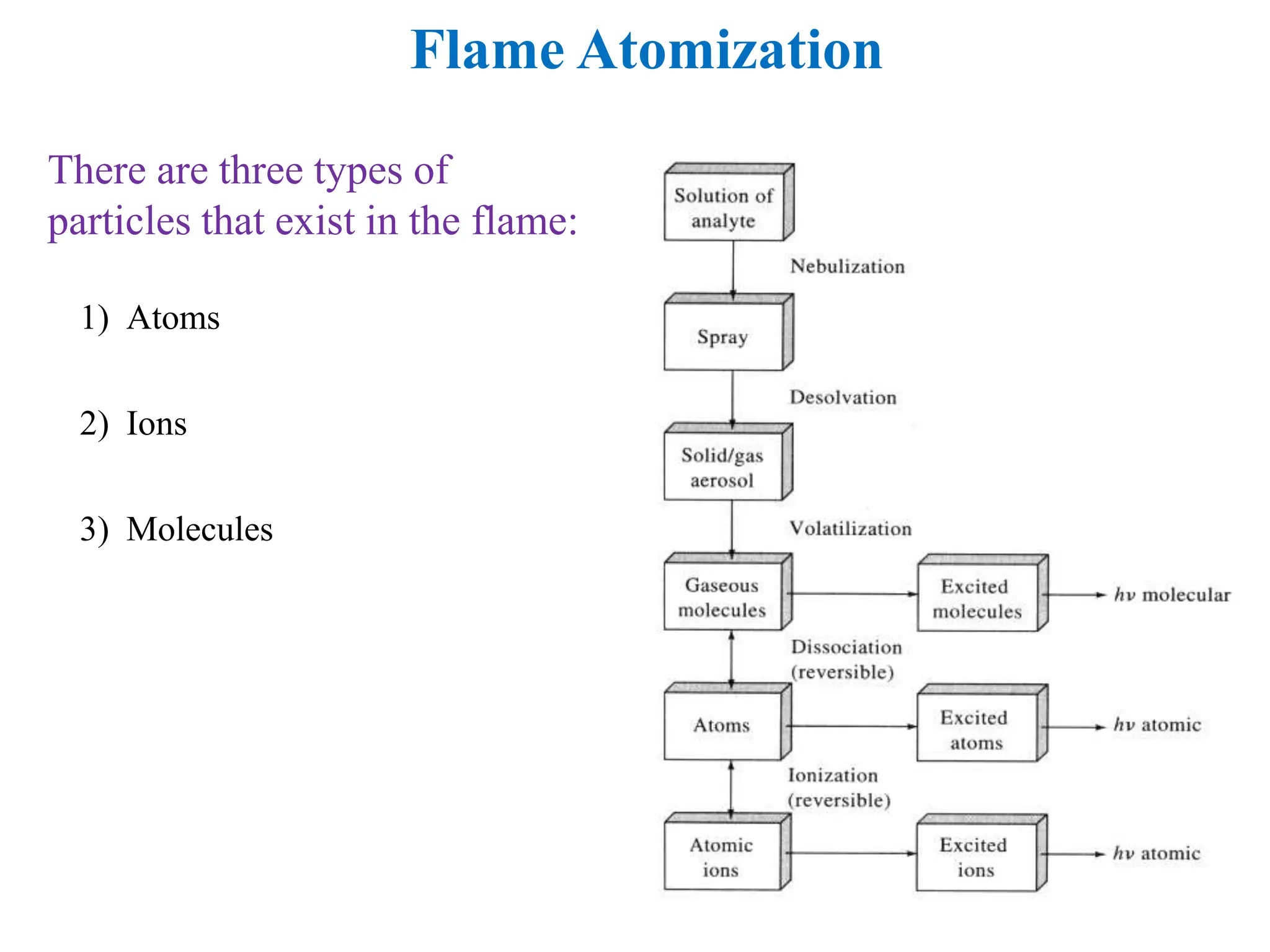
Three Steps are involved in turning a Liquid
Sample into an Atomic gas:--
 Nebulization
 Desolvation
 Volatilization
Flame Atomization
There are three types of
particles that exist in the flame:
1) Atoms
2) Ions
3) Molecules
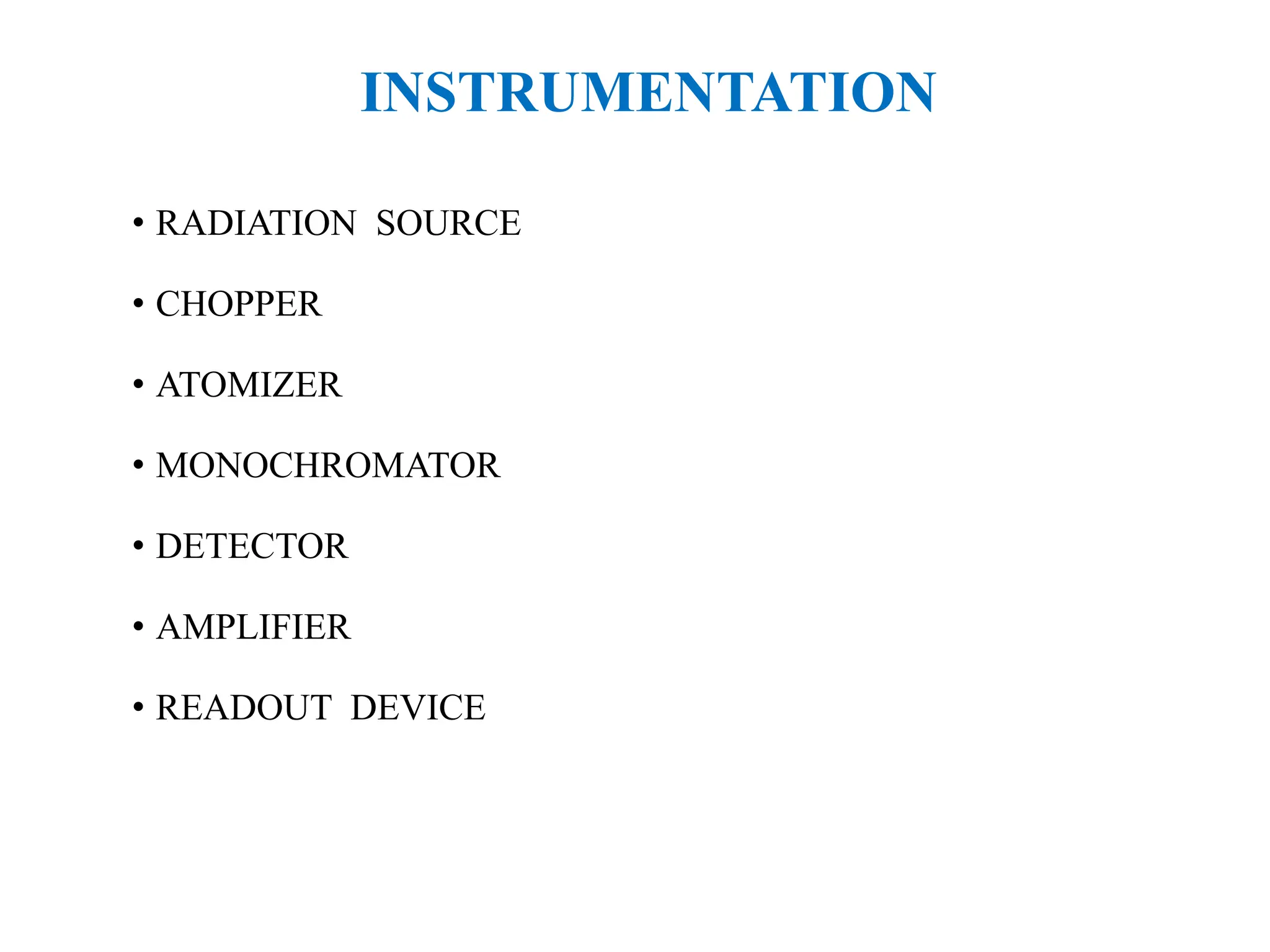
INSTRUMENTATION
• RADIATION SOURCE
• CHOPPER
• ATOMIZER
• MONOCHROMATOR
• DETECTOR
• AMPLIFIER
• READOUT DEVICE
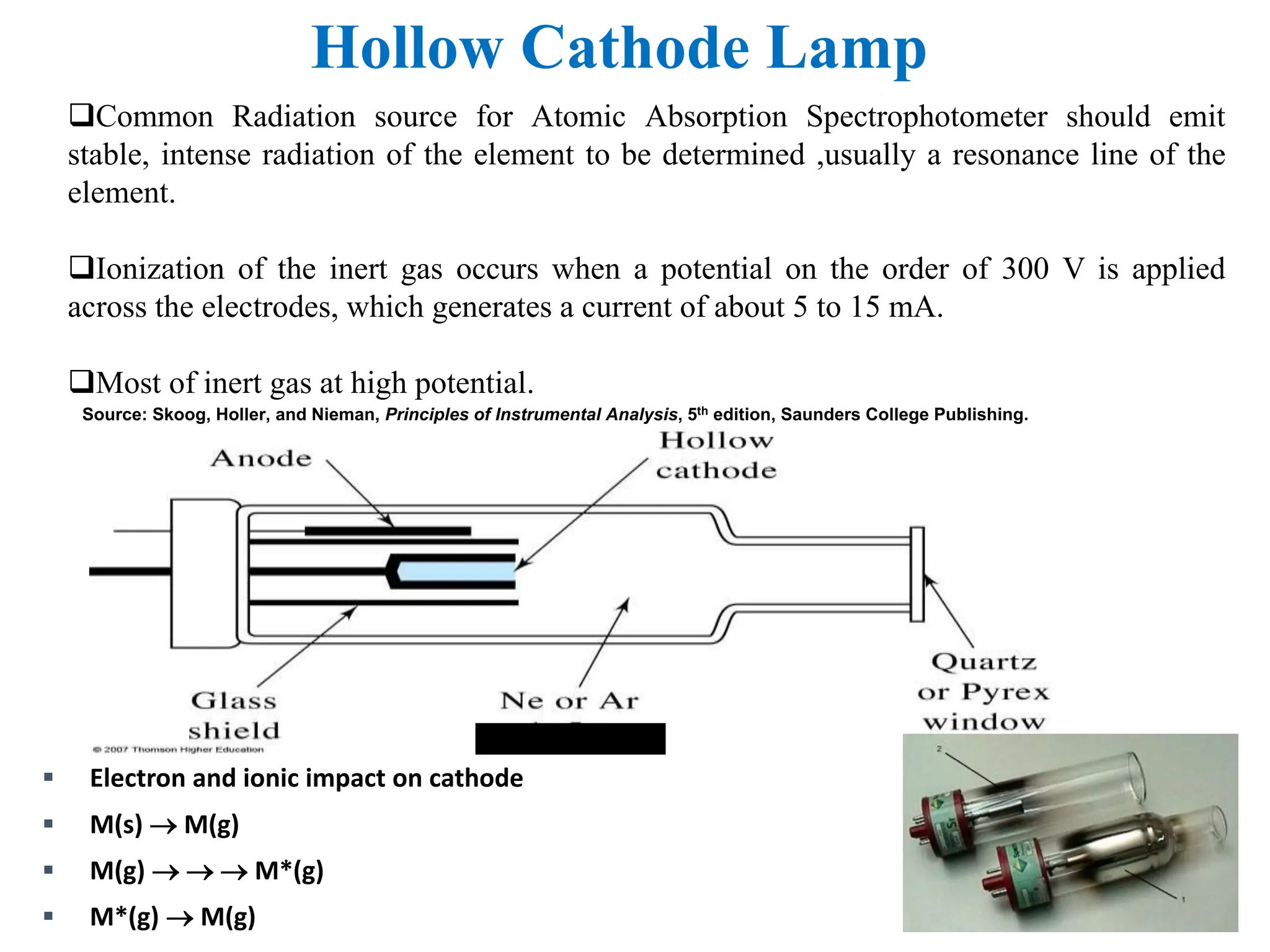
Hollow Cathode Lamp
Common Radiation source for Atomic Absorption Spectrophotometer should emit
stable, intense radiation of the element to be determined ,usually a resonance line of the
element.
Ionization of the inert gas occurs when a potential on the order of 300 V is applied
across the electrodes, which generates a current of about 5 to 15 mA.
Most of inert gas at high potential.
Source: Skoog, Holler, and Nieman, Principles of Instrumental Analysis, 5th edition, Saunders College Publishing.
 Electron and ionic impact on cathode
 M(s)  M(g)
 M(g)    M*(g)
 M*(g)  M(g)
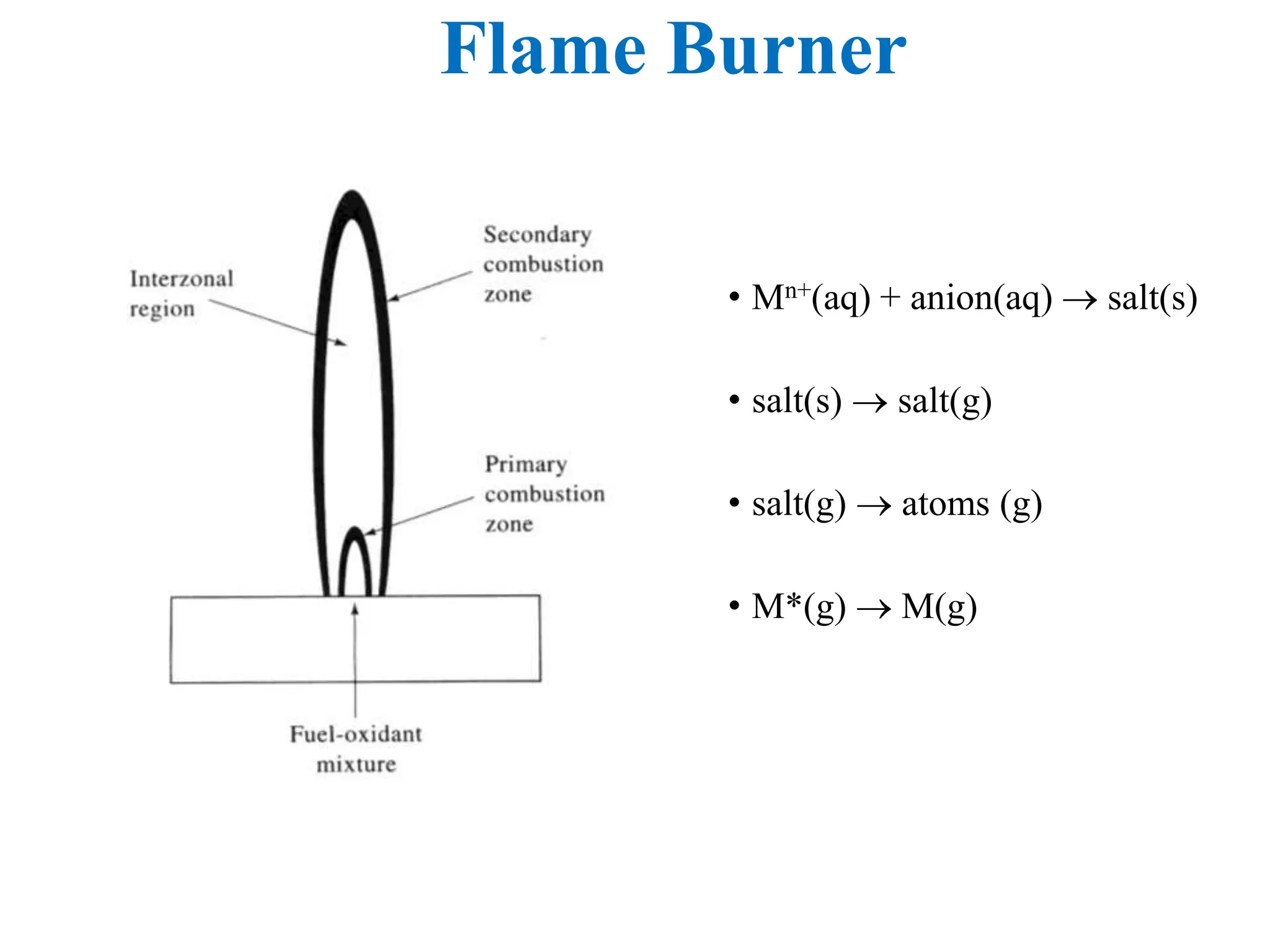
Flame Burner
• Mn+(aq) + anion(aq)  salt(s)
• salt(s)  salt(g)
• salt(g)  atoms (g)
• M*(g)  M(g)
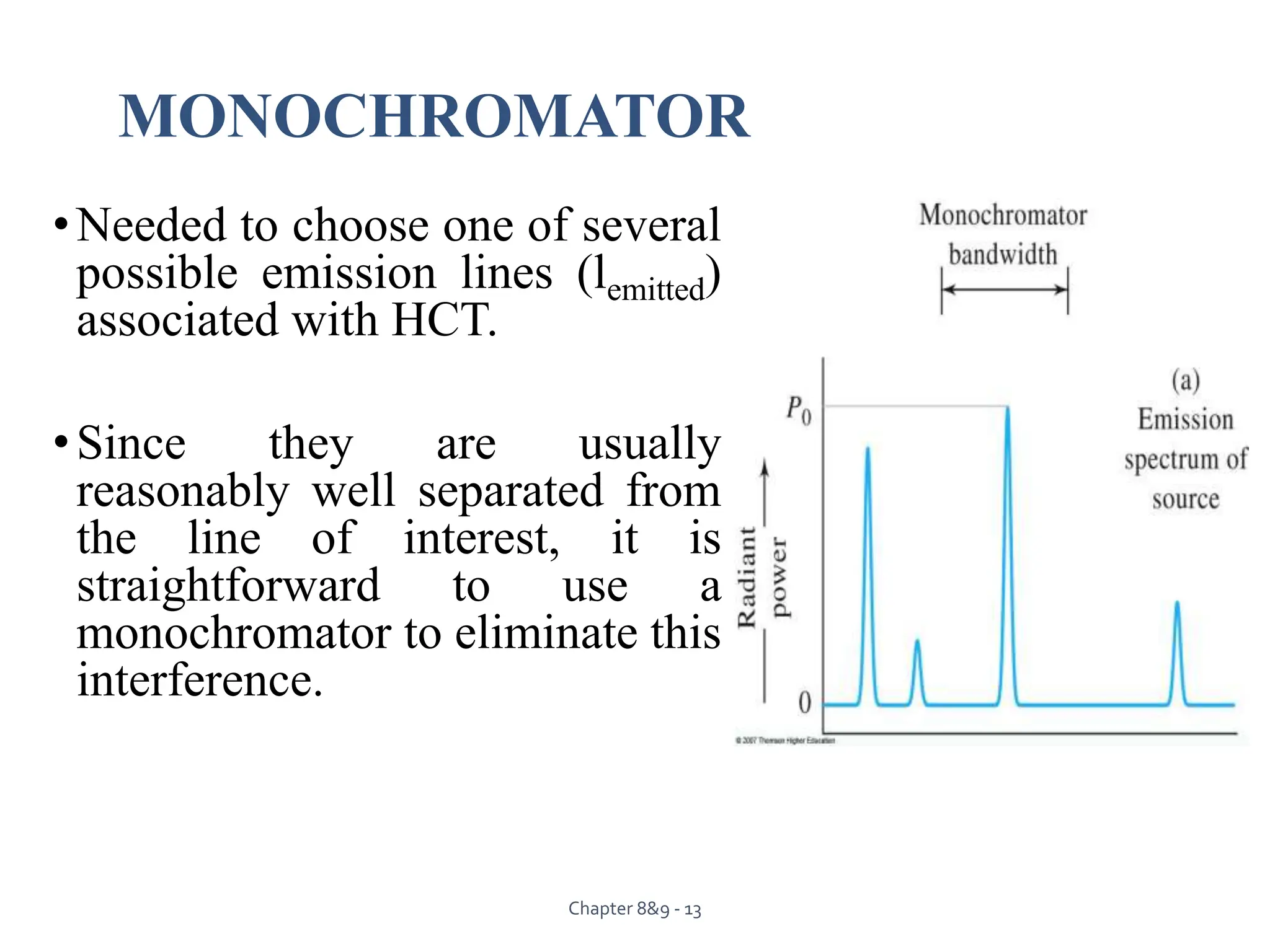
MONOCHROMATOR
•Needed to choose one of several
possible emission lines (lemitted)
associated with HCT.
•Since they are usually
reasonably well separated from
the line of interest, it is
straightforward to use a
monochromator to eliminate this
interference.
Chapter 8&9 - 13
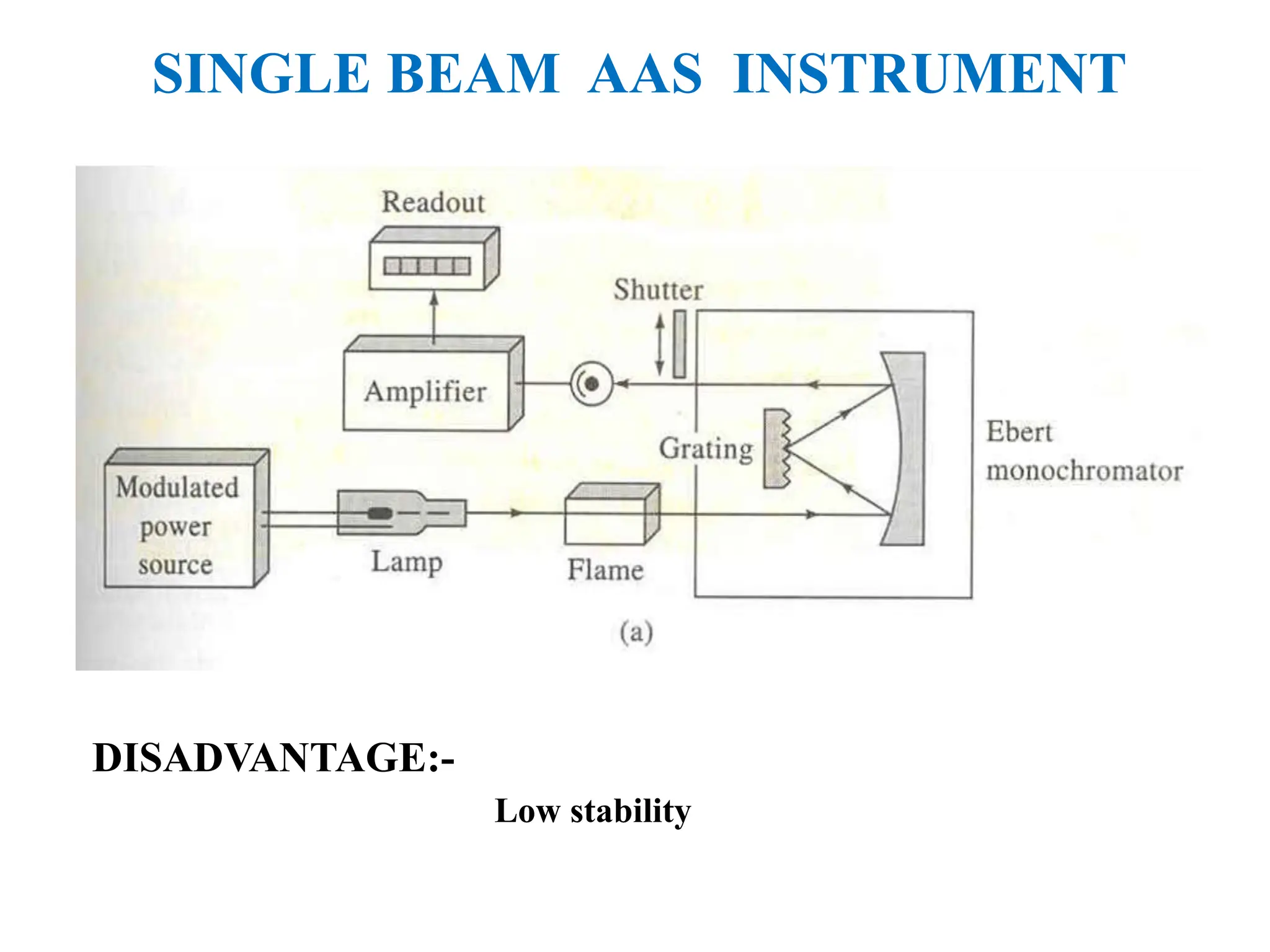
SINGLE BEAM AAS INSTRUMENT
DISADVANTAGE:-
Low stability
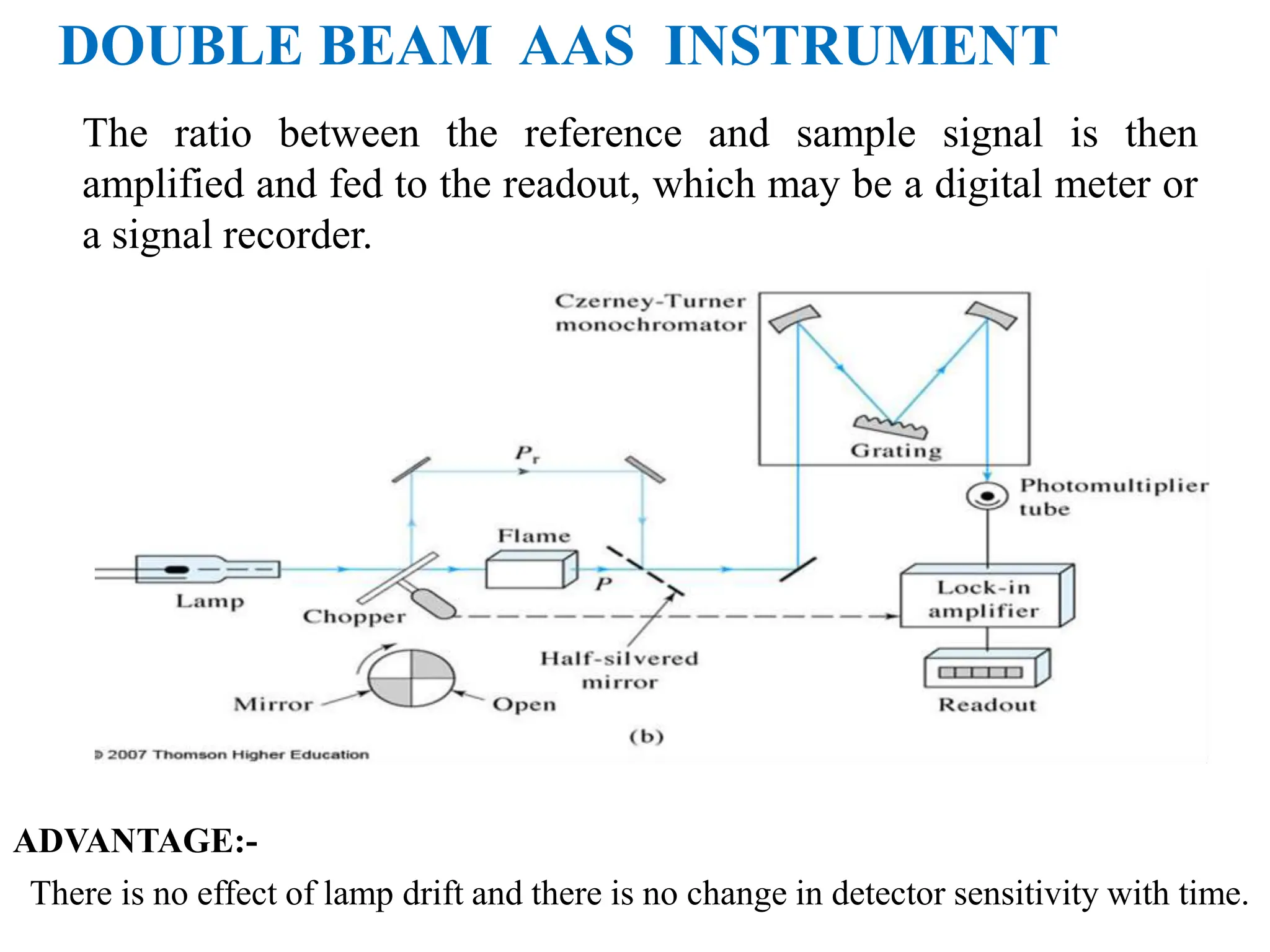
DOUBLE BEAM AAS INSTRUMENT
ADVANTAGE:-
There is no effect of lamp drift and there is no change in detector sensitivity with time.
The ratio between the reference and sample signal is then
amplified and fed to the readout, which may be a digital meter or
a signal recorder.
ADVANTAGES OF AAS
• Determination of 68 metals and metalloid elements.
• Ability to make ppb determinations on major components of a sample.
• Precision of measurements by flame are better than 1% rsd. There are
few other instrumental methods that offer this precision so easily.
• AA analysis is subject to little interference.
• Most interference that occurs have been well studied and documented.
• Sample preparation is simple.
• Instrument easy to tune and operate.
DISADVANTAGES OF AAS
• Limited to specific elements
• Requires skilled operators
• Interference affects accuracy
• Hollow cathode lamp source is needed for each element.
• Expensive element.
• Sample preparation is time-consuming
APPLICATION
• Atomic Absorption is in the assay of elements in biological samples
such as blood, plasma, other body fluids such as urine, saliva, milk &
even in the macromolecules.
• AAS is a more sensitive technique & can detect presence of much less
quantities of element with the exception of alkali .
• AAS can detect quantity less than 1 part 10-6 of more than twenty
elements.
REFERENCE
Biophysical Chemistry by Upadhyay & Upadhyay Nath. 3rd
edition,2004.
Principles of Instrumental Analysis. By Skoog, Holler, and Neiman.
5th edition,1998.
Instrumental Methods of Analysis B. Shivashankar
Instrumental methods of chemical analysis Gurdeep R. Chatwal,
Sham K. Anand 5th edition.
THANK YOU

A BRIEF ABOUT ATOMIC ABSORPTION SPECTROSCOPY.ppt

  • 1.
    Dr. Rachana Choudhary Departmentof Microbiology Shri Shankaracharya Mahavidyalaya Junwani Bhilai ATOMIC ABSORPTION SPECTROSCOPY
  • 2.
    CONTENT • INTRODUCTION • PRINCIPLE •INSTRUMENTATION • ADVANTAGE AND DISADVANTAGE • APPLICATION • REFERENCE
  • 3.
    INTRODUCTION • A. Walshin 1955,fisrtly introduced the AAS. • AAS determines the presence of Metals in liquid sample.metal include Fe, Cu, Al, Ca, Zn, Cd and many more. • AAS is the most powerful instrumental technique for the quantitative and qualitative determination of trace metals in liquids. • AAS is a technique for determining the concentration of a particular metal element in a sample.
  • 4.
    Elements Detectable ByAA are Highlighted in Pink
  • 5.
    PRINCIPLE:- • The absorptionof energy absolutely by ground state atoms while they are in the gaseous form. • Calibration Curves: Atomic absorption should follow Beer’s law with absorbance being directly proportional to concentration.
  • 6.
  • 7.
  • 8.
    Three Steps areinvolved in turning a Liquid Sample into an Atomic gas:--  Nebulization  Desolvation  Volatilization
  • 9.
    Flame Atomization There arethree types of particles that exist in the flame: 1) Atoms 2) Ions 3) Molecules
  • 10.
    INSTRUMENTATION • RADIATION SOURCE •CHOPPER • ATOMIZER • MONOCHROMATOR • DETECTOR • AMPLIFIER • READOUT DEVICE
  • 11.
    Hollow Cathode Lamp CommonRadiation source for Atomic Absorption Spectrophotometer should emit stable, intense radiation of the element to be determined ,usually a resonance line of the element. Ionization of the inert gas occurs when a potential on the order of 300 V is applied across the electrodes, which generates a current of about 5 to 15 mA. Most of inert gas at high potential. Source: Skoog, Holler, and Nieman, Principles of Instrumental Analysis, 5th edition, Saunders College Publishing.  Electron and ionic impact on cathode  M(s)  M(g)  M(g)    M*(g)  M*(g)  M(g)
  • 12.
    Flame Burner • Mn+(aq)+ anion(aq)  salt(s) • salt(s)  salt(g) • salt(g)  atoms (g) • M*(g)  M(g)
  • 13.
    MONOCHROMATOR •Needed to chooseone of several possible emission lines (lemitted) associated with HCT. •Since they are usually reasonably well separated from the line of interest, it is straightforward to use a monochromator to eliminate this interference. Chapter 8&9 - 13
  • 14.
    SINGLE BEAM AASINSTRUMENT DISADVANTAGE:- Low stability
  • 15.
    DOUBLE BEAM AASINSTRUMENT ADVANTAGE:- There is no effect of lamp drift and there is no change in detector sensitivity with time. The ratio between the reference and sample signal is then amplified and fed to the readout, which may be a digital meter or a signal recorder.
  • 16.
    ADVANTAGES OF AAS •Determination of 68 metals and metalloid elements. • Ability to make ppb determinations on major components of a sample. • Precision of measurements by flame are better than 1% rsd. There are few other instrumental methods that offer this precision so easily. • AA analysis is subject to little interference. • Most interference that occurs have been well studied and documented. • Sample preparation is simple. • Instrument easy to tune and operate.
  • 17.
    DISADVANTAGES OF AAS •Limited to specific elements • Requires skilled operators • Interference affects accuracy • Hollow cathode lamp source is needed for each element. • Expensive element. • Sample preparation is time-consuming
  • 18.
    APPLICATION • Atomic Absorptionis in the assay of elements in biological samples such as blood, plasma, other body fluids such as urine, saliva, milk & even in the macromolecules. • AAS is a more sensitive technique & can detect presence of much less quantities of element with the exception of alkali . • AAS can detect quantity less than 1 part 10-6 of more than twenty elements.
  • 19.
    REFERENCE Biophysical Chemistry byUpadhyay & Upadhyay Nath. 3rd edition,2004. Principles of Instrumental Analysis. By Skoog, Holler, and Neiman. 5th edition,1998. Instrumental Methods of Analysis B. Shivashankar Instrumental methods of chemical analysis Gurdeep R. Chatwal, Sham K. Anand 5th edition.
  • 20.