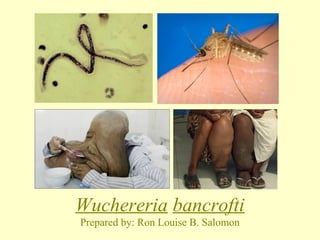
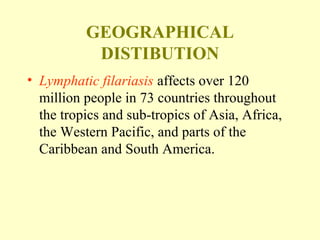
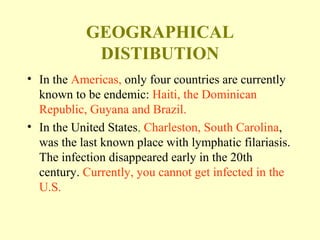
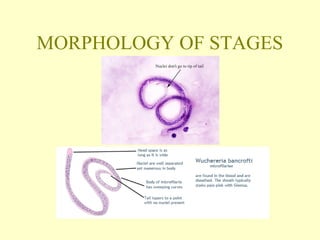
Wuchereria bancrofti 
Prepared by: Ron Louise B. Salomon
TAXONOMY 
• Domain: Eukaryota 
• Kingdom: Metazoa 
• Phylum: Nematoda 
• Class: Secernentea 
• Order: Spirurida 
• Family: Filariidae 
• Genus: Wuchereria 
• Species: bancrofti
GEOGRAPHICAL 
DISTIBUTION 
• Lymphatic filariasis affects over 120 
million people in 73 countries throughout 
the tropics and sub-tropics of Asia, Africa, 
the Western Pacific, and parts of the 
Caribbean and South America.
GEOGRAPHICAL 
DISTIBUTION 
• In the Americas, only four countries are currently 
known to be endemic: Haiti, the Dominican 
Republic, Guyana and Brazil. 
• In the United States, Charleston, South Carolina, 
was the last known place with lymphatic filariasis. 
The infection disappeared early in the 20th 
century. Currently, you cannot get infected in the 
U.S.
GEOGRAPHICAL 
DISTRIBUTION 
• In the Philippines, it can be found in: 
1. Camarines Norte, Sur 
2. Albay, Sorsogon, Mindoro, Masbate, 
Romblon, Marinduque 
3. Bohol, Samar, Leyte, Palawan 
4. Mountain Provinces 
5. All provinces of Mindanao
MORPHOLOGY OF STAGES 
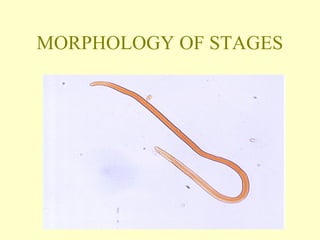
A. MICROFILARIA 
The embryo itself averages 
290 μm by 6-7 μm, though 
the sheath surrounding it 
is slightly larger. The 
cuticle of the embryo has 
well-marked striations and 
the tail tapers gradually to 
a rounded tip.
MORPHOLOGY OF STAGES
MORPHOLOGY OF STAGES 
• B. INFECTIVE (3RD STAGE) LARVA 
The head of the infective larva is truncate-conic, 
trapezoidal when viewed laterally. The oral 
aperture is circular with prominent papillae 
ringing the outer edge. The tail is blunt with three 
caudal papillae, two latero-ventral and one dorso-terminal. 
In females the tail is relatively longer. As 
the larva grows the head loses its truncate shape 
and is well rounded by the time it develops into a 
4th stage larva.
MORPHOLOGY OF STAGES
MORPHOLOGY OF STAGES 
• C. ADULT 
A translucent white worm with a 
smooth cuticle. The head is 
rounded and separated from the 
body by a neck-like 
constriction. In females the tail 
tapers gradually and is rounded 
at the tip, while in males the tail 
curves ventrally. Males and 
females live coiled together. 
Females vary in length from 30- 
100 mm with a diameter 
ranging from 100-300 μm. 
Males are smaller, typically half 
the size of females.
LIFE CYCLE
DISEASES AND SYMPTOMS 
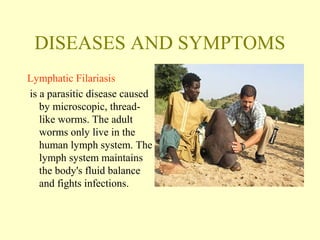
Lymphatic Filariasis 
is a parasitic disease caused 
by microscopic, thread-like 
worms. The adult 
worms only live in the 
human lymph system. The 
lymph system maintains 
the body's fluid balance 
and fights infections.
DISEASES AND SYMPTOMS 
• The disease spreads from person to person by mosquito 
bites. When a mosquito bites a person who has lymphatic 
filariasis, microscopic worms circulating in the person's 
blood enter and infect the mosquito. People get lymphatic 
filariasis from the bite of an infected mosquito. The 
microscopic worms pass from the mosquito through the 
skin, and travel to the lymph vessels. In the lymph vessels 
they grow into adults. An adult worm lives for about 5–7 
years. The adult worms mate and release millions of 
microscopic worms, called microfilariae, into the blood. 
People with the worms in their blood can give the infection 
to others through mosquitoes.
DISEASES AND SYMPTOMS 
• Although the parasite damages the lymph 
system, most infected people have no 
symptoms and will never develop clinical 
symptoms. These people do not know they 
have lymphatic filariasis unless tested.
DISEASES AND SYMPTOMS 
• • A small percentage of persons 
will develop lymphedema. This 
is caused by fluid collection 
because of improper 
functioning of the lymph 
system resulting in swelling. 
This mostly affects the legs, but 
can also occur in the arms, 
breasts, and genitalia. Most 
people develop these symptoms 
years after being infected.
DISEASES AND SYMPTOMS 
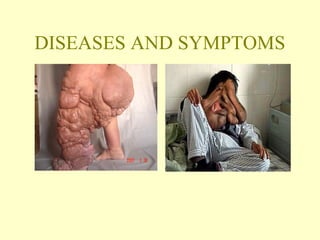
Elephantiasis 
The swelling and the decreased 
function of the lymph system 
make it difficult for the body to 
fight germs and infections. 
These people will have more 
bacterial infections in the skin 
and lymph system. This causes 
hardening and thickening of the 
skin, which is called 
elephantiasis. Many of these 
bacterial infections can be 
prevented with appropriate skin 
hygiene and exercise.
DISEASES AND SYMPTOMS
DISEASES AND SYMPTOMS 
Hydrocele/ Scrotal 
Swelling
DISEASES AND SYMPTOMS 
Kidney Damage 
This will lead to blood and protein loss in 
urine (hematuria).
DISEASES AND SYMPTOMS 
Tropical Pulmonary Eosinophilia Syndrome 
This syndrome is typically found in persons living 
with the disease in Asia. Symptoms of tropical 
pulmonary eosinophilia syndrome include cough, 
shortness of breath, and wheezing. The 
eosinophilia is often accompanied by high levels 
of IgE (Immunoglobulin E) and antifilarial 
antibodies.
DIAGNOSIS 
1. Night Blood Sampling 
1.1. Collect blood specimen from 8 pm to 4 am – 
Thick Smear (Giemsa or H&E) 
1.2. Microscopic examination for microfilariae 
1.3. Concentration Technique (increased 
sensitivity) 
2. Antigen-detection (ELISA) to detect CFA 
(circulating filarial antigen) 
“Gold Standard”
DIAGNOSIS 
3. Search for microfilaria in chylous urine, lymph exudates 
and hydrocoele fluid. 
4. Search for adult worm 
4.1. Lymph node biopsy 
4.2. X-Ray (calcified worm) 
4.3. Ultrasonography (dancing worm/filarial dance sign) 
5. Xenodiagnosis 
-mosquito stomach blood, not very helpful
TREATMENT 
• Antifilarial Drugs 
a. Diethylcarbamazine (DEC) 
Dosage: 6 mg/kg/day for 12 
days 
b. Ivermectin 
Dosage: single oral dose of 
150 ug/kg body weight 
c. Combination of 2 =better results
TREATMENT 
General Measures: 
1. Rest 
2. Antibiotics 
3. Antifungal 
4. Physiotherapy 
5. Bandaging 
Elephantiasis 
Elephantoid tissues can be corrected surgically.
PREVENTION AND CONTROL 
Avoiding mosquito bites is the best form of prevention. The 
mosquitoes that carry the microscopic worms usually bite 
between the hours of dusk and dawn. If you live in or 
travel to an area with lymphatic filariasis: 
1. Sleep under a mosquito net. 
2. Wear long sleeves and trousers. 
3. Use mosquito repellent on exposed skin between dusk 
and dawn.
PREVENTION AND CONTROL 
Even after the adult worms die, lymphedema can develop. 
You can ask your physician for a referral to see a 
lymphedema therapist for specialized care. Prevent the 
lymphedema from getting worse by following several 
basic principles: 
1. Carefully wash the swollen area with soap and water every 
day. 
2. Elevate and exercise the swollen arm or leg to move the 
fluid and improve the lymph flow. 
3. Disinfect any wounds. Use antibacterial or antifungal 
cream if necessary.
LINKS TO SOURCES 
• http://bioweb.uwlax.edu/bio203/s2008/krout_bria/• http://www.cdc.gov/parasites/lymphaticfilariasis/• https://uqu.edu.sa/files2/tiny_mce/plugins/filemanager/
THE END

Wuchereria bancrofti

  • 1.
    Wuchereria bancrofti Preparedby: Ron Louise B. Salomon
  • 2.
    TAXONOMY • Domain:Eukaryota • Kingdom: Metazoa • Phylum: Nematoda • Class: Secernentea • Order: Spirurida • Family: Filariidae • Genus: Wuchereria • Species: bancrofti
  • 3.
    GEOGRAPHICAL DISTIBUTION •Lymphatic filariasis affects over 120 million people in 73 countries throughout the tropics and sub-tropics of Asia, Africa, the Western Pacific, and parts of the Caribbean and South America.
  • 4.
    GEOGRAPHICAL DISTIBUTION •In the Americas, only four countries are currently known to be endemic: Haiti, the Dominican Republic, Guyana and Brazil. • In the United States, Charleston, South Carolina, was the last known place with lymphatic filariasis. The infection disappeared early in the 20th century. Currently, you cannot get infected in the U.S.
  • 5.
    GEOGRAPHICAL DISTRIBUTION •In the Philippines, it can be found in: 1. Camarines Norte, Sur 2. Albay, Sorsogon, Mindoro, Masbate, Romblon, Marinduque 3. Bohol, Samar, Leyte, Palawan 4. Mountain Provinces 5. All provinces of Mindanao
  • 6.
    MORPHOLOGY OF STAGES A. MICROFILARIA The embryo itself averages 290 μm by 6-7 μm, though the sheath surrounding it is slightly larger. The cuticle of the embryo has well-marked striations and the tail tapers gradually to a rounded tip.
  • 7.
  • 8.
    MORPHOLOGY OF STAGES • B. INFECTIVE (3RD STAGE) LARVA The head of the infective larva is truncate-conic, trapezoidal when viewed laterally. The oral aperture is circular with prominent papillae ringing the outer edge. The tail is blunt with three caudal papillae, two latero-ventral and one dorso-terminal. In females the tail is relatively longer. As the larva grows the head loses its truncate shape and is well rounded by the time it develops into a 4th stage larva.
  • 9.
  • 10.
    MORPHOLOGY OF STAGES • C. ADULT A translucent white worm with a smooth cuticle. The head is rounded and separated from the body by a neck-like constriction. In females the tail tapers gradually and is rounded at the tip, while in males the tail curves ventrally. Males and females live coiled together. Females vary in length from 30- 100 mm with a diameter ranging from 100-300 μm. Males are smaller, typically half the size of females.
  • 11.
  • 12.
    DISEASES AND SYMPTOMS Lymphatic Filariasis is a parasitic disease caused by microscopic, thread-like worms. The adult worms only live in the human lymph system. The lymph system maintains the body's fluid balance and fights infections.
  • 13.
    DISEASES AND SYMPTOMS • The disease spreads from person to person by mosquito bites. When a mosquito bites a person who has lymphatic filariasis, microscopic worms circulating in the person's blood enter and infect the mosquito. People get lymphatic filariasis from the bite of an infected mosquito. The microscopic worms pass from the mosquito through the skin, and travel to the lymph vessels. In the lymph vessels they grow into adults. An adult worm lives for about 5–7 years. The adult worms mate and release millions of microscopic worms, called microfilariae, into the blood. People with the worms in their blood can give the infection to others through mosquitoes.
  • 14.
    DISEASES AND SYMPTOMS • Although the parasite damages the lymph system, most infected people have no symptoms and will never develop clinical symptoms. These people do not know they have lymphatic filariasis unless tested.
  • 15.
    DISEASES AND SYMPTOMS • • A small percentage of persons will develop lymphedema. This is caused by fluid collection because of improper functioning of the lymph system resulting in swelling. This mostly affects the legs, but can also occur in the arms, breasts, and genitalia. Most people develop these symptoms years after being infected.
  • 16.
    DISEASES AND SYMPTOMS Elephantiasis The swelling and the decreased function of the lymph system make it difficult for the body to fight germs and infections. These people will have more bacterial infections in the skin and lymph system. This causes hardening and thickening of the skin, which is called elephantiasis. Many of these bacterial infections can be prevented with appropriate skin hygiene and exercise.
  • 17.
  • 18.
    DISEASES AND SYMPTOMS Hydrocele/ Scrotal Swelling
  • 19.
    DISEASES AND SYMPTOMS Kidney Damage This will lead to blood and protein loss in urine (hematuria).
  • 20.
    DISEASES AND SYMPTOMS Tropical Pulmonary Eosinophilia Syndrome This syndrome is typically found in persons living with the disease in Asia. Symptoms of tropical pulmonary eosinophilia syndrome include cough, shortness of breath, and wheezing. The eosinophilia is often accompanied by high levels of IgE (Immunoglobulin E) and antifilarial antibodies.
  • 21.
    DIAGNOSIS 1. NightBlood Sampling 1.1. Collect blood specimen from 8 pm to 4 am – Thick Smear (Giemsa or H&E) 1.2. Microscopic examination for microfilariae 1.3. Concentration Technique (increased sensitivity) 2. Antigen-detection (ELISA) to detect CFA (circulating filarial antigen) “Gold Standard”
  • 22.
    DIAGNOSIS 3. Searchfor microfilaria in chylous urine, lymph exudates and hydrocoele fluid. 4. Search for adult worm 4.1. Lymph node biopsy 4.2. X-Ray (calcified worm) 4.3. Ultrasonography (dancing worm/filarial dance sign) 5. Xenodiagnosis -mosquito stomach blood, not very helpful
  • 23.
    TREATMENT • AntifilarialDrugs a. Diethylcarbamazine (DEC) Dosage: 6 mg/kg/day for 12 days b. Ivermectin Dosage: single oral dose of 150 ug/kg body weight c. Combination of 2 =better results
  • 24.
    TREATMENT General Measures: 1. Rest 2. Antibiotics 3. Antifungal 4. Physiotherapy 5. Bandaging Elephantiasis Elephantoid tissues can be corrected surgically.
  • 25.
    PREVENTION AND CONTROL Avoiding mosquito bites is the best form of prevention. The mosquitoes that carry the microscopic worms usually bite between the hours of dusk and dawn. If you live in or travel to an area with lymphatic filariasis: 1. Sleep under a mosquito net. 2. Wear long sleeves and trousers. 3. Use mosquito repellent on exposed skin between dusk and dawn.
  • 26.
    PREVENTION AND CONTROL Even after the adult worms die, lymphedema can develop. You can ask your physician for a referral to see a lymphedema therapist for specialized care. Prevent the lymphedema from getting worse by following several basic principles: 1. Carefully wash the swollen area with soap and water every day. 2. Elevate and exercise the swollen arm or leg to move the fluid and improve the lymph flow. 3. Disinfect any wounds. Use antibacterial or antifungal cream if necessary.
  • 27.
    LINKS TO SOURCES • http://bioweb.uwlax.edu/bio203/s2008/krout_bria/• http://www.cdc.gov/parasites/lymphaticfilariasis/• https://uqu.edu.sa/files2/tiny_mce/plugins/filemanager/
  • 28.