
METHIMAZOLE
ANTITHYROID DRUG
PRESENTED BY:
MEENAKSHI
M.Sc. 1st Year
HISTORY
• Antithyroid drugs were developed as derivatives of
thiourea, which was discovered to goiter in rats.
• ƒThiourea was the first drug used in man, followed by
thiouracil (after testing hundreds of compounds in rats)
(JAMA 1943)
• ƒBoth compounds caused agranulocytosis in
approximately 1% of patients
• ƒPropylthiouracil was found to have a lower risk of
agranulocytosis, and methimazole, introduced a few
years later, in 1949, seemed to have a lower rate still
HYPERTHYROIDISM
The over production of thyroid hormones.
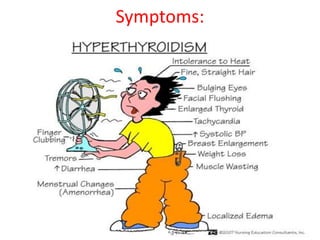
Symptoms include fatigue, weight lose, rapid heart beat, anxiety,
swollen eyes, and sensitivity to hot temperatures.
Causes:
Grave’s disease, and autoimmune disorder in which antibodies
serve as agonists to the THS receptors on the thyroid’s surface,
causing thyroid growth and activation of hormone synthesis and
secretion.
Thyroid tumors which cause the uncontrolled synthesis and
secretion of thyroid hormones.
Thyroiditis, inflammation of the thyroid typically caused by
infection.
Symptoms:
Anti-thyroid drugs
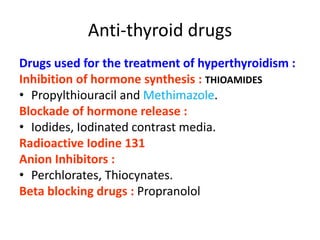
Drugs used for the treatment of hyperthyroidism :
Inhibition of hormone synthesis : THIOAMIDES
• Propylthiouracil and Methimazole.
Blockade of hormone release :
• Iodides, Iodinated contrast media.
Radioactive Iodine 131
Anion Inhibitors :
• Perchlorates, Thiocynates.
Beta blocking drugs : Propranolol
Anti-thyroid agents
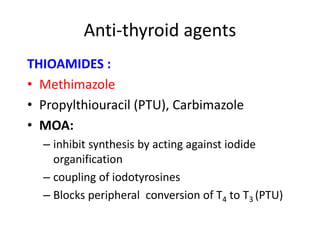
THIOAMIDES :
• Methimazole
• Propylthiouracil (PTU), Carbimazole
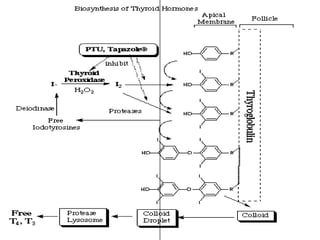
• MOA:
– inhibit synthesis by acting against iodide
organification
– coupling of iodotyrosines
– Blocks peripheral conversion of T4 to T3 (PTU)
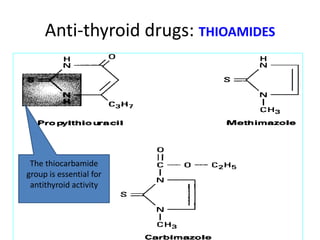
Anti-thyroid drugs: THIOAMIDES
The thiocarbamide
group is essential for
antithyroid activity
THIOAMIDES :
• Pharmacokinetics:
– almost completely absorbed in the GIT
– serum half life: 90mins(PTU) ; 6 hours
(methimazole)
– excretion: kidney – 24 hours (PTU) ; 48 hours
(Methimazole)
– can cross placental barrier (lesser with PTU)
– Methimazole 10x more potent than PTU
– PTU more protein-bound
Pharmacological action:
Inhibition of the synthesis of T3 & T4
• Mechanism
• All thioamides inhibit peroxidase-catalyzing reactions
• Iodine organification
• Iodotyrosines condensation
• Propylthiouracil also inhibit T4 converting to T3
Characteristics
① Result appears slowly: in 3-4 w hyperthyroid ameliorated, and
in 2-3 months BMR normalized;
② Long-term use leads to thyroid hyperplasia
③ Methimazole is 10 times as potent as propylthiouracil
• Clinical use
• treatment of hyperthyroid
• 1. Mild hyperthyroid and surgery & 131I not permitted;
• 2. Operation preparation;
• 3. Thyroid crisis (comprehensive therapy).
• Adverse reactions
• 1. Long-term use leads to thyroid hyperplasia;
• 2. Pruritic maculopapular rash is the most common adverse
raaction
• 3. The severe adverse reaction is agranulocytosis
11
Iodides (NaI, KI)
Pharmacological action
Inhibition of T3 & T4 release and synthesis
Decrease of size & vascularity of the hyperplastic gland
Clinical use
Ministrant treatment of hyperthyroid
1. Operation preparation;
2. Thyroid crisis.
Adverse reactions
1. Acneiform rash (similar to that of bromism);
2. Swollen salivary glands, mucous membrane ulcerations, and etc.
Radioactive iodine (131I)
12
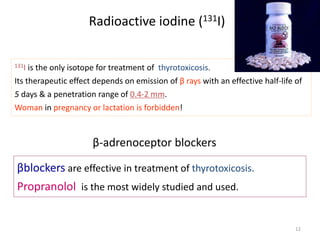
131I is the only isotope for treatment of thyrotoxicosis.
Its therapeutic effect depends on emission of β rays with an effective half-life of
5 days & a penetration range of 0.4-2 mm.
Woman in pregnancy or lactation is forbidden!
β-adrenoceptor blockers
βblockers are effective in treatment of thyrotoxicosis.
Propranolol is the most widely studied and used.
ANION INHIBITORS :
• Monovalent ions like perchlorate, pertechnetate,
thiocyanate can competitively block the uptake of iodine.
• Anion inhibitors are uncommon in use because of
aplastic anemia.
• These are effective in iodine induced hyperthyroidism
IODINATED CONTRAST MEDIA: Diatrizoate / Iohexol :
• They are valuable in hyperthyroidism and as adjunctive in
thyroid storm.
• They inhibit the peripheral conversion of T4 into T3.
• Inhibition of hormone release is an additional mechanism
Other Anti-thyroid drugs :
• Propranolol is used in the management of
cardiac symptoms of thyrotoxicosis.
• Lithium is known to inhibit synthesis and release
of thyroid hormones.
• Amiodarone can also result in hypothyroidism.
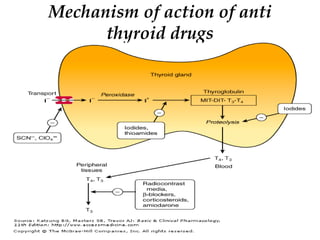
Mechanism of action of anti
thyroid drugs
METHIMAZOLE
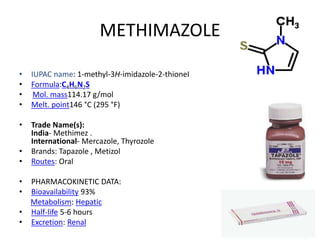
• IUPAC name: 1-methyl-3H-imidazole-2-thioneI
• Formula:C4H6N2S
• Mol. mass114.17 g/mol
• Melt. point146 °C (295 °F)
• Trade Name(s):
India- Methimez .
International- Mercazole, Thyrozole
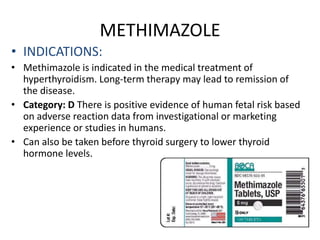
• Brands: Tapazole , Metizol
• Routes: Oral
• PHARMACOKINETIC DATA:
• Bioavailability 93%
Metabolism: Hepatic
• Half-life 5-6 hours
• Excretion: Renal
METHIMAZOLE
• INDICATIONS:
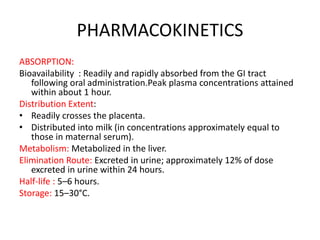
• Methimazole is indicated in the medical treatment of
hyperthyroidism. Long-term therapy may lead to remission of
the disease.
• Category: D There is positive evidence of human fetal risk based
on adverse reaction data from investigational or marketing
experience or studies in humans.
• Can also be taken before thyroid surgery to lower thyroid
hormone levels.
PHARMACOKINETICS
ABSORPTION:
Bioavailability : Readily and rapidly absorbed from the GI tract
following oral administration.Peak plasma concentrations attained
within about 1 hour.
Distribution Extent:
• Readily crosses the placenta.
• Distributed into milk (in concentrations approximately equal to
those in maternal serum).
Metabolism: Metabolized in the liver.
Elimination Route: Excreted in urine; approximately 12% of dose
excreted in urine within 24 hours.
Half-life : 5–6 hours.
Storage: 15–30°C.
• DOSAGE
• Adult: The initial daily dosage is 15 mg.
• It may be increased upto 60 mg, divided into 3 doses at 8-hour
intervals.
• The maintenance dosage is 5 to 15 mg daily.
• Pediatric: Initially, the daily dosage is 0.4 mg/kg, divided into 3
doses and given at 8-hour intervals.
• ADMINISTRATION: Oral, with or without food
• Warnings and Precautions : Caution should be exercised in
patients with history of decrease in blood cells, liver disease,
any allergy, who are taking other medications, during
pregnancy and breastfeeding.
It may cause drowsiness, dizziness, or lightheadedness, do
not drive a car or operate machinery while taking this
medication
• SIDE EFFECTS: Skin - Rash, hives, abnormal loss of
hair, itching and skin pigmentation.
Gastrointestinal - Nausea, vomiting and stomach
upset.
Musculoskeletal - Joint/muscle pain.
Central Nervous System - Tingling, headache,
drowsiness, dizziness and fainting.
Miscellaneous - Loss of taste, swelling and jaundice.
Other Precautions : Avoid excess dosage.
Storage Conditions : Store it at controlled room
temperature (15° to 30°C), and in an airtight
container. Keep away from children.
COMMON ADVERSE EFFECTS:
• skin rash
• itching
• abnormal hair loss
• upset stomach
• vomiting
• loss of taste
• abnormal sensations (tingling, prickling, burning, tightness, and
pulling)
• swelling
• joint and muscle pain
• drowsiness
• dizziness
• decreased white blood cells
• decreased platelets
• List of Contraindications
• Methimazole and Pregnancy
• Contraindicated in pregnancy
USFDA pregnancy category D. Methimazole can harm an
unborn baby. Perform pregnancy tests before using
Methimazole. Use effective contraceptive modes to
prevent unintended pregnancies while taking
Methimazole.
• Methimazole and Lactation
• Methimazole can pass into breast milk and harm a
breast-feeding baby. Consult a physician before taking
Methimazole.
• Storage
• Store at 20-25°C.
Anti-Thyroid Drugs

Anti-Thyroid Drugs

  • 1.
  • 2.
    HISTORY • Antithyroid drugswere developed as derivatives of thiourea, which was discovered to goiter in rats. • ƒThiourea was the first drug used in man, followed by thiouracil (after testing hundreds of compounds in rats) (JAMA 1943) • ƒBoth compounds caused agranulocytosis in approximately 1% of patients • ƒPropylthiouracil was found to have a lower risk of agranulocytosis, and methimazole, introduced a few years later, in 1949, seemed to have a lower rate still
  • 3.
    HYPERTHYROIDISM The over productionof thyroid hormones. Symptoms include fatigue, weight lose, rapid heart beat, anxiety, swollen eyes, and sensitivity to hot temperatures. Causes: Grave’s disease, and autoimmune disorder in which antibodies serve as agonists to the THS receptors on the thyroid’s surface, causing thyroid growth and activation of hormone synthesis and secretion. Thyroid tumors which cause the uncontrolled synthesis and secretion of thyroid hormones. Thyroiditis, inflammation of the thyroid typically caused by infection.
  • 4.
  • 5.
    Anti-thyroid drugs Drugs usedfor the treatment of hyperthyroidism : Inhibition of hormone synthesis : THIOAMIDES • Propylthiouracil and Methimazole. Blockade of hormone release : • Iodides, Iodinated contrast media. Radioactive Iodine 131 Anion Inhibitors : • Perchlorates, Thiocynates. Beta blocking drugs : Propranolol
  • 6.
    Anti-thyroid agents THIOAMIDES : •Methimazole • Propylthiouracil (PTU), Carbimazole • MOA: – inhibit synthesis by acting against iodide organification – coupling of iodotyrosines – Blocks peripheral conversion of T4 to T3 (PTU)
  • 7.
    Anti-thyroid drugs: THIOAMIDES Thethiocarbamide group is essential for antithyroid activity
  • 8.
    THIOAMIDES : • Pharmacokinetics: –almost completely absorbed in the GIT – serum half life: 90mins(PTU) ; 6 hours (methimazole) – excretion: kidney – 24 hours (PTU) ; 48 hours (Methimazole) – can cross placental barrier (lesser with PTU) – Methimazole 10x more potent than PTU – PTU more protein-bound
  • 9.
    Pharmacological action: Inhibition ofthe synthesis of T3 & T4 • Mechanism • All thioamides inhibit peroxidase-catalyzing reactions • Iodine organification • Iodotyrosines condensation • Propylthiouracil also inhibit T4 converting to T3 Characteristics ① Result appears slowly: in 3-4 w hyperthyroid ameliorated, and in 2-3 months BMR normalized; ② Long-term use leads to thyroid hyperplasia ③ Methimazole is 10 times as potent as propylthiouracil
  • 10.
    • Clinical use •treatment of hyperthyroid • 1. Mild hyperthyroid and surgery & 131I not permitted; • 2. Operation preparation; • 3. Thyroid crisis (comprehensive therapy). • Adverse reactions • 1. Long-term use leads to thyroid hyperplasia; • 2. Pruritic maculopapular rash is the most common adverse raaction • 3. The severe adverse reaction is agranulocytosis
  • 11.
    11 Iodides (NaI, KI) Pharmacologicalaction Inhibition of T3 & T4 release and synthesis Decrease of size & vascularity of the hyperplastic gland Clinical use Ministrant treatment of hyperthyroid 1. Operation preparation; 2. Thyroid crisis. Adverse reactions 1. Acneiform rash (similar to that of bromism); 2. Swollen salivary glands, mucous membrane ulcerations, and etc.
  • 12.
    Radioactive iodine (131I) 12 131Iis the only isotope for treatment of thyrotoxicosis. Its therapeutic effect depends on emission of β rays with an effective half-life of 5 days & a penetration range of 0.4-2 mm. Woman in pregnancy or lactation is forbidden! β-adrenoceptor blockers βblockers are effective in treatment of thyrotoxicosis. Propranolol is the most widely studied and used.
  • 13.
    ANION INHIBITORS : •Monovalent ions like perchlorate, pertechnetate, thiocyanate can competitively block the uptake of iodine. • Anion inhibitors are uncommon in use because of aplastic anemia. • These are effective in iodine induced hyperthyroidism IODINATED CONTRAST MEDIA: Diatrizoate / Iohexol : • They are valuable in hyperthyroidism and as adjunctive in thyroid storm. • They inhibit the peripheral conversion of T4 into T3. • Inhibition of hormone release is an additional mechanism
  • 14.
    Other Anti-thyroid drugs: • Propranolol is used in the management of cardiac symptoms of thyrotoxicosis. • Lithium is known to inhibit synthesis and release of thyroid hormones. • Amiodarone can also result in hypothyroidism.
  • 15.
    Mechanism of actionof anti thyroid drugs
  • 16.
    METHIMAZOLE • IUPAC name:1-methyl-3H-imidazole-2-thioneI • Formula:C4H6N2S • Mol. mass114.17 g/mol • Melt. point146 °C (295 °F) • Trade Name(s): India- Methimez . International- Mercazole, Thyrozole • Brands: Tapazole , Metizol • Routes: Oral • PHARMACOKINETIC DATA: • Bioavailability 93% Metabolism: Hepatic • Half-life 5-6 hours • Excretion: Renal
  • 17.
    METHIMAZOLE • INDICATIONS: • Methimazoleis indicated in the medical treatment of hyperthyroidism. Long-term therapy may lead to remission of the disease. • Category: D There is positive evidence of human fetal risk based on adverse reaction data from investigational or marketing experience or studies in humans. • Can also be taken before thyroid surgery to lower thyroid hormone levels.
  • 18.
    PHARMACOKINETICS ABSORPTION: Bioavailability : Readilyand rapidly absorbed from the GI tract following oral administration.Peak plasma concentrations attained within about 1 hour. Distribution Extent: • Readily crosses the placenta. • Distributed into milk (in concentrations approximately equal to those in maternal serum). Metabolism: Metabolized in the liver. Elimination Route: Excreted in urine; approximately 12% of dose excreted in urine within 24 hours. Half-life : 5–6 hours. Storage: 15–30°C.
  • 19.
    • DOSAGE • Adult:The initial daily dosage is 15 mg. • It may be increased upto 60 mg, divided into 3 doses at 8-hour intervals. • The maintenance dosage is 5 to 15 mg daily. • Pediatric: Initially, the daily dosage is 0.4 mg/kg, divided into 3 doses and given at 8-hour intervals. • ADMINISTRATION: Oral, with or without food • Warnings and Precautions : Caution should be exercised in patients with history of decrease in blood cells, liver disease, any allergy, who are taking other medications, during pregnancy and breastfeeding. It may cause drowsiness, dizziness, or lightheadedness, do not drive a car or operate machinery while taking this medication
  • 22.
    • SIDE EFFECTS:Skin - Rash, hives, abnormal loss of hair, itching and skin pigmentation. Gastrointestinal - Nausea, vomiting and stomach upset. Musculoskeletal - Joint/muscle pain. Central Nervous System - Tingling, headache, drowsiness, dizziness and fainting. Miscellaneous - Loss of taste, swelling and jaundice. Other Precautions : Avoid excess dosage. Storage Conditions : Store it at controlled room temperature (15° to 30°C), and in an airtight container. Keep away from children.
  • 23.
    COMMON ADVERSE EFFECTS: •skin rash • itching • abnormal hair loss • upset stomach • vomiting • loss of taste • abnormal sensations (tingling, prickling, burning, tightness, and pulling) • swelling • joint and muscle pain • drowsiness • dizziness • decreased white blood cells • decreased platelets
  • 24.
    • List ofContraindications • Methimazole and Pregnancy • Contraindicated in pregnancy USFDA pregnancy category D. Methimazole can harm an unborn baby. Perform pregnancy tests before using Methimazole. Use effective contraceptive modes to prevent unintended pregnancies while taking Methimazole. • Methimazole and Lactation • Methimazole can pass into breast milk and harm a breast-feeding baby. Consult a physician before taking Methimazole. • Storage • Store at 20-25°C.

Editor's Notes

  • #7 Thioamides inhibit the enzyme thyroid peroxidase in the thyroid, reducing the synthesis of triiodothyronine (T3) and thyroxine (T4); block uptake of iodotyrosines from the colloid. They also block iodine release from peripheral hormone. Maximum effects occur only after a month since hormone depletion is caused by reduced synthesis, which is a slow process.
  • #8 Slow in onset ~ 4 weeks because they do not inhibit secretion of hormones. These may exert immunosuppressive effects. Acts by inhibiting peroxidase and thus block coupling reaction and iodine organification.
  • #12 IODIDE SHOULD NOT BE USED ALONE BECOZ THE GLAND WILL ESCAPE FROM THE IODIDE BLOCK IN 2-8 WEEKS. Lugol's solution consists of 5 g iodine (I2) and 10 g potassium iodide (KI) mixed with 85 ml distilled water, to make a brown solution with a total iodine content of 130 mg/mL. Administration of KI to inhibit the uptake and incorporation of radioactive iodine into the thyroid gland. CHRONIC USE OF IODIDE IN PREGNANCY SHOULD BE AVOIDED, SINCE THEY CROSS THE PLACENTA AND CAN CAUSE FETAL GOITER.