REPRODUCTIO
N IN
PROTOZOABy
VYSHNAV P V
M.Sc. Microbiology (2020-2022)
Department of microbiology
Central University of Punjab Mansa Road,
Bathinda
WHAT IS PROTOZOA ?
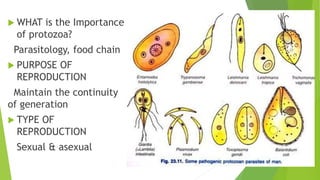
 WHAT is the Importance
of protozoa?
Parasitology, food chain
 PURPOSE OF
REPRODUCTION
Maintain the continuity
of generation
 TYPE OF
REPRODUCTION
Sexual & asexual
ASEXUAL REPRODUCTION
 without the fusion of nucleus
 During favourable condition
 Clone
 Different examples are
BINARY FISSION
 Common type
 Karyokinesis followed by cytokinesis
 Reconstruction of required materials
 Depending on the plane of fission binary fission is of the following
types.
 LONGITUDINAL BINARY FISSION
 TRANSVERSE BINARY FISSION
 IRREGULAR BINARY FISSION
 OBLIQUE BINARY FISSION
LONGITUDINAL BINARY FISSION
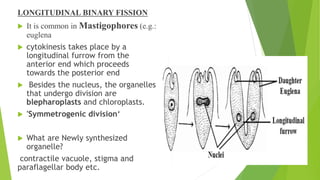
 It is common in Mastigophores (e.g.:
euglena
 cytokinesis takes place by a
longitudinal furrow from the
anterior end which proceeds
towards the posterior end
 Besides the nucleus, the organelles
that undergo division are
blepharoplasts and chloroplasts.
 'Symmetrogenic division‘
 What are Newly synthesized
organelle?
contractile vacuole, stigma and
paraflagellar body etc.
TRANSVERSE BINARY FISSION
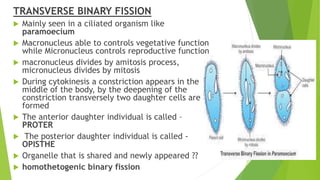
 Mainly seen in a ciliated organism like
paramoecium
 Macronucleus able to controls vegetative function
while Micronucleus controls reproductive function
 macronucleus divides by amitosis process,
micronucleus divides by mitosis
 During cytokinesis a constriction appears in the
middle of the body, by the deepening of the
constriction transversely two daughter cells are
formed
 The anterior daughter individual is called –
PROTER
 The posterior daughter individual is called -
OPISTHE
 Organelle that is shared and newly appeared ??
 homothetogenic binary fission
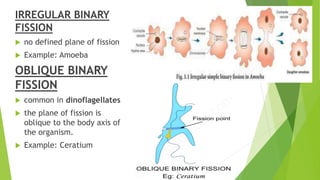
IRREGULAR BINARY
FISSION
 no defined plane of fission
 Example: Amoeba
OBLIQUE BINARY
FISSION
 common in dinoflagellates
 the plane of fission is
oblique to the body axis of
the organism.
 Example: Ceratium
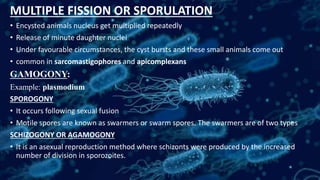
MULTIPLE FISSION OR SPORULATION
• Encysted animals nucleus get multiplied repeatedly
• Release of minute daughter nuclei
• Under favourable circumstances, the cyst bursts and these small animals come out
• common in sarcomastigophores and apicomplexans
GAMOGONY:
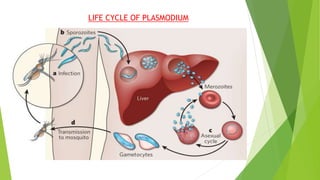
Example: plasmodium
SPOROGONY
• It occurs following sexual fusion
• Motile spores are known as swarmers or swarm spores. The swarmers are of two types
SCHIZOGONY OR AGAMOGONY
• It is an asexual reproduction method where schizonts were produced by the increased
number of division in sporozoites.
LIFE CYCLE OF PLASMODIUM
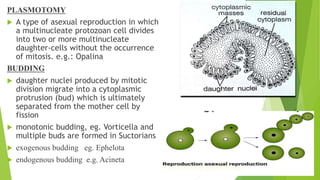
PLASMOTOMY
 A type of asexual reproduction in which
a multinucleate protozoan cell divides
into two or more multinucleate
daughter-cells without the occurrence
of mitosis. e.g.: Opalina
BUDDING
 daughter nuclei produced by mitotic
division migrate into a cytoplasmic
protrusion (bud) which is ultimately
separated from the mother cell by
fission
 monotonic budding, eg. Vorticella and
multiple buds are formed in Suctorians
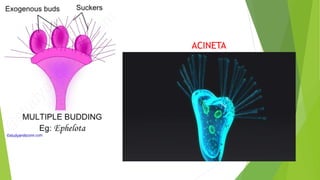
 exogenous budding eg. Ephelota
 endogenous budding e.g. Acineta
ACINETA
SEXUAL
REPRODUCTION
• gametes fuse to form a new individual
• Able to survive unfavourable condition by
creating genetic variability
• involves the meiotic division.
SYNGAMY OR SEXUAL FUSION:
• complete and permanent union or fusion of two
specialised protozoan unit or gametes resulting in
the formation of a fertilized cell or zygote or
oospore
• Depending upon the degree of differentiation of
the fusing gametes syngamy may be of the
following types
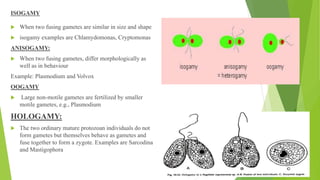
ISOGAMY
 When two fusing gametes are similar in size and shape
 isogamy examples are Chlamydomonas, Cryptomonas
ANISOGAMY:
 When two fusing gametes, differ morphologically as
well as in behaviour
Example: Plasmodium and Volvox
OOGAMY
 Large non-motile gametes are fertilized by smaller
motile gametes, e.g., Plasmodium
HOLOGAMY:
 The two ordinary mature protozoan individuals do not
form gametes but themselves behave as gametes and
fuse together to form a zygote. Examples are Sarcodina
and Mastigophora
SIGNIFICANCE OF SYNGAMY:
 (i) Syngamy brings about a nuclear reorganization,
and physiologically it has distinct effects
 (ii) It brings two previously separated lines of
heredity in close association.
 (iii) It increases diversity among the offspring
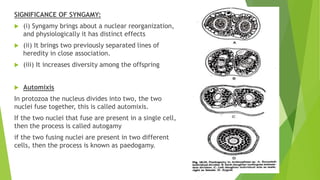
 Automixis
In protozoa the nucleus divides into two, the two
nuclei fuse together, this is called automixis.
If the two nuclei that fuse are present in a single cell,
then the process is called autogamy
if the two fusing nuclei are present in two different
cells, then the process is known as paedogamy.
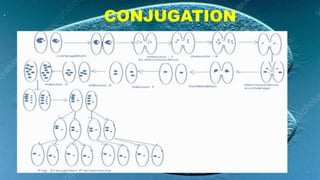
CONJUGATION
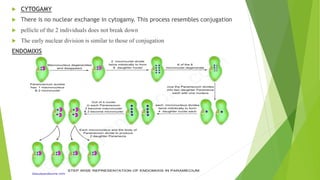
 CYTOGAMY
 There is no nuclear exchange in cytogamy. This process resembles conjugation
 pellicle of the 2 individuals does not break down
 The early nuclear division is similar to those of conjugation
ENDOMIXIS
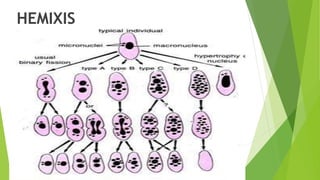
HEMIXIS
THANK YOU

Reproduction in protozoa

  • 1.
    REPRODUCTIO N IN PROTOZOABy VYSHNAV PV M.Sc. Microbiology (2020-2022) Department of microbiology Central University of Punjab Mansa Road, Bathinda
  • 2.
  • 3.
     WHAT isthe Importance of protozoa? Parasitology, food chain  PURPOSE OF REPRODUCTION Maintain the continuity of generation  TYPE OF REPRODUCTION Sexual & asexual
  • 4.
    ASEXUAL REPRODUCTION  withoutthe fusion of nucleus  During favourable condition  Clone  Different examples are BINARY FISSION  Common type  Karyokinesis followed by cytokinesis  Reconstruction of required materials  Depending on the plane of fission binary fission is of the following types.  LONGITUDINAL BINARY FISSION  TRANSVERSE BINARY FISSION  IRREGULAR BINARY FISSION  OBLIQUE BINARY FISSION
  • 5.
    LONGITUDINAL BINARY FISSION It is common in Mastigophores (e.g.: euglena  cytokinesis takes place by a longitudinal furrow from the anterior end which proceeds towards the posterior end  Besides the nucleus, the organelles that undergo division are blepharoplasts and chloroplasts.  'Symmetrogenic division‘  What are Newly synthesized organelle? contractile vacuole, stigma and paraflagellar body etc.
  • 6.
    TRANSVERSE BINARY FISSION Mainly seen in a ciliated organism like paramoecium  Macronucleus able to controls vegetative function while Micronucleus controls reproductive function  macronucleus divides by amitosis process, micronucleus divides by mitosis  During cytokinesis a constriction appears in the middle of the body, by the deepening of the constriction transversely two daughter cells are formed  The anterior daughter individual is called – PROTER  The posterior daughter individual is called - OPISTHE  Organelle that is shared and newly appeared ??  homothetogenic binary fission
  • 7.
    IRREGULAR BINARY FISSION  nodefined plane of fission  Example: Amoeba OBLIQUE BINARY FISSION  common in dinoflagellates  the plane of fission is oblique to the body axis of the organism.  Example: Ceratium
  • 8.
    MULTIPLE FISSION ORSPORULATION • Encysted animals nucleus get multiplied repeatedly • Release of minute daughter nuclei • Under favourable circumstances, the cyst bursts and these small animals come out • common in sarcomastigophores and apicomplexans GAMOGONY: Example: plasmodium SPOROGONY • It occurs following sexual fusion • Motile spores are known as swarmers or swarm spores. The swarmers are of two types SCHIZOGONY OR AGAMOGONY • It is an asexual reproduction method where schizonts were produced by the increased number of division in sporozoites.
  • 9.
    LIFE CYCLE OFPLASMODIUM
  • 10.
    PLASMOTOMY  A typeof asexual reproduction in which a multinucleate protozoan cell divides into two or more multinucleate daughter-cells without the occurrence of mitosis. e.g.: Opalina BUDDING  daughter nuclei produced by mitotic division migrate into a cytoplasmic protrusion (bud) which is ultimately separated from the mother cell by fission  monotonic budding, eg. Vorticella and multiple buds are formed in Suctorians  exogenous budding eg. Ephelota  endogenous budding e.g. Acineta
  • 11.
  • 12.
    SEXUAL REPRODUCTION • gametes fuseto form a new individual • Able to survive unfavourable condition by creating genetic variability • involves the meiotic division. SYNGAMY OR SEXUAL FUSION: • complete and permanent union or fusion of two specialised protozoan unit or gametes resulting in the formation of a fertilized cell or zygote or oospore • Depending upon the degree of differentiation of the fusing gametes syngamy may be of the following types
  • 13.
    ISOGAMY  When twofusing gametes are similar in size and shape  isogamy examples are Chlamydomonas, Cryptomonas ANISOGAMY:  When two fusing gametes, differ morphologically as well as in behaviour Example: Plasmodium and Volvox OOGAMY  Large non-motile gametes are fertilized by smaller motile gametes, e.g., Plasmodium HOLOGAMY:  The two ordinary mature protozoan individuals do not form gametes but themselves behave as gametes and fuse together to form a zygote. Examples are Sarcodina and Mastigophora
  • 14.
    SIGNIFICANCE OF SYNGAMY: (i) Syngamy brings about a nuclear reorganization, and physiologically it has distinct effects  (ii) It brings two previously separated lines of heredity in close association.  (iii) It increases diversity among the offspring  Automixis In protozoa the nucleus divides into two, the two nuclei fuse together, this is called automixis. If the two nuclei that fuse are present in a single cell, then the process is called autogamy if the two fusing nuclei are present in two different cells, then the process is known as paedogamy.
  • 15.
  • 16.
     CYTOGAMY  Thereis no nuclear exchange in cytogamy. This process resembles conjugation  pellicle of the 2 individuals does not break down  The early nuclear division is similar to those of conjugation ENDOMIXIS
  • 17.
  • 19.