NEMATHELMINTHES
ASHOK KUMAR BOLLAPALLI
M.SC.,B.ED.,CSIR-NET,M.A(LIT) D.C.A.
LECTURER IN ZOOLOGY
KRK GOVT DEGREE COLLEGE
ADDANKI-523201
9652929696,9441635264
ASHOKKUMARZOOLOGY@GMAIL.COM
INTRODUCTION
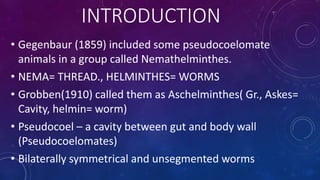
• Gegenbaur (1859) included some pseudocoelomate
animals in a group called Nemathelminthes.
• NEMA= THREAD., HELMINTHES= WORMS
• Grobben(1910) called them as Aschelminthes( Gr., Askes=
Cavity, helmin= worm)
• Pseudocoel – a cavity between gut and body wall
(Pseudocoelomates)
• Bilaterally symmetrical and unsegmented worms
GENERAL CHARACTERS
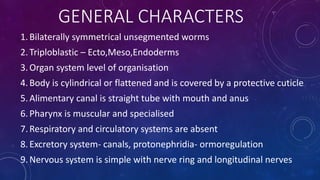
1.Bilaterally symmetrical unsegmented worms
2.Triploblastic – Ecto,Meso,Endoderms
3.Organ system level of organisation
4.Body is cylindrical or flattened and is covered by a protective cuticle
5.Alimentary canal is straight tube with mouth and anus
6.Pharynx is muscular and specialised
7.Respiratory and circulatory systems are absent
8.Excretory system- canals, protonephridia- ormoregulation
9.Nervous system is simple with nerve ring and longitudinal nerves
GENERAL CHARACTERS CONTD..
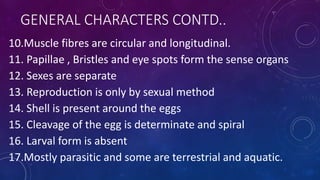
10.Muscle fibres are circular and longitudinal.
11. Papillae , Bristles and eye spots form the sense organs
12. Sexes are separate
13. Reproduction is only by sexual method
14. Shell is present around the eggs
15. Cleavage of the egg is determinate and spiral
16. Larval form is absent
17.Mostly parasitic and some are terrestrial and aquatic.
CLASSIFICATION - NEMATHELMINTHES
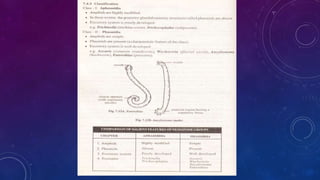
Class Aphasmidia (Adenophorea) Phasmidia (Secernentea)
1 Caudal sense organs/ Phasmids
are present
Phasmids present
2 Amphids (internal sense organs)
of various types present
Amphids present and pore like
3 Caudal adhesive glands are
present
Caudal adhesive glands are absent
4 Excretory system is absent. If
present poorly developed
Excretory system is well
developed
5 Mesenterial tissue well developed Poorly developed
6 Divided into 6 orders Divided into 10 orders
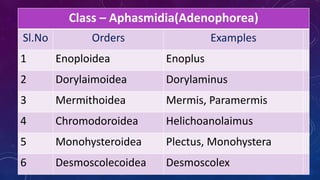
Class – Aphasmidia(Adenophorea)
Sl.No Orders Examples
1 Enoploidea Enoplus
2 Dorylaimoidea Dorylaminus
3 Mermithoidea Mermis, Paramermis
4 Chromodoroidea Helichoanolaimus
5 Monohysteroidea Plectus, Monohystera
6 Desmoscolecoidea Desmoscolex
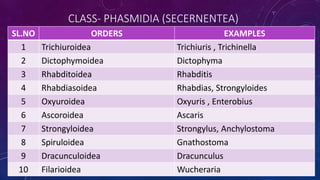
CLASS- PHASMIDIA (SECERNENTEA)
SL.NO ORDERS EXAMPLES
1 Trichiuroidea Trichiuris , Trichinella
2 Dictophymoidea Dictophyma
3 Rhabditoidea Rhabditis
4 Rhabdiasoidea Rhabdias, Strongyloides
5 Oxyuroidea Oxyuris , Enterobius
6 Ascoroidea Ascaris
7 Strongyloidea Strongylus, Anchylostoma
8 Spiruloidea Gnathostoma
9 Dracunculoidea Dracunculus
10 Filarioidea Wucheraria
Nemathelminthes general characters and classification

Nemathelminthes general characters and classification

  • 1.
    NEMATHELMINTHES ASHOK KUMAR BOLLAPALLI M.SC.,B.ED.,CSIR-NET,M.A(LIT)D.C.A. LECTURER IN ZOOLOGY KRK GOVT DEGREE COLLEGE ADDANKI-523201 9652929696,9441635264 ASHOKKUMARZOOLOGY@GMAIL.COM
  • 2.
    INTRODUCTION • Gegenbaur (1859)included some pseudocoelomate animals in a group called Nemathelminthes. • NEMA= THREAD., HELMINTHES= WORMS • Grobben(1910) called them as Aschelminthes( Gr., Askes= Cavity, helmin= worm) • Pseudocoel – a cavity between gut and body wall (Pseudocoelomates) • Bilaterally symmetrical and unsegmented worms
  • 3.
    GENERAL CHARACTERS 1.Bilaterally symmetricalunsegmented worms 2.Triploblastic – Ecto,Meso,Endoderms 3.Organ system level of organisation 4.Body is cylindrical or flattened and is covered by a protective cuticle 5.Alimentary canal is straight tube with mouth and anus 6.Pharynx is muscular and specialised 7.Respiratory and circulatory systems are absent 8.Excretory system- canals, protonephridia- ormoregulation 9.Nervous system is simple with nerve ring and longitudinal nerves
  • 4.
    GENERAL CHARACTERS CONTD.. 10.Musclefibres are circular and longitudinal. 11. Papillae , Bristles and eye spots form the sense organs 12. Sexes are separate 13. Reproduction is only by sexual method 14. Shell is present around the eggs 15. Cleavage of the egg is determinate and spiral 16. Larval form is absent 17.Mostly parasitic and some are terrestrial and aquatic.
  • 5.
    CLASSIFICATION - NEMATHELMINTHES ClassAphasmidia (Adenophorea) Phasmidia (Secernentea) 1 Caudal sense organs/ Phasmids are present Phasmids present 2 Amphids (internal sense organs) of various types present Amphids present and pore like 3 Caudal adhesive glands are present Caudal adhesive glands are absent 4 Excretory system is absent. If present poorly developed Excretory system is well developed 5 Mesenterial tissue well developed Poorly developed 6 Divided into 6 orders Divided into 10 orders
  • 6.
    Class – Aphasmidia(Adenophorea) Sl.NoOrders Examples 1 Enoploidea Enoplus 2 Dorylaimoidea Dorylaminus 3 Mermithoidea Mermis, Paramermis 4 Chromodoroidea Helichoanolaimus 5 Monohysteroidea Plectus, Monohystera 6 Desmoscolecoidea Desmoscolex
  • 7.
    CLASS- PHASMIDIA (SECERNENTEA) SL.NOORDERS EXAMPLES 1 Trichiuroidea Trichiuris , Trichinella 2 Dictophymoidea Dictophyma 3 Rhabditoidea Rhabditis 4 Rhabdiasoidea Rhabdias, Strongyloides 5 Oxyuroidea Oxyuris , Enterobius 6 Ascoroidea Ascaris 7 Strongyloidea Strongylus, Anchylostoma 8 Spiruloidea Gnathostoma 9 Dracunculoidea Dracunculus 10 Filarioidea Wucheraria