Classification of
protozoa
Ajay Subedi
Janamaitri foundation
Kathmandu,Nepal
Protozoa
The word protozoa arises from the greek word
“protos” meaning first or primitive and “zoon”
meaning animal.
Kingdom Protista includes unicellular,eukaryotic
and microscopic organisms.The diverse group of
Protista is regarded as phylum protozoa.
It includes almost 50,000 species.
General characters of phylum protozoa;
 They may be free living found in freshwater
,marine,or live in damp soil.some are parasites
and few are saprophytes and commensals.
 Protoplasm is differentiated into outer clear
and transparent ectoplasm and inner granular
and semi-fluid endoplasm.
Body is nacked or bounded by a definite layer
called pellicle.
Locomotion takes place by finger like
pseudopodia[e.g.Amoeba],or hair like
cilia[e.g.paramecium] and whip like
flagella[e.g.Euglena].
Digestion is intracellular.
Respiration takes place by general body surface
by the process of diffusion.
Reproduction mainly occur asxually by
budding(Vorticella),binary fission(Amoeba) or
multiple fission (Plasmodium) and sexually by
conjugation of adults(i.e.hologamy) or fusion of
gametes(i.e.syngamy).
Life cycle
Protozoa have active stage known as trophozoite
and inactive stage known as cyst.
Trophozoite stage is infective stage and occur in
favourable condition.
Cyst(non motile) is disinfective stage which is
developed in unfavourable condition.such as,
dehydration, low nutrient supply, and even
anaerobic enviroment.
Classification
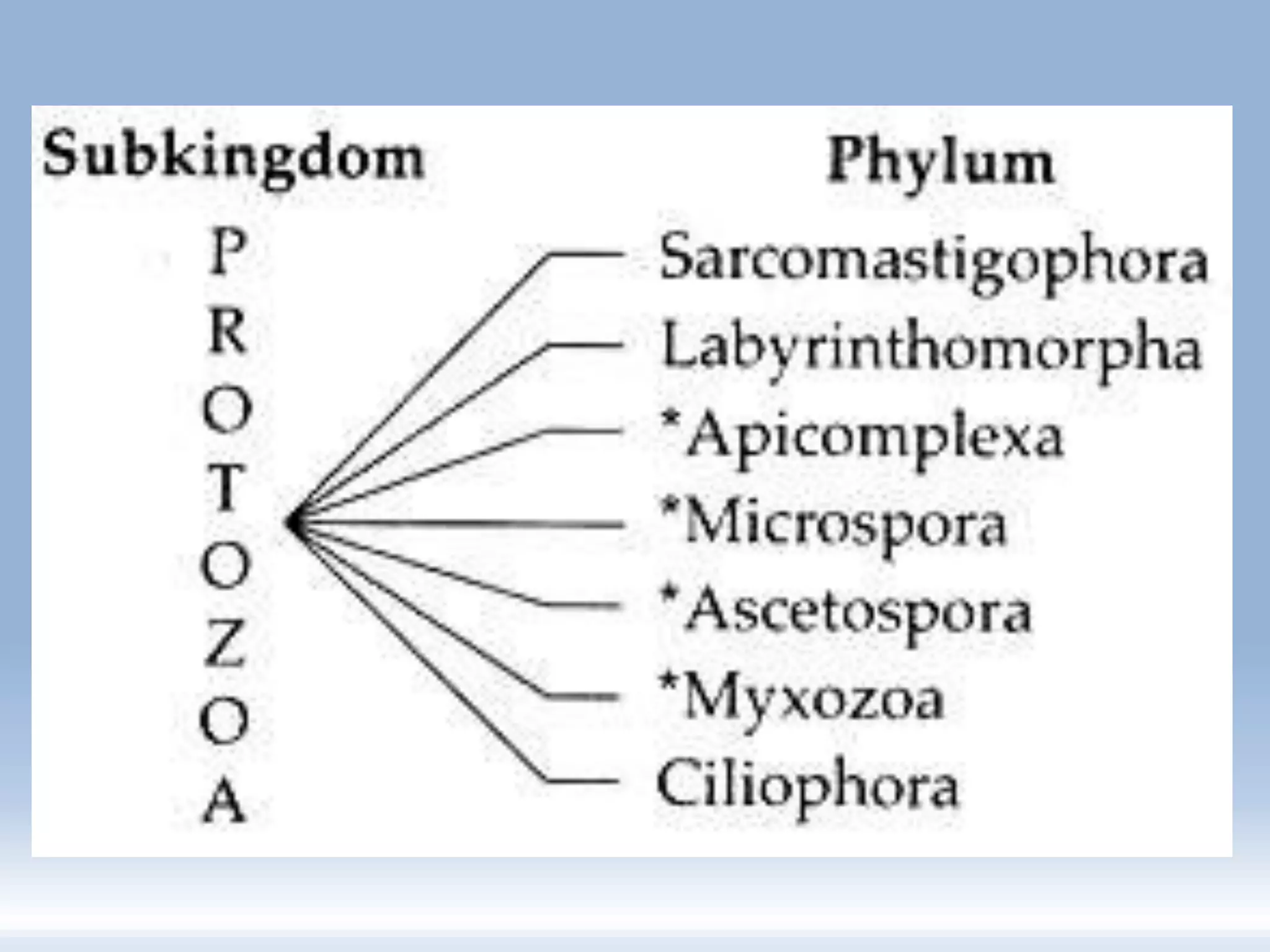
On the basis of light and electron microscopic
morphology, the protozoa are currently
classified into seven phyla. Most species causing
human disease are members of the phyla
Sacromastigophora and Apicomplexa.
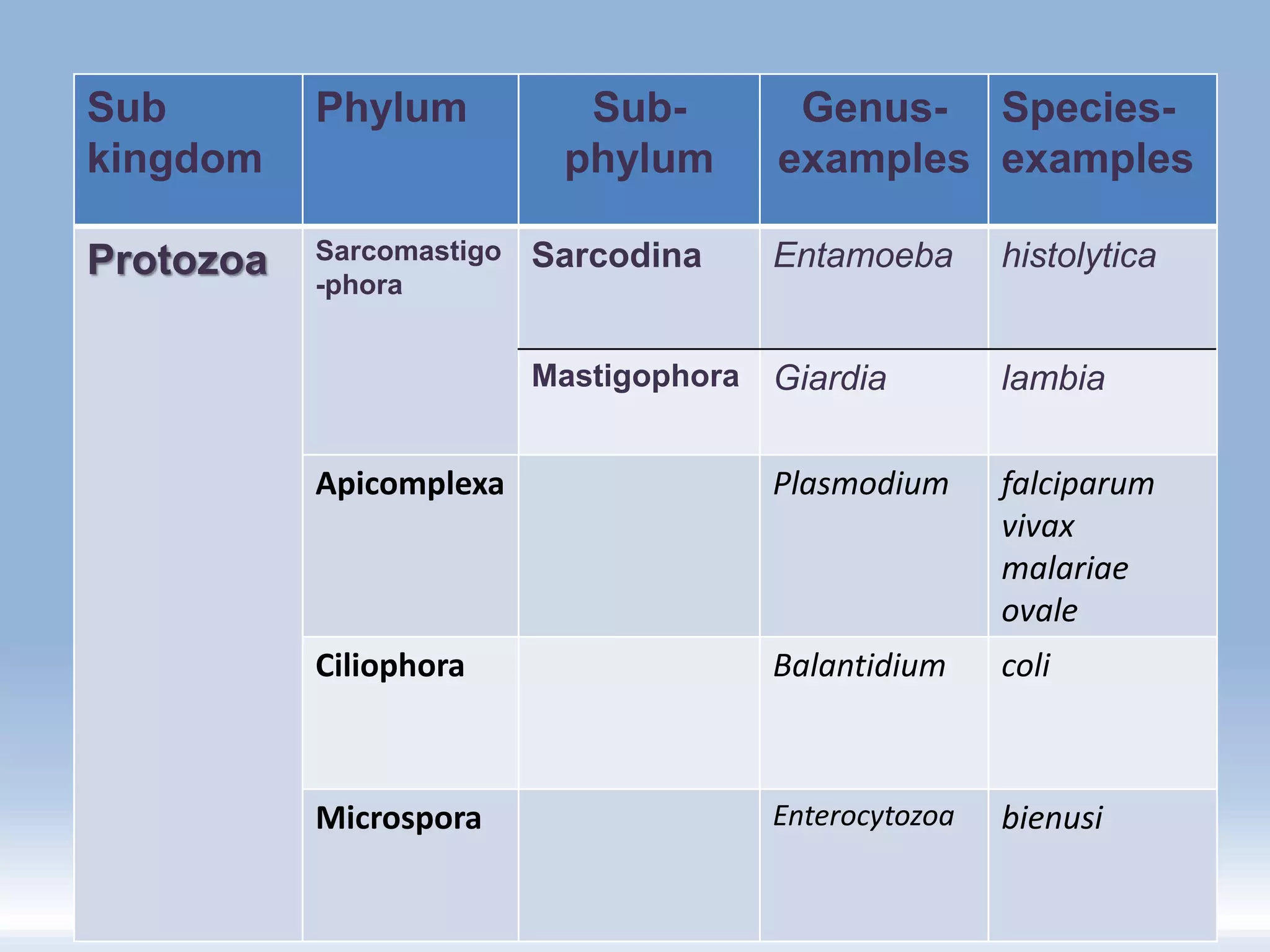
Sub
kingdom
Phylum Sub-
phylum
Genus-
examples
Species-
examples
Protozoa Sarcomastigo
-phora
Sarcodina Entamoeba histolytica
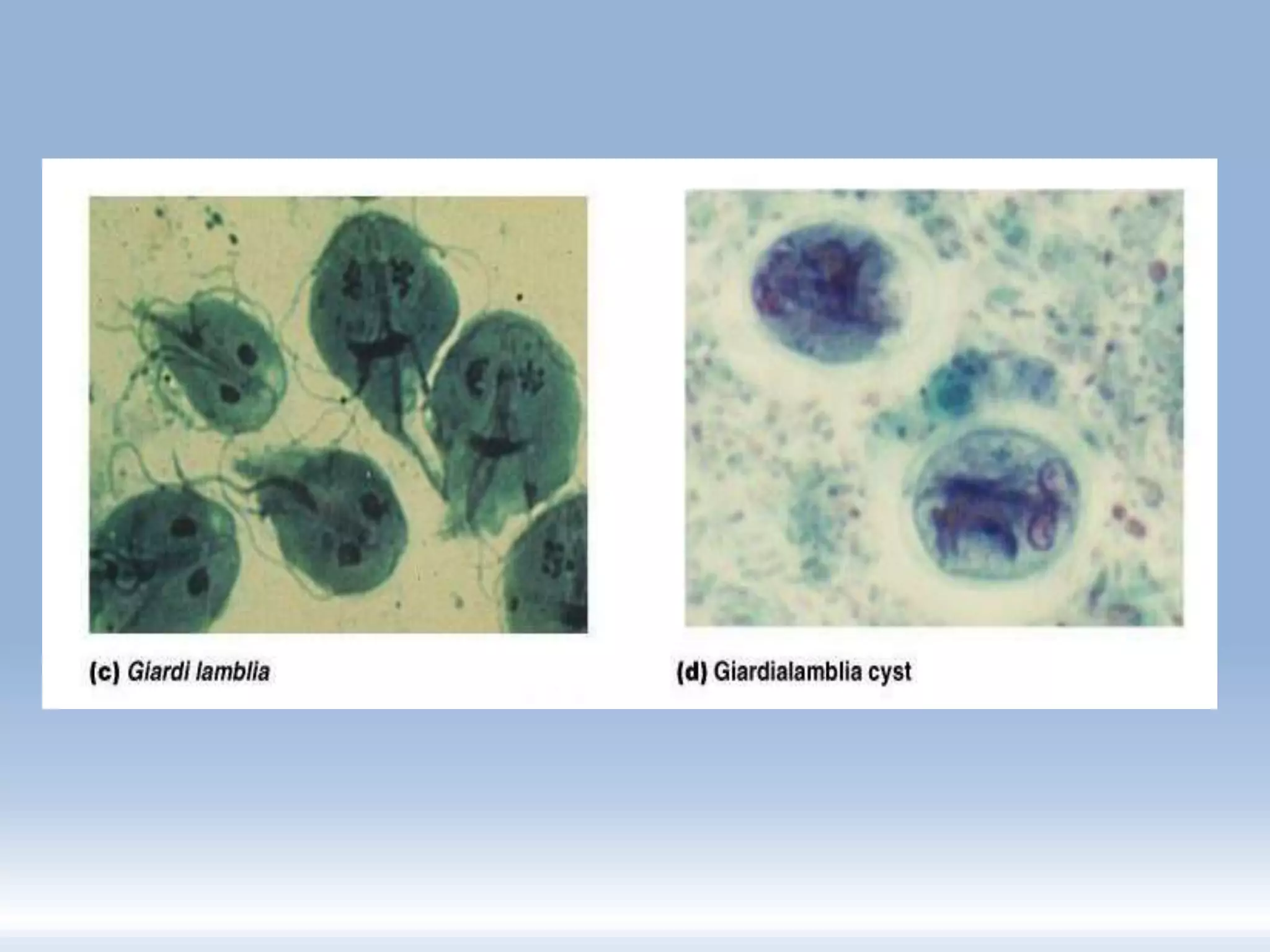
Mastigophora Giardia lambia
Apicomplexa Plasmodium falciparum
vivax
malariae
ovale
Ciliophora Balantidium coli
Microspora Enterocytozoa bienusi
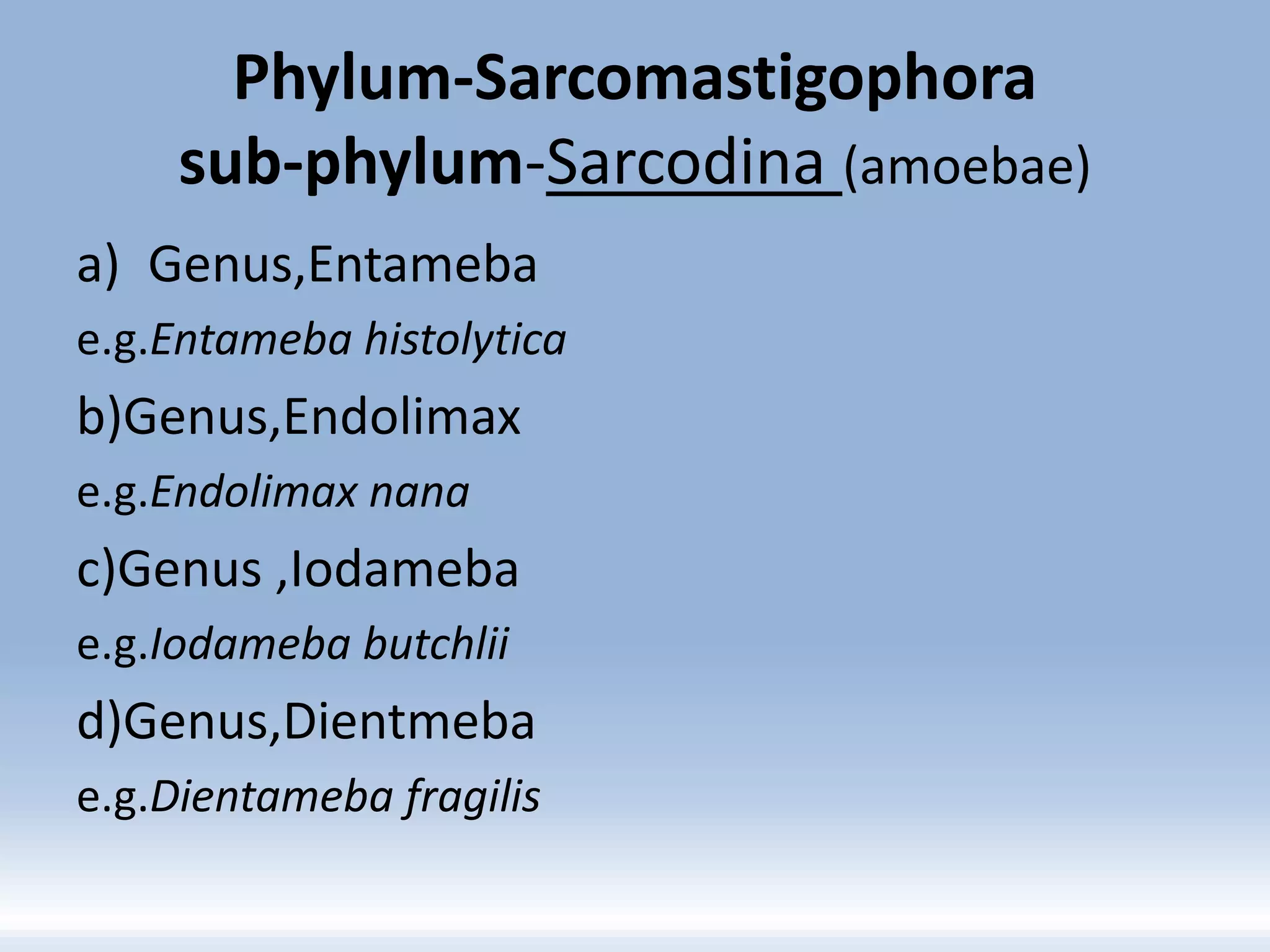
Phylum-Sarcomastigophora
sub-phylum-Sarcodina (amoebae)
a) Genus,Entameba
e.g.Entameba histolytica
b)Genus,Endolimax
e.g.Endolimax nana
c)Genus ,Iodameba
e.g.Iodameba butchlii
d)Genus,Dientmeba
e.g.Dientameba fragilis
Sub phylum-Mastigophora (Flagellates)
(a) Genus Giardia
e.g. G. lamblia
(b) Genus Trichomonas
e.g. T. vaginalis
(c) Genus Trypanosoma
e.g. T. brucci
(d) Genus Leishmania
e.g. L. donovani
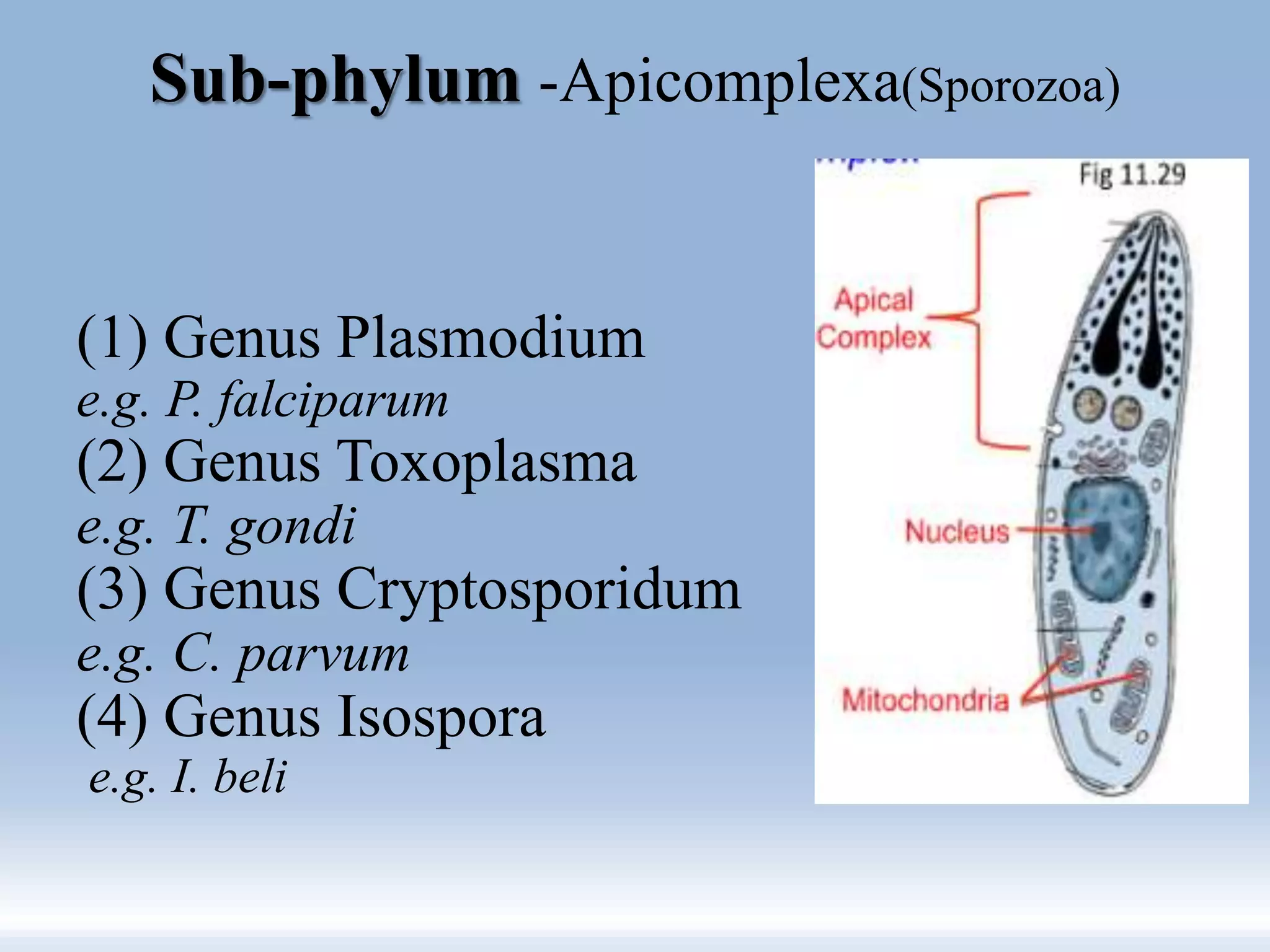
Sub-phylum -Apicomplexa(Sporozoa)
(1) Genus Plasmodium
e.g. P. falciparum
(2) Genus Toxoplasma
e.g. T. gondi
(3) Genus Cryptosporidum
e.g. C. parvum
(4) Genus Isospora
e.g. I. beli
Sub –phylum-Ciliophora(ciliates)
e.g. Balantidium coli
Thank you
Life straw ,this can filter
99.99% of bacteria and
waterborne protozoa.
Award-winner.

Presentation on classification of protozoa

  • 1.
  • 3.
    Protozoa The word protozoaarises from the greek word “protos” meaning first or primitive and “zoon” meaning animal. Kingdom Protista includes unicellular,eukaryotic and microscopic organisms.The diverse group of Protista is regarded as phylum protozoa. It includes almost 50,000 species.
  • 4.
    General characters ofphylum protozoa;  They may be free living found in freshwater ,marine,or live in damp soil.some are parasites and few are saprophytes and commensals.  Protoplasm is differentiated into outer clear and transparent ectoplasm and inner granular and semi-fluid endoplasm. Body is nacked or bounded by a definite layer called pellicle.
  • 5.
    Locomotion takes placeby finger like pseudopodia[e.g.Amoeba],or hair like cilia[e.g.paramecium] and whip like flagella[e.g.Euglena]. Digestion is intracellular. Respiration takes place by general body surface by the process of diffusion. Reproduction mainly occur asxually by budding(Vorticella),binary fission(Amoeba) or multiple fission (Plasmodium) and sexually by conjugation of adults(i.e.hologamy) or fusion of gametes(i.e.syngamy).
  • 6.
    Life cycle Protozoa haveactive stage known as trophozoite and inactive stage known as cyst. Trophozoite stage is infective stage and occur in favourable condition. Cyst(non motile) is disinfective stage which is developed in unfavourable condition.such as, dehydration, low nutrient supply, and even anaerobic enviroment.
  • 8.
    Classification On the basisof light and electron microscopic morphology, the protozoa are currently classified into seven phyla. Most species causing human disease are members of the phyla Sacromastigophora and Apicomplexa.
  • 10.
    Sub kingdom Phylum Sub- phylum Genus- examples Species- examples Protozoa Sarcomastigo -phora SarcodinaEntamoeba histolytica Mastigophora Giardia lambia Apicomplexa Plasmodium falciparum vivax malariae ovale Ciliophora Balantidium coli Microspora Enterocytozoa bienusi
  • 11.
    Phylum-Sarcomastigophora sub-phylum-Sarcodina (amoebae) a) Genus,Entameba e.g.Entamebahistolytica b)Genus,Endolimax e.g.Endolimax nana c)Genus ,Iodameba e.g.Iodameba butchlii d)Genus,Dientmeba e.g.Dientameba fragilis
  • 12.
    Sub phylum-Mastigophora (Flagellates) (a)Genus Giardia e.g. G. lamblia (b) Genus Trichomonas e.g. T. vaginalis (c) Genus Trypanosoma e.g. T. brucci (d) Genus Leishmania e.g. L. donovani
  • 13.
    Sub-phylum -Apicomplexa(Sporozoa) (1) GenusPlasmodium e.g. P. falciparum (2) Genus Toxoplasma e.g. T. gondi (3) Genus Cryptosporidum e.g. C. parvum (4) Genus Isospora e.g. I. beli
  • 14.
  • 15.
    Thank you Life straw,this can filter 99.99% of bacteria and waterborne protozoa. Award-winner.