lamblia
Prepared by:
NOE P. MENDEZ
CENTRAL MINDANAO UNIVERSITY (CMU)
npolomendez@gmail.com
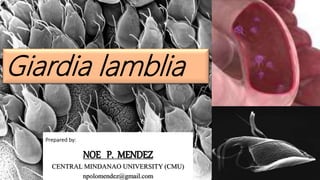
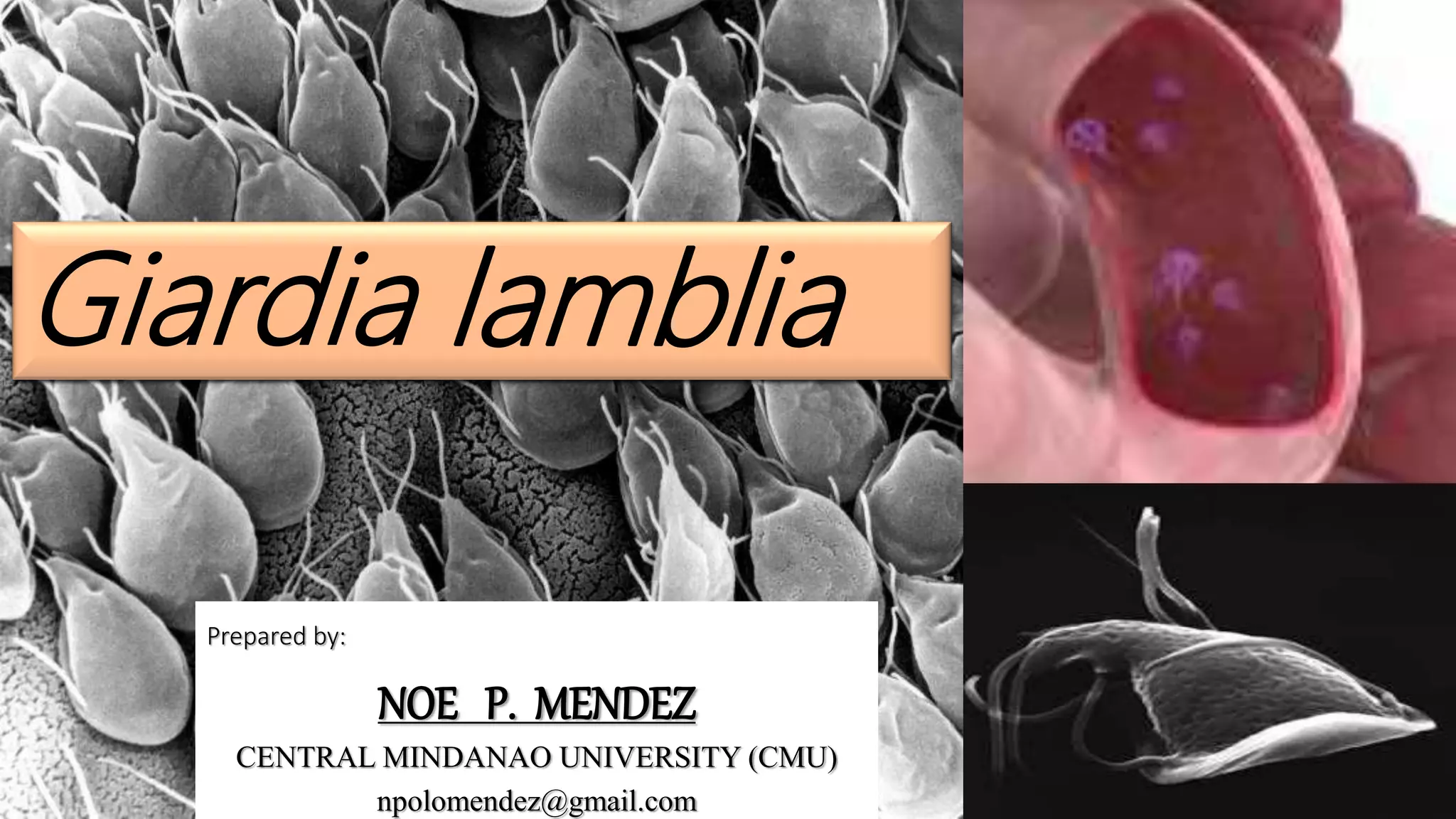
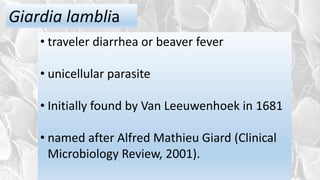
Giardia lamblia
• traveler diarrhea or beaver fever
• unicellular parasite
• Initially found by Van Leeuwenhoek in 1681
• named after Alfred Mathieu Giard (Clinical
Microbiology Review, 2001).
Domain: Eukarya
Kingdom: Protista
Phylum: Sarcomastigophora
Class: Zoomastigophora
Order: Diplomonadida
Family: Hexamitidae
Genus: Giardia
Species: G. lamblia
Giardia lamblia
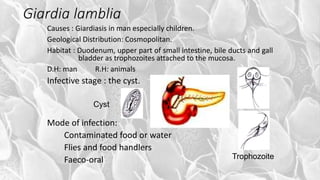
Causes : Giardiasis in man especially children.
Geological Distribution: Cosmopolitan.
Habitat : Duodenum, upper part of small intestine, bile ducts and gall
bladder as trophozoites attached to the mucosa.
D.H: man R.H: animals
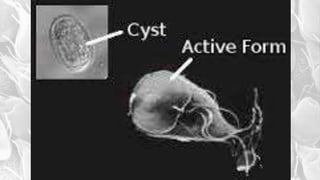
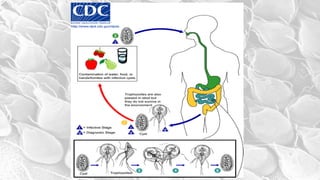
Infective stage : the cyst.
Mode of infection:
Contaminated food or water
Flies and food handlers
Faeco-oral Trophozoite
Cyst
Giardia lamblia
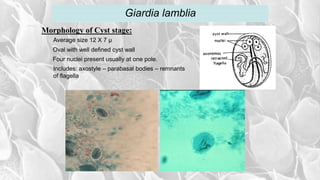
Morphology of Cyst stage:
Average size 12 X 7 µ
Oval with well defined cyst wall
Four nuclei present usually at one pole.
Includes: axostyle – parabasal bodies – remnants
of flagella
Giardia lamblia
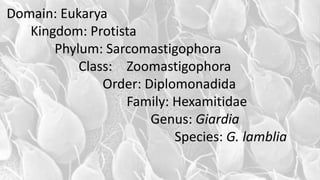
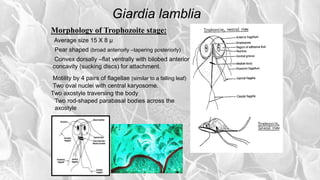
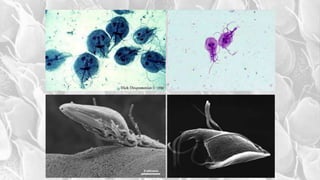
Morphology of Trophozoite stage:
Average size 15 X 8 µ
Pear shaped (broad anteriorly –tapering posteriorly)
Convex dorsally –flat ventrally with bilobed anterior
concavity (sucking discs) for attachment.
Motility by 4 pairs of flagellae (similar to a falling leaf)
Two oval nuclei with central karyosome.
Two axostyle traversing the body
Two rod-shaped parabasal bodies across the
axostyle
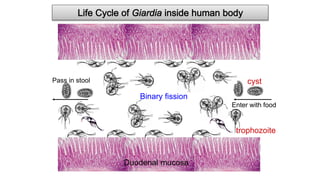
Binary fission
Enter with food
Pass in stool
Duodenal mucosa
cyst
trophozoite
• Giardia infected patients complain of
diarrhoea and flatulence.
• Stool of Giardia infected patients is light-
coloured and greasy.
• G. lamblia infection is common in children.
• Giardia cysts are infective to man.
Muller, J., G. Ruhle, N. Muller, JF. Rossignol and A. Hemphill.
2006.In Vitro Effects of Thiazolides on Giardia lamblia
WB Clone C6 Cultured Axenically and in Coculture with
Caco2 Cells. American Society for Microbiology.50:1
(162–170).
Mohamed, R. 2003. Giardia lamblia.

Giardia lamblia

  • 1.
    lamblia Prepared by: NOE P.MENDEZ CENTRAL MINDANAO UNIVERSITY (CMU) npolomendez@gmail.com
  • 2.
    Giardia lamblia • travelerdiarrhea or beaver fever • unicellular parasite • Initially found by Van Leeuwenhoek in 1681 • named after Alfred Mathieu Giard (Clinical Microbiology Review, 2001).
  • 3.
    Domain: Eukarya Kingdom: Protista Phylum:Sarcomastigophora Class: Zoomastigophora Order: Diplomonadida Family: Hexamitidae Genus: Giardia Species: G. lamblia
  • 4.
    Giardia lamblia Causes :Giardiasis in man especially children. Geological Distribution: Cosmopolitan. Habitat : Duodenum, upper part of small intestine, bile ducts and gall bladder as trophozoites attached to the mucosa. D.H: man R.H: animals Infective stage : the cyst. Mode of infection: Contaminated food or water Flies and food handlers Faeco-oral Trophozoite Cyst
  • 6.
    Giardia lamblia Morphology ofCyst stage: Average size 12 X 7 µ Oval with well defined cyst wall Four nuclei present usually at one pole. Includes: axostyle – parabasal bodies – remnants of flagella
  • 7.
    Giardia lamblia Morphology ofTrophozoite stage: Average size 15 X 8 µ Pear shaped (broad anteriorly –tapering posteriorly) Convex dorsally –flat ventrally with bilobed anterior concavity (sucking discs) for attachment. Motility by 4 pairs of flagellae (similar to a falling leaf) Two oval nuclei with central karyosome. Two axostyle traversing the body Two rod-shaped parabasal bodies across the axostyle
  • 9.
    Binary fission Enter withfood Pass in stool Duodenal mucosa cyst trophozoite
  • 11.
    • Giardia infectedpatients complain of diarrhoea and flatulence. • Stool of Giardia infected patients is light- coloured and greasy. • G. lamblia infection is common in children. • Giardia cysts are infective to man.
  • 12.
    Muller, J., G.Ruhle, N. Muller, JF. Rossignol and A. Hemphill. 2006.In Vitro Effects of Thiazolides on Giardia lamblia WB Clone C6 Cultured Axenically and in Coculture with Caco2 Cells. American Society for Microbiology.50:1 (162–170). Mohamed, R. 2003. Giardia lamblia.

Editor's Notes

  • #3 Giardia lamblia, also known as traveler diarrhea, or beaver fever, is a unicellular parasite that is found in the fecal matter of infected mammals. Initially found by Van Leeuwenhoek in 1681 after studying his own fecal matter, Giardia lamblia was named after Alfred Mathieu Giard because of his lasting research on the parasite (Clinical Microbiology Review 2001).
  • #4 Protista- All members of this kingdom are eukaryotic and contain most commonly unicellular organisms Sarcomastigophora- are categorized as being flagellated, and are usually 10-20 micrometers in size. (Contain either free-living or parasitic protozoan. ) Zoomastigophora- how organisms move through the use of one or more flagella. Diplomondida- contains mostly parasitic organisms. These organisms don’t possess a mitochondria or Golgi apparatus, but instead contain mitosomes, which involve the growth of iron sulfur proteins. Hexamitidae - having six or eight flagella, these organisms contain two true nuclei, also bilaterally symmetrical. Giardia- The genus Giardia contains anaerobic parasites that feed off of and reproduce in the small intestine of humans and other mammals. These organisms have two stages of life, one in which it is a swimming trophozoite and the other in which it is a cyst feeding off the host organism. Giardia lamblia- most commonly associated with the disease giardiasis, can be distinguished from other Giardia species because of the two vertical adhesion disks on the top of the organism. These disks allow the organisms to attatch to the hosts small intestine and retain nutrients from the host. The name Giardia lamblia literally means flagellated protozoan.