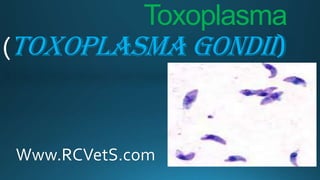
Toxoplasma
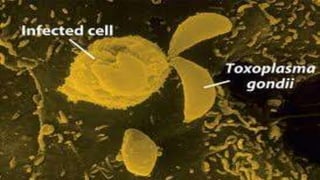
(Toxoplasma gondii)

Www.RCVetS.com
Introduction:
Toxoplasma
gondii.
1908
• Toxoplasma gondii
intestinal epithelium
and muscle.
• It
blood and peritoneal exudate
Site of infection:
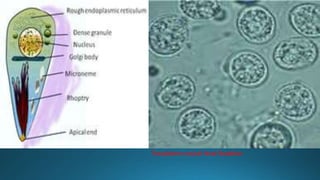
Toxoplasma oocyst fecal floatation.
Host :
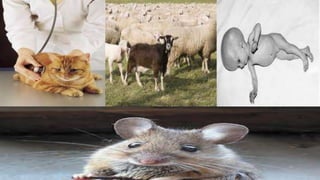
• Intermediate host:
• Human, cattle, birds, rodents, pigs, and sheep.

• Definitive host:
• Mainly domestic and wild cats.
Classification:
• Phylum: Apicomplexa
• Class:
Conoidasida
• Subclass: Coccidiasina
• Order:
Eucoccidiorida
• Family:
Sarcocystidae
• Genus: Toxoplasma
• Species: T.gondii
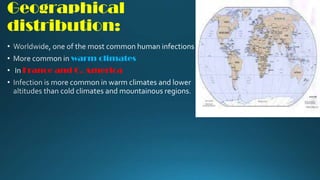
Geographical
distribution:
warm climates
France and C. America
Signs & symptoms:
• Body aches
• Swollen lymph nodes
• Headache

• Fever
• Fatigue
• Occasionally, a sore throat

People with weakened immune system

•

Headache

• Confusion
• Poor coordination
• Blurred vision caused by severe inflammation of your retina (ocular toxoplasmosis).
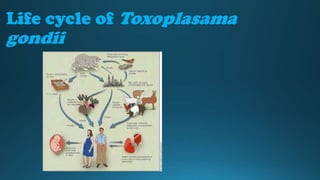
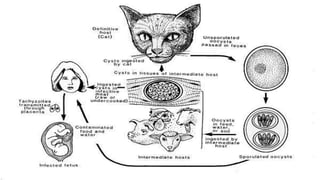
Life cycle of Toxoplasama

gondii
The protozoa multiplies sexually in the cat’s
intestine and asexually in a many
mammals and even birds.
Cats are infected by eating infected rodent.the
zoitocyst which contains bradyzoites travel to
the intestine via digestive tract.
Cont. life cycle
Bradyzoites are released in the intestine.
Bradyzoites infect cells and become trophozoites.
Fertilization occurs in the intestine and immature
oocyst are passed in the cat’s feces.
The Oocyst are contaminated with water, food and soil are
ingested by intermediate host.
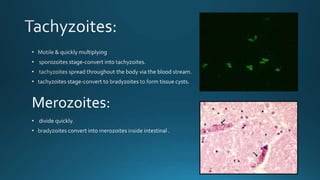
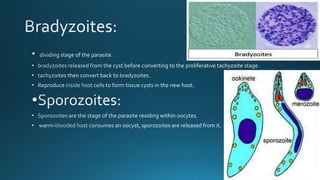
Merozoites:
Diagnosis:
• Biopsy of humans.
• (ELISA) Enzyme-Linked Immunoabsorbent Assays.
• (IFAT) Indirect Fluorescent Antibody tests.
Treatment:
• Sulphonamides
• Pyrimethamine
• Spiramycine
• Atovaquone
• Clindamycin
• Spiramycin during pregnancy
• Antibiotics and steroid tablets during an infection
Pathogenesis:
immunocompetent persons

asymptomatic

infection.
is benign and self-limited
central nervous system (CNS) disease
retinochoroiditis, or pneumonitis
AIDS toxoplasma encephalitis
intracerebral mass lesions
by reactivation of chronic infection.
Lymphadenitis is the most common in humans.
Children exhibit Hydrocephalous, retinochoroiditis, convulsion and
intracerebral calsifications.
Congenital neurological defects in infants.
Control:
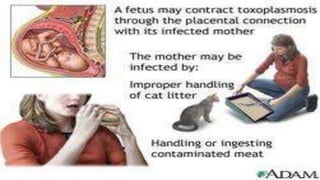
• Pets should be checked and cured.
• Wash hands thoroughly with soup
• Cats should be kept indoors and litter boxes changed daily.
• Better cook your meat well.
• Cat feces should be flashed down the toilet or burned.
Toxoplasma

Toxoplasma