SAMSUDEEN. S
• Sometimes called the “Junk drawer”
• Contains animal-like, plant-like and
fungus-like organisms
• Plankton (zoo-/phyto-/myco)
 Unicellular
 Eukaryotic
 Basically Ingestive Heterotrophs
 Lack cell walls but have definite
shapes
 Most are motile
 Basically reproduce by asexual
reproduction
 Aerobic but some can live in
anaerobic conditions (ones living in
digestive tracts)
1. Macronucleus – controls metabolism
2. Micronucleus - involved in conjugation
3. Contractile vacuoles – maintains structure
4. Homeostasis – auto regulate
5. Ingestion structures
6. Anal pore – excretion of wastes
7. Trichocysts – defense mechanism
 Majority of free-living
 Marine, terrestrial & freshwater.
 Some are parasites on algae to
vertebrates
 Make up the zooplankton in marine
ecosystems. Feed on phytoplankton
 Abundant in soil or on plants &
animals
 Some live in guts of termites, roaches
& ruminants (cows)
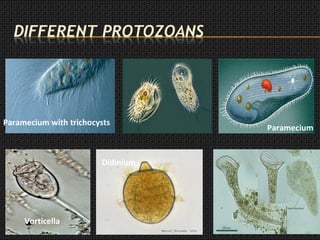
Paramecium
Stenor
Paramecium with trichocysts
Vorticella
Didinium
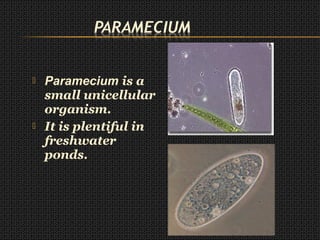
 Paramecium is a
small unicellular
organism.
 It is plentiful in
freshwater
ponds.
 Ciliata (Ciliophora)
- Have cilia.
- Similar in structure to flagella but
shorter and all over surface of organisms
- Cilia usually arranged in rows &
connected to each other
- Cilia near oral cavity involved food
gathering.
- Transverse fission & sexual
reproduction by conjugation
i.e) – Paramecium.
 Ciliata (Ciliophora)
- Have cilia.
- Similar in structure to flagella but shorter
and all over surface of organisms
- Cilia usually arranged in rows & connected
to each other
- Cilia near oral cavity involved getting food.
- Transverse fission, & sexual reproduction
by conjugation
i.e) – Paramecium, Didinium.
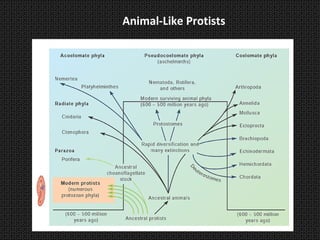
Animal-Like Protists
 Flagellates are the ancestors of
ameoboid protozoan
 Phytoflagellated (photosynthesizing)
 Zooflagellated (particle feeding and
parasitic)
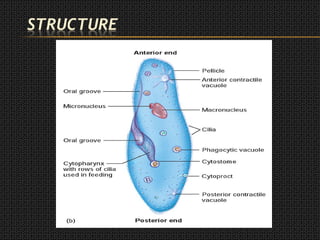
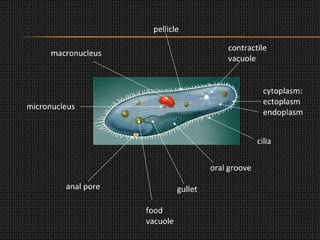
macronucleus
micronucleus
oral groove
gullet
contractile
vacuole
food
vacuole
cilia
pellicle
anal pore
cytoplasm:
ectoplasm
endoplasm
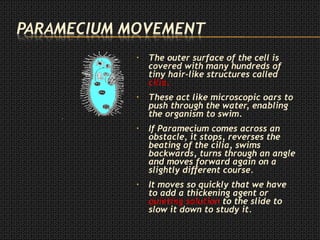
• The outer surface of the cell is
covered with many hundreds of
tiny hair-like structures called
cilia.
• These act like microscopic oars to
push through the water, enabling
the organism to swim.
• If Paramecium comes across an
obstacle, it stops, reverses the
beating of the cilia, swims
backwards, turns through an angle
and moves forward again on a
slightly different course.
• It moves so quickly that we have
to add a thickening agent or
quieting solution to the slide to
slow it down to study it.
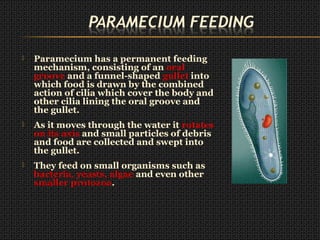
 Paramecium has a permanent feeding
mechanism, consisting of an oral
groove and a funnel-shaped gullet into
which food is drawn by the combined
action of cilia which cover the body and
other cilia lining the oral groove and
the gullet.
 As it moves through the water it rotates
on its axis and small particles of debris
and food are collected and swept into
the gullet.
 They feed on small organisms such as
bacteria, yeasts, algae and even other
smaller protozoa.
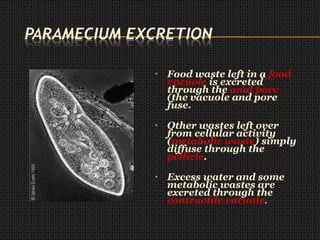
• Food waste left in a food
vacuole is excreted
through the anal pore
(the vacuole and pore
fuse.
• Other wastes left over
from cellular activity
(metabolic waste) simply
diffuse through the
pellicle.
• Excess water and some
metabolic wastes are
excreted through the
contractile vacuole.
Asexual Reproduction in Protozoa
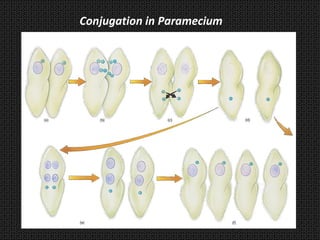
Conjugation in Paramecium
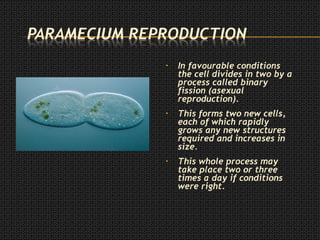
• In favourable conditions
the cell divides in two by a
process called binary
fission (asexual
reproduction).
• This forms two new cells,
each of which rapidly
grows any new structures
required and increases in
size.
• This whole process may
take place two or three
times a day if conditions
were right.
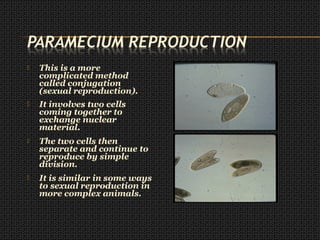
 This is a more
complicated method
called conjugation
(sexual reproduction).
 It involves two cells
coming together to
exchange nuclear
material.
 The two cells then
separate and continue to
reproduce by simple
division.
 It is similar in some ways
to sexual reproduction in
more complex animals.
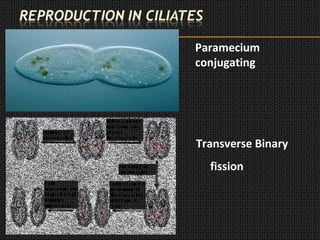
Paramecium
conjugating
Transverse Binary
fission
 Adaptations:
 Cilia to help feed and escape
 Contractile vacuoles
 Trichocysts
• Movement: by cilia in circular motion,
move ~ 60 mm/hr
• Metabolism:
-food pulled into oral groove by cilia
-food vacuole forms at gullet
-lysosome aids with digestion
• Feed mostly on bacteria, smaller
protozoans and algae.
 Excretion:
-Contractile vacuole removes excess
H20.
-C02 across pellicle by diffusion
-anal pore removes waste.
 Reproduction: Asexual - cell division
Sexual – conjugation
(exchange of micronucleus DNA)
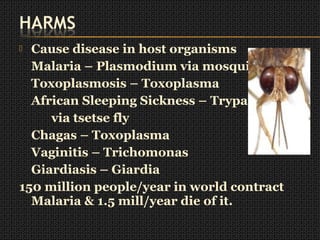
 Cause disease in host organisms
Malaria – Plasmodium via mosquito
Toxoplasmosis – Toxoplasma
African Sleeping Sickness – Trypanosoma
via tsetse fly
Chagas – Toxoplasma
Vaginitis – Trichomonas
Giardiasis – Giardia
150 million people/year in world contract
Malaria & 1.5 mill/year die of it.
“One scientist calculated that if all the
progeny of a single Paramecium
survived, assuming a division rate of
once a day, then after 113 days, the
mass of paramecia would equal the
volume of the Earth! “

Paramecium

  • 1.
  • 2.
    • Sometimes calledthe “Junk drawer” • Contains animal-like, plant-like and fungus-like organisms • Plankton (zoo-/phyto-/myco)
  • 3.
     Unicellular  Eukaryotic Basically Ingestive Heterotrophs  Lack cell walls but have definite shapes  Most are motile  Basically reproduce by asexual reproduction  Aerobic but some can live in anaerobic conditions (ones living in digestive tracts)
  • 4.
    1. Macronucleus –controls metabolism 2. Micronucleus - involved in conjugation 3. Contractile vacuoles – maintains structure 4. Homeostasis – auto regulate 5. Ingestion structures 6. Anal pore – excretion of wastes 7. Trichocysts – defense mechanism
  • 5.
     Majority offree-living  Marine, terrestrial & freshwater.  Some are parasites on algae to vertebrates  Make up the zooplankton in marine ecosystems. Feed on phytoplankton  Abundant in soil or on plants & animals  Some live in guts of termites, roaches & ruminants (cows)
  • 6.
  • 7.
     Paramecium isa small unicellular organism.  It is plentiful in freshwater ponds.
  • 9.
     Ciliata (Ciliophora) -Have cilia. - Similar in structure to flagella but shorter and all over surface of organisms - Cilia usually arranged in rows & connected to each other - Cilia near oral cavity involved food gathering. - Transverse fission & sexual reproduction by conjugation i.e) – Paramecium.
  • 10.
     Ciliata (Ciliophora) -Have cilia. - Similar in structure to flagella but shorter and all over surface of organisms - Cilia usually arranged in rows & connected to each other - Cilia near oral cavity involved getting food. - Transverse fission, & sexual reproduction by conjugation i.e) – Paramecium, Didinium.
  • 11.
  • 12.
     Flagellates arethe ancestors of ameoboid protozoan  Phytoflagellated (photosynthesizing)  Zooflagellated (particle feeding and parasitic)
  • 13.
  • 14.
    • The outersurface of the cell is covered with many hundreds of tiny hair-like structures called cilia. • These act like microscopic oars to push through the water, enabling the organism to swim. • If Paramecium comes across an obstacle, it stops, reverses the beating of the cilia, swims backwards, turns through an angle and moves forward again on a slightly different course. • It moves so quickly that we have to add a thickening agent or quieting solution to the slide to slow it down to study it.
  • 15.
     Paramecium hasa permanent feeding mechanism, consisting of an oral groove and a funnel-shaped gullet into which food is drawn by the combined action of cilia which cover the body and other cilia lining the oral groove and the gullet.  As it moves through the water it rotates on its axis and small particles of debris and food are collected and swept into the gullet.  They feed on small organisms such as bacteria, yeasts, algae and even other smaller protozoa.
  • 16.
    • Food wasteleft in a food vacuole is excreted through the anal pore (the vacuole and pore fuse. • Other wastes left over from cellular activity (metabolic waste) simply diffuse through the pellicle. • Excess water and some metabolic wastes are excreted through the contractile vacuole.
  • 18.
  • 19.
  • 20.
    • In favourableconditions the cell divides in two by a process called binary fission (asexual reproduction). • This forms two new cells, each of which rapidly grows any new structures required and increases in size. • This whole process may take place two or three times a day if conditions were right.
  • 21.
     This isa more complicated method called conjugation (sexual reproduction).  It involves two cells coming together to exchange nuclear material.  The two cells then separate and continue to reproduce by simple division.  It is similar in some ways to sexual reproduction in more complex animals.
  • 22.
  • 23.
     Adaptations:  Ciliato help feed and escape  Contractile vacuoles  Trichocysts
  • 24.
    • Movement: bycilia in circular motion, move ~ 60 mm/hr • Metabolism: -food pulled into oral groove by cilia -food vacuole forms at gullet -lysosome aids with digestion • Feed mostly on bacteria, smaller protozoans and algae.
  • 25.
     Excretion: -Contractile vacuoleremoves excess H20. -C02 across pellicle by diffusion -anal pore removes waste.  Reproduction: Asexual - cell division Sexual – conjugation (exchange of micronucleus DNA)
  • 26.
     Cause diseasein host organisms Malaria – Plasmodium via mosquito Toxoplasmosis – Toxoplasma African Sleeping Sickness – Trypanosoma via tsetse fly Chagas – Toxoplasma Vaginitis – Trichomonas Giardiasis – Giardia 150 million people/year in world contract Malaria & 1.5 mill/year die of it.
  • 27.
    “One scientist calculatedthat if all the progeny of a single Paramecium survived, assuming a division rate of once a day, then after 113 days, the mass of paramecia would equal the volume of the Earth! “