TRYPANOSOMIASISTRYPANOSOMIASIS
GUIDE:DR. MRS.VAIDYAGUIDE:DR. MRS.VAIDYA
TRYPANOSOMIASISTRYPANOSOMIASIS
IINTRODUCTION:-NTRODUCTION:-
 Human trypanosomiasis is endemic in AfricaHuman trypanosomiasis is endemic in Africa
and South America. In Africa the disease is knownand South America. In Africa the disease is known
as Human African Trypanosomiasis (HAT) oras Human African Trypanosomiasis (HAT) or
sleeping sicknesssleeping sickness. Whereas American. Whereas American
trypanosomiasis is known astrypanosomiasis is known as Chaga’s disease.Chaga’s disease.
 Trypanosomes are haemoflagellates.Trypanosomes are haemoflagellates.
 Disease caused by pathogenic types is calledDisease caused by pathogenic types is called
trypanosomiasis.trypanosomiasis.
Genus TrypanosomaGenus Trypanosoma
 Exist as trypomastigotes in vertebrate hosts and someExist as trypomastigotes in vertebrate hosts and some
assuming amastigote forms.assuming amastigote forms.
 Pass their life cycle in two hosts Vertebrate and insectPass their life cycle in two hosts Vertebrate and insect
( amastigote, promastigote, epimastigote and( amastigote, promastigote, epimastigote and
metacyclic trypomastigote).metacyclic trypomastigote).
 Transmission is effected from one vertebrate toTransmission is effected from one vertebrate to
another by blood sucking insects.another by blood sucking insects.
Types of Development :-Types of Development :-
1.1. Anterior stationAnterior station
2.2. Posterior stationPosterior station
Morphology of TrypomastigotesMorphology of Trypomastigotes
 Method of reproduction – binary longitudinal fission.Method of reproduction – binary longitudinal fission.
Classification of TrypanosomiasisClassification of Trypanosomiasis
Two British scientists (Forbe andTwo British scientists (Forbe and
Dutton) discovered trypanosomes inDutton) discovered trypanosomes in
1901 in Gambia1901 in Gambia
 T. Brucei-T. Brucei-
a) T. Brucei Gambiensea) T. Brucei Gambiense
b) T. Brucei Rhodesienseb) T. Brucei Rhodesiense
c ) T. Brucei bruceic ) T. Brucei brucei
 T. Cruzi-T. Cruzi-
 T. Rangeli-T. Rangeli-
 Found in peripheral blood of man inFound in peripheral blood of man in
venezuela.venezuela.
 Non pathogenic for man.Non pathogenic for man.
Trypanosomiasis Seen in AnimalsTrypanosomiasis Seen in Animals
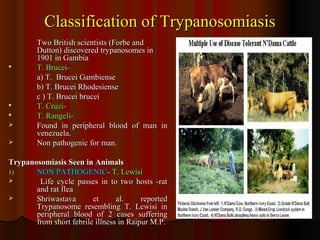
1)1) NON PATHOGENICNON PATHOGENIC-- T. LewisiT. Lewisi
 Life cycle passes in to two hosts -ratLife cycle passes in to two hosts -rat
and rat fleaand rat flea
 Shriwastava et al. reportedShriwastava et al. reported
Trypanosome resembling T. Lewisi inTrypanosome resembling T. Lewisi in
peripheral blood of 2 cases sufferingperipheral blood of 2 cases suffering
from short febrile illness in Raipur M.P.from short febrile illness in Raipur M.P.
2)2) PATHOGENIC –PATHOGENIC –
 T. Brucei brucei-T. Brucei brucei-
Transmitted by G. MorsitansTransmitted by G. Morsitans
 T. Evansi – ( Causes ‘Surra’ in horses,T. Evansi – ( Causes ‘Surra’ in horses,
mules, camel, elephants)mules, camel, elephants)
 T. Equiperdum- Stallions diseaseT. Equiperdum- Stallions disease
 T. EquinumT. Equinum
 T. VivaxT. Vivax
 T. CongolenseT. Congolense
African TrypanosomiasisAfrican Trypanosomiasis
The parasite discovered by David Bruce inThe parasite discovered by David Bruce in
1890.He suggested it to be the cause of1890.He suggested it to be the cause of
NaganaNagana
 Trypanosoma BruceiTrypanosoma Brucei
Based on host specificity, clinical features,Based on host specificity, clinical features,
geographical distribution andgeographical distribution and
epidemiological features originally classifiedepidemiological features originally classified
intointo
1)1) The animal strain –The animal strain –
T. Brucei bruceiT. Brucei brucei
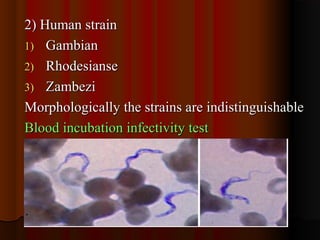
2) Human strain2) Human strain
1)1) GambianGambian
2)2) RhodesianseRhodesianse
3)3) ZambeziZambezi
Morphologically the strains are indistinguishableMorphologically the strains are indistinguishable
Blood incubation infectivity testBlood incubation infectivity test
African TrypanosomiasisAfrican Trypanosomiasis
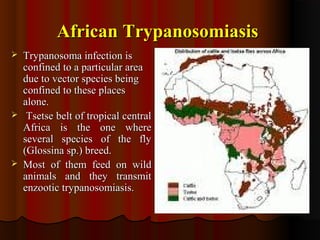
 Trypanosoma infection isTrypanosoma infection is
confined to a particular areaconfined to a particular area
due to vector species beingdue to vector species being
confined to these placesconfined to these places
alone.alone.
 Tsetse belt of tropical centralTsetse belt of tropical central
Africa is the one whereAfrica is the one where
several species of the flyseveral species of the fly
(Glossina sp.) breed.(Glossina sp.) breed.
 Most of them feed on wildMost of them feed on wild
animals and they transmitanimals and they transmit
enzootic trypanosomiasis.enzootic trypanosomiasis.
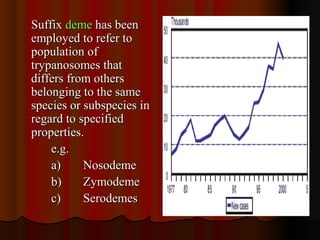
SuffixSuffix demedeme has beenhas been
employed to refer toemployed to refer to
population ofpopulation of
trypanosomes thattrypanosomes that
differs from othersdiffers from others
belonging to the samebelonging to the same
species or subspecies inspecies or subspecies in
regard to specifiedregard to specified
properties.properties.
e.g.e.g.
a)a) NosodemeNosodeme
b)b) ZymodemeZymodeme
c)c) SerodemesSerodemes
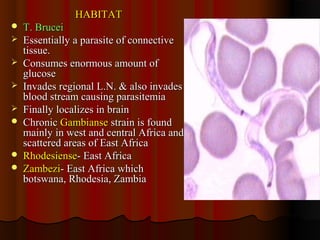
HABITATHABITAT
 T. BruceiT. Brucei
 Essentially a parasite of connectiveEssentially a parasite of connective
tissue.tissue.
 Consumes enormous amount ofConsumes enormous amount of
glucoseglucose
 Invades regional L.N. & also invadesInvades regional L.N. & also invades
blood stream causing parasitemiablood stream causing parasitemia
 Finally localizes in brainFinally localizes in brain
 ChronicChronic GambianseGambianse strain is foundstrain is found
mainly in west and central Africa andmainly in west and central Africa and
scattered areas of East Africascattered areas of East Africa
 RhodesienseRhodesiense- East Africa- East Africa
 ZambeziZambezi- East Africa which- East Africa which
botswana, Rhodesia, Zambiabotswana, Rhodesia, Zambia
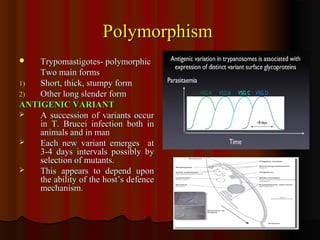
PolymorphismPolymorphism
 Trypomastigotes- polymorphicTrypomastigotes- polymorphic
Two main formsTwo main forms
1)1) Short, thick, stumpy formShort, thick, stumpy form
2)2) Other long slender formOther long slender form
ANTIGENIC VARIANTANTIGENIC VARIANT
 A succession of variants occurA succession of variants occur
in T. Brucei infection both inin T. Brucei infection both in
animals and in mananimals and in man
 Each new variant emerges atEach new variant emerges at
3-4 days intervals possibly by3-4 days intervals possibly by
selection of mutants.selection of mutants.
 This appears to depend uponThis appears to depend upon
the ability of the host’s defencethe ability of the host’s defence
mechanism.mechanism.
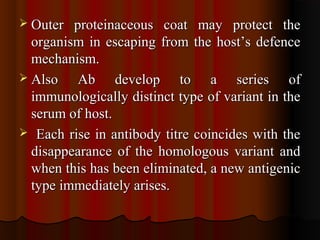
 Outer proteinaceous coat may protect theOuter proteinaceous coat may protect the
organism in escaping from the host’s defenceorganism in escaping from the host’s defence
mechanism.mechanism.
 Also Ab develop to a series ofAlso Ab develop to a series of
immunologically distinct type of variant in theimmunologically distinct type of variant in the
serum of host.serum of host.
 Each rise in antibody titre coincides with theEach rise in antibody titre coincides with the
disappearance of the homologous variant anddisappearance of the homologous variant and
when this has been eliminated, a new antigenicwhen this has been eliminated, a new antigenic
type immediately arises.type immediately arises.
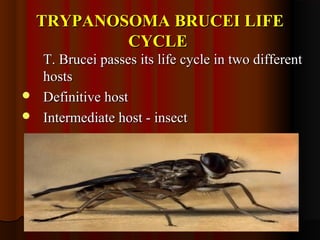
TRYPANOSOMA BRUCEI LIFETRYPANOSOMA BRUCEI LIFE
CYCLECYCLE
T. Brucei passes its life cycle in two differentT. Brucei passes its life cycle in two different
hostshosts
 Definitive hostDefinitive host
 Intermediate host - insectIntermediate host - insect
Infective from is metacyclicInfective from is metacyclic
trypomastigotetrypomastigote
Metacyclic trypomastigotes areMetacyclic trypomastigotes are
inoculated through the skin when a tsetseinoculated through the skin when a tsetse
fly takes a blood meal. Initially theyfly takes a blood meal. Initially they
proliferate at site of inoculation and thenproliferate at site of inoculation and then
through lymphatics, enters blood streamthrough lymphatics, enters blood stream
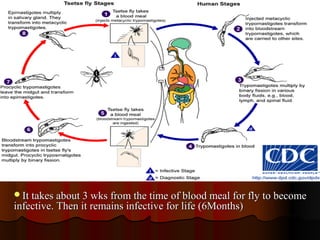
It takes about 3 wks from the time of blood meal for fly to becomeIt takes about 3 wks from the time of blood meal for fly to become
infective. Then it remains infective for life (6Months)infective. Then it remains infective for life (6Months)
Clinical DiseaseClinical Disease
PathogenesisPathogenesis
1.1. Mode of infectionMode of infection
2.2. Trypomastigotes introduced by the fly with saliva into theTrypomastigotes introduced by the fly with saliva into the
S.C. pool of bloodS.C. pool of blood
3.3. Majority get entangled in the tissue spacesMajority get entangled in the tissue spaces
4.4. Initial growth occurs in tissue spaces which form a moreInitial growth occurs in tissue spaces which form a more
favourable nidusfavourable nidus
5.5. It is also suggested that connective tissue damage caused byIt is also suggested that connective tissue damage caused by
trypomastigotes may be due to exaggerated immunetrypomastigotes may be due to exaggerated immune
response rather than any direct effectresponse rather than any direct effect
6.6. Trypomastogotes in tissue excites host’s response in twoTrypomastogotes in tissue excites host’s response in two
waysways
a) Producing large amount of nonspecifica) Producing large amount of nonspecific
immunoglobulinsimmunoglobulins
b) By heavily infilltrating the site of infection withb) By heavily infilltrating the site of infection with
macrophages.macrophages.
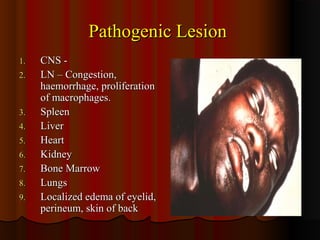
Pathogenic LesionPathogenic Lesion
1.1. CNS -CNS -
2.2. LN – Congestion,LN – Congestion,
haemorrhage, proliferationhaemorrhage, proliferation
of macrophages.of macrophages.
3.3. SpleenSpleen
4.4. LiverLiver
5.5. HeartHeart
6.6. KidneyKidney
7.7. Bone MarrowBone Marrow
8.8. LungsLungs
9.9. Localized edema of eyelid,Localized edema of eyelid,
perineum, skin of backperineum, skin of back
Clinical FeaturesClinical Features
 The disease occurs inThe disease occurs in
two stages. Incubationtwo stages. Incubation
period – 2-3 weeksperiod – 2-3 weeks
1st stage1st stage
 Enlarged postEnlarged post
cervical L.N.cervical L.N.
Winterbottom’sWinterbottom’s
signsign
 Pruritus ,TransientPruritus ,Transient
edemaedema
 PapuloerythematousPapuloerythematous
eruptioneruption
 Endocrine dysfunctionEndocrine dysfunction
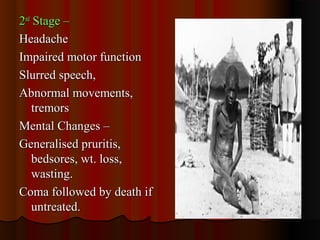
22ndnd
Stage –Stage –
HeadacheHeadache
Impaired motor functionImpaired motor function
Slurred speech,Slurred speech,
Abnormal movements,Abnormal movements,
tremorstremors
Mental Changes –Mental Changes –
Generalised pruritis,Generalised pruritis,
bedsores, wt. loss,bedsores, wt. loss,
wasting.wasting.
Coma followed by death ifComa followed by death if
untreated.untreated.
T.B. RhodesienseT.B. Rhodesiense
 11stst
StageStage
1.1. ChancreChancre
2.2. Painful, indurated, redPainful, indurated, red
papule 2-5 cmpapule 2-5 cm
3.3. RegionalRegional
lymphadenitis,lymphadenitis,
adjacent cellulitisadjacent cellulitis
4.4. Fever, parasitaemiaFever, parasitaemia
 22ndnd
StageStage
1.1. Rapid progress toRapid progress to
death.death.
Lab Diagnosis African TrypanosomiasisLab Diagnosis African Trypanosomiasis
1.1. Examination of bloodExamination of blood
2.2. Examination of aspirates fromExamination of aspirates from
enlarged lymph glandsenlarged lymph glands
3.3. Examination of CSFExamination of CSF
4.4. Detection of trypanosomal antibodyDetection of trypanosomal antibody
in serumin serum
11.. Examination of BloodExamination of Blood
1. Thick and thin films, Wet1. Thick and thin films, Wet
preparationpreparation
2. Concentration method2. Concentration method
a. Triple centrifugationa. Triple centrifugation
techniquetechnique
b. Miniature anion-b. Miniature anion-
exchange centrifugation techniqueexchange centrifugation technique
c. Buffy coat preparationc. Buffy coat preparation
22.. Examination of Aspirates inExamination of Aspirates in
lymph nodeslymph nodes
3. Examination of CSF3. Examination of CSF
4. Detection of trypanosomes4. Detection of trypanosomes
antibody in serumantibody in serum
- CATT- CATT
- Direct agglutination, indirect- Direct agglutination, indirect
haemagglutination, gelhaemagglutination, gel
precipitation, ELISA , PCRprecipitation, ELISA , PCR
 Also animalAlso animal
inoculation ofinoculation of
mice, rat, guineamice, rat, guinea
pig can be done .pig can be done .
ProphylaxisProphylaxis
1.1. Attack on parasiteAttack on parasite
2.2. Attack on vectorAttack on vector
3.3. PersonalPersonal
prophylaxisprophylaxis
South American TrypanosomiasisSouth American Trypanosomiasis
 HistoryHistory
 HabitatHabitat
 Muscular and nervousMuscular and nervous
tissues, RES.tissues, RES.
 Exists in the amastigoteExists in the amastigote
formform
 MorphologyMorphology
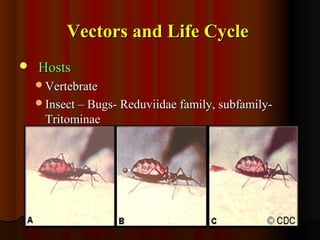
Vectors and Life CycleVectors and Life Cycle
 HostsHosts
VertebrateVertebrate
Insect – Bugs- Reduviidae family, subfamily-Insect – Bugs- Reduviidae family, subfamily-
TritominaeTritominae
Life CycleLife Cycle
 Metacyclic trypomastigotes are deposited on skinMetacyclic trypomastigotes are deposited on skin
 Trypomastigotes become amastigotes in localized RETrypomastigotes become amastigotes in localized RE
cells and multiply by longitudinal fission .cells and multiply by longitudinal fission .
 After passing through promastigote and epimastigoteAfter passing through promastigote and epimastigote
forms are transformed into trypomastigote formsforms are transformed into trypomastigote forms
 Taken up by bug during act of bitingTaken up by bug during act of biting
 In midgut- transformed to amastigote formsIn midgut- transformed to amastigote forms
 Amastigote forms later transformed into epimastigoteAmastigote forms later transformed into epimastigote
forms which migrate backwards to hindgut andforms which migrate backwards to hindgut and
multiply by longitudinal fission.multiply by longitudinal fission.
 In 8-10 days time metacylic forms of trypomastigotesIn 8-10 days time metacylic forms of trypomastigotes
appear and are excreted in faeces of bug .appear and are excreted in faeces of bug .
PathogenicityPathogenicity
a.a. ChagomaChagoma
b.b. Romana’s SignRomana’s Sign
c.c. Gross lesions mainly in heart, skeletal muscle and nervousGross lesions mainly in heart, skeletal muscle and nervous
tissuetissue
Clinical FeaturesClinical Features
1)1) Incub period 7-14 daysIncub period 7-14 days
2)2) Infection - asymptomatic, acute, chronicInfection - asymptomatic, acute, chronic
a)a) Acute stage – Fever, conjunctivitis , unilat edema of face,Acute stage – Fever, conjunctivitis , unilat edema of face,
enlargement of spleen and L.N., anaemia, lymphocytosis.enlargement of spleen and L.N., anaemia, lymphocytosis.
b)b) Chronic –Chronic –
Signs of cardiac muscle damage, edema, heartSigns of cardiac muscle damage, edema, heart
enlargement.enlargement.
Dilatation of tubular organs- Due to degeneration ofDilatation of tubular organs- Due to degeneration of
intramural autonomic nerve plexus.intramural autonomic nerve plexus.
Chaga’s Cardiomyopathy (10%)Chaga’s Cardiomyopathy (10%)
Lab DiagnosisLab Diagnosis
1)Examination of Blood1)Examination of Blood
a)a) Thick, thin film, Wet preparationThick, thin film, Wet preparation
b)b) Buffy coat examinationBuffy coat examination
2) Xenodiagnosis2) Xenodiagnosis
3) Blood Culture -3) Blood Culture - As sensitive as xenodiagnosisAs sensitive as xenodiagnosis
4) Serology4) Serology
a)a) Indirect fluorescence Ab testIndirect fluorescence Ab test
b)b) CFTCFT
c)c) IHATIHAT
d)d) ELISAELISA
Other tests like intradermal test, biopsy from involved L.N. or muscle.Other tests like intradermal test, biopsy from involved L.N. or muscle.
Other findings are increased ESR; marked lymphocytosisOther findings are increased ESR; marked lymphocytosis
ProphylaxisProphylaxis
11stst
case of Trypanosomiasis in Indiacase of Trypanosomiasis in India
 45 yrs old man45 yrs old man
 Farmer from Chandrapur dist in MaharashtraFarmer from Chandrapur dist in Maharashtra
 Came with fever associated with chills andCame with fever associated with chills and
sweating for 15 days. Then he developed signs ofsweating for 15 days. Then he developed signs of
sensory deficitsensory deficit
 In GMC Nagpur- Blood smear showed presence ofIn GMC Nagpur- Blood smear showed presence of
parasites with morphology typical of monomorphic,parasites with morphology typical of monomorphic,
slender, flagellated, dividing trypomastigote formslender, flagellated, dividing trypomastigote form
of trypanosomaof trypanosoma
 Later on PCR based methods confirmed diagnosisLater on PCR based methods confirmed diagnosis
of T. evansi.of T. evansi.
REFERENCESREFERENCES
Medical parasitology – Rajesh KaryakarteMedical parasitology – Rajesh Karyakarte
Paniker’s medical parasitologyPaniker’s medical parasitology
K.D Chatterjee’s human parasites & parasiticK.D Chatterjee’s human parasites & parasitic
diseasesdiseases
Harrison’s internal medicineHarrison’s internal medicine
InternetInternet
Trypanosoma

Trypanosoma

  • 1.
  • 2.
    TRYPANOSOMIASISTRYPANOSOMIASIS IINTRODUCTION:-NTRODUCTION:-  Human trypanosomiasisis endemic in AfricaHuman trypanosomiasis is endemic in Africa and South America. In Africa the disease is knownand South America. In Africa the disease is known as Human African Trypanosomiasis (HAT) oras Human African Trypanosomiasis (HAT) or sleeping sicknesssleeping sickness. Whereas American. Whereas American trypanosomiasis is known astrypanosomiasis is known as Chaga’s disease.Chaga’s disease.  Trypanosomes are haemoflagellates.Trypanosomes are haemoflagellates.  Disease caused by pathogenic types is calledDisease caused by pathogenic types is called trypanosomiasis.trypanosomiasis.
  • 3.
    Genus TrypanosomaGenus Trypanosoma Exist as trypomastigotes in vertebrate hosts and someExist as trypomastigotes in vertebrate hosts and some assuming amastigote forms.assuming amastigote forms.  Pass their life cycle in two hosts Vertebrate and insectPass their life cycle in two hosts Vertebrate and insect ( amastigote, promastigote, epimastigote and( amastigote, promastigote, epimastigote and metacyclic trypomastigote).metacyclic trypomastigote).  Transmission is effected from one vertebrate toTransmission is effected from one vertebrate to another by blood sucking insects.another by blood sucking insects. Types of Development :-Types of Development :- 1.1. Anterior stationAnterior station 2.2. Posterior stationPosterior station
  • 4.
    Morphology of TrypomastigotesMorphologyof Trypomastigotes  Method of reproduction – binary longitudinal fission.Method of reproduction – binary longitudinal fission.
  • 5.
    Classification of TrypanosomiasisClassificationof Trypanosomiasis Two British scientists (Forbe andTwo British scientists (Forbe and Dutton) discovered trypanosomes inDutton) discovered trypanosomes in 1901 in Gambia1901 in Gambia  T. Brucei-T. Brucei- a) T. Brucei Gambiensea) T. Brucei Gambiense b) T. Brucei Rhodesienseb) T. Brucei Rhodesiense c ) T. Brucei bruceic ) T. Brucei brucei  T. Cruzi-T. Cruzi-  T. Rangeli-T. Rangeli-  Found in peripheral blood of man inFound in peripheral blood of man in venezuela.venezuela.  Non pathogenic for man.Non pathogenic for man. Trypanosomiasis Seen in AnimalsTrypanosomiasis Seen in Animals 1)1) NON PATHOGENICNON PATHOGENIC-- T. LewisiT. Lewisi  Life cycle passes in to two hosts -ratLife cycle passes in to two hosts -rat and rat fleaand rat flea  Shriwastava et al. reportedShriwastava et al. reported Trypanosome resembling T. Lewisi inTrypanosome resembling T. Lewisi in peripheral blood of 2 cases sufferingperipheral blood of 2 cases suffering from short febrile illness in Raipur M.P.from short febrile illness in Raipur M.P.
  • 6.
    2)2) PATHOGENIC –PATHOGENIC–  T. Brucei brucei-T. Brucei brucei- Transmitted by G. MorsitansTransmitted by G. Morsitans  T. Evansi – ( Causes ‘Surra’ in horses,T. Evansi – ( Causes ‘Surra’ in horses, mules, camel, elephants)mules, camel, elephants)  T. Equiperdum- Stallions diseaseT. Equiperdum- Stallions disease  T. EquinumT. Equinum  T. VivaxT. Vivax  T. CongolenseT. Congolense
  • 7.
    African TrypanosomiasisAfrican Trypanosomiasis Theparasite discovered by David Bruce inThe parasite discovered by David Bruce in 1890.He suggested it to be the cause of1890.He suggested it to be the cause of NaganaNagana  Trypanosoma BruceiTrypanosoma Brucei Based on host specificity, clinical features,Based on host specificity, clinical features, geographical distribution andgeographical distribution and epidemiological features originally classifiedepidemiological features originally classified intointo 1)1) The animal strain –The animal strain – T. Brucei bruceiT. Brucei brucei
  • 8.
    2) Human strain2)Human strain 1)1) GambianGambian 2)2) RhodesianseRhodesianse 3)3) ZambeziZambezi Morphologically the strains are indistinguishableMorphologically the strains are indistinguishable Blood incubation infectivity testBlood incubation infectivity test
  • 9.
    African TrypanosomiasisAfrican Trypanosomiasis Trypanosoma infection isTrypanosoma infection is confined to a particular areaconfined to a particular area due to vector species beingdue to vector species being confined to these placesconfined to these places alone.alone.  Tsetse belt of tropical centralTsetse belt of tropical central Africa is the one whereAfrica is the one where several species of the flyseveral species of the fly (Glossina sp.) breed.(Glossina sp.) breed.  Most of them feed on wildMost of them feed on wild animals and they transmitanimals and they transmit enzootic trypanosomiasis.enzootic trypanosomiasis.
  • 10.
    SuffixSuffix demedeme hasbeenhas been employed to refer toemployed to refer to population ofpopulation of trypanosomes thattrypanosomes that differs from othersdiffers from others belonging to the samebelonging to the same species or subspecies inspecies or subspecies in regard to specifiedregard to specified properties.properties. e.g.e.g. a)a) NosodemeNosodeme b)b) ZymodemeZymodeme c)c) SerodemesSerodemes
  • 11.
    HABITATHABITAT  T. BruceiT.Brucei  Essentially a parasite of connectiveEssentially a parasite of connective tissue.tissue.  Consumes enormous amount ofConsumes enormous amount of glucoseglucose  Invades regional L.N. & also invadesInvades regional L.N. & also invades blood stream causing parasitemiablood stream causing parasitemia  Finally localizes in brainFinally localizes in brain  ChronicChronic GambianseGambianse strain is foundstrain is found mainly in west and central Africa andmainly in west and central Africa and scattered areas of East Africascattered areas of East Africa  RhodesienseRhodesiense- East Africa- East Africa  ZambeziZambezi- East Africa which- East Africa which botswana, Rhodesia, Zambiabotswana, Rhodesia, Zambia
  • 12.
    PolymorphismPolymorphism  Trypomastigotes- polymorphicTrypomastigotes-polymorphic Two main formsTwo main forms 1)1) Short, thick, stumpy formShort, thick, stumpy form 2)2) Other long slender formOther long slender form ANTIGENIC VARIANTANTIGENIC VARIANT  A succession of variants occurA succession of variants occur in T. Brucei infection both inin T. Brucei infection both in animals and in mananimals and in man  Each new variant emerges atEach new variant emerges at 3-4 days intervals possibly by3-4 days intervals possibly by selection of mutants.selection of mutants.  This appears to depend uponThis appears to depend upon the ability of the host’s defencethe ability of the host’s defence mechanism.mechanism.
  • 13.
     Outer proteinaceouscoat may protect theOuter proteinaceous coat may protect the organism in escaping from the host’s defenceorganism in escaping from the host’s defence mechanism.mechanism.  Also Ab develop to a series ofAlso Ab develop to a series of immunologically distinct type of variant in theimmunologically distinct type of variant in the serum of host.serum of host.  Each rise in antibody titre coincides with theEach rise in antibody titre coincides with the disappearance of the homologous variant anddisappearance of the homologous variant and when this has been eliminated, a new antigenicwhen this has been eliminated, a new antigenic type immediately arises.type immediately arises.
  • 14.
    TRYPANOSOMA BRUCEI LIFETRYPANOSOMABRUCEI LIFE CYCLECYCLE T. Brucei passes its life cycle in two differentT. Brucei passes its life cycle in two different hostshosts  Definitive hostDefinitive host  Intermediate host - insectIntermediate host - insect
  • 15.
    Infective from ismetacyclicInfective from is metacyclic trypomastigotetrypomastigote Metacyclic trypomastigotes areMetacyclic trypomastigotes are inoculated through the skin when a tsetseinoculated through the skin when a tsetse fly takes a blood meal. Initially theyfly takes a blood meal. Initially they proliferate at site of inoculation and thenproliferate at site of inoculation and then through lymphatics, enters blood streamthrough lymphatics, enters blood stream
  • 16.
    It takes about3 wks from the time of blood meal for fly to becomeIt takes about 3 wks from the time of blood meal for fly to become infective. Then it remains infective for life (6Months)infective. Then it remains infective for life (6Months)
  • 17.
    Clinical DiseaseClinical Disease PathogenesisPathogenesis 1.1.Mode of infectionMode of infection 2.2. Trypomastigotes introduced by the fly with saliva into theTrypomastigotes introduced by the fly with saliva into the S.C. pool of bloodS.C. pool of blood 3.3. Majority get entangled in the tissue spacesMajority get entangled in the tissue spaces 4.4. Initial growth occurs in tissue spaces which form a moreInitial growth occurs in tissue spaces which form a more favourable nidusfavourable nidus 5.5. It is also suggested that connective tissue damage caused byIt is also suggested that connective tissue damage caused by trypomastigotes may be due to exaggerated immunetrypomastigotes may be due to exaggerated immune response rather than any direct effectresponse rather than any direct effect 6.6. Trypomastogotes in tissue excites host’s response in twoTrypomastogotes in tissue excites host’s response in two waysways a) Producing large amount of nonspecifica) Producing large amount of nonspecific immunoglobulinsimmunoglobulins b) By heavily infilltrating the site of infection withb) By heavily infilltrating the site of infection with macrophages.macrophages.
  • 18.
    Pathogenic LesionPathogenic Lesion 1.1.CNS -CNS - 2.2. LN – Congestion,LN – Congestion, haemorrhage, proliferationhaemorrhage, proliferation of macrophages.of macrophages. 3.3. SpleenSpleen 4.4. LiverLiver 5.5. HeartHeart 6.6. KidneyKidney 7.7. Bone MarrowBone Marrow 8.8. LungsLungs 9.9. Localized edema of eyelid,Localized edema of eyelid, perineum, skin of backperineum, skin of back
  • 19.
    Clinical FeaturesClinical Features The disease occurs inThe disease occurs in two stages. Incubationtwo stages. Incubation period – 2-3 weeksperiod – 2-3 weeks 1st stage1st stage  Enlarged postEnlarged post cervical L.N.cervical L.N. Winterbottom’sWinterbottom’s signsign  Pruritus ,TransientPruritus ,Transient edemaedema  PapuloerythematousPapuloerythematous eruptioneruption  Endocrine dysfunctionEndocrine dysfunction
  • 20.
    22ndnd Stage –Stage – HeadacheHeadache Impairedmotor functionImpaired motor function Slurred speech,Slurred speech, Abnormal movements,Abnormal movements, tremorstremors Mental Changes –Mental Changes – Generalised pruritis,Generalised pruritis, bedsores, wt. loss,bedsores, wt. loss, wasting.wasting. Coma followed by death ifComa followed by death if untreated.untreated.
  • 21.
    T.B. RhodesienseT.B. Rhodesiense 11stst StageStage 1.1. ChancreChancre 2.2. Painful, indurated, redPainful, indurated, red papule 2-5 cmpapule 2-5 cm 3.3. RegionalRegional lymphadenitis,lymphadenitis, adjacent cellulitisadjacent cellulitis 4.4. Fever, parasitaemiaFever, parasitaemia  22ndnd StageStage 1.1. Rapid progress toRapid progress to death.death.
  • 22.
    Lab Diagnosis AfricanTrypanosomiasisLab Diagnosis African Trypanosomiasis 1.1. Examination of bloodExamination of blood 2.2. Examination of aspirates fromExamination of aspirates from enlarged lymph glandsenlarged lymph glands 3.3. Examination of CSFExamination of CSF 4.4. Detection of trypanosomal antibodyDetection of trypanosomal antibody in serumin serum
  • 23.
    11.. Examination ofBloodExamination of Blood 1. Thick and thin films, Wet1. Thick and thin films, Wet preparationpreparation 2. Concentration method2. Concentration method a. Triple centrifugationa. Triple centrifugation techniquetechnique b. Miniature anion-b. Miniature anion- exchange centrifugation techniqueexchange centrifugation technique c. Buffy coat preparationc. Buffy coat preparation 22.. Examination of Aspirates inExamination of Aspirates in lymph nodeslymph nodes 3. Examination of CSF3. Examination of CSF 4. Detection of trypanosomes4. Detection of trypanosomes antibody in serumantibody in serum - CATT- CATT - Direct agglutination, indirect- Direct agglutination, indirect haemagglutination, gelhaemagglutination, gel precipitation, ELISA , PCRprecipitation, ELISA , PCR
  • 24.
     Also animalAlsoanimal inoculation ofinoculation of mice, rat, guineamice, rat, guinea pig can be done .pig can be done . ProphylaxisProphylaxis 1.1. Attack on parasiteAttack on parasite 2.2. Attack on vectorAttack on vector 3.3. PersonalPersonal prophylaxisprophylaxis
  • 25.
    South American TrypanosomiasisSouthAmerican Trypanosomiasis  HistoryHistory  HabitatHabitat  Muscular and nervousMuscular and nervous tissues, RES.tissues, RES.  Exists in the amastigoteExists in the amastigote formform  MorphologyMorphology
  • 26.
    Vectors and LifeCycleVectors and Life Cycle  HostsHosts VertebrateVertebrate Insect – Bugs- Reduviidae family, subfamily-Insect – Bugs- Reduviidae family, subfamily- TritominaeTritominae
  • 27.
    Life CycleLife Cycle Metacyclic trypomastigotes are deposited on skinMetacyclic trypomastigotes are deposited on skin  Trypomastigotes become amastigotes in localized RETrypomastigotes become amastigotes in localized RE cells and multiply by longitudinal fission .cells and multiply by longitudinal fission .  After passing through promastigote and epimastigoteAfter passing through promastigote and epimastigote forms are transformed into trypomastigote formsforms are transformed into trypomastigote forms  Taken up by bug during act of bitingTaken up by bug during act of biting  In midgut- transformed to amastigote formsIn midgut- transformed to amastigote forms  Amastigote forms later transformed into epimastigoteAmastigote forms later transformed into epimastigote forms which migrate backwards to hindgut andforms which migrate backwards to hindgut and multiply by longitudinal fission.multiply by longitudinal fission.  In 8-10 days time metacylic forms of trypomastigotesIn 8-10 days time metacylic forms of trypomastigotes appear and are excreted in faeces of bug .appear and are excreted in faeces of bug .
  • 28.
    PathogenicityPathogenicity a.a. ChagomaChagoma b.b. Romana’sSignRomana’s Sign c.c. Gross lesions mainly in heart, skeletal muscle and nervousGross lesions mainly in heart, skeletal muscle and nervous tissuetissue Clinical FeaturesClinical Features 1)1) Incub period 7-14 daysIncub period 7-14 days 2)2) Infection - asymptomatic, acute, chronicInfection - asymptomatic, acute, chronic a)a) Acute stage – Fever, conjunctivitis , unilat edema of face,Acute stage – Fever, conjunctivitis , unilat edema of face, enlargement of spleen and L.N., anaemia, lymphocytosis.enlargement of spleen and L.N., anaemia, lymphocytosis. b)b) Chronic –Chronic – Signs of cardiac muscle damage, edema, heartSigns of cardiac muscle damage, edema, heart enlargement.enlargement. Dilatation of tubular organs- Due to degeneration ofDilatation of tubular organs- Due to degeneration of intramural autonomic nerve plexus.intramural autonomic nerve plexus. Chaga’s Cardiomyopathy (10%)Chaga’s Cardiomyopathy (10%)
  • 29.
    Lab DiagnosisLab Diagnosis 1)Examinationof Blood1)Examination of Blood a)a) Thick, thin film, Wet preparationThick, thin film, Wet preparation b)b) Buffy coat examinationBuffy coat examination 2) Xenodiagnosis2) Xenodiagnosis 3) Blood Culture -3) Blood Culture - As sensitive as xenodiagnosisAs sensitive as xenodiagnosis 4) Serology4) Serology a)a) Indirect fluorescence Ab testIndirect fluorescence Ab test b)b) CFTCFT c)c) IHATIHAT d)d) ELISAELISA Other tests like intradermal test, biopsy from involved L.N. or muscle.Other tests like intradermal test, biopsy from involved L.N. or muscle. Other findings are increased ESR; marked lymphocytosisOther findings are increased ESR; marked lymphocytosis ProphylaxisProphylaxis
  • 30.
    11stst case of Trypanosomiasisin Indiacase of Trypanosomiasis in India  45 yrs old man45 yrs old man  Farmer from Chandrapur dist in MaharashtraFarmer from Chandrapur dist in Maharashtra  Came with fever associated with chills andCame with fever associated with chills and sweating for 15 days. Then he developed signs ofsweating for 15 days. Then he developed signs of sensory deficitsensory deficit  In GMC Nagpur- Blood smear showed presence ofIn GMC Nagpur- Blood smear showed presence of parasites with morphology typical of monomorphic,parasites with morphology typical of monomorphic, slender, flagellated, dividing trypomastigote formslender, flagellated, dividing trypomastigote form of trypanosomaof trypanosoma  Later on PCR based methods confirmed diagnosisLater on PCR based methods confirmed diagnosis of T. evansi.of T. evansi.
  • 31.
    REFERENCESREFERENCES Medical parasitology –Rajesh KaryakarteMedical parasitology – Rajesh Karyakarte Paniker’s medical parasitologyPaniker’s medical parasitology K.D Chatterjee’s human parasites & parasiticK.D Chatterjee’s human parasites & parasitic diseasesdiseases Harrison’s internal medicineHarrison’s internal medicine InternetInternet