N YUVARAJU, 95058623921
ADVANCED CALCULUS & COMPLEX VARIABLES
UNIT - I
First Order Ordinary Differential Equations
PAMERA RAJESHWAR RAO
Assistant Professor of Mathematics.
Science and Humanities Department.
SNIST.
2.
N YUVARAJU, 95058623922
Topics
Exact & Non-Exact Differential Equation
Linear Differential Equation
Bernoulli’s Equation
Applications:
(1) Newton’s Law of cooling
(2) Law of natural Growth/decay
3.
N YUVARAJU, 95058623923
Introduction:
Differential equations are of fundamental importance in
engineering because most of the physical laws and relations
appear mathematically are in the form of differential equations.
For engineers the purpose of learning the theory of
differential equations is to be able to solve practical problems
where differential equations are used.
4.
N YUVARAJU, 95058623924
Applications of Differential Equations:
Differential Equations have wide applications in various engineering and
science disciplines. In general, modeling of the variation of physical quantity, such as
temperature, pressure, displacement, velocity, stress, strain, current, voltage or
concentration of a pollutant, with the change of time or location or both would result in
the differential equations.
Similarly, studying the variation of some physical quantities on other physical
quantities would also lead to differential equations.
In fact many engineering subjects, such as mechanical vibration or structural
dynamics, heat transfer, theory of electric circuits are founded on the theory of
differential equations.
5.
N YUVARAJU, 95058623925
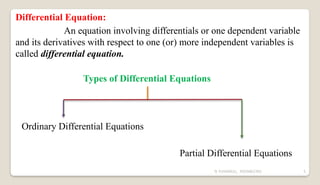
Differential Equation:
An equation involving differentials or one dependent variable
and its derivatives with respect to one (or) more independent variables is
called differential equation.
Types of Differential Equations
Ordinary Differential Equations
Partial Differential Equations
6.
N YUVARAJU, 95058623926
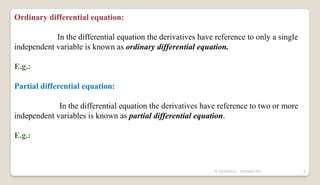
Ordinary differential equation:
In the differential equation the derivatives have reference to only a single
independent variable is known as ordinary differential equation.
E.g.:
Partial differential equation:
In the differential equation the derivatives have reference to two or more
independent variables is known as partial differential equation.
E.g.:
7.
N YUVARAJU, 95058623927
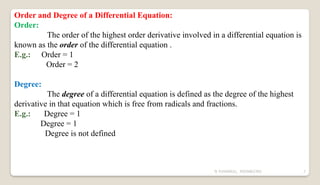
Order and Degree of a Differential Equation:
Order:
The order of the highest order derivative involved in a differential equation is
known as the order of the differential equation .
E.g.: Order = 1
Order = 2
Degree:
The degree of a differential equation is defined as the degree of the highest
derivative in that equation which is free from radicals and fractions.
E.g.: Degree = 1
Degree = 1
Degree is not defined
8.
N YUVARAJU, 95058623928
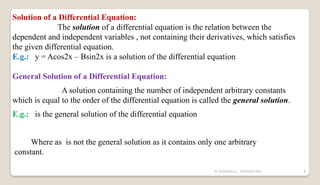
Solution of a Differential Equation:
The solution of a differential equation is the relation between the
dependent and independent variables , not containing their derivatives, which satisfies
the given differential equation.
E.g.: y = Acos2x – Bsin2x is a solution of the differential equation
General Solution of a Differential Equation:
A solution containing the number of independent arbitrary constants
which is equal to the order of the differential equation is called the general solution.
E.g.: is the general solution of the differential equation
Where as is not the general solution as it contains only one arbitrary
constant.
9.
N YUVARAJU, 95058623929
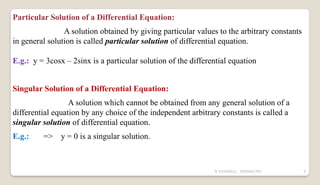
Particular Solution of a Differential Equation:
A solution obtained by giving particular values to the arbitrary constants
in general solution is called particular solution of differential equation.
E.g.: y = 3cosx – 2sinx is a particular solution of the differential equation
Singular Solution of a Differential Equation:
A solution which cannot be obtained from any general solution of a
differential equation by any choice of the independent arbitrary constants is called a
singular solution of differential equation.
E.g.: => y = 0 is a singular solution.
10.
N YUVARAJU, 950586239210
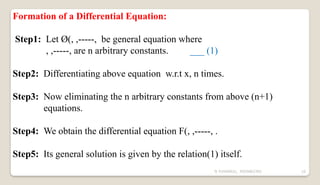
Formation of a Differential Equation:
Step1: Let Ø(, ,-----, be general equation where
, ,-----, are n arbitrary constants. ___ (1)
Step2: Differentiating above equation w.r.t x, n times.
Step3: Now eliminating the n arbitrary constants from above (n+1)
equations.
Step4: We obtain the differential equation F(, ,-----, .
Step5: Its general solution is given by the relation(1) itself.
11.
N YUVARAJU, 950586239211
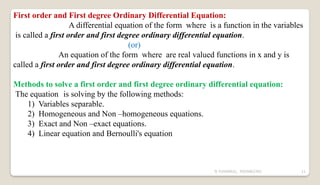
First order and First degree Ordinary Differential Equation:
A differential equation of the form where is a function in the variables
is called a first order and first degree ordinary differential equation.
(or)
An equation of the form where are real valued functions in x and y is
called a first order and first degree ordinary differential equation.
Methods to solve a first order and first degree ordinary differential equation:
The equation is solving by the following methods:
1) Variables separable.
2) Homogeneous and Non –homogeneous equations.
3) Exact and Non –exact equations.
4) Linear equation and Bernoulli's equation
12.
N YUVARAJU, 950586239212
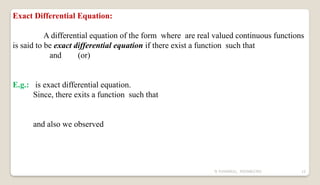
Exact Differential Equation:
A differential equation of the form where are real valued continuous functions
is said to be exact differential equation if there exist a function such that
and (or)
E.g.: is exact differential equation.
Since, there exits a function such that
and also we observed
13.
N YUVARAJU, 950586239213
Condition for Exact Differential Equation:
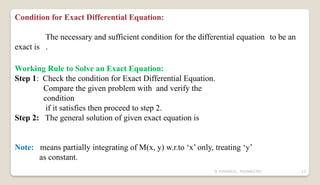
The necessary and sufficient condition for the differential equation to be an
exact is .
Working Rule to Solve an Exact Equation:
Step 1: Check the condition for Exact Differential Equation.
Compare the given problem with and verify the
condition
if it satisfies then proceed to step 2.
Step 2: The general solution of given exact equation is
Note: means partially integrating of M(x, y) w.r.to ‘x’ only, treating ‘y’
as constant.
14.
N YUVARAJU, 950586239214
Problems:
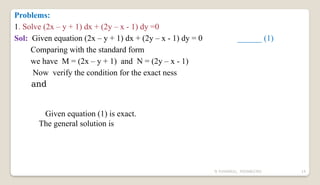
1. Solve (2x – y + 1) dx + (2y – x - 1) dy =0
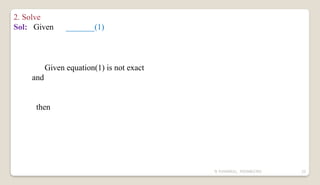
Sol: Given equation (2x – y + 1) dx + (2y – x - 1) dy = 0 ______ (1)
Comparing with the standard form
we have M = (2x – y + 1) and N = (2y – x - 1)
Now verify the condition for the exact ness
and
Given equation (1) is exact.
The general solution is
15.
N YUVARAJU, 950586239215
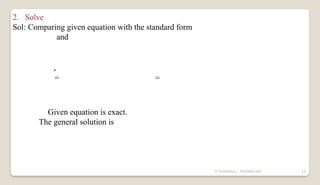
2. Solve
Sol: Comparing given equation with the standard form
and
.
= =
Given equation is exact.
The general solution is
16.
N YUVARAJU, 950586239216
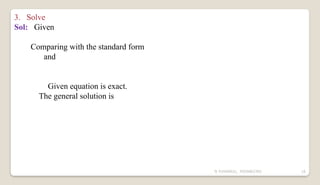
3. Solve
Sol: Given
Comparing with the standard form
and
Given equation is exact.
The general solution is
17.
N YUVARAJU, 950586239217
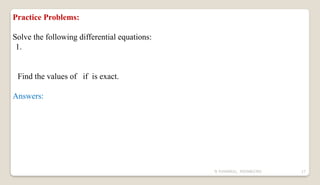
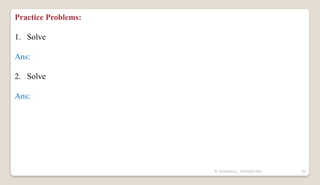
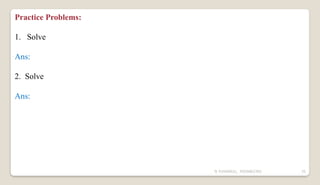
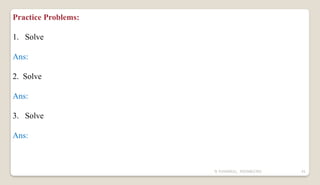
Practice Problems:
Solve the following differential equations:
1.
Find the values of if is exact.
Answers:
18.
N YUVARAJU, 950586239218
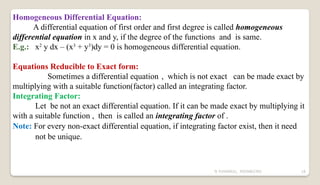
Homogeneous Differential Equation:
A differential equation of first order and first degree is called homogeneous
differential equation in x and y, if the degree of the functions and is same.
E.g.: x2
y dx – (x3
+ y3
)dy = 0 is homogeneous differential equation.
Equations Reducible to Exact form:
Sometimes a differential equation , which is not exact can be made exact by
multiplying with a suitable function(factor) called an integrating factor.
Integrating Factor:
Let be not an exact differential equation. If it can be made exact by multiplying it
with a suitable function , then is called an integrating factor of .
Note: For every non-exact differential equation, if integrating factor exist, then it need
not be unique.
19.
N YUVARAJU, 950586239219
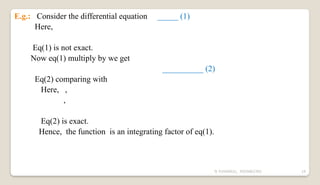
E.g.: Consider the differential equation _____ (1)
Here,
Eq(1) is not exact.
Now eq(1) multiply by we get
__________ (2)
Eq(2) comparing with
Here, ,
,
Eq(2) is exact.
Hence, the function is an integrating factor of eq(1).
20.
N YUVARAJU, 950586239220
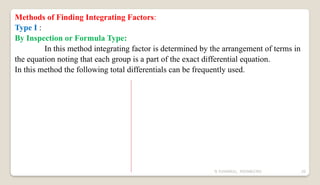
Methods of Finding Integrating Factors:
Type I :
By Inspection or Formula Type:
In this method integrating factor is determined by the arrangement of terms in
the equation noting that each group is a part of the exact differential equation.
In this method the following total differentials can be frequently used.
21.
N YUVARAJU, 950586239221
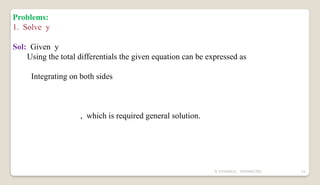
Problems:
1. Solve y
Sol: Given y
Using the total differentials the given equation can be expressed as
Integrating on both sides
, which is required general solution.
22.
N YUVARAJU, 950586239222
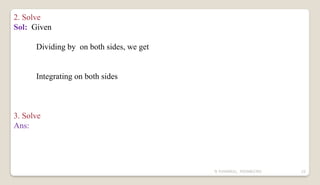
2. Solve
Sol: Given
Dividing by on both sides, we get
Integrating on both sides
3. Solve
Ans:
23.
N YUVARAJU, 950586239223
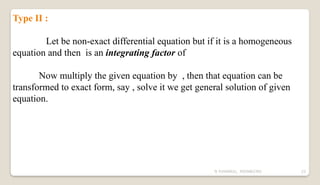
Type II :
Let be non-exact differential equation but if it is a homogeneous
equation and then is an integrating factor of
Now multiply the given equation by , then that equation can be
transformed to exact form, say , solve it we get general solution of given
equation.
24.
N YUVARAJU, 950586239224
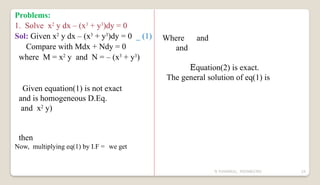
Problems:
1. Solve x2
y dx – (x3
+ y3
)dy = 0
Sol: Given x2
y dx – (x3
+ y3
)dy = 0 _ (1)
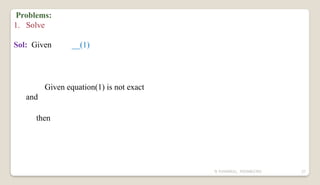
Compare with Mdx + Ndy = 0
where M = x2
y and N = – (x3
+ y3
)
Given equation(1) is not exact
and is homogeneous D.Eq.
and x2
y)
then
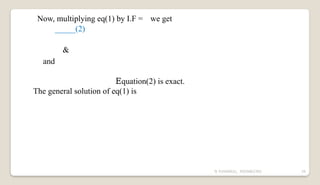
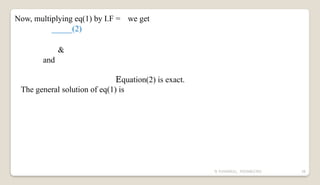
Now, multiplying eq(1) by I.F = we get
Where and
and
Equation(2) is exact.
The general solution of eq(1) is
25.
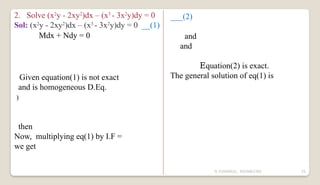
N YUVARAJU, 950586239225
2. Solve (x2
y - 2xy2
)dx – (x3
- 3x2
y)dy = 0
Sol: (x2
y - 2xy2
)dx – (x3
- 3x2
y)dy = 0 __(1)
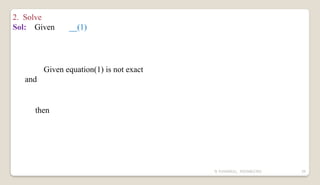
Mdx + Ndy = 0
Given equation(1) is not exact
and is homogeneous D.Eq.
)
then
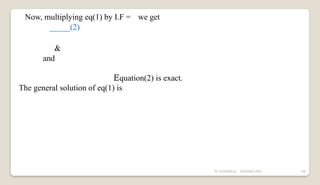
Now, multiplying eq(1) by I.F =
we get
___(2)
and
and
Equation(2) is exact.
The general solution of eq(1) is
N YUVARAJU, 950586239227
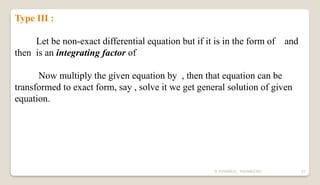
Type III :
Let be non-exact differential equation but if it is in the form of and
then is an integrating factor of
Now multiply the given equation by , then that equation can be
transformed to exact form, say , solve it we get general solution of given
equation.
28.
N YUVARAJU, 950586239228
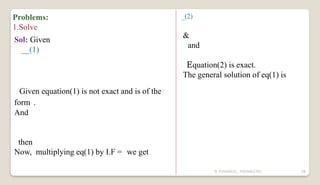
Problems:
1.Solve
Sol: Given
__(1)
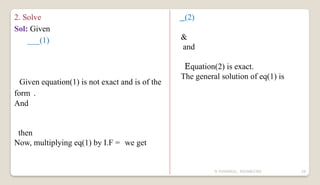
Given equation(1) is not exact and is of the
form .
And
then
Now, multiplying eq(1) by I.F = we get
_(2)
&
and
Equation(2) is exact.
The general solution of eq(1) is
29.
N YUVARAJU, 950586239229
2. Solve
Sol: Given
___(1)
Given equation(1) is not exact and is of the
form .
And
then
Now, multiplying eq(1) by I.F = we get
_(2)
&
and
Equation(2) is exact.
The general solution of eq(1) is
N YUVARAJU, 950586239231
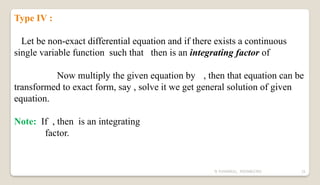
Type IV :
Let be non-exact differential equation and if there exists a continuous
single variable function such that then is an integrating factor of
Now multiply the given equation by , then that equation can be
transformed to exact form, say , solve it we get general solution of given
equation.
Note: If , then is an integrating
factor.
32.
N YUVARAJU, 950586239232
Problems:
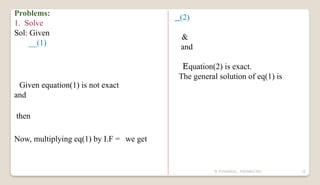
1. Solve
Sol: Given
__(1)
Given equation(1) is not exact
and
then
Now, multiplying eq(1) by I.F = we get
_(2)
&
and
Equation(2) is exact.
The general solution of eq(1) is
33.
N YUVARAJU, 950586239233
2. Solve
Sol: Given _______(1)
Given equation(1) is not exact
and
then
34.
N YUVARAJU, 950586239234
Now, multiplying eq(1) by I.F = we get
_____(2)
&
and
Equation(2) is exact.
The general solution of eq(1) is
N YUVARAJU, 950586239236
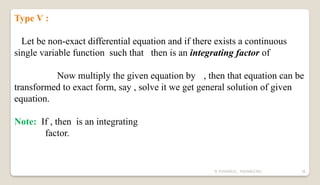
Type V :
Let be non-exact differential equation and if there exists a continuous
single variable function such that then is an integrating factor of
Now multiply the given equation by , then that equation can be
transformed to exact form, say , solve it we get general solution of given
equation.
Note: If , then is an integrating
factor.
37.
N YUVARAJU, 950586239237
Problems:
1. Solve
Sol: Given __(1)
Given equation(1) is not exact
and
then
38.
N YUVARAJU, 950586239238
Now, multiplying eq(1) by I.F = we get
_____(2)
&
and
Equation(2) is exact.
The general solution of eq(1) is
39.
N YUVARAJU, 950586239239
2. Solve
Sol: Given __(1)
Given equation(1) is not exact
and
then
40.
N YUVARAJU, 950586239240
Now, multiplying eq(1) by I.F = we get
_____(2)
&
and
Equation(2) is exact.
The general solution of eq(1) is
N YUVARAJU, 950586239242
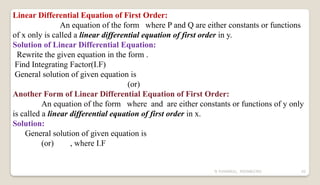
Linear Differential Equation of First Order:
An equation of the form where P and Q are either constants or functions
of x only is called a linear differential equation of first order in y.
Solution of Linear Differential Equation:
Rewrite the given equation in the form .
Find Integrating Factor(I.F)
General solution of given equation is
(or)
Another Form of Linear Differential Equation of First Order:
An equation of the form where and are either constants or functions of y only
is called a linear differential equation of first order in x.
Solution:
General solution of given equation is
(or) , where I.F
43.
N YUVARAJU, 950586239243
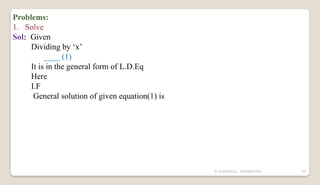
Problems:
1. Solve
Sol: Given
Dividing by ‘x’
____ (1)
It is in the general form of L.D.Eq
Here
I.F
General solution of given equation(1) is
44.
N YUVARAJU, 950586239244
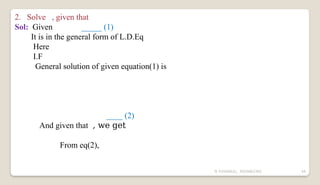
2. Solve , given that
Sol: Given _____ (1)
It is in the general form of L.D.Eq
Here
I.F
General solution of given equation(1) is
____ (2)
And given that , we get
From eq(2),
45.
N YUVARAJU, 950586239245
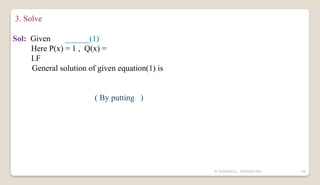
3. Solve
Sol: Given ______(1)
Here P(x) = 1 , Q(x) =
I.F
General solution of given equation(1) is
( By putting )
46.
N YUVARAJU, 950586239246
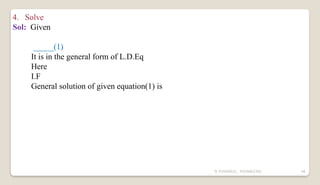
4. Solve
Sol: Given
_____(1)
It is in the general form of L.D.Eq
Here
I.F
General solution of given equation(1) is
47.
N YUVARAJU, 950586239247
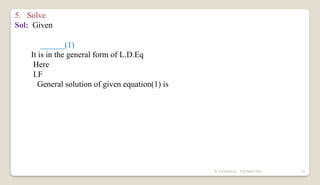
5. Solve
Sol: Given
______(1)
It is in the general form of L.D.Eq
Here
I.F
General solution of given equation(1) is
48.
N YUVARAJU, 950586239248
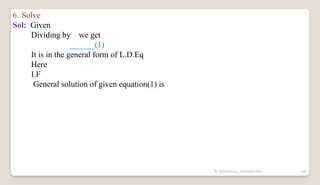
6. Solve
Sol: Given
Dividing by we get
______(1)
It is in the general form of L.D.Eq
Here
I.F
General solution of given equation(1) is
49.
N YUVARAJU, 950586239249
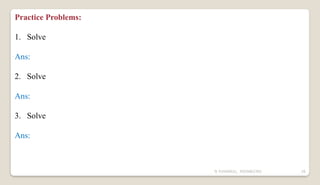
Practice Problems:
Solve the followings:
1.
2.
3.
4.
5.
Answers:
1.
2.
3.
4.
5.
50.
N YUVARAJU, 950586239250
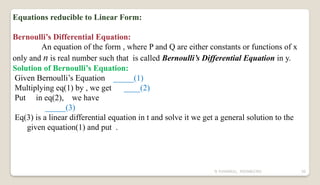
Equations reducible to Linear Form:
Bernoulli’s Differential Equation:
An equation of the form , where P and Q are either constants or functions of x
only and n is real number such that is called Bernoulli’s Differential Equation in y.
Solution of Bernoulli’s Equation:
Given Bernoulli’s Equation _____(1)
Multiplying eq(1) by , we get ____(2)
Put in eq(2), we have
_____(3)
Eq(3) is a linear differential equation in t and solve it we get a general solution to the
given equation(1) and put .
N YUVARAJU, 950586239252
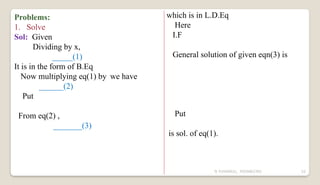
Problems:
1. Solve
Sol: Given
Dividing by x,
_____(1)
It is in the form of B.Eq
Now multiplying eq(1) by we have
______(2)
Put
From eq(2) ,
_______(3)
which is in L.D.Eq
Here
I.F
General solution of given eqn(3) is
Put
is sol. of eq(1).
53.
N YUVARAJU, 950586239253
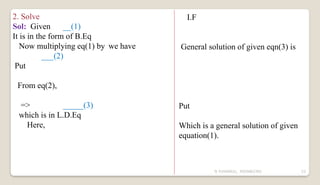
2. Solve
Sol: Given __(1)
It is in the form of B.Eq
Now multiplying eq(1) by we have
___(2)
Put
From eq(2),
=> _____(3)
which is in L.D.Eq
Here,
I.F
General solution of given eqn(3) is
Put
Which is a general solution of given
equation(1).
54.
N YUVARAJU, 950586239254
3. Solve
Sol: Given
____(1)
It is in the form of B.Eq
Now multiplying eq(1) by we have
____(2)
Put
From eq(2),
___(3)
which is in L.D.Eq
Here
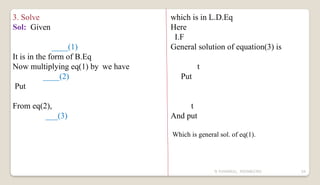
I.F
General solution of equation(3) is
t
Put
t
And put
Which is general sol. of eq(1).
55.
N YUVARAJU, 950586239255
4. Solve
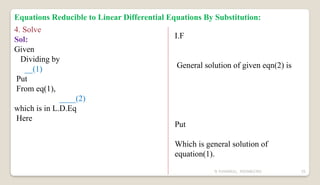
Sol:
Given
Dividing by
__(1)
Put
From eq(1),
____(2)
which is in L.D.Eq
Here
I.F
General solution of given eqn(2) is
Put
Which is general solution of
equation(1).
Equations Reducible to Linear Differential Equations By Substitution:
56.
N YUVARAJU, 950586239256
5. Solve
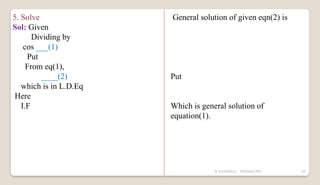
Sol: Given
Dividing by
cos ___(1)
Put
From eq(1),
____(2)
which is in L.D.Eq
Here
I.F
General solution of given eqn(2) is
Put
Which is general solution of
equation(1).
N YUVARAJU, 950586239258
Applications of First Order Ordinary Differential Equations:
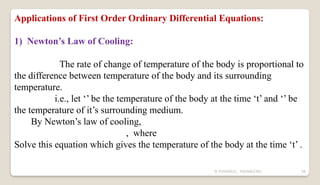
1) Newton’s Law of Cooling:
The rate of change of temperature of the body is proportional to
the difference between temperature of the body and its surrounding
temperature.
i.e., let ‘’ be the temperature of the body at the time ‘t’ and ‘’ be
the temperature of it’s surrounding medium.
By Newton’s law of cooling,
, where
Solve this equation which gives the temperature of the body at the time ‘t’ .
59.
N YUVARAJU, 950586239259
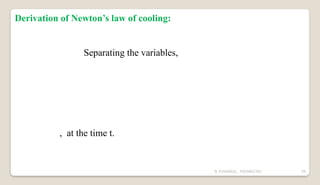
Derivation of Newton’s law of cooling:
Separating the variables,
, at the time t.
60.
N YUVARAJU, 950586239260
Examples:
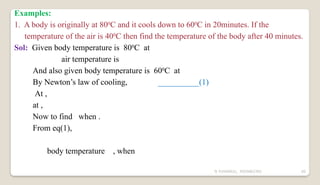
1. A body is originally at 800
C and it cools down to 600
C in 20minutes. If the
temperature of the air is 400
C then find the temperature of the body after 40 minutes.
Sol: Given body temperature is 800
C at
air temperature is
And also given body temperature is 600
C at
By Newton’s law of cooling, __________(1)
At ,
at ,
Now to find when .
From eq(1),
body temperature , when
61.
N YUVARAJU, 950586239261
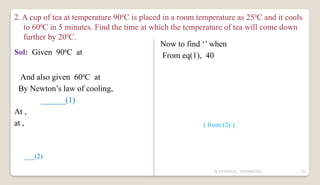
2. A cup of tea at temperature 900
C is placed in a room temperature as 250
C and it cools
to 600
C in 5 minutes. Find the time at which the temperature of tea will come down
further by 200
C.
Sol: Given 900
C at
And also given 600
C at
By Newton’s law of cooling,
______(1)
At ,
at ,
___(2)
Now to find ‘’ when
From eq(1), 40
( from (2) )
62.
N YUVARAJU, 950586239262
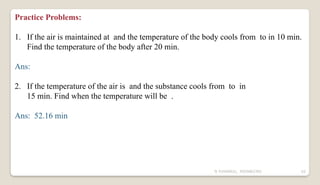
Practice Problems:
1. If the air is maintained at and the temperature of the body cools from to in 10 min.
Find the temperature of the body after 20 min.
Ans:
2. If the temperature of the air is and the substance cools from to in
15 min. Find when the temperature will be .
Ans: 52.16 min
63.
N YUVARAJU, 950586239263
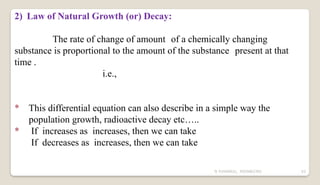
2) Law of Natural Growth (or) Decay:
The rate of change of amount of a chemically changing
substance is proportional to the amount of the substance present at that
time .
i.e.,
* This differential equation can also describe in a simple way the
population growth, radioactive decay etc…..
* If increases as increases, then we can take
If decreases as increases, then we can take
64.
N YUVARAJU, 950586239264
Examples:
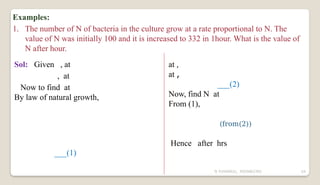
1. The number of N of bacteria in the culture grow at a rate proportional to N. The
value of N was initially 100 and it is increased to 332 in 1hour. What is the value of
N after hour.
Sol: Given , at
, at
Now to find at
By law of natural growth,
___(1)
at ,
at ,
___(2)
Now, find N at
From (1),
(from(2))
Hence after hrs
65.
N YUVARAJU, 950586239265
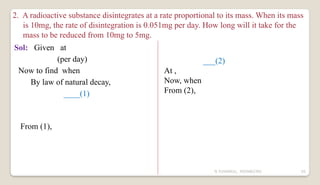
2. A radioactive substance disintegrates at a rate proportional to its mass. When its mass
is 10mg, the rate of disintegration is 0.051mg per day. How long will it take for the
mass to be reduced from 10mg to 5mg.
Sol: Given at
(per day)
Now to find when
By law of natural decay,
____(1)
From (1),
___(2)
At ,
Now, when
From (2),
66.
N YUVARAJU, 950586239266
Practice Problem:
1. In certain culture of bacteria, the rate of increase is proportional to the number
present. If it is found that the number doubles in 4 hours, how many may be
expected at the end of 12 hours.
Ans: 8 times of present number.