PRESENTED BY
ITISHREE DASH
ASSISTANT PROFESSOR
DEPARTMENT OF BSH
Differential Equations
DIFFERENTIAL EQUATION
An equation which involves derivatives of one or more dependent
variables w.r.t one or more independent variable
 ordinary differential equation (ode) : D.E in which the
dependent variable y depends only on one independent
variable say x.
 partial differential equation (pde) : D.E in which
dependent variable y depends on two or more
independent variables say x , t etc.
ORDER OF D.E : Order of differential equation is the order of the
highest order derivative appearing in the equation.
DEGREE OF D.E : Degree of differential equation is the degree of the
highest ordered derivatives.
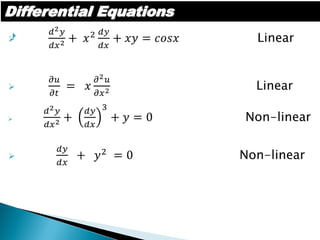
LINEAR D.E : An D.E the is said to be linear in if
(i) Every dependent variable and derivatives involved occurs to the first
degree only and
(ii) Products of derivatives and/or dependent variables do not occur.
NOTE : D.E which is not linear is called non-linear differential equation.
Differential Equations
Differential Equations

Differential Equations
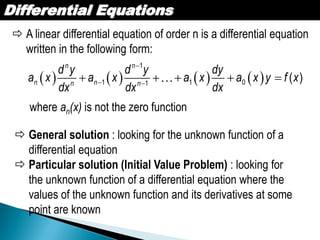
 A linear differential equation of order n is a differential equation
written in the following form:
       

 
    
1
1 1 01
( )
n n
n nn n
d y d y dy
a x a x a x a x y f x
dx dx dx
where an(x) is not the zero function
 General solution : looking for the unknown function of a
differential equation
 Particular solution (Initial Value Problem) : looking for
the unknown function of a differential equation where the
values of the unknown function and its derivatives at some
point are known
1st Order DE - Separable Equations
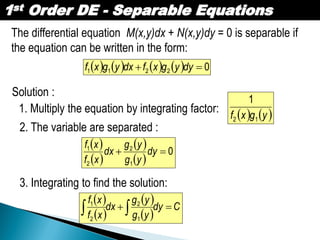
The differential equation M(x,y)dx + N(x,y)dy = 0 is separable if
the equation can be written in the form:
        02211  dyygxfdxygxf
Solution :
1. Multiply the equation by integrating factor:
   ygxf 12
1
2. The variable are separated :
 
 
 
 
0
1
2
2
1
 dy
yg
yg
dx
xf
xf
3. Integrating to find the solution:
 
 
 
 
Cdy
yg
yg
dx
xf
xf
  1
2
2
1
1st Order DE - Separable Equations
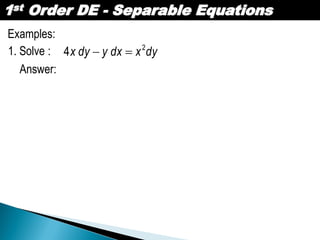
Examples:
1. Solve : dyxdxydyx 2
4 
Answer:
1st Order DE - Separable Equations
Examples:
1. Solve :
y
x
dx
dy 22


Answer:
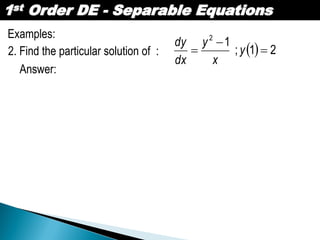
1st Order DE - Separable Equations
Examples:
2. Find the particular solution of :   21;
12


 y
x
y
dx
dy
Answer:
1st Order DE - Homogeneous Equations
Homogeneous Function
f (x,y) is called homogenous of degree n if :    y,xfy,xf n
 
Examples:
  yxxy,xf 34
  homogeneous of degree 4
       
   yxfyxx
yxxyxf
,
,
4344
34




  yxxyxf cossin, 2
  non-homogeneous
       
   
 yxf
yxx
yxxyxf
n
,
cossin
cossin,
22
2






1st Order DE - Homogeneous Equations
The differential equation M(x,y)dx + N(x,y)dy = 0 is homogeneous
if M(x,y) and N(x,y) are homogeneous and of the same degree
Solution :
1. Use the transformation to : dvxdxvdyvxy 
2. The equation become separable equation:
    0,,  dvvxQdxvxP
3. Use solution method for separable equation
 
 
 
 
Cdv
vg
vg
dx
xf
xf
  1
2
2
1
4. After integrating, v is replaced by y/x
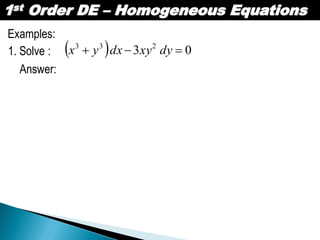
1st Order DE – Homogeneous Equations
Examples:
1. Solve :   03 233
 dyxydxyx
Answer:
1st Order DE - Homogeneous Equations
Examples:
2. Solve :
2
52
yx
yx
dx
dy



Answer:
1st Order DE – Exact Equation
The differential equation M(x,y)dx + N(x,y)dy = 0 is an exact
equation if :
Solution :
The solutions is given by the equation
x
N
y
M





  CyxF ,
1. Integrate either M(x,y) with respect to x or N(x,y) to y.
Assume integrating M(x,y), then :
where : F/ x = M(x,y) and F/ y = N(x,y)
     ydxyxMyxF   ,,
2. Now :       yxNydxyxM
yy
F
,', 





 
or :       

 dxyxM
y
yxNy ,,'
1st Order DE – Exact Equation
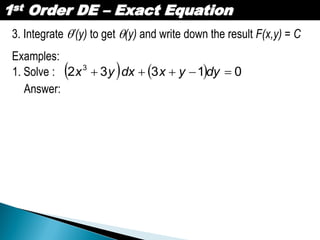
3. Integrate ’(y) to get (y) and write down the result F(x,y) = C
Examples:
1. Solve :     01332 3
 dyyxdxyx
Answer:
1st Order DE – Exact Equation
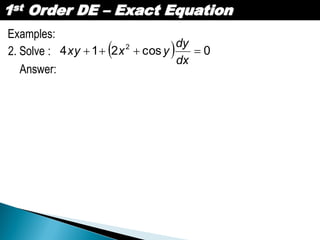
Examples:
2. Solve :   0cos214 2

dx
dy
yxxy
Answer:
1st Order DE – Non Exact Equation
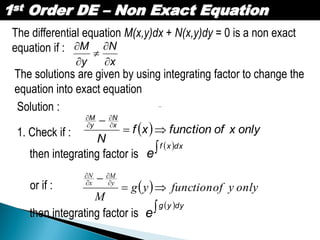
The differential equation M(x,y)dx + N(x,y)dy = 0 is a non exact
equation if :
Solution :
The solutions are given by using integrating factor to change the
equation into exact equation
x
N
y
M





1. Check if :   onlyxoffunctionxf
N
x
N
y
M

 



then integrating factor is
  dxxf
e
  onlyyoffunctionyg
M
y
M
x
N

 



or if :
then integrating factor is
  dyyg
e
1st Order DE – Non Exact Equation
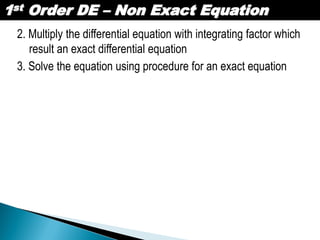
2. Multiply the differential equation with integrating factor which
result an exact differential equation
3. Solve the equation using procedure for an exact equation
1st Order DE – Non Exact Equation
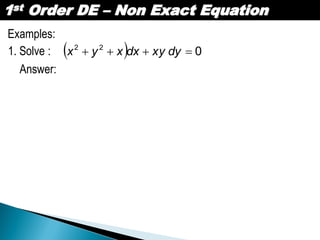
Examples:
1. Solve :   022
 dyxydxxyx
Answer:
1st Order DE – Non Exact Equation
Examples:
2. Solve :
Answer:
I. 1st order differential equation can be solved using
variable separation method.
II. By checking whether the equation is homogeneous
or exact we can solve according to the procedure.
Differential Equations
THANK YOU

First Order Differential Equations

  • 1.
    PRESENTED BY ITISHREE DASH ASSISTANTPROFESSOR DEPARTMENT OF BSH
  • 2.
    Differential Equations DIFFERENTIAL EQUATION Anequation which involves derivatives of one or more dependent variables w.r.t one or more independent variable  ordinary differential equation (ode) : D.E in which the dependent variable y depends only on one independent variable say x.  partial differential equation (pde) : D.E in which dependent variable y depends on two or more independent variables say x , t etc.
  • 3.
    ORDER OF D.E: Order of differential equation is the order of the highest order derivative appearing in the equation. DEGREE OF D.E : Degree of differential equation is the degree of the highest ordered derivatives. LINEAR D.E : An D.E the is said to be linear in if (i) Every dependent variable and derivatives involved occurs to the first degree only and (ii) Products of derivatives and/or dependent variables do not occur. NOTE : D.E which is not linear is called non-linear differential equation. Differential Equations
  • 4.
  • 5.
  • 6.
    Differential Equations  Alinear differential equation of order n is a differential equation written in the following form:                 1 1 1 01 ( ) n n n nn n d y d y dy a x a x a x a x y f x dx dx dx where an(x) is not the zero function  General solution : looking for the unknown function of a differential equation  Particular solution (Initial Value Problem) : looking for the unknown function of a differential equation where the values of the unknown function and its derivatives at some point are known
  • 7.
    1st Order DE- Separable Equations The differential equation M(x,y)dx + N(x,y)dy = 0 is separable if the equation can be written in the form:         02211  dyygxfdxygxf Solution : 1. Multiply the equation by integrating factor:    ygxf 12 1 2. The variable are separated :         0 1 2 2 1  dy yg yg dx xf xf 3. Integrating to find the solution:         Cdy yg yg dx xf xf   1 2 2 1
  • 8.
    1st Order DE- Separable Equations Examples: 1. Solve : dyxdxydyx 2 4  Answer:
  • 9.
    1st Order DE- Separable Equations Examples: 1. Solve : y x dx dy 22   Answer:
  • 10.
    1st Order DE- Separable Equations Examples: 2. Find the particular solution of :   21; 12    y x y dx dy Answer:
  • 11.
    1st Order DE- Homogeneous Equations Homogeneous Function f (x,y) is called homogenous of degree n if :    y,xfy,xf n   Examples:   yxxy,xf 34   homogeneous of degree 4            yxfyxx yxxyxf , , 4344 34       yxxyxf cossin, 2   non-homogeneous              yxf yxx yxxyxf n , cossin cossin, 22 2      
  • 12.
    1st Order DE- Homogeneous Equations The differential equation M(x,y)dx + N(x,y)dy = 0 is homogeneous if M(x,y) and N(x,y) are homogeneous and of the same degree Solution : 1. Use the transformation to : dvxdxvdyvxy  2. The equation become separable equation:     0,,  dvvxQdxvxP 3. Use solution method for separable equation         Cdv vg vg dx xf xf   1 2 2 1 4. After integrating, v is replaced by y/x
  • 13.
    1st Order DE– Homogeneous Equations Examples: 1. Solve :   03 233  dyxydxyx Answer:
  • 14.
    1st Order DE- Homogeneous Equations Examples: 2. Solve : 2 52 yx yx dx dy    Answer:
  • 15.
    1st Order DE– Exact Equation The differential equation M(x,y)dx + N(x,y)dy = 0 is an exact equation if : Solution : The solutions is given by the equation x N y M        CyxF , 1. Integrate either M(x,y) with respect to x or N(x,y) to y. Assume integrating M(x,y), then : where : F/ x = M(x,y) and F/ y = N(x,y)      ydxyxMyxF   ,, 2. Now :       yxNydxyxM yy F ,',         or :          dxyxM y yxNy ,,'
  • 16.
    1st Order DE– Exact Equation 3. Integrate ’(y) to get (y) and write down the result F(x,y) = C Examples: 1. Solve :     01332 3  dyyxdxyx Answer:
  • 17.
    1st Order DE– Exact Equation Examples: 2. Solve :   0cos214 2  dx dy yxxy Answer:
  • 18.
    1st Order DE– Non Exact Equation The differential equation M(x,y)dx + N(x,y)dy = 0 is a non exact equation if : Solution : The solutions are given by using integrating factor to change the equation into exact equation x N y M      1. Check if :   onlyxoffunctionxf N x N y M       then integrating factor is   dxxf e   onlyyoffunctionyg M y M x N       or if : then integrating factor is   dyyg e
  • 19.
    1st Order DE– Non Exact Equation 2. Multiply the differential equation with integrating factor which result an exact differential equation 3. Solve the equation using procedure for an exact equation
  • 20.
    1st Order DE– Non Exact Equation Examples: 1. Solve :   022  dyxydxxyx Answer:
  • 21.
    1st Order DE– Non Exact Equation Examples: 2. Solve : Answer:
  • 22.
    I. 1st orderdifferential equation can be solved using variable separation method. II. By checking whether the equation is homogeneous or exact we can solve according to the procedure. Differential Equations
  • 23.