APPLICATIONS OF DIFFERENTIAL
EQUATIONS
PRESENTED BY PRESENTED TO
Md . Sohag
Em@il : sohag.0315@gmail.com
Daffodil international University
INVENTION OF DIFFERENTIAL
EQUATION:
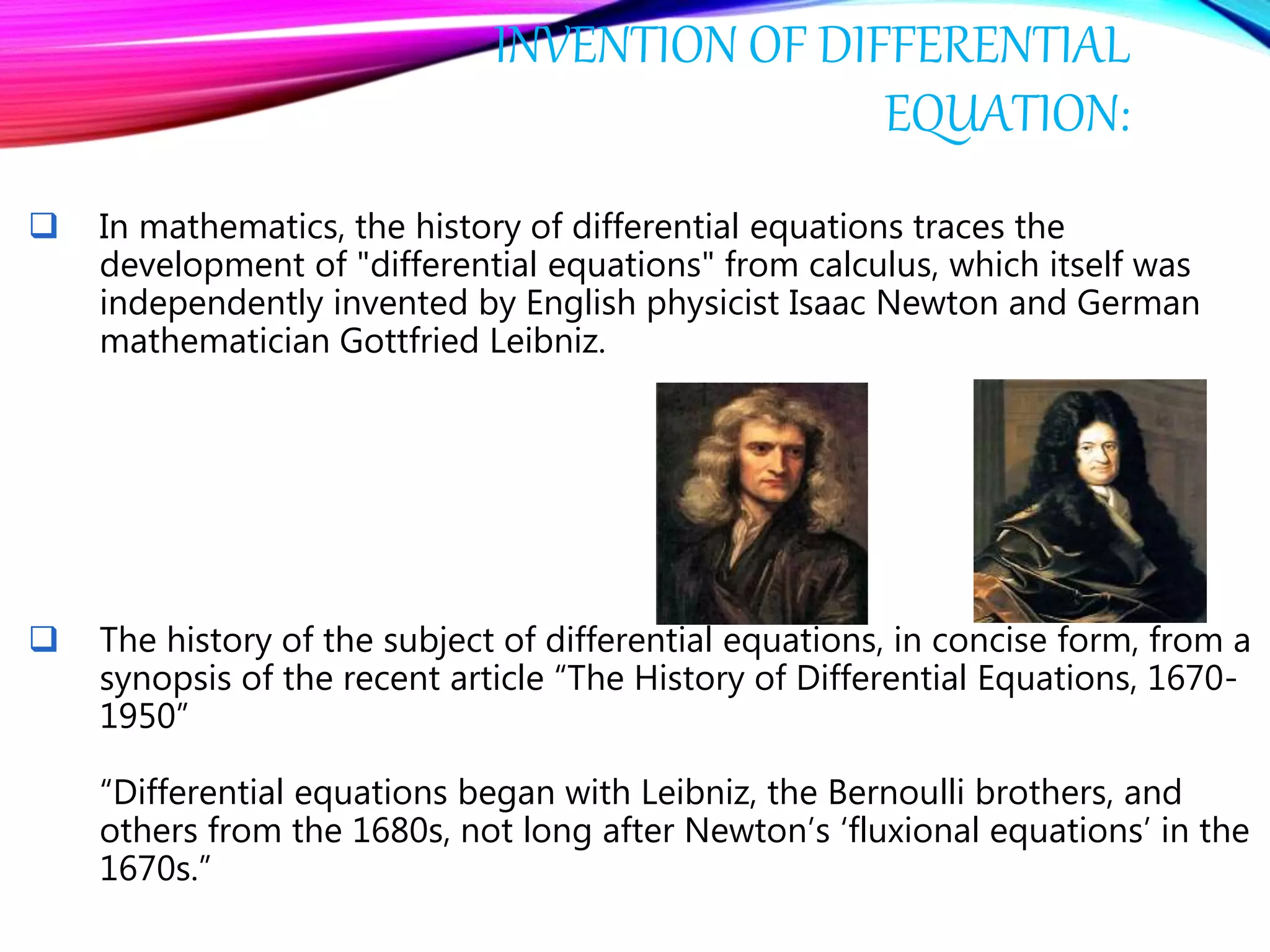
 In mathematics, the history of differential equations traces the
development of "differential equations" from calculus, which itself was
independently invented by English physicist Isaac Newton and German
mathematician Gottfried Leibniz.
 The history of the subject of differential equations, in concise form, from a
synopsis of the recent article “The History of Differential Equations, 1670-
1950”
“Differential equations began with Leibniz, the Bernoulli brothers, and
others from the 1680s, not long after Newton’s ‘fluxional equations’ in the
1670s.”
DIFFERENTIAL EQUATION:
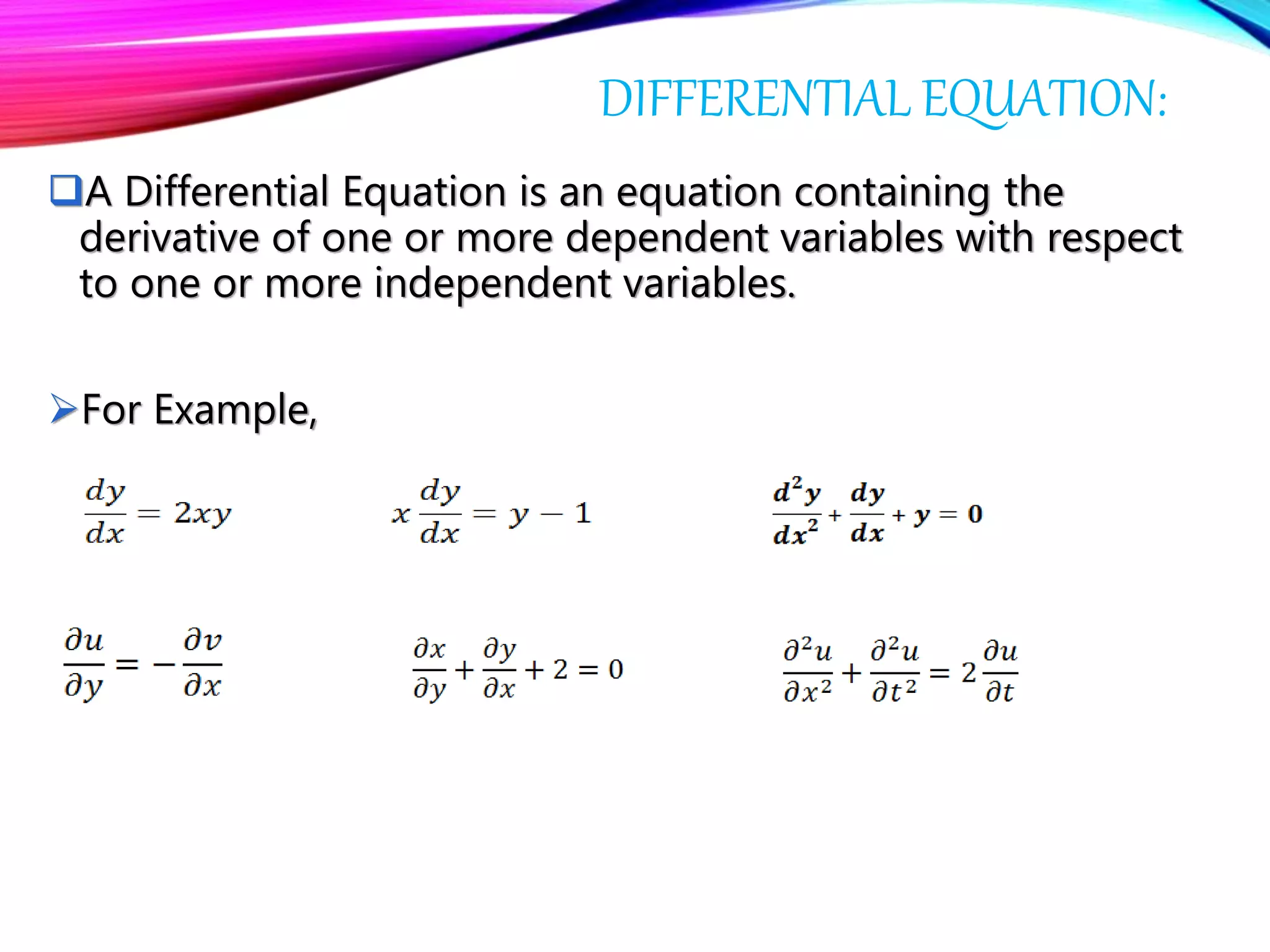
A Differential Equation is an equation containing the
derivative of one or more dependent variables with respect
to one or more independent variables.
For Example,
TYPES OF DIFFERENTIAL
EQUATION:
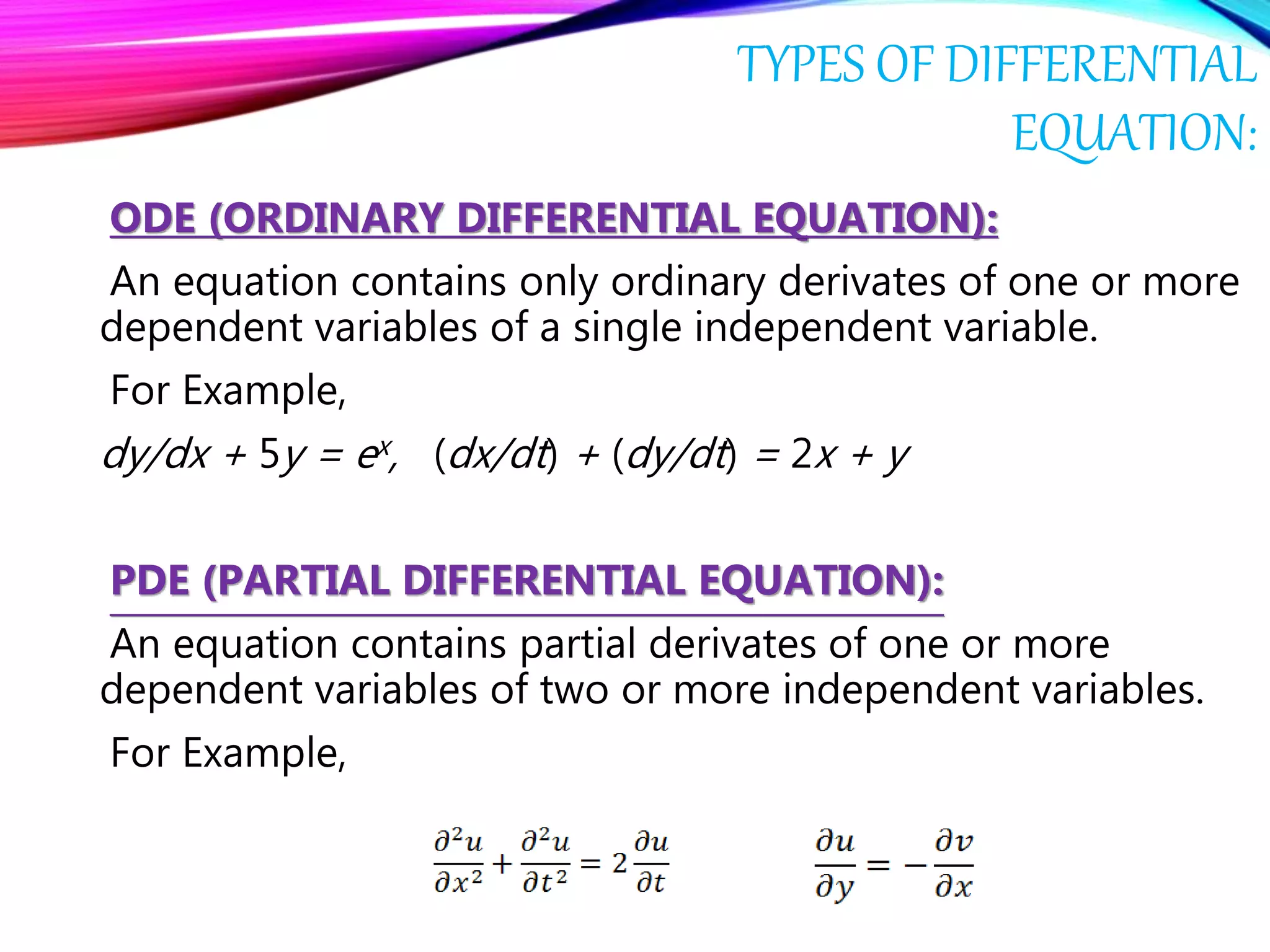
ODE (ORDINARY DIFFERENTIAL EQUATION):
An equation contains only ordinary derivates of one or more
dependent variables of a single independent variable.
For Example,
dy/dx + 5y = ex, (dx/dt) + (dy/dt) = 2x + y
PDE (PARTIAL DIFFERENTIAL EQUATION):
An equation contains partial derivates of one or more
dependent variables of two or more independent variables.
For Example,
APPLICATIONS OF ODE:
MODELLING WITH FIRST-ORDER EQUATIONS
 Newton’s Law of Cooling
 Electrical Circuits
MODELLING FREE MECHANICAL OSCILLATIONS
 No Damping
 Light Damping
 Heavy Damping
MODELLING FORCED MECHANICAL OSCILLATIONS
COMPUTER EXERCISE OR ACTIVITY
GAME APPS DEVELOPMENT
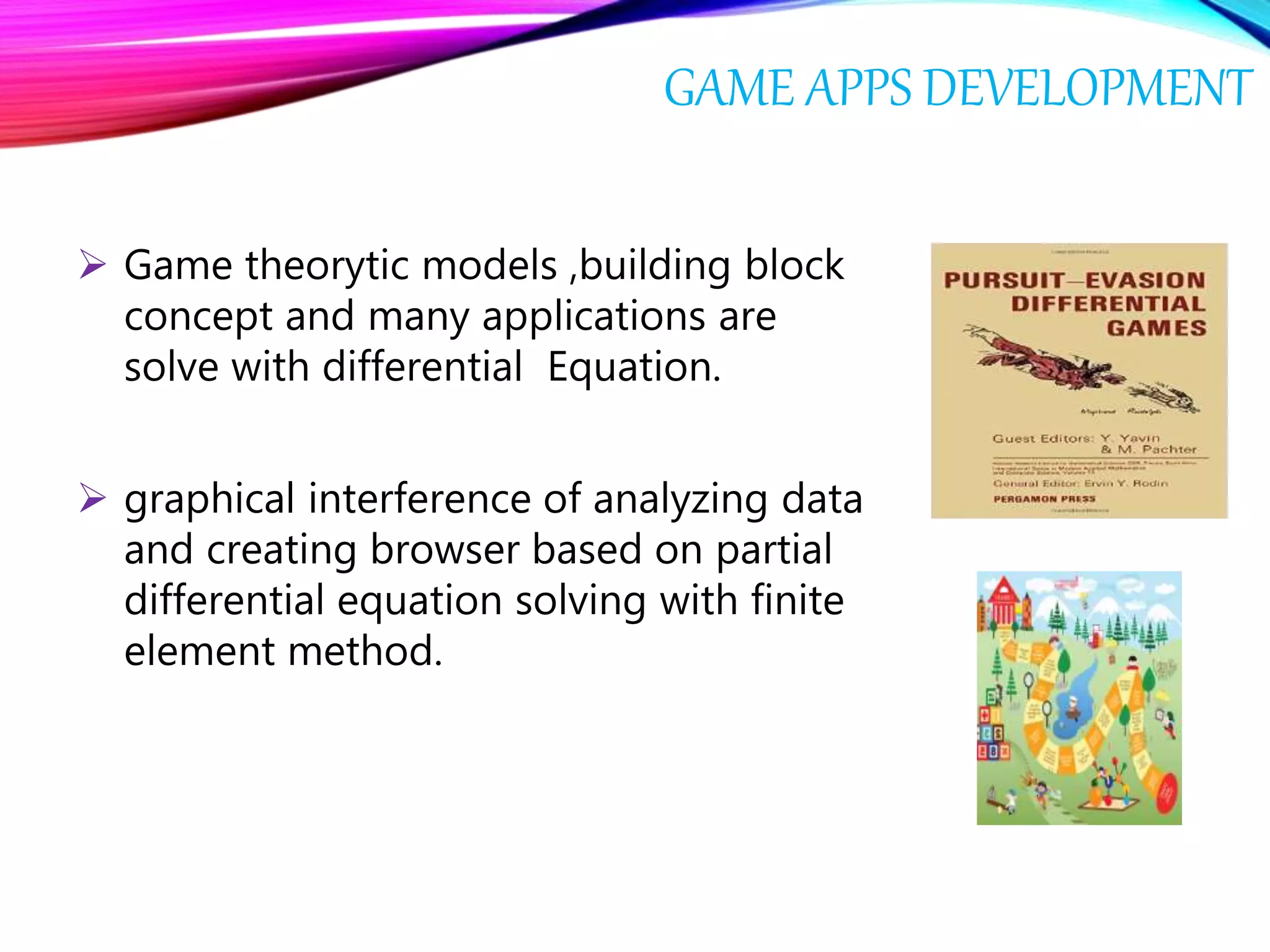
 Game theorytic models ,building block
concept and many applications are
solve with differential Equation.
 graphical interference of analyzing data
and creating browser based on partial
differential equation solving with finite
element method.
ROBOTIC INDUSTRIALIZATION
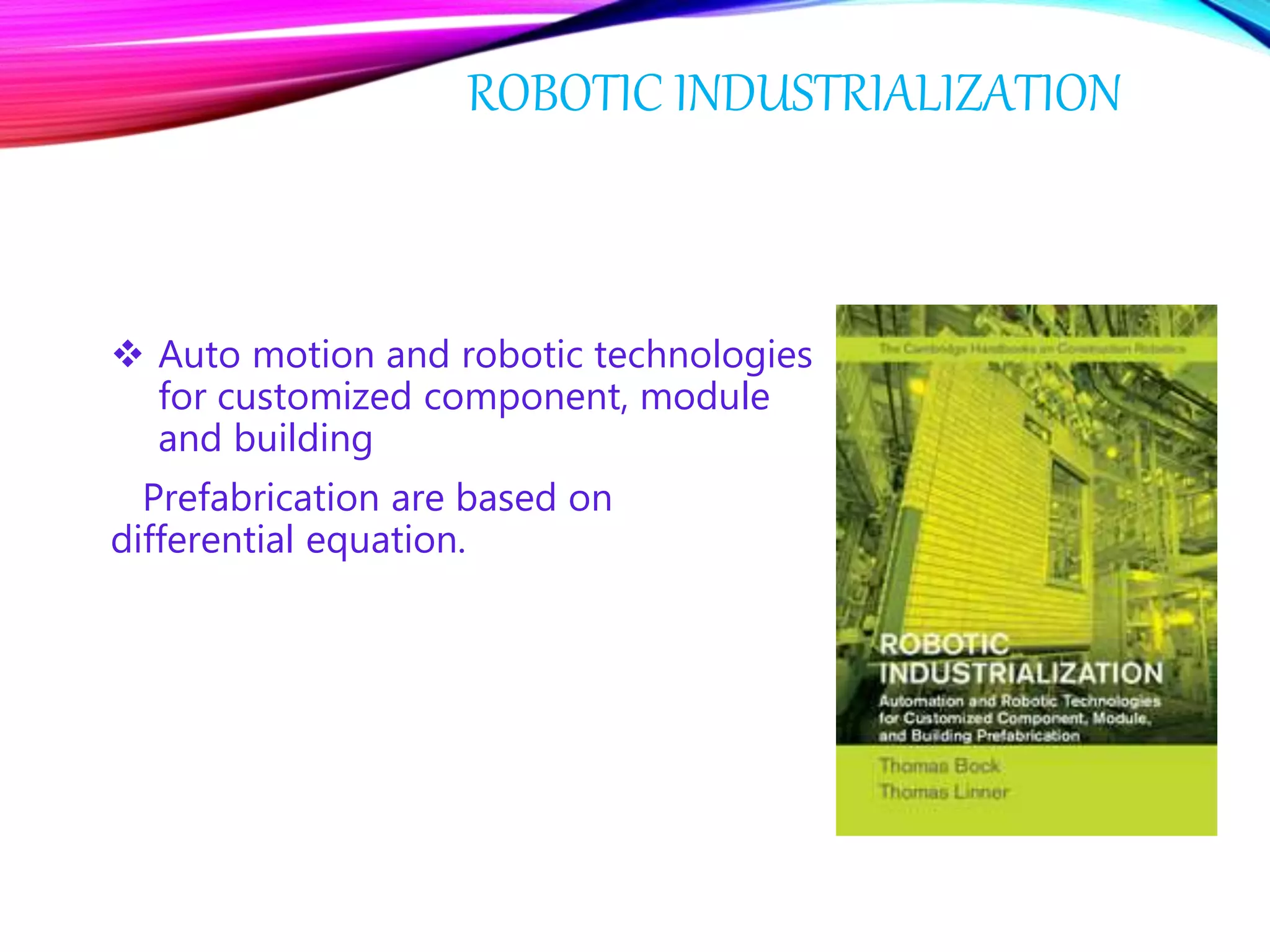
 Auto motion and robotic technologies
for customized component, module
and building
Prefabrication are based on
differential equation.
MOTIVATING EXAMPLES
Differential equations have wide applications in various engineering
and science disciplines. In general , modeling variations of a physical
quantity, such as temperature, pressure, displacement, velocity, stress,
strain, or concentration of a pollutant, with the change of time t or
location, such as the coordinates (x, y, z), or both would require
differential equations. Similarly, studying the variation of a physical
quantity on other physical quantities would lead to differential
equations.
 For example, the change of strain on stress for some viscoelastic
materials follows a differential equation.
EXAMPLES OF PDE:
PDES are used to model many systems in
many different fields of science and
engineering.
Important Examples:
Laplace Equation
Heat Equation
Wave Equation
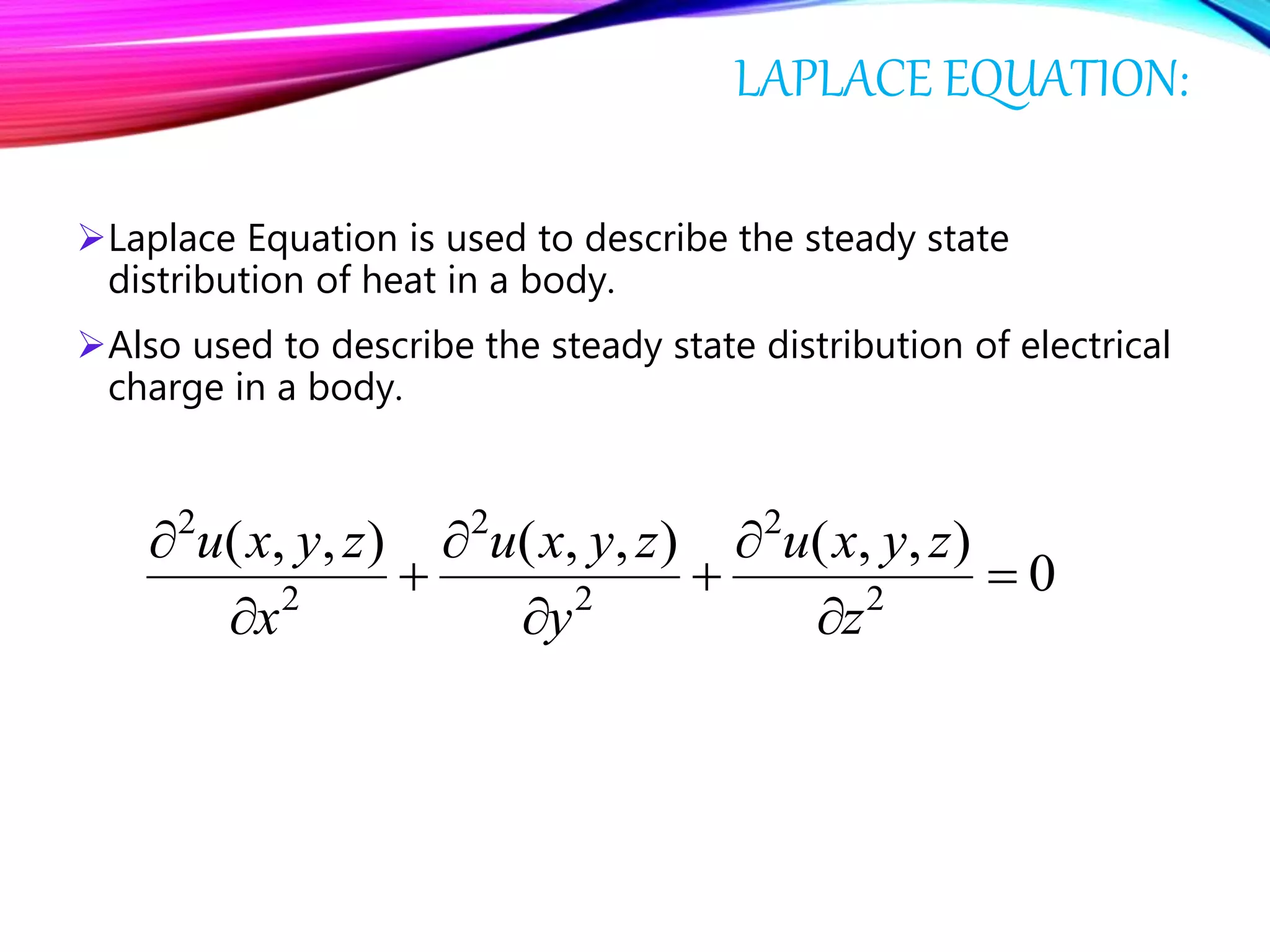
LAPLACE EQUATION:
Laplace Equation is used to describe the steady state
distribution of heat in a body.
Also used to describe the steady state distribution of electrical
charge in a body.
0
),,(),,(),,(
2
2
2
2
2
2









z
zyxu
y
zyxu
x
zyxu
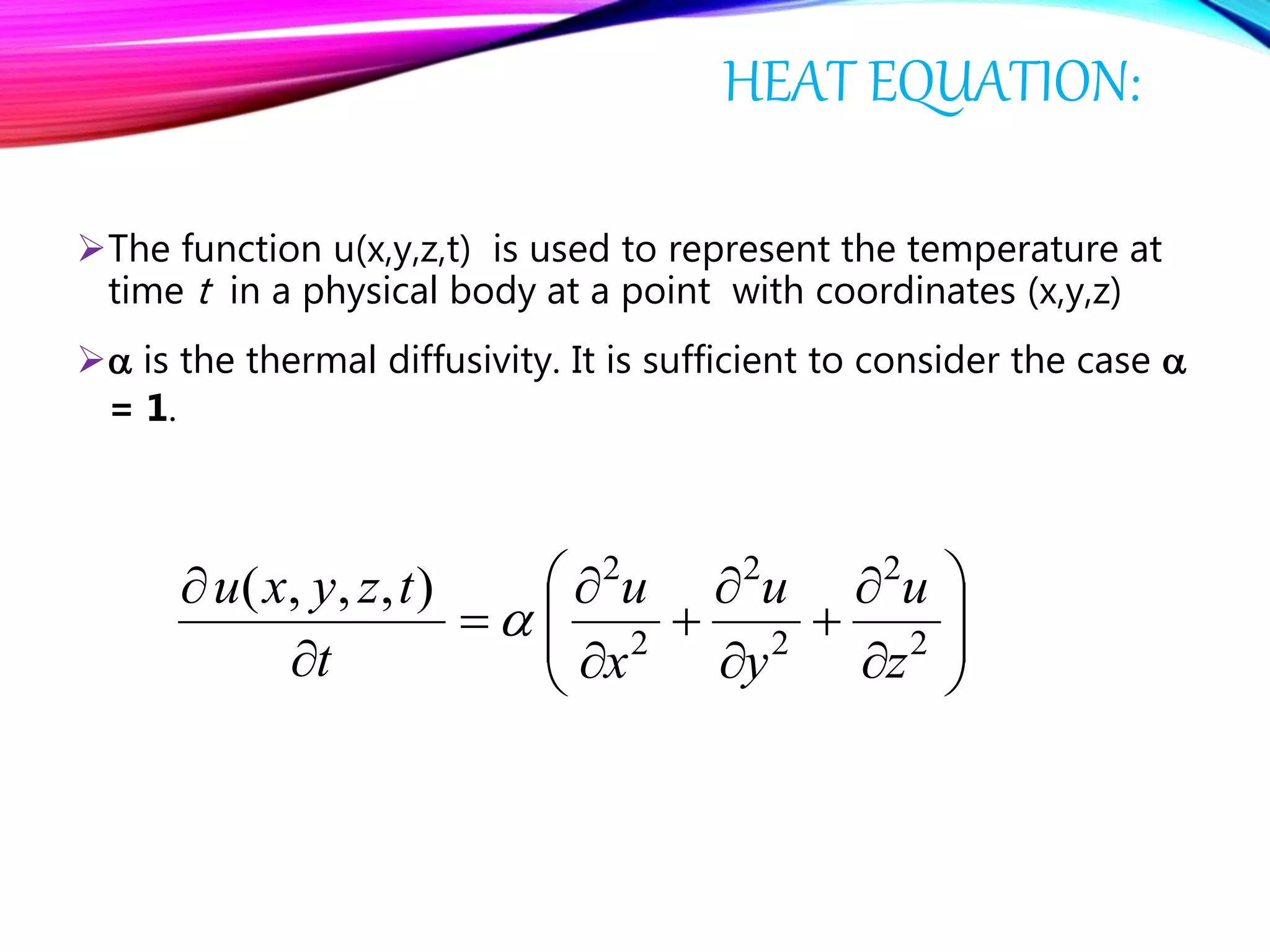
HEAT EQUATION:
The function u(x,y,z,t) is used to represent the temperature at
time t in a physical body at a point with coordinates (x,y,z)
 is the thermal diffusivity. It is sufficient to consider the case 
= 1.



















2
2
2
2
2
2
),,,(
z
u
y
u
x
u
t
tzyxu

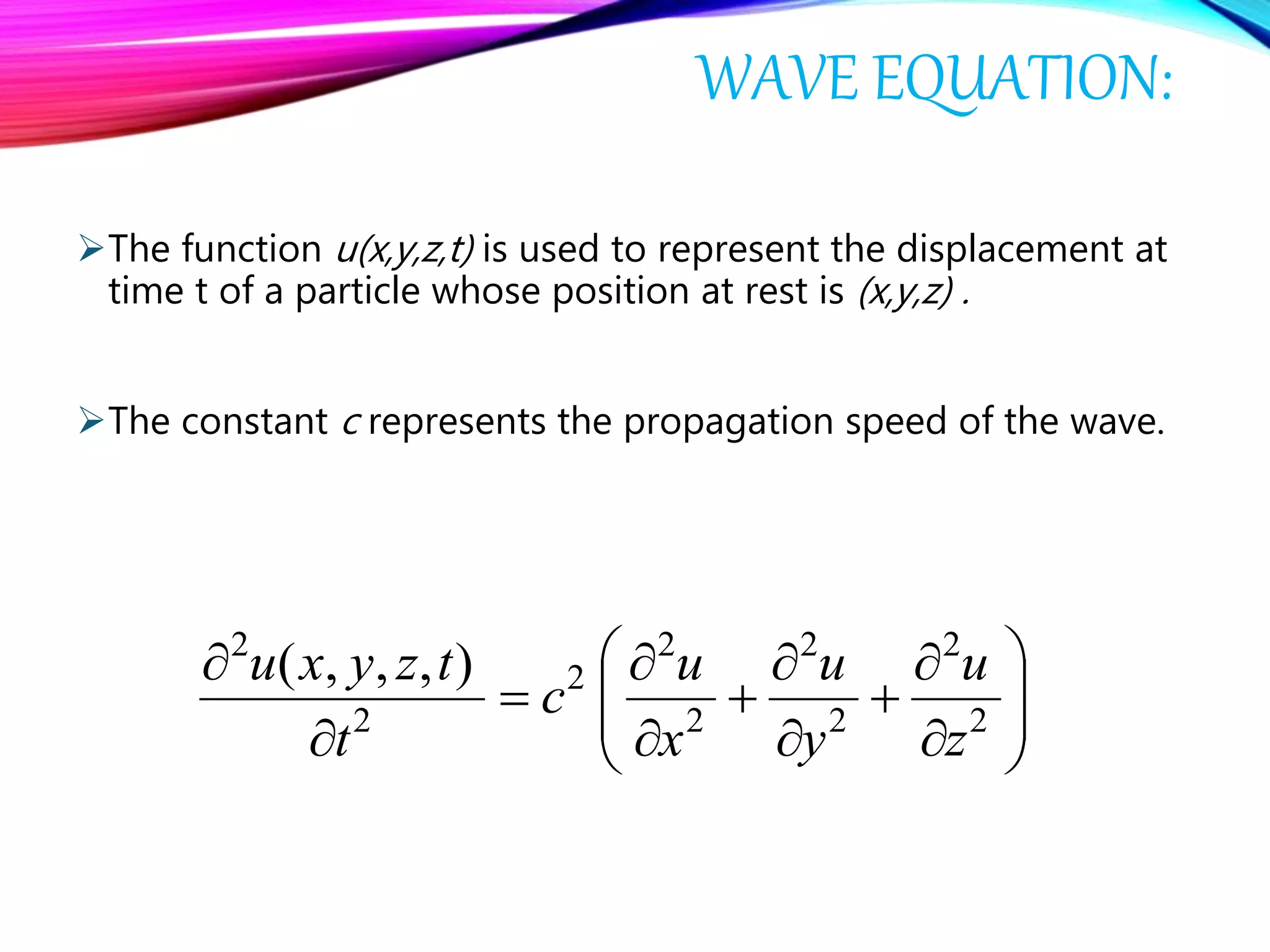
WAVE EQUATION:
The function u(x,y,z,t) is used to represent the displacement at
time t of a particle whose position at rest is (x,y,z) .
The constant c represents the propagation speed of the wave.



















2
2
2
2
2
2
2
2
2
),,,(
z
u
y
u
x
u
c
t
tzyxu
PHYSICAL APPLICATIONS
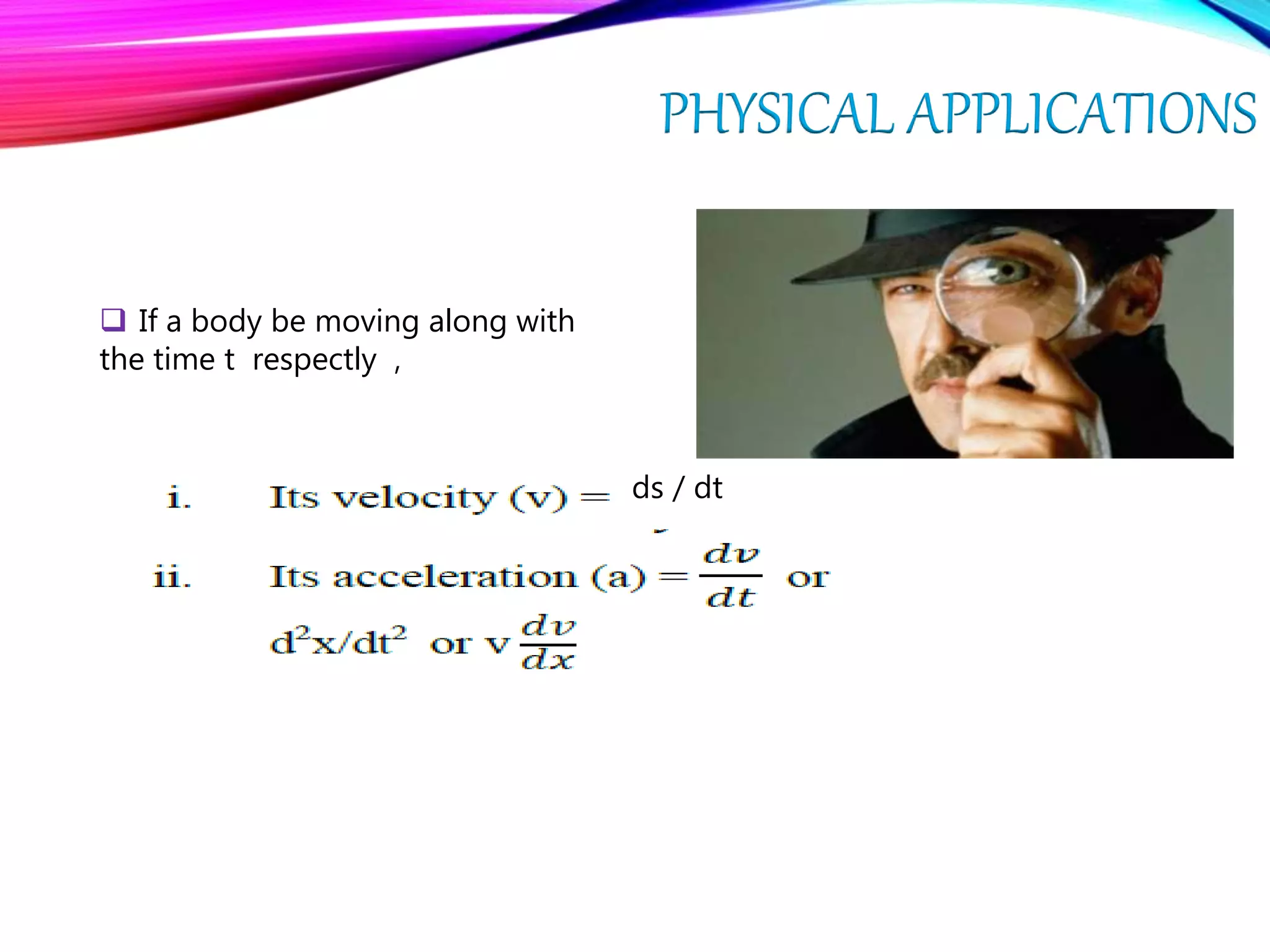
ds / dt
 If a body be moving along with
the time t respectly ,
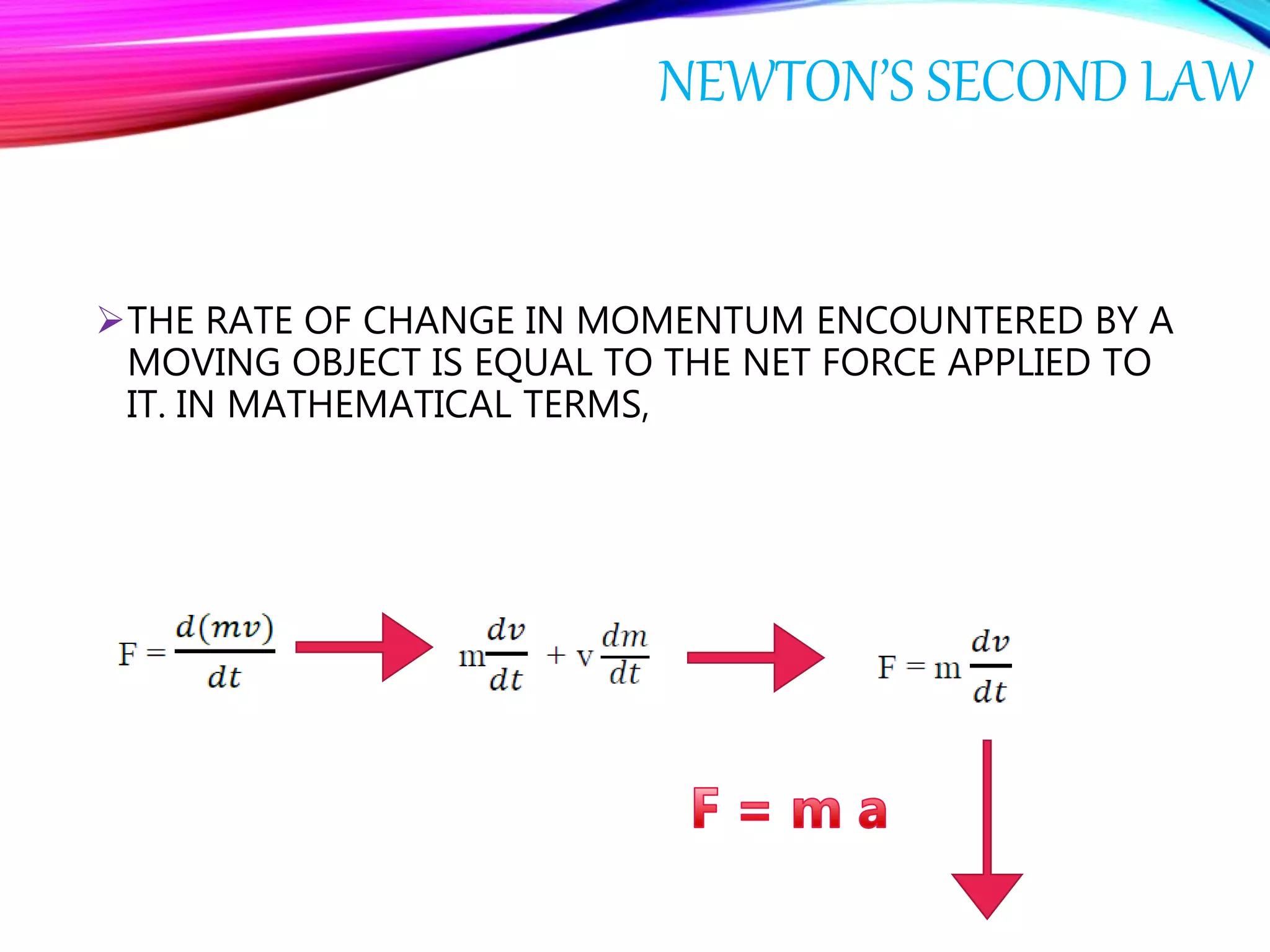
NEWTON’S SECOND LAW
THE RATE OF CHANGE IN MOMENTUM ENCOUNTERED BY A
MOVING OBJECT IS EQUAL TO THE NET FORCE APPLIED TO
IT. IN MATHEMATICAL TERMS,
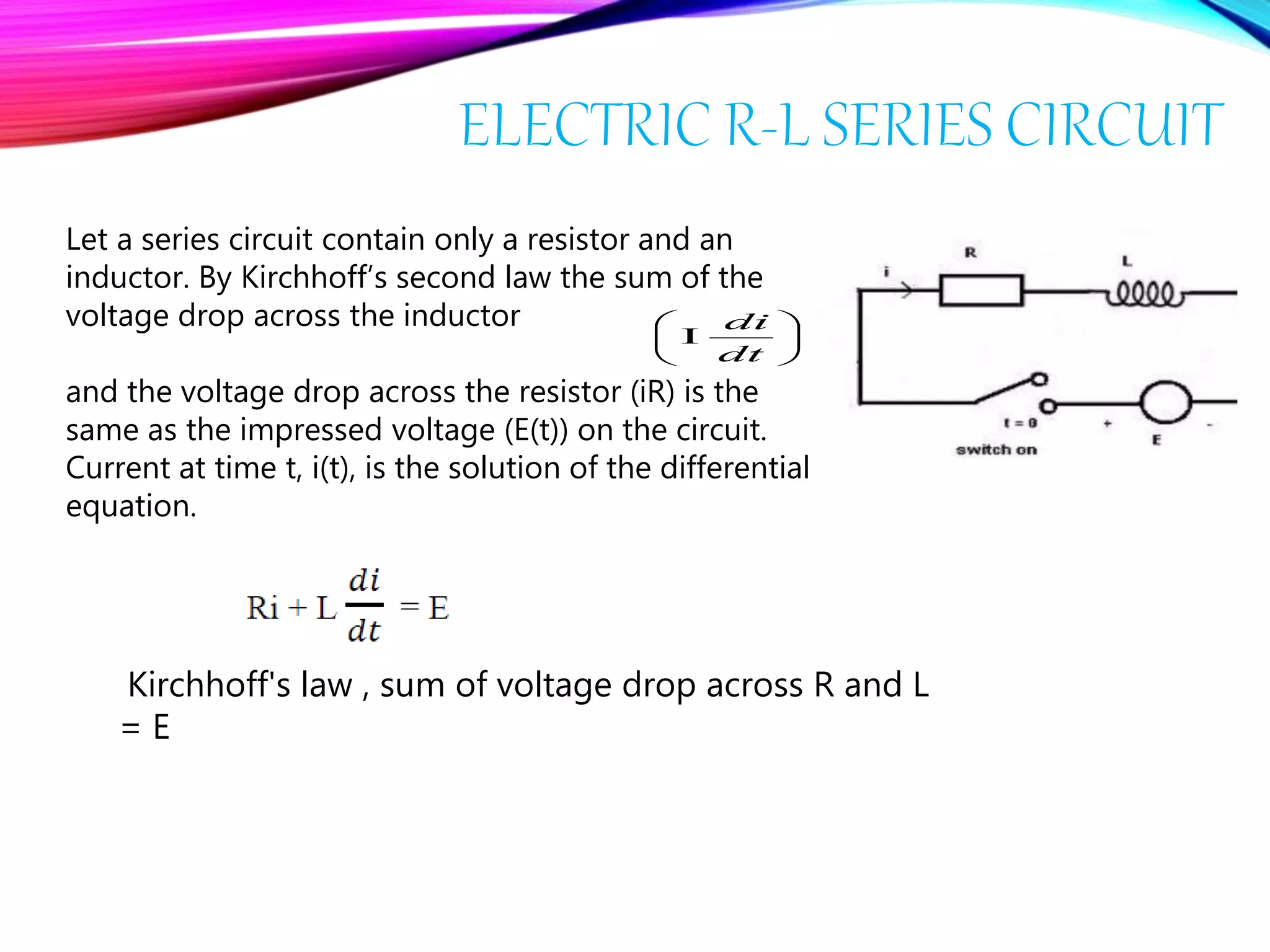
Kirchhoff's law , sum of voltage drop across R and L
= E
Let a series circuit contain only a resistor and an
inductor. By Kirchhoff’s second law the sum of the
voltage drop across the inductor
and the voltage drop across the resistor (iR) is the
same as the impressed voltage (E(t)) on the circuit.
Current at time t, i(t), is the solution of the differential
equation.







dt
di
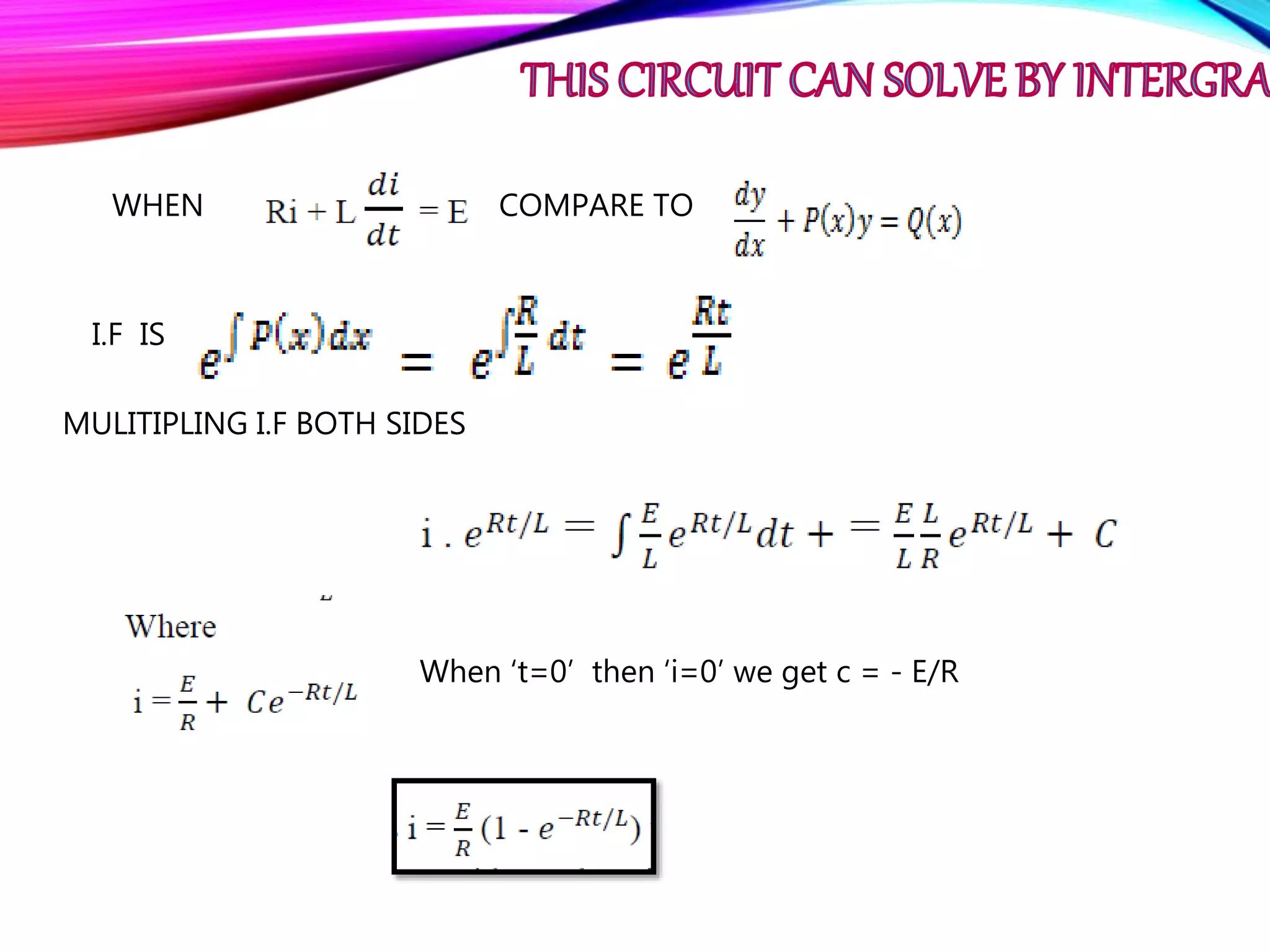
WHEN COMPARE TO
I.F IS
MULITIPLING I.F BOTH SIDES
When ‘t=0’ then ‘i=0’ we get c = - E/R
RADIOACTIVE HALF-LIFE
• A stochastic (random) process
• The RATE of decay is dependent upon the
number of molecules/atoms that are there
• Negative because the number is decreasing
• K is the constant of proportionality
kN
dt
dN

POPULATION GROWTH AND DECAY
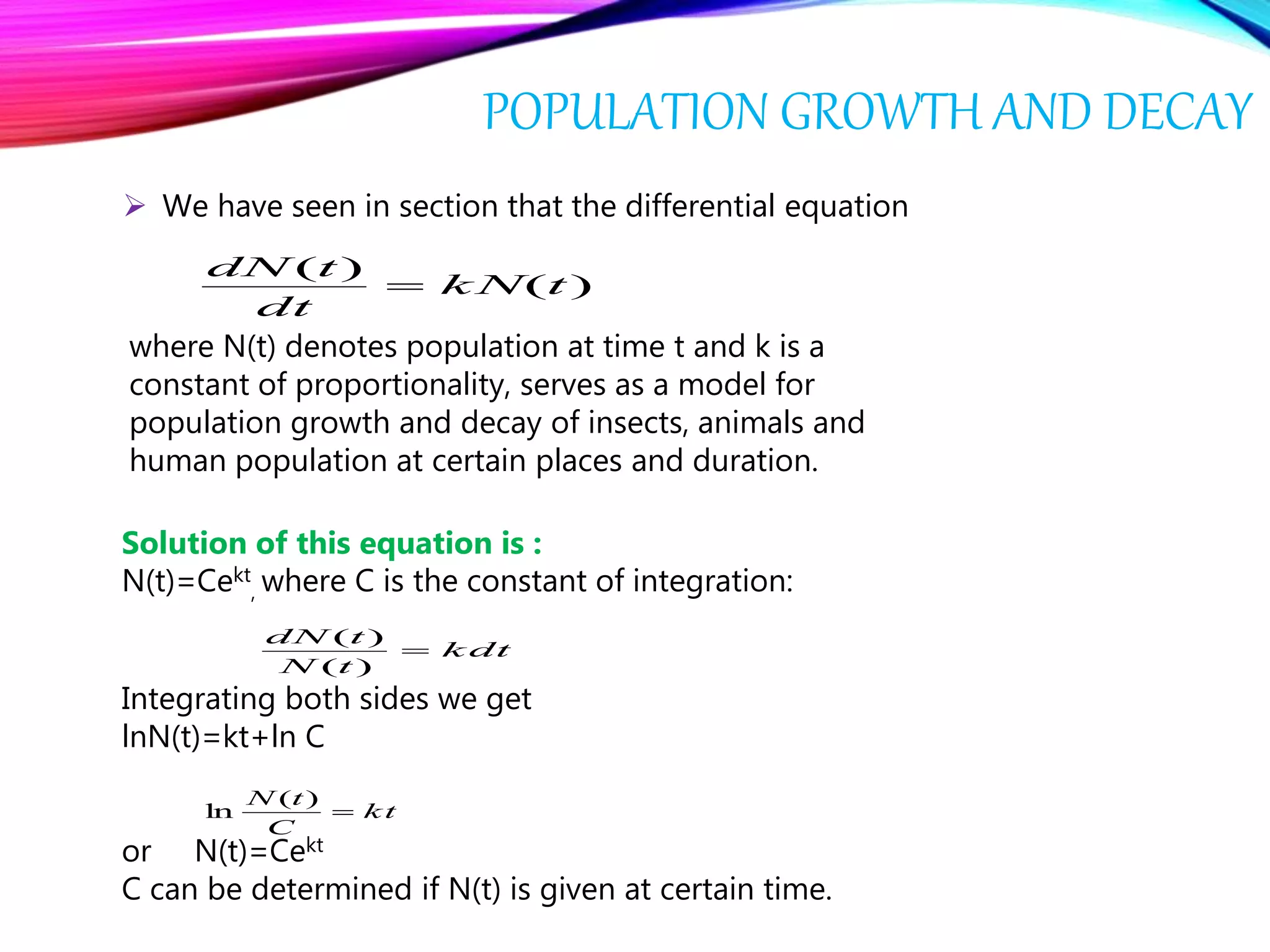
 We have seen in section that the differential equation
)(
)(
tk N
dt
tdN

where N(t) denotes population at time t and k is a
constant of proportionality, serves as a model for
population growth and decay of insects, animals and
human population at certain places and duration.
Solution of this equation is :
N(t)=Cekt
, where C is the constant of integration:
k dt
tN
tdN

)(
)(
Integrating both sides we get
lnN(t)=kt+ln C
or N(t)=Cekt
C can be determined if N(t) is given at certain time.
kt
C
tN

)(
ln
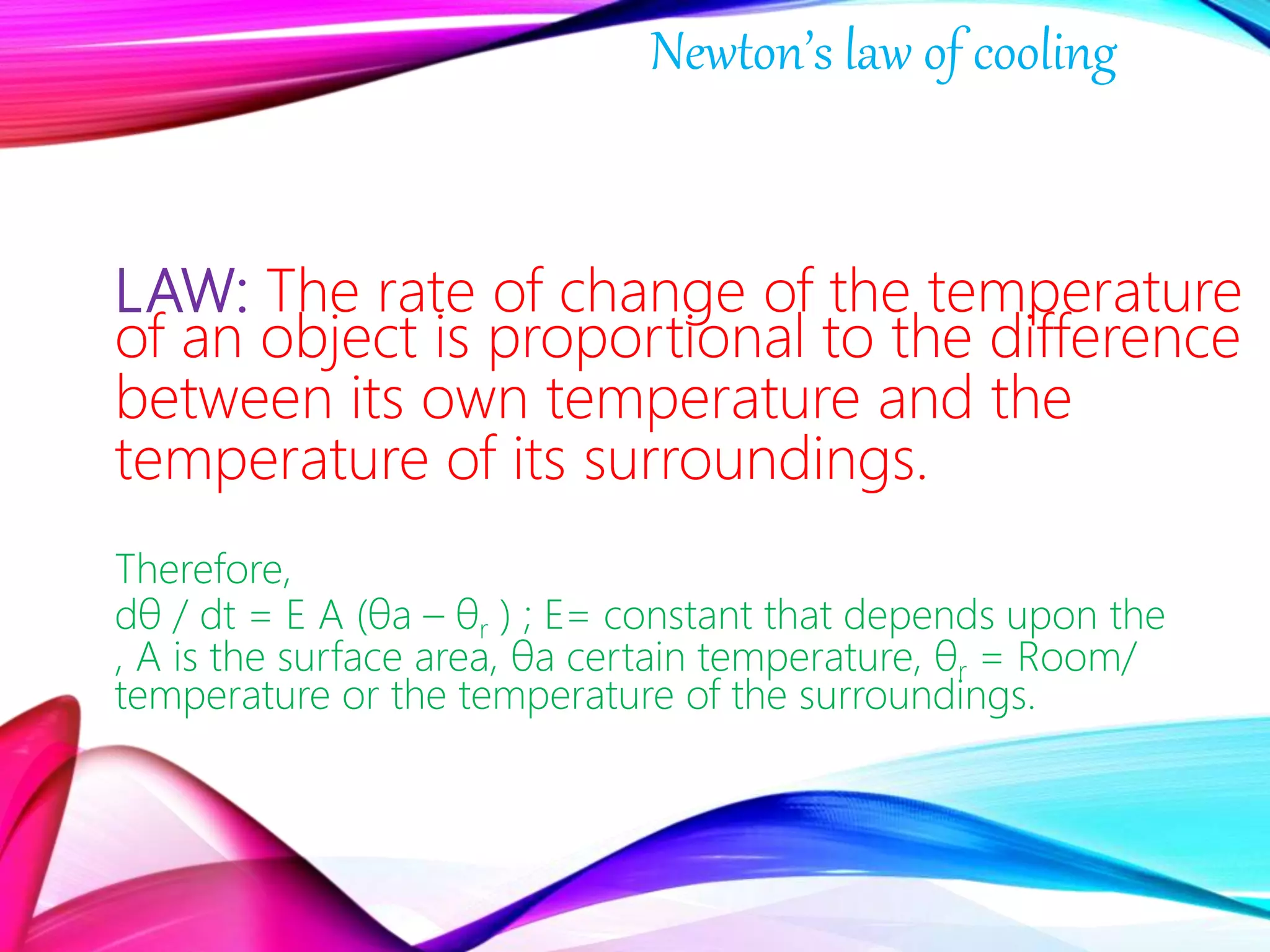
LAW: The rate of change of the temperature
of an object is proportional to the difference
between its own temperature and the
temperature of its surroundings.
Therefore,
dθ / dt = E A (θa – θr ) ; E= constant that depends upon the
, A is the surface area, θa certain temperature, θr = Room/
temperature or the temperature of the surroundings.
Newton’s law of cooling
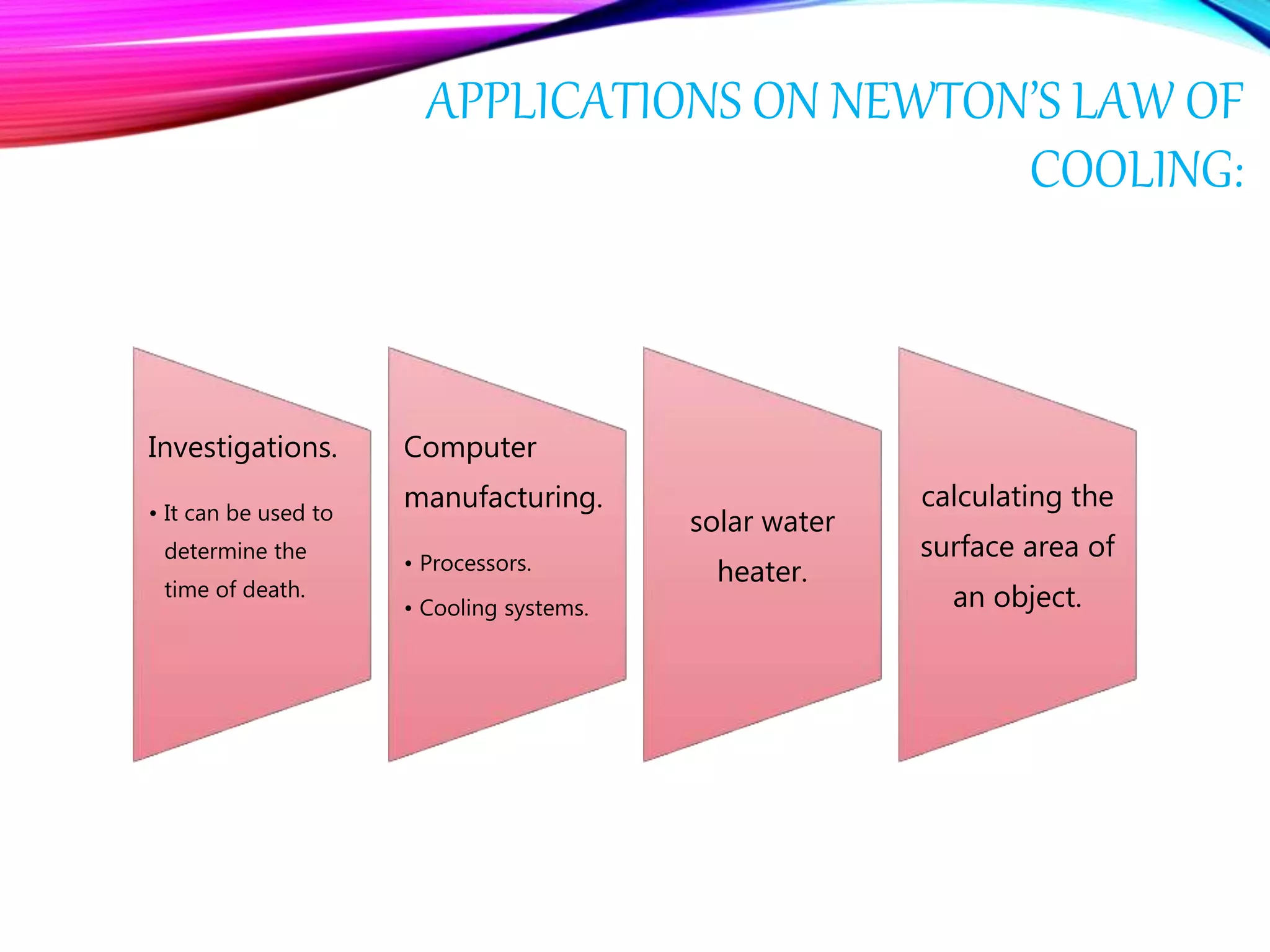
APPLICATIONS ON NEWTON’S LAW OF
COOLING:
Investigations.
• It can be used to
determine the
time of death.
Computer
manufacturing.
• Processors.
• Cooling systems.
solar water
heater.
calculating the
surface area of
an object.
Example :
A global company such as Intel is willing to produce a new cooling system for
their processors that can cool the processors from a temperature of 50℃ to
27℃ in just half an hour when the temperature outside is 20℃ but they don’t
know what kind of materials they should use or what the surface area and the
geometry of the shape are. So what should they do ?
Simply they have to use the general formula of Newton’s law of cooling
T (t) = Te + (T0 − Te ) e –t k
And by substituting the numbers they get
27 = 20 + (50 − 20) e-0.5k
Solving for k we get k =2.9
so they need a material with k=2.9 (k is a constant that is related to the heat
capacity , thermodynamics of the material and also the shape and the
geometry of the material)
EVERY ONE !!!!

Applications of differential equations

  • 1.
    APPLICATIONS OF DIFFERENTIAL EQUATIONS PRESENTEDBY PRESENTED TO Md . Sohag Em@il : sohag.0315@gmail.com Daffodil international University
  • 2.
    INVENTION OF DIFFERENTIAL EQUATION: In mathematics, the history of differential equations traces the development of "differential equations" from calculus, which itself was independently invented by English physicist Isaac Newton and German mathematician Gottfried Leibniz.  The history of the subject of differential equations, in concise form, from a synopsis of the recent article “The History of Differential Equations, 1670- 1950” “Differential equations began with Leibniz, the Bernoulli brothers, and others from the 1680s, not long after Newton’s ‘fluxional equations’ in the 1670s.”
  • 3.
    DIFFERENTIAL EQUATION: A DifferentialEquation is an equation containing the derivative of one or more dependent variables with respect to one or more independent variables. For Example,
  • 4.
    TYPES OF DIFFERENTIAL EQUATION: ODE(ORDINARY DIFFERENTIAL EQUATION): An equation contains only ordinary derivates of one or more dependent variables of a single independent variable. For Example, dy/dx + 5y = ex, (dx/dt) + (dy/dt) = 2x + y PDE (PARTIAL DIFFERENTIAL EQUATION): An equation contains partial derivates of one or more dependent variables of two or more independent variables. For Example,
  • 5.
    APPLICATIONS OF ODE: MODELLINGWITH FIRST-ORDER EQUATIONS  Newton’s Law of Cooling  Electrical Circuits MODELLING FREE MECHANICAL OSCILLATIONS  No Damping  Light Damping  Heavy Damping MODELLING FORCED MECHANICAL OSCILLATIONS COMPUTER EXERCISE OR ACTIVITY
  • 6.
    GAME APPS DEVELOPMENT Game theorytic models ,building block concept and many applications are solve with differential Equation.  graphical interference of analyzing data and creating browser based on partial differential equation solving with finite element method.
  • 7.
    ROBOTIC INDUSTRIALIZATION  Automotion and robotic technologies for customized component, module and building Prefabrication are based on differential equation.
  • 8.
    MOTIVATING EXAMPLES Differential equationshave wide applications in various engineering and science disciplines. In general , modeling variations of a physical quantity, such as temperature, pressure, displacement, velocity, stress, strain, or concentration of a pollutant, with the change of time t or location, such as the coordinates (x, y, z), or both would require differential equations. Similarly, studying the variation of a physical quantity on other physical quantities would lead to differential equations.  For example, the change of strain on stress for some viscoelastic materials follows a differential equation.
  • 9.
    EXAMPLES OF PDE: PDESare used to model many systems in many different fields of science and engineering. Important Examples: Laplace Equation Heat Equation Wave Equation
  • 10.
    LAPLACE EQUATION: Laplace Equationis used to describe the steady state distribution of heat in a body. Also used to describe the steady state distribution of electrical charge in a body. 0 ),,(),,(),,( 2 2 2 2 2 2          z zyxu y zyxu x zyxu
  • 11.
    HEAT EQUATION: The functionu(x,y,z,t) is used to represent the temperature at time t in a physical body at a point with coordinates (x,y,z)  is the thermal diffusivity. It is sufficient to consider the case  = 1.                    2 2 2 2 2 2 ),,,( z u y u x u t tzyxu 
  • 12.
    WAVE EQUATION: The functionu(x,y,z,t) is used to represent the displacement at time t of a particle whose position at rest is (x,y,z) . The constant c represents the propagation speed of the wave.                    2 2 2 2 2 2 2 2 2 ),,,( z u y u x u c t tzyxu
  • 13.
    PHYSICAL APPLICATIONS ds /dt  If a body be moving along with the time t respectly ,
  • 14.
    NEWTON’S SECOND LAW THERATE OF CHANGE IN MOMENTUM ENCOUNTERED BY A MOVING OBJECT IS EQUAL TO THE NET FORCE APPLIED TO IT. IN MATHEMATICAL TERMS,
  • 15.
    Kirchhoff's law ,sum of voltage drop across R and L = E Let a series circuit contain only a resistor and an inductor. By Kirchhoff’s second law the sum of the voltage drop across the inductor and the voltage drop across the resistor (iR) is the same as the impressed voltage (E(t)) on the circuit. Current at time t, i(t), is the solution of the differential equation.        dt di
  • 16.
    WHEN COMPARE TO I.FIS MULITIPLING I.F BOTH SIDES When ‘t=0’ then ‘i=0’ we get c = - E/R
  • 17.
    RADIOACTIVE HALF-LIFE • Astochastic (random) process • The RATE of decay is dependent upon the number of molecules/atoms that are there • Negative because the number is decreasing • K is the constant of proportionality kN dt dN 
  • 18.
    POPULATION GROWTH ANDDECAY  We have seen in section that the differential equation )( )( tk N dt tdN  where N(t) denotes population at time t and k is a constant of proportionality, serves as a model for population growth and decay of insects, animals and human population at certain places and duration. Solution of this equation is : N(t)=Cekt , where C is the constant of integration: k dt tN tdN  )( )( Integrating both sides we get lnN(t)=kt+ln C or N(t)=Cekt C can be determined if N(t) is given at certain time. kt C tN  )( ln
  • 19.
    LAW: The rateof change of the temperature of an object is proportional to the difference between its own temperature and the temperature of its surroundings. Therefore, dθ / dt = E A (θa – θr ) ; E= constant that depends upon the , A is the surface area, θa certain temperature, θr = Room/ temperature or the temperature of the surroundings. Newton’s law of cooling
  • 20.
    APPLICATIONS ON NEWTON’SLAW OF COOLING: Investigations. • It can be used to determine the time of death. Computer manufacturing. • Processors. • Cooling systems. solar water heater. calculating the surface area of an object.
  • 21.
    Example : A globalcompany such as Intel is willing to produce a new cooling system for their processors that can cool the processors from a temperature of 50℃ to 27℃ in just half an hour when the temperature outside is 20℃ but they don’t know what kind of materials they should use or what the surface area and the geometry of the shape are. So what should they do ? Simply they have to use the general formula of Newton’s law of cooling T (t) = Te + (T0 − Te ) e –t k And by substituting the numbers they get 27 = 20 + (50 − 20) e-0.5k Solving for k we get k =2.9 so they need a material with k=2.9 (k is a constant that is related to the heat capacity , thermodynamics of the material and also the shape and the geometry of the material)
  • 22.