ORDINARY DIFFERENTIAL EQUATIONS
FOR ENGINEERS
— THE LECTURE NOTES FOR MATH-
263 (2011)
ORDINARY DIFFERENTIAL EQUATIONS
FOR ENGINEERS
JIAN-JUN XU
Department of Mathematics and Statistics, McGill University
Kluwer Academic Publishers
Boston/Dordrecht/London
Contents
1. INTRODUCTION 1
1 Definitions and Basic Concepts 1
1.1 Ordinary Differential Equation (ODE) 1
1.2 Solution 1
1.3 Order n of the DE 2
1.4 Linear Equation: 2
1.5 Homogeneous Linear Equation: 3
1.6 Partial Differential Equation (PDE) 3
1.7 General Solution of a Linear Differential Equation 3
1.8 A System of ODE’s 4
2 The Approaches of Finding Solutions of ODE 5
2.1 Analytical Approaches 5
2.2 Numerical Approaches 5
2. FIRST ORDER DIFFERENTIAL EQUATIONS 7
1 Linear Equation 7
1.1 Linear homogeneous equation 8
1.2 Linear inhomogeneous equation 8
2 Nonlinear Equations (I) 11
2.1 Separable Equations. 11
2.2 Logistic Equation 14
2.3 Fundamental Existence and Uniqueness Theorem 16
2.4 Bernoulli Equation: 17
2.5 Homogeneous Equation: 18
3 Nonlinear Equations (II)— Exact Equation and Integrating
Factor 20
3.1 Exact Equations. 20
v
vi ORDINARY DIFFERENTIAL EQUATIONS FOR ENGINEERS
4 Integrating Factors. 21
Contents vii
3. N-TH ORDER DIFFERENTIAL EQUATIONS 25
1 Introduction 25
2 (*)Fundamental Theorem of Existence and Uniqueness 26
2.1 Theorem of Existence and Uniqueness (I) 26
2.2 Theorem of Existence and Uniqueness (II) 27
2.3 Theorem of Existence and Uniqueness (III) 27
3 Linear Equations 27
3.1 Basic Concepts and General Properties 27
3.1.1 Linearity 28
3.1.2 Superposition of Solutions 29
3.1.3 (∗) Kernel of Linear operator L(y) 29
3.2 New Notations 29
4 Basic Theory of Linear Differential Equations 30
4.1 Basics of Linear Vector Space 31
4.1.1 Dimension and Basis of Vector Space, Fundamental
Set of Solutions of Eq. 31
4.1.2 Linear Independency 31
4.2 Wronskian of n-functions 34
4.2.1 Definition 34
4.2.2 Theorem 1 35
4.2.3 Theorem 2 36
4.2.4 The Solutions of L[y] = 0 as a Linear Vector Space 38
5 Finding the Solutions in terms of the Method with Differential
Operators 38
5.1 Solutions for Equations with Constants Coefficients
38
5.1.1 Basic Equalities (I). 39
5.1.2 Cases (I) 39
5.1.3 Cases (II) 40
5.1.4 Cases (III) 40
5.1.5 Summary 42
5.1.6 Theorem 1 43
6 Solutions for Equations with Variable Coefficients 46
6.1 Euler Equations 47
7 Finding the Solutions in terms of the Method with Undetermined
Parameters 49
7.1 Solutions for Equations with Constants Coefficients
50
7.2 Basic Equalities (II) 50
viii ORDINARY DIFFERENTIAL EQUATIONS FOR ENGINEERS
7.3 Cases (I) ( r1 > r2) 51
7.4 Cases (II) ( r1 = r2 ) 51
7.5 Cases (III) ( r1,2 = λ ± iµ) 54
7.6 Solutions for Euler Equations 54
7.7 Basic Equalities (III) 54
7.8 Cases (I) ( r1 ̸= r2) 55
7.9 Cases (II) ( r1 = r2 ) 55
7.10 Cases (III) ( r1,2 = λ ± iµ) 56
7.11 (*) Exact Equations 58
8 Finding a Particular Solution for Inhomogeneous Equation
59
8.1 The Annihilator and the Method of Undetermined
Constants 59
8.1.1 The Annihilators for Some Types of Functions 60
8.1.2 Basic Properties of the Annihilators 61
8.1.3 The Basic Theorems of the Annihilator Method 62
8.2 The Method of Variation of Parameters 67
8.3 Reduction of Order 71
4. LAPLACE TRANSFORMS 75
1 Introduction 75
2 Laplace Transform 77
2.1 Definition 77
2.1.1 Piecewise Continuous Function 77
2.1.2 Laplace Transform 77
2.2 Existence of Laplace Transform 77
3 Basic Properties and Formulas of
Laplace Transform 78
3.1 Linearity of Laplace Transform 78
3.2 Laplace Transforms for f(t) = eat 78
3.3 Laplace Transforms for f(t) = {sin(bt) and cos(bt)}
78
3.4 Laplace Transforms for {eatf(t); f(bt)} 79
3.5 Laplace Transforms for {tnf(t)} 79
3.6 Laplace Transforms for {f′(t)} 80
4 Inverse Laplace Transform 80
4.1 Theorem 1: 80
4.2 Theorem 2: 81
4.3 Definition 81
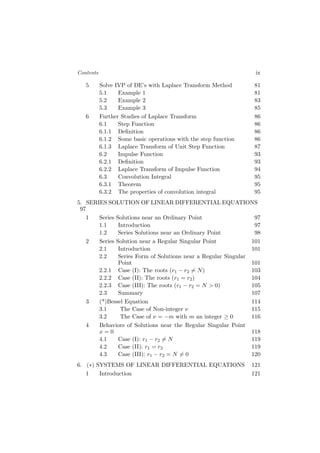
Contents ix
5 Solve IVP of DE’s with Laplace Transform Method 81
5.1 Example 1 81
5.2 Example 2 83
5.3 Example 3 85
6 Further Studies of Laplace Transform 86
6.1 Step Function 86
6.1.1 Definition 86
6.1.2 Some basic operations with the step function 86
6.1.3 Laplace Transform of Unit Step Function 87
6.2 Impulse Function 93
6.2.1 Definition 93
6.2.2 Laplace Transform of Impulse Function 94
6.3 Convolution Integral 95
6.3.1 Theorem 95
6.3.2 The properties of convolution integral 95
5. SERIES SOLUTION OF LINEAR DIFFERENTIAL EQUATIONS
97
1 Series Solutions near an Ordinary Point 97
1.1 Introduction 97
1.2 Series Solutions near an Ordinary Point 98
2 Series Solution near a Regular Singular Point 101
2.1 Introduction 101
2.2 Series Form of Solutions near a Regular Singular
Point 101
2.2.1 Case (I): The roots (r1 − r2 ̸= N) 103
2.2.2 Case (II): The roots (r1 = r2) 104
2.2.3 Case (III): The roots (r1 − r2 = N > 0) 105
2.3 Summary 107
3 (*)Bessel Equation 114
3.1 The Case of Non-integer ν 115
3.2 The Case of ν = −m with m an integer ≥ 0 116
4 Behaviors of Solutions near the Regular Singular Point
x = 0 118
4.1 Case (I): r1 − r2 ̸= N 119
4.2 Case (II): r1 = r2 119
4.3 Case (III): r1 − r2 = N ̸= 0 120
6. (∗) SYSTEMS OF LINEAR DIFFERENTIAL EQUATIONS 121
1 Introduction 121
x ORDINARY DIFFERENTIAL EQUATIONS FOR ENGINEERS
1.1 (2 × 2) System of Linear Equations 122
1.2 Case 1: ∆ > 0 122
1.3 Case 2: ∆ < 0 123
1.4 Case 3: ∆ = 0 124
2 Solutions for (n × n) Homogeneous Linear System 128
2.1 Case (I): (A) is non-defective matrix 128
2.2 Case (II): (A) has a pair of complex conjugate
eigen-values 130
2.3 Case (III): (A) is a defective matrix 130
3 Solutions for Non-homogeneous Linear System 133
3.1 Variation of Parameters Method 133
Chapter 1
INTRODUCTION
1. Definitions and Basic Concepts
1.1 Ordinary Differential Equation (ODE)
An equation involving the derivatives of an unknown function y of a
single variable x over an interval x ∈ (I). More clearly and precisely
speaking, a well defined ODE must the following features:
It can be written in the form:
F[x, y, y′
, y′′
, · · · , yn
] = 0; (1.1)
where the mathematical expression on the right hand side contains
(1). variable x, (2). function y of x, and (3). some derivatives of y
with respect to x;
The values of variables x, y must be specified in a certain number
field, such as N, R, or C;
The variation region of variable x of Eq. must be specified, such as
x ∈ (I) = (a, b).
1.2 Solution
Any function y = f(x) which satisfies this equation over the interval
(I) is called a solution of the ODE. More clearly speaking, function ϕ(x)
is called a solution of the give EQ. (1.1), if the following requirements
are satisfies:
The function ϕ(x) is defined in the region x ∈ (I);
The function ϕ(x) is differentiable, hence, {ϕ′(x), · · · , ϕ(n)(x)} all
exit, in the region x ∈ (I);
1
2 ORDINARY DIFFERENTIAL EQUATIONS FOR ENGINEERS
With the replacements of the variables y, y′, · · · , y(n) in 1.1 by the
functions ϕ(x), ϕ′(x), · · · , ϕ(n)(x), the EQ. (1.1) becomes an identity
over x ∈ (I). In other words, the right hand side of Eq. (1.1) becomes
to zero for all x ∈ (I).
For example, one can verify that y = e2x is a solution of the ODE
y′
= 2y, x ∈ (−∞, ∞),
and y = sin(x2) is a solution of the ODE
xy′′
− y′
+ 4x3
y = 0, x ∈ (−∞, ∞).
1.3 Order n of the DE
An ODE is said to be order n, if y(n) is the highest order derivative
occurring in the equation. The simplest first order ODE is y′ = g(x).
Note that the expression F on the right hand side of an n-th order
ODE: F[x, y, y′, . . . , y(n)] = 0 can be considered as a function of n + 2
variables (x, u0, u1, . . . , un). Namely, one may write
F(x, u0, u1, · · · , un) = 0.
Thus, the equations
xy′′
+ y = x3
, y′
+ y2
= 0, y′′′
+ 2y′
+ y = 0
which are examples of ODE’s of second order, first order and third order
respectively, can be in the forms:
F(x, u0, u1, u2) = xu2 + u0 − x3,
F(x, u0, u1) = u1 + u2
0,
F(x, u0, u1, u2, u3) = u3 + 2u1 + u0.
respectively.
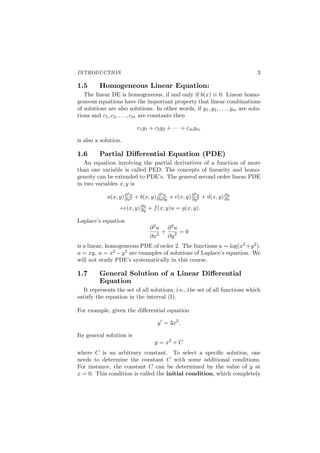
1.4 Linear Equation:
If the function F is linear in the variables u0, u1, . . . , un, which means
every term in F is proportional to u0, u1, . . . , un, the ODE is said to be
linear. If, in addition, F is homogeneous then the ODE is said to be
homogeneous. The first of the above examples above is linear are linear,
the second is non-linear and the third is linear and homogeneous. The
general n-th order linear ODE can be written
an(x)dny
dxn + an−1(x)dn−1y
dxn−1 + · · · + a1(x)dy
dx
+a0(x)y = b(x).
INTRODUCTION 3
1.5 Homogeneous Linear Equation:
The linear DE is homogeneous, if and only if b(x) ≡ 0. Linear homo-
geneous equations have the important property that linear combinations
of solutions are also solutions. In other words, if y1, y2, . . . , ym are solu-
tions and c1, c2, . . . , cm are constants then
c1y1 + c2y2 + · · · + cmym
is also a solution.
1.6 Partial Differential Equation (PDE)
An equation involving the partial derivatives of a function of more
than one variable is called PED. The concepts of linearity and homo-
geneity can be extended to PDE’s. The general second order linear PDE
in two variables x, y is
a(x, y)∂2u
∂x2 + b(x, y) ∂2u
∂x∂y + c(x, y)∂2u
∂y2 + d(x, y)∂u
∂x
+e(x, y)∂u
∂y + f(x, y)u = g(x, y).
Laplace’s equation
∂2u
∂x2 +
∂2u
∂y2 = 0
is a linear, homogeneous PDE of order 2. The functions u = log(x2 +y2),
u = xy, u = x2 −y2 are examples of solutions of Laplace’s equation. We
will not study PDE’s systematically in this course.
1.7 General Solution of a Linear Differential
Equation
It represents the set of all solutions, i.e., the set of all functions which
satisfy the equation in the interval (I).
For example, given the differential equation
y′
= 3x2
.
Its general solution is
y = x3
+ C
where C is an arbitrary constant. To select a specific solution, one
needs to determine the constant C with some additional conditions.
For instance, the constant C can be determined by the value of y at
x = 0. This condition is called the initial condition, which completely
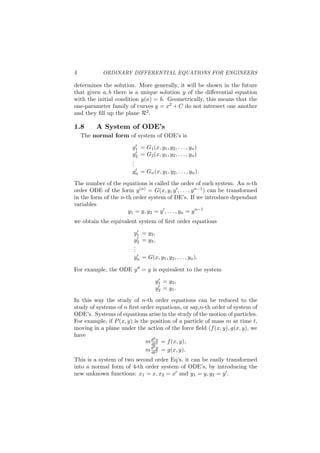
4 ORDINARY DIFFERENTIAL EQUATIONS FOR ENGINEERS
determines the solution. More generally, it will be shown in the future
that given a, b there is a unique solution y of the differential equation
with the initial condition y(a) = b. Geometrically, this means that the
one-parameter family of curves y = x2 + C do not intersect one another
and they fill up the plane R2.
1.8 A System of ODE’s
The normal form of system of ODE’s is
y′
1 = G1(x, y1, y2, . . . , yn)
y′
2 = G2(x, y1, y2, . . . , yn)
.
.
.
y′
n = Gn(x, y1, y2, . . . , yn).
The number of the equations is called the order of such system. An n-th
order ODE of the form y(n) = G(x, y, y′, . . . , yn−1) can be transformed
in the form of the n-th order system of DE’s. If we introduce dependant
variables
y1 = y, y2 = y′
, . . . , yn = yn−1
we obtain the equivalent system of first order equations
y′
1 = y2,
y′
2 = y3,
.
.
.
y′
n = G(x, y1, y2, . . . , yn).
For example, the ODE y′′ = y is equivalent to the system
y′
1 = y2,
y′
2 = y1.
In this way the study of n-th order equations can be reduced to the
study of systems of n first order equations, or say,n-th order of system of
ODE’s. Systems of equations arise in the study of the motion of particles.
For example, if P(x, y) is the position of a particle of mass m at time t,
moving in a plane under the action of the force field (f(x, y), g(x, y), we
have
md2x
dt2 = f(x, y),
md2y
dt2 = g(x, y).
This is a system of two second order Eq’s, it can be easily transformed
into a normal form of 4-th order system of ODE’s, by introducing the
new unknown functions: x1 = x, x2 = x′ and y1 = y, y2 = y′.
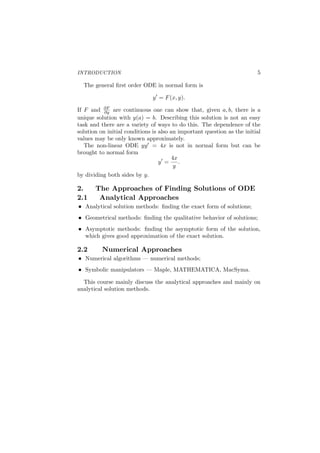
INTRODUCTION 5
The general first order ODE in normal form is
y′
= F(x, y).
If F and ∂F
∂y are continuous one can show that, given a, b, there is a
unique solution with y(a) = b. Describing this solution is not an easy
task and there are a variety of ways to do this. The dependence of the
solution on initial conditions is also an important question as the initial
values may be only known approximately.
The non-linear ODE yy′ = 4x is not in normal form but can be
brought to normal form
y′
=
4x
y
.
by dividing both sides by y.
2. The Approaches of Finding Solutions of ODE
2.1 Analytical Approaches
Analytical solution methods: finding the exact form of solutions;
Geometrical methods: finding the qualitative behavior of solutions;
Asymptotic methods: finding the asymptotic form of the solution,
which gives good approximation of the exact solution.
2.2 Numerical Approaches
Numerical algorithms — numerical methods;
Symbolic manipulators — Maple, MATHEMATICA, MacSyma.
This course mainly discuss the analytical approaches and mainly on
analytical solution methods.
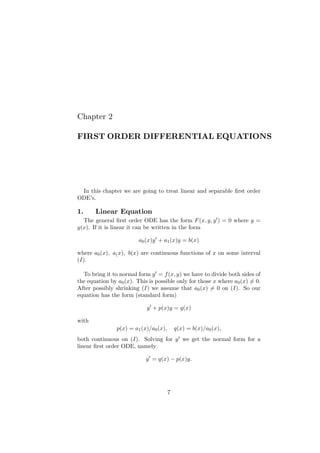
Chapter 2
FIRST ORDER DIFFERENTIAL EQUATIONS
In this chapter we are going to treat linear and separable first order
ODE’s.
1. Linear Equation
The general first order ODE has the form F(x, y, y′) = 0 where y =
y(x). If it is linear it can be written in the form
a0(x)y′
+ a1(x)y = b(x)
where a0(x), a(x), b(x) are continuous functions of x on some interval
(I).
To bring it to normal form y′ = f(x, y) we have to divide both sides of
the equation by a0(x). This is possible only for those x where a0(x) ̸= 0.
After possibly shrinking (I) we assume that a0(x) ̸= 0 on (I). So our
equation has the form (standard form)
y′
+ p(x)y = q(x)
with
p(x) = a1(x)/a0(x), q(x) = b(x)/a0(x),
both continuous on (I). Solving for y′ we get the normal form for a
linear first order ODE, namely
y′
= q(x) − p(x)y.
7
8 ORDINARY DIFFERENTIAL EQUATIONS FOR ENGINEERS
1.1 Linear homogeneous equation
Let us first consider the simple case: q(x) = 0, namely,
dy
dx
+ p(x)y = 0. (2.1)
To find the solutions, we proceed in the following three steps:
Assume that the solution exists and in the form y = y(x);
Find the necessary form of the function y(x). In doing so, by the
definition of the solution, one substitute the function y(x) in the Eq.,
and try to transform the EQ. in such a way that its LHS of EQ. is a
complete differentiation d
dx[.....], while its RHS is a known function.
Verify y(x) is indeed a solution.
In the step #2, with the chain law of derivative, one may transform Eq.
(2.1) into the following form:
y′(x)
y
=
d
dx
ln |y(x)| = −p(x).
Its LHS is now changed a complete differentiation with respect to x,
while its RHS is a known function. By integrating both sides, we derive
ln |y(x)| = −
∫
p(x)dx + C,
or
y = ±C1e−
∫
p(x)dx
,
where C, as well as C1 = eC > 0, is arbitrary constant. As C=0, y(x) = 0
is a trivial solution, we derive the necessary form of solution:
y = Ae−
∫
p(x)dx
. (2.2)
As the final step of derivation, one can verify the function (2.2) is indeed
a solution for any value of constant A. In summary, we deduce that (2.2)
is the form of solution, that contains all possible solution. Hence, one
can call (2.2) as the general solution of Eq. (2.1).
1.2 Linear inhomogeneous equation
We now consider the general case:
dy
dx
+ p(x)y = q(x).
FIRST ORDER DIFFERENTIAL EQUATIONS 9
We still proceed in the three steps as we did in the previous subsection.
However, now in the step #2 one cannot directly transform the LHS of
Eq. in the complete differential form as we did for the case of homoge-
neous Eq. For this purpose, we multiply the both sides of our differential
equation with a factor µ(x) ̸= 0. Then our equation is equivalent (has
the same solutions) to the equation
µ(x)y′
(x) + µ(x)p(x)y(x) = µ(x)q(x).
We wish that with a properly chosen function µ(x),
µ(x)y′
(x) + µ(x)p(x)y(x) =
d
dx
[µ(x)y(x)].
For this purpose, the function µ(x) must has the property
µ′
(x) = p(x)µ(x), (2.3)
and µ(x) ̸= 0 for all x. By solving the linear homogeneous equation
(2.3), one obtain
µ(x) = e
∫
p(x)dx
. (2.4)
With this function, which is called an integrating factor, our equation
is now transformed into the form that we wanted:
d
dx
[µ(x)y(x)] = µ(x)q(x), (2.5)
Integrating both sides, we get
µ(x)y =
∫
µ(x)q(x)dx + C
with C an arbitrary constant. Solving for y, we get
y =
1
µ(x)
∫
µ(x)q(x)dx +
C
µ(x)
= yP (x) + yH(x) (2.6)
as the general solution for the general linear first order ODE
y′
+ p(x)y = q(x).
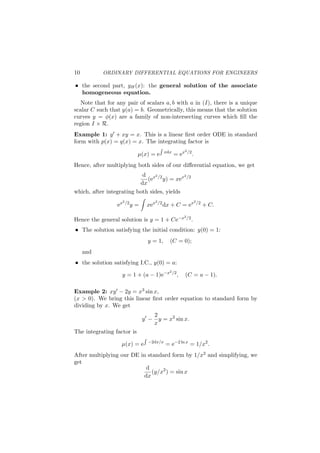
In solution (2.6):
the first part, yP (x): a particular solution of the inhomogeneous
equation,
10 ORDINARY DIFFERENTIAL EQUATIONS FOR ENGINEERS
the second part, yH(x): the general solution of the associate
homogeneous equation.
Note that for any pair of scalars a, b with a in (I), there is a unique
scalar C such that y(a) = b. Geometrically, this means that the solution
curves y = ϕ(x) are a family of non-intersecting curves which fill the
region I × R.
Example 1: y′ + xy = x. This is a linear first order ODE in standard
form with p(x) = q(x) = x. The integrating factor is
µ(x) = e
∫
xdx
= ex2/2
.
Hence, after multiplying both sides of our differential equation, we get
d
dx
(ex2/2
y) = xex2/2
which, after integrating both sides, yields
ex2/2
y =
∫
xex2/2
dx + C = ex2/2
+ C.
Hence the general solution is y = 1 + Ce−x2/2.
The solution satisfying the initial condition: y(0) = 1:
y = 1, (C = 0);
and
the solution satisfying I.C., y(0) = a:
y = 1 + (a − 1)e−x2/2
, (C = a − 1).
Example 2: xy′ − 2y = x3 sin x,
(x > 0). We bring this linear first order equation to standard form by
dividing by x. We get
y′
−
2
x
y = x2
sin x.
The integrating factor is
µ(x) = e
∫
−2dx/x
= e−2 ln x
= 1/x2
.
After multiplying our DE in standard form by 1/x2 and simplifying, we
get
d
dx
(y/x2
) = sin x
FIRST ORDER DIFFERENTIAL EQUATIONS 11
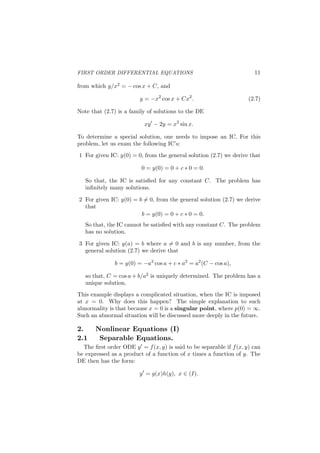
from which y/x2 = − cos x + C, and
y = −x2
cos x + Cx2
. (2.7)
Note that (2.7) is a family of solutions to the DE
xy′
− 2y = x3
sin x.
To determine a special solution, one needs to impose an IC. For this
problem, let us exam the following IC’s:
1 For given IC: y(0) = 0, from the general solution (2.7) we derive that
0 = y(0) = 0 + c ∗ 0 = 0.
So that, the IC is satisfied for any constant C. The problem has
infinitely many solutions.
2 For given IC: y(0) = b ̸= 0, from the general solution (2.7) we derive
that
b = y(0) = 0 + c ∗ 0 = 0.
So that, the IC cannot be satisfied with any constant C. The problem
has no solution.
3 For given IC: y(a) = b where a ̸= 0 and b is any number, from the
general solution (2.7) we derive that
b = y(0) = −a2
cos a + c ∗ a2
= a2
(C − cos a),
so that, C = cos a + b/a2 is uniquely determined. The problem has a
unique solution.
This example displays a complicated situation, when the IC is imposed
at x = 0. Why does this happen? The simple explanation to such
abnormality is that because x = 0 is a singular point, where p(0) = ∞.
Such an abnormal situation will be discussed more deeply in the future.
2. Nonlinear Equations (I)
2.1 Separable Equations.
The first order ODE y′ = f(x, y) is said to be separable if f(x, y) can
be expressed as a product of a function of x times a function of y. The
DE then has the form:
y′
= g(x)h(y), x ∈ (I).
12 ORDINARY DIFFERENTIAL EQUATIONS FOR ENGINEERS
We apply the procedure of three steps for the solutions as before. Assume
that the solution y = y(x) exists, and h(y) ̸= 0 as x ∈ (I). Then by
dividing both sides by h[y(x)], it becomes
y′(x)
h[y(x)]
= g(x). (2.8)
Of course this is not valid for those solutions y = y(x) at the points
where h[y(x)] = 0. Furthermore, we assume that the LHS can be written
in the form of complete differentiation: d
dxH[y(x)], where H[y(x)] is a
composite function of x to be determined. Once we find the function
H(y), we may write
H[y(x)] =
∫
y′(x)
h[y(x)]
dx =
∫
g(x)dx + C.
However, by chain rule we have
d
dx
H[y(x)] = H′
(y)y′
(x).
By comparing the above with the LHS of (3.33), it follows that
H′
(y) =
1
h(y)
.
Thus, we derive that
H(y) =
∫
dy
h(y)
=
∫
g(x)dx + C, (2.9)
This gives the implicit form of the solution. It determines the value of y
implicitly in terms of x. The function given in (2.9) can be easily verified
as indeed a solution. Note that with the assumption h(y) ̸= 0 at the
beginning of the derivation, some solution may be excluded in (2.9). As
a matter of fact, one can verify that the Eq. may allow the constant
solutions,
y = y∗, (2.10)
as h(y∗) = 0.
Example 1: y′ = x−5
y2 .
To solve it using the above method we multiply both sides of the
equation by y2 to get
y2
y′
= (x − 5).
FIRST ORDER DIFFERENTIAL EQUATIONS 13
Integrating both sides we get y3/3 = x2/2 − 5x + C. Hence,
y =
[
3x2
/2 − 15x + C1
]1/3
.
Example 2: y′ = y−1
x+3 (x > −3). By inspection, y = 1 is a solution.
Dividing both sides of the given DE by y − 1 we get
y′
y − 1
=
1
x + 3
.
This will be possible for those x where y(x) ̸= 1. Integrating both sides
we get ∫
y′
y − 1
dx =
∫
dx
x + 3
+ C1,
from which we get ln |y − 1| = ln(x + 3) + C1. Thus |y − 1| = eC1 (x + 3)
from which y − 1 = ±eC1 (x + 3). If we let C = ±eC1 , we get
y = 1 + C(x + 3)
. Since y = 1 was found to be a solution by inspection the general
solution is
y = 1 + C(x + 3),
where C can be any scalar. For any (a, b) with a ̸= −3, there is only one
member of this family which passes through (a, b).
However, it is seen that there is a family of lines passing through
(−3, 1), while no solution line passing through (−3, b) with b ̸= 1). Here,
x = −3 is a singular point.
Example 3: y′ = y cos x
1+2y2 . Transforming in the standard form then
integrating both sides we get
∫
(1 + 2y2)
y
dy =
∫
cos x dx + C,
from which we get a family of the solutions:
ln |y| + y2
= sin x + C,
where C is an arbitrary constant. However, this is not the general solu-
tion of the equation, as it does not contains, for instance, the solution:
y = 0. With I.C.: y(0)=1, we get C = 1, hence, the solution:
ln |y| + y2
= sin x + 1.
14 ORDINARY DIFFERENTIAL EQUATIONS FOR ENGINEERS
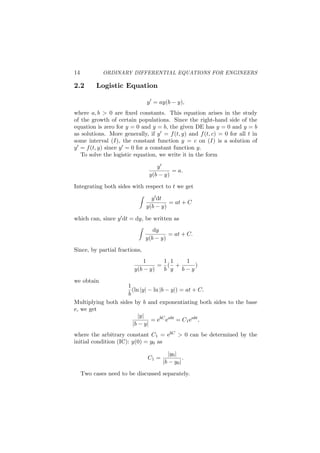
2.2 Logistic Equation
y′
= ay(b − y),
where a, b > 0 are fixed constants. This equation arises in the study
of the growth of certain populations. Since the right-hand side of the
equation is zero for y = 0 and y = b, the given DE has y = 0 and y = b
as solutions. More generally, if y′ = f(t, y) and f(t, c) = 0 for all t in
some interval (I), the constant function y = c on (I) is a solution of
y′ = f(t, y) since y′ = 0 for a constant function y.
To solve the logistic equation, we write it in the form
y′
y(b − y)
= a.
Integrating both sides with respect to t we get
∫
y′dt
y(b − y)
= at + C
which can, since y′dt = dy, be written as
∫
dy
y(b − y)
= at + C.
Since, by partial fractions,
1
y(b − y)
=
1
b
(
1
y
+
1
b − y
)
we obtain
1
b
(ln |y| − ln |b − y|) = at + C.
Multiplying both sides by b and exponentiating both sides to the base
e, we get
|y|
|b − y|
= ebC
eabt
= C1eabt
,
where the arbitrary constant C1 = ebC > 0 can be determined by the
initial condition (IC): y(0) = y0 as
C1 =
|y0|
|b − y0|
.
Two cases need to be discussed separately.
FIRST ORDER DIFFERENTIAL EQUATIONS 15
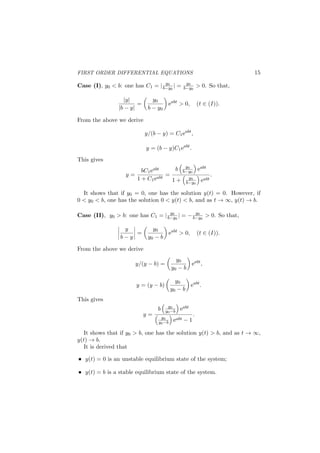
Case (I), y0 < b: one has C1 = | y0
b−y0
| = y0
b−y0
> 0. So that,
|y|
|b − y|
=
(
y0
b − y0
)
eabt
> 0, (t ∈ (I)).
From the above we derive
y/(b − y) = C1eabt
,
y = (b − y)C1eabt
.
This gives
y =
bC1eabt
1 + C1eabt
=
b
(
y0
b−y0
)
eabt
1 +
(
y0
b−y0
)
eabt
.
It shows that if y0 = 0, one has the solution y(t) = 0. However, if
0 < y0 < b, one has the solution 0 < y(t) < b, and as t → ∞, y(t) → b.
Case (II), y0 > b: one has C1 = | y0
b−y0
| = − y0
b−y0
> 0. So that,
y
b − y
=
(
y0
y0 − b
)
eabt
> 0, (t ∈ (I)).
From the above we derive
y/(y − b) =
(
y0
y0 − b
)
eabt
,
y = (y − b)
(
y0
y0 − b
)
eabt
.
This gives
y =
b
(
y0
y0−b
)
eabt
(
y0
y0−b
)
eabt − 1
.
It shows that if y0 > b, one has the solution y(t) > b, and as t → ∞,
y(t) → b.
It is derived that
y(t) = 0 is an unstable equilibrium state of the system;
y(t) = b is a stable equilibrium state of the system.
16 ORDINARY DIFFERENTIAL EQUATIONS FOR ENGINEERS
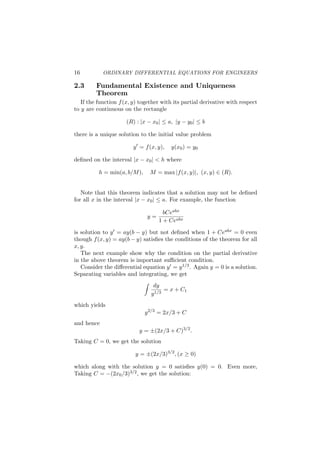
2.3 Fundamental Existence and Uniqueness
Theorem
If the function f(x, y) together with its partial derivative with respect
to y are continuous on the rectangle
(R) : |x − x0| ≤ a, |y − y0| ≤ b
there is a unique solution to the initial value problem
y′
= f(x, y), y(x0) = y0
defined on the interval |x − x0| < h where
h = min(a, b/M), M = max |f(x, y)|, (x, y) ∈ (R).
Note that this theorem indicates that a solution may not be defined
for all x in the interval |x − x0| ≤ a. For example, the function
y =
bCeabx
1 + Ceabx
is solution to y′ = ay(b − y) but not defined when 1 + Ceabx = 0 even
though f(x, y) = ay(b − y) satisfies the conditions of the theorem for all
x, y.
The next example show why the condition on the partial derivative
in the above theorem is important sufficient condition.
Consider the differential equation y′ = y1/3. Again y = 0 is a solution.
Separating variables and integrating, we get
∫
dy
y1/3
= x + C1
which yields
y2/3
= 2x/3 + C
and hence
y = ±(2x/3 + C)3/2
.
Taking C = 0, we get the solution
y = ±(2x/3)3/2
, (x ≥ 0)
which along with the solution y = 0 satisfies y(0) = 0. Even more,
Taking C = −(2x0/3)3/2, we get the solution:
FIRST ORDER DIFFERENTIAL EQUATIONS 17
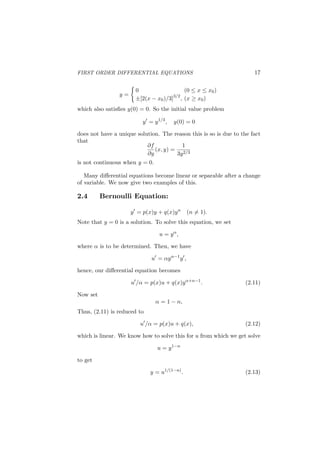
y =
{
0 (0 ≤ x ≤ x0)
±[2(x − x0)/3]3/2
, (x ≥ x0)
which also satisfies y(0) = 0. So the initial value problem
y′
= y1/3
, y(0) = 0
does not have a unique solution. The reason this is so is due to the fact
that
∂f
∂y
(x, y) =
1
3y2/3
is not continuous when y = 0.
Many differential equations become linear or separable after a change
of variable. We now give two examples of this.
2.4 Bernoulli Equation:
y′
= p(x)y + q(x)yn
(n ̸= 1).
Note that y = 0 is a solution. To solve this equation, we set
u = yα
,
where α is to be determined. Then, we have
u′
= αyα−1
y′
,
hence, our differential equation becomes
u′
/α = p(x)u + q(x)yα+n−1
. (2.11)
Now set
α = 1 − n,
Thus, (2.11) is reduced to
u′
/α = p(x)u + q(x), (2.12)
which is linear. We know how to solve this for u from which we get solve
u = y1−n
to get
y = u1/(1−n)
. (2.13)
18 ORDINARY DIFFERENTIAL EQUATIONS FOR ENGINEERS
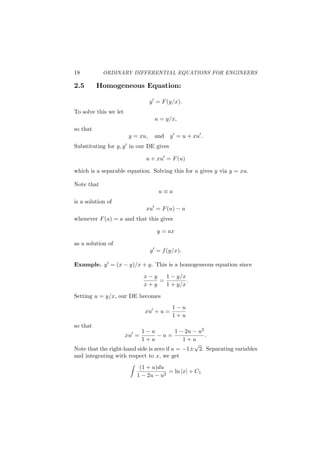
2.5 Homogeneous Equation:
y′
= F(y/x).
To solve this we let
u = y/x,
so that
y = xu, and y′
= u + xu′
.
Substituting for y, y′ in our DE gives
u + xu′
= F(u)
which is a separable equation. Solving this for u gives y via y = xu.
Note that
u ≡ a
is a solution of
xu′
= F(u) − u
whenever F(a) = a and that this gives
y = ax
as a solution of
y′
= f(y/x).
Example. y′ = (x − y)/x + y. This is a homogeneous equation since
x − y
x + y
=
1 − y/x
1 + y/x
.
Setting u = y/x, our DE becomes
xu′
+ u =
1 − u
1 + u
so that
xu′
=
1 − u
1 + u
− u =
1 − 2u − u2
1 + u
.
Note that the right-hand side is zero if u = −1±
√
2. Separating variables
and integrating with respect to x, we get
∫
(1 + u)du
1 − 2u − u2
= ln |x| + C1
FIRST ORDER DIFFERENTIAL EQUATIONS 19
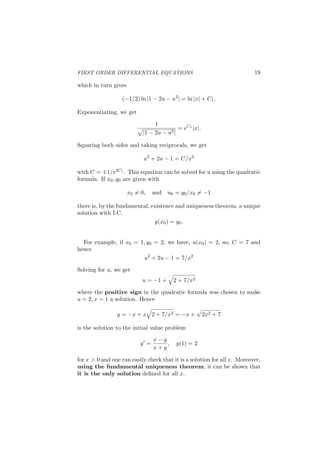
which in turn gives
(−1/2) ln |1 − 2u − u2
| = ln |x| + C1.
Exponentiating, we get
1
√
|1 − 2u − u2|
= eC1
|x|.
Squaring both sides and taking reciprocals, we get
u2
+ 2u − 1 = C/x2
with C = ±1/e2C1 . This equation can be solved for u using the quadratic
formula. If x0, y0 are given with
x0 ̸= 0, and u0 = y0/x0 ̸= −1
there is, by the fundamental, existence and uniqueness theorem, a unique
solution with I.C.
y(x0) = y0.
For example, if x0 = 1, y0 = 2, we have, u(x0) = 2, so, C = 7 and
hence
u2
+ 2u − 1 = 7/x2
Solving for u, we get
u = −1 +
√
2 + 7/x2
where the positive sign in the quadratic formula was chosen to make
u = 2, x = 1 a solution. Hence
y = −x + x
√
2 + 7/x2 = −x +
√
2x2 + 7
is the solution to the initial value problem
y′
=
x − y
x + y
, y(1) = 2
for x > 0 and one can easily check that it is a solution for all x. Moreover,
using the fundamental uniqueness theorem, it can be shown that
it is the only solution defined for all x.
20 ORDINARY DIFFERENTIAL EQUATIONS FOR ENGINEERS
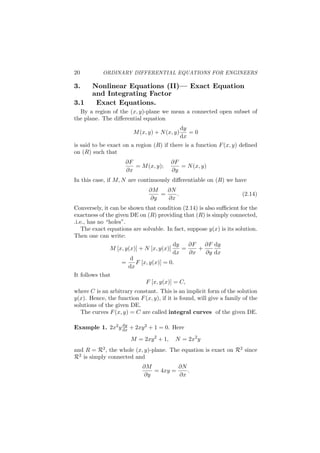
3. Nonlinear Equations (II)— Exact Equation
and Integrating Factor
3.1 Exact Equations.
By a region of the (x, y)-plane we mean a connected open subset of
the plane. The differential equation
M(x, y) + N(x, y)
dy
dx
= 0
is said to be exact on a region (R) if there is a function F(x, y) defined
on (R) such that
∂F
∂x
= M(x, y);
∂F
∂y
= N(x, y)
In this case, if M, N are continuously differentiable on (R) we have
∂M
∂y
=
∂N
∂x
. (2.14)
Conversely, it can be shown that condition (2.14) is also sufficient for the
exactness of the given DE on (R) providing that (R) is simply connected,
.i.e., has no “holes”.
The exact equations are solvable. In fact, suppose y(x) is its solution.
Then one can write:
M [x, y(x)] + N [x, y(x)]
dy
dx
=
∂F
∂x
+
∂F
∂y
dy
dx
=
d
dx
F [x, y(x)] = 0.
It follows that
F [x, y(x)] = C,
where C is an arbitrary constant. This is an implicit form of the solution
y(x). Hence, the function F(x, y), if it is found, will give a family of the
solutions of the given DE.
The curves F(x, y) = C are called integral curves of the given DE.
Example 1. 2x2y dy
dx + 2xy2 + 1 = 0. Here
M = 2xy2
+ 1, N = 2x2
y
and R = R2, the whole (x, y)-plane. The equation is exact on R2 since
R2 is simply connected and
∂M
∂y
= 4xy =
∂N
∂x
.
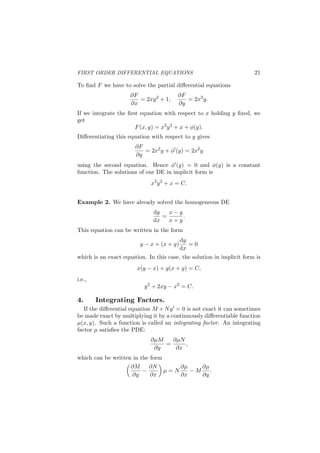
FIRST ORDER DIFFERENTIAL EQUATIONS 21
To find F we have to solve the partial differential equations
∂F
∂x
= 2xy2
+ 1,
∂F
∂y
= 2x2
y.
If we integrate the first equation with respect to x holding y fixed, we
get
F(x, y) = x2
y2
+ x + ϕ(y).
Differentiating this equation with respect to y gives
∂F
∂y
= 2x2
y + ϕ′
(y) = 2x2
y
using the second equation. Hence ϕ′(y) = 0 and ϕ(y) is a constant
function. The solutions of our DE in implicit form is
x2
y2
+ x = C.
Example 2. We have already solved the homogeneous DE
dy
dx
=
x − y
x + y
.
This equation can be written in the form
y − x + (x + y)
dy
dx
= 0
which is an exact equation. In this case, the solution in implicit form is
x(y − x) + y(x + y) = C,
i.e.,
y2
+ 2xy − x2
= C.
4. Integrating Factors.
If the differential equation M +Ny′ = 0 is not exact it can sometimes
be made exact by multiplying it by a continuously differentiable function
µ(x, y). Such a function is called an integrating factor. An integrating
factor µ satisfies the PDE:
∂µM
∂y
=
∂µN
∂x
,
which can be written in the form
(
∂M
∂y
−
∂N
∂x
)
µ = N
∂µ
∂x
− M
∂µ
∂y
.
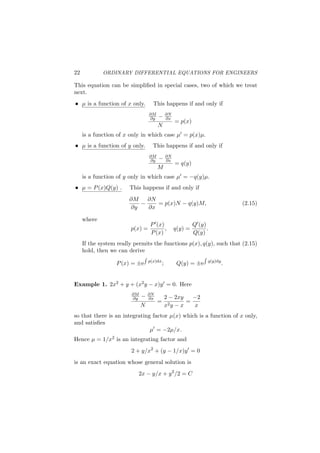
22 ORDINARY DIFFERENTIAL EQUATIONS FOR ENGINEERS
This equation can be simplified in special cases, two of which we treat
next.
µ is a function of x only. This happens if and only if
∂M
∂y − ∂N
∂x
N
= p(x)
is a function of x only in which case µ′ = p(x)µ.
µ is a function of y only. This happens if and only if
∂M
∂y − ∂N
∂x
M
= q(y)
is a function of y only in which case µ′ = −q(y)µ.
µ = P(x)Q(y) . This happens if and only if
∂M
∂y
−
∂N
∂x
= p(x)N − q(y)M, (2.15)
where
p(x) =
P′(x)
P(x)
, q(y) =
Q′(y)
Q(y)
.
If the system really permits the functions p(x), q(y), such that (2.15)
hold, then we can derive
P(x) = ±e
∫
p(x)dx
; Q(y) = ±e
∫
q(y)dy
.
Example 1. 2x2 + y + (x2y − x)y′ = 0. Here
∂M
∂y − ∂N
∂x
N
=
2 − 2xy
x2y − x
=
−2
x
so that there is an integrating factor µ(x) which is a function of x only,
and satisfies
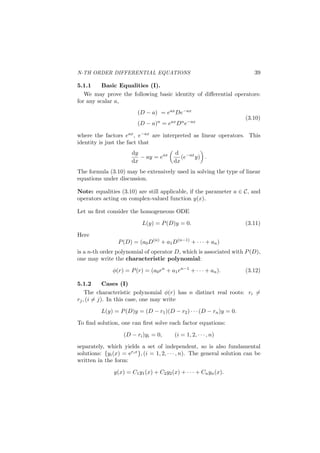
µ′
= −2µ/x.
Hence µ = 1/x2 is an integrating factor and
2 + y/x2
+ (y − 1/x)y′
= 0
is an exact equation whose general solution is
2x − y/x + y2
/2 = C
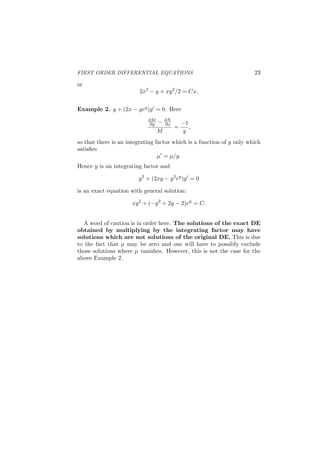
FIRST ORDER DIFFERENTIAL EQUATIONS 23
or
2x2
− y + xy2
/2 = Cx.
Example 2. y + (2x − yey)y′ = 0. Here
∂M
∂y − ∂N
∂x
M
=
−1
y
,
so that there is an integrating factor which is a function of y only which
satisfies
µ′
= µ/y.
Hence y is an integrating factor and
y2
+ (2xy − y2
ey
)y′
= 0
is an exact equation with general solution:
xy2
+ (−y2
+ 2y − 2)ey
= C.
A word of caution is in order here. The solutions of the exact DE
obtained by multiplying by the integrating factor may have
solutions which are not solutions of the original DE. This is due
to the fact that µ may be zero and one will have to possibly exclude
those solutions where µ vanishes. However, this is not the case for the
above Example 2.
Chapter 3
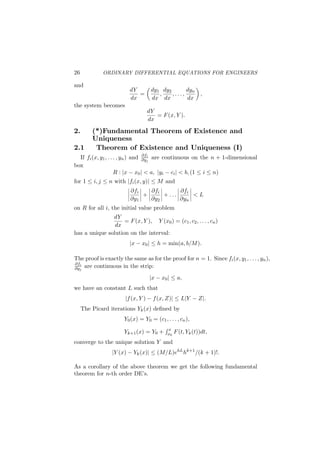
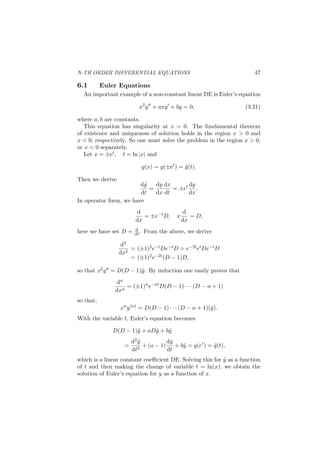
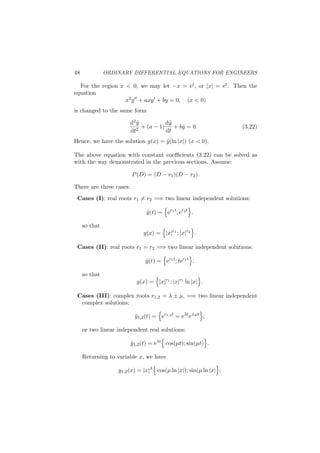
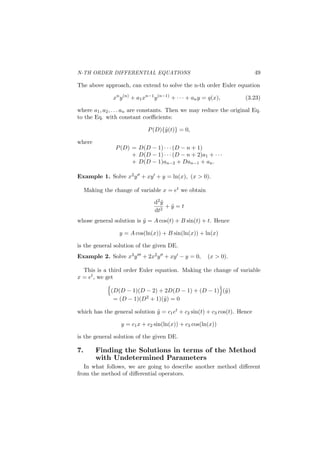
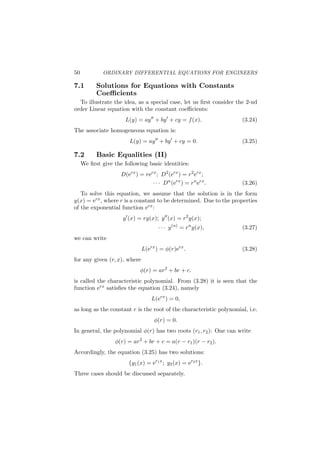
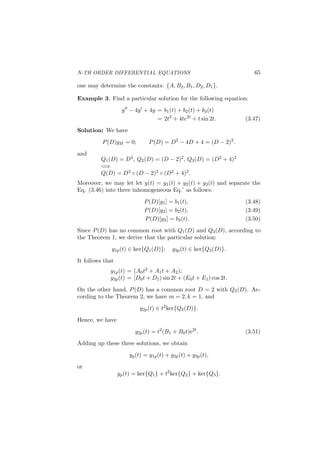
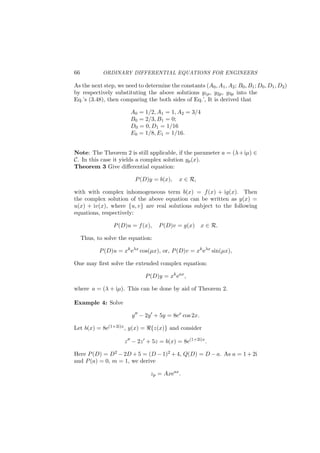
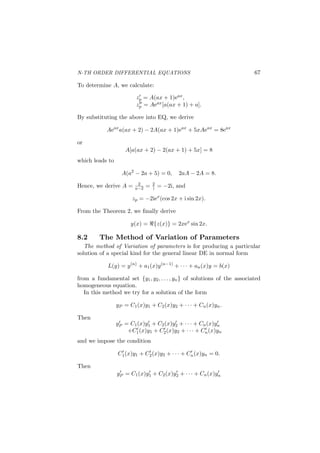
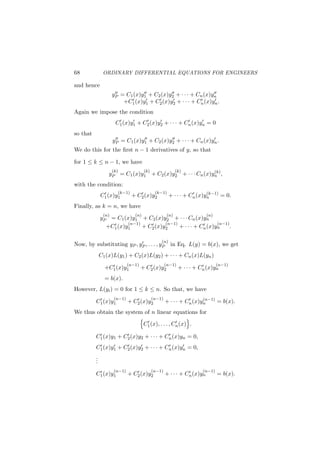
N-TH ORDER DIFFERENTIAL EQUATIONS
1. Introduction
In this lecture we will state and sketch the proof of the fundamental
existence and uniqueness theorem for the n-th order DE
y(n)
= f(x, y, y′
, . . . , y(n−1)
).
The starting point is to convert this DE into a system of first order DE’.
Let y1 = y, y2 = y′, . . . y(n−1) = yn. Then the above DE is equivalent to
the system
dy1
dx = y2
dy2
dx = y3
.
.
.
dyn
dx = f(x, y1, y2, . . . , yn).
(3.1)
More generally let us consider the system
dy1
dx = f1(x, y1, y2, . . . , yn)
dy2
dx = f2(x, y1, y2, . . . , yn)
.
.
.
dyn
dx = fn(x, y1, y2, . . . , yn).
(3.2)
If we let
Y = (y1, y2, . . . , yn),
F(x, Y ) =
{
f1(x, Y ), f2(x, Y ), . . . , fn(x, Y )
}
25
26 ORDINARY DIFFERENTIAL EQUATIONS FOR ENGINEERS
and
dY
dx
=
(
dy1
dx
,
dy2
dx
, . . . ,
dyn
dx
)
,
the system becomes
dY
dx
= F(x, Y ).
2. (*)Fundamental Theorem of Existence and
Uniqueness
2.1 Theorem of Existence and Uniqueness (I)
If fi(x, y1, . . . , yn) and ∂fi
∂yj
are continuous on the n + 1-dimensional
box
R : |x − x0| < a, |yi − ci| < b, (1 ≤ i ≤ n)
for 1 ≤ i, j ≤ n with |fi(x, y)| ≤ M and
∂fi
∂y1
+
∂fi
∂y2
+ . . .
∂fi
∂yn
< L
on R for all i, the initial value problem
dY
dx
= F(x, Y ), Y (x0) = (c1, c2, . . . , cn)
has a unique solution on the interval:
|x − x0| ≤ h = min(a, b/M).
The proof is exactly the same as for the proof for n = 1. Since fi(x, y1, . . . , yn),
∂fi
∂yj
are continuous in the strip:
|x − x0| ≤ a,
we have an constant L such that
|f(x, Y ) − f(x, Z)| ≤ L|Y − Z|.
The Picard iterations Yk(x) defined by
Y0(x) = Y0 = (c1, . . . , cn),
Yk+1(x) = Y0 +
∫ x
x0
F(t, Yk(t))dt,
converge to the unique solution Y and
|Y (x) − Yk(x)| ≤ (M/L)ehL
hk+1
/(k + 1)!.
As a corollary of the above theorem we get the following fundamental
theorem for n-th order DE’s.
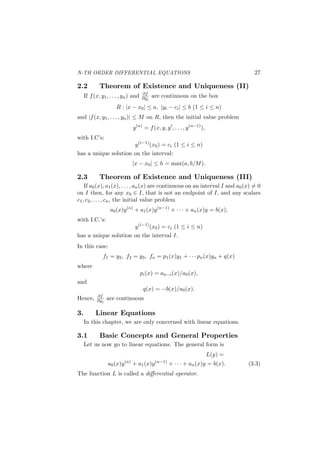
N-TH ORDER DIFFERENTIAL EQUATIONS 27
2.2 Theorem of Existence and Uniqueness (II)
If f(x, y1, . . . , yn) and ∂f
∂yj
are continuous on the box
R : |x − x0| ≤ a, |yi − ci| ≤ b (1 ≤ i ≤ n)
and |f(x, y1, . . . , yn)| ≤ M on R, then the initial value problem
y(n)
= f(x, y, y′
, . . . , y(n−1)
),
with I.C’s:
y(i−1)
(x0) = ci (1 ≤ i ≤ n)
has a unique solution on the interval:
|x − x0| ≤ h = max(a, b/M).
2.3 Theorem of Existence and Uniqueness (III)
If a0(x), a1(x), . . . , an(x) are continuous on an interval I and a0(x) ̸= 0
on I then, for any x0 ∈ I, that is not an endpoint of I, and any scalars
c1, c2, . . . , cn, the initial value problem
a0(x)y(n)
+ a1(x)y(n−1)
+ · · · + an(x)y = b(x),
with I.C.’s:
y(i−1)
(x0) = ci (1 ≤ i ≤ n)
has a unique solution on the interval I.
In this case:
f1 = y2, f2 = y3, fn = p1(x)y1 + · · · pn(x)yn + q(x)
where
pi(x) = an−i(x)/a0(x),
and
q(x) = −b(x)/a0(x).
Hence, ∂f
∂yj
are continuous
3. Linear Equations
In this chapter, we are only concerned with linear equations.
3.1 Basic Concepts and General Properties
Let us now go to linear equations. The general form is
L(y) =
a0(x)y(n)
+ a1(x)y(n−1)
+ · · · + an(x)y = b(x). (3.3)
The function L is called a differential operator.
28 ORDINARY DIFFERENTIAL EQUATIONS FOR ENGINEERS
3.1.1 Linearity
The characteristic features of linear operator L is that
With any constants (C1, C2),
L(C1y1 + C2y2) = C1L(y1) + C2L(y2).
With any given functions of x, p1(x), p2(x), and the Linear operators,
L1(y) = a0(x)y(n)
+ a1(x)y(n−1)
+ · · · + an(x)y
L2(y) = b0(x)y(n)
+ b1(x)y(n−1)
+ · · · + bn(x)y,
the function
p1L1 + p2L2
defined by
(p1L1 + p2L2)(y) = p1(x)L1(y) + p2(x)L2(y)
=
[
p(x)a0(x) + p2(x)b0(x)
]
y(n) + · · ·
+ [p1(x)an(x) + p2(x)bn(x)] y
is again a linear differential operator.
Linear operators in general are subject to the distributive law:
L(L1 + L2) = LL1 + LL2,
(L1 + L2)L = L1L + L2L.
Linear operators with constant coefficients are commutative:
L1L2 = L2L1.
Note: In general the linear operators with non-constant coeffi-
cients are not commutative: Namely,
L1L2 ̸= L2L1.
For instance, let L1 = a(x) d
dx , L2 = d
dx.
L1L2 = a(x)
d2
dx2
̸= L2L1 =
d
dx
[
a(x)
d
dx
]
.
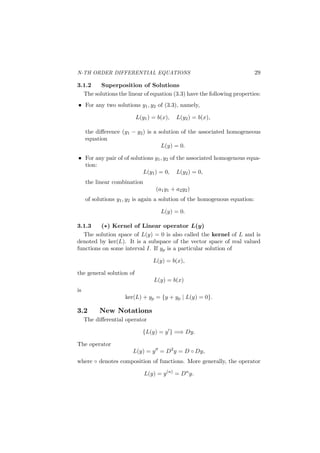
N-TH ORDER DIFFERENTIAL EQUATIONS 29
3.1.2 Superposition of Solutions
The solutions the linear of equation (3.3) have the following properties:
For any two solutions y1, y2 of (3.3), namely,
L(y1) = b(x), L(y2) = b(x),
the difference (y1 − y2) is a solution of the associated homogeneous
equation
L(y) = 0.
For any pair of of solutions y1, y2 of the associated homogenous equa-
tion:
L(y1) = 0, L(y2) = 0,
the linear combination
(a1y1 + a2y2)
of solutions y1, y2 is again a solution of the homogenous equation:
L(y) = 0.
3.1.3 (∗) Kernel of Linear operator L(y)
The solution space of L(y) = 0 is also called the kernel of L and is
denoted by ker(L). It is a subspace of the vector space of real valued
functions on some interval I. If yp is a particular solution of
L(y) = b(x),
the general solution of
L(y) = b(x)
is
ker(L) + yp = {y + yp | L(y) = 0}.
3.2 New Notations
The differential operator
{L(y) = y′
} =⇒ Dy.
The operator
L(y) = y′′
= D2
y = D ◦ Dy,
where ◦ denotes composition of functions. More generally, the operator
L(y) = y(n)
= Dn
y.
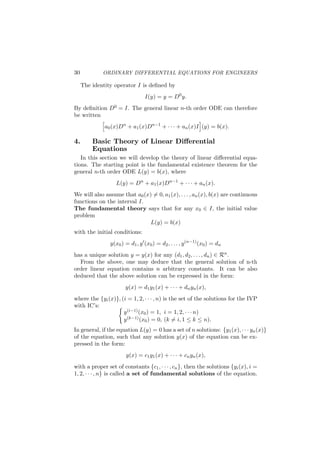
30 ORDINARY DIFFERENTIAL EQUATIONS FOR ENGINEERS
The identity operator I is defined by
I(y) = y = D0
y.
By definition D0 = I. The general linear n-th order ODE can therefore
be written
[
a0(x)Dn
+ a1(x)Dn−1
+ · · · + an(x)I
]
(y) = b(x).
4. Basic Theory of Linear Differential
Equations
In this section we will develop the theory of linear differential equa-
tions. The starting point is the fundamental existence theorem for the
general n-th order ODE L(y) = b(x), where
L(y) = Dn
+ a1(x)Dn−1
+ · · · + an(x).
We will also assume that a0(x) ̸= 0, a1(x), . . . , an(x), b(x) are continuous
functions on the interval I.
The fundamental theory says that for any x0 ∈ I, the initial value
problem
L(y) = b(x)
with the initial conditions:
y(x0) = d1, y′
(x0) = d2, . . . , y(n−1)
(x0) = dn
has a unique solution y = y(x) for any (d1, d2, . . . , dn) ∈ Rn.
From the above, one may deduce that the general solution of n-th
order linear equation contains n arbitrary constants. It can be also
deduced that the above solution can be expressed in the form:
y(x) = d1y1(x) + · · · + dnyn(x),
where the {yi(x)}, (i = 1, 2, · · · , n) is the set of the solutions for the IVP
with IC’s: {
y(i−1)(x0) = 1, i = 1, 2, · · · n)
y(k−1)(x0) = 0, (k ̸= i, 1 ≤ k ≤ n).
In general, if the equation L(y) = 0 has a set of n solutions: {y1(x), · · · yn(x)}
of the equation, such that any solution y(x) of the equation can be ex-
pressed in the form:
y(x) = c1y1(x) + · · · + cnyn(x),
with a proper set of constants {c1, · · · , cn}, then the solutions {yi(x), i =
1, 2, · · · , n} is called a set of fundamental solutions of the equation.
N-TH ORDER DIFFERENTIAL EQUATIONS 31
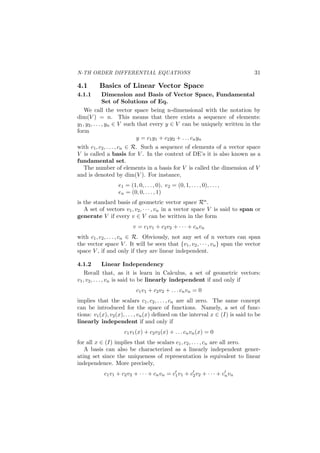
4.1 Basics of Linear Vector Space
4.1.1 Dimension and Basis of Vector Space, Fundamental
Set of Solutions of Eq.
We call the vector space being n-dimensional with the notation by
dim(V ) = n. This means that there exists a sequence of elements:
y1, y2, . . . , yn ∈ V such that every y ∈ V can be uniquely written in the
form
y = c1y1 + c2y2 + . . . cnyn
with c1, c2, . . . , cn ∈ R. Such a sequence of elements of a vector space
V is called a basis for V . In the context of DE’s it is also known as a
fundamental set.
The number of elements in a basis for V is called the dimension of V
and is denoted by dim(V ). For instance,
e1 = (1, 0, . . . , 0), e2 = (0, 1, . . . , 0), . . . ,
en = (0, 0, . . . , 1)
is the standard basis of geometric vector space Rn.
A set of vectors v1, v2, · · · , vn in a vector space V is said to span or
generate V if every v ∈ V can be written in the form
v = c1v1 + c2v2 + · · · + cnvn
with c1, c2, . . . , cn ∈ R. Obviously, not any set of n vectors can span
the vector space V . It will be seen that {v1, v2, · · · , vn} span the vector
space V , if and only if they are linear independent.
4.1.2 Linear Independency
Recall that, as it is learn in Calculus, a set of geometric vectors:
v1, v2, . . . , vn is said to be linearly independent if and only if
c1v1 + c2v2 + . . . cnvn = 0
implies that the scalars c1, c2, . . . , cn are all zero. The same concept
can be introduced for the space of functions. Namely, a set of func-
tions: v1(x), v2(x), . . . , vn(x) defined on the interval x ∈ (I) is said to be
linearly independent if and only if
c1v1(x) + c2v2(x) + . . . cnvn(x) = 0
for all x ∈ (I) implies that the scalars c1, c2, . . . , cn are all zero.
A basis can also be characterized as a linearly independent gener-
ating set since the uniqueness of representation is equivalent to linear
independence. More precisely,
c1v1 + c2v2 + · · · + cnvn = c′
1v1 + c′
2v2 + · · · + c′
nvn
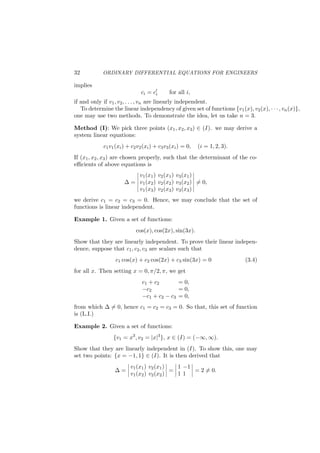
32 ORDINARY DIFFERENTIAL EQUATIONS FOR ENGINEERS
implies
ci = c′
i for all i,
if and only if v1, v2, . . . , vn are linearly independent.
To determine the linear independency of given set of functions {v1(x), v2(x), · · · , vn(x)},
one may use two methods. To demonstrate the idea, let us take n = 3.
Method (I): We pick three points (x1, x2, x3) ∈ (I). we may derive a
system linear equations:
c1v1(xi) + c2v2(xi) + c3v3(xi) = 0, (i = 1, 2, 3).
If (x1, x2, x3) are chosen properly, such that the determinant of the co-
efficients of above equations is
∆ =
v1(x1) v2(x1) v3(x1)
v1(x2) v2(x2) v3(x2)
v1(x3) v2(x3) v3(x3)
̸= 0,
we derive c1 = c2 = c3 = 0. Hence, we may conclude that the set of
functions is linear independent.
Example 1. Given a set of functions:
cos(x), cos(2x), sin(3x).
Show that they are linearly independent. To prove their linear indepen-
dence, suppose that c1, c2, c3 are scalars such that
c1 cos(x) + c2 cos(2x) + c3 sin(3x) = 0 (3.4)
for all x. Then setting x = 0, π/2, π, we get
c1 + c2 = 0,
−c2 = 0,
−c1 + c2 − c3 = 0,
from which ∆ ̸= 0, hence c1 = c2 = c3 = 0. So that, this set of function
is (L.I.)
Example 2. Given a set of functions:
{v1 = x3
, v2 = |x|3
}, x ∈ (I) = (−∞, ∞).
Show that they are linearly independent in (I). To show this, one may
set two points: {x = −1, 1} ∈ (I). It is then derived that
∆ =
v1(x1) v2(x1)
v1(x2) v2(x2)
=
1 −1
1 1
= 2 ̸= 0.
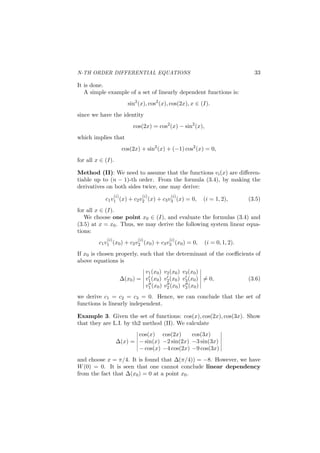
N-TH ORDER DIFFERENTIAL EQUATIONS 33
It is done.
A simple example of a set of linearly dependent functions is:
sin2
(x), cos2
(x), cos(2x), x ∈ (I).
since we have the identity
cos(2x) = cos2
(x) − sin2
(x),
which implies that
cos(2x) + sin2
(x) + (−1) cos2
(x) = 0,
for all x ∈ (I).
Method (II): We need to assume that the functions vi(x) are differen-
tiable up to (n − 1)-th order. From the formula (3.4), by making the
derivatives on both sides twice, one may derive:
c1v
(i)
1 (x) + c2v
(i)
2 (x) + c3v
(i)
3 (x) = 0, (i = 1, 2), (3.5)
for all x ∈ (I).
We choose one point x0 ∈ (I), and evaluate the formulas (3.4) and
(3.5) at x = x0. Thus, we may derive the following system linear equa-
tions:
c1v
(i)
1 (x0) + c2v
(i)
2 (x0) + c3v
(i)
3 (x0) = 0, (i = 0, 1, 2).
If x0 is chosen properly, such that the determinant of the coefficients of
above equations is
∆(x0) =
v1(x0) v2(x0) v3(x0)
v′
1(x0) v′
2(x0) v′
3(x0)
v′′
1 (x0) v′′
2 (x0) v′′
3 (x0)
̸= 0, (3.6)
we derive c1 = c2 = c3 = 0. Hence, we can conclude that the set of
functions is linearly independent.
Example 3. Given the set of functions: cos(x), cos(2x), cos(3x). Show
that they are L.I. by th2 method (II). We calculate
∆(x) =
cos(x) cos(2x) cos(3x)
− sin(x) −2 sin(2x) −3 sin(3x)
− cos(x) −4 cos(2x) −9 cos(3x)
and choose x = π/4. It is found that ∆(π/4)) = −8. However, we have
W(0) = 0. It is seen that one cannot conclude linear dependency
from the fact that ∆(x0) = 0 at a point x0.
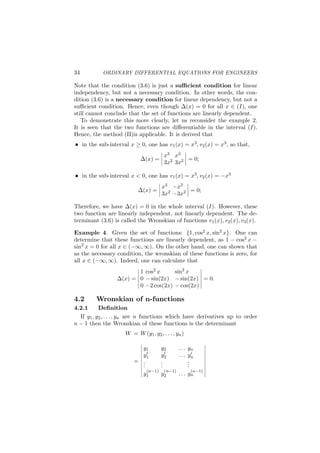
34 ORDINARY DIFFERENTIAL EQUATIONS FOR ENGINEERS
Note that the condition (3.6) is just a sufficient condition for linear
independency, but not a necessary condition. In other words, the con-
dition (3.6) is a necessary condition for linear dependency, but not a
sufficient condition. Hence, even though ∆(x) = 0 for all x ∈ (I), one
still cannot conclude that the set of functions are linearly dependent.
To demonstrate this more clearly, let us reconsider the example 2.
It is seen that the two functions are differentiable in the interval (I).
Hence, the method (II)is applicable. It is derived that
in the sub-interval x ≥ 0, one has v1(x) = x3, v2(x) = x3, so that,
∆(x) =
x3 x3
3x2 3x2
= 0;
in the sub-interval x < 0, one has v1(x) = x3, v2(x) = −x3
∆(x) =
x3 −x3
3x2 −3x2
= 0;
Therefore, we have ∆(x) = 0 in the whole interval (I). However, these
two function are linearly independent, not linearly dependent. The de-
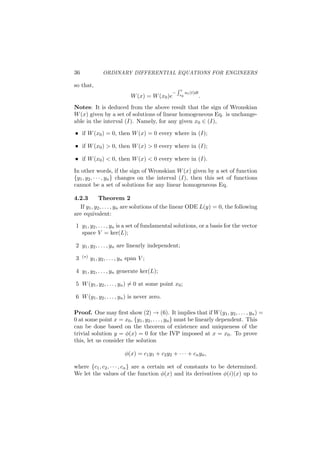
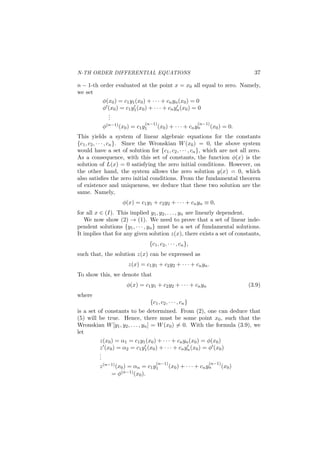
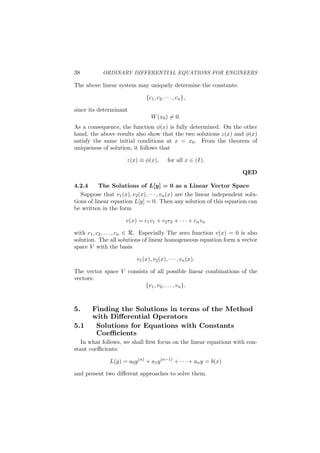
terminant (3.6) is called the Wronskian of functions v1(x), v2(x), v3(x).
Example 4. Given the set of functions: {1, cos2 x, sin2
x}. One can
determine that these functions are linearly dependent, as 1 − cos2 x −
sin2
x = 0 for all x ∈ (−∞, ∞). On the other hand, one can shown that
as the necessary condition, the wronskian of these functions is zero, for
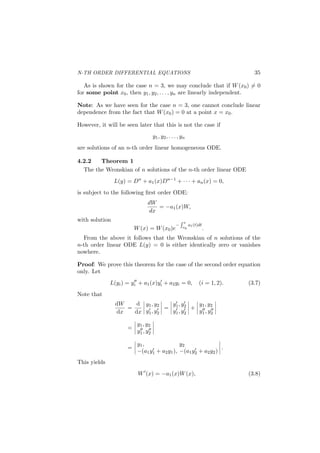
all x ∈ (−∞, ∞). Indeed, one can calculate that
∆(x) =

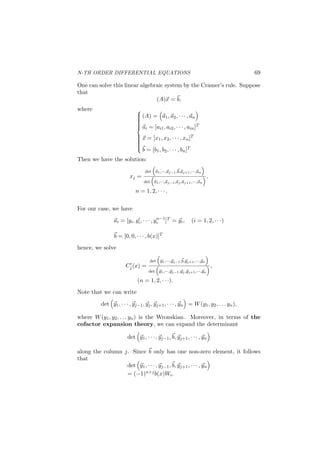
ODE.pdf

  • 1.
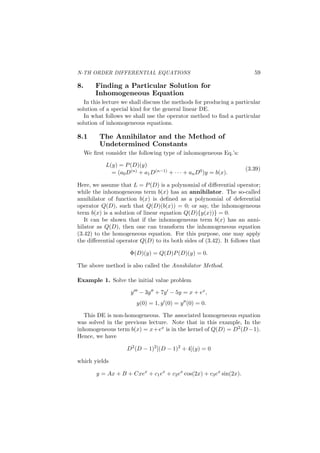
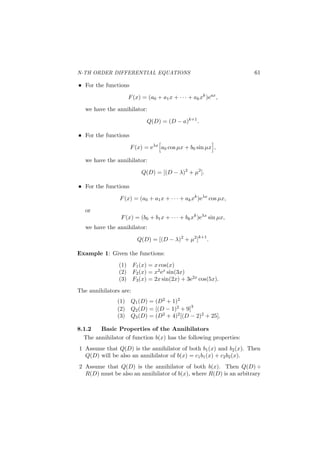
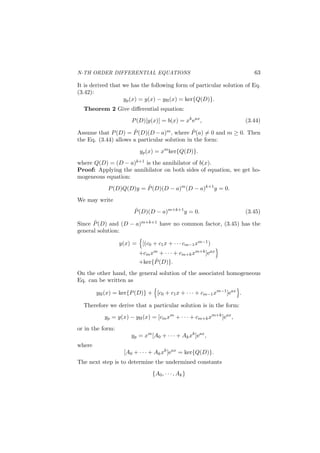
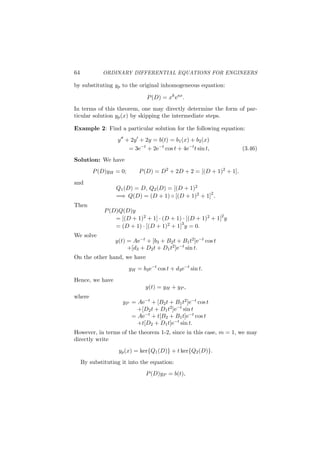
    ORDINARY DIFFERENTIAL EQUATIONS FORENGINEERS — THE LECTURE NOTES FOR MATH- 263 (2011)
  • 3.
    ORDINARY DIFFERENTIAL EQUATIONS FORENGINEERS JIAN-JUN XU Department of Mathematics and Statistics, McGill University Kluwer Academic Publishers Boston/Dordrecht/London
  • 4.
    Contents 1. INTRODUCTION 1 1Definitions and Basic Concepts 1 1.1 Ordinary Differential Equation (ODE) 1 1.2 Solution 1 1.3 Order n of the DE 2 1.4 Linear Equation: 2 1.5 Homogeneous Linear Equation: 3 1.6 Partial Differential Equation (PDE) 3 1.7 General Solution of a Linear Differential Equation 3 1.8 A System of ODE’s 4 2 The Approaches of Finding Solutions of ODE 5 2.1 Analytical Approaches 5 2.2 Numerical Approaches 5 2. FIRST ORDER DIFFERENTIAL EQUATIONS 7 1 Linear Equation 7 1.1 Linear homogeneous equation 8 1.2 Linear inhomogeneous equation 8 2 Nonlinear Equations (I) 11 2.1 Separable Equations. 11 2.2 Logistic Equation 14 2.3 Fundamental Existence and Uniqueness Theorem 16 2.4 Bernoulli Equation: 17 2.5 Homogeneous Equation: 18 3 Nonlinear Equations (II)— Exact Equation and Integrating Factor 20 3.1 Exact Equations. 20 v
  • 5.
    vi ORDINARY DIFFERENTIALEQUATIONS FOR ENGINEERS 4 Integrating Factors. 21
  • 6.
    Contents vii 3. N-THORDER DIFFERENTIAL EQUATIONS 25 1 Introduction 25 2 (*)Fundamental Theorem of Existence and Uniqueness 26 2.1 Theorem of Existence and Uniqueness (I) 26 2.2 Theorem of Existence and Uniqueness (II) 27 2.3 Theorem of Existence and Uniqueness (III) 27 3 Linear Equations 27 3.1 Basic Concepts and General Properties 27 3.1.1 Linearity 28 3.1.2 Superposition of Solutions 29 3.1.3 (∗) Kernel of Linear operator L(y) 29 3.2 New Notations 29 4 Basic Theory of Linear Differential Equations 30 4.1 Basics of Linear Vector Space 31 4.1.1 Dimension and Basis of Vector Space, Fundamental Set of Solutions of Eq. 31 4.1.2 Linear Independency 31 4.2 Wronskian of n-functions 34 4.2.1 Definition 34 4.2.2 Theorem 1 35 4.2.3 Theorem 2 36 4.2.4 The Solutions of L[y] = 0 as a Linear Vector Space 38 5 Finding the Solutions in terms of the Method with Differential Operators 38 5.1 Solutions for Equations with Constants Coefficients 38 5.1.1 Basic Equalities (I). 39 5.1.2 Cases (I) 39 5.1.3 Cases (II) 40 5.1.4 Cases (III) 40 5.1.5 Summary 42 5.1.6 Theorem 1 43 6 Solutions for Equations with Variable Coefficients 46 6.1 Euler Equations 47 7 Finding the Solutions in terms of the Method with Undetermined Parameters 49 7.1 Solutions for Equations with Constants Coefficients 50 7.2 Basic Equalities (II) 50
  • 7.
    viii ORDINARY DIFFERENTIALEQUATIONS FOR ENGINEERS 7.3 Cases (I) ( r1 > r2) 51 7.4 Cases (II) ( r1 = r2 ) 51 7.5 Cases (III) ( r1,2 = λ ± iµ) 54 7.6 Solutions for Euler Equations 54 7.7 Basic Equalities (III) 54 7.8 Cases (I) ( r1 ̸= r2) 55 7.9 Cases (II) ( r1 = r2 ) 55 7.10 Cases (III) ( r1,2 = λ ± iµ) 56 7.11 (*) Exact Equations 58 8 Finding a Particular Solution for Inhomogeneous Equation 59 8.1 The Annihilator and the Method of Undetermined Constants 59 8.1.1 The Annihilators for Some Types of Functions 60 8.1.2 Basic Properties of the Annihilators 61 8.1.3 The Basic Theorems of the Annihilator Method 62 8.2 The Method of Variation of Parameters 67 8.3 Reduction of Order 71 4. LAPLACE TRANSFORMS 75 1 Introduction 75 2 Laplace Transform 77 2.1 Definition 77 2.1.1 Piecewise Continuous Function 77 2.1.2 Laplace Transform 77 2.2 Existence of Laplace Transform 77 3 Basic Properties and Formulas of Laplace Transform 78 3.1 Linearity of Laplace Transform 78 3.2 Laplace Transforms for f(t) = eat 78 3.3 Laplace Transforms for f(t) = {sin(bt) and cos(bt)} 78 3.4 Laplace Transforms for {eatf(t); f(bt)} 79 3.5 Laplace Transforms for {tnf(t)} 79 3.6 Laplace Transforms for {f′(t)} 80 4 Inverse Laplace Transform 80 4.1 Theorem 1: 80 4.2 Theorem 2: 81 4.3 Definition 81
  • 8.
    Contents ix 5 SolveIVP of DE’s with Laplace Transform Method 81 5.1 Example 1 81 5.2 Example 2 83 5.3 Example 3 85 6 Further Studies of Laplace Transform 86 6.1 Step Function 86 6.1.1 Definition 86 6.1.2 Some basic operations with the step function 86 6.1.3 Laplace Transform of Unit Step Function 87 6.2 Impulse Function 93 6.2.1 Definition 93 6.2.2 Laplace Transform of Impulse Function 94 6.3 Convolution Integral 95 6.3.1 Theorem 95 6.3.2 The properties of convolution integral 95 5. SERIES SOLUTION OF LINEAR DIFFERENTIAL EQUATIONS 97 1 Series Solutions near an Ordinary Point 97 1.1 Introduction 97 1.2 Series Solutions near an Ordinary Point 98 2 Series Solution near a Regular Singular Point 101 2.1 Introduction 101 2.2 Series Form of Solutions near a Regular Singular Point 101 2.2.1 Case (I): The roots (r1 − r2 ̸= N) 103 2.2.2 Case (II): The roots (r1 = r2) 104 2.2.3 Case (III): The roots (r1 − r2 = N > 0) 105 2.3 Summary 107 3 (*)Bessel Equation 114 3.1 The Case of Non-integer ν 115 3.2 The Case of ν = −m with m an integer ≥ 0 116 4 Behaviors of Solutions near the Regular Singular Point x = 0 118 4.1 Case (I): r1 − r2 ̸= N 119 4.2 Case (II): r1 = r2 119 4.3 Case (III): r1 − r2 = N ̸= 0 120 6. (∗) SYSTEMS OF LINEAR DIFFERENTIAL EQUATIONS 121 1 Introduction 121
  • 9.
    x ORDINARY DIFFERENTIALEQUATIONS FOR ENGINEERS 1.1 (2 × 2) System of Linear Equations 122 1.2 Case 1: ∆ > 0 122 1.3 Case 2: ∆ < 0 123 1.4 Case 3: ∆ = 0 124 2 Solutions for (n × n) Homogeneous Linear System 128 2.1 Case (I): (A) is non-defective matrix 128 2.2 Case (II): (A) has a pair of complex conjugate eigen-values 130 2.3 Case (III): (A) is a defective matrix 130 3 Solutions for Non-homogeneous Linear System 133 3.1 Variation of Parameters Method 133
  • 12.
    Chapter 1 INTRODUCTION 1. Definitionsand Basic Concepts 1.1 Ordinary Differential Equation (ODE) An equation involving the derivatives of an unknown function y of a single variable x over an interval x ∈ (I). More clearly and precisely speaking, a well defined ODE must the following features: It can be written in the form: F[x, y, y′ , y′′ , · · · , yn ] = 0; (1.1) where the mathematical expression on the right hand side contains (1). variable x, (2). function y of x, and (3). some derivatives of y with respect to x; The values of variables x, y must be specified in a certain number field, such as N, R, or C; The variation region of variable x of Eq. must be specified, such as x ∈ (I) = (a, b). 1.2 Solution Any function y = f(x) which satisfies this equation over the interval (I) is called a solution of the ODE. More clearly speaking, function ϕ(x) is called a solution of the give EQ. (1.1), if the following requirements are satisfies: The function ϕ(x) is defined in the region x ∈ (I); The function ϕ(x) is differentiable, hence, {ϕ′(x), · · · , ϕ(n)(x)} all exit, in the region x ∈ (I); 1
  • 13.
    2 ORDINARY DIFFERENTIALEQUATIONS FOR ENGINEERS With the replacements of the variables y, y′, · · · , y(n) in 1.1 by the functions ϕ(x), ϕ′(x), · · · , ϕ(n)(x), the EQ. (1.1) becomes an identity over x ∈ (I). In other words, the right hand side of Eq. (1.1) becomes to zero for all x ∈ (I). For example, one can verify that y = e2x is a solution of the ODE y′ = 2y, x ∈ (−∞, ∞), and y = sin(x2) is a solution of the ODE xy′′ − y′ + 4x3 y = 0, x ∈ (−∞, ∞). 1.3 Order n of the DE An ODE is said to be order n, if y(n) is the highest order derivative occurring in the equation. The simplest first order ODE is y′ = g(x). Note that the expression F on the right hand side of an n-th order ODE: F[x, y, y′, . . . , y(n)] = 0 can be considered as a function of n + 2 variables (x, u0, u1, . . . , un). Namely, one may write F(x, u0, u1, · · · , un) = 0. Thus, the equations xy′′ + y = x3 , y′ + y2 = 0, y′′′ + 2y′ + y = 0 which are examples of ODE’s of second order, first order and third order respectively, can be in the forms: F(x, u0, u1, u2) = xu2 + u0 − x3, F(x, u0, u1) = u1 + u2 0, F(x, u0, u1, u2, u3) = u3 + 2u1 + u0. respectively. 1.4 Linear Equation: If the function F is linear in the variables u0, u1, . . . , un, which means every term in F is proportional to u0, u1, . . . , un, the ODE is said to be linear. If, in addition, F is homogeneous then the ODE is said to be homogeneous. The first of the above examples above is linear are linear, the second is non-linear and the third is linear and homogeneous. The general n-th order linear ODE can be written an(x)dny dxn + an−1(x)dn−1y dxn−1 + · · · + a1(x)dy dx +a0(x)y = b(x).
  • 14.
    INTRODUCTION 3 1.5 HomogeneousLinear Equation: The linear DE is homogeneous, if and only if b(x) ≡ 0. Linear homo- geneous equations have the important property that linear combinations of solutions are also solutions. In other words, if y1, y2, . . . , ym are solu- tions and c1, c2, . . . , cm are constants then c1y1 + c2y2 + · · · + cmym is also a solution. 1.6 Partial Differential Equation (PDE) An equation involving the partial derivatives of a function of more than one variable is called PED. The concepts of linearity and homo- geneity can be extended to PDE’s. The general second order linear PDE in two variables x, y is a(x, y)∂2u ∂x2 + b(x, y) ∂2u ∂x∂y + c(x, y)∂2u ∂y2 + d(x, y)∂u ∂x +e(x, y)∂u ∂y + f(x, y)u = g(x, y). Laplace’s equation ∂2u ∂x2 + ∂2u ∂y2 = 0 is a linear, homogeneous PDE of order 2. The functions u = log(x2 +y2), u = xy, u = x2 −y2 are examples of solutions of Laplace’s equation. We will not study PDE’s systematically in this course. 1.7 General Solution of a Linear Differential Equation It represents the set of all solutions, i.e., the set of all functions which satisfy the equation in the interval (I). For example, given the differential equation y′ = 3x2 . Its general solution is y = x3 + C where C is an arbitrary constant. To select a specific solution, one needs to determine the constant C with some additional conditions. For instance, the constant C can be determined by the value of y at x = 0. This condition is called the initial condition, which completely
  • 15.
    4 ORDINARY DIFFERENTIALEQUATIONS FOR ENGINEERS determines the solution. More generally, it will be shown in the future that given a, b there is a unique solution y of the differential equation with the initial condition y(a) = b. Geometrically, this means that the one-parameter family of curves y = x2 + C do not intersect one another and they fill up the plane R2. 1.8 A System of ODE’s The normal form of system of ODE’s is y′ 1 = G1(x, y1, y2, . . . , yn) y′ 2 = G2(x, y1, y2, . . . , yn) . . . y′ n = Gn(x, y1, y2, . . . , yn). The number of the equations is called the order of such system. An n-th order ODE of the form y(n) = G(x, y, y′, . . . , yn−1) can be transformed in the form of the n-th order system of DE’s. If we introduce dependant variables y1 = y, y2 = y′ , . . . , yn = yn−1 we obtain the equivalent system of first order equations y′ 1 = y2, y′ 2 = y3, . . . y′ n = G(x, y1, y2, . . . , yn). For example, the ODE y′′ = y is equivalent to the system y′ 1 = y2, y′ 2 = y1. In this way the study of n-th order equations can be reduced to the study of systems of n first order equations, or say,n-th order of system of ODE’s. Systems of equations arise in the study of the motion of particles. For example, if P(x, y) is the position of a particle of mass m at time t, moving in a plane under the action of the force field (f(x, y), g(x, y), we have md2x dt2 = f(x, y), md2y dt2 = g(x, y). This is a system of two second order Eq’s, it can be easily transformed into a normal form of 4-th order system of ODE’s, by introducing the new unknown functions: x1 = x, x2 = x′ and y1 = y, y2 = y′.
  • 16.
    INTRODUCTION 5 The generalfirst order ODE in normal form is y′ = F(x, y). If F and ∂F ∂y are continuous one can show that, given a, b, there is a unique solution with y(a) = b. Describing this solution is not an easy task and there are a variety of ways to do this. The dependence of the solution on initial conditions is also an important question as the initial values may be only known approximately. The non-linear ODE yy′ = 4x is not in normal form but can be brought to normal form y′ = 4x y . by dividing both sides by y. 2. The Approaches of Finding Solutions of ODE 2.1 Analytical Approaches Analytical solution methods: finding the exact form of solutions; Geometrical methods: finding the qualitative behavior of solutions; Asymptotic methods: finding the asymptotic form of the solution, which gives good approximation of the exact solution. 2.2 Numerical Approaches Numerical algorithms — numerical methods; Symbolic manipulators — Maple, MATHEMATICA, MacSyma. This course mainly discuss the analytical approaches and mainly on analytical solution methods.
  • 18.
    Chapter 2 FIRST ORDERDIFFERENTIAL EQUATIONS In this chapter we are going to treat linear and separable first order ODE’s. 1. Linear Equation The general first order ODE has the form F(x, y, y′) = 0 where y = y(x). If it is linear it can be written in the form a0(x)y′ + a1(x)y = b(x) where a0(x), a(x), b(x) are continuous functions of x on some interval (I). To bring it to normal form y′ = f(x, y) we have to divide both sides of the equation by a0(x). This is possible only for those x where a0(x) ̸= 0. After possibly shrinking (I) we assume that a0(x) ̸= 0 on (I). So our equation has the form (standard form) y′ + p(x)y = q(x) with p(x) = a1(x)/a0(x), q(x) = b(x)/a0(x), both continuous on (I). Solving for y′ we get the normal form for a linear first order ODE, namely y′ = q(x) − p(x)y. 7
  • 19.
    8 ORDINARY DIFFERENTIALEQUATIONS FOR ENGINEERS 1.1 Linear homogeneous equation Let us first consider the simple case: q(x) = 0, namely, dy dx + p(x)y = 0. (2.1) To find the solutions, we proceed in the following three steps: Assume that the solution exists and in the form y = y(x); Find the necessary form of the function y(x). In doing so, by the definition of the solution, one substitute the function y(x) in the Eq., and try to transform the EQ. in such a way that its LHS of EQ. is a complete differentiation d dx[.....], while its RHS is a known function. Verify y(x) is indeed a solution. In the step #2, with the chain law of derivative, one may transform Eq. (2.1) into the following form: y′(x) y = d dx ln |y(x)| = −p(x). Its LHS is now changed a complete differentiation with respect to x, while its RHS is a known function. By integrating both sides, we derive ln |y(x)| = − ∫ p(x)dx + C, or y = ±C1e− ∫ p(x)dx , where C, as well as C1 = eC > 0, is arbitrary constant. As C=0, y(x) = 0 is a trivial solution, we derive the necessary form of solution: y = Ae− ∫ p(x)dx . (2.2) As the final step of derivation, one can verify the function (2.2) is indeed a solution for any value of constant A. In summary, we deduce that (2.2) is the form of solution, that contains all possible solution. Hence, one can call (2.2) as the general solution of Eq. (2.1). 1.2 Linear inhomogeneous equation We now consider the general case: dy dx + p(x)y = q(x).
  • 20.
    FIRST ORDER DIFFERENTIALEQUATIONS 9 We still proceed in the three steps as we did in the previous subsection. However, now in the step #2 one cannot directly transform the LHS of Eq. in the complete differential form as we did for the case of homoge- neous Eq. For this purpose, we multiply the both sides of our differential equation with a factor µ(x) ̸= 0. Then our equation is equivalent (has the same solutions) to the equation µ(x)y′ (x) + µ(x)p(x)y(x) = µ(x)q(x). We wish that with a properly chosen function µ(x), µ(x)y′ (x) + µ(x)p(x)y(x) = d dx [µ(x)y(x)]. For this purpose, the function µ(x) must has the property µ′ (x) = p(x)µ(x), (2.3) and µ(x) ̸= 0 for all x. By solving the linear homogeneous equation (2.3), one obtain µ(x) = e ∫ p(x)dx . (2.4) With this function, which is called an integrating factor, our equation is now transformed into the form that we wanted: d dx [µ(x)y(x)] = µ(x)q(x), (2.5) Integrating both sides, we get µ(x)y = ∫ µ(x)q(x)dx + C with C an arbitrary constant. Solving for y, we get y = 1 µ(x) ∫ µ(x)q(x)dx + C µ(x) = yP (x) + yH(x) (2.6) as the general solution for the general linear first order ODE y′ + p(x)y = q(x). In solution (2.6): the first part, yP (x): a particular solution of the inhomogeneous equation,
  • 21.
    10 ORDINARY DIFFERENTIALEQUATIONS FOR ENGINEERS the second part, yH(x): the general solution of the associate homogeneous equation. Note that for any pair of scalars a, b with a in (I), there is a unique scalar C such that y(a) = b. Geometrically, this means that the solution curves y = ϕ(x) are a family of non-intersecting curves which fill the region I × R. Example 1: y′ + xy = x. This is a linear first order ODE in standard form with p(x) = q(x) = x. The integrating factor is µ(x) = e ∫ xdx = ex2/2 . Hence, after multiplying both sides of our differential equation, we get d dx (ex2/2 y) = xex2/2 which, after integrating both sides, yields ex2/2 y = ∫ xex2/2 dx + C = ex2/2 + C. Hence the general solution is y = 1 + Ce−x2/2. The solution satisfying the initial condition: y(0) = 1: y = 1, (C = 0); and the solution satisfying I.C., y(0) = a: y = 1 + (a − 1)e−x2/2 , (C = a − 1). Example 2: xy′ − 2y = x3 sin x, (x > 0). We bring this linear first order equation to standard form by dividing by x. We get y′ − 2 x y = x2 sin x. The integrating factor is µ(x) = e ∫ −2dx/x = e−2 ln x = 1/x2 . After multiplying our DE in standard form by 1/x2 and simplifying, we get d dx (y/x2 ) = sin x
  • 22.
    FIRST ORDER DIFFERENTIALEQUATIONS 11 from which y/x2 = − cos x + C, and y = −x2 cos x + Cx2 . (2.7) Note that (2.7) is a family of solutions to the DE xy′ − 2y = x3 sin x. To determine a special solution, one needs to impose an IC. For this problem, let us exam the following IC’s: 1 For given IC: y(0) = 0, from the general solution (2.7) we derive that 0 = y(0) = 0 + c ∗ 0 = 0. So that, the IC is satisfied for any constant C. The problem has infinitely many solutions. 2 For given IC: y(0) = b ̸= 0, from the general solution (2.7) we derive that b = y(0) = 0 + c ∗ 0 = 0. So that, the IC cannot be satisfied with any constant C. The problem has no solution. 3 For given IC: y(a) = b where a ̸= 0 and b is any number, from the general solution (2.7) we derive that b = y(0) = −a2 cos a + c ∗ a2 = a2 (C − cos a), so that, C = cos a + b/a2 is uniquely determined. The problem has a unique solution. This example displays a complicated situation, when the IC is imposed at x = 0. Why does this happen? The simple explanation to such abnormality is that because x = 0 is a singular point, where p(0) = ∞. Such an abnormal situation will be discussed more deeply in the future. 2. Nonlinear Equations (I) 2.1 Separable Equations. The first order ODE y′ = f(x, y) is said to be separable if f(x, y) can be expressed as a product of a function of x times a function of y. The DE then has the form: y′ = g(x)h(y), x ∈ (I).
  • 23.
    12 ORDINARY DIFFERENTIALEQUATIONS FOR ENGINEERS We apply the procedure of three steps for the solutions as before. Assume that the solution y = y(x) exists, and h(y) ̸= 0 as x ∈ (I). Then by dividing both sides by h[y(x)], it becomes y′(x) h[y(x)] = g(x). (2.8) Of course this is not valid for those solutions y = y(x) at the points where h[y(x)] = 0. Furthermore, we assume that the LHS can be written in the form of complete differentiation: d dxH[y(x)], where H[y(x)] is a composite function of x to be determined. Once we find the function H(y), we may write H[y(x)] = ∫ y′(x) h[y(x)] dx = ∫ g(x)dx + C. However, by chain rule we have d dx H[y(x)] = H′ (y)y′ (x). By comparing the above with the LHS of (3.33), it follows that H′ (y) = 1 h(y) . Thus, we derive that H(y) = ∫ dy h(y) = ∫ g(x)dx + C, (2.9) This gives the implicit form of the solution. It determines the value of y implicitly in terms of x. The function given in (2.9) can be easily verified as indeed a solution. Note that with the assumption h(y) ̸= 0 at the beginning of the derivation, some solution may be excluded in (2.9). As a matter of fact, one can verify that the Eq. may allow the constant solutions, y = y∗, (2.10) as h(y∗) = 0. Example 1: y′ = x−5 y2 . To solve it using the above method we multiply both sides of the equation by y2 to get y2 y′ = (x − 5).
  • 24.
    FIRST ORDER DIFFERENTIALEQUATIONS 13 Integrating both sides we get y3/3 = x2/2 − 5x + C. Hence, y = [ 3x2 /2 − 15x + C1 ]1/3 . Example 2: y′ = y−1 x+3 (x > −3). By inspection, y = 1 is a solution. Dividing both sides of the given DE by y − 1 we get y′ y − 1 = 1 x + 3 . This will be possible for those x where y(x) ̸= 1. Integrating both sides we get ∫ y′ y − 1 dx = ∫ dx x + 3 + C1, from which we get ln |y − 1| = ln(x + 3) + C1. Thus |y − 1| = eC1 (x + 3) from which y − 1 = ±eC1 (x + 3). If we let C = ±eC1 , we get y = 1 + C(x + 3) . Since y = 1 was found to be a solution by inspection the general solution is y = 1 + C(x + 3), where C can be any scalar. For any (a, b) with a ̸= −3, there is only one member of this family which passes through (a, b). However, it is seen that there is a family of lines passing through (−3, 1), while no solution line passing through (−3, b) with b ̸= 1). Here, x = −3 is a singular point. Example 3: y′ = y cos x 1+2y2 . Transforming in the standard form then integrating both sides we get ∫ (1 + 2y2) y dy = ∫ cos x dx + C, from which we get a family of the solutions: ln |y| + y2 = sin x + C, where C is an arbitrary constant. However, this is not the general solu- tion of the equation, as it does not contains, for instance, the solution: y = 0. With I.C.: y(0)=1, we get C = 1, hence, the solution: ln |y| + y2 = sin x + 1.
  • 25.
    14 ORDINARY DIFFERENTIALEQUATIONS FOR ENGINEERS 2.2 Logistic Equation y′ = ay(b − y), where a, b > 0 are fixed constants. This equation arises in the study of the growth of certain populations. Since the right-hand side of the equation is zero for y = 0 and y = b, the given DE has y = 0 and y = b as solutions. More generally, if y′ = f(t, y) and f(t, c) = 0 for all t in some interval (I), the constant function y = c on (I) is a solution of y′ = f(t, y) since y′ = 0 for a constant function y. To solve the logistic equation, we write it in the form y′ y(b − y) = a. Integrating both sides with respect to t we get ∫ y′dt y(b − y) = at + C which can, since y′dt = dy, be written as ∫ dy y(b − y) = at + C. Since, by partial fractions, 1 y(b − y) = 1 b ( 1 y + 1 b − y ) we obtain 1 b (ln |y| − ln |b − y|) = at + C. Multiplying both sides by b and exponentiating both sides to the base e, we get |y| |b − y| = ebC eabt = C1eabt , where the arbitrary constant C1 = ebC > 0 can be determined by the initial condition (IC): y(0) = y0 as C1 = |y0| |b − y0| . Two cases need to be discussed separately.
  • 26.
    FIRST ORDER DIFFERENTIALEQUATIONS 15 Case (I), y0 < b: one has C1 = | y0 b−y0 | = y0 b−y0 > 0. So that, |y| |b − y| = ( y0 b − y0 ) eabt > 0, (t ∈ (I)). From the above we derive y/(b − y) = C1eabt , y = (b − y)C1eabt . This gives y = bC1eabt 1 + C1eabt = b ( y0 b−y0 ) eabt 1 + ( y0 b−y0 ) eabt . It shows that if y0 = 0, one has the solution y(t) = 0. However, if 0 < y0 < b, one has the solution 0 < y(t) < b, and as t → ∞, y(t) → b. Case (II), y0 > b: one has C1 = | y0 b−y0 | = − y0 b−y0 > 0. So that,
  • 30.
  • 34.
    = ( y0 y0 − b ) eabt >0, (t ∈ (I)). From the above we derive y/(y − b) = ( y0 y0 − b ) eabt , y = (y − b) ( y0 y0 − b ) eabt . This gives y = b ( y0 y0−b ) eabt ( y0 y0−b ) eabt − 1 . It shows that if y0 > b, one has the solution y(t) > b, and as t → ∞, y(t) → b. It is derived that y(t) = 0 is an unstable equilibrium state of the system; y(t) = b is a stable equilibrium state of the system.
  • 35.
    16 ORDINARY DIFFERENTIALEQUATIONS FOR ENGINEERS 2.3 Fundamental Existence and Uniqueness Theorem If the function f(x, y) together with its partial derivative with respect to y are continuous on the rectangle (R) : |x − x0| ≤ a, |y − y0| ≤ b there is a unique solution to the initial value problem y′ = f(x, y), y(x0) = y0 defined on the interval |x − x0| < h where h = min(a, b/M), M = max |f(x, y)|, (x, y) ∈ (R). Note that this theorem indicates that a solution may not be defined for all x in the interval |x − x0| ≤ a. For example, the function y = bCeabx 1 + Ceabx is solution to y′ = ay(b − y) but not defined when 1 + Ceabx = 0 even though f(x, y) = ay(b − y) satisfies the conditions of the theorem for all x, y. The next example show why the condition on the partial derivative in the above theorem is important sufficient condition. Consider the differential equation y′ = y1/3. Again y = 0 is a solution. Separating variables and integrating, we get ∫ dy y1/3 = x + C1 which yields y2/3 = 2x/3 + C and hence y = ±(2x/3 + C)3/2 . Taking C = 0, we get the solution y = ±(2x/3)3/2 , (x ≥ 0) which along with the solution y = 0 satisfies y(0) = 0. Even more, Taking C = −(2x0/3)3/2, we get the solution:
  • 36.
    FIRST ORDER DIFFERENTIALEQUATIONS 17 y = { 0 (0 ≤ x ≤ x0) ±[2(x − x0)/3]3/2 , (x ≥ x0) which also satisfies y(0) = 0. So the initial value problem y′ = y1/3 , y(0) = 0 does not have a unique solution. The reason this is so is due to the fact that ∂f ∂y (x, y) = 1 3y2/3 is not continuous when y = 0. Many differential equations become linear or separable after a change of variable. We now give two examples of this. 2.4 Bernoulli Equation: y′ = p(x)y + q(x)yn (n ̸= 1). Note that y = 0 is a solution. To solve this equation, we set u = yα , where α is to be determined. Then, we have u′ = αyα−1 y′ , hence, our differential equation becomes u′ /α = p(x)u + q(x)yα+n−1 . (2.11) Now set α = 1 − n, Thus, (2.11) is reduced to u′ /α = p(x)u + q(x), (2.12) which is linear. We know how to solve this for u from which we get solve u = y1−n to get y = u1/(1−n) . (2.13)
  • 37.
    18 ORDINARY DIFFERENTIALEQUATIONS FOR ENGINEERS 2.5 Homogeneous Equation: y′ = F(y/x). To solve this we let u = y/x, so that y = xu, and y′ = u + xu′ . Substituting for y, y′ in our DE gives u + xu′ = F(u) which is a separable equation. Solving this for u gives y via y = xu. Note that u ≡ a is a solution of xu′ = F(u) − u whenever F(a) = a and that this gives y = ax as a solution of y′ = f(y/x). Example. y′ = (x − y)/x + y. This is a homogeneous equation since x − y x + y = 1 − y/x 1 + y/x . Setting u = y/x, our DE becomes xu′ + u = 1 − u 1 + u so that xu′ = 1 − u 1 + u − u = 1 − 2u − u2 1 + u . Note that the right-hand side is zero if u = −1± √ 2. Separating variables and integrating with respect to x, we get ∫ (1 + u)du 1 − 2u − u2 = ln |x| + C1
  • 38.
    FIRST ORDER DIFFERENTIALEQUATIONS 19 which in turn gives (−1/2) ln |1 − 2u − u2 | = ln |x| + C1. Exponentiating, we get 1 √ |1 − 2u − u2| = eC1 |x|. Squaring both sides and taking reciprocals, we get u2 + 2u − 1 = C/x2 with C = ±1/e2C1 . This equation can be solved for u using the quadratic formula. If x0, y0 are given with x0 ̸= 0, and u0 = y0/x0 ̸= −1 there is, by the fundamental, existence and uniqueness theorem, a unique solution with I.C. y(x0) = y0. For example, if x0 = 1, y0 = 2, we have, u(x0) = 2, so, C = 7 and hence u2 + 2u − 1 = 7/x2 Solving for u, we get u = −1 + √ 2 + 7/x2 where the positive sign in the quadratic formula was chosen to make u = 2, x = 1 a solution. Hence y = −x + x √ 2 + 7/x2 = −x + √ 2x2 + 7 is the solution to the initial value problem y′ = x − y x + y , y(1) = 2 for x > 0 and one can easily check that it is a solution for all x. Moreover, using the fundamental uniqueness theorem, it can be shown that it is the only solution defined for all x.
  • 39.
    20 ORDINARY DIFFERENTIALEQUATIONS FOR ENGINEERS 3. Nonlinear Equations (II)— Exact Equation and Integrating Factor 3.1 Exact Equations. By a region of the (x, y)-plane we mean a connected open subset of the plane. The differential equation M(x, y) + N(x, y) dy dx = 0 is said to be exact on a region (R) if there is a function F(x, y) defined on (R) such that ∂F ∂x = M(x, y); ∂F ∂y = N(x, y) In this case, if M, N are continuously differentiable on (R) we have ∂M ∂y = ∂N ∂x . (2.14) Conversely, it can be shown that condition (2.14) is also sufficient for the exactness of the given DE on (R) providing that (R) is simply connected, .i.e., has no “holes”. The exact equations are solvable. In fact, suppose y(x) is its solution. Then one can write: M [x, y(x)] + N [x, y(x)] dy dx = ∂F ∂x + ∂F ∂y dy dx = d dx F [x, y(x)] = 0. It follows that F [x, y(x)] = C, where C is an arbitrary constant. This is an implicit form of the solution y(x). Hence, the function F(x, y), if it is found, will give a family of the solutions of the given DE. The curves F(x, y) = C are called integral curves of the given DE. Example 1. 2x2y dy dx + 2xy2 + 1 = 0. Here M = 2xy2 + 1, N = 2x2 y and R = R2, the whole (x, y)-plane. The equation is exact on R2 since R2 is simply connected and ∂M ∂y = 4xy = ∂N ∂x .
  • 40.
    FIRST ORDER DIFFERENTIALEQUATIONS 21 To find F we have to solve the partial differential equations ∂F ∂x = 2xy2 + 1, ∂F ∂y = 2x2 y. If we integrate the first equation with respect to x holding y fixed, we get F(x, y) = x2 y2 + x + ϕ(y). Differentiating this equation with respect to y gives ∂F ∂y = 2x2 y + ϕ′ (y) = 2x2 y using the second equation. Hence ϕ′(y) = 0 and ϕ(y) is a constant function. The solutions of our DE in implicit form is x2 y2 + x = C. Example 2. We have already solved the homogeneous DE dy dx = x − y x + y . This equation can be written in the form y − x + (x + y) dy dx = 0 which is an exact equation. In this case, the solution in implicit form is x(y − x) + y(x + y) = C, i.e., y2 + 2xy − x2 = C. 4. Integrating Factors. If the differential equation M +Ny′ = 0 is not exact it can sometimes be made exact by multiplying it by a continuously differentiable function µ(x, y). Such a function is called an integrating factor. An integrating factor µ satisfies the PDE: ∂µM ∂y = ∂µN ∂x , which can be written in the form ( ∂M ∂y − ∂N ∂x ) µ = N ∂µ ∂x − M ∂µ ∂y .
  • 41.
    22 ORDINARY DIFFERENTIALEQUATIONS FOR ENGINEERS This equation can be simplified in special cases, two of which we treat next. µ is a function of x only. This happens if and only if ∂M ∂y − ∂N ∂x N = p(x) is a function of x only in which case µ′ = p(x)µ. µ is a function of y only. This happens if and only if ∂M ∂y − ∂N ∂x M = q(y) is a function of y only in which case µ′ = −q(y)µ. µ = P(x)Q(y) . This happens if and only if ∂M ∂y − ∂N ∂x = p(x)N − q(y)M, (2.15) where p(x) = P′(x) P(x) , q(y) = Q′(y) Q(y) . If the system really permits the functions p(x), q(y), such that (2.15) hold, then we can derive P(x) = ±e ∫ p(x)dx ; Q(y) = ±e ∫ q(y)dy . Example 1. 2x2 + y + (x2y − x)y′ = 0. Here ∂M ∂y − ∂N ∂x N = 2 − 2xy x2y − x = −2 x so that there is an integrating factor µ(x) which is a function of x only, and satisfies µ′ = −2µ/x. Hence µ = 1/x2 is an integrating factor and 2 + y/x2 + (y − 1/x)y′ = 0 is an exact equation whose general solution is 2x − y/x + y2 /2 = C
  • 42.
    FIRST ORDER DIFFERENTIALEQUATIONS 23 or 2x2 − y + xy2 /2 = Cx. Example 2. y + (2x − yey)y′ = 0. Here ∂M ∂y − ∂N ∂x M = −1 y , so that there is an integrating factor which is a function of y only which satisfies µ′ = µ/y. Hence y is an integrating factor and y2 + (2xy − y2 ey )y′ = 0 is an exact equation with general solution: xy2 + (−y2 + 2y − 2)ey = C. A word of caution is in order here. The solutions of the exact DE obtained by multiplying by the integrating factor may have solutions which are not solutions of the original DE. This is due to the fact that µ may be zero and one will have to possibly exclude those solutions where µ vanishes. However, this is not the case for the above Example 2.
  • 44.
    Chapter 3 N-TH ORDERDIFFERENTIAL EQUATIONS 1. Introduction In this lecture we will state and sketch the proof of the fundamental existence and uniqueness theorem for the n-th order DE y(n) = f(x, y, y′ , . . . , y(n−1) ). The starting point is to convert this DE into a system of first order DE’. Let y1 = y, y2 = y′, . . . y(n−1) = yn. Then the above DE is equivalent to the system dy1 dx = y2 dy2 dx = y3 . . . dyn dx = f(x, y1, y2, . . . , yn). (3.1) More generally let us consider the system dy1 dx = f1(x, y1, y2, . . . , yn) dy2 dx = f2(x, y1, y2, . . . , yn) . . . dyn dx = fn(x, y1, y2, . . . , yn). (3.2) If we let Y = (y1, y2, . . . , yn), F(x, Y ) = { f1(x, Y ), f2(x, Y ), . . . , fn(x, Y ) } 25
  • 45.
    26 ORDINARY DIFFERENTIALEQUATIONS FOR ENGINEERS and dY dx = ( dy1 dx , dy2 dx , . . . , dyn dx ) , the system becomes dY dx = F(x, Y ). 2. (*)Fundamental Theorem of Existence and Uniqueness 2.1 Theorem of Existence and Uniqueness (I) If fi(x, y1, . . . , yn) and ∂fi ∂yj are continuous on the n + 1-dimensional box R : |x − x0| < a, |yi − ci| < b, (1 ≤ i ≤ n) for 1 ≤ i, j ≤ n with |fi(x, y)| ≤ M and
  • 49.
  • 53.
  • 57.
  • 61.
  • 65.
  • 69.
    < L on Rfor all i, the initial value problem dY dx = F(x, Y ), Y (x0) = (c1, c2, . . . , cn) has a unique solution on the interval: |x − x0| ≤ h = min(a, b/M). The proof is exactly the same as for the proof for n = 1. Since fi(x, y1, . . . , yn), ∂fi ∂yj are continuous in the strip: |x − x0| ≤ a, we have an constant L such that |f(x, Y ) − f(x, Z)| ≤ L|Y − Z|. The Picard iterations Yk(x) defined by Y0(x) = Y0 = (c1, . . . , cn), Yk+1(x) = Y0 + ∫ x x0 F(t, Yk(t))dt, converge to the unique solution Y and |Y (x) − Yk(x)| ≤ (M/L)ehL hk+1 /(k + 1)!. As a corollary of the above theorem we get the following fundamental theorem for n-th order DE’s.
  • 70.
    N-TH ORDER DIFFERENTIALEQUATIONS 27 2.2 Theorem of Existence and Uniqueness (II) If f(x, y1, . . . , yn) and ∂f ∂yj are continuous on the box R : |x − x0| ≤ a, |yi − ci| ≤ b (1 ≤ i ≤ n) and |f(x, y1, . . . , yn)| ≤ M on R, then the initial value problem y(n) = f(x, y, y′ , . . . , y(n−1) ), with I.C’s: y(i−1) (x0) = ci (1 ≤ i ≤ n) has a unique solution on the interval: |x − x0| ≤ h = max(a, b/M). 2.3 Theorem of Existence and Uniqueness (III) If a0(x), a1(x), . . . , an(x) are continuous on an interval I and a0(x) ̸= 0 on I then, for any x0 ∈ I, that is not an endpoint of I, and any scalars c1, c2, . . . , cn, the initial value problem a0(x)y(n) + a1(x)y(n−1) + · · · + an(x)y = b(x), with I.C.’s: y(i−1) (x0) = ci (1 ≤ i ≤ n) has a unique solution on the interval I. In this case: f1 = y2, f2 = y3, fn = p1(x)y1 + · · · pn(x)yn + q(x) where pi(x) = an−i(x)/a0(x), and q(x) = −b(x)/a0(x). Hence, ∂f ∂yj are continuous 3. Linear Equations In this chapter, we are only concerned with linear equations. 3.1 Basic Concepts and General Properties Let us now go to linear equations. The general form is L(y) = a0(x)y(n) + a1(x)y(n−1) + · · · + an(x)y = b(x). (3.3) The function L is called a differential operator.
  • 71.
    28 ORDINARY DIFFERENTIALEQUATIONS FOR ENGINEERS 3.1.1 Linearity The characteristic features of linear operator L is that With any constants (C1, C2), L(C1y1 + C2y2) = C1L(y1) + C2L(y2). With any given functions of x, p1(x), p2(x), and the Linear operators, L1(y) = a0(x)y(n) + a1(x)y(n−1) + · · · + an(x)y L2(y) = b0(x)y(n) + b1(x)y(n−1) + · · · + bn(x)y, the function p1L1 + p2L2 defined by (p1L1 + p2L2)(y) = p1(x)L1(y) + p2(x)L2(y) = [ p(x)a0(x) + p2(x)b0(x) ] y(n) + · · · + [p1(x)an(x) + p2(x)bn(x)] y is again a linear differential operator. Linear operators in general are subject to the distributive law: L(L1 + L2) = LL1 + LL2, (L1 + L2)L = L1L + L2L. Linear operators with constant coefficients are commutative: L1L2 = L2L1. Note: In general the linear operators with non-constant coeffi- cients are not commutative: Namely, L1L2 ̸= L2L1. For instance, let L1 = a(x) d dx , L2 = d dx. L1L2 = a(x) d2 dx2 ̸= L2L1 = d dx [ a(x) d dx ] .
  • 72.
    N-TH ORDER DIFFERENTIALEQUATIONS 29 3.1.2 Superposition of Solutions The solutions the linear of equation (3.3) have the following properties: For any two solutions y1, y2 of (3.3), namely, L(y1) = b(x), L(y2) = b(x), the difference (y1 − y2) is a solution of the associated homogeneous equation L(y) = 0. For any pair of of solutions y1, y2 of the associated homogenous equa- tion: L(y1) = 0, L(y2) = 0, the linear combination (a1y1 + a2y2) of solutions y1, y2 is again a solution of the homogenous equation: L(y) = 0. 3.1.3 (∗) Kernel of Linear operator L(y) The solution space of L(y) = 0 is also called the kernel of L and is denoted by ker(L). It is a subspace of the vector space of real valued functions on some interval I. If yp is a particular solution of L(y) = b(x), the general solution of L(y) = b(x) is ker(L) + yp = {y + yp | L(y) = 0}. 3.2 New Notations The differential operator {L(y) = y′ } =⇒ Dy. The operator L(y) = y′′ = D2 y = D ◦ Dy, where ◦ denotes composition of functions. More generally, the operator L(y) = y(n) = Dn y.
  • 73.
    30 ORDINARY DIFFERENTIALEQUATIONS FOR ENGINEERS The identity operator I is defined by I(y) = y = D0 y. By definition D0 = I. The general linear n-th order ODE can therefore be written [ a0(x)Dn + a1(x)Dn−1 + · · · + an(x)I ] (y) = b(x). 4. Basic Theory of Linear Differential Equations In this section we will develop the theory of linear differential equa- tions. The starting point is the fundamental existence theorem for the general n-th order ODE L(y) = b(x), where L(y) = Dn + a1(x)Dn−1 + · · · + an(x). We will also assume that a0(x) ̸= 0, a1(x), . . . , an(x), b(x) are continuous functions on the interval I. The fundamental theory says that for any x0 ∈ I, the initial value problem L(y) = b(x) with the initial conditions: y(x0) = d1, y′ (x0) = d2, . . . , y(n−1) (x0) = dn has a unique solution y = y(x) for any (d1, d2, . . . , dn) ∈ Rn. From the above, one may deduce that the general solution of n-th order linear equation contains n arbitrary constants. It can be also deduced that the above solution can be expressed in the form: y(x) = d1y1(x) + · · · + dnyn(x), where the {yi(x)}, (i = 1, 2, · · · , n) is the set of the solutions for the IVP with IC’s: { y(i−1)(x0) = 1, i = 1, 2, · · · n) y(k−1)(x0) = 0, (k ̸= i, 1 ≤ k ≤ n). In general, if the equation L(y) = 0 has a set of n solutions: {y1(x), · · · yn(x)} of the equation, such that any solution y(x) of the equation can be ex- pressed in the form: y(x) = c1y1(x) + · · · + cnyn(x), with a proper set of constants {c1, · · · , cn}, then the solutions {yi(x), i = 1, 2, · · · , n} is called a set of fundamental solutions of the equation.
  • 74.
    N-TH ORDER DIFFERENTIALEQUATIONS 31 4.1 Basics of Linear Vector Space 4.1.1 Dimension and Basis of Vector Space, Fundamental Set of Solutions of Eq. We call the vector space being n-dimensional with the notation by dim(V ) = n. This means that there exists a sequence of elements: y1, y2, . . . , yn ∈ V such that every y ∈ V can be uniquely written in the form y = c1y1 + c2y2 + . . . cnyn with c1, c2, . . . , cn ∈ R. Such a sequence of elements of a vector space V is called a basis for V . In the context of DE’s it is also known as a fundamental set. The number of elements in a basis for V is called the dimension of V and is denoted by dim(V ). For instance, e1 = (1, 0, . . . , 0), e2 = (0, 1, . . . , 0), . . . , en = (0, 0, . . . , 1) is the standard basis of geometric vector space Rn. A set of vectors v1, v2, · · · , vn in a vector space V is said to span or generate V if every v ∈ V can be written in the form v = c1v1 + c2v2 + · · · + cnvn with c1, c2, . . . , cn ∈ R. Obviously, not any set of n vectors can span the vector space V . It will be seen that {v1, v2, · · · , vn} span the vector space V , if and only if they are linear independent. 4.1.2 Linear Independency Recall that, as it is learn in Calculus, a set of geometric vectors: v1, v2, . . . , vn is said to be linearly independent if and only if c1v1 + c2v2 + . . . cnvn = 0 implies that the scalars c1, c2, . . . , cn are all zero. The same concept can be introduced for the space of functions. Namely, a set of func- tions: v1(x), v2(x), . . . , vn(x) defined on the interval x ∈ (I) is said to be linearly independent if and only if c1v1(x) + c2v2(x) + . . . cnvn(x) = 0 for all x ∈ (I) implies that the scalars c1, c2, . . . , cn are all zero. A basis can also be characterized as a linearly independent gener- ating set since the uniqueness of representation is equivalent to linear independence. More precisely, c1v1 + c2v2 + · · · + cnvn = c′ 1v1 + c′ 2v2 + · · · + c′ nvn
  • 75.
    32 ORDINARY DIFFERENTIALEQUATIONS FOR ENGINEERS implies ci = c′ i for all i, if and only if v1, v2, . . . , vn are linearly independent. To determine the linear independency of given set of functions {v1(x), v2(x), · · · , vn(x)}, one may use two methods. To demonstrate the idea, let us take n = 3. Method (I): We pick three points (x1, x2, x3) ∈ (I). we may derive a system linear equations: c1v1(xi) + c2v2(xi) + c3v3(xi) = 0, (i = 1, 2, 3). If (x1, x2, x3) are chosen properly, such that the determinant of the co- efficients of above equations is ∆ =
  • 81.
    v1(x1) v2(x1) v3(x1) v1(x2)v2(x2) v3(x2) v1(x3) v2(x3) v3(x3)
  • 87.
    ̸= 0, we derivec1 = c2 = c3 = 0. Hence, we may conclude that the set of functions is linear independent. Example 1. Given a set of functions: cos(x), cos(2x), sin(3x). Show that they are linearly independent. To prove their linear indepen- dence, suppose that c1, c2, c3 are scalars such that c1 cos(x) + c2 cos(2x) + c3 sin(3x) = 0 (3.4) for all x. Then setting x = 0, π/2, π, we get c1 + c2 = 0, −c2 = 0, −c1 + c2 − c3 = 0, from which ∆ ̸= 0, hence c1 = c2 = c3 = 0. So that, this set of function is (L.I.) Example 2. Given a set of functions: {v1 = x3 , v2 = |x|3 }, x ∈ (I) = (−∞, ∞). Show that they are linearly independent in (I). To show this, one may set two points: {x = −1, 1} ∈ (I). It is then derived that ∆ =
  • 91.
  • 95.
  • 99.
  • 103.
  • 104.
    N-TH ORDER DIFFERENTIALEQUATIONS 33 It is done. A simple example of a set of linearly dependent functions is: sin2 (x), cos2 (x), cos(2x), x ∈ (I). since we have the identity cos(2x) = cos2 (x) − sin2 (x), which implies that cos(2x) + sin2 (x) + (−1) cos2 (x) = 0, for all x ∈ (I). Method (II): We need to assume that the functions vi(x) are differen- tiable up to (n − 1)-th order. From the formula (3.4), by making the derivatives on both sides twice, one may derive: c1v (i) 1 (x) + c2v (i) 2 (x) + c3v (i) 3 (x) = 0, (i = 1, 2), (3.5) for all x ∈ (I). We choose one point x0 ∈ (I), and evaluate the formulas (3.4) and (3.5) at x = x0. Thus, we may derive the following system linear equa- tions: c1v (i) 1 (x0) + c2v (i) 2 (x0) + c3v (i) 3 (x0) = 0, (i = 0, 1, 2). If x0 is chosen properly, such that the determinant of the coefficients of above equations is ∆(x0) =
  • 110.
    v1(x0) v2(x0) v3(x0) v′ 1(x0)v′ 2(x0) v′ 3(x0) v′′ 1 (x0) v′′ 2 (x0) v′′ 3 (x0)
  • 116.
    ̸= 0, (3.6) wederive c1 = c2 = c3 = 0. Hence, we can conclude that the set of functions is linearly independent. Example 3. Given the set of functions: cos(x), cos(2x), cos(3x). Show that they are L.I. by th2 method (II). We calculate ∆(x) =
  • 122.
    cos(x) cos(2x) cos(3x) −sin(x) −2 sin(2x) −3 sin(3x) − cos(x) −4 cos(2x) −9 cos(3x)
  • 128.
    and choose x= π/4. It is found that ∆(π/4)) = −8. However, we have W(0) = 0. It is seen that one cannot conclude linear dependency from the fact that ∆(x0) = 0 at a point x0.
  • 129.
    34 ORDINARY DIFFERENTIALEQUATIONS FOR ENGINEERS Note that the condition (3.6) is just a sufficient condition for linear independency, but not a necessary condition. In other words, the con- dition (3.6) is a necessary condition for linear dependency, but not a sufficient condition. Hence, even though ∆(x) = 0 for all x ∈ (I), one still cannot conclude that the set of functions are linearly dependent. To demonstrate this more clearly, let us reconsider the example 2. It is seen that the two functions are differentiable in the interval (I). Hence, the method (II)is applicable. It is derived that in the sub-interval x ≥ 0, one has v1(x) = x3, v2(x) = x3, so that, ∆(x) =
  • 133.
  • 137.
    = 0; in thesub-interval x < 0, one has v1(x) = x3, v2(x) = −x3 ∆(x) =
  • 141.
  • 145.
    = 0; Therefore, wehave ∆(x) = 0 in the whole interval (I). However, these two function are linearly independent, not linearly dependent. The de- terminant (3.6) is called the Wronskian of functions v1(x), v2(x), v3(x). Example 4. Given the set of functions: {1, cos2 x, sin2 x}. One can determine that these functions are linearly dependent, as 1 − cos2 x − sin2 x = 0 for all x ∈ (−∞, ∞). On the other hand, one can shown that as the necessary condition, the wronskian of these functions is zero, for all x ∈ (−∞, ∞). Indeed, one can calculate that ∆(x) =