Differential equations of first order
Introduction
 Definition of differential equation
 Classification of differential equations
 The order and the degree of a differential
equation
 Classification of first order differential
equation
Definition of differential
equation
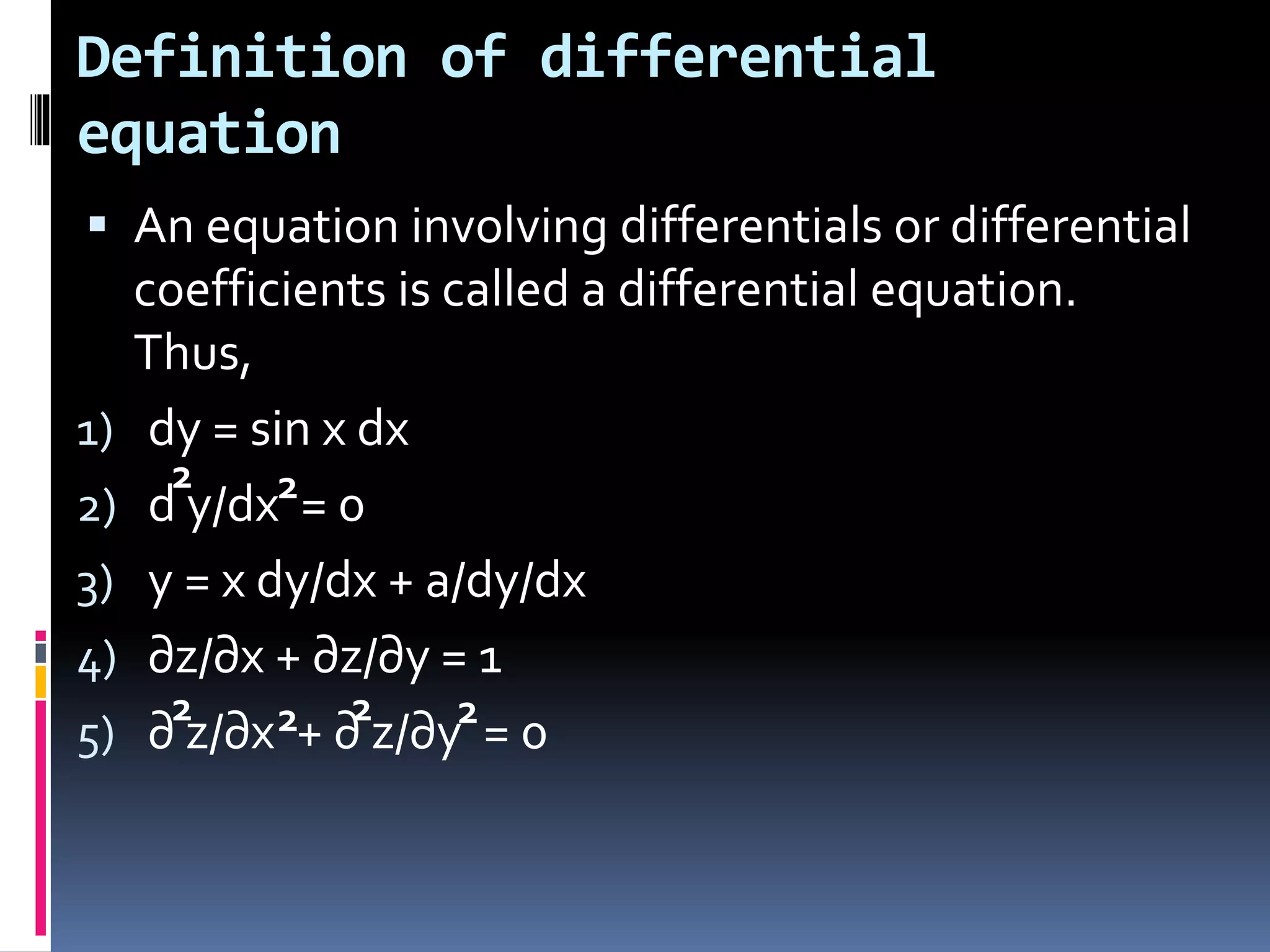
 An equation involving differentials or differential
coefficients is called a differential equation.
Thus,
1) dy = sin x dx
2) d y/dx = 0
3) y = x dy/dx + a/dy/dx
4) ∂z/∂x + ∂z/∂y = 1
5) ∂ z/∂x + ∂ z/∂y = 0
2 2
2 2 2 2
Classification of differential
equations
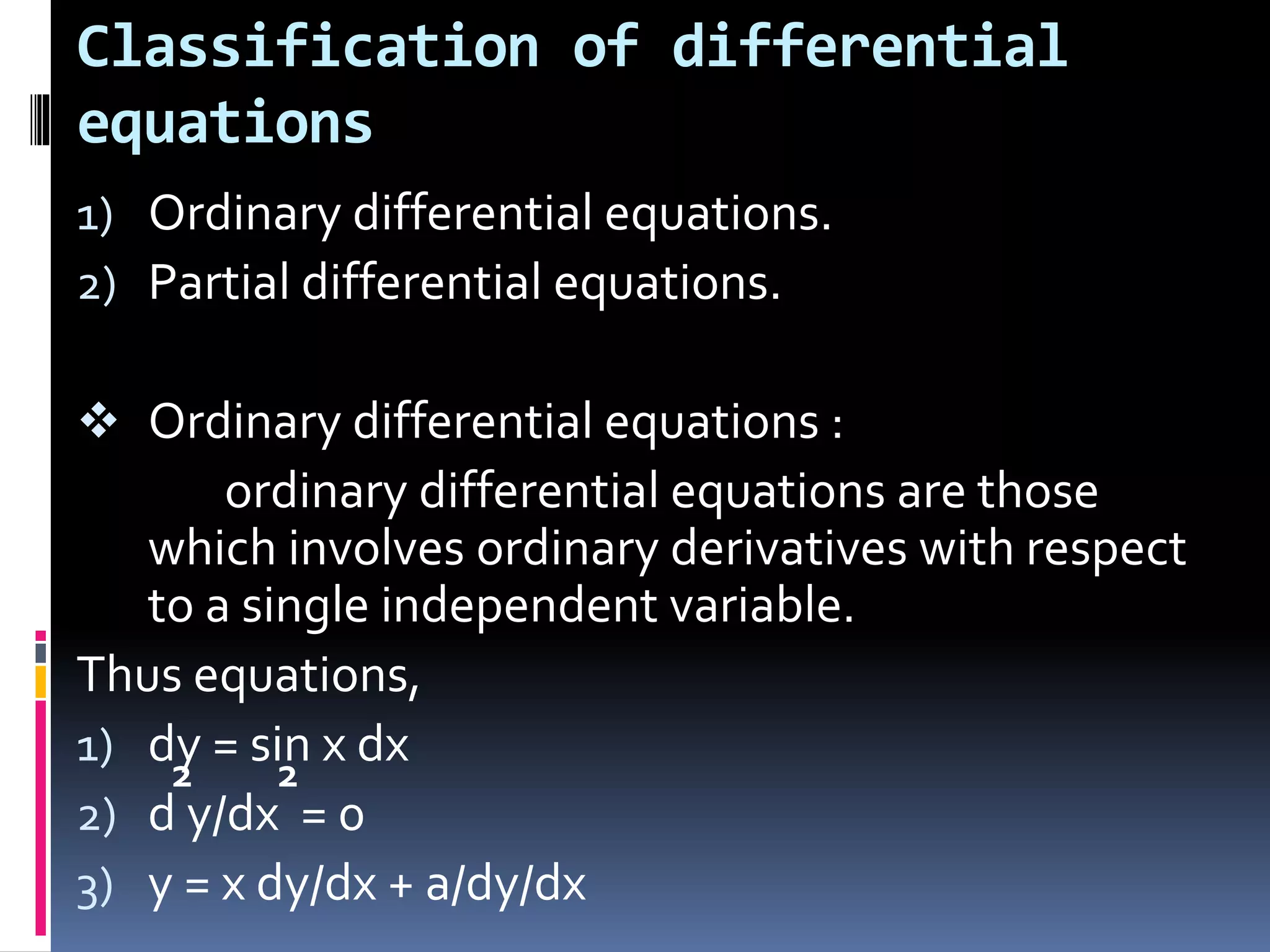
1) Ordinary differential equations.
2) Partial differential equations.
 Ordinary differential equations :
ordinary differential equations are those
which involves ordinary derivatives with respect
to a single independent variable.
Thus equations,
1) dy = sin x dx
2) d y/dx = 0
3) y = x dy/dx + a/dy/dx
2 2
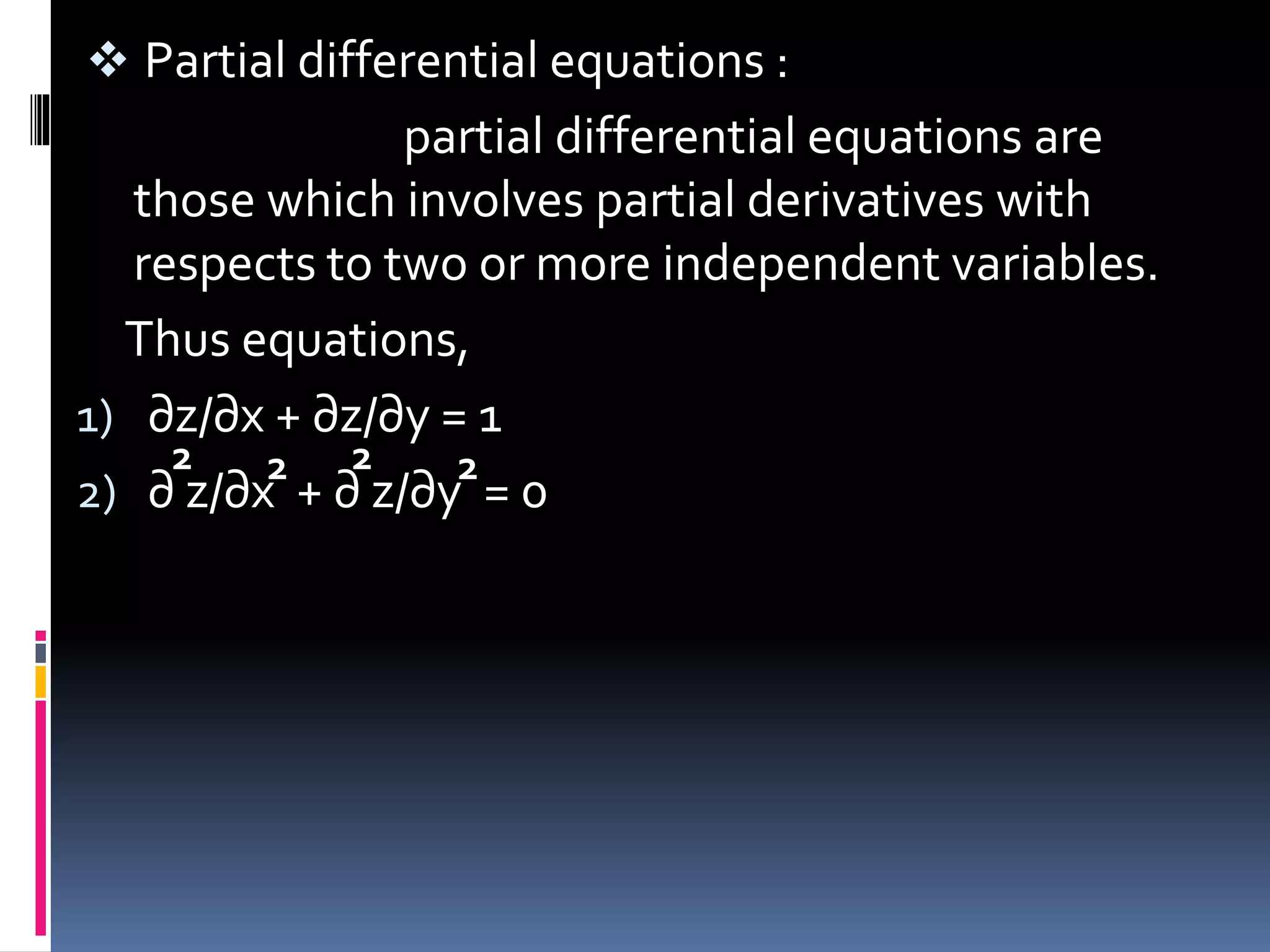
 Partial differential equations :
partial differential equations are
those which involves partial derivatives with
respects to two or more independent variables.
Thus equations,
1) ∂z/∂x + ∂z/∂y = 1
2) ∂ z/∂x + ∂ z/∂y = 0
2 2 2 2
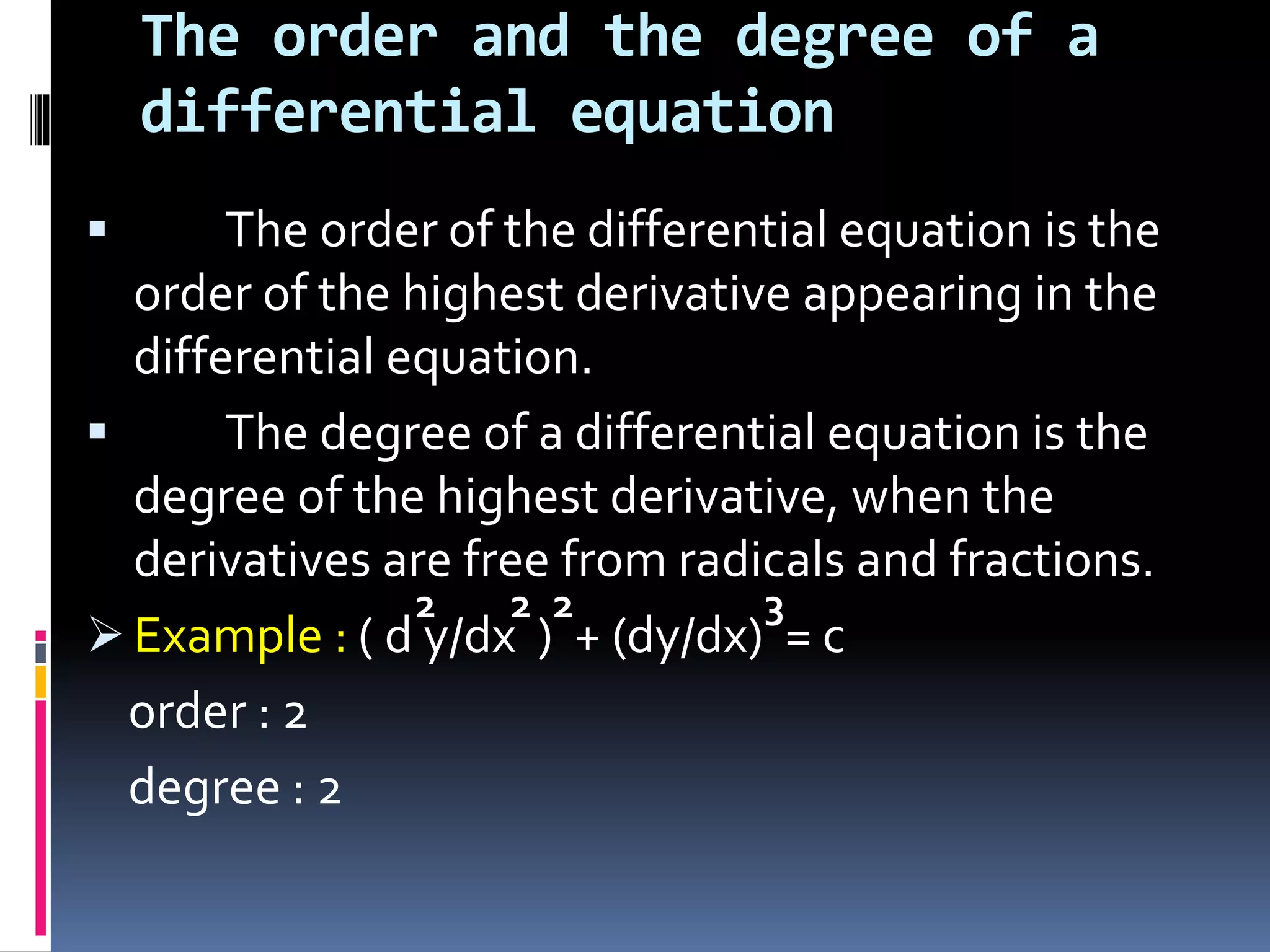
The order and the degree of a
differential equation
 The order of the differential equation is the
order of the highest derivative appearing in the
differential equation.
 The degree of a differential equation is the
degree of the highest derivative, when the
derivatives are free from radicals and fractions.
 Example : ( d y/dx ) + (dy/dx) = c
order : 2
degree : 2
2 22 3
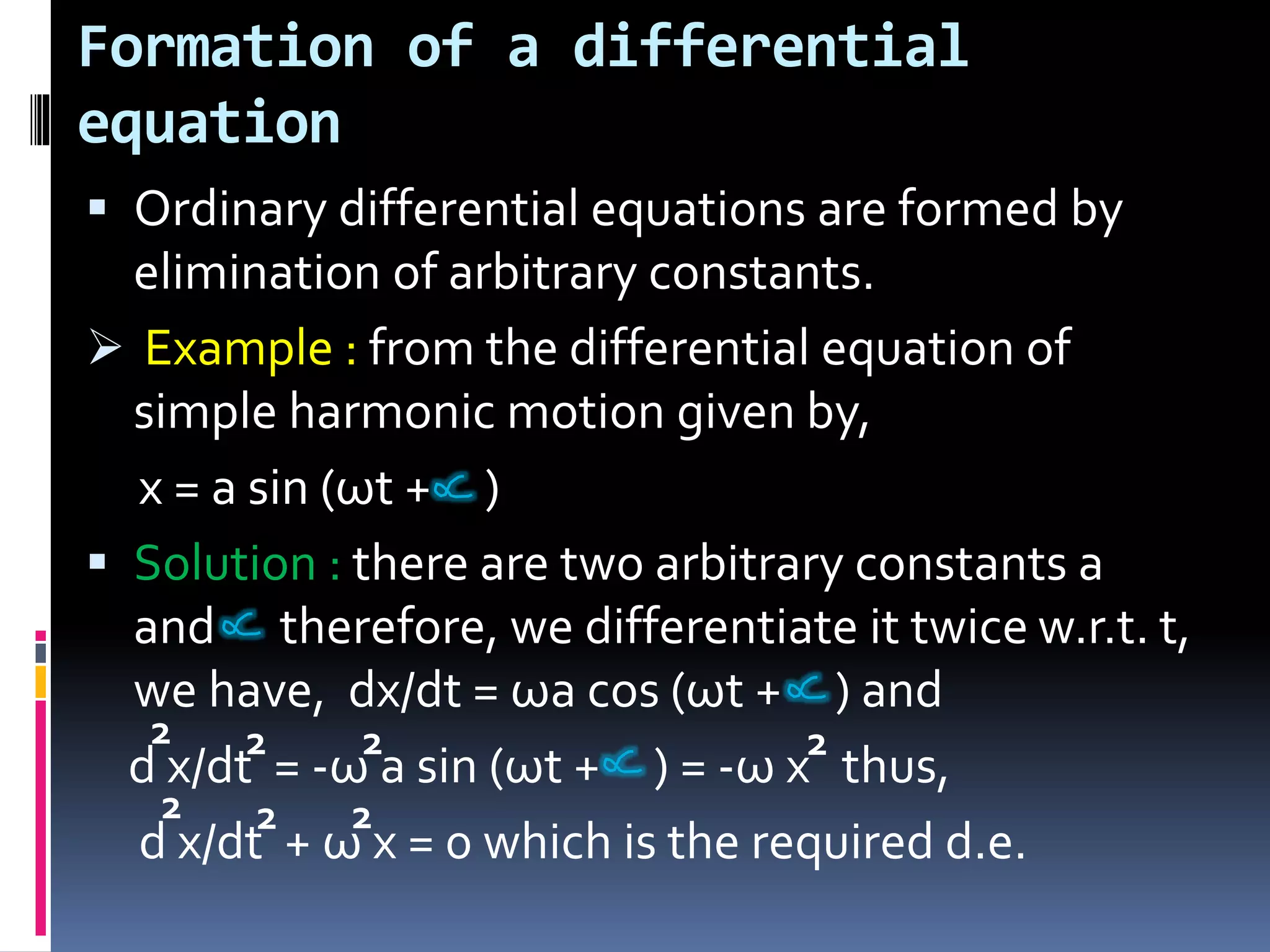
Formation of a differential
equation
 Ordinary differential equations are formed by
elimination of arbitrary constants.
 Example : from the differential equation of
simple harmonic motion given by,
x = a sin (ωt + )
 Solution : there are two arbitrary constants a
and therefore, we differentiate it twice w.r.t. t,
we have, dx/dt = ωa cos (ωt + ) and
d x/dt = -ω a sin (ωt + ) = -ω x thus,
d x/dt + ω x = 0 which is the required d.e.
2 2 2 2
2 2 2
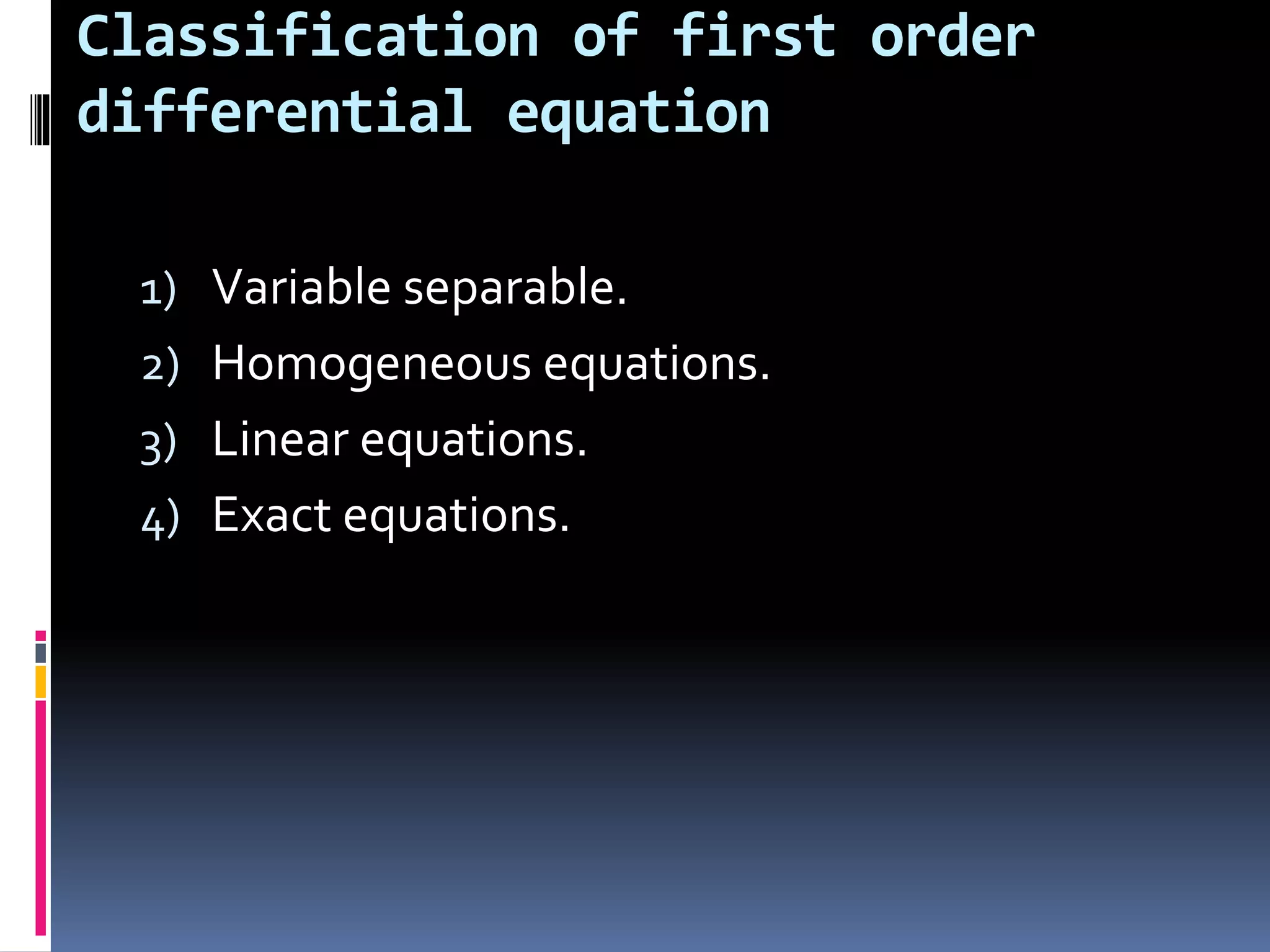
Classification of first order
differential equation
1) Variable separable.
2) Homogeneous equations.
3) Linear equations.
4) Exact equations.
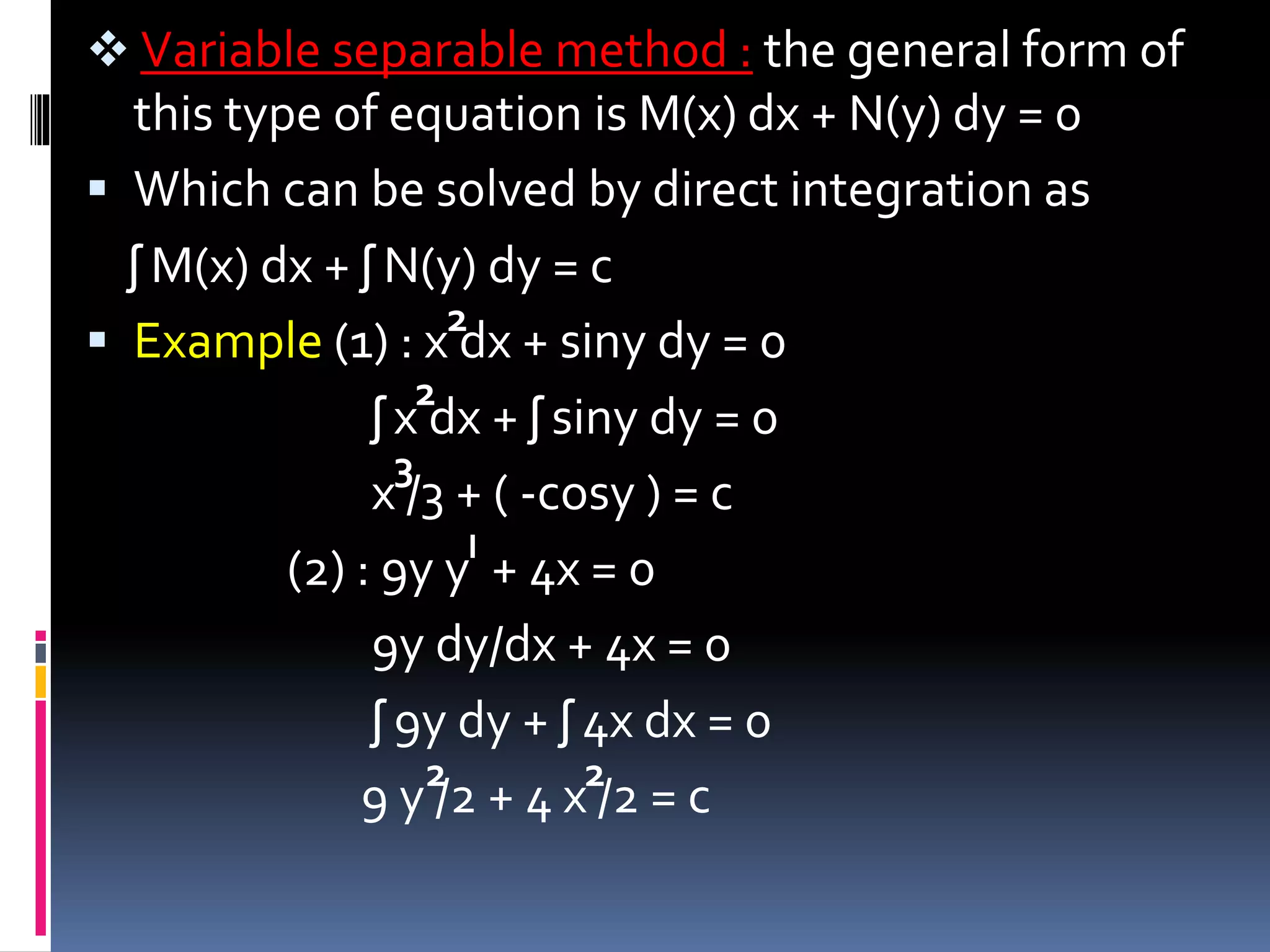
 Variable separable method : the general form of
this type of equation is M(x) dx + N(y) dy = 0
 Which can be solved by direct integration as
ʃ M(x) dx + ʃ N(y) dy = c
 Example (1) : x dx + siny dy = 0
ʃ x dx + ʃ siny dy = 0
x /3 + ( -cosy ) = c
(2) : 9y y + 4x = 0
9y dy/dx + 4x = 0
ʃ 9y dy + ʃ 4x dx = 0
9 y /2 + 4 x /2 = c
2
2
3
І
2 2
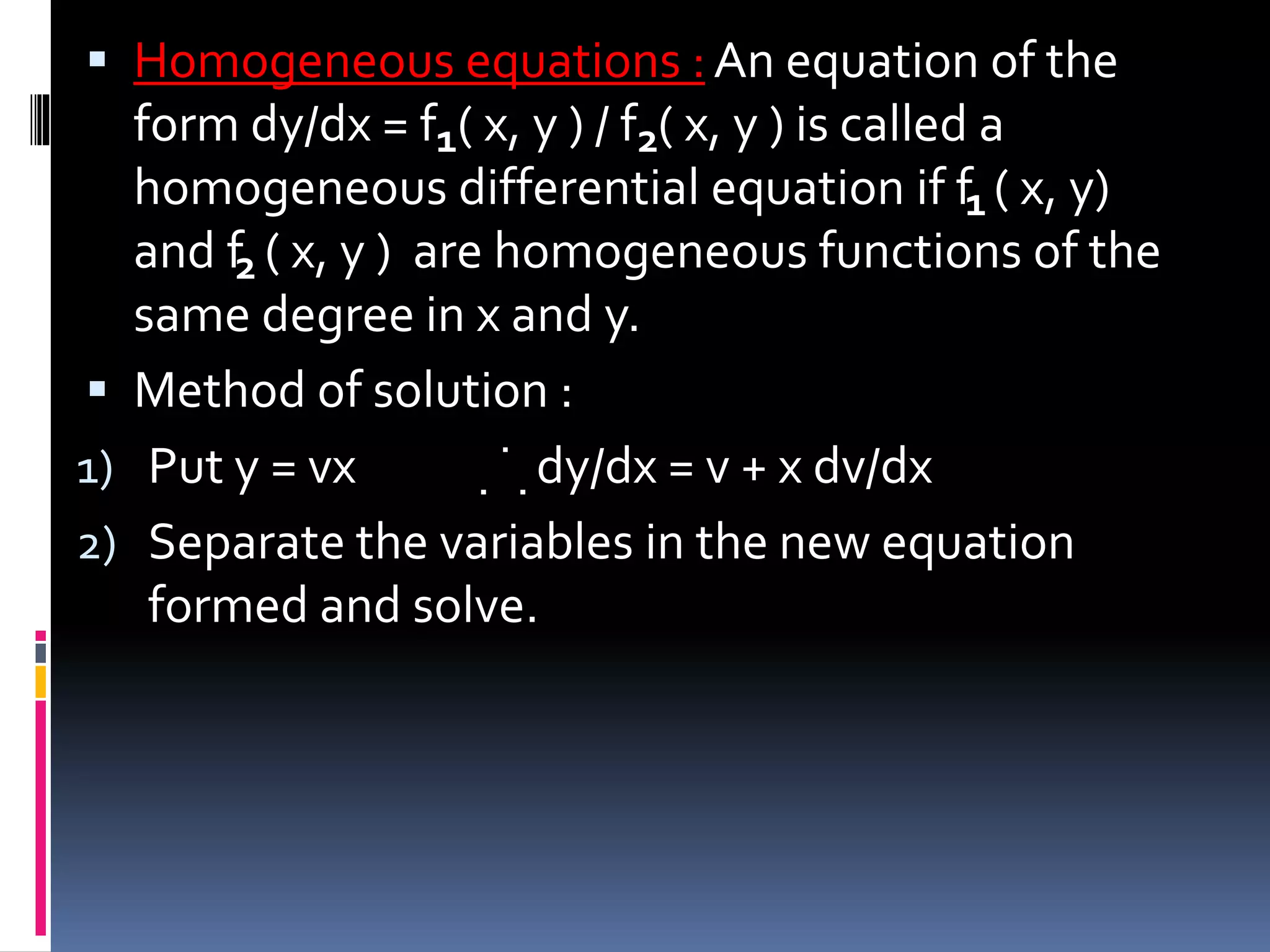
 Homogeneous equations :An equation of the
form dy/dx = f ( x, y ) / f ( x, y ) is called a
homogeneous differential equation if f ( x, y)
and f ( x, y ) are homogeneous functions of the
same degree in x and y.
 Method of solution :
1) Put y = vx dy/dx = v + x dv/dx
2) Separate the variables in the new equation
formed and solve.
1
1
2
2
.
. .
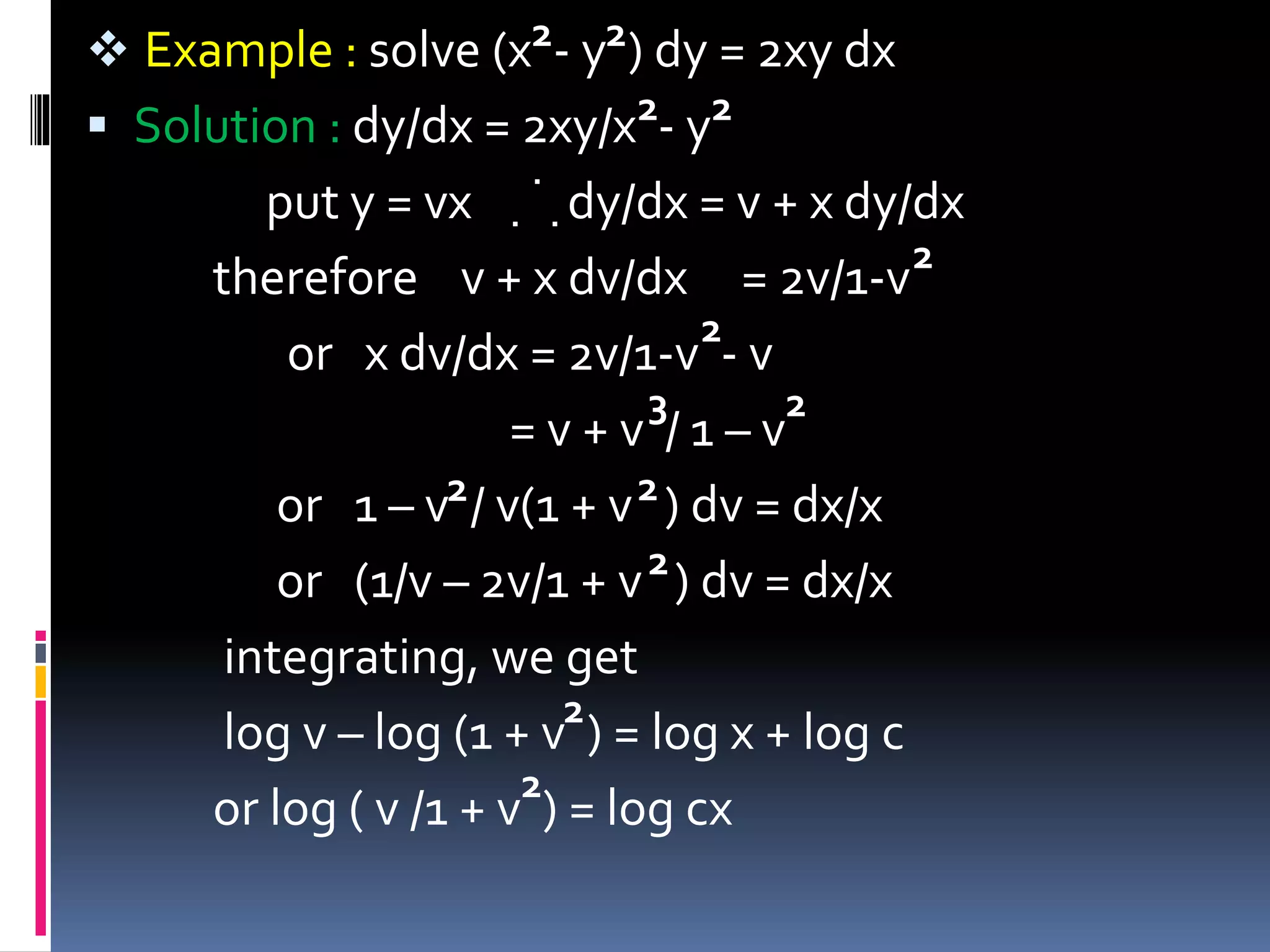
 Example : solve (x - y ) dy = 2xy dx
 Solution : dy/dx = 2xy/x - y
put y = vx dy/dx = v + x dy/dx
therefore v + x dv/dx = 2v/1-v
or x dv/dx = 2v/1-v - v
= v + v / 1 – v
or 1 – v / v(1 + v ) dv = dx/x
or (1/v – 2v/1 + v ) dv = dx/x
integrating, we get
log v – log (1 + v ) = log x + log c
or log ( v /1 + v ) = log cx
2 2
2 2
2
2
.
. .
3 2
22
2
2
2
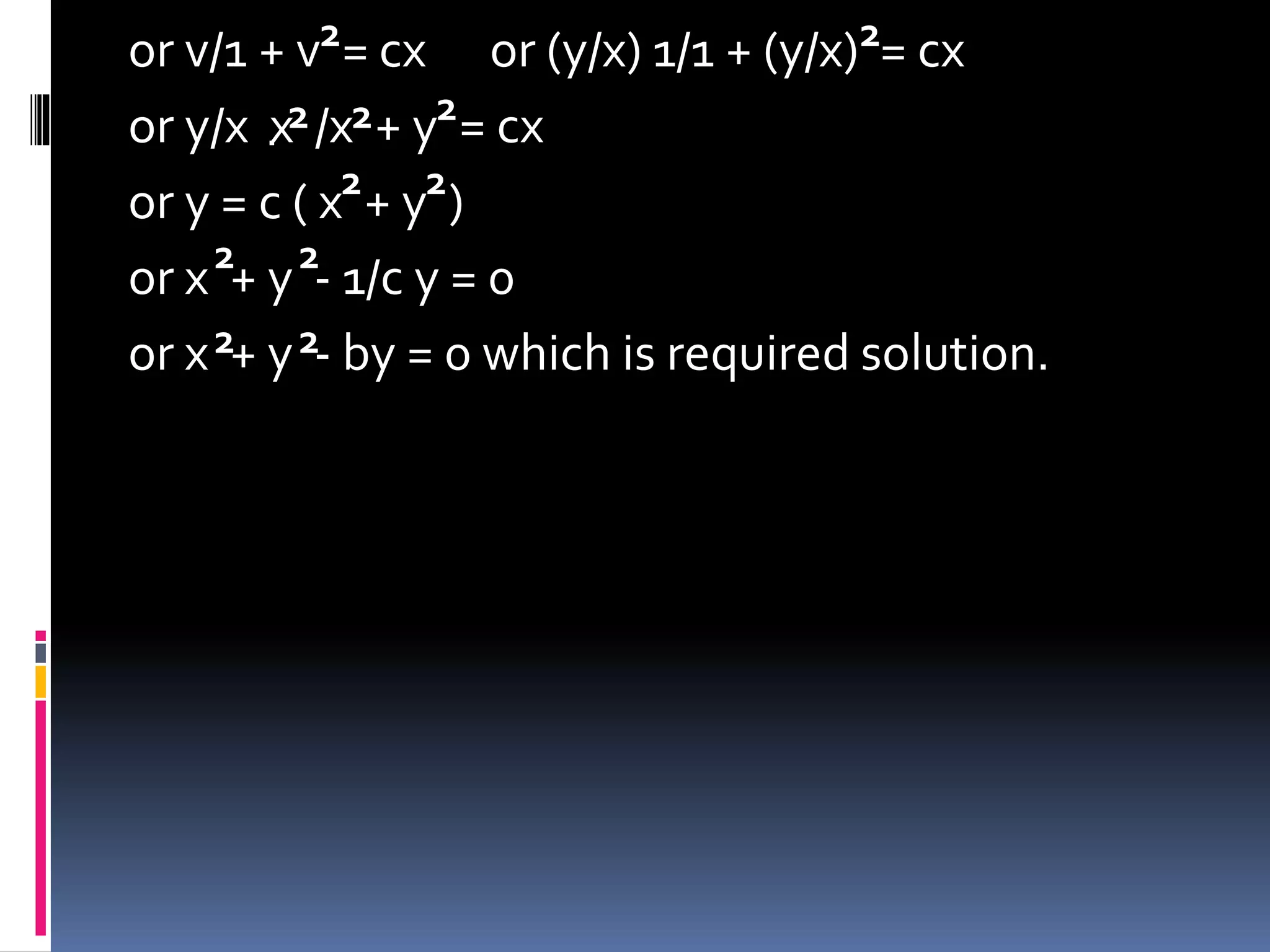
or v/1 + v = cx or (y/x) 1/1 + (y/x) = cx
or y/x x /x + y = cx
or y = c ( x + y )
or x + y - 1/c y = 0
or x + y - by = 0 which is required solution.
2 2
. 2 2 2
2 2
2 2
2 2
Differential equations of first order

Differential equations of first order

  • 1.
  • 2.
    Introduction  Definition ofdifferential equation  Classification of differential equations  The order and the degree of a differential equation  Classification of first order differential equation
  • 3.
    Definition of differential equation An equation involving differentials or differential coefficients is called a differential equation. Thus, 1) dy = sin x dx 2) d y/dx = 0 3) y = x dy/dx + a/dy/dx 4) ∂z/∂x + ∂z/∂y = 1 5) ∂ z/∂x + ∂ z/∂y = 0 2 2 2 2 2 2
  • 4.
    Classification of differential equations 1)Ordinary differential equations. 2) Partial differential equations.  Ordinary differential equations : ordinary differential equations are those which involves ordinary derivatives with respect to a single independent variable. Thus equations, 1) dy = sin x dx 2) d y/dx = 0 3) y = x dy/dx + a/dy/dx 2 2
  • 5.
     Partial differentialequations : partial differential equations are those which involves partial derivatives with respects to two or more independent variables. Thus equations, 1) ∂z/∂x + ∂z/∂y = 1 2) ∂ z/∂x + ∂ z/∂y = 0 2 2 2 2
  • 6.
    The order andthe degree of a differential equation  The order of the differential equation is the order of the highest derivative appearing in the differential equation.  The degree of a differential equation is the degree of the highest derivative, when the derivatives are free from radicals and fractions.  Example : ( d y/dx ) + (dy/dx) = c order : 2 degree : 2 2 22 3
  • 7.
    Formation of adifferential equation  Ordinary differential equations are formed by elimination of arbitrary constants.  Example : from the differential equation of simple harmonic motion given by, x = a sin (ωt + )  Solution : there are two arbitrary constants a and therefore, we differentiate it twice w.r.t. t, we have, dx/dt = ωa cos (ωt + ) and d x/dt = -ω a sin (ωt + ) = -ω x thus, d x/dt + ω x = 0 which is the required d.e. 2 2 2 2 2 2 2
  • 8.
    Classification of firstorder differential equation 1) Variable separable. 2) Homogeneous equations. 3) Linear equations. 4) Exact equations.
  • 9.
     Variable separablemethod : the general form of this type of equation is M(x) dx + N(y) dy = 0  Which can be solved by direct integration as ʃ M(x) dx + ʃ N(y) dy = c  Example (1) : x dx + siny dy = 0 ʃ x dx + ʃ siny dy = 0 x /3 + ( -cosy ) = c (2) : 9y y + 4x = 0 9y dy/dx + 4x = 0 ʃ 9y dy + ʃ 4x dx = 0 9 y /2 + 4 x /2 = c 2 2 3 І 2 2
  • 10.
     Homogeneous equations:An equation of the form dy/dx = f ( x, y ) / f ( x, y ) is called a homogeneous differential equation if f ( x, y) and f ( x, y ) are homogeneous functions of the same degree in x and y.  Method of solution : 1) Put y = vx dy/dx = v + x dv/dx 2) Separate the variables in the new equation formed and solve. 1 1 2 2 . . .
  • 11.
     Example :solve (x - y ) dy = 2xy dx  Solution : dy/dx = 2xy/x - y put y = vx dy/dx = v + x dy/dx therefore v + x dv/dx = 2v/1-v or x dv/dx = 2v/1-v - v = v + v / 1 – v or 1 – v / v(1 + v ) dv = dx/x or (1/v – 2v/1 + v ) dv = dx/x integrating, we get log v – log (1 + v ) = log x + log c or log ( v /1 + v ) = log cx 2 2 2 2 2 2 . . . 3 2 22 2 2 2
  • 12.
    or v/1 +v = cx or (y/x) 1/1 + (y/x) = cx or y/x x /x + y = cx or y = c ( x + y ) or x + y - 1/c y = 0 or x + y - by = 0 which is required solution. 2 2 . 2 2 2 2 2 2 2 2 2