DIFFERENTIAL EQUATIONS
• An equation involving the Independent Variable
x, dependent Variable y and the differential
coefficients of dependent Variable with respect to
independent variable is called a Differential Equation
Order of a Differential Equation
• The Order of a Differential equation is the order of the
highest derivative occurring in the Differential equation
• Eg : (i)
𝑑3
𝑦
𝑑𝑥3 + 2
𝑑2
𝑦
𝑑𝑥2
2
_ 𝑑𝑦
𝑑𝑥
= 0
Order of the equation is 3
(ii)
𝑑2
𝑦
𝑑𝑥2 = 1 +
𝑑𝑦
𝑑𝑥
Order of the equation is 2
Degree of a Differential Equation
• The Degree of a Differential equation is the degree of the
highest derivative occurring in the Differential equation
• Eg : (i)
𝑑3
𝑦
𝑑𝑥3 + 2
𝑑2
𝑦
𝑑𝑥2
2
_ 𝑑𝑦
𝑑𝑥
= 0
Degree of the equation is 1
(ii)
𝑑2
𝑦
𝑑𝑥2 = 1 +
𝑑𝑦
𝑑𝑥
Degree of the equation is 2
• Note: Order and degree (if defined) of a differential equation are always
positive integers.
Classifications of Differential Equation
• Classifications of Differential Equation
depends on their
(i) Order
(ii) Linearity
Classifications of Differential Equation
according to their Order
• First Order Differential Equation
First Order Differential Equation are those
in which only the First Order derivative of the
dependent variable occurs.
• Higher Order Differential Equation
Differential equations of order two or
more are referred as higher Order Differential
Equation
Solution of a differential equation
A function which satisfies the given differential
equation is called its solution.
GENERAL AND PARTICULAR SOLUTIONS OF A
DIFFERENTIAL EQUATION
• The solution which contains arbitrary constants is called the
general solution (primitive) of the differential equation.
• The solution free from arbitrary constants i.e., the solution
obtained from the general solution by giving particular values
to the arbitrary constants is called a particular solution of the
differential equation.
Differential equation to form family of curves
• If the given family F1 of curves depends on only one
parameter then it is represented by an equation of the form
F1 (x, y, a) = 0
• If the given family F2 of curves depends on the parameters a,
b (say) then it is represented by an equation of the from
F2 (x, y, a, b) = 0
DIFFERENTIAL EQUATIONS WITH VARIABLES
SEPARABLE
• If F (x, y) can be expressed as a product g (x) and h(y),
where, g(x) is a function of x and h(y) is a function of
y, then the differential equation
𝑑𝑦
𝑑𝑥
= F(x,y) is said to
be of variable separable type.
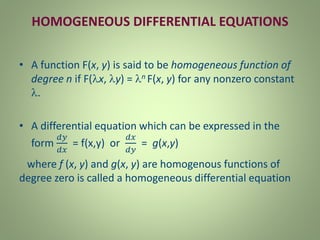
HOMOGENEOUS DIFFERENTIAL EQUATIONS
• A function F(x, y) is said to be homogeneous function of
degree n if F(x, y) = n F(x, y) for any nonzero constant
.
• A differential equation which can be expressed in the
form
𝑑𝑦
𝑑𝑥
= f(x,y) or
𝑑𝑥
𝑑𝑦
= g(x,y)
where f (x, y) and g(x, y) are homogenous functions of
degree zero is called a homogeneous differential equation
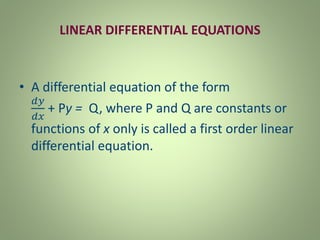
LINEAR DIFFERENTIAL EQUATIONS
• A differential equation of the form
𝑑𝑦
𝑑𝑥
+ Py = Q, where P and Q are constants or
functions of x only is called a first order linear
differential equation.
Classifications of Differential Equation
according to their Linearity
• Linear and non-linear differential equations
A differential equation in which the
dependent variable and its derivatives occur
only in the 1st degree and are not multiplied
together is called a Linear differential equation
otherwise it is non-linear.
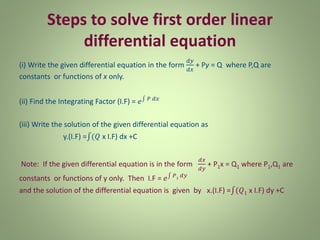
Steps to solve first order linear
differential equation
(i) Write the given differential equation in the form
𝑑𝑦
𝑑𝑥
+ Py = Q where P,Q are
constants or functions of x only.
(ii) Find the Integrating Factor (I.F) = 𝑒 𝑃 𝑑𝑥
(iii) Write the solution of the given differential equation as
y.(I.F) = (𝑄 x I.F) dx +C
Note: If the given differential equation is in the form
𝑑𝑥
𝑑𝑦
+ P1x = Q1 where P1,Q1 are
constants or functions of y only. Then I.F = 𝑒 𝑃1
𝑑𝑦
and the solution of the differential equation is given by x.(I.F) = (𝑄1 x I.F) dy +C

Differential equations

  • 1.
    DIFFERENTIAL EQUATIONS • Anequation involving the Independent Variable x, dependent Variable y and the differential coefficients of dependent Variable with respect to independent variable is called a Differential Equation
  • 2.
    Order of aDifferential Equation • The Order of a Differential equation is the order of the highest derivative occurring in the Differential equation • Eg : (i) 𝑑3 𝑦 𝑑𝑥3 + 2 𝑑2 𝑦 𝑑𝑥2 2 _ 𝑑𝑦 𝑑𝑥 = 0 Order of the equation is 3 (ii) 𝑑2 𝑦 𝑑𝑥2 = 1 + 𝑑𝑦 𝑑𝑥 Order of the equation is 2
  • 3.
    Degree of aDifferential Equation • The Degree of a Differential equation is the degree of the highest derivative occurring in the Differential equation • Eg : (i) 𝑑3 𝑦 𝑑𝑥3 + 2 𝑑2 𝑦 𝑑𝑥2 2 _ 𝑑𝑦 𝑑𝑥 = 0 Degree of the equation is 1 (ii) 𝑑2 𝑦 𝑑𝑥2 = 1 + 𝑑𝑦 𝑑𝑥 Degree of the equation is 2 • Note: Order and degree (if defined) of a differential equation are always positive integers.
  • 4.
    Classifications of DifferentialEquation • Classifications of Differential Equation depends on their (i) Order (ii) Linearity
  • 5.
    Classifications of DifferentialEquation according to their Order • First Order Differential Equation First Order Differential Equation are those in which only the First Order derivative of the dependent variable occurs. • Higher Order Differential Equation Differential equations of order two or more are referred as higher Order Differential Equation
  • 6.
    Solution of adifferential equation A function which satisfies the given differential equation is called its solution.
  • 7.
    GENERAL AND PARTICULARSOLUTIONS OF A DIFFERENTIAL EQUATION • The solution which contains arbitrary constants is called the general solution (primitive) of the differential equation. • The solution free from arbitrary constants i.e., the solution obtained from the general solution by giving particular values to the arbitrary constants is called a particular solution of the differential equation.
  • 8.
    Differential equation toform family of curves • If the given family F1 of curves depends on only one parameter then it is represented by an equation of the form F1 (x, y, a) = 0 • If the given family F2 of curves depends on the parameters a, b (say) then it is represented by an equation of the from F2 (x, y, a, b) = 0
  • 9.
    DIFFERENTIAL EQUATIONS WITHVARIABLES SEPARABLE • If F (x, y) can be expressed as a product g (x) and h(y), where, g(x) is a function of x and h(y) is a function of y, then the differential equation 𝑑𝑦 𝑑𝑥 = F(x,y) is said to be of variable separable type.
  • 10.
    HOMOGENEOUS DIFFERENTIAL EQUATIONS •A function F(x, y) is said to be homogeneous function of degree n if F(x, y) = n F(x, y) for any nonzero constant . • A differential equation which can be expressed in the form 𝑑𝑦 𝑑𝑥 = f(x,y) or 𝑑𝑥 𝑑𝑦 = g(x,y) where f (x, y) and g(x, y) are homogenous functions of degree zero is called a homogeneous differential equation
  • 11.
    LINEAR DIFFERENTIAL EQUATIONS •A differential equation of the form 𝑑𝑦 𝑑𝑥 + Py = Q, where P and Q are constants or functions of x only is called a first order linear differential equation.
  • 12.
    Classifications of DifferentialEquation according to their Linearity • Linear and non-linear differential equations A differential equation in which the dependent variable and its derivatives occur only in the 1st degree and are not multiplied together is called a Linear differential equation otherwise it is non-linear.
  • 13.
    Steps to solvefirst order linear differential equation (i) Write the given differential equation in the form 𝑑𝑦 𝑑𝑥 + Py = Q where P,Q are constants or functions of x only. (ii) Find the Integrating Factor (I.F) = 𝑒 𝑃 𝑑𝑥 (iii) Write the solution of the given differential equation as y.(I.F) = (𝑄 x I.F) dx +C Note: If the given differential equation is in the form 𝑑𝑥 𝑑𝑦 + P1x = Q1 where P1,Q1 are constants or functions of y only. Then I.F = 𝑒 𝑃1 𝑑𝑦 and the solution of the differential equation is given by x.(I.F) = (𝑄1 x I.F) dy +C