Chapter 1
First order differential equations
Lecture3

ODE (Lecture3)

Introduction to ODE-Math214

Dr Lamia Jaafar

1 / 22
Linear equations
Follow-up

ODE (Lecture3)

Introduction to ODE-Math214

Dr Lamia Jaafar

2 / 22
Example
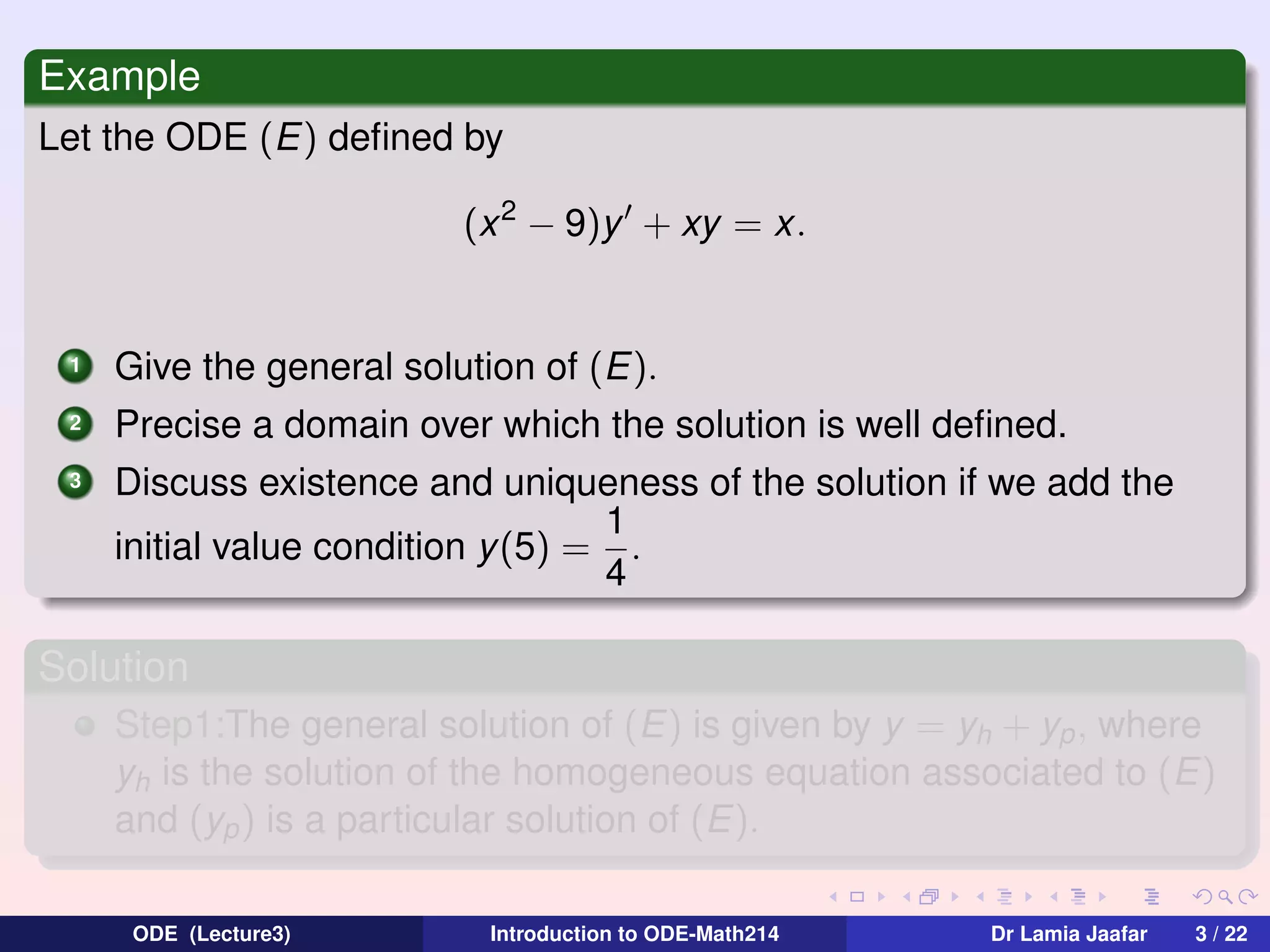
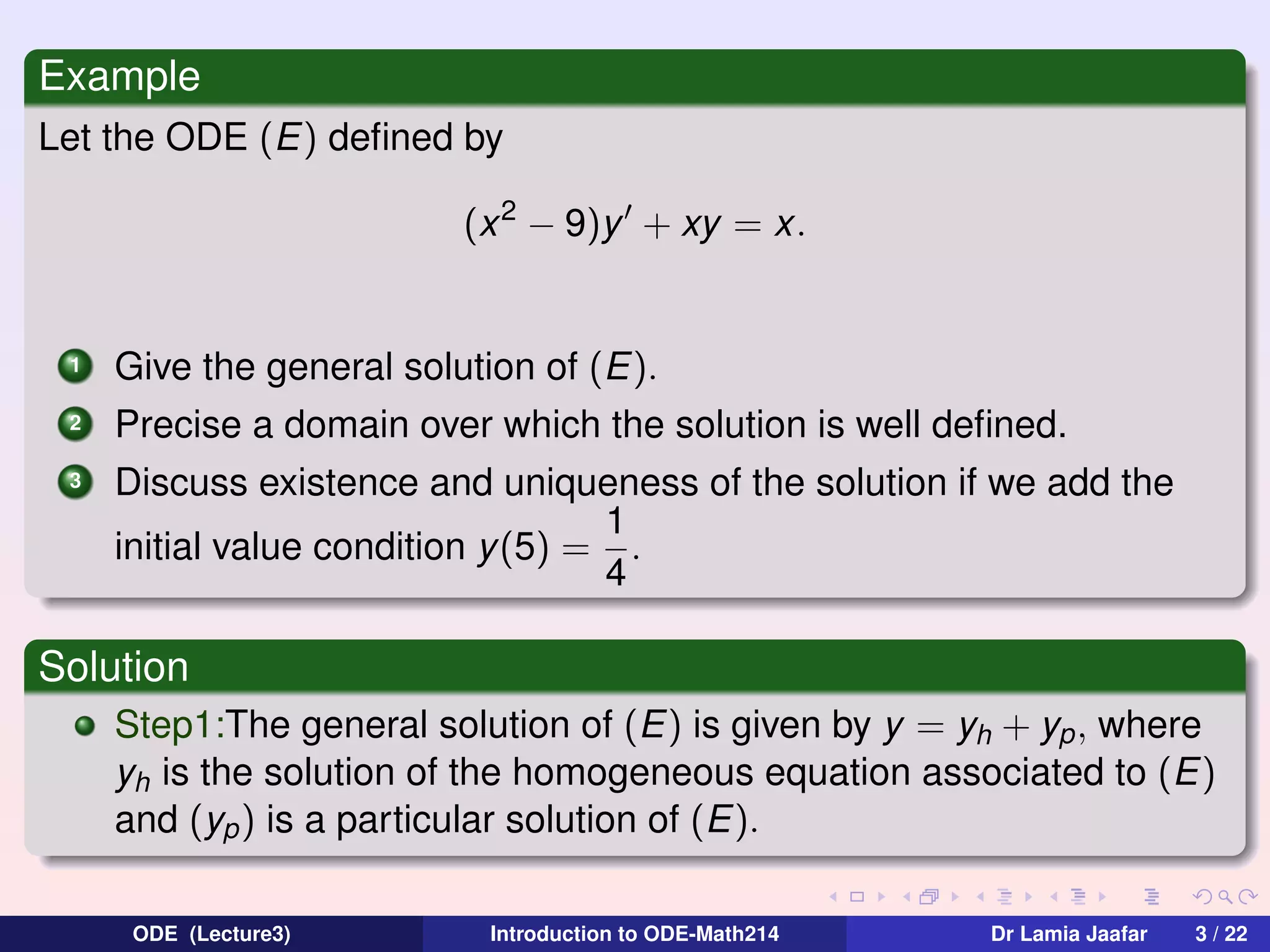
Let the ODE (E) defined by
(x 2 − 9)y + xy = x.

1

Give the general solution of (E).

2

Precise a domain over which the solution is well defined.

3

Discuss existence and uniqueness of the solution if we add the
1
initial value condition y(5) = .
4

Solution
Step1:The general solution of (E) is given by y = yh + yp , where
yh is the solution of the homogeneous equation associated to (E)
and (yp ) is a particular solution of (E).
ODE (Lecture3)

Introduction to ODE-Math214

Dr Lamia Jaafar

3 / 22
Example
Let the ODE (E) defined by
(x 2 − 9)y + xy = x.

1

Give the general solution of (E).

2

Precise a domain over which the solution is well defined.

3

Discuss existence and uniqueness of the solution if we add the
1
initial value condition y(5) = .
4

Solution
Step1:The general solution of (E) is given by y = yh + yp , where
yh is the solution of the homogeneous equation associated to (E)
and (yp ) is a particular solution of (E).
ODE (Lecture3)

Introduction to ODE-Math214

Dr Lamia Jaafar

3 / 22
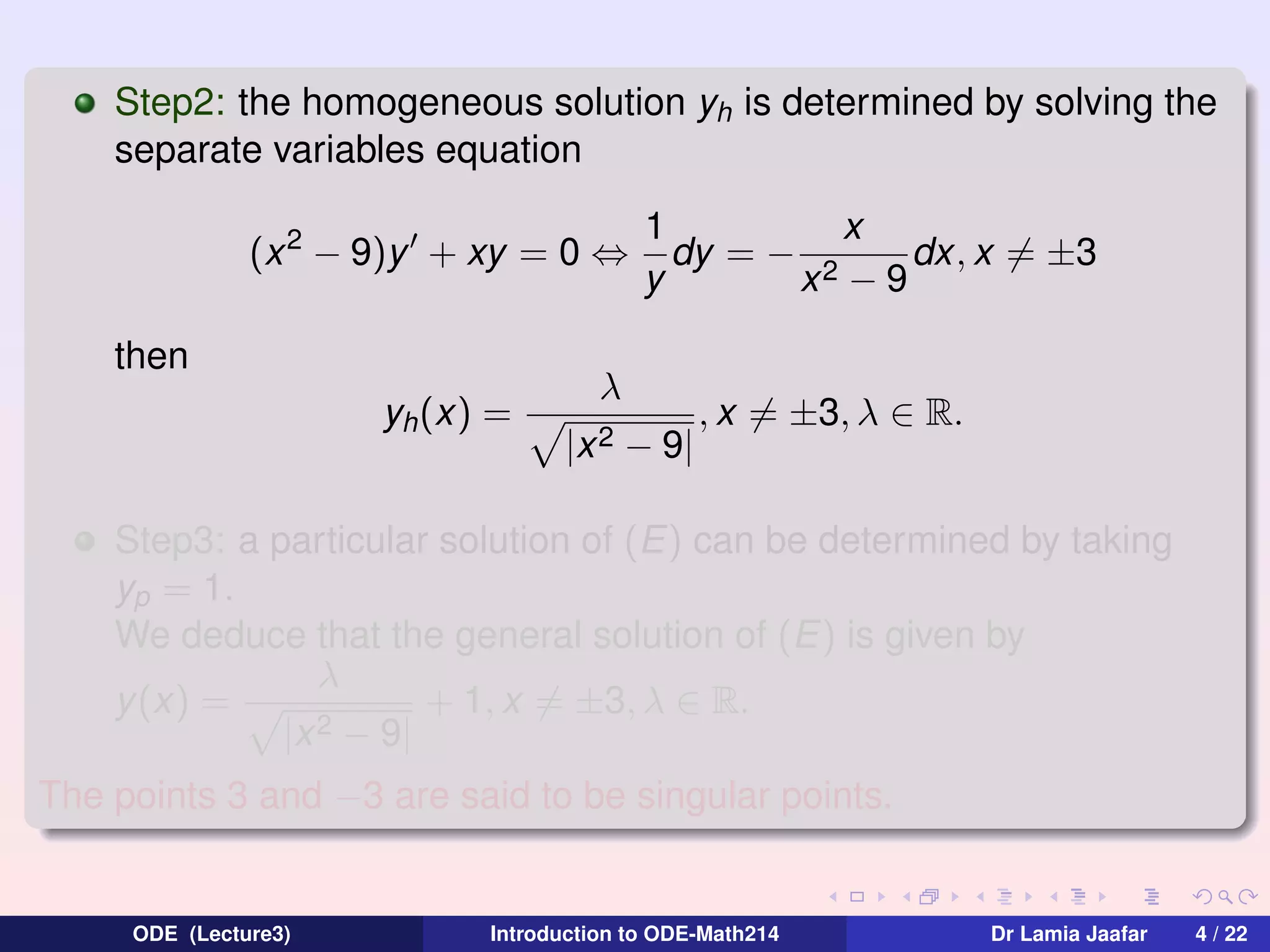
Step2: the homogeneous solution yh is determined by solving the
separate variables equation
(x 2 − 9)y + xy = 0 ⇔
then
yh (x) =

1
x
dy = − 2
dx, x = ±3
y
x −9

λ
|x 2

− 9|

, x = ±3, λ ∈ R.

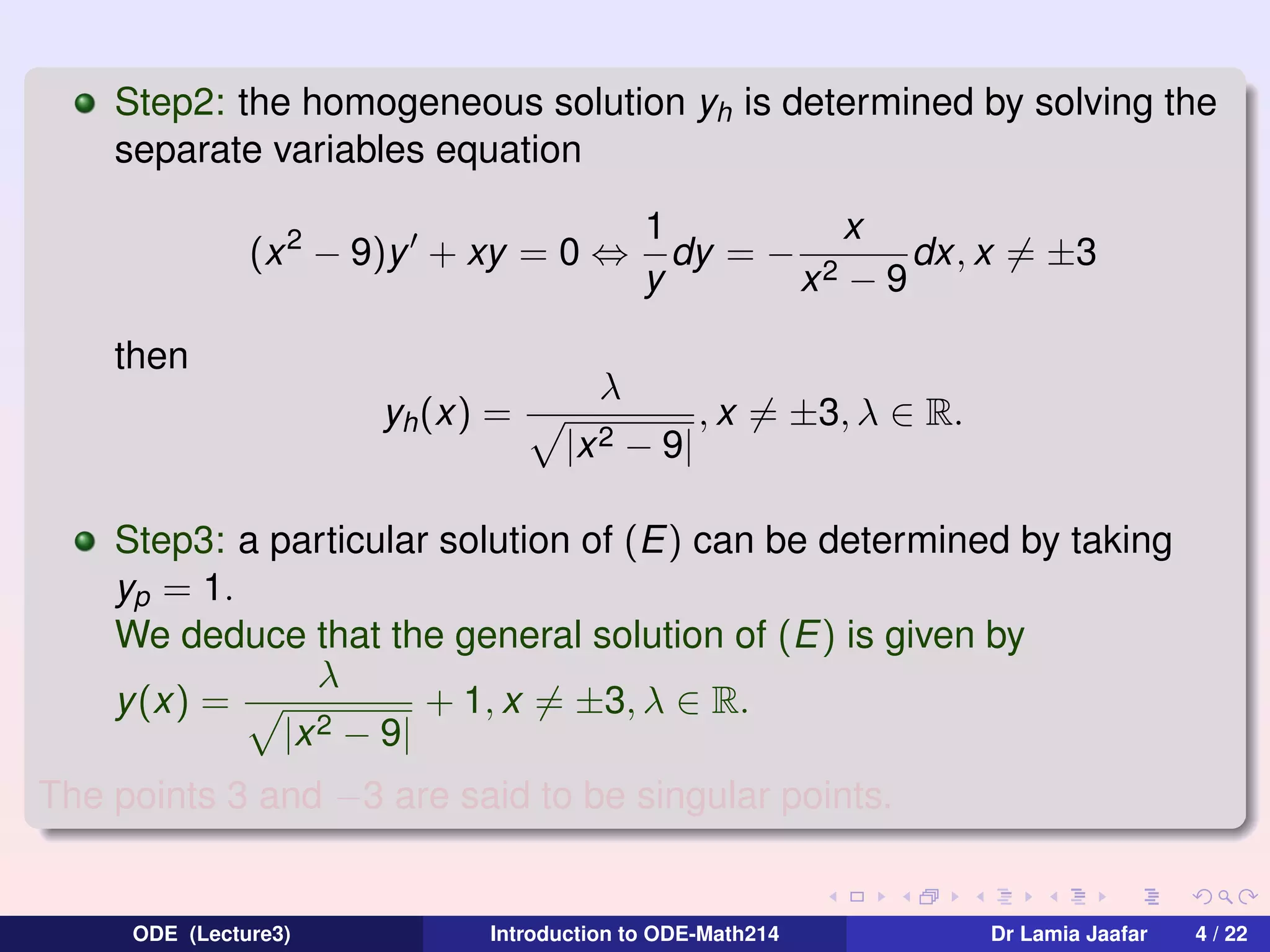
Step3: a particular solution of (E) can be determined by taking
yp = 1.
We deduce that the general solution of (E) is given by
λ
+ 1, x = ±3, λ ∈ R.
y (x) =
2 − 9|
|x
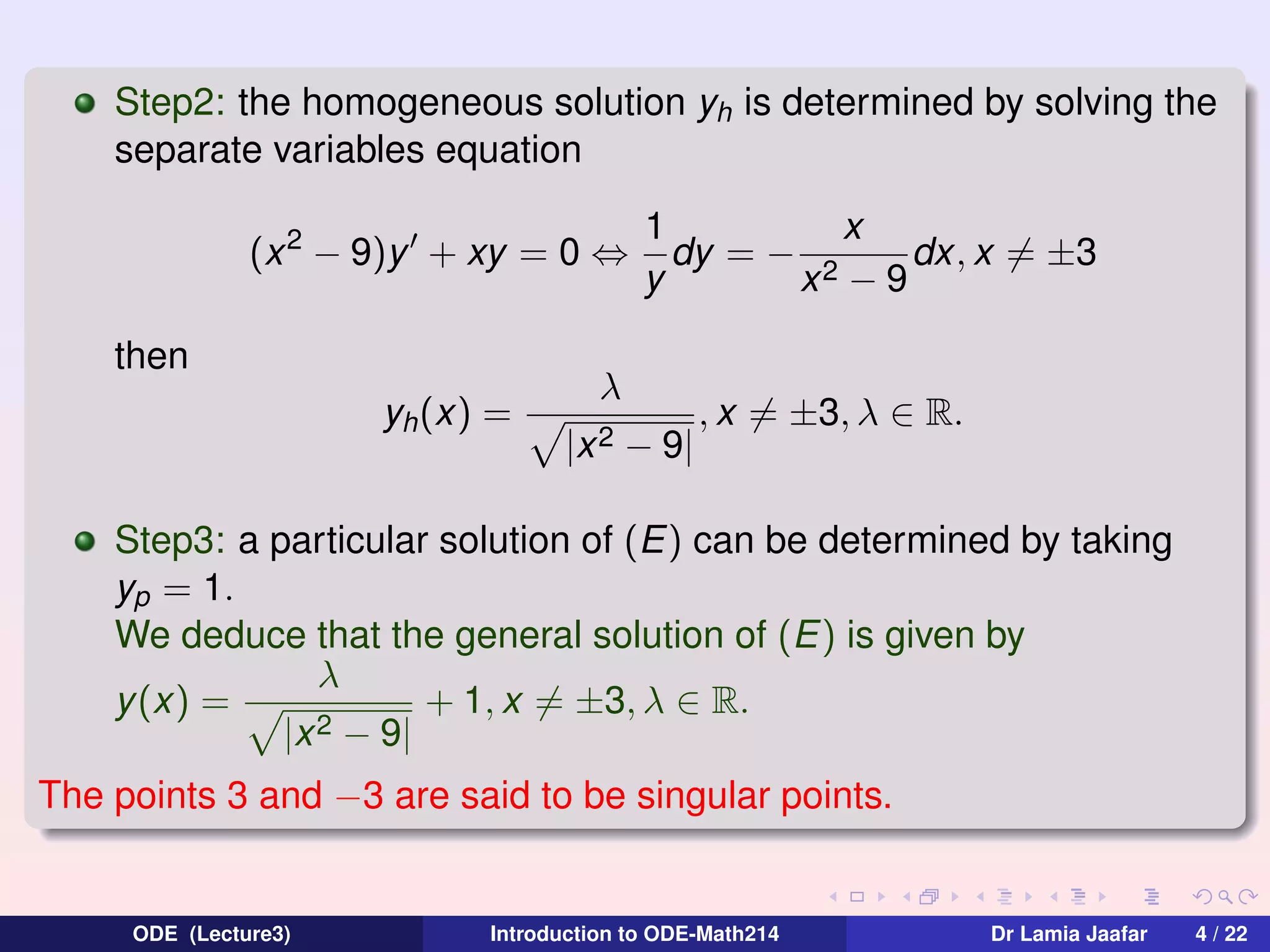
The points 3 and −3 are said to be singular points.

ODE (Lecture3)

Introduction to ODE-Math214

Dr Lamia Jaafar

4 / 22
Step2: the homogeneous solution yh is determined by solving the
separate variables equation
(x 2 − 9)y + xy = 0 ⇔
then
yh (x) =

1
x
dy = − 2
dx, x = ±3
y
x −9

λ
|x 2

− 9|

, x = ±3, λ ∈ R.

Step3: a particular solution of (E) can be determined by taking
yp = 1.
We deduce that the general solution of (E) is given by
λ
+ 1, x = ±3, λ ∈ R.
y (x) =
2 − 9|
|x
The points 3 and −3 are said to be singular points.

ODE (Lecture3)

Introduction to ODE-Math214

Dr Lamia Jaafar

4 / 22
Step2: the homogeneous solution yh is determined by solving the
separate variables equation
(x 2 − 9)y + xy = 0 ⇔
then
yh (x) =

1
x
dy = − 2
dx, x = ±3
y
x −9

λ
|x 2

− 9|

, x = ±3, λ ∈ R.

Step3: a particular solution of (E) can be determined by taking
yp = 1.
We deduce that the general solution of (E) is given by
λ
+ 1, x = ±3, λ ∈ R.
y (x) =
2 − 9|
|x
The points 3 and −3 are said to be singular points.

ODE (Lecture3)

Introduction to ODE-Math214

Dr Lamia Jaafar

4 / 22
If x ∈] − ∞, −3[, the general solution is given by
λ
y1 (x) = √
+ 1.
x2 − 9
If x ∈] − 3, 3[, the general solution is given by
λ
+ 1.
y2 (x) = √
9 − x2
If x ∈]3, +∞[, the general solution is given by
λ
+ 1.
y3 (x) = √
2−9
x
1
, we solve the equation on (3, +∞), on which the
4
theorem of existence and uniqueness are assured:
By taking y (5) =

∃!y(x) = √

ODE (Lecture3)

4
x2

−9

+ 1, x ∈ (3, +∞).

Introduction to ODE-Math214

Dr Lamia Jaafar

5 / 22
If x ∈] − ∞, −3[, the general solution is given by
λ
y1 (x) = √
+ 1.
x2 − 9
If x ∈] − 3, 3[, the general solution is given by
λ
+ 1.
y2 (x) = √
9 − x2
If x ∈]3, +∞[, the general solution is given by
λ
+ 1.
y3 (x) = √
2−9
x
1
, we solve the equation on (3, +∞), on which the
4
theorem of existence and uniqueness are assured:
By taking y (5) =

∃!y(x) = √

ODE (Lecture3)

4
x2

−9

+ 1, x ∈ (3, +∞).

Introduction to ODE-Math214

Dr Lamia Jaafar

5 / 22
If x ∈] − ∞, −3[, the general solution is given by
λ
y1 (x) = √
+ 1.
x2 − 9
If x ∈] − 3, 3[, the general solution is given by
λ
+ 1.
y2 (x) = √
9 − x2
If x ∈]3, +∞[, the general solution is given by
λ
+ 1.
y3 (x) = √
2−9
x
1
, we solve the equation on (3, +∞), on which the
4
theorem of existence and uniqueness are assured:
By taking y (5) =

∃!y(x) = √

ODE (Lecture3)

4
x2

−9

+ 1, x ∈ (3, +∞).

Introduction to ODE-Math214

Dr Lamia Jaafar

5 / 22
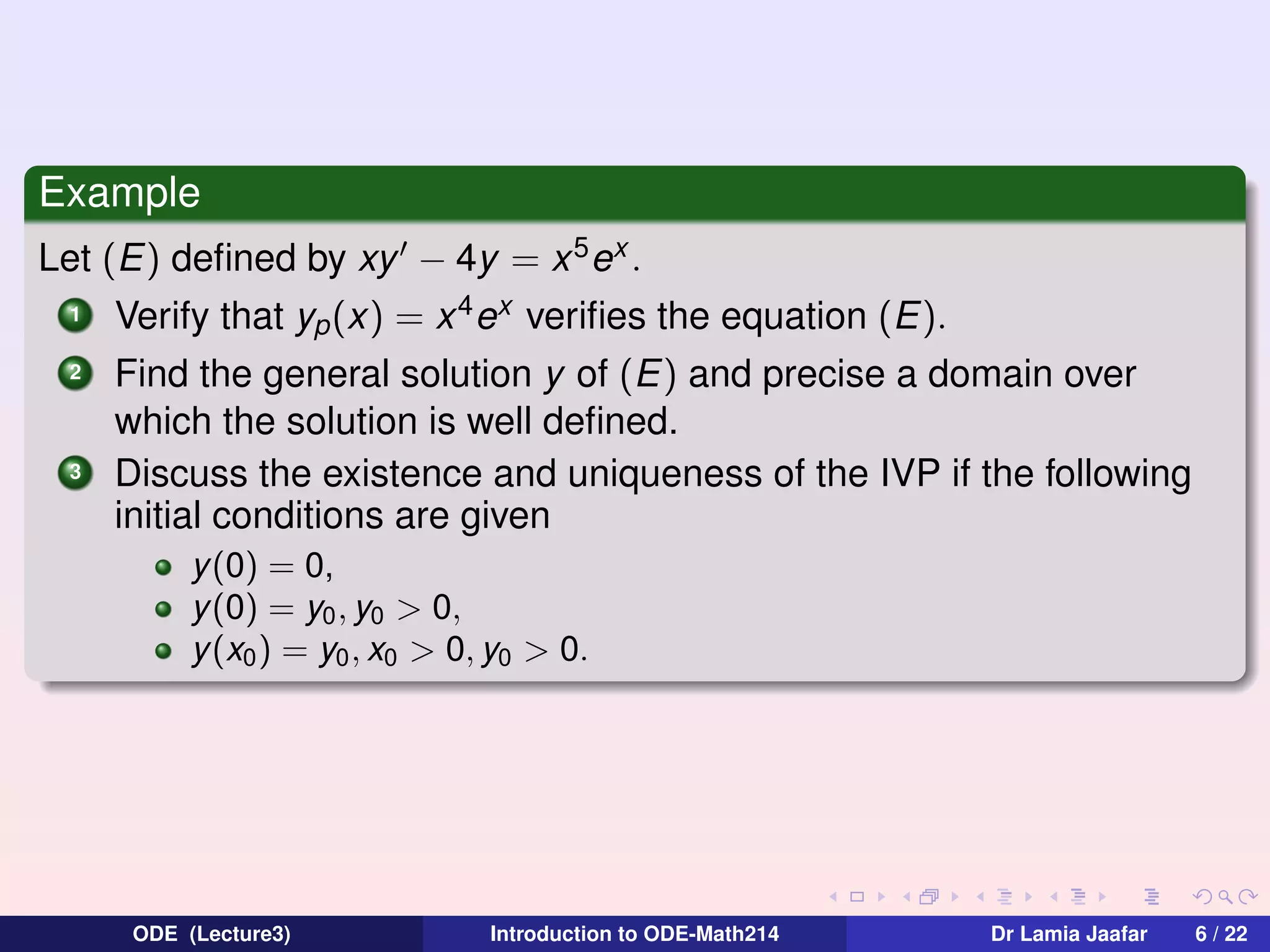
Example
Let (E) defined by xy − 4y = x 5 ex .
1
2

3

Verify that yp (x) = x 4 ex verifies the equation (E).
Find the general solution y of (E) and precise a domain over
which the solution is well defined.
Discuss the existence and uniqueness of the IVP if the following
initial conditions are given
y(0) = 0,
y(0) = y0 , y0 > 0,
y(x0 ) = y0 , x0 > 0, y0 > 0.

ODE (Lecture3)

Introduction to ODE-Math214

Dr Lamia Jaafar

6 / 22
1
2

3

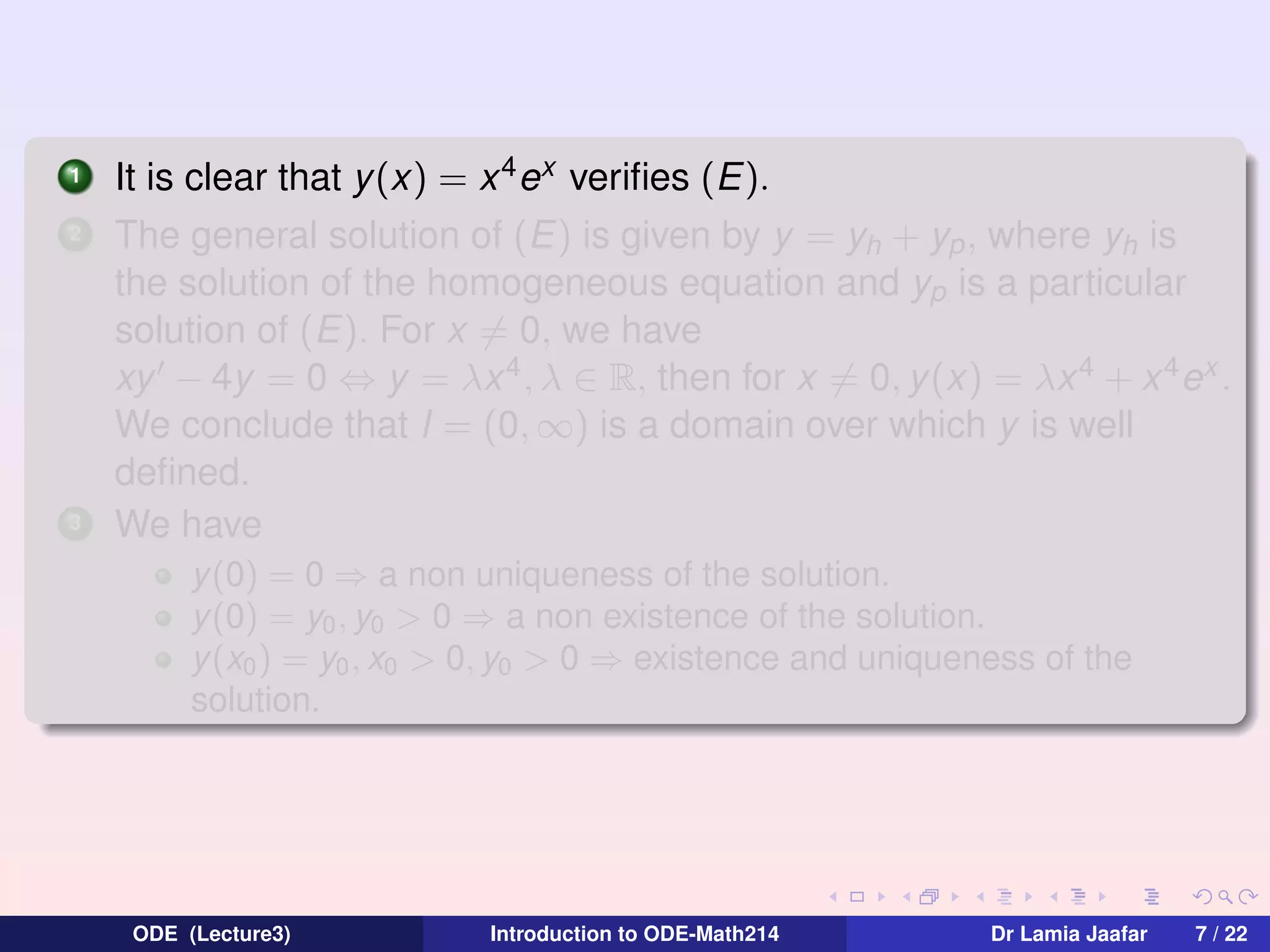
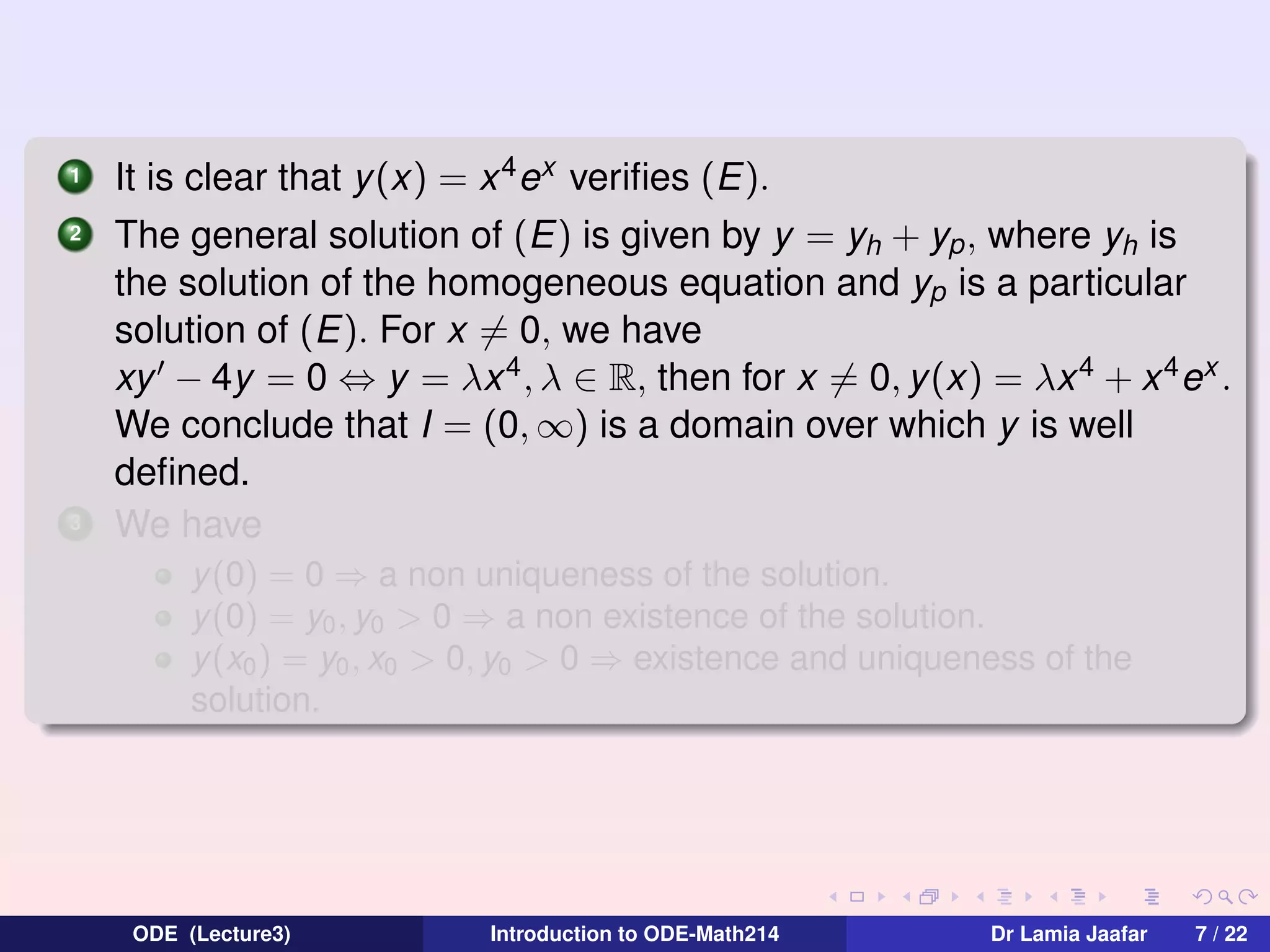
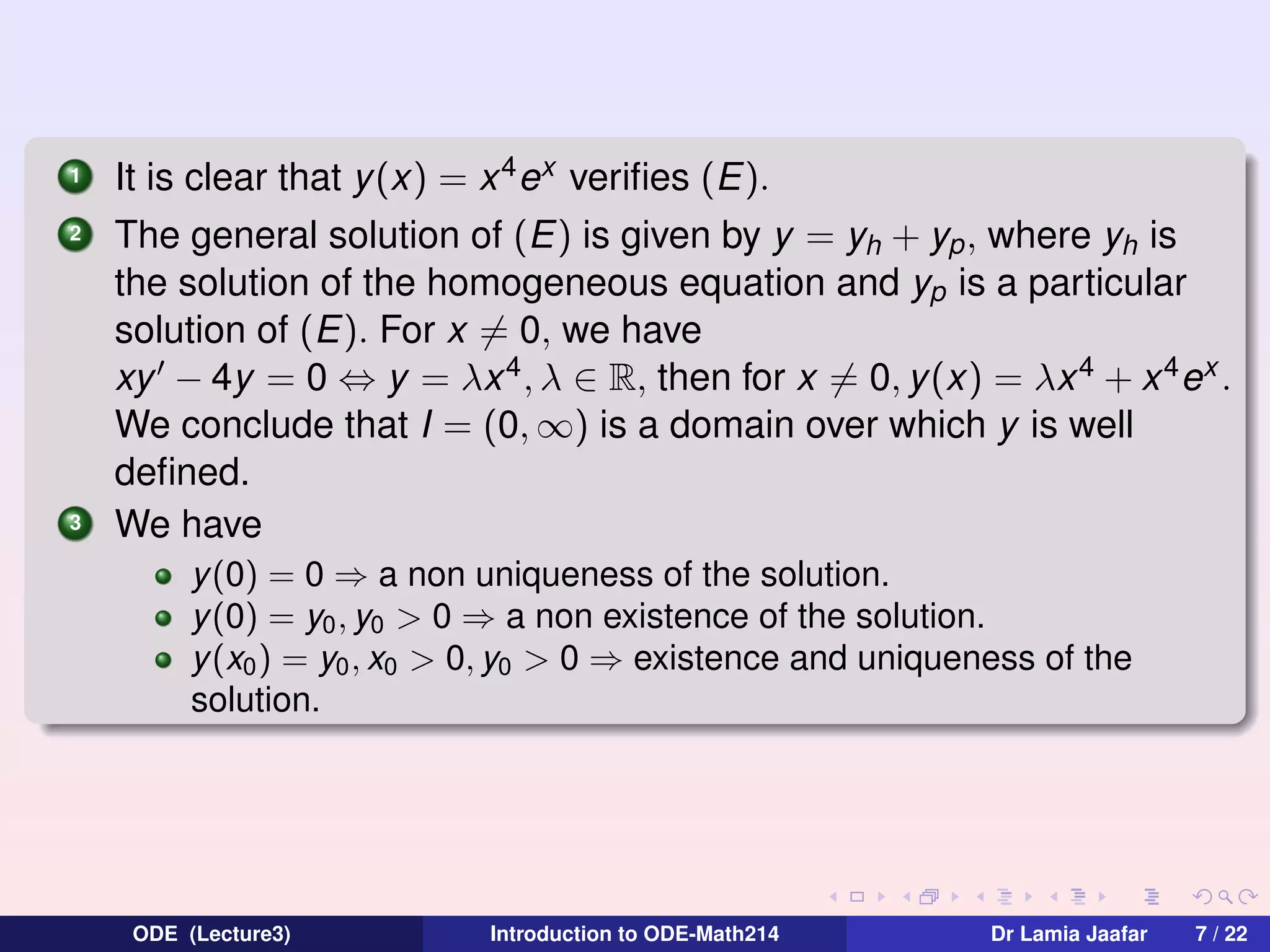
It is clear that y (x) = x 4 ex verifies (E).
The general solution of (E) is given by y = yh + yp , where yh is
the solution of the homogeneous equation and yp is a particular
solution of (E). For x = 0, we have
xy − 4y = 0 ⇔ y = λx 4 , λ ∈ R, then for x = 0, y(x) = λx 4 + x 4 ex .
We conclude that I = (0, ∞) is a domain over which y is well
defined.
We have
y(0) = 0 ⇒ a non uniqueness of the solution.
y(0) = y0 , y0 > 0 ⇒ a non existence of the solution.
y(x0 ) = y0 , x0 > 0, y0 > 0 ⇒ existence and uniqueness of the
solution.

ODE (Lecture3)

Introduction to ODE-Math214

Dr Lamia Jaafar

7 / 22
1
2

3

It is clear that y (x) = x 4 ex verifies (E).
The general solution of (E) is given by y = yh + yp , where yh is
the solution of the homogeneous equation and yp is a particular
solution of (E). For x = 0, we have
xy − 4y = 0 ⇔ y = λx 4 , λ ∈ R, then for x = 0, y(x) = λx 4 + x 4 ex .
We conclude that I = (0, ∞) is a domain over which y is well
defined.
We have
y(0) = 0 ⇒ a non uniqueness of the solution.
y(0) = y0 , y0 > 0 ⇒ a non existence of the solution.
y(x0 ) = y0 , x0 > 0, y0 > 0 ⇒ existence and uniqueness of the
solution.

ODE (Lecture3)

Introduction to ODE-Math214

Dr Lamia Jaafar

7 / 22
1
2

3

It is clear that y (x) = x 4 ex verifies (E).
The general solution of (E) is given by y = yh + yp , where yh is
the solution of the homogeneous equation and yp is a particular
solution of (E). For x = 0, we have
xy − 4y = 0 ⇔ y = λx 4 , λ ∈ R, then for x = 0, y(x) = λx 4 + x 4 ex .
We conclude that I = (0, ∞) is a domain over which y is well
defined.
We have
y(0) = 0 ⇒ a non uniqueness of the solution.
y(0) = y0 , y0 > 0 ⇒ a non existence of the solution.
y(x0 ) = y0 , x0 > 0, y0 > 0 ⇒ existence and uniqueness of the
solution.

ODE (Lecture3)

Introduction to ODE-Math214

Dr Lamia Jaafar

7 / 22
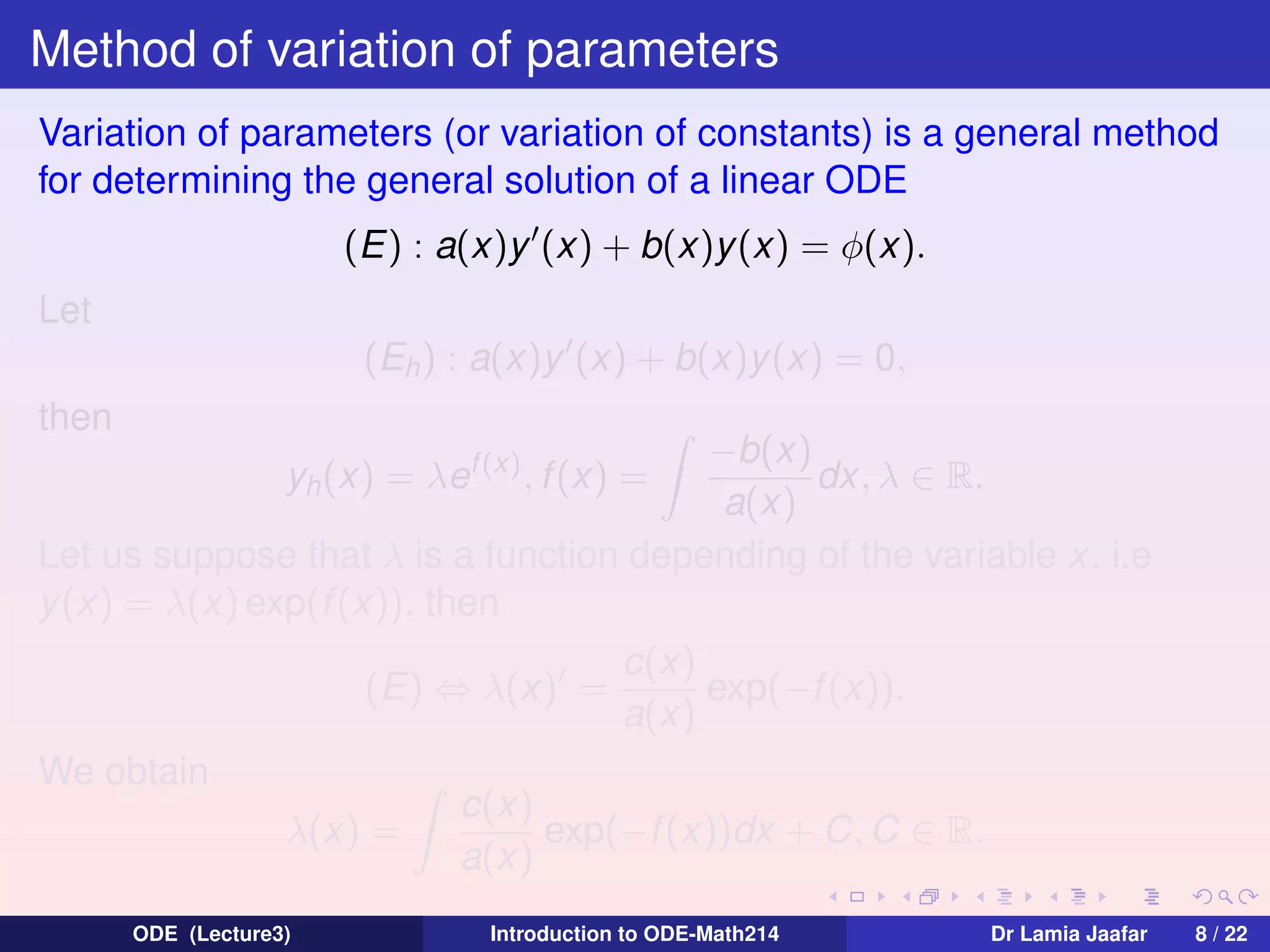
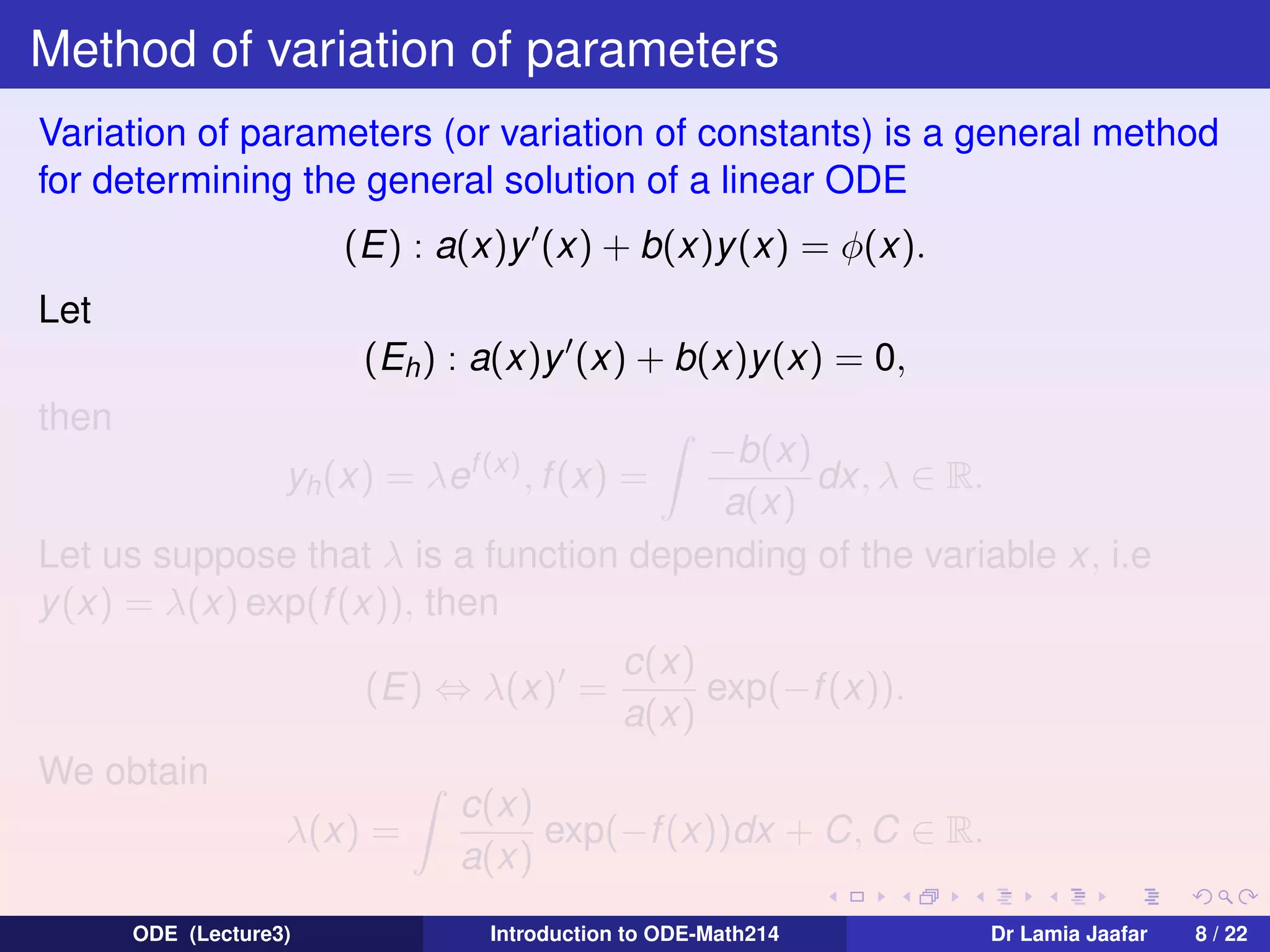
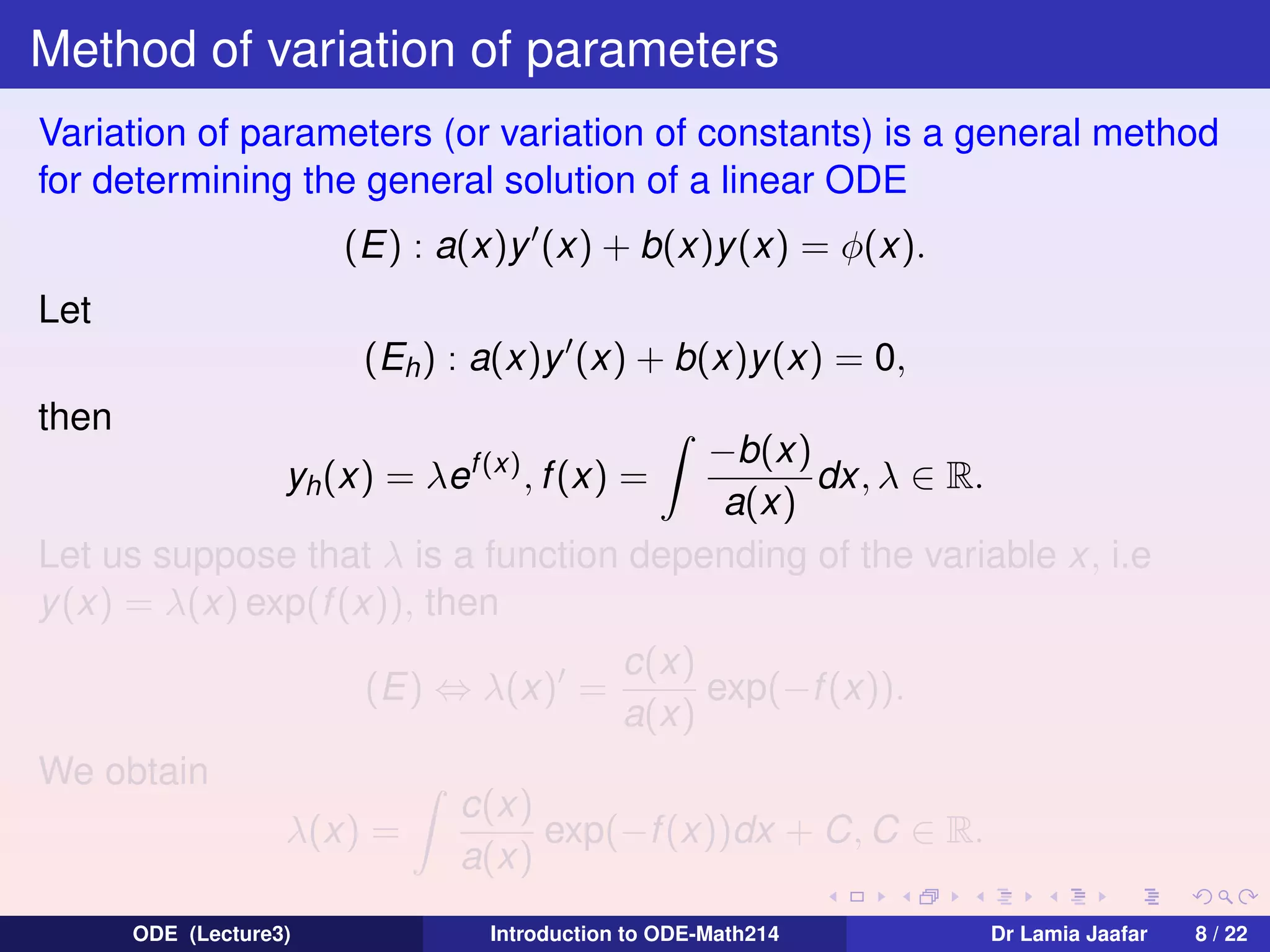
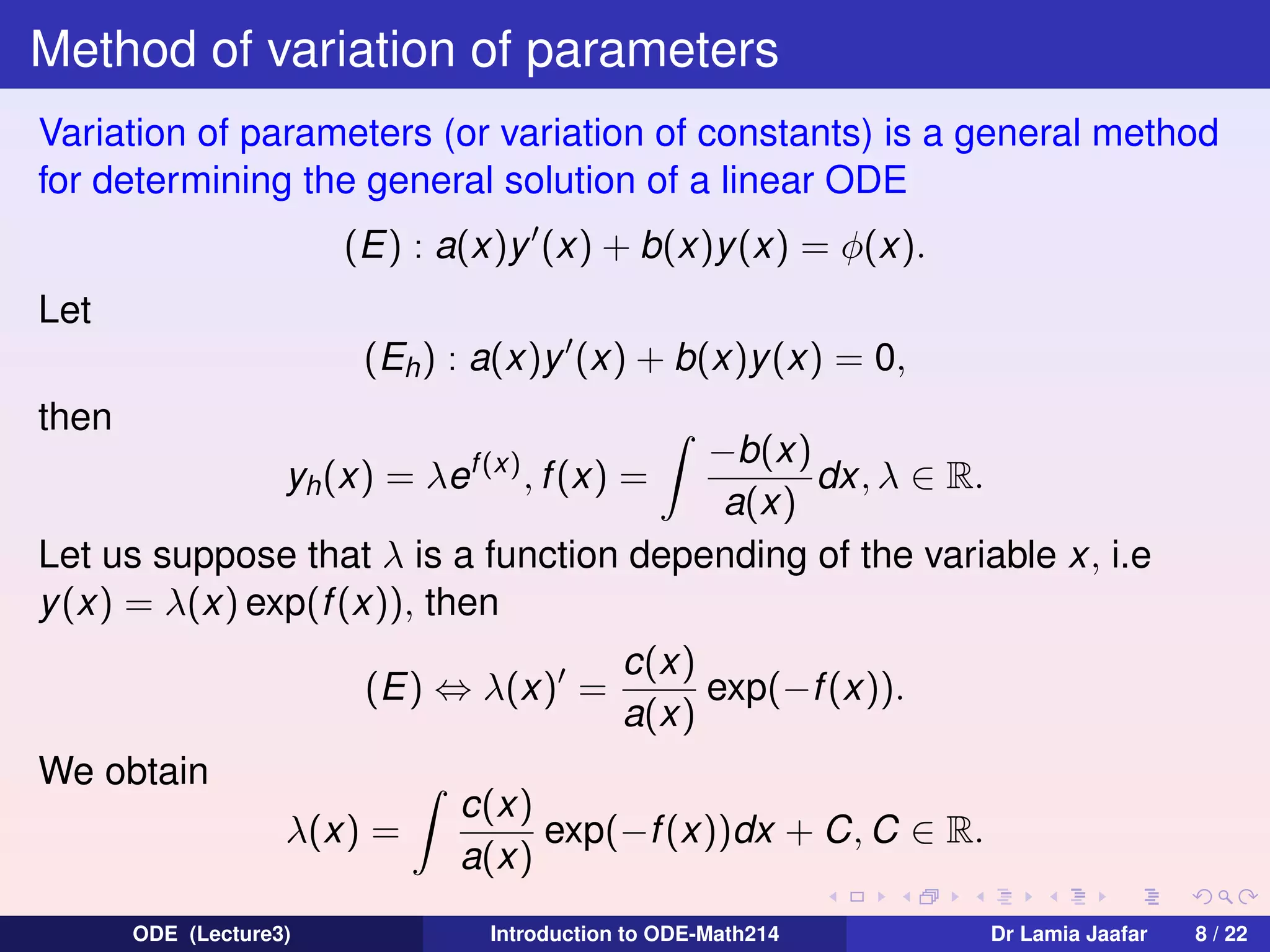
Method of variation of parameters
Variation of parameters (or variation of constants) is a general method
for determining the general solution of a linear ODE
(E) : a(x)y (x) + b(x)y (x) = φ(x).
Let
(Eh ) : a(x)y (x) + b(x)y (x) = 0,
then

−b(x)
dx, λ ∈ R.
a(x)
Let us suppose that λ is a function depending of the variable x, i.e
y (x) = λ(x) exp(f (x)), then
yh (x) = λef (x) , f (x) =

(E) ⇔ λ(x) =
We obtain
λ(x) =
ODE (Lecture3)

c(x)
exp(−f (x)).
a(x)

c(x)
exp(−f (x))dx + C, C ∈ R.
a(x)
Introduction to ODE-Math214

Dr Lamia Jaafar

8 / 22
Method of variation of parameters
Variation of parameters (or variation of constants) is a general method
for determining the general solution of a linear ODE
(E) : a(x)y (x) + b(x)y (x) = φ(x).
Let
(Eh ) : a(x)y (x) + b(x)y(x) = 0,
then

−b(x)
dx, λ ∈ R.
a(x)
Let us suppose that λ is a function depending of the variable x, i.e
y (x) = λ(x) exp(f (x)), then
yh (x) = λef (x) , f (x) =

(E) ⇔ λ(x) =
We obtain
λ(x) =
ODE (Lecture3)

c(x)
exp(−f (x)).
a(x)

c(x)
exp(−f (x))dx + C, C ∈ R.
a(x)
Introduction to ODE-Math214

Dr Lamia Jaafar

8 / 22
Method of variation of parameters
Variation of parameters (or variation of constants) is a general method
for determining the general solution of a linear ODE
(E) : a(x)y (x) + b(x)y (x) = φ(x).
Let
(Eh ) : a(x)y (x) + b(x)y(x) = 0,
then

−b(x)
dx, λ ∈ R.
a(x)
Let us suppose that λ is a function depending of the variable x, i.e
y (x) = λ(x) exp(f (x)), then
yh (x) = λef (x) , f (x) =

(E) ⇔ λ(x) =
We obtain
λ(x) =
ODE (Lecture3)

c(x)
exp(−f (x)).
a(x)

c(x)
exp(−f (x))dx + C, C ∈ R.
a(x)
Introduction to ODE-Math214

Dr Lamia Jaafar

8 / 22
Method of variation of parameters
Variation of parameters (or variation of constants) is a general method
for determining the general solution of a linear ODE
(E) : a(x)y (x) + b(x)y (x) = φ(x).
Let
(Eh ) : a(x)y (x) + b(x)y(x) = 0,
then

−b(x)
dx, λ ∈ R.
a(x)
Let us suppose that λ is a function depending of the variable x, i.e
y (x) = λ(x) exp(f (x)), then
yh (x) = λef (x) , f (x) =

(E) ⇔ λ(x) =
We obtain
λ(x) =
ODE (Lecture3)

c(x)
exp(−f (x)).
a(x)

c(x)
exp(−f (x))dx + C, C ∈ R.
a(x)
Introduction to ODE-Math214

Dr Lamia Jaafar

8 / 22
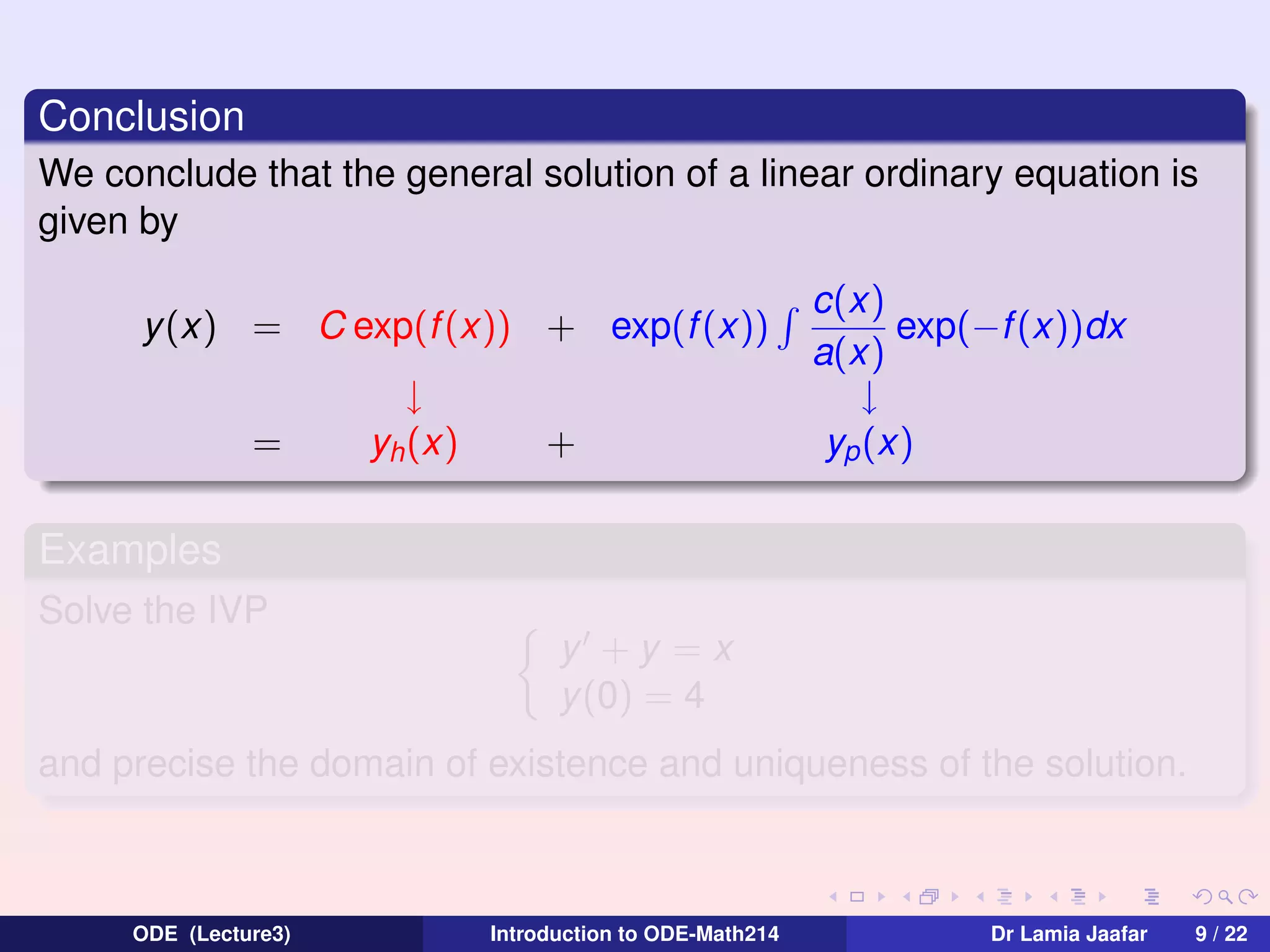
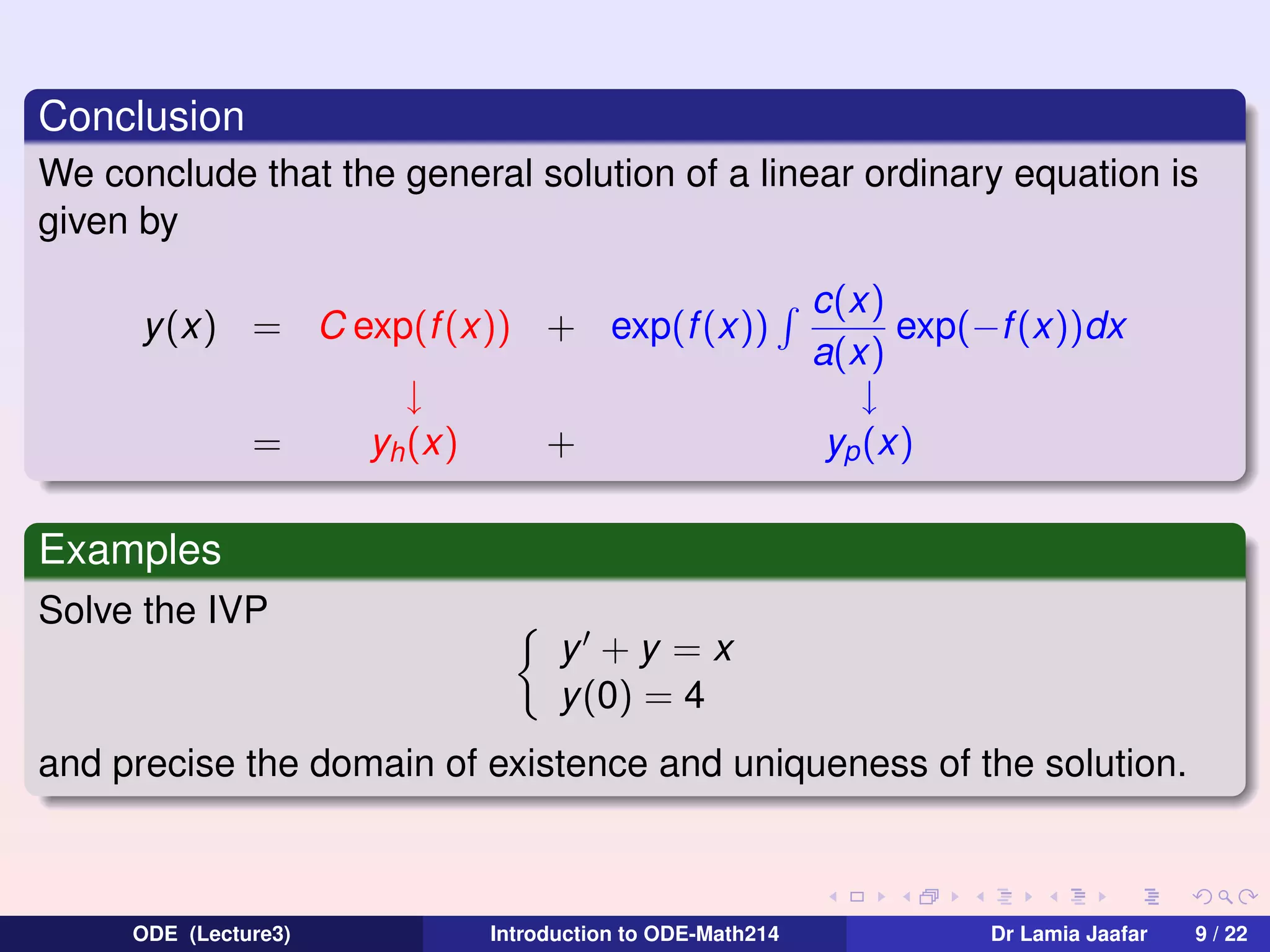
Conclusion
We conclude that the general solution of a linear ordinary equation is
given by
y(x) = C exp(f (x)) + exp(f (x))
=

↓
yh (x)

+

c(x)
exp(−f (x))dx
a(x)
↓
yp (x)

Examples
Solve the IVP
y +y =x
y (0) = 4
and precise the domain of existence and uniqueness of the solution.

ODE (Lecture3)

Introduction to ODE-Math214

Dr Lamia Jaafar

9 / 22
Conclusion
We conclude that the general solution of a linear ordinary equation is
given by
y(x) = C exp(f (x)) + exp(f (x))
=

↓
yh (x)

+

c(x)
exp(−f (x))dx
a(x)
↓
yp (x)

Examples
Solve the IVP
y +y =x
y (0) = 4
and precise the domain of existence and uniqueness of the solution.

ODE (Lecture3)

Introduction to ODE-Math214

Dr Lamia Jaafar

9 / 22
Exact equations

ODE (Lecture3)

Introduction to ODE-Math214

Dr Lamia Jaafar

10 / 22
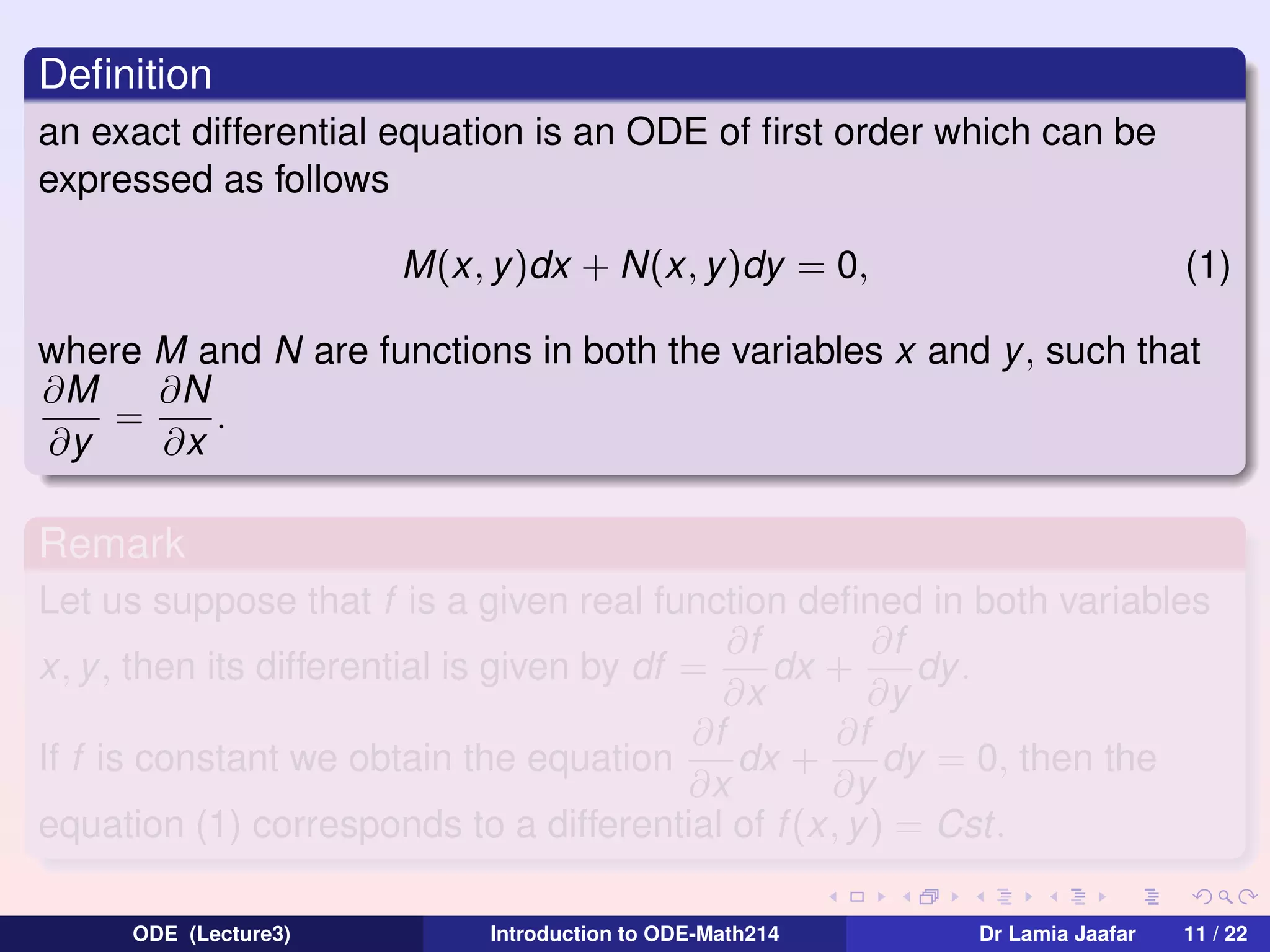
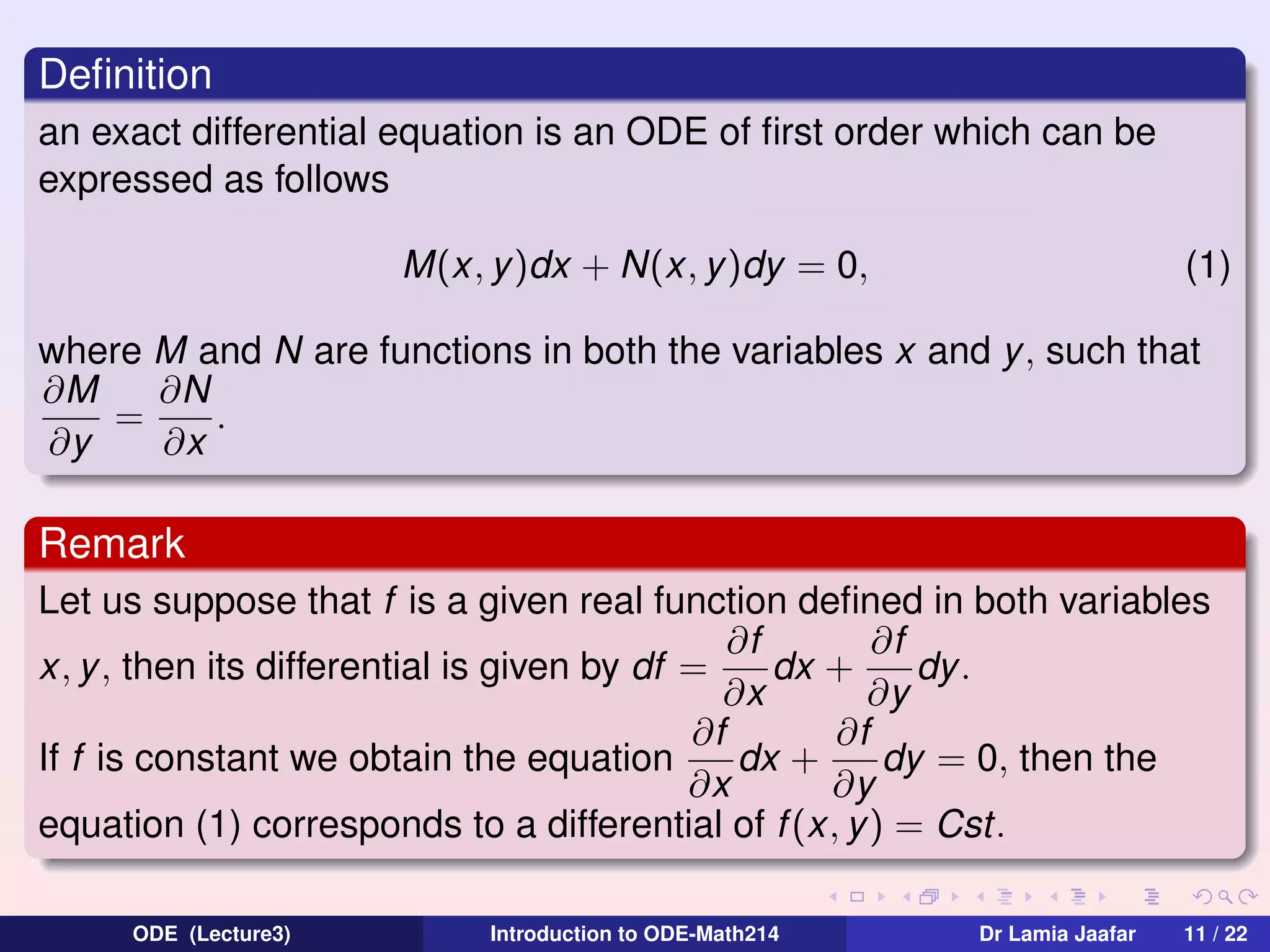
Definition
an exact differential equation is an ODE of first order which can be
expressed as follows
M(x, y)dx + N(x, y)dy = 0,

(1)

where M and N are functions in both the variables x and y, such that
∂M
∂N
=
.
∂y
∂x

Remark
Let us suppose that f is a given real function defined in both variables
∂f
∂f
x, y , then its differential is given by df =
dx +
dy .
∂x
∂y
∂f
∂f
If f is constant we obtain the equation
dx +
dy = 0, then the
∂x
∂y
equation (1) corresponds to a differential of f (x, y) = Cst.
ODE (Lecture3)

Introduction to ODE-Math214

Dr Lamia Jaafar

11 / 22
Definition
an exact differential equation is an ODE of first order which can be
expressed as follows
M(x, y)dx + N(x, y)dy = 0,

(1)

where M and N are functions in both the variables x and y, such that
∂M
∂N
=
.
∂y
∂x

Remark
Let us suppose that f is a given real function defined in both variables
∂f
∂f
x, y , then its differential is given by df =
dx +
dy .
∂x
∂y
∂f
∂f
If f is constant we obtain the equation
dx +
dy = 0, then the
∂x
∂y
equation (1) corresponds to a differential of f (x, y) = Cst.
ODE (Lecture3)

Introduction to ODE-Math214

Dr Lamia Jaafar

11 / 22
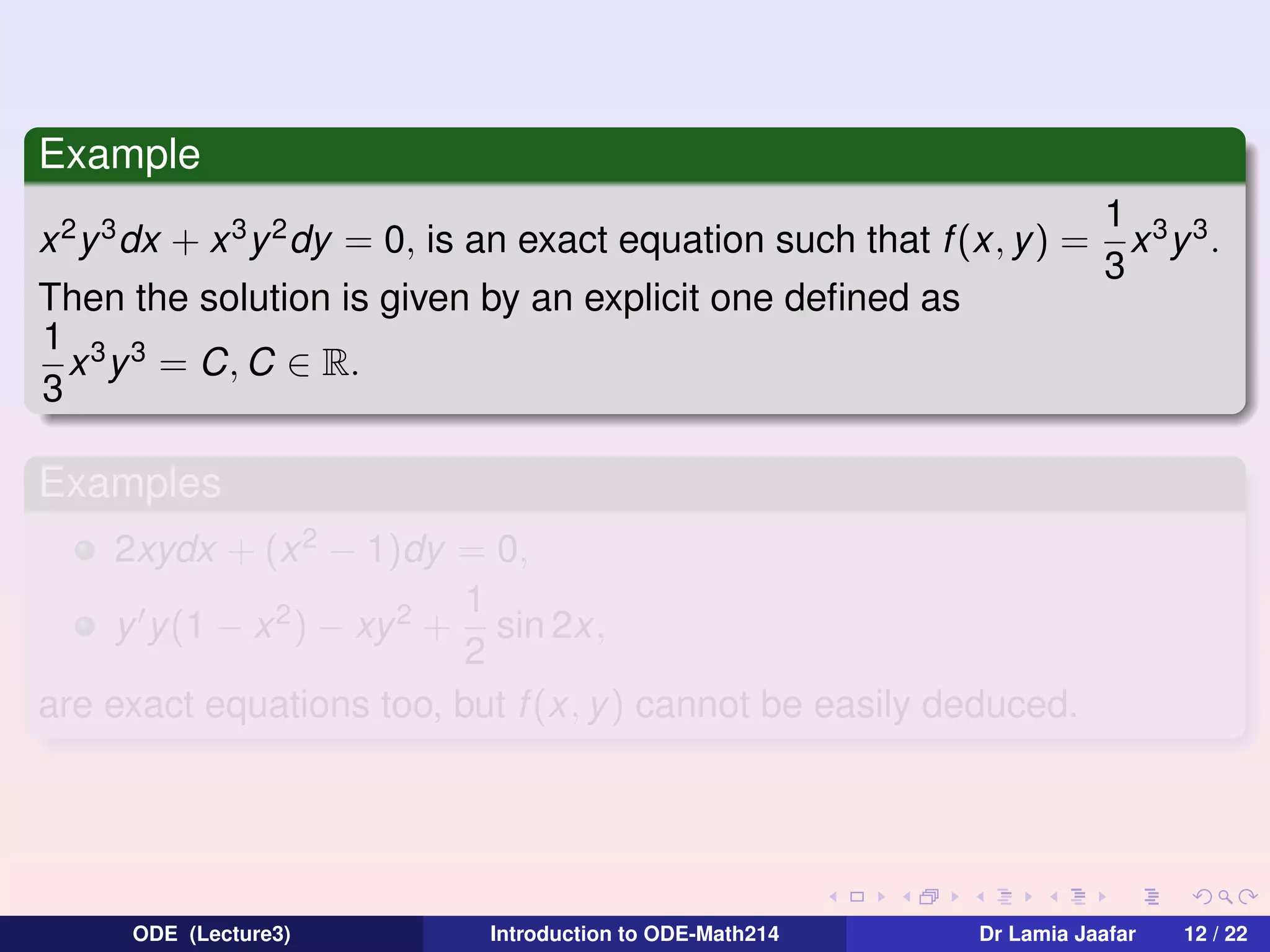
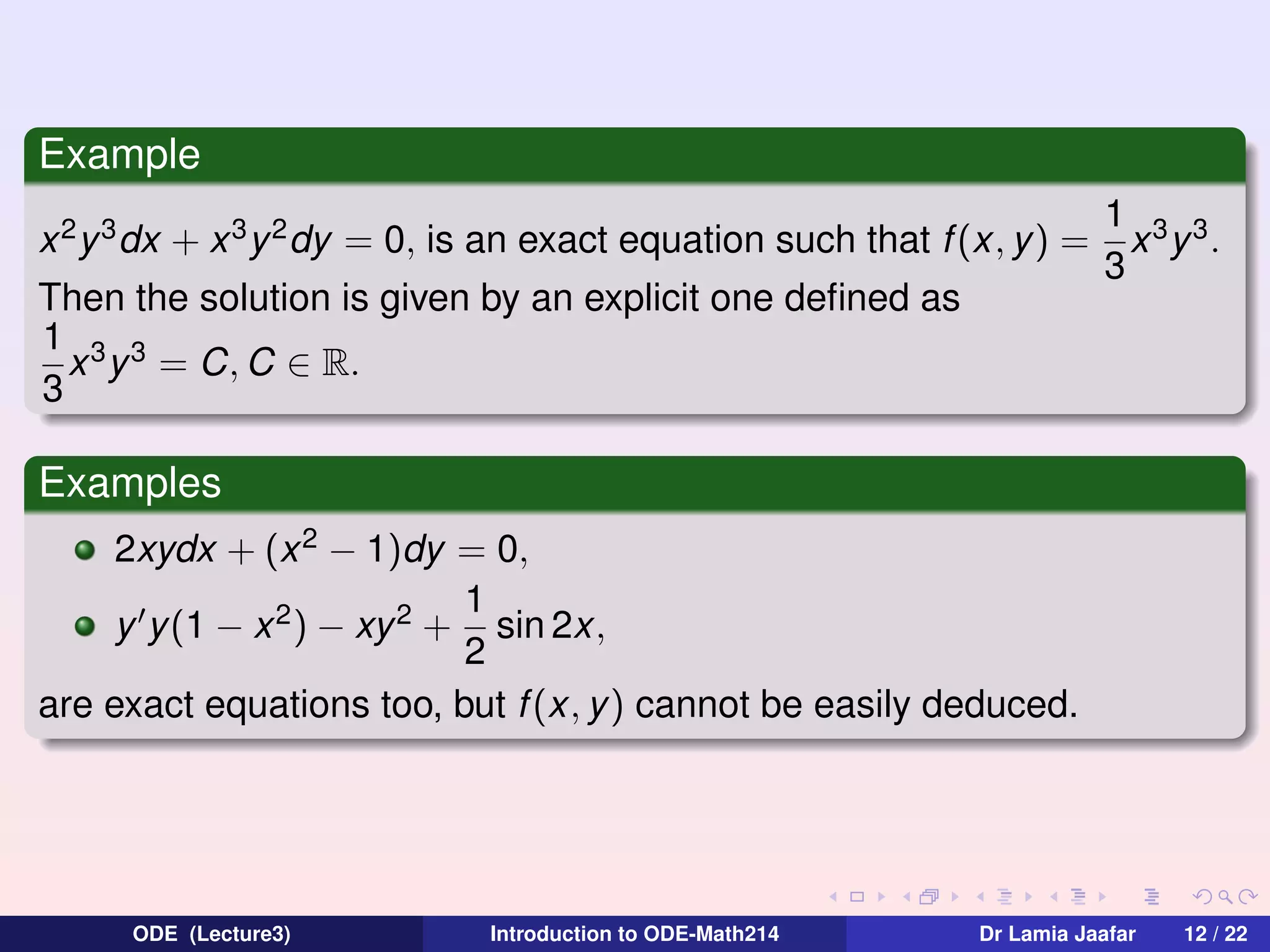
Example
x 2 y 3 dx + x 3 y 2 dy = 0, is an exact equation such that f (x, y) =
Then the solution is given by an explicit one defined as
1 3 3
x y = C, C ∈ R.
3

1 3 3
x y .
3

Examples
2xydx + (x 2 − 1)dy = 0,
1
y y(1 − x 2 ) − xy 2 + sin 2x,
2
are exact equations too, but f (x, y) cannot be easily deduced.

ODE (Lecture3)

Introduction to ODE-Math214

Dr Lamia Jaafar

12 / 22
Example
x 2 y 3 dx + x 3 y 2 dy = 0, is an exact equation such that f (x, y) =
Then the solution is given by an explicit one defined as
1 3 3
x y = C, C ∈ R.
3

1 3 3
x y .
3

Examples
2xydx + (x 2 − 1)dy = 0,
1
y y(1 − x 2 ) − xy 2 + sin 2x,
2
are exact equations too, but f (x, y) cannot be easily deduced.

ODE (Lecture3)

Introduction to ODE-Math214

Dr Lamia Jaafar

12 / 22
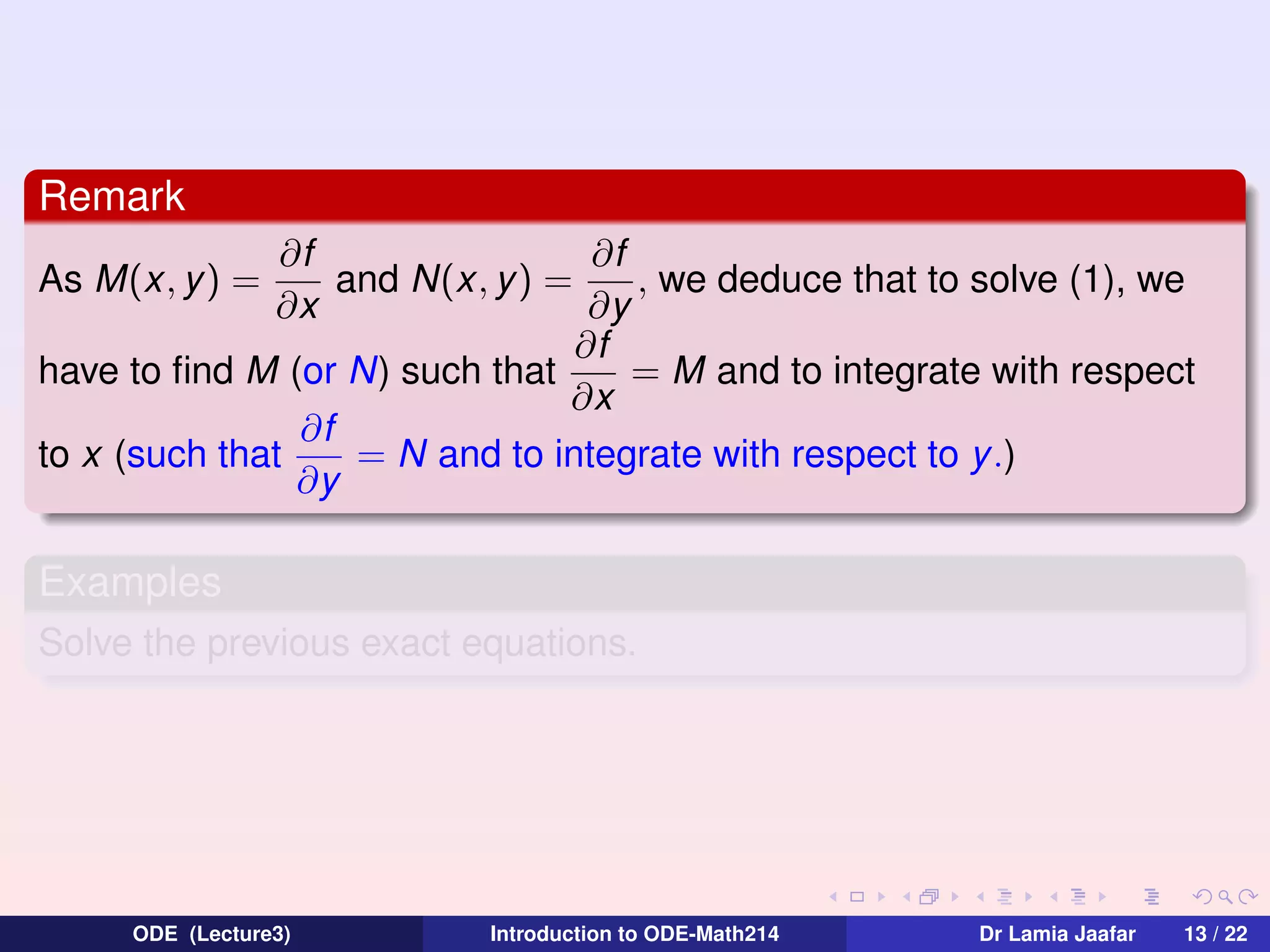
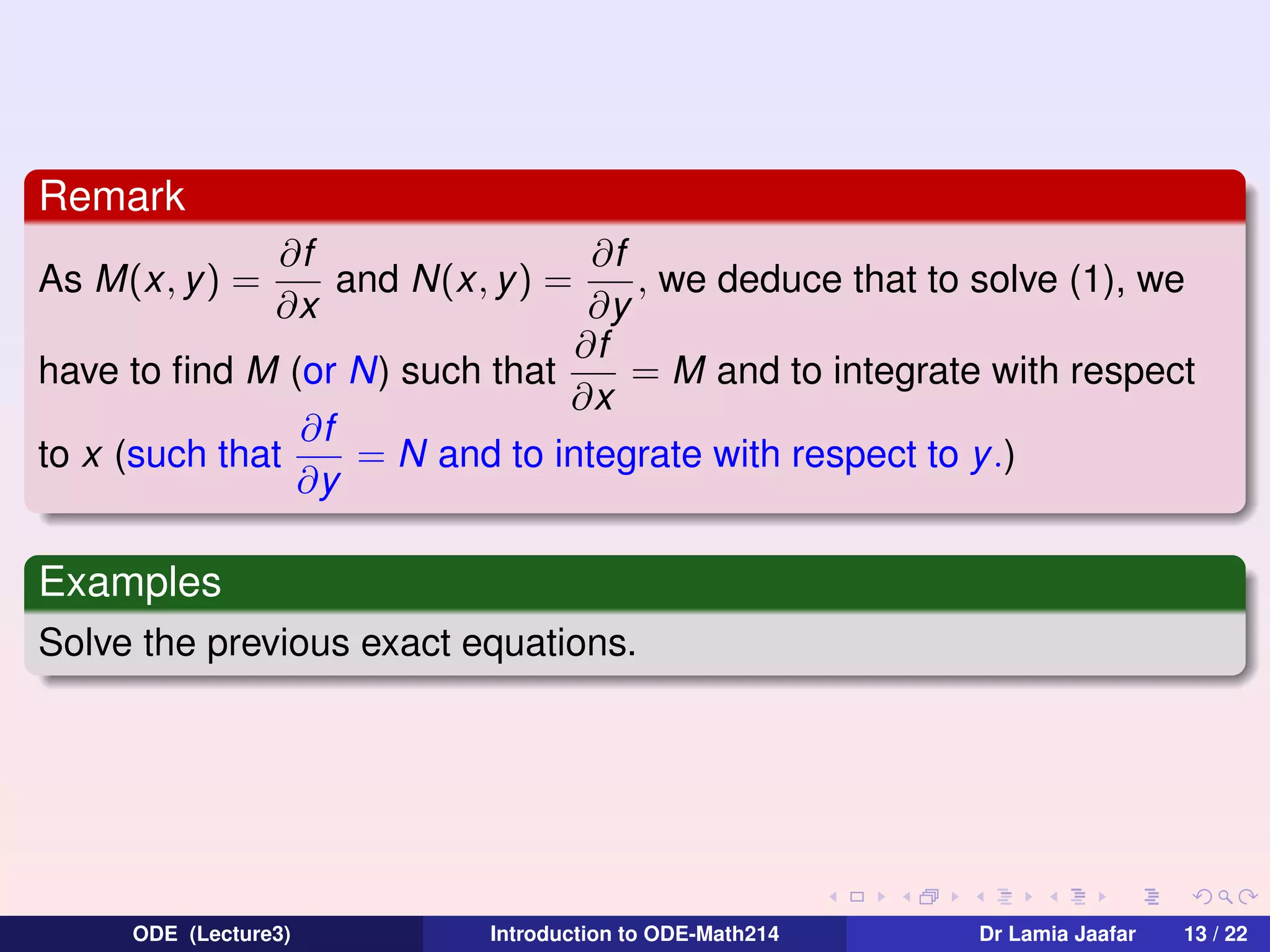
Remark
∂f
∂f
and N(x, y ) =
, we deduce that to solve (1), we
∂x
∂y
∂f
= M and to integrate with respect
have to find M (or N) such that
∂x
∂f
to x (such that
= N and to integrate with respect to y .)
∂y
As M(x, y ) =

Examples
Solve the previous exact equations.

ODE (Lecture3)

Introduction to ODE-Math214

Dr Lamia Jaafar

13 / 22
Remark
∂f
∂f
and N(x, y ) =
, we deduce that to solve (1), we
∂x
∂y
∂f
= M and to integrate with respect
have to find M (or N) such that
∂x
∂f
to x (such that
= N and to integrate with respect to y .)
∂y
As M(x, y ) =

Examples
Solve the previous exact equations.

ODE (Lecture3)

Introduction to ODE-Math214

Dr Lamia Jaafar

13 / 22
Solution of (E) : 2xydx + (x 2 − 1)dy = 0
Let M(x, y) = 2xy and N(x, y) = x 2 − 1.
∂M
∂N
As
=
then (E) is an exact equation. We deduce that it exists f
∂y
∂x
defined on a domain I such that
 ∂f

2
 ∂x = 2xy,
 f (x, y) = x y + F (y),
⇒
 ∂f
 ∂f
2−1
= x 2 − 1 = x 2 + F (y )
∂y
∂y = x
we deduce that
F (y) = −1 ⇒ F (y ) = −y + Cst ⇒ f (x, y) = x 2 y − y + Cst, then an
implicit solution is giving by x 2 y − y − C, C ∈ R and an explicit solution
C
is y = 2
, x = ±1.
x −1
The solution of the initial ODE is defined on any interval not containing
either 1 or −1, i.e a domain of the solution y is ] − ∞, −1[ or ] − 1, 1[ or
]1, +∞[.
ODE (Lecture3)

Introduction to ODE-Math214

Dr Lamia Jaafar

14 / 22
Solution of (E) : 2xydx + (x 2 − 1)dy = 0
Let M(x, y) = 2xy and N(x, y) = x 2 − 1.
∂M
∂N
As
=
then (E) is an exact equation. We deduce that it exists f
∂y
∂x
defined on a domain I such that
 ∂f

2
 ∂x = 2xy,
 f (x, y) = x y + F (y),
⇒
 ∂f
 ∂f
2−1
= x 2 − 1 = x 2 + F (y )
∂y
∂y = x
we deduce that
F (y) = −1 ⇒ F (y ) = −y + Cst ⇒ f (x, y) = x 2 y − y + Cst, then an
implicit solution is giving by x 2 y − y − C, C ∈ R and an explicit solution
C
is y = 2
, x = ±1.
x −1
The solution of the initial ODE is defined on any interval not containing
either 1 or −1, i.e a domain of the solution y is ] − ∞, −1[ or ] − 1, 1[ or
]1, +∞[.
ODE (Lecture3)

Introduction to ODE-Math214

Dr Lamia Jaafar

14 / 22
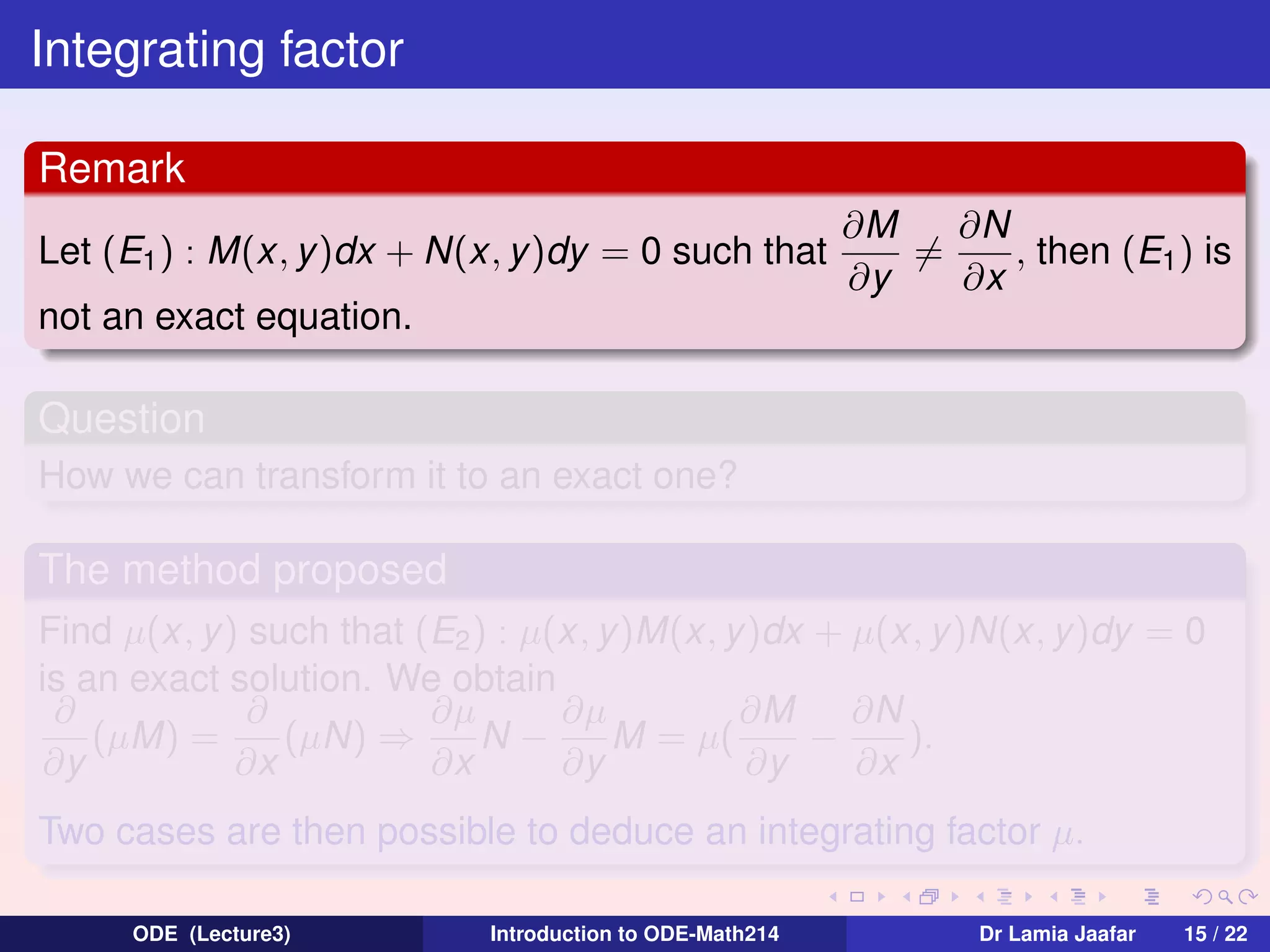
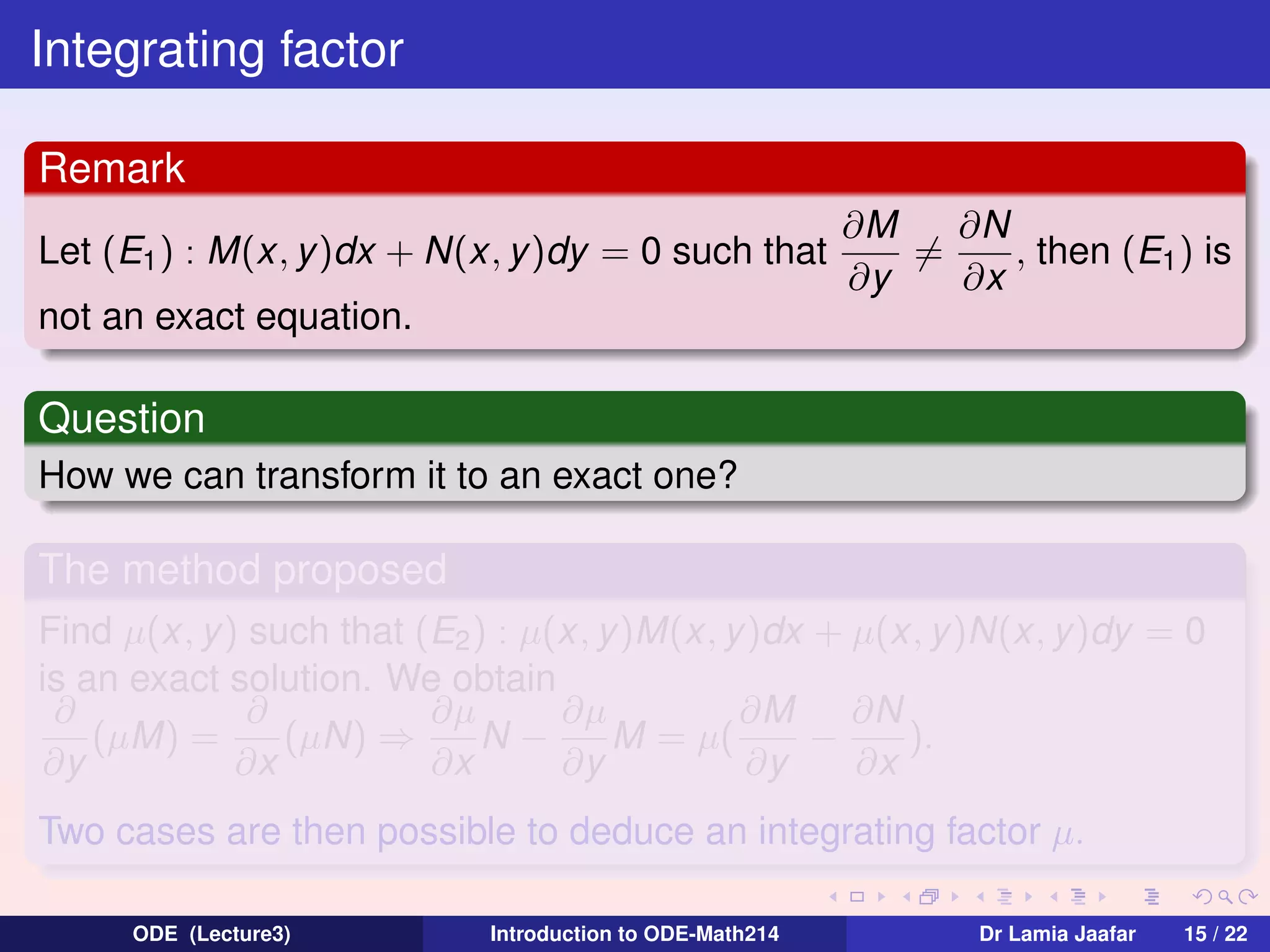
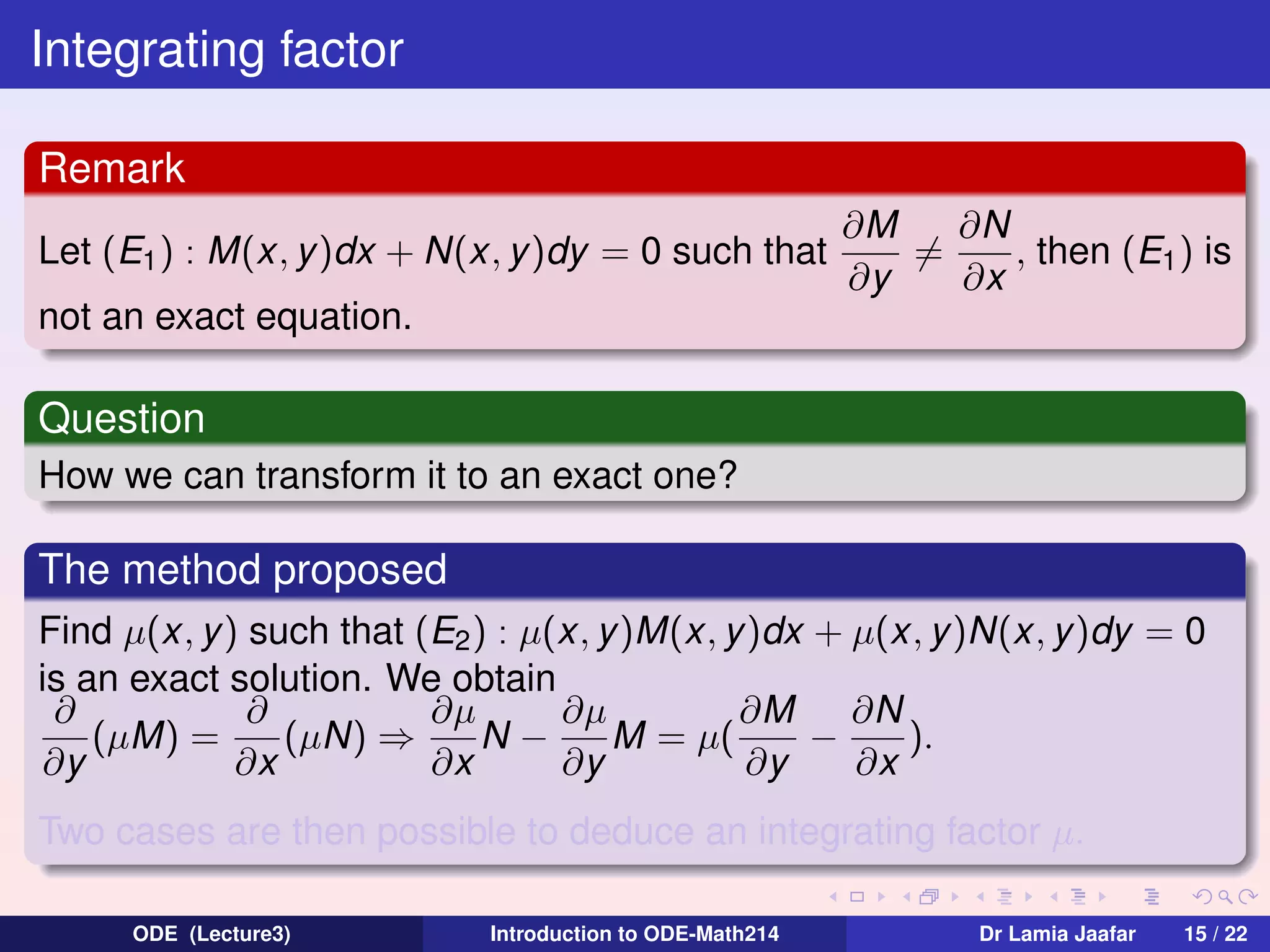
Integrating factor
Remark
Let (E1 ) : M(x, y )dx + N(x, y )dy = 0 such that

∂N
∂M
=
, then (E1 ) is
∂y
∂x

not an exact equation.

Question
How we can transform it to an exact one?

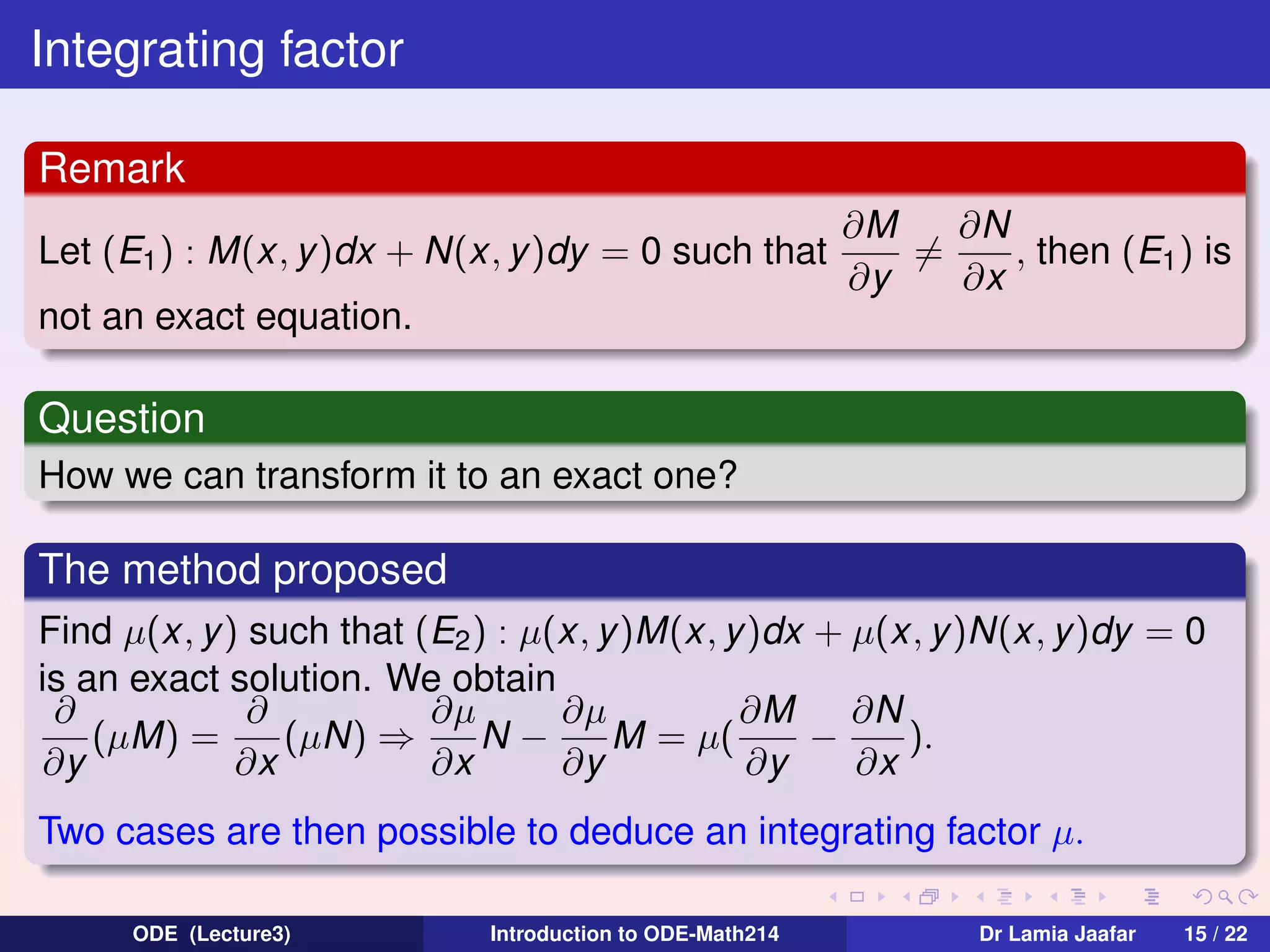
The method proposed
Find µ(x, y) such that (E2 ) : µ(x, y)M(x, y )dx + µ(x, y)N(x, y)dy = 0
is an exact solution. We obtain
∂
∂
∂µ
∂µ
∂M
∂N
(µM) =
(µN) ⇒
N−
M = µ(
−
).
∂y
∂x
∂x
∂y
∂y
∂x
Two cases are then possible to deduce an integrating factor µ.
ODE (Lecture3)

Introduction to ODE-Math214

Dr Lamia Jaafar

15 / 22
Integrating factor
Remark
Let (E1 ) : M(x, y )dx + N(x, y )dy = 0 such that

∂N
∂M
=
, then (E1 ) is
∂y
∂x

not an exact equation.

Question
How we can transform it to an exact one?

The method proposed
Find µ(x, y) such that (E2 ) : µ(x, y)M(x, y )dx + µ(x, y)N(x, y)dy = 0
is an exact solution. We obtain
∂
∂
∂µ
∂µ
∂M
∂N
(µM) =
(µN) ⇒
N−
M = µ(
−
).
∂y
∂x
∂x
∂y
∂y
∂x
Two cases are then possible to deduce an integrating factor µ.
ODE (Lecture3)

Introduction to ODE-Math214

Dr Lamia Jaafar

15 / 22
Integrating factor
Remark
Let (E1 ) : M(x, y )dx + N(x, y )dy = 0 such that

∂N
∂M
=
, then (E1 ) is
∂y
∂x

not an exact equation.

Question
How we can transform it to an exact one?

The method proposed
Find µ(x, y) such that (E2 ) : µ(x, y)M(x, y )dx + µ(x, y)N(x, y)dy = 0
is an exact solution. We obtain
∂
∂
∂µ
∂µ
∂M
∂N
(µM) =
(µN) ⇒
N−
M = µ(
−
).
∂y
∂x
∂x
∂y
∂y
∂x
Two cases are then possible to deduce an integrating factor µ.
ODE (Lecture3)

Introduction to ODE-Math214

Dr Lamia Jaafar

15 / 22
Integrating factor
Remark
Let (E1 ) : M(x, y )dx + N(x, y )dy = 0 such that

∂N
∂M
=
, then (E1 ) is
∂y
∂x

not an exact equation.

Question
How we can transform it to an exact one?

The method proposed
Find µ(x, y) such that (E2 ) : µ(x, y)M(x, y )dx + µ(x, y)N(x, y)dy = 0
is an exact solution. We obtain
∂
∂
∂µ
∂µ
∂M
∂N
(µM) =
(µN) ⇒
N−
M = µ(
−
).
∂y
∂x
∂x
∂y
∂y
∂x
Two cases are then possible to deduce an integrating factor µ.
ODE (Lecture3)

Introduction to ODE-Math214

Dr Lamia Jaafar

15 / 22
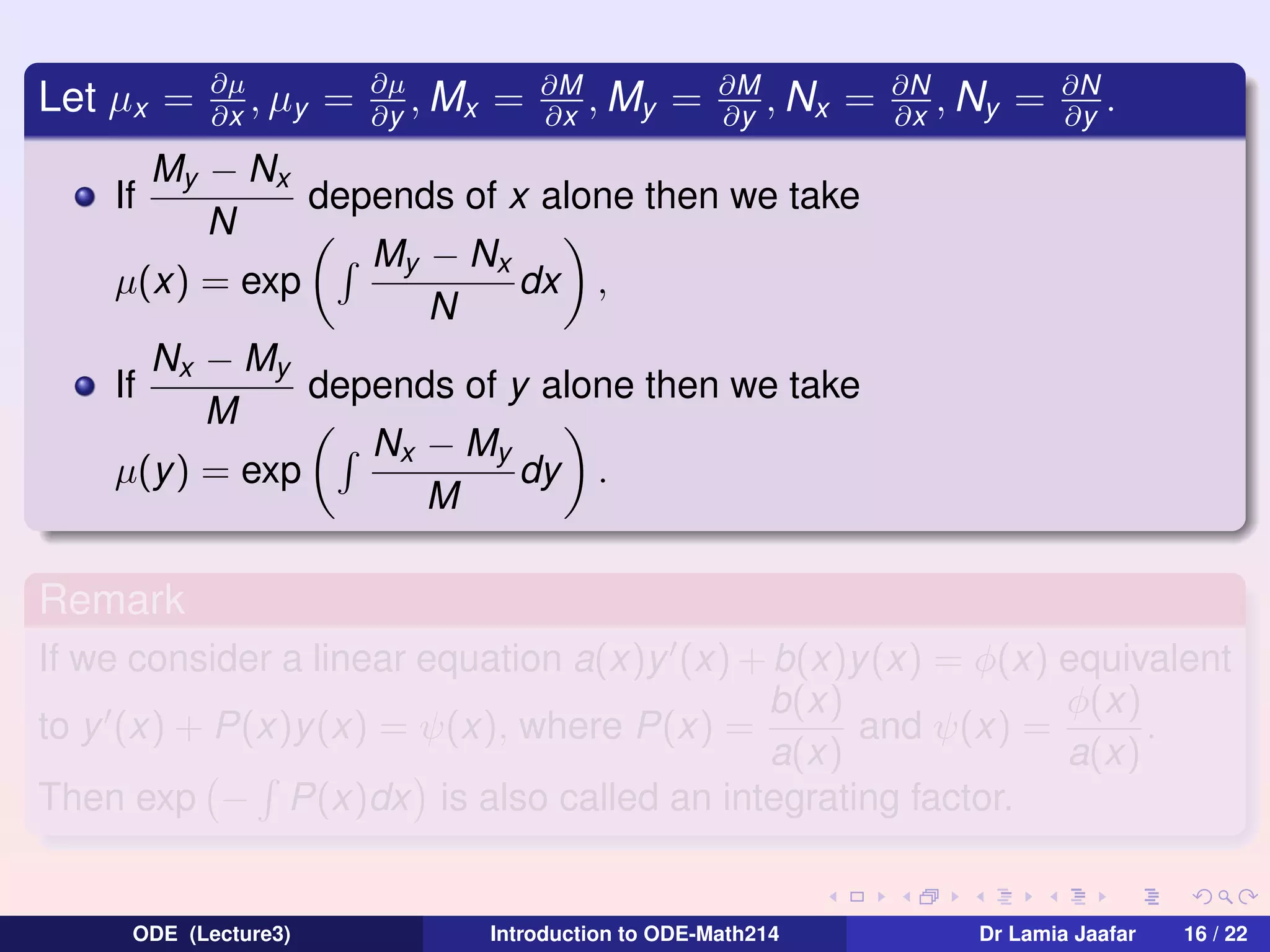
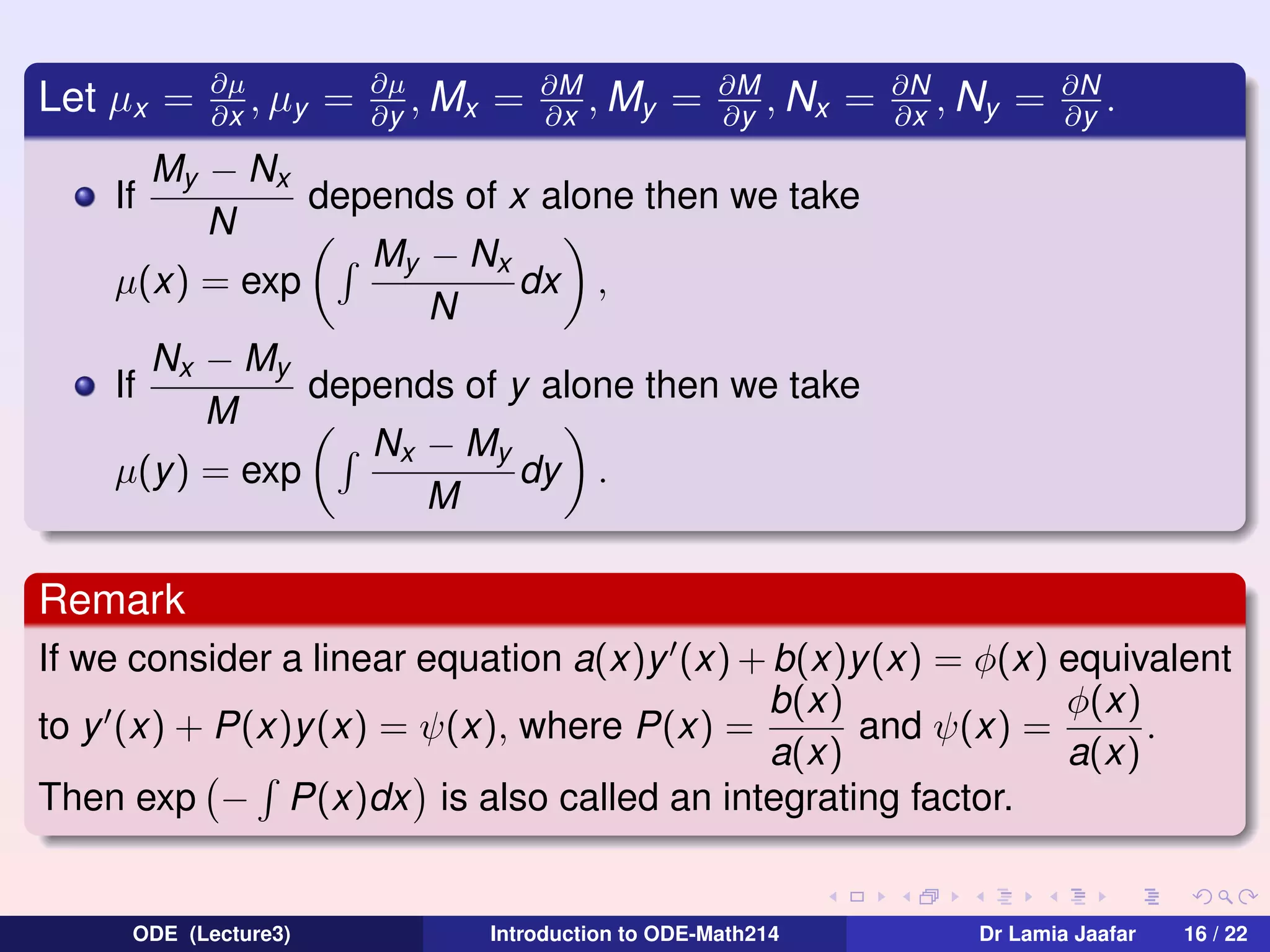
Let µx =

∂µ
, µy
∂x

=

∂µ
, Mx
∂y

=

∂M
, My
∂x

=

∂M
, Nx
∂y

=

∂N
, Ny
∂x

=

∂N
.
∂y

My − Nx
depends of x alone then we take
N
My − Nx
dx ,
µ(x) = exp
N
Nx − My
If
depends of y alone then we take
M
Nx − My
µ(y) = exp
dy .
M
If

Remark
If we consider a linear equation a(x)y (x) + b(x)y (x) = φ(x) equivalent
b(x)
φ(x)
to y (x) + P(x)y(x) = ψ(x), where P(x) =
and ψ(x) =
.
a(x)
a(x)
Then exp − P(x)dx is also called an integrating factor.

ODE (Lecture3)

Introduction to ODE-Math214

Dr Lamia Jaafar

16 / 22
Let µx =

∂µ
, µy
∂x

=

∂µ
, Mx
∂y

=

∂M
, My
∂x

=

∂M
, Nx
∂y

=

∂N
, Ny
∂x

=

∂N
.
∂y

My − Nx
depends of x alone then we take
N
My − Nx
dx ,
µ(x) = exp
N
Nx − My
If
depends of y alone then we take
M
Nx − My
µ(y) = exp
dy .
M
If

Remark
If we consider a linear equation a(x)y (x) + b(x)y (x) = φ(x) equivalent
b(x)
φ(x)
to y (x) + P(x)y(x) = ψ(x), where P(x) =
and ψ(x) =
.
a(x)
a(x)
Then exp − P(x)dx is also called an integrating factor.

ODE (Lecture3)

Introduction to ODE-Math214

Dr Lamia Jaafar

16 / 22
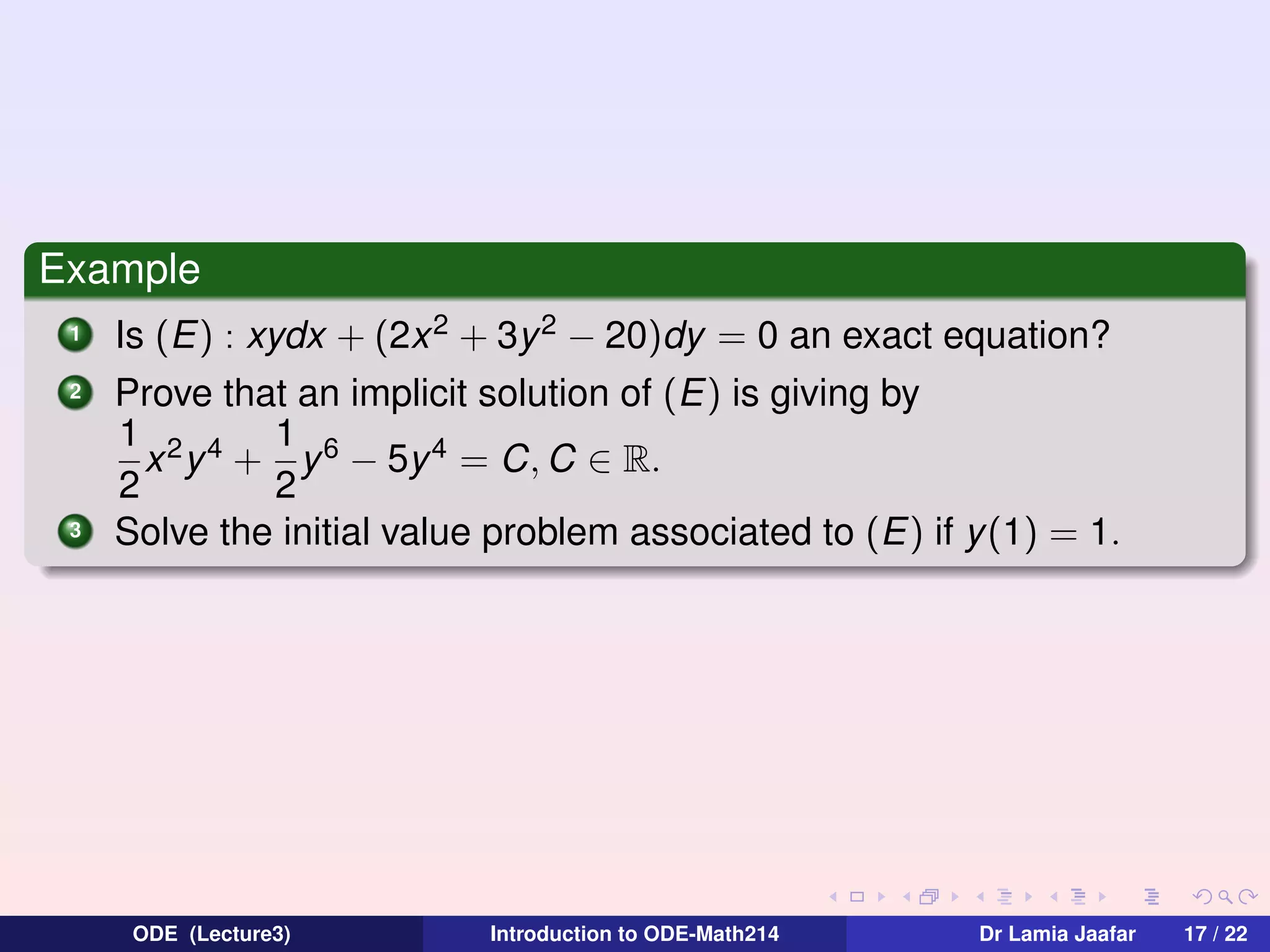
Example
1
2

3

Is (E) : xydx + (2x 2 + 3y 2 − 20)dy = 0 an exact equation?
Prove that an implicit solution of (E) is giving by
1 2 4 1 6
x y + y − 5y 4 = C, C ∈ R.
2
2
Solve the initial value problem associated to (E) if y(1) = 1.

ODE (Lecture3)

Introduction to ODE-Math214

Dr Lamia Jaafar

17 / 22
Solutions by substitutions

ODE (Lecture3)

Introduction to ODE-Math214

Dr Lamia Jaafar

18 / 22
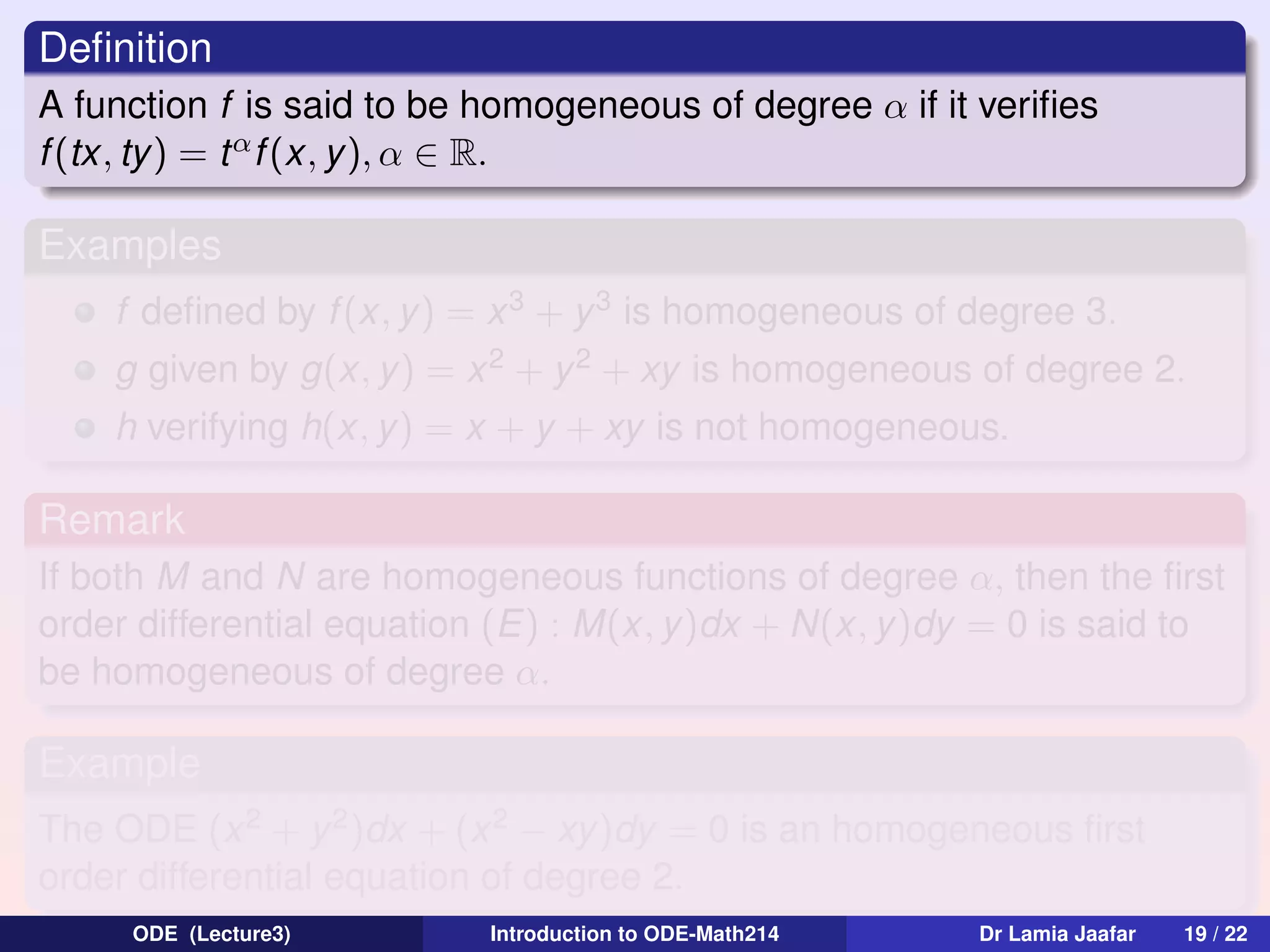
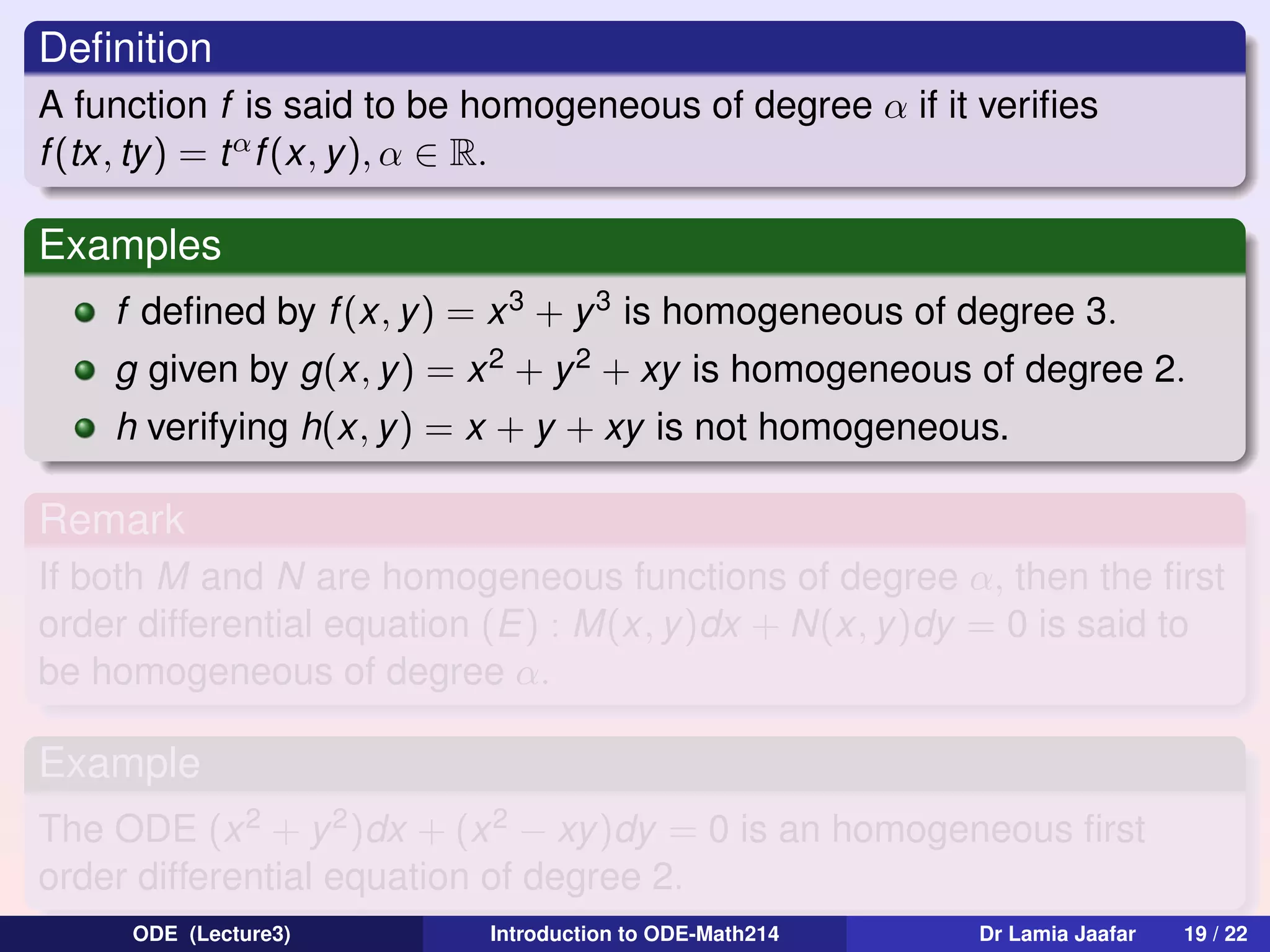
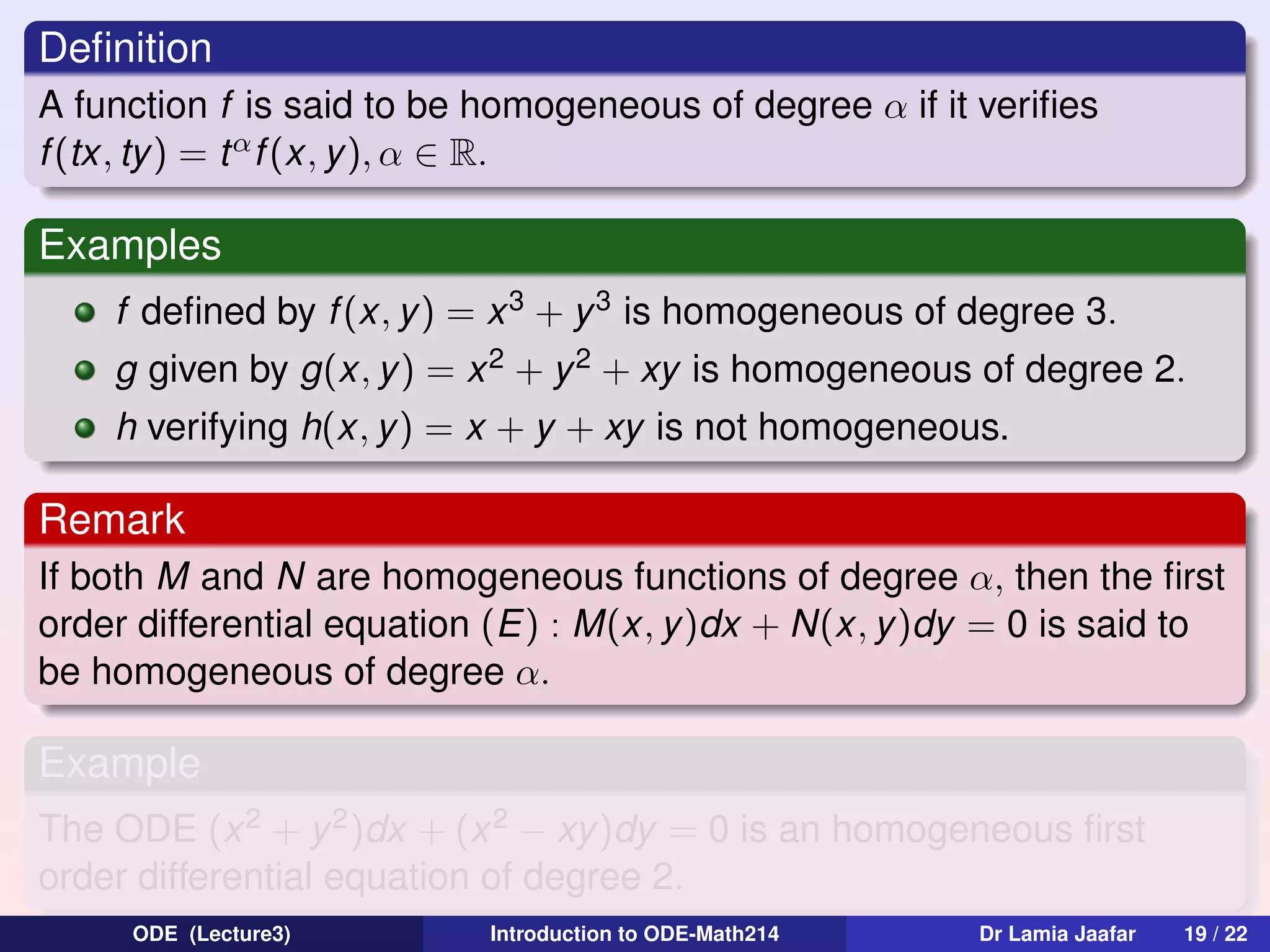
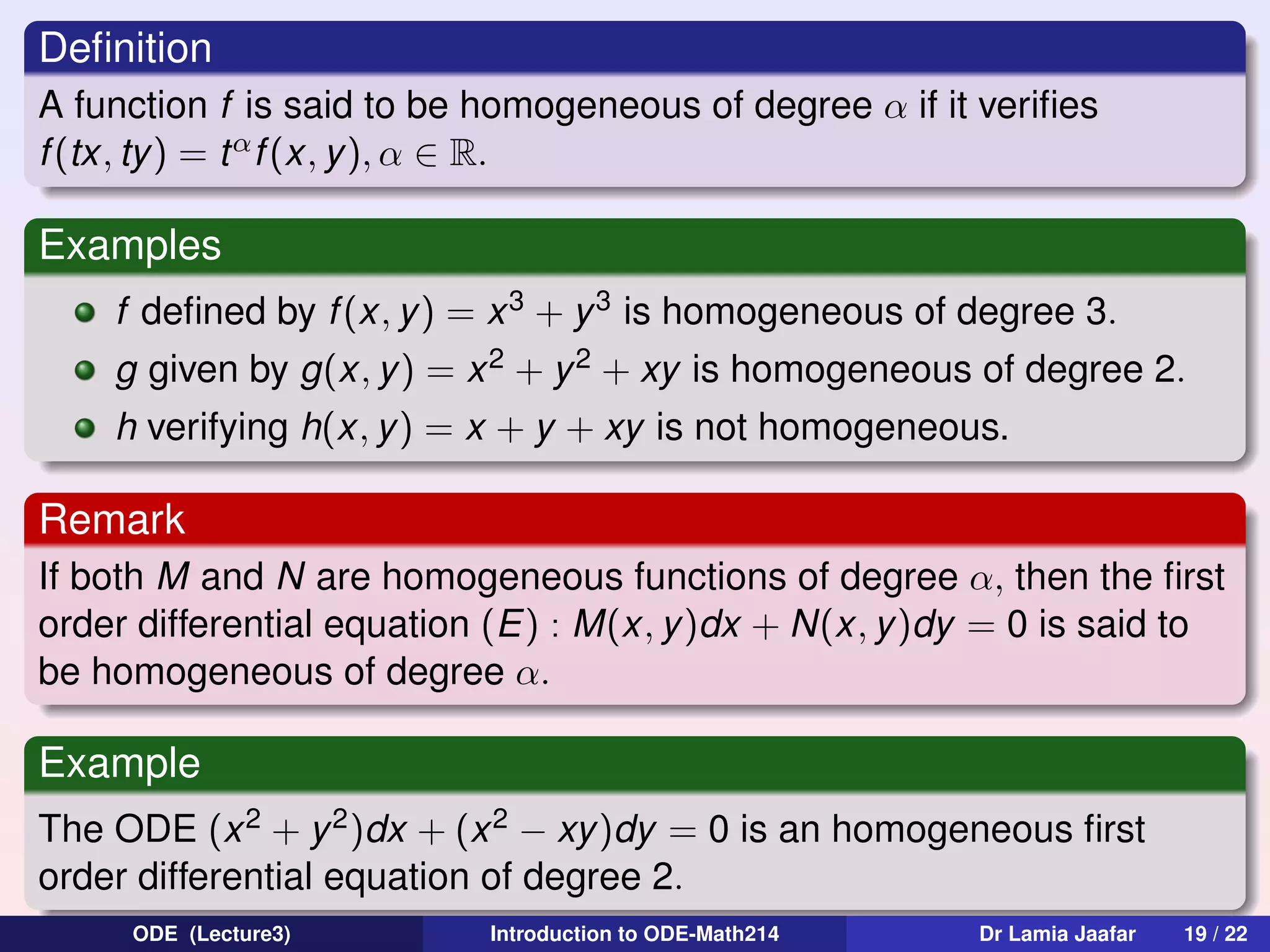
Definition
A function f is said to be homogeneous of degree α if it verifies
f (tx, ty) = t α f (x, y ), α ∈ R.

Examples
f defined by f (x, y) = x 3 + y 3 is homogeneous of degree 3.
g given by g(x, y ) = x 2 + y 2 + xy is homogeneous of degree 2.
h verifying h(x, y) = x + y + xy is not homogeneous.

Remark
If both M and N are homogeneous functions of degree α, then the first
order differential equation (E) : M(x, y)dx + N(x, y)dy = 0 is said to
be homogeneous of degree α.

Example
The ODE (x 2 + y 2 )dx + (x 2 − xy)dy = 0 is an homogeneous first
order differential equation of degree 2.
ODE (Lecture3)

Introduction to ODE-Math214

Dr Lamia Jaafar

19 / 22
Definition
A function f is said to be homogeneous of degree α if it verifies
f (tx, ty) = t α f (x, y ), α ∈ R.

Examples
f defined by f (x, y) = x 3 + y 3 is homogeneous of degree 3.
g given by g(x, y ) = x 2 + y 2 + xy is homogeneous of degree 2.
h verifying h(x, y) = x + y + xy is not homogeneous.

Remark
If both M and N are homogeneous functions of degree α, then the first
order differential equation (E) : M(x, y)dx + N(x, y)dy = 0 is said to
be homogeneous of degree α.

Example
The ODE (x 2 + y 2 )dx + (x 2 − xy)dy = 0 is an homogeneous first
order differential equation of degree 2.
ODE (Lecture3)

Introduction to ODE-Math214

Dr Lamia Jaafar

19 / 22
Definition
A function f is said to be homogeneous of degree α if it verifies
f (tx, ty) = t α f (x, y ), α ∈ R.

Examples
f defined by f (x, y) = x 3 + y 3 is homogeneous of degree 3.
g given by g(x, y ) = x 2 + y 2 + xy is homogeneous of degree 2.
h verifying h(x, y) = x + y + xy is not homogeneous.

Remark
If both M and N are homogeneous functions of degree α, then the first
order differential equation (E) : M(x, y)dx + N(x, y)dy = 0 is said to
be homogeneous of degree α.

Example
The ODE (x 2 + y 2 )dx + (x 2 − xy)dy = 0 is an homogeneous first
order differential equation of degree 2.
ODE (Lecture3)

Introduction to ODE-Math214

Dr Lamia Jaafar

19 / 22
Definition
A function f is said to be homogeneous of degree α if it verifies
f (tx, ty) = t α f (x, y ), α ∈ R.

Examples
f defined by f (x, y) = x 3 + y 3 is homogeneous of degree 3.
g given by g(x, y ) = x 2 + y 2 + xy is homogeneous of degree 2.
h verifying h(x, y) = x + y + xy is not homogeneous.

Remark
If both M and N are homogeneous functions of degree α, then the first
order differential equation (E) : M(x, y)dx + N(x, y)dy = 0 is said to
be homogeneous of degree α.

Example
The ODE (x 2 + y 2 )dx + (x 2 − xy)dy = 0 is an homogeneous first
order differential equation of degree 2.
ODE (Lecture3)

Introduction to ODE-Math214

Dr Lamia Jaafar

19 / 22
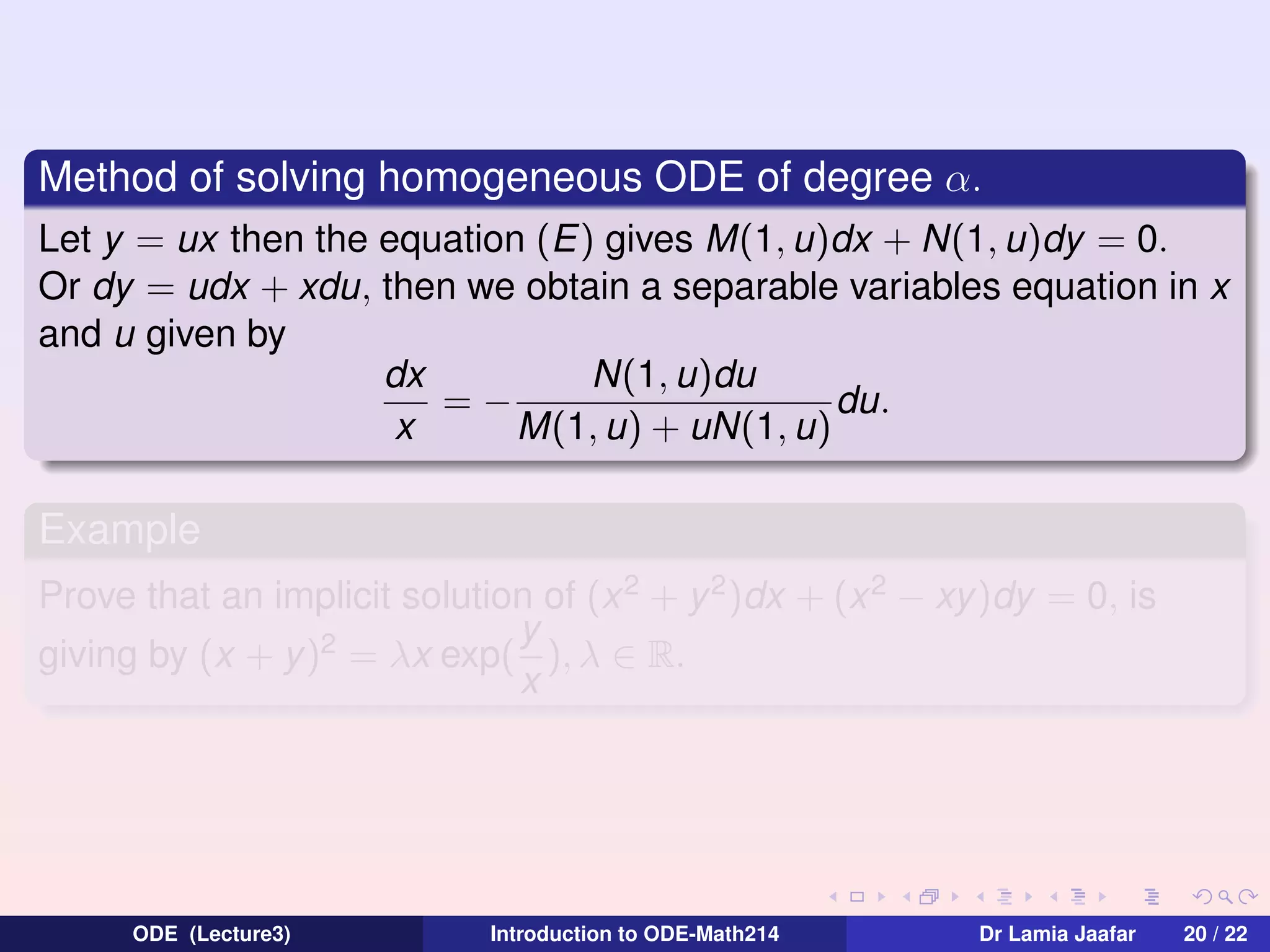
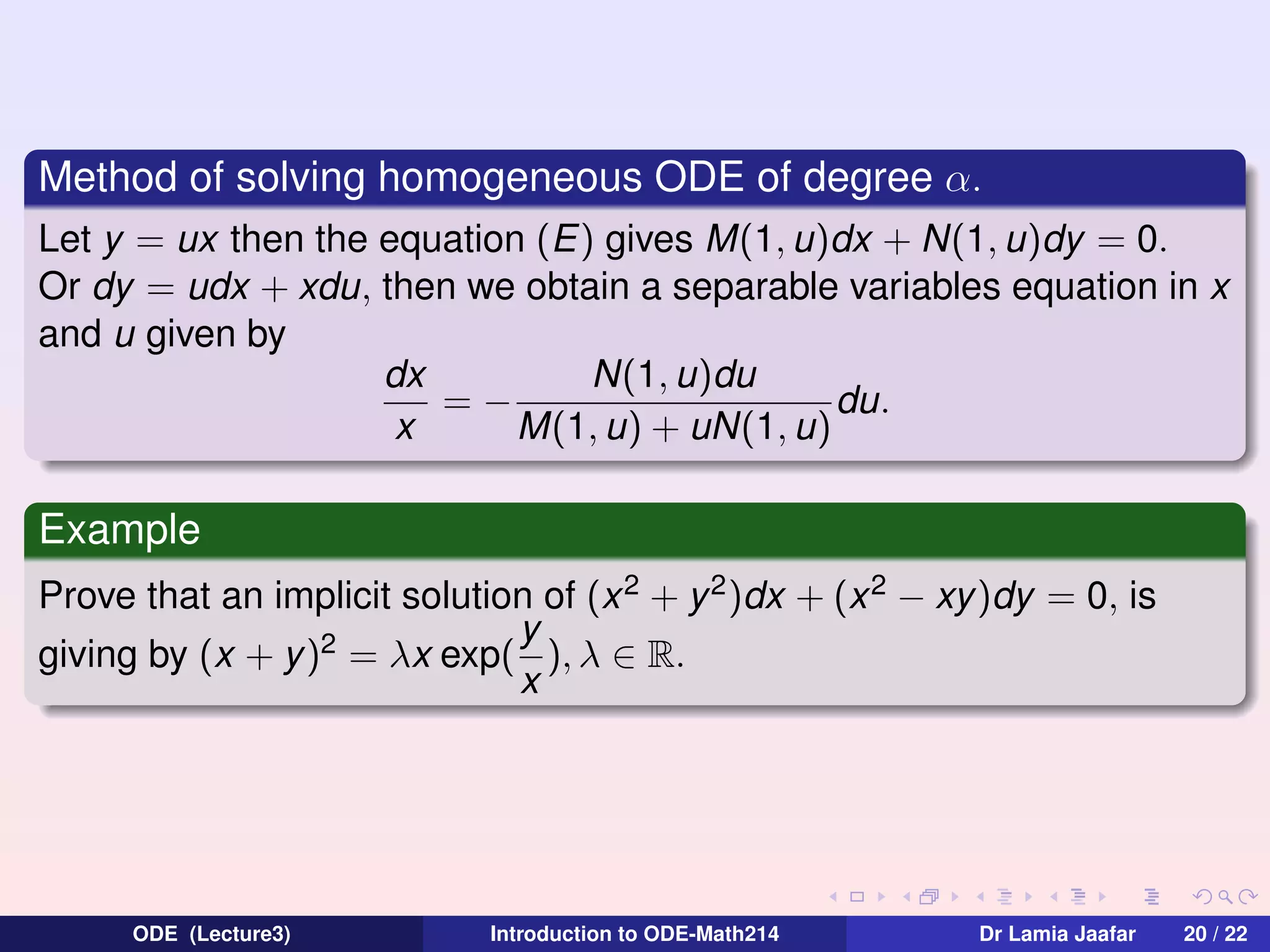
Method of solving homogeneous ODE of degree α.
Let y = ux then the equation (E) gives M(1, u)dx + N(1, u)dy = 0.
Or dy = udx + xdu, then we obtain a separable variables equation in x
and u given by
N(1, u)du
dx
=−
du.
x
M(1, u) + uN(1, u)

Example
Prove that an implicit solution of (x 2 + y 2 )dx + (x 2 − xy)dy = 0, is
y
giving by (x + y)2 = λx exp( ), λ ∈ R.
x

ODE (Lecture3)

Introduction to ODE-Math214

Dr Lamia Jaafar

20 / 22
Method of solving homogeneous ODE of degree α.
Let y = ux then the equation (E) gives M(1, u)dx + N(1, u)dy = 0.
Or dy = udx + xdu, then we obtain a separable variables equation in x
and u given by
N(1, u)du
dx
=−
du.
x
M(1, u) + uN(1, u)

Example
Prove that an implicit solution of (x 2 + y 2 )dx + (x 2 − xy)dy = 0, is
y
giving by (x + y)2 = λx exp( ), λ ∈ R.
x

ODE (Lecture3)

Introduction to ODE-Math214

Dr Lamia Jaafar

20 / 22
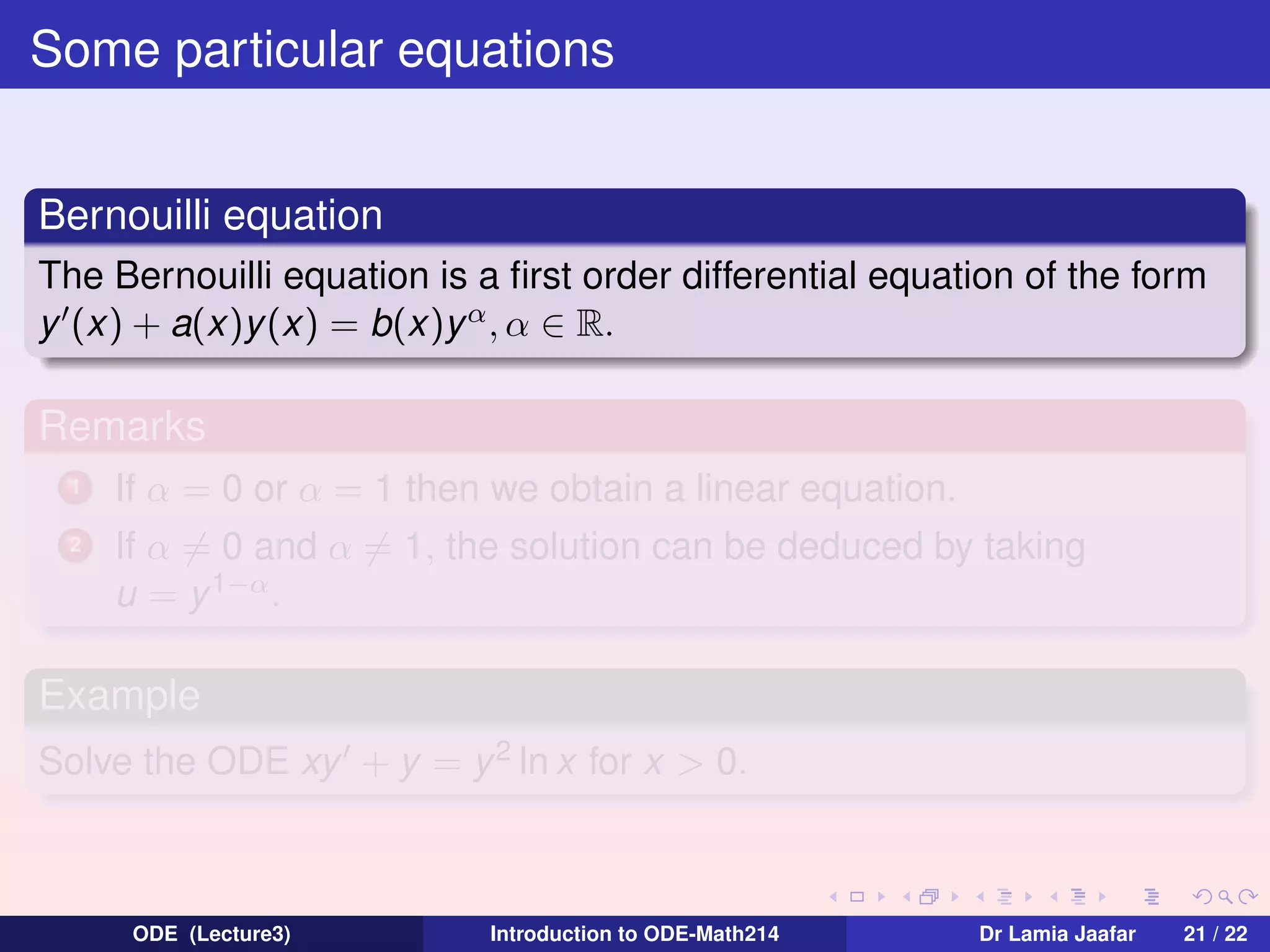
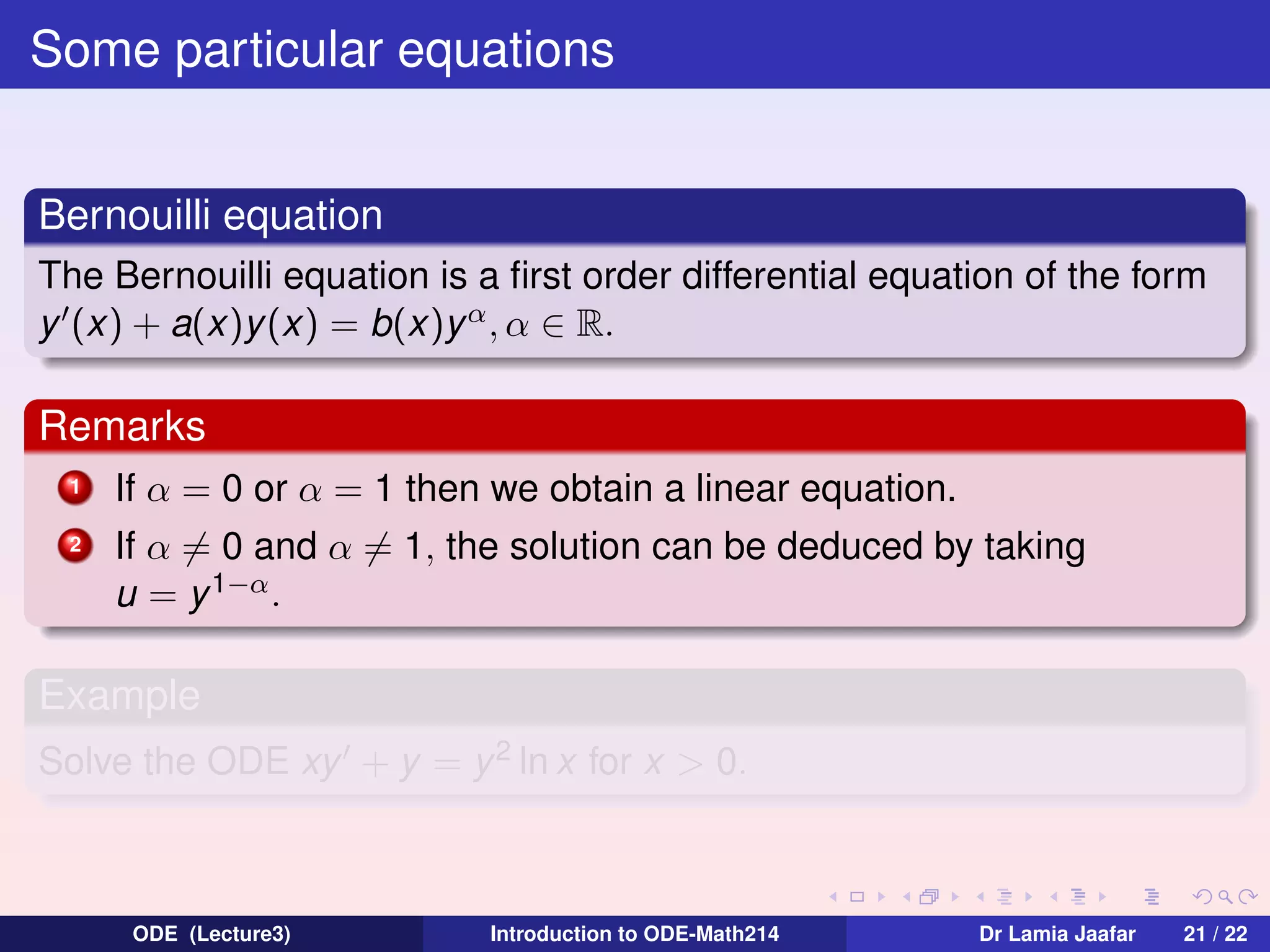
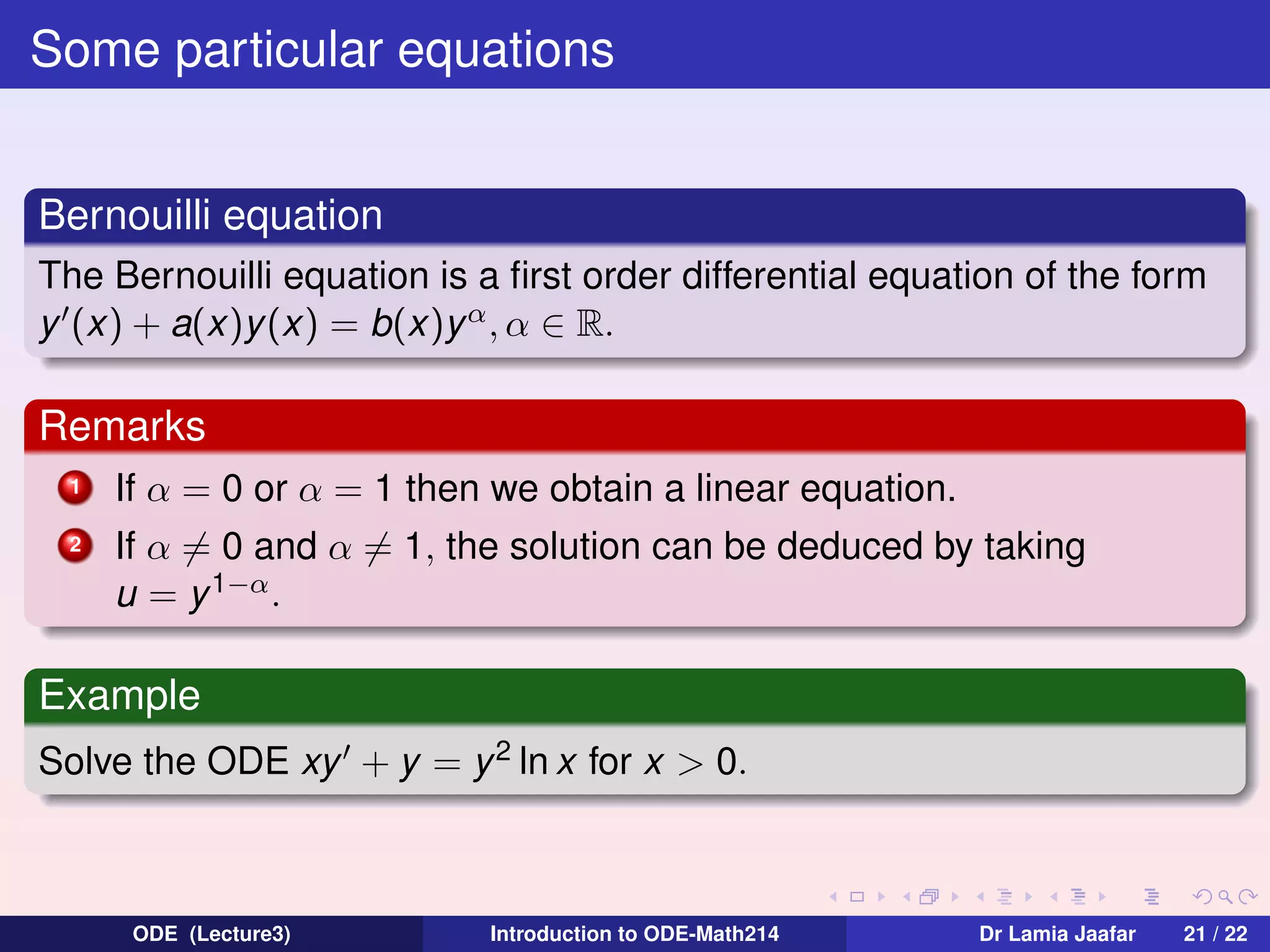
Some particular equations
Bernouilli equation
The Bernouilli equation is a first order differential equation of the form
y (x) + a(x)y (x) = b(x)y α , α ∈ R.

Remarks
1

If α = 0 or α = 1 then we obtain a linear equation.

2

If α = 0 and α = 1, the solution can be deduced by taking
u = y 1−α .

Example
Solve the ODE xy + y = y 2 ln x for x > 0.

ODE (Lecture3)

Introduction to ODE-Math214

Dr Lamia Jaafar

21 / 22
Some particular equations
Bernouilli equation
The Bernouilli equation is a first order differential equation of the form
y (x) + a(x)y (x) = b(x)y α , α ∈ R.

Remarks
1

If α = 0 or α = 1 then we obtain a linear equation.

2

If α = 0 and α = 1, the solution can be deduced by taking
u = y 1−α .

Example
Solve the ODE xy + y = y 2 ln x for x > 0.

ODE (Lecture3)

Introduction to ODE-Math214

Dr Lamia Jaafar

21 / 22
Some particular equations
Bernouilli equation
The Bernouilli equation is a first order differential equation of the form
y (x) + a(x)y (x) = b(x)y α , α ∈ R.

Remarks
1

If α = 0 or α = 1 then we obtain a linear equation.

2

If α = 0 and α = 1, the solution can be deduced by taking
u = y 1−α .

Example
Solve the ODE xy + y = y 2 ln x for x > 0.

ODE (Lecture3)

Introduction to ODE-Math214

Dr Lamia Jaafar

21 / 22
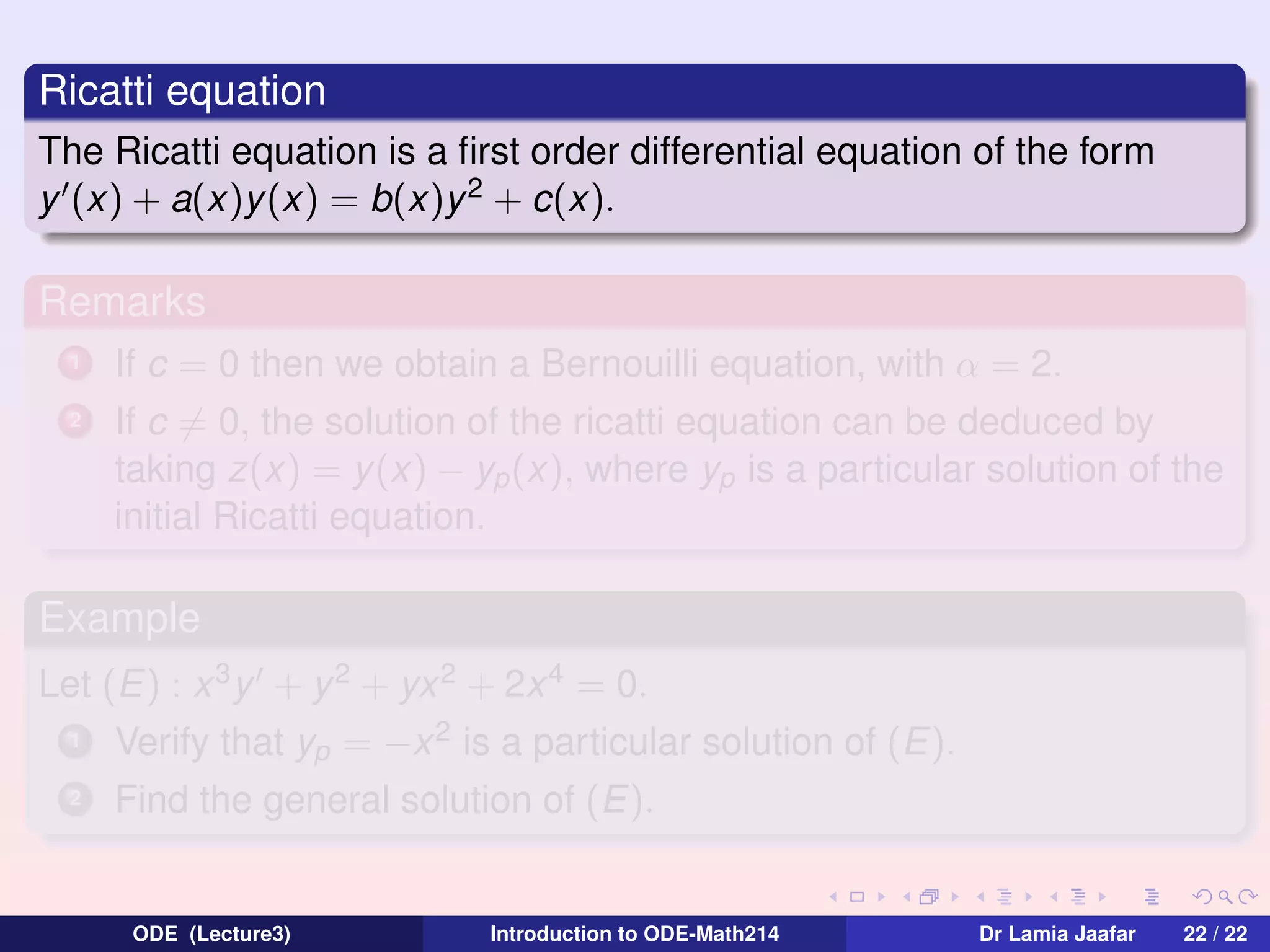
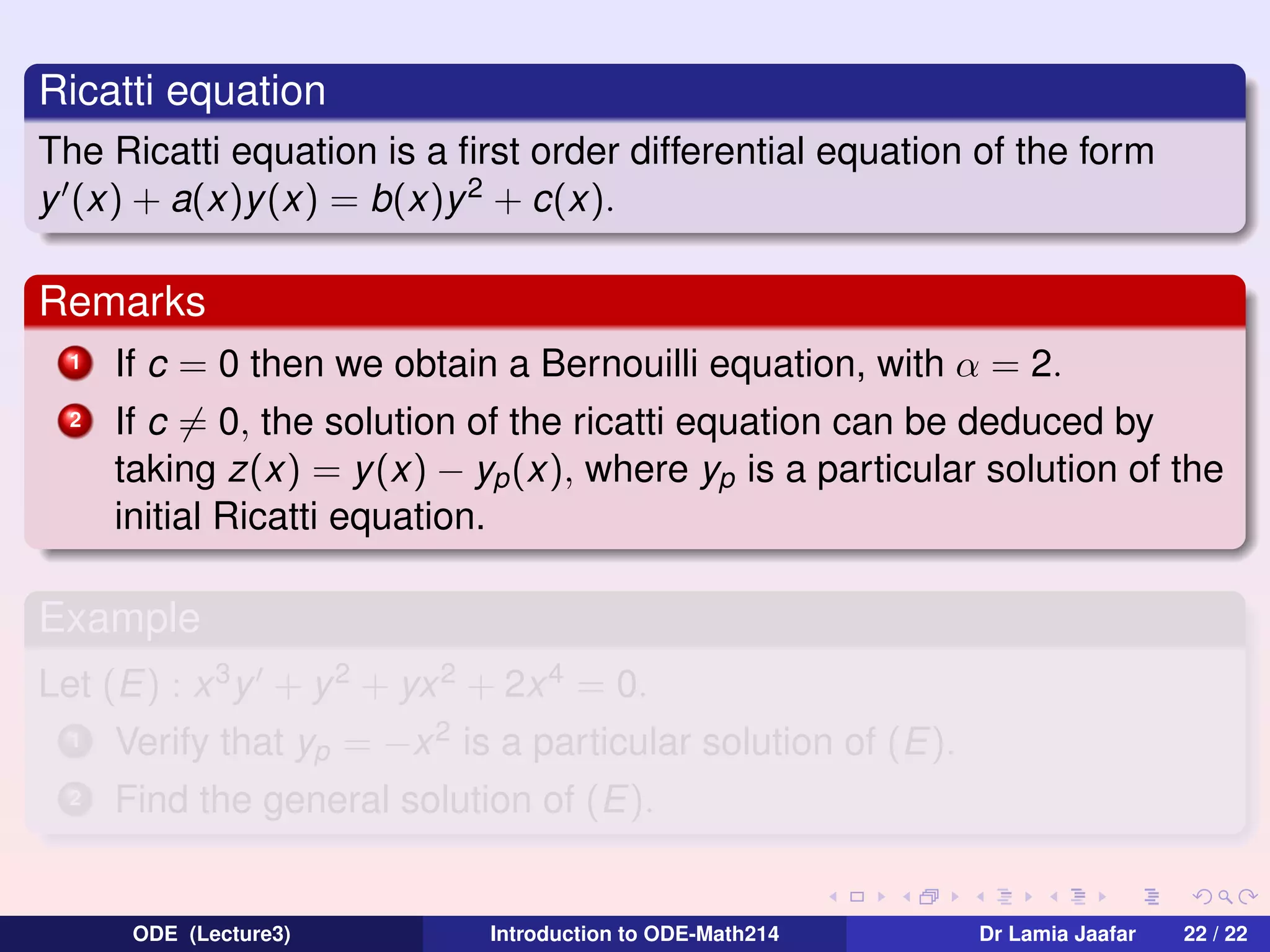
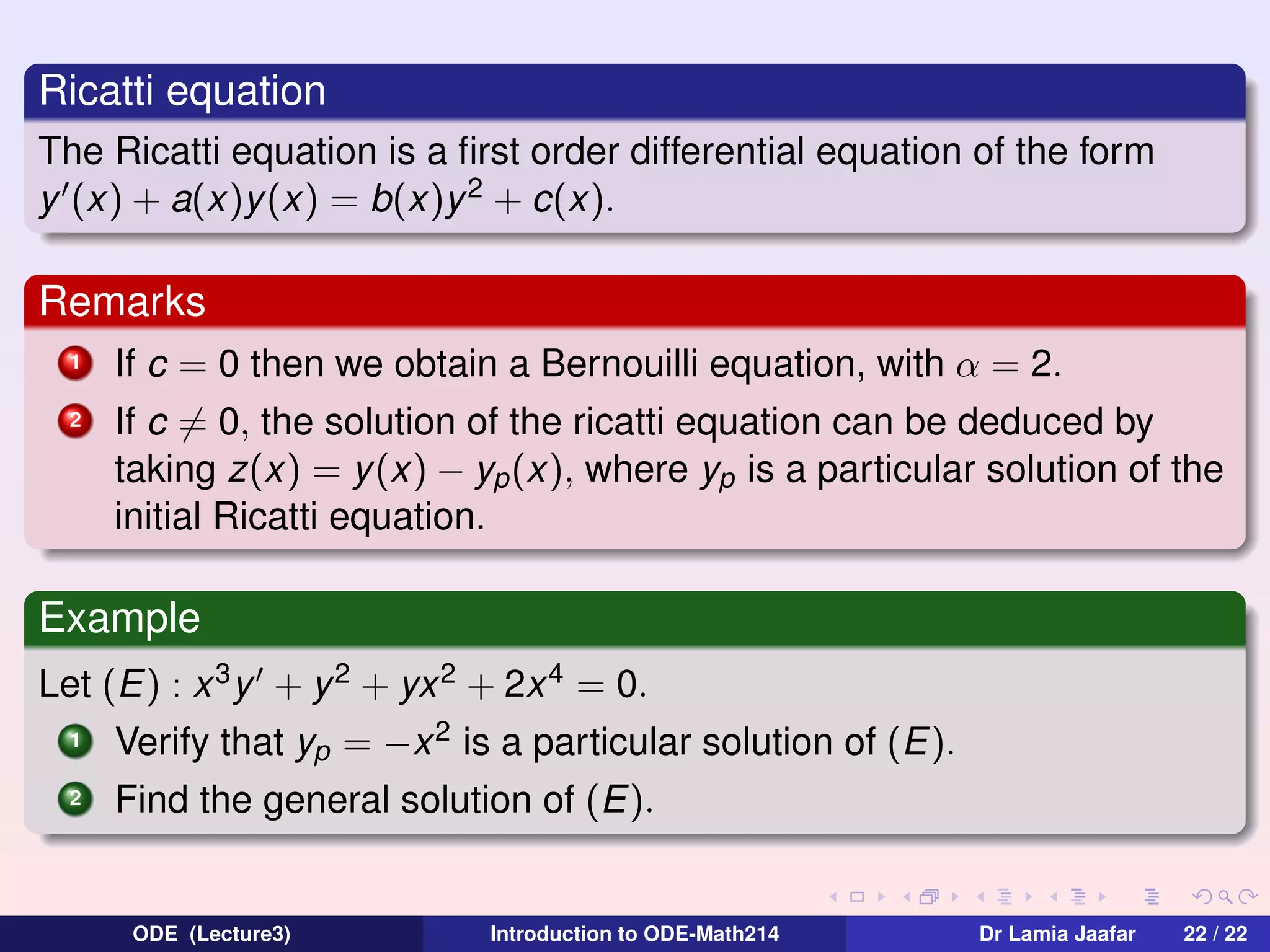
Ricatti equation
The Ricatti equation is a first order differential equation of the form
y (x) + a(x)y (x) = b(x)y 2 + c(x).

Remarks
1

If c = 0 then we obtain a Bernouilli equation, with α = 2.

2

If c = 0, the solution of the ricatti equation can be deduced by
taking z(x) = y (x) − yp (x), where yp is a particular solution of the
initial Ricatti equation.

Example
Let (E) : x 3 y + y 2 + yx 2 + 2x 4 = 0.
1

Verify that yp = −x 2 is a particular solution of (E).

2

Find the general solution of (E).

ODE (Lecture3)

Introduction to ODE-Math214

Dr Lamia Jaafar

22 / 22
Ricatti equation
The Ricatti equation is a first order differential equation of the form
y (x) + a(x)y (x) = b(x)y 2 + c(x).

Remarks
1

If c = 0 then we obtain a Bernouilli equation, with α = 2.

2

If c = 0, the solution of the ricatti equation can be deduced by
taking z(x) = y (x) − yp (x), where yp is a particular solution of the
initial Ricatti equation.

Example
Let (E) : x 3 y + y 2 + yx 2 + 2x 4 = 0.
1

Verify that yp = −x 2 is a particular solution of (E).

2

Find the general solution of (E).

ODE (Lecture3)

Introduction to ODE-Math214

Dr Lamia Jaafar

22 / 22
Ricatti equation
The Ricatti equation is a first order differential equation of the form
y (x) + a(x)y (x) = b(x)y 2 + c(x).

Remarks
1

If c = 0 then we obtain a Bernouilli equation, with α = 2.

2

If c = 0, the solution of the ricatti equation can be deduced by
taking z(x) = y (x) − yp (x), where yp is a particular solution of the
initial Ricatti equation.

Example
Let (E) : x 3 y + y 2 + yx 2 + 2x 4 = 0.
1

Verify that yp = −x 2 is a particular solution of (E).

2

Find the general solution of (E).

ODE (Lecture3)

Introduction to ODE-Math214

Dr Lamia Jaafar

22 / 22

Lecture3 ode (1) lamia

  • 1.
    Chapter 1 First orderdifferential equations Lecture3 ODE (Lecture3) Introduction to ODE-Math214 Dr Lamia Jaafar 1 / 22
  • 2.
    Linear equations Follow-up ODE (Lecture3) Introductionto ODE-Math214 Dr Lamia Jaafar 2 / 22
  • 3.
    Example Let the ODE(E) defined by (x 2 − 9)y + xy = x. 1 Give the general solution of (E). 2 Precise a domain over which the solution is well defined. 3 Discuss existence and uniqueness of the solution if we add the 1 initial value condition y(5) = . 4 Solution Step1:The general solution of (E) is given by y = yh + yp , where yh is the solution of the homogeneous equation associated to (E) and (yp ) is a particular solution of (E). ODE (Lecture3) Introduction to ODE-Math214 Dr Lamia Jaafar 3 / 22
  • 4.
    Example Let the ODE(E) defined by (x 2 − 9)y + xy = x. 1 Give the general solution of (E). 2 Precise a domain over which the solution is well defined. 3 Discuss existence and uniqueness of the solution if we add the 1 initial value condition y(5) = . 4 Solution Step1:The general solution of (E) is given by y = yh + yp , where yh is the solution of the homogeneous equation associated to (E) and (yp ) is a particular solution of (E). ODE (Lecture3) Introduction to ODE-Math214 Dr Lamia Jaafar 3 / 22
  • 5.
    Step2: the homogeneoussolution yh is determined by solving the separate variables equation (x 2 − 9)y + xy = 0 ⇔ then yh (x) = 1 x dy = − 2 dx, x = ±3 y x −9 λ |x 2 − 9| , x = ±3, λ ∈ R. Step3: a particular solution of (E) can be determined by taking yp = 1. We deduce that the general solution of (E) is given by λ + 1, x = ±3, λ ∈ R. y (x) = 2 − 9| |x The points 3 and −3 are said to be singular points. ODE (Lecture3) Introduction to ODE-Math214 Dr Lamia Jaafar 4 / 22
  • 6.
    Step2: the homogeneoussolution yh is determined by solving the separate variables equation (x 2 − 9)y + xy = 0 ⇔ then yh (x) = 1 x dy = − 2 dx, x = ±3 y x −9 λ |x 2 − 9| , x = ±3, λ ∈ R. Step3: a particular solution of (E) can be determined by taking yp = 1. We deduce that the general solution of (E) is given by λ + 1, x = ±3, λ ∈ R. y (x) = 2 − 9| |x The points 3 and −3 are said to be singular points. ODE (Lecture3) Introduction to ODE-Math214 Dr Lamia Jaafar 4 / 22
  • 7.
    Step2: the homogeneoussolution yh is determined by solving the separate variables equation (x 2 − 9)y + xy = 0 ⇔ then yh (x) = 1 x dy = − 2 dx, x = ±3 y x −9 λ |x 2 − 9| , x = ±3, λ ∈ R. Step3: a particular solution of (E) can be determined by taking yp = 1. We deduce that the general solution of (E) is given by λ + 1, x = ±3, λ ∈ R. y (x) = 2 − 9| |x The points 3 and −3 are said to be singular points. ODE (Lecture3) Introduction to ODE-Math214 Dr Lamia Jaafar 4 / 22
  • 8.
    If x ∈]− ∞, −3[, the general solution is given by λ y1 (x) = √ + 1. x2 − 9 If x ∈] − 3, 3[, the general solution is given by λ + 1. y2 (x) = √ 9 − x2 If x ∈]3, +∞[, the general solution is given by λ + 1. y3 (x) = √ 2−9 x 1 , we solve the equation on (3, +∞), on which the 4 theorem of existence and uniqueness are assured: By taking y (5) = ∃!y(x) = √ ODE (Lecture3) 4 x2 −9 + 1, x ∈ (3, +∞). Introduction to ODE-Math214 Dr Lamia Jaafar 5 / 22
  • 9.
    If x ∈]− ∞, −3[, the general solution is given by λ y1 (x) = √ + 1. x2 − 9 If x ∈] − 3, 3[, the general solution is given by λ + 1. y2 (x) = √ 9 − x2 If x ∈]3, +∞[, the general solution is given by λ + 1. y3 (x) = √ 2−9 x 1 , we solve the equation on (3, +∞), on which the 4 theorem of existence and uniqueness are assured: By taking y (5) = ∃!y(x) = √ ODE (Lecture3) 4 x2 −9 + 1, x ∈ (3, +∞). Introduction to ODE-Math214 Dr Lamia Jaafar 5 / 22
  • 10.
    If x ∈]− ∞, −3[, the general solution is given by λ y1 (x) = √ + 1. x2 − 9 If x ∈] − 3, 3[, the general solution is given by λ + 1. y2 (x) = √ 9 − x2 If x ∈]3, +∞[, the general solution is given by λ + 1. y3 (x) = √ 2−9 x 1 , we solve the equation on (3, +∞), on which the 4 theorem of existence and uniqueness are assured: By taking y (5) = ∃!y(x) = √ ODE (Lecture3) 4 x2 −9 + 1, x ∈ (3, +∞). Introduction to ODE-Math214 Dr Lamia Jaafar 5 / 22
  • 11.
    Example Let (E) definedby xy − 4y = x 5 ex . 1 2 3 Verify that yp (x) = x 4 ex verifies the equation (E). Find the general solution y of (E) and precise a domain over which the solution is well defined. Discuss the existence and uniqueness of the IVP if the following initial conditions are given y(0) = 0, y(0) = y0 , y0 > 0, y(x0 ) = y0 , x0 > 0, y0 > 0. ODE (Lecture3) Introduction to ODE-Math214 Dr Lamia Jaafar 6 / 22
  • 12.
    1 2 3 It is clearthat y (x) = x 4 ex verifies (E). The general solution of (E) is given by y = yh + yp , where yh is the solution of the homogeneous equation and yp is a particular solution of (E). For x = 0, we have xy − 4y = 0 ⇔ y = λx 4 , λ ∈ R, then for x = 0, y(x) = λx 4 + x 4 ex . We conclude that I = (0, ∞) is a domain over which y is well defined. We have y(0) = 0 ⇒ a non uniqueness of the solution. y(0) = y0 , y0 > 0 ⇒ a non existence of the solution. y(x0 ) = y0 , x0 > 0, y0 > 0 ⇒ existence and uniqueness of the solution. ODE (Lecture3) Introduction to ODE-Math214 Dr Lamia Jaafar 7 / 22
  • 13.
    1 2 3 It is clearthat y (x) = x 4 ex verifies (E). The general solution of (E) is given by y = yh + yp , where yh is the solution of the homogeneous equation and yp is a particular solution of (E). For x = 0, we have xy − 4y = 0 ⇔ y = λx 4 , λ ∈ R, then for x = 0, y(x) = λx 4 + x 4 ex . We conclude that I = (0, ∞) is a domain over which y is well defined. We have y(0) = 0 ⇒ a non uniqueness of the solution. y(0) = y0 , y0 > 0 ⇒ a non existence of the solution. y(x0 ) = y0 , x0 > 0, y0 > 0 ⇒ existence and uniqueness of the solution. ODE (Lecture3) Introduction to ODE-Math214 Dr Lamia Jaafar 7 / 22
  • 14.
    1 2 3 It is clearthat y (x) = x 4 ex verifies (E). The general solution of (E) is given by y = yh + yp , where yh is the solution of the homogeneous equation and yp is a particular solution of (E). For x = 0, we have xy − 4y = 0 ⇔ y = λx 4 , λ ∈ R, then for x = 0, y(x) = λx 4 + x 4 ex . We conclude that I = (0, ∞) is a domain over which y is well defined. We have y(0) = 0 ⇒ a non uniqueness of the solution. y(0) = y0 , y0 > 0 ⇒ a non existence of the solution. y(x0 ) = y0 , x0 > 0, y0 > 0 ⇒ existence and uniqueness of the solution. ODE (Lecture3) Introduction to ODE-Math214 Dr Lamia Jaafar 7 / 22
  • 15.
    Method of variationof parameters Variation of parameters (or variation of constants) is a general method for determining the general solution of a linear ODE (E) : a(x)y (x) + b(x)y (x) = φ(x). Let (Eh ) : a(x)y (x) + b(x)y (x) = 0, then −b(x) dx, λ ∈ R. a(x) Let us suppose that λ is a function depending of the variable x, i.e y (x) = λ(x) exp(f (x)), then yh (x) = λef (x) , f (x) = (E) ⇔ λ(x) = We obtain λ(x) = ODE (Lecture3) c(x) exp(−f (x)). a(x) c(x) exp(−f (x))dx + C, C ∈ R. a(x) Introduction to ODE-Math214 Dr Lamia Jaafar 8 / 22
  • 16.
    Method of variationof parameters Variation of parameters (or variation of constants) is a general method for determining the general solution of a linear ODE (E) : a(x)y (x) + b(x)y (x) = φ(x). Let (Eh ) : a(x)y (x) + b(x)y(x) = 0, then −b(x) dx, λ ∈ R. a(x) Let us suppose that λ is a function depending of the variable x, i.e y (x) = λ(x) exp(f (x)), then yh (x) = λef (x) , f (x) = (E) ⇔ λ(x) = We obtain λ(x) = ODE (Lecture3) c(x) exp(−f (x)). a(x) c(x) exp(−f (x))dx + C, C ∈ R. a(x) Introduction to ODE-Math214 Dr Lamia Jaafar 8 / 22
  • 17.
    Method of variationof parameters Variation of parameters (or variation of constants) is a general method for determining the general solution of a linear ODE (E) : a(x)y (x) + b(x)y (x) = φ(x). Let (Eh ) : a(x)y (x) + b(x)y(x) = 0, then −b(x) dx, λ ∈ R. a(x) Let us suppose that λ is a function depending of the variable x, i.e y (x) = λ(x) exp(f (x)), then yh (x) = λef (x) , f (x) = (E) ⇔ λ(x) = We obtain λ(x) = ODE (Lecture3) c(x) exp(−f (x)). a(x) c(x) exp(−f (x))dx + C, C ∈ R. a(x) Introduction to ODE-Math214 Dr Lamia Jaafar 8 / 22
  • 18.
    Method of variationof parameters Variation of parameters (or variation of constants) is a general method for determining the general solution of a linear ODE (E) : a(x)y (x) + b(x)y (x) = φ(x). Let (Eh ) : a(x)y (x) + b(x)y(x) = 0, then −b(x) dx, λ ∈ R. a(x) Let us suppose that λ is a function depending of the variable x, i.e y (x) = λ(x) exp(f (x)), then yh (x) = λef (x) , f (x) = (E) ⇔ λ(x) = We obtain λ(x) = ODE (Lecture3) c(x) exp(−f (x)). a(x) c(x) exp(−f (x))dx + C, C ∈ R. a(x) Introduction to ODE-Math214 Dr Lamia Jaafar 8 / 22
  • 19.
    Conclusion We conclude thatthe general solution of a linear ordinary equation is given by y(x) = C exp(f (x)) + exp(f (x)) = ↓ yh (x) + c(x) exp(−f (x))dx a(x) ↓ yp (x) Examples Solve the IVP y +y =x y (0) = 4 and precise the domain of existence and uniqueness of the solution. ODE (Lecture3) Introduction to ODE-Math214 Dr Lamia Jaafar 9 / 22
  • 20.
    Conclusion We conclude thatthe general solution of a linear ordinary equation is given by y(x) = C exp(f (x)) + exp(f (x)) = ↓ yh (x) + c(x) exp(−f (x))dx a(x) ↓ yp (x) Examples Solve the IVP y +y =x y (0) = 4 and precise the domain of existence and uniqueness of the solution. ODE (Lecture3) Introduction to ODE-Math214 Dr Lamia Jaafar 9 / 22
  • 21.
    Exact equations ODE (Lecture3) Introductionto ODE-Math214 Dr Lamia Jaafar 10 / 22
  • 22.
    Definition an exact differentialequation is an ODE of first order which can be expressed as follows M(x, y)dx + N(x, y)dy = 0, (1) where M and N are functions in both the variables x and y, such that ∂M ∂N = . ∂y ∂x Remark Let us suppose that f is a given real function defined in both variables ∂f ∂f x, y , then its differential is given by df = dx + dy . ∂x ∂y ∂f ∂f If f is constant we obtain the equation dx + dy = 0, then the ∂x ∂y equation (1) corresponds to a differential of f (x, y) = Cst. ODE (Lecture3) Introduction to ODE-Math214 Dr Lamia Jaafar 11 / 22
  • 23.
    Definition an exact differentialequation is an ODE of first order which can be expressed as follows M(x, y)dx + N(x, y)dy = 0, (1) where M and N are functions in both the variables x and y, such that ∂M ∂N = . ∂y ∂x Remark Let us suppose that f is a given real function defined in both variables ∂f ∂f x, y , then its differential is given by df = dx + dy . ∂x ∂y ∂f ∂f If f is constant we obtain the equation dx + dy = 0, then the ∂x ∂y equation (1) corresponds to a differential of f (x, y) = Cst. ODE (Lecture3) Introduction to ODE-Math214 Dr Lamia Jaafar 11 / 22
  • 24.
    Example x 2 y3 dx + x 3 y 2 dy = 0, is an exact equation such that f (x, y) = Then the solution is given by an explicit one defined as 1 3 3 x y = C, C ∈ R. 3 1 3 3 x y . 3 Examples 2xydx + (x 2 − 1)dy = 0, 1 y y(1 − x 2 ) − xy 2 + sin 2x, 2 are exact equations too, but f (x, y) cannot be easily deduced. ODE (Lecture3) Introduction to ODE-Math214 Dr Lamia Jaafar 12 / 22
  • 25.
    Example x 2 y3 dx + x 3 y 2 dy = 0, is an exact equation such that f (x, y) = Then the solution is given by an explicit one defined as 1 3 3 x y = C, C ∈ R. 3 1 3 3 x y . 3 Examples 2xydx + (x 2 − 1)dy = 0, 1 y y(1 − x 2 ) − xy 2 + sin 2x, 2 are exact equations too, but f (x, y) cannot be easily deduced. ODE (Lecture3) Introduction to ODE-Math214 Dr Lamia Jaafar 12 / 22
  • 26.
    Remark ∂f ∂f and N(x, y) = , we deduce that to solve (1), we ∂x ∂y ∂f = M and to integrate with respect have to find M (or N) such that ∂x ∂f to x (such that = N and to integrate with respect to y .) ∂y As M(x, y ) = Examples Solve the previous exact equations. ODE (Lecture3) Introduction to ODE-Math214 Dr Lamia Jaafar 13 / 22
  • 27.
    Remark ∂f ∂f and N(x, y) = , we deduce that to solve (1), we ∂x ∂y ∂f = M and to integrate with respect have to find M (or N) such that ∂x ∂f to x (such that = N and to integrate with respect to y .) ∂y As M(x, y ) = Examples Solve the previous exact equations. ODE (Lecture3) Introduction to ODE-Math214 Dr Lamia Jaafar 13 / 22
  • 28.
    Solution of (E): 2xydx + (x 2 − 1)dy = 0 Let M(x, y) = 2xy and N(x, y) = x 2 − 1. ∂M ∂N As = then (E) is an exact equation. We deduce that it exists f ∂y ∂x defined on a domain I such that  ∂f  2  ∂x = 2xy,  f (x, y) = x y + F (y), ⇒  ∂f  ∂f 2−1 = x 2 − 1 = x 2 + F (y ) ∂y ∂y = x we deduce that F (y) = −1 ⇒ F (y ) = −y + Cst ⇒ f (x, y) = x 2 y − y + Cst, then an implicit solution is giving by x 2 y − y − C, C ∈ R and an explicit solution C is y = 2 , x = ±1. x −1 The solution of the initial ODE is defined on any interval not containing either 1 or −1, i.e a domain of the solution y is ] − ∞, −1[ or ] − 1, 1[ or ]1, +∞[. ODE (Lecture3) Introduction to ODE-Math214 Dr Lamia Jaafar 14 / 22
  • 29.
    Solution of (E): 2xydx + (x 2 − 1)dy = 0 Let M(x, y) = 2xy and N(x, y) = x 2 − 1. ∂M ∂N As = then (E) is an exact equation. We deduce that it exists f ∂y ∂x defined on a domain I such that  ∂f  2  ∂x = 2xy,  f (x, y) = x y + F (y), ⇒  ∂f  ∂f 2−1 = x 2 − 1 = x 2 + F (y ) ∂y ∂y = x we deduce that F (y) = −1 ⇒ F (y ) = −y + Cst ⇒ f (x, y) = x 2 y − y + Cst, then an implicit solution is giving by x 2 y − y − C, C ∈ R and an explicit solution C is y = 2 , x = ±1. x −1 The solution of the initial ODE is defined on any interval not containing either 1 or −1, i.e a domain of the solution y is ] − ∞, −1[ or ] − 1, 1[ or ]1, +∞[. ODE (Lecture3) Introduction to ODE-Math214 Dr Lamia Jaafar 14 / 22
  • 30.
    Integrating factor Remark Let (E1) : M(x, y )dx + N(x, y )dy = 0 such that ∂N ∂M = , then (E1 ) is ∂y ∂x not an exact equation. Question How we can transform it to an exact one? The method proposed Find µ(x, y) such that (E2 ) : µ(x, y)M(x, y )dx + µ(x, y)N(x, y)dy = 0 is an exact solution. We obtain ∂ ∂ ∂µ ∂µ ∂M ∂N (µM) = (µN) ⇒ N− M = µ( − ). ∂y ∂x ∂x ∂y ∂y ∂x Two cases are then possible to deduce an integrating factor µ. ODE (Lecture3) Introduction to ODE-Math214 Dr Lamia Jaafar 15 / 22
  • 31.
    Integrating factor Remark Let (E1) : M(x, y )dx + N(x, y )dy = 0 such that ∂N ∂M = , then (E1 ) is ∂y ∂x not an exact equation. Question How we can transform it to an exact one? The method proposed Find µ(x, y) such that (E2 ) : µ(x, y)M(x, y )dx + µ(x, y)N(x, y)dy = 0 is an exact solution. We obtain ∂ ∂ ∂µ ∂µ ∂M ∂N (µM) = (µN) ⇒ N− M = µ( − ). ∂y ∂x ∂x ∂y ∂y ∂x Two cases are then possible to deduce an integrating factor µ. ODE (Lecture3) Introduction to ODE-Math214 Dr Lamia Jaafar 15 / 22
  • 32.
    Integrating factor Remark Let (E1) : M(x, y )dx + N(x, y )dy = 0 such that ∂N ∂M = , then (E1 ) is ∂y ∂x not an exact equation. Question How we can transform it to an exact one? The method proposed Find µ(x, y) such that (E2 ) : µ(x, y)M(x, y )dx + µ(x, y)N(x, y)dy = 0 is an exact solution. We obtain ∂ ∂ ∂µ ∂µ ∂M ∂N (µM) = (µN) ⇒ N− M = µ( − ). ∂y ∂x ∂x ∂y ∂y ∂x Two cases are then possible to deduce an integrating factor µ. ODE (Lecture3) Introduction to ODE-Math214 Dr Lamia Jaafar 15 / 22
  • 33.
    Integrating factor Remark Let (E1) : M(x, y )dx + N(x, y )dy = 0 such that ∂N ∂M = , then (E1 ) is ∂y ∂x not an exact equation. Question How we can transform it to an exact one? The method proposed Find µ(x, y) such that (E2 ) : µ(x, y)M(x, y )dx + µ(x, y)N(x, y)dy = 0 is an exact solution. We obtain ∂ ∂ ∂µ ∂µ ∂M ∂N (µM) = (µN) ⇒ N− M = µ( − ). ∂y ∂x ∂x ∂y ∂y ∂x Two cases are then possible to deduce an integrating factor µ. ODE (Lecture3) Introduction to ODE-Math214 Dr Lamia Jaafar 15 / 22
  • 34.
    Let µx = ∂µ ,µy ∂x = ∂µ , Mx ∂y = ∂M , My ∂x = ∂M , Nx ∂y = ∂N , Ny ∂x = ∂N . ∂y My − Nx depends of x alone then we take N My − Nx dx , µ(x) = exp N Nx − My If depends of y alone then we take M Nx − My µ(y) = exp dy . M If Remark If we consider a linear equation a(x)y (x) + b(x)y (x) = φ(x) equivalent b(x) φ(x) to y (x) + P(x)y(x) = ψ(x), where P(x) = and ψ(x) = . a(x) a(x) Then exp − P(x)dx is also called an integrating factor. ODE (Lecture3) Introduction to ODE-Math214 Dr Lamia Jaafar 16 / 22
  • 35.
    Let µx = ∂µ ,µy ∂x = ∂µ , Mx ∂y = ∂M , My ∂x = ∂M , Nx ∂y = ∂N , Ny ∂x = ∂N . ∂y My − Nx depends of x alone then we take N My − Nx dx , µ(x) = exp N Nx − My If depends of y alone then we take M Nx − My µ(y) = exp dy . M If Remark If we consider a linear equation a(x)y (x) + b(x)y (x) = φ(x) equivalent b(x) φ(x) to y (x) + P(x)y(x) = ψ(x), where P(x) = and ψ(x) = . a(x) a(x) Then exp − P(x)dx is also called an integrating factor. ODE (Lecture3) Introduction to ODE-Math214 Dr Lamia Jaafar 16 / 22
  • 36.
    Example 1 2 3 Is (E) :xydx + (2x 2 + 3y 2 − 20)dy = 0 an exact equation? Prove that an implicit solution of (E) is giving by 1 2 4 1 6 x y + y − 5y 4 = C, C ∈ R. 2 2 Solve the initial value problem associated to (E) if y(1) = 1. ODE (Lecture3) Introduction to ODE-Math214 Dr Lamia Jaafar 17 / 22
  • 37.
    Solutions by substitutions ODE(Lecture3) Introduction to ODE-Math214 Dr Lamia Jaafar 18 / 22
  • 38.
    Definition A function fis said to be homogeneous of degree α if it verifies f (tx, ty) = t α f (x, y ), α ∈ R. Examples f defined by f (x, y) = x 3 + y 3 is homogeneous of degree 3. g given by g(x, y ) = x 2 + y 2 + xy is homogeneous of degree 2. h verifying h(x, y) = x + y + xy is not homogeneous. Remark If both M and N are homogeneous functions of degree α, then the first order differential equation (E) : M(x, y)dx + N(x, y)dy = 0 is said to be homogeneous of degree α. Example The ODE (x 2 + y 2 )dx + (x 2 − xy)dy = 0 is an homogeneous first order differential equation of degree 2. ODE (Lecture3) Introduction to ODE-Math214 Dr Lamia Jaafar 19 / 22
  • 39.
    Definition A function fis said to be homogeneous of degree α if it verifies f (tx, ty) = t α f (x, y ), α ∈ R. Examples f defined by f (x, y) = x 3 + y 3 is homogeneous of degree 3. g given by g(x, y ) = x 2 + y 2 + xy is homogeneous of degree 2. h verifying h(x, y) = x + y + xy is not homogeneous. Remark If both M and N are homogeneous functions of degree α, then the first order differential equation (E) : M(x, y)dx + N(x, y)dy = 0 is said to be homogeneous of degree α. Example The ODE (x 2 + y 2 )dx + (x 2 − xy)dy = 0 is an homogeneous first order differential equation of degree 2. ODE (Lecture3) Introduction to ODE-Math214 Dr Lamia Jaafar 19 / 22
  • 40.
    Definition A function fis said to be homogeneous of degree α if it verifies f (tx, ty) = t α f (x, y ), α ∈ R. Examples f defined by f (x, y) = x 3 + y 3 is homogeneous of degree 3. g given by g(x, y ) = x 2 + y 2 + xy is homogeneous of degree 2. h verifying h(x, y) = x + y + xy is not homogeneous. Remark If both M and N are homogeneous functions of degree α, then the first order differential equation (E) : M(x, y)dx + N(x, y)dy = 0 is said to be homogeneous of degree α. Example The ODE (x 2 + y 2 )dx + (x 2 − xy)dy = 0 is an homogeneous first order differential equation of degree 2. ODE (Lecture3) Introduction to ODE-Math214 Dr Lamia Jaafar 19 / 22
  • 41.
    Definition A function fis said to be homogeneous of degree α if it verifies f (tx, ty) = t α f (x, y ), α ∈ R. Examples f defined by f (x, y) = x 3 + y 3 is homogeneous of degree 3. g given by g(x, y ) = x 2 + y 2 + xy is homogeneous of degree 2. h verifying h(x, y) = x + y + xy is not homogeneous. Remark If both M and N are homogeneous functions of degree α, then the first order differential equation (E) : M(x, y)dx + N(x, y)dy = 0 is said to be homogeneous of degree α. Example The ODE (x 2 + y 2 )dx + (x 2 − xy)dy = 0 is an homogeneous first order differential equation of degree 2. ODE (Lecture3) Introduction to ODE-Math214 Dr Lamia Jaafar 19 / 22
  • 42.
    Method of solvinghomogeneous ODE of degree α. Let y = ux then the equation (E) gives M(1, u)dx + N(1, u)dy = 0. Or dy = udx + xdu, then we obtain a separable variables equation in x and u given by N(1, u)du dx =− du. x M(1, u) + uN(1, u) Example Prove that an implicit solution of (x 2 + y 2 )dx + (x 2 − xy)dy = 0, is y giving by (x + y)2 = λx exp( ), λ ∈ R. x ODE (Lecture3) Introduction to ODE-Math214 Dr Lamia Jaafar 20 / 22
  • 43.
    Method of solvinghomogeneous ODE of degree α. Let y = ux then the equation (E) gives M(1, u)dx + N(1, u)dy = 0. Or dy = udx + xdu, then we obtain a separable variables equation in x and u given by N(1, u)du dx =− du. x M(1, u) + uN(1, u) Example Prove that an implicit solution of (x 2 + y 2 )dx + (x 2 − xy)dy = 0, is y giving by (x + y)2 = λx exp( ), λ ∈ R. x ODE (Lecture3) Introduction to ODE-Math214 Dr Lamia Jaafar 20 / 22
  • 44.
    Some particular equations Bernouilliequation The Bernouilli equation is a first order differential equation of the form y (x) + a(x)y (x) = b(x)y α , α ∈ R. Remarks 1 If α = 0 or α = 1 then we obtain a linear equation. 2 If α = 0 and α = 1, the solution can be deduced by taking u = y 1−α . Example Solve the ODE xy + y = y 2 ln x for x > 0. ODE (Lecture3) Introduction to ODE-Math214 Dr Lamia Jaafar 21 / 22
  • 45.
    Some particular equations Bernouilliequation The Bernouilli equation is a first order differential equation of the form y (x) + a(x)y (x) = b(x)y α , α ∈ R. Remarks 1 If α = 0 or α = 1 then we obtain a linear equation. 2 If α = 0 and α = 1, the solution can be deduced by taking u = y 1−α . Example Solve the ODE xy + y = y 2 ln x for x > 0. ODE (Lecture3) Introduction to ODE-Math214 Dr Lamia Jaafar 21 / 22
  • 46.
    Some particular equations Bernouilliequation The Bernouilli equation is a first order differential equation of the form y (x) + a(x)y (x) = b(x)y α , α ∈ R. Remarks 1 If α = 0 or α = 1 then we obtain a linear equation. 2 If α = 0 and α = 1, the solution can be deduced by taking u = y 1−α . Example Solve the ODE xy + y = y 2 ln x for x > 0. ODE (Lecture3) Introduction to ODE-Math214 Dr Lamia Jaafar 21 / 22
  • 47.
    Ricatti equation The Ricattiequation is a first order differential equation of the form y (x) + a(x)y (x) = b(x)y 2 + c(x). Remarks 1 If c = 0 then we obtain a Bernouilli equation, with α = 2. 2 If c = 0, the solution of the ricatti equation can be deduced by taking z(x) = y (x) − yp (x), where yp is a particular solution of the initial Ricatti equation. Example Let (E) : x 3 y + y 2 + yx 2 + 2x 4 = 0. 1 Verify that yp = −x 2 is a particular solution of (E). 2 Find the general solution of (E). ODE (Lecture3) Introduction to ODE-Math214 Dr Lamia Jaafar 22 / 22
  • 48.
    Ricatti equation The Ricattiequation is a first order differential equation of the form y (x) + a(x)y (x) = b(x)y 2 + c(x). Remarks 1 If c = 0 then we obtain a Bernouilli equation, with α = 2. 2 If c = 0, the solution of the ricatti equation can be deduced by taking z(x) = y (x) − yp (x), where yp is a particular solution of the initial Ricatti equation. Example Let (E) : x 3 y + y 2 + yx 2 + 2x 4 = 0. 1 Verify that yp = −x 2 is a particular solution of (E). 2 Find the general solution of (E). ODE (Lecture3) Introduction to ODE-Math214 Dr Lamia Jaafar 22 / 22
  • 49.
    Ricatti equation The Ricattiequation is a first order differential equation of the form y (x) + a(x)y (x) = b(x)y 2 + c(x). Remarks 1 If c = 0 then we obtain a Bernouilli equation, with α = 2. 2 If c = 0, the solution of the ricatti equation can be deduced by taking z(x) = y (x) − yp (x), where yp is a particular solution of the initial Ricatti equation. Example Let (E) : x 3 y + y 2 + yx 2 + 2x 4 = 0. 1 Verify that yp = −x 2 is a particular solution of (E). 2 Find the general solution of (E). ODE (Lecture3) Introduction to ODE-Math214 Dr Lamia Jaafar 22 / 22