GOVINDRAO WANJARICOLLOGEOFENGINEERINGAND
TECHNOLOGY,POLYTECHNIC, NAGPUR
SALAI GODHANI ,NEAR CHIKANA VILLAGE ,HUDKESHWAR
ROAD, NAGPUR
MAHARASHTRA -
441204
TOPIC :- DIFFERENTIAL EQUATION
STD :- POLYTECHNIC 1ST YEAR
DIPLOMA BRANCH :- MECHANICAL
ENGINEERING
PROJECT GUIDE :- DEEPALI GAUTAM MAM
PRESENTED BY :- VEER GADLING
DANESH GAHERWAR
ROHIT GEDAM, NILESHDHAR DVIVEDI, MANISH
GAWAD
DIFFERENTIALEQUATION
1. INTRODUCTION An equation involving independent and dependent variables and
the derivatives of the dependent variables is called a differential equation. There
are two kinds of differential equations: I. Ordinary Differential Equation : If the
dependent variables depend on one independent variable x, then the differential
equation is said to be ordinary. II. Partial differential equation : If the dependent
variables depend on two or more independent variables, then it is known as partial
differential equation.
1. ORDER AND DEGREE OF A DIFFERENTIAL EQUATION Order Order is the
highest differential appearing in a differential equation. Degree It is determined by
the degree of the highest order derivative present in it after the differential equation is
cleared of radicals and fractions so far as the derivatives are concerned. m n1 m 1 n2
nk d y d y dy f1 ( x, y ) f 2 ( x, y ) ........ f k ( x, y) 0 dx m dx m 1 dx The above
differential equation has the order m and degree n1.
1.EXAMPLES
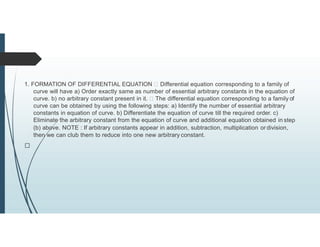
1. FORMATION OF DIFFERENTIAL EQUATION Differential equation corresponding to a family of
curve will have a) Order exactly same as number of essential arbitrary constants in the equation of
curve. b) no arbitrary constant present in it. The differential equation corresponding to a family of
curve can be obtained by using the following steps: a) Identify the number of essential arbitrary
constants in equation of curve. b) Differentiate the equation of curve till the required order. c)
Eliminate the arbitrary constant from the equation of curve and additional equation obtained in step
(b) above. NOTE : If arbitrary constants appear in addition, subtraction, multiplication or division,
then we can club them to reduce into one new arbitrary constant.
1.EXAMPLES
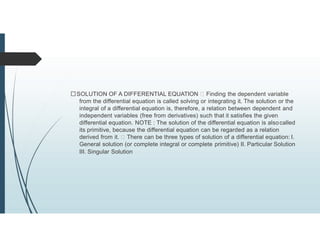
SOLUTION OF A DIFFERENTIAL EQUATION Finding the dependent variable
from the differential equation is called solving or integrating it. The solution or the
integral of a differential equation is, therefore, a relation between dependent and
independent variables (free from derivatives) such that it satisfies the given
differential equation. NOTE : The solution of the differential equation is alsocalled
its primitive, because the differential equation can be regarded as a relation
derived from it. There can be three types of solution of a differential equation: I.
General solution (or complete integral or complete primitive) II. Particular Solution
III. Singular Solution
1. General solution (or complete integral or complete primitive) A relation in x and y
satisfying a given differential equation and involving exactly same number of
arbitrary constants as order of differential equation. Particular Solution A solution
obtained by assigning values to one or more than one arbitrary constant of
general solution. Singular Solution It is not obtainable from general solution.
Geometrically, General solution acts as an envelope to singular solution.
1. DIFFERENTIAL EQUATION OF FIRST ORDER AND FIRST DEGREE A
differential equation of first order and first degree is of the type dy + f(x, y) = 0,
which can also be dx written as : Mdx + Ndy = 0, where M and N are functions ofx
and y.
ELEMENTARY TYPES OF FIRST ORDER AND FIRST DEGREE DIFFERENTIAL
EQUATIONS Variables separable : If the differential equation can be put in the
form, f(x) dx = (y) dy we say that variables are separable and solution can be
obtained by integrating each side separately. A general solution of this will be f(x)
= dx + ( y ) dy c, where c is an arbitrary constant. I. Sometimes transformation to
the polar co-ordinates facilitates separation of variables. In this connection it is
convenient to remember the following differentials: If x = r cos ; y = r sin then ,(i)
x dx + y dy = r dr , (ii) dx2 + dy2 = dr2 + r2d 2 (iii) x dy – y dx = r2d If x = r sec &
y = r tan then (i) x dx – y dy = r dr , (ii) x dy – y dx = r2 sec d .
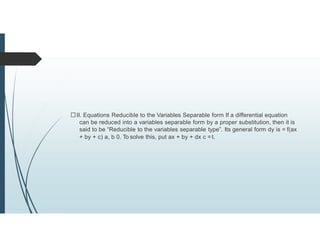
II. Equations Reducible to the Variables Separable form If a differential equation
can be reduced into a variables separable form by a proper substitution, then it is
said to be “Reducible to the variables separable type”. Its general form dy is = f(ax
+ by + c) a, b 0. To solve this, put ax + by + dx c =t.
1.EXAMPLES
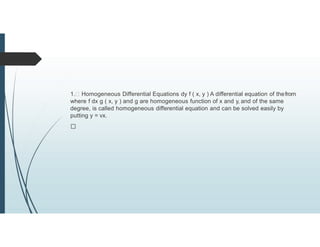
1. Homogeneous Differential Equations dy f ( x, y ) A differential equation of thefrom
where f dx g ( x, y ) and g are homogeneous function of x and y, and of the same
degree, is called homogeneous differential equation and can be solved easily by
putting y = vx.
1. I. Equations Reducible to the Homogeneous form Equations of the form dy ax by c
.........(1) dx Ax By C can be made homogeneous (in new variables X and Y) by
substituting x = X + h and y = Y + k, where h and k are constants, we get dY aX bY
(ah bk c ) = ..........(2) dX AX BY ( Ah Bk C) Now, h and k are chosen such that ah +
bk + c = 0, and Ah + Bk + C = 0; the differential equation can now be solved by
putting Y = vX.
EXAMPLES
Exact Differential Equation dy The differential equation M + N = 0 ...........(1)dx
Where M and N are functions of x and y is said to be exact if it can be derived by
direct differentiation (without any subsequent multiplication, elimination etc.) of an
equation of the form f(x, y) = c e.g. y2 dy + x dx + = 0 is an exact differential
equation. NOTE (i) The necessary condition for (1) to be exact is . M N yx
(ii) For finding the solution of Exact differential equation, following exact
differentials must be remembered : xdy ydx y I. xdy + y dx = d(xy) II. 2 d x x III. 2(x
dx + y dy) = d (x2 + y2) IV. xdy ydx y d ln xy x xdy ydx y xdy ydx V. d tan 1 VI. d ln
xy x2 y2 x xy VII. xdy ydx 1 d x2 y 2 xy
EXAMPLES Solve : xdy + ydx + xy ey dy = 0 Ans. ln(xy) + ey = c Solve :ye–
x/y dx – (xe–x/y + y3) dy = 0 Ans. 2e–x/y + y2 = c
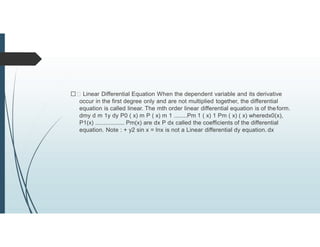
Linear Differential Equation When the dependent variable and its derivative
occur in the first degree only and are not multiplied together, the differential
equation is called linear. The mth order linear differential equation is of theform.
dmy d m 1y dy P0 ( x) m P ( x) m 1 ........Pm 1 ( x) 1 Pm ( x) ( x) wheredx0(x),
P1(x) .................. Pm(x) are dx P dx called the coefficients of the differential
equation. Note : + y2 sin x = lnx is not a Linear differential dy equation. dx
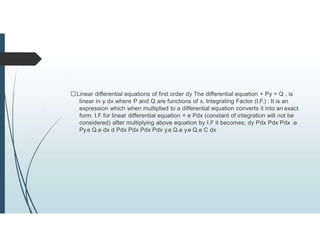
Linear differential equations of first order dy The differential equation + Py = Q , is
linear in y. dx where P and Q are functions of x. Integrating Factor (I.F.) : It is an
expression which when multiplied to a differential equation converts it into an exact
form. I.F for linear differential equation = e Pdx (constant of integration will not be
considered) after multiplying above equation by I.F it becomes; dy Pdx Pdx Pdx .e
Py.e Q.e dx d Pdx Pdx Pdx Pdx y.e Q.e y.e Q.e C dx
EXAMPLE
Equations reducible to linear form By change of variable Bernoulli’s equation :
dy Equations of the form n dx+ P y = Q . y , n 0 and n 1 where P and Q are
functions of x, is called Bernoulli’s equation and can be made linear in v by dividing
by yn and putting y –n+1 = v. Now its solution can be obtained as in (v).
EXAMPLES
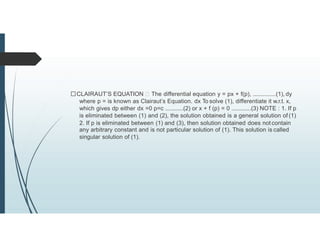
CLAIRAUT’S EQUATION The differential equation y = px + f(p), ..............(1), dy
where p = is known as Clairaut’s Equation. dx To solve (1), differentiate it w.r.t. x,
which gives dp either dx =0 p=c ...........(2) or x + f (p) = 0 ............(3) NOTE : 1. If p
is eliminated between (1) and (2), the solution obtained is a general solution of (1)
2. If p is eliminated between (1) and (3), then solution obtained does not contain
any arbitrary constant and is not particular solution of (1). This solution is called
singular solution of (1).
EXAMPLES
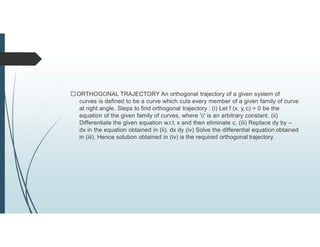
ORTHOGONAL TRAJECTORY An orthogonal trajectory of a given system of
curves is defined to be a curve which cuts every member of a given family of curve
at right angle. Steps to find orthogonal trajectory : (i) Let f (x, y, c) = 0 be the
equation of the given family of curves, where 'c' is an arbitrary constant. (ii)
Differentiate the given equation w.r.t. x and then eliminate c. (iii) Replace dy by –
dx in the equation obtained in (ii). dx dy (iv) Solve the differential equation obtained
in (iii). Hence solution obtained in (iv) is the required orthogonal trajectory.
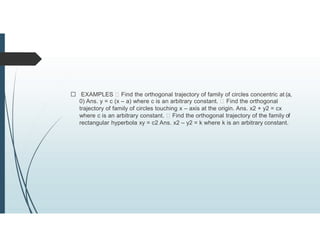
EXAMPLES Find the orthogonal trajectory of family of circles concentric at (a,
0) Ans. y = c (x – a) where c is an arbitrary constant. Find the orthogonal
trajectory of family of circles touching x – axis at the origin. Ans. x2 + y2 = cx
where c is an arbitrary constant. Find the orthogonal trajectory of the family of
rectangular hyperbola xy = c2 Ans. x2 – y2 = k where k is an arbitrary constant.

veer gadling.pptx

  • 1.
    GOVINDRAO WANJARICOLLOGEOFENGINEERINGAND TECHNOLOGY,POLYTECHNIC, NAGPUR SALAIGODHANI ,NEAR CHIKANA VILLAGE ,HUDKESHWAR ROAD, NAGPUR MAHARASHTRA - 441204 TOPIC :- DIFFERENTIAL EQUATION STD :- POLYTECHNIC 1ST YEAR DIPLOMA BRANCH :- MECHANICAL ENGINEERING PROJECT GUIDE :- DEEPALI GAUTAM MAM PRESENTED BY :- VEER GADLING DANESH GAHERWAR ROHIT GEDAM, NILESHDHAR DVIVEDI, MANISH GAWAD
  • 2.
  • 3.
    1. INTRODUCTION Anequation involving independent and dependent variables and the derivatives of the dependent variables is called a differential equation. There are two kinds of differential equations: I. Ordinary Differential Equation : If the dependent variables depend on one independent variable x, then the differential equation is said to be ordinary. II. Partial differential equation : If the dependent variables depend on two or more independent variables, then it is known as partial differential equation.
  • 4.
    1. ORDER ANDDEGREE OF A DIFFERENTIAL EQUATION Order Order is the highest differential appearing in a differential equation. Degree It is determined by the degree of the highest order derivative present in it after the differential equation is cleared of radicals and fractions so far as the derivatives are concerned. m n1 m 1 n2 nk d y d y dy f1 ( x, y ) f 2 ( x, y ) ........ f k ( x, y) 0 dx m dx m 1 dx The above differential equation has the order m and degree n1.
  • 5.
  • 6.
    1. FORMATION OFDIFFERENTIAL EQUATION Differential equation corresponding to a family of curve will have a) Order exactly same as number of essential arbitrary constants in the equation of curve. b) no arbitrary constant present in it. The differential equation corresponding to a family of curve can be obtained by using the following steps: a) Identify the number of essential arbitrary constants in equation of curve. b) Differentiate the equation of curve till the required order. c) Eliminate the arbitrary constant from the equation of curve and additional equation obtained in step (b) above. NOTE : If arbitrary constants appear in addition, subtraction, multiplication or division, then we can club them to reduce into one new arbitrary constant.
  • 7.
  • 8.
    SOLUTION OF ADIFFERENTIAL EQUATION Finding the dependent variable from the differential equation is called solving or integrating it. The solution or the integral of a differential equation is, therefore, a relation between dependent and independent variables (free from derivatives) such that it satisfies the given differential equation. NOTE : The solution of the differential equation is alsocalled its primitive, because the differential equation can be regarded as a relation derived from it. There can be three types of solution of a differential equation: I. General solution (or complete integral or complete primitive) II. Particular Solution III. Singular Solution
  • 9.
    1. General solution(or complete integral or complete primitive) A relation in x and y satisfying a given differential equation and involving exactly same number of arbitrary constants as order of differential equation. Particular Solution A solution obtained by assigning values to one or more than one arbitrary constant of general solution. Singular Solution It is not obtainable from general solution. Geometrically, General solution acts as an envelope to singular solution.
  • 10.
    1. DIFFERENTIAL EQUATIONOF FIRST ORDER AND FIRST DEGREE A differential equation of first order and first degree is of the type dy + f(x, y) = 0, which can also be dx written as : Mdx + Ndy = 0, where M and N are functions ofx and y.
  • 11.
    ELEMENTARY TYPES OFFIRST ORDER AND FIRST DEGREE DIFFERENTIAL EQUATIONS Variables separable : If the differential equation can be put in the form, f(x) dx = (y) dy we say that variables are separable and solution can be obtained by integrating each side separately. A general solution of this will be f(x) = dx + ( y ) dy c, where c is an arbitrary constant. I. Sometimes transformation to the polar co-ordinates facilitates separation of variables. In this connection it is convenient to remember the following differentials: If x = r cos ; y = r sin then ,(i) x dx + y dy = r dr , (ii) dx2 + dy2 = dr2 + r2d 2 (iii) x dy – y dx = r2d If x = r sec & y = r tan then (i) x dx – y dy = r dr , (ii) x dy – y dx = r2 sec d .
  • 12.
    II. Equations Reducibleto the Variables Separable form If a differential equation can be reduced into a variables separable form by a proper substitution, then it is said to be “Reducible to the variables separable type”. Its general form dy is = f(ax + by + c) a, b 0. To solve this, put ax + by + dx c =t.
  • 13.
  • 14.
    1. Homogeneous DifferentialEquations dy f ( x, y ) A differential equation of thefrom where f dx g ( x, y ) and g are homogeneous function of x and y, and of the same degree, is called homogeneous differential equation and can be solved easily by putting y = vx.
  • 15.
    1. I. EquationsReducible to the Homogeneous form Equations of the form dy ax by c .........(1) dx Ax By C can be made homogeneous (in new variables X and Y) by substituting x = X + h and y = Y + k, where h and k are constants, we get dY aX bY (ah bk c ) = ..........(2) dX AX BY ( Ah Bk C) Now, h and k are chosen such that ah + bk + c = 0, and Ah + Bk + C = 0; the differential equation can now be solved by putting Y = vX.
  • 16.
  • 17.
    Exact Differential Equationdy The differential equation M + N = 0 ...........(1)dx Where M and N are functions of x and y is said to be exact if it can be derived by direct differentiation (without any subsequent multiplication, elimination etc.) of an equation of the form f(x, y) = c e.g. y2 dy + x dx + = 0 is an exact differential equation. NOTE (i) The necessary condition for (1) to be exact is . M N yx
  • 18.
    (ii) For findingthe solution of Exact differential equation, following exact differentials must be remembered : xdy ydx y I. xdy + y dx = d(xy) II. 2 d x x III. 2(x dx + y dy) = d (x2 + y2) IV. xdy ydx y d ln xy x xdy ydx y xdy ydx V. d tan 1 VI. d ln xy x2 y2 x xy VII. xdy ydx 1 d x2 y 2 xy
  • 19.
    EXAMPLES Solve :xdy + ydx + xy ey dy = 0 Ans. ln(xy) + ey = c Solve :ye– x/y dx – (xe–x/y + y3) dy = 0 Ans. 2e–x/y + y2 = c
  • 20.
    Linear Differential EquationWhen the dependent variable and its derivative occur in the first degree only and are not multiplied together, the differential equation is called linear. The mth order linear differential equation is of theform. dmy d m 1y dy P0 ( x) m P ( x) m 1 ........Pm 1 ( x) 1 Pm ( x) ( x) wheredx0(x), P1(x) .................. Pm(x) are dx P dx called the coefficients of the differential equation. Note : + y2 sin x = lnx is not a Linear differential dy equation. dx
  • 21.
    Linear differential equationsof first order dy The differential equation + Py = Q , is linear in y. dx where P and Q are functions of x. Integrating Factor (I.F.) : It is an expression which when multiplied to a differential equation converts it into an exact form. I.F for linear differential equation = e Pdx (constant of integration will not be considered) after multiplying above equation by I.F it becomes; dy Pdx Pdx Pdx .e Py.e Q.e dx d Pdx Pdx Pdx Pdx y.e Q.e y.e Q.e C dx
  • 22.
  • 23.
    Equations reducible tolinear form By change of variable Bernoulli’s equation : dy Equations of the form n dx+ P y = Q . y , n 0 and n 1 where P and Q are functions of x, is called Bernoulli’s equation and can be made linear in v by dividing by yn and putting y –n+1 = v. Now its solution can be obtained as in (v).
  • 24.
  • 25.
    CLAIRAUT’S EQUATION Thedifferential equation y = px + f(p), ..............(1), dy where p = is known as Clairaut’s Equation. dx To solve (1), differentiate it w.r.t. x, which gives dp either dx =0 p=c ...........(2) or x + f (p) = 0 ............(3) NOTE : 1. If p is eliminated between (1) and (2), the solution obtained is a general solution of (1) 2. If p is eliminated between (1) and (3), then solution obtained does not contain any arbitrary constant and is not particular solution of (1). This solution is called singular solution of (1).
  • 26.
  • 27.
    ORTHOGONAL TRAJECTORY Anorthogonal trajectory of a given system of curves is defined to be a curve which cuts every member of a given family of curve at right angle. Steps to find orthogonal trajectory : (i) Let f (x, y, c) = 0 be the equation of the given family of curves, where 'c' is an arbitrary constant. (ii) Differentiate the given equation w.r.t. x and then eliminate c. (iii) Replace dy by – dx in the equation obtained in (ii). dx dy (iv) Solve the differential equation obtained in (iii). Hence solution obtained in (iv) is the required orthogonal trajectory.
  • 28.
    EXAMPLES Find theorthogonal trajectory of family of circles concentric at (a, 0) Ans. y = c (x – a) where c is an arbitrary constant. Find the orthogonal trajectory of family of circles touching x – axis at the origin. Ans. x2 + y2 = cx where c is an arbitrary constant. Find the orthogonal trajectory of the family of rectangular hyperbola xy = c2 Ans. x2 – y2 = k where k is an arbitrary constant.