CHAPTER 2
LAPLACE TRANSFORM
AND TRANSFER FUNCTION
MAR JKE







2.1 Explain the concept of Laplace Transform
2.2 Understand the concept of transfer function
2.3 Understand block diagram representation
2.4 Explain Signal Flow Graph representation
Identify the Mason’s gain formula

LAPLACE TRANSFORM AND TRANSFER
FUNCTION
MAR JKE


The transform method is used to solve certain
problems, that are difficult to solve directly.



In this method the original problems is first
transformed and solved.



Laplace transform is one of the tools for solving
ordinary linear differential equations.

Definition of Laplace Transform
MAR JKE


First : Convert the given differential equation
from time domain to complex frequency domain
by taking Laplace transform of the equation



From this equation, determine the Laplace
transform of the unknown variable



Finally, convert this expression into time domain
by taking inverse Laplace transform

MAR JKE


Laplace transform method of solving differential
equations offers two distinct advantages over
classical method of problem solving



From this equation, determine the Laplace
transform of the unknown variable



Finally, convert this expression into time domain
by taking inverse Laplace transform

MAR JKE


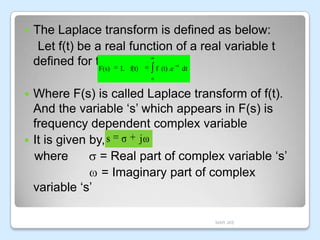
The Laplace transform is defined as below:
Let f(t) be a real function of a real variable t
defined for t>0, then f (t) .e dt
F(s) L f(t)
- st

0

Where F(s) is called Laplace transform of f(t).
And the variable ‘s’ which appears in F(s) is
frequency dependent complex variable
 It is given by, s σ jω
where
= Real part of complex variable ‘s’
= Imaginary part of complex
variable ‘s’


MAR JKE
Example 1


Find the Laplace transform of e-at and 1 for t ≥ 0

MAR JKE


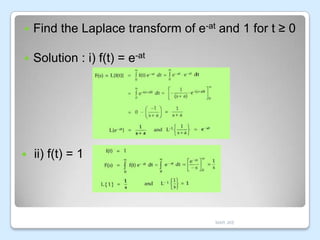
Find the Laplace transform of e-at and 1 for t ≥ 0



Solution : i) f(t) = e-at



ii) f(t) = 1

MAR JKE


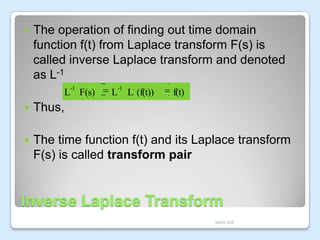
The operation of finding out time domain
function f(t) from Laplace transform F(s) is
called inverse Laplace transform and denoted
as L-1
-1

L F(s)

-1

L

L (f(t))

f(t)



Thus,



The time function f(t) and its Laplace transform
F(s) is called transform pair

Inverse Laplace Transform
MAR JKE
The properties of Laplace transform enable us
to find out Laplace transform without having to
compute them directly from the definition.
 The properties are given:


A) The Linear Property
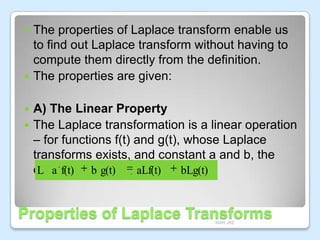
 The Laplace transformation is a linear operation
– for functions f(t) and g(t), whose Laplace
transforms exists, and constant a and b, the
equation isb:g(t)
L a f(t)
aLf(t)
bLg(t)


Properties of Laplace Transforms
MAR JKE
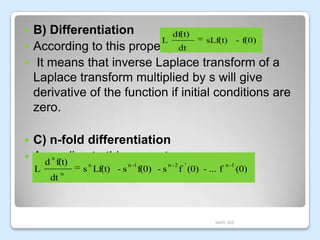
B) Differentiation
df(t)
L
sLf(t) - f(0)
 According to this property, dt
 It means that inverse Laplace transform of a
Laplace transform multiplied by s will give
derivative of the function if initial conditions are
zero.


C) n-fold differentiation
n
 According to this property,
d f(t)


n

L

dt

n

s Lf(t) - s

n -1

f(0) - s

n -2

'

f (0) - ... f

n -1

MAR JKE

(0)


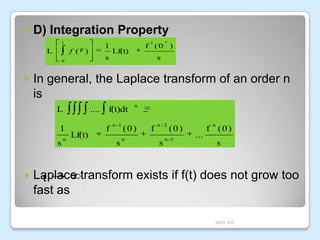
D) Integration Property
t

L

1

f ( )

s

In general, the Laplace transform of an order n
is
L
1
s



Lf(t)

s

0



1

f (0 )

n

....
Lf(t)

f(t)dt
f

n -1

s

n

(0)
n

f

n -2

s

(0)

n -1

n

...

f (0)
s

Laplace transform exists if f(t) does not grow too
t
fast as
MAR JKE


E) Time Shift



The Laplace transform of f(t) delayed by time T
is equal to the Laplace transform of f(t)
multiplied by e-sT ; that is
L[f ( t – T ) u( t – T )] = e-sT F(s), where u (t – T)
denotes the unit step function, which is shifted
to the right in time by T.

MAR JKE
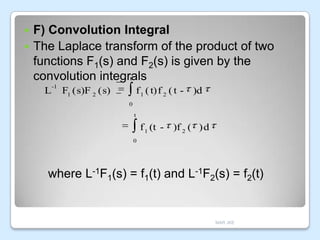
F) Convolution Integral
 The Laplace transform of the product of two
functions F1(s) and F2(s) is given by the
convolution integrals
t


L

-1

F1 ( s)F 2 ( s)

f 1 ( t) f 2 ( t - )d
0
t

f 1 (t - )f 2 ( ) d
0

where L-1F1(s) = f1(t) and L-1F2(s) = f2(t)

MAR JKE


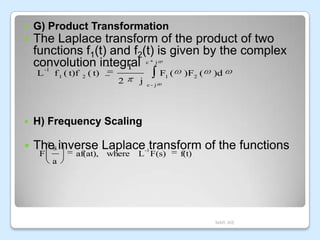
G) Product Transformation



The Laplace transform of the product of two
functions f1(t) and f2(t) is given by the complex
convolution integral
1
c

L

-1

f 1 ( t)f

2

j

( t)

2

j

F1 (

)F2 (

)d

c- j



H) Frequency Scaling



Thes inverse Laplace transform of the functions
F

af(at), where

-1

L F(s)

f(t)

a

MAR JKE


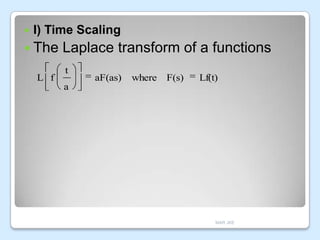
I) Time Scaling

 The
L f

Laplace transform of a functions
t

aF(as)

where

F(s)

Lf(t)

a

MAR JKE
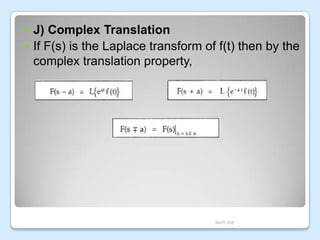
J) Complex Translation
 If F(s) is the Laplace transform of f(t) then by the
complex translation property,


MAR JKE


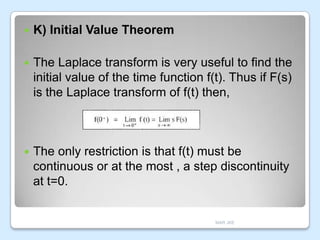
K) Initial Value Theorem



The Laplace transform is very useful to find the
initial value of the time function f(t). Thus if F(s)
is the Laplace transform of f(t) then,



The only restriction is that f(t) must be
continuous or at the most , a step discontinuity
at t=0.

MAR JKE


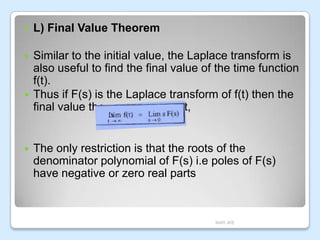
L) Final Value Theorem



Similar to the initial value, the Laplace transform is
also useful to find the final value of the time function
f(t).
Thus if F(s) is the Laplace transform of f(t) then the
final value theorem states that,





The only restriction is that the roots of the
denominator polynomial of F(s) i.e poles of F(s)
have negative or zero real parts

MAR JKE
Example 2


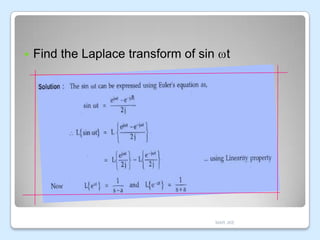
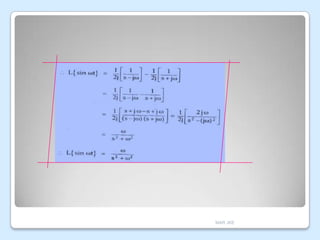
Find the Laplace transform of sin t

MAR JKE


Find the Laplace transform of sin t

MAR JKE
MAR JKE
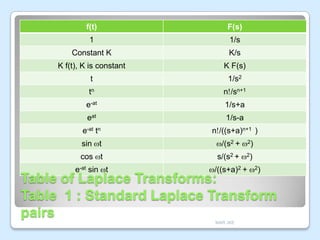
f(t)

F(s)

1

1/s

Constant K

K/s

K f(t), K is constant

K F(s)

t

1/s2

tn

n /sn+1

e-at

1/s+a

eat

1/s-a

e-at tn

n /((s+a)n+1 )

sin t

/(s2 +

2)

cos t

s/(s2 +

2)

e-at sin t

/((s+a)2 +

2)

Table of Laplace Transforms:
Table 1 : Standard Laplace Transform
pairs
MAR JKE
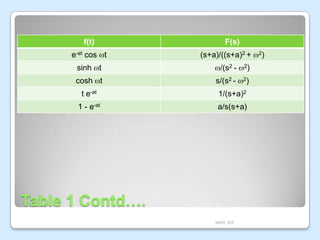
f(t)
e-at cos t

F(s)
(s+a)/((s+a)2 +

sinh t

/(s2 -

2)

cosh t

s/(s2 -

2)

t e-at

1/(s+a)2

1 - e-at

a/s(s+a)

Table 1 Contd….
MAR JKE

2)
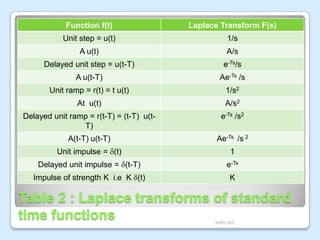
Function f(t)

Laplace Transform F(s)

Unit step = u(t)

1/s

A u(t)

A/s

Delayed unit step = u(t-T)

e-Ts/s

A u(t-T)

Ae-Ts /s

Unit ramp = r(t) = t u(t)

1/s2

At u(t)

A/s2

Delayed unit ramp = r(t-T) = (t-T) u(tT)

e-Ts /s2

A(t-T) u(t-T)

Ae-Ts /s 2

Unit impulse = (t)

1

Delayed unit impulse = (t-T)

e-Ts

Impulse of strength K i.e K (t)

K

Table 2 : Laplace transforms of standard
time functions
MAR JKE


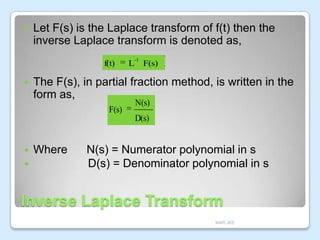
Let F(s) is the Laplace transform of f(t) then the
inverse Laplace transform is denoted as,
f(t)



-1

L

F(s)

The F(s), in partial fraction method, is written in the
form as,
F(s)

N(s)

D(s)




Where

N(s) = Numerator polynomial in s
D(s) = Denominator polynomial in s

Inverse Laplace Transform
MAR JKE
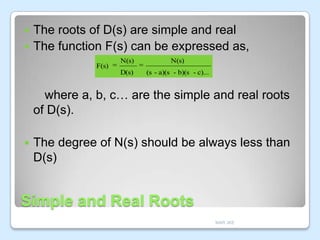
The roots of D(s) are simple and real
 The function F(s) can be expressed as,


N(s)

N(s)

D(s)

F(s)

(s - a)(s - b)(s - c)...

where a, b, c… are the simple and real roots
of D(s).


The degree of N(s) should be always less than
D(s)

Simple and Real Roots
MAR JKE


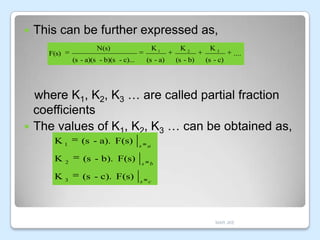
This can be further expressed as,
N(s)

K1

K2

K3

(s - a)(s - b)(s - c)...

F(s)

(s - a)

(s - b)

(s - c)

....

where K1, K2, K3 … are called partial fraction
coefficients
 The values of K1, K2, K3 … can be obtained as,
K1

(s - a). F(s)

K

(s - b). F(s)

2

K3

(s - c). F(s)

s

s

s

a

b

c

MAR JKE


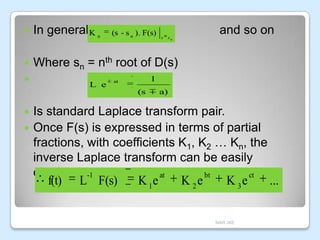
In general,
K



Where sn = nth root of D(s)



n

L e

(s - s n ). F(s)

at

s

and so on

sn

1
(s  a)

Is standard Laplace transform pair.
 Once F(s) is expressed in terms of partial
fractions, with coefficients K1, K2 … Kn, the
inverse Laplace transform can be easily
obtained -1
at
bt
ct


f(t)

L F(s)

K 1e

K 2e

K 3e

MAR JKE

...
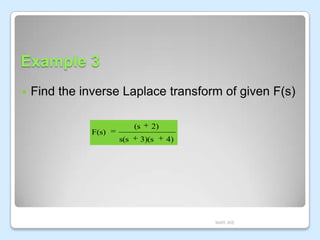
Example 3


Find the inverse Laplace transform of given F(s)
(s

F(s)
s(s

2)

3)(s

4)

MAR JKE


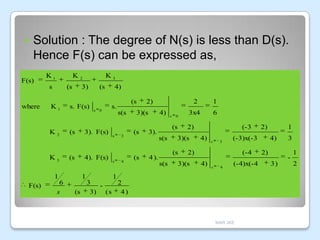
Solution : The degree of N(s) is less than D(s).
Hence F(s) can be expressed as,

F(s)

K1
s

where

(s

K1

K2

K3
1
F(s)

K3

K2

6
s

3)

s. F(s)

(s

(s

(s

s

0

3). F(s)

4). F(s)

4)
(s

s.
s(s

s

s

3

4

2)

3)(s
(s

2
4)

0

(s

3).
s(s

(s

s

s(s

3x4

6

2)

3)(s
(s

4 ).

1

(-3
4)

s

3

(-3)x(-3

2)

3)(s

(-4
4)

s

4

2)

(-4)x(-4

1

1
3 2
(s 3) ( s 4 )

MAR JKE

1
4)

2)

3
-

3)

1
2


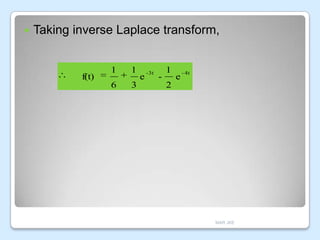
Taking inverse Laplace transform,

f(t)

1

1

6

3

e

- 3t

-

1

e

- 4t

2

MAR JKE


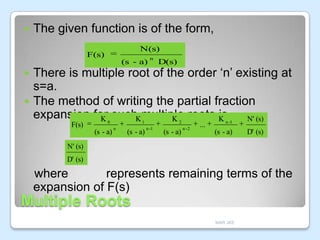
The given function is of the form,
N(s)

F(s)

(s - a)

n

D(s)

There is multiple root of the order ‘n’ existing at
s=a.
 The method of writing the partial fraction
expansion for suchKmultiple roots K
is, N' (s)
K
K


F(s)

0

(s - a)

1

n

(s - a)

2

n -1

(s - a)

n -2

...

n -1

(s - a)

D' (s)

N' (s)
D' (s)

where
represents remaining terms of the
expansion of F(s)

Multiple Roots
MAR JKE
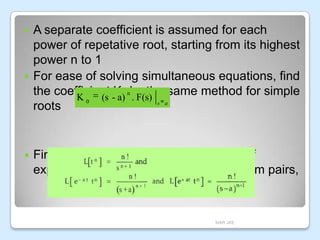
A separate coefficient is assumed for each
power of repetative root, starting from its highest
power n to 1
 For ease of solving simultaneous equations, find
the coefficient -K0 nby the same method for simple
K 0 (s a) . F(s) s a
roots




Finding the Laplace inverse transform of
expanded F(s) refer to standard transform pairs,

MAR JKE
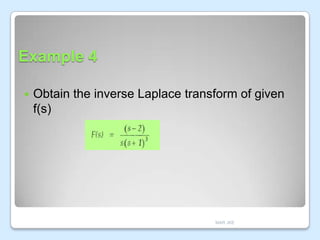
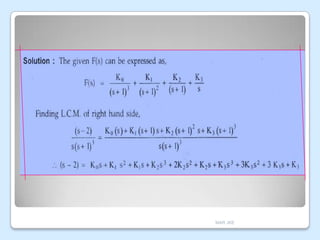
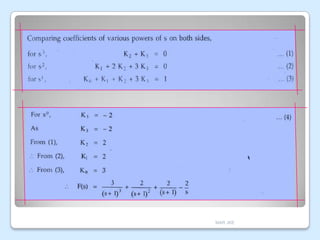
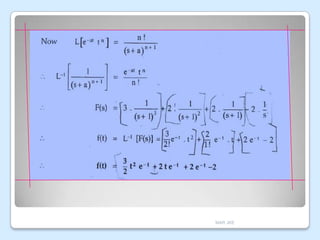
Example 4


Obtain the inverse Laplace transform of given
f(s)

MAR JKE
MAR JKE
MAR JKE
MAR JKE


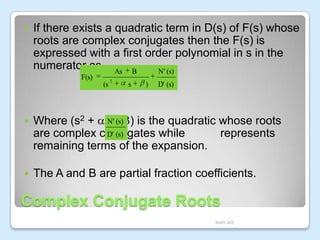
If there exists a quadratic term in D(s) of F(s) whose
roots are complex conjugates then the F(s) is
expressed with a first order polynomial in s in the
numerator as, As B
N' (s)
F(s)

(s

2

s

)

D' (s)



N' (s)
Where (s2 + s + ) is the quadratic whose roots
D' (s)
are complex conjugates while
represents
remaining terms of the expansion.

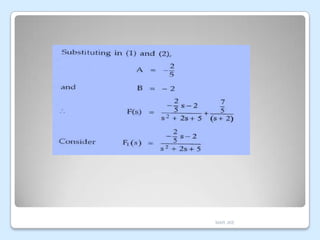


The A and B are partial fraction coefficients.

Complex Conjugate Roots
MAR JKE
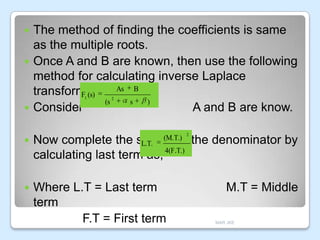
The method of finding the coefficients is same
as the multiple roots.
 Once A and B are known, then use the following
method for calculating inverse Laplace
As B
transform.(s)
F
(s
s
)
 Consider
A and B are know.


1

2

2



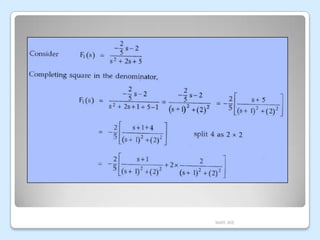
Now complete the square in the denominator by
L.T.
4(F.T.)
calculating last term as,



Where L.T = Last term
term
F.T = First term

(M.T.)

M.T = Middle
MAR JKE
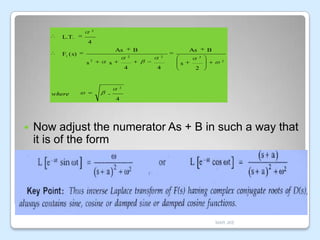
2

L.T.
4
As

F1 ( s)

B
2

s

2

As
2

s
4

4

B
2
2

s
2

2

where

4



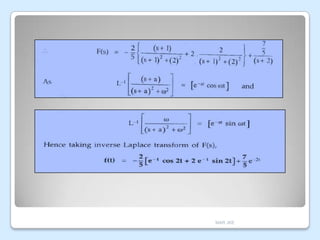
Now adjust the numerator As + B in such a way that
it is of the form

MAR JKE
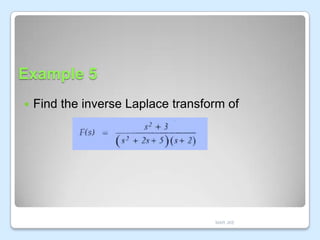
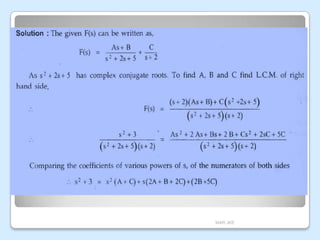
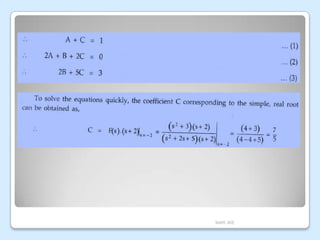
Example 5


Find the inverse Laplace transform of

MAR JKE
MAR JKE
MAR JKE
MAR JKE
MAR JKE
MAR JKE
The control system can be classified as
electrical, mechanical, hydraulic, thermal and so
on.
 All system can be described by
integrodifferential equations of various orders
 While the o/p of such systems for any i/p can be
obtained by solving such integrodifferential
equations
 Mathematically, it is very difficult to solve such
equations in time domain


Application of Laplace Transform in
Control System
MAR JKE


The Laplace transform of such integrodifferential
equations converts them into simple algebraic
equations



All the complicated computations then can be
easily performed in s domain as the equations
to be handled are algebraic in nature.



Such transformed equations are known as
equations in frequency domain

MAR JKE


By eliminating unwanted variable, the required
variable in s domain can be obtained



By using technique of Laplace inverse, time
domain function for the required variable can be
obtained



Hence making the computations easy by
converting the integrodifferential equations into
algebraic is the main essence of the Laplace
transform
MAR JKE

Chapter 2 Laplace Transform

  • 1.
    CHAPTER 2 LAPLACE TRANSFORM ANDTRANSFER FUNCTION MAR JKE
  • 2.
         2.1 Explain theconcept of Laplace Transform 2.2 Understand the concept of transfer function 2.3 Understand block diagram representation 2.4 Explain Signal Flow Graph representation Identify the Mason’s gain formula LAPLACE TRANSFORM AND TRANSFER FUNCTION MAR JKE
  • 3.
     The transform methodis used to solve certain problems, that are difficult to solve directly.  In this method the original problems is first transformed and solved.  Laplace transform is one of the tools for solving ordinary linear differential equations. Definition of Laplace Transform MAR JKE
  • 4.
     First : Convertthe given differential equation from time domain to complex frequency domain by taking Laplace transform of the equation  From this equation, determine the Laplace transform of the unknown variable  Finally, convert this expression into time domain by taking inverse Laplace transform MAR JKE
  • 5.
     Laplace transform methodof solving differential equations offers two distinct advantages over classical method of problem solving  From this equation, determine the Laplace transform of the unknown variable  Finally, convert this expression into time domain by taking inverse Laplace transform MAR JKE
  • 6.
     The Laplace transformis defined as below: Let f(t) be a real function of a real variable t defined for t>0, then f (t) .e dt F(s) L f(t) - st 0 Where F(s) is called Laplace transform of f(t). And the variable ‘s’ which appears in F(s) is frequency dependent complex variable  It is given by, s σ jω where = Real part of complex variable ‘s’ = Imaginary part of complex variable ‘s’  MAR JKE
  • 7.
    Example 1  Find theLaplace transform of e-at and 1 for t ≥ 0 MAR JKE
  • 8.
     Find the Laplacetransform of e-at and 1 for t ≥ 0  Solution : i) f(t) = e-at  ii) f(t) = 1 MAR JKE
  • 9.
     The operation offinding out time domain function f(t) from Laplace transform F(s) is called inverse Laplace transform and denoted as L-1 -1 L F(s) -1 L L (f(t)) f(t)  Thus,  The time function f(t) and its Laplace transform F(s) is called transform pair Inverse Laplace Transform MAR JKE
  • 10.
    The properties ofLaplace transform enable us to find out Laplace transform without having to compute them directly from the definition.  The properties are given:  A) The Linear Property  The Laplace transformation is a linear operation – for functions f(t) and g(t), whose Laplace transforms exists, and constant a and b, the equation isb:g(t) L a f(t) aLf(t) bLg(t)  Properties of Laplace Transforms MAR JKE
  • 11.
    B) Differentiation df(t) L sLf(t) -f(0)  According to this property, dt  It means that inverse Laplace transform of a Laplace transform multiplied by s will give derivative of the function if initial conditions are zero.  C) n-fold differentiation n  According to this property, d f(t)  n L dt n s Lf(t) - s n -1 f(0) - s n -2 ' f (0) - ... f n -1 MAR JKE (0)
  • 12.
     D) Integration Property t L 1 f( ) s In general, the Laplace transform of an order n is L 1 s  Lf(t) s 0  1 f (0 ) n .... Lf(t) f(t)dt f n -1 s n (0) n f n -2 s (0) n -1 n ... f (0) s Laplace transform exists if f(t) does not grow too t fast as MAR JKE
  • 13.
     E) Time Shift  TheLaplace transform of f(t) delayed by time T is equal to the Laplace transform of f(t) multiplied by e-sT ; that is L[f ( t – T ) u( t – T )] = e-sT F(s), where u (t – T) denotes the unit step function, which is shifted to the right in time by T. MAR JKE
  • 14.
    F) Convolution Integral The Laplace transform of the product of two functions F1(s) and F2(s) is given by the convolution integrals t  L -1 F1 ( s)F 2 ( s) f 1 ( t) f 2 ( t - )d 0 t f 1 (t - )f 2 ( ) d 0 where L-1F1(s) = f1(t) and L-1F2(s) = f2(t) MAR JKE
  • 15.
     G) Product Transformation  TheLaplace transform of the product of two functions f1(t) and f2(t) is given by the complex convolution integral 1 c L -1 f 1 ( t)f 2 j ( t) 2 j F1 ( )F2 ( )d c- j  H) Frequency Scaling  Thes inverse Laplace transform of the functions F af(at), where -1 L F(s) f(t) a MAR JKE
  • 16.
     I) Time Scaling The L f Laplace transform of a functions t aF(as) where F(s) Lf(t) a MAR JKE
  • 17.
    J) Complex Translation If F(s) is the Laplace transform of f(t) then by the complex translation property,  MAR JKE
  • 18.
     K) Initial ValueTheorem  The Laplace transform is very useful to find the initial value of the time function f(t). Thus if F(s) is the Laplace transform of f(t) then,  The only restriction is that f(t) must be continuous or at the most , a step discontinuity at t=0. MAR JKE
  • 19.
     L) Final ValueTheorem  Similar to the initial value, the Laplace transform is also useful to find the final value of the time function f(t). Thus if F(s) is the Laplace transform of f(t) then the final value theorem states that,   The only restriction is that the roots of the denominator polynomial of F(s) i.e poles of F(s) have negative or zero real parts MAR JKE
  • 20.
    Example 2  Find theLaplace transform of sin t MAR JKE
  • 21.
     Find the Laplacetransform of sin t MAR JKE
  • 22.
  • 23.
    f(t) F(s) 1 1/s Constant K K/s K f(t),K is constant K F(s) t 1/s2 tn n /sn+1 e-at 1/s+a eat 1/s-a e-at tn n /((s+a)n+1 ) sin t /(s2 + 2) cos t s/(s2 + 2) e-at sin t /((s+a)2 + 2) Table of Laplace Transforms: Table 1 : Standard Laplace Transform pairs MAR JKE
  • 24.
    f(t) e-at cos t F(s) (s+a)/((s+a)2+ sinh t /(s2 - 2) cosh t s/(s2 - 2) t e-at 1/(s+a)2 1 - e-at a/s(s+a) Table 1 Contd…. MAR JKE 2)
  • 25.
    Function f(t) Laplace TransformF(s) Unit step = u(t) 1/s A u(t) A/s Delayed unit step = u(t-T) e-Ts/s A u(t-T) Ae-Ts /s Unit ramp = r(t) = t u(t) 1/s2 At u(t) A/s2 Delayed unit ramp = r(t-T) = (t-T) u(tT) e-Ts /s2 A(t-T) u(t-T) Ae-Ts /s 2 Unit impulse = (t) 1 Delayed unit impulse = (t-T) e-Ts Impulse of strength K i.e K (t) K Table 2 : Laplace transforms of standard time functions MAR JKE
  • 26.
     Let F(s) isthe Laplace transform of f(t) then the inverse Laplace transform is denoted as, f(t)  -1 L F(s) The F(s), in partial fraction method, is written in the form as, F(s) N(s) D(s)   Where N(s) = Numerator polynomial in s D(s) = Denominator polynomial in s Inverse Laplace Transform MAR JKE
  • 27.
    The roots ofD(s) are simple and real  The function F(s) can be expressed as,  N(s) N(s) D(s) F(s) (s - a)(s - b)(s - c)... where a, b, c… are the simple and real roots of D(s).  The degree of N(s) should be always less than D(s) Simple and Real Roots MAR JKE
  • 28.
     This can befurther expressed as, N(s) K1 K2 K3 (s - a)(s - b)(s - c)... F(s) (s - a) (s - b) (s - c) .... where K1, K2, K3 … are called partial fraction coefficients  The values of K1, K2, K3 … can be obtained as, K1 (s - a). F(s) K (s - b). F(s) 2 K3 (s - c). F(s) s s s a b c MAR JKE
  • 29.
     In general, K  Where sn= nth root of D(s)  n L e (s - s n ). F(s) at s and so on sn 1 (s  a) Is standard Laplace transform pair.  Once F(s) is expressed in terms of partial fractions, with coefficients K1, K2 … Kn, the inverse Laplace transform can be easily obtained -1 at bt ct  f(t) L F(s) K 1e K 2e K 3e MAR JKE ...
  • 30.
    Example 3  Find theinverse Laplace transform of given F(s) (s F(s) s(s 2) 3)(s 4) MAR JKE
  • 31.
     Solution : Thedegree of N(s) is less than D(s). Hence F(s) can be expressed as, F(s) K1 s where (s K1 K2 K3 1 F(s) K3 K2 6 s 3) s. F(s) (s (s (s s 0 3). F(s) 4). F(s) 4) (s s. s(s s s 3 4 2) 3)(s (s 2 4) 0 (s 3). s(s (s s s(s 3x4 6 2) 3)(s (s 4 ). 1 (-3 4) s 3 (-3)x(-3 2) 3)(s (-4 4) s 4 2) (-4)x(-4 1 1 3 2 (s 3) ( s 4 ) MAR JKE 1 4) 2) 3 - 3) 1 2
  • 32.
     Taking inverse Laplacetransform, f(t) 1 1 6 3 e - 3t - 1 e - 4t 2 MAR JKE
  • 33.
     The given functionis of the form, N(s) F(s) (s - a) n D(s) There is multiple root of the order ‘n’ existing at s=a.  The method of writing the partial fraction expansion for suchKmultiple roots K is, N' (s) K K  F(s) 0 (s - a) 1 n (s - a) 2 n -1 (s - a) n -2 ... n -1 (s - a) D' (s) N' (s) D' (s) where represents remaining terms of the expansion of F(s) Multiple Roots MAR JKE
  • 34.
    A separate coefficientis assumed for each power of repetative root, starting from its highest power n to 1  For ease of solving simultaneous equations, find the coefficient -K0 nby the same method for simple K 0 (s a) . F(s) s a roots   Finding the Laplace inverse transform of expanded F(s) refer to standard transform pairs, MAR JKE
  • 35.
    Example 4  Obtain theinverse Laplace transform of given f(s) MAR JKE
  • 36.
  • 37.
  • 38.
  • 39.
     If there existsa quadratic term in D(s) of F(s) whose roots are complex conjugates then the F(s) is expressed with a first order polynomial in s in the numerator as, As B N' (s) F(s) (s 2 s ) D' (s)  N' (s) Where (s2 + s + ) is the quadratic whose roots D' (s) are complex conjugates while represents remaining terms of the expansion.  The A and B are partial fraction coefficients. Complex Conjugate Roots MAR JKE
  • 40.
    The method offinding the coefficients is same as the multiple roots.  Once A and B are known, then use the following method for calculating inverse Laplace As B transform.(s) F (s s )  Consider A and B are know.  1 2 2  Now complete the square in the denominator by L.T. 4(F.T.) calculating last term as,  Where L.T = Last term term F.T = First term (M.T.) M.T = Middle MAR JKE
  • 41.
    2 L.T. 4 As F1 ( s) B 2 s 2 As 2 s 4 4 B 2 2 s 2 2 where 4  Nowadjust the numerator As + B in such a way that it is of the form MAR JKE
  • 42.
    Example 5  Find theinverse Laplace transform of MAR JKE
  • 43.
  • 44.
  • 45.
  • 46.
  • 47.
  • 48.
    The control systemcan be classified as electrical, mechanical, hydraulic, thermal and so on.  All system can be described by integrodifferential equations of various orders  While the o/p of such systems for any i/p can be obtained by solving such integrodifferential equations  Mathematically, it is very difficult to solve such equations in time domain  Application of Laplace Transform in Control System MAR JKE
  • 49.
     The Laplace transformof such integrodifferential equations converts them into simple algebraic equations  All the complicated computations then can be easily performed in s domain as the equations to be handled are algebraic in nature.  Such transformed equations are known as equations in frequency domain MAR JKE
  • 50.
     By eliminating unwantedvariable, the required variable in s domain can be obtained  By using technique of Laplace inverse, time domain function for the required variable can be obtained  Hence making the computations easy by converting the integrodifferential equations into algebraic is the main essence of the Laplace transform MAR JKE