LINEAR DIFFERENTIAL
EQUATIONS
Prepared By:
Bakhtiyar Mohamad Ali
Saadi Salim Ismael
Supervised By:
Dr. Karmina K. Ali
Date: 28/1/2024
University of Zakho
College of Science
Department of Mathematics
Agenda Style
Abstract
01
Introduction
02
Conclusion
03
References
04
I n t h i s p r o j e c t , a f i r s t - o r d e r l i n e a r d i f f e r e n t i a l e q u a t i o n
i s s t u d i e d . T h e a p p l i c a t i o n s o f d i f f e r e n t i a l e q u a t i o n s a r e
w r i t e . S o m e e x a m p l e s a n d h o w t o s o l v e t h e m a r e
p r e s e n t e d i n t h i s p r o j e c t .
Abstract
Linearity: The dependent variable (y) and its first
derivative (y') appear only to the first power and are
not multiplied together.
Order: The highest derivative involved is the first
derivative.
Integrating Factor: In Mathematics, an integrating
factor is a function used to solve differential
equations. It is a function in which an ordinary
differential equation can be multiplied to make the
function integrable. It is usually applied to solve
ordinary differential equations.
General Solution: The complete set of solutions to
a first-order linear differential equations.
Here is the general form of a first-order linear
differential equation:
𝒚′
+ 𝒑 𝒙 𝒚 = 𝑸 𝒙 ,
Where 𝒚 is the unknown function. 𝑦′
is the
derivative of 𝒚 with respect to 𝒙. 𝒑 𝒙 and 𝑸(𝒙) are
known functions of 𝒙.
2. INTRODUCTION
2.1 Overview
A first-order linear differential equation is an
equation that relates an unknown function y of
a variable x, its derivative y', and possibly
other functions of x, in a specific way, and
also can defined as the equations that are
fundamental in many areas of science and
engineering, such as population growth, heat
transfer, and electrical circuits. They can be
solved using a variety of methods, including
separation of variables, integrating factors,
and variation of parameters. First-order linear
differential equations are a fundamental class
of differential equations characterized by:
Importance of the linear differential
equation:
1.Building blocks for higher-order linear
differential equations.
2.Wide range of applications in
science, engineering, and finance.
3.Provide a foundation for
understanding more complex differential
equations.
Solving Techniques:
Separation of variables (for
homogeneous).
Integrating factors (for non-
homogeneous).
There are two main types of first-order linear
differential equations:
1- Homogeneous equations: These are equations in
which the right-hand side is zero (Q(x) = 0).
2- Nonhomogeneous equations: These are equations in
which the right-hand side is not zero (Q(x) ≠ 0).
Applications of the linear differential equation:
Modeling population growth and decay
Radioactive decay
Chemical kinetics
Electrical circuits
Heat transfer
2.2 Calculation
The general form of the first order of the linear differential equation in the dependent variable 𝑦 is :
𝑎0(𝑥)𝒚′ + 𝑎1(𝑥)𝑦 = 𝑎2(𝑥),
where 𝑎0(𝑥) ≠ 0 , we get
𝒚′
+
𝑎1(𝑥)
𝑎0(𝑥)
𝑦 =
𝑎2(𝑥)
𝑎0(𝑥)
⇒ 𝒚′ + 𝑝 𝑥 𝑦 = 𝑄 𝑥 . (1)
where 𝑝 𝑥 =
𝑎1(𝑥)
𝑎0(𝑥)
𝑎𝑛𝑑 𝑄 𝑥 =
𝑎2(𝑥)
𝑎0(𝑥)
.
Integrating factor will be a function 𝑓(𝑥) such that multiplying it to both sides of the equation
𝑓 𝑥 (𝑦′ + 𝑝 𝑥 𝑦) = 𝑓 𝑥 𝑄 𝑥
𝑓 𝑥 𝑦′ + 𝑓 𝑥 𝑝 𝑥 𝑦 = 𝑓 𝑥 𝑄 𝑥
𝑓 𝑥 𝑦′ + 𝑓 𝑥 𝑝 𝑥 𝑦 = 𝑓 𝑥 𝑦′ + 𝑓′ 𝑥 𝑦
𝑓 𝑥 𝑦′
+ 𝑓 𝑥 𝑝 𝑥 𝑦 𝑑𝑥 = 𝑓 𝑥 𝑦 + 𝐶.
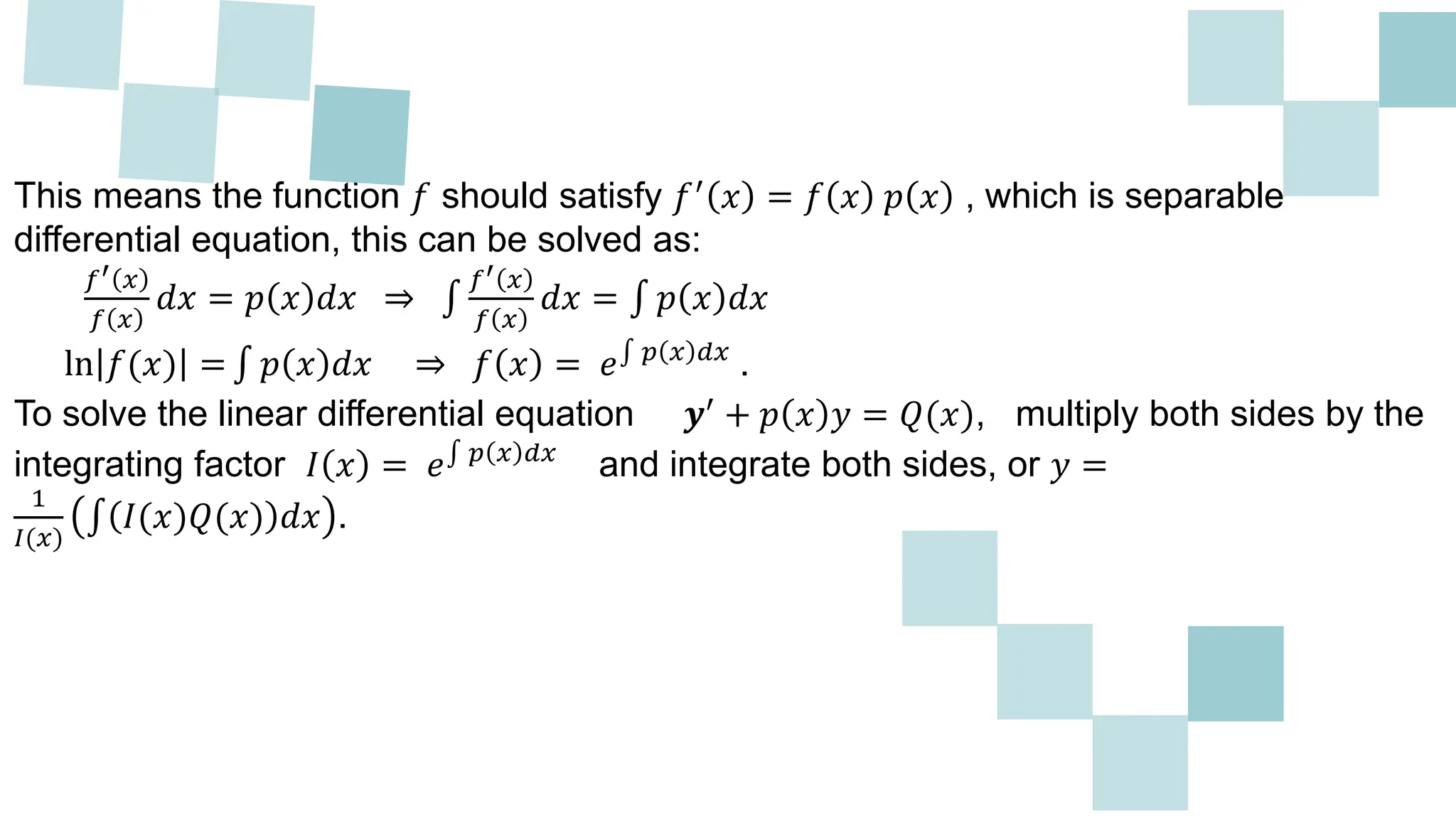
This means the function 𝑓 should satisfy 𝑓′ 𝑥 = 𝑓 𝑥 𝑝 𝑥 , which is separable
differential equation, this can be solved as:
𝑓′ 𝑥
𝑓 𝑥
𝑑𝑥 = 𝑝 𝑥 𝑑𝑥 ⇒
𝑓′ 𝑥
𝑓 𝑥
𝑑𝑥 = 𝑝 𝑥 𝑑𝑥
ln 𝑓(𝑥) = 𝑝 𝑥 𝑑𝑥 ⇒ 𝑓 𝑥 = 𝑒 𝑝 𝑥 𝑑𝑥
.
To solve the linear differential equation 𝒚′ + 𝑝 𝑥 𝑦 = 𝑄(𝑥), multiply both sides by the
integrating factor 𝐼 𝑥 = 𝑒 𝑝 𝑥 𝑑𝑥
and integrate both sides, or 𝑦 =
1
𝐼(𝑥)
𝐼(𝑥)𝑄(𝑥) 𝑑𝑥 .
Example 1: Solve the LDE
𝑑𝑦
𝑑𝑥
=
1
1+𝑥3 −
3𝑥2
1+𝑥2 𝑦 ?
Solution:
The above-mentioned equation can
be rewritten as,
𝑑𝑦
𝑑𝑥
+
3𝑥2
1+𝑥3 𝑦 =
1
1+𝑥3 .
Comparing it with
𝑑𝑦
𝑑𝑥
+ 𝑃(𝑥)𝑦 =Q(x)
, we get
𝑃(𝑥) =
3𝑥2
1+𝑥3 , and 𝑄(𝑥) =
1
1+𝑥3 .
Let’s figure out the integrating factor
(I.F.) which is 𝑒 𝑃(𝑥)𝑑𝑥. I. 𝐹 =
𝑒
3𝑥2
1+𝑥3
𝑑𝑥 = 𝑒ln 1+𝑥3
⇒𝐼. 𝐹. = 1 + 𝑥
3
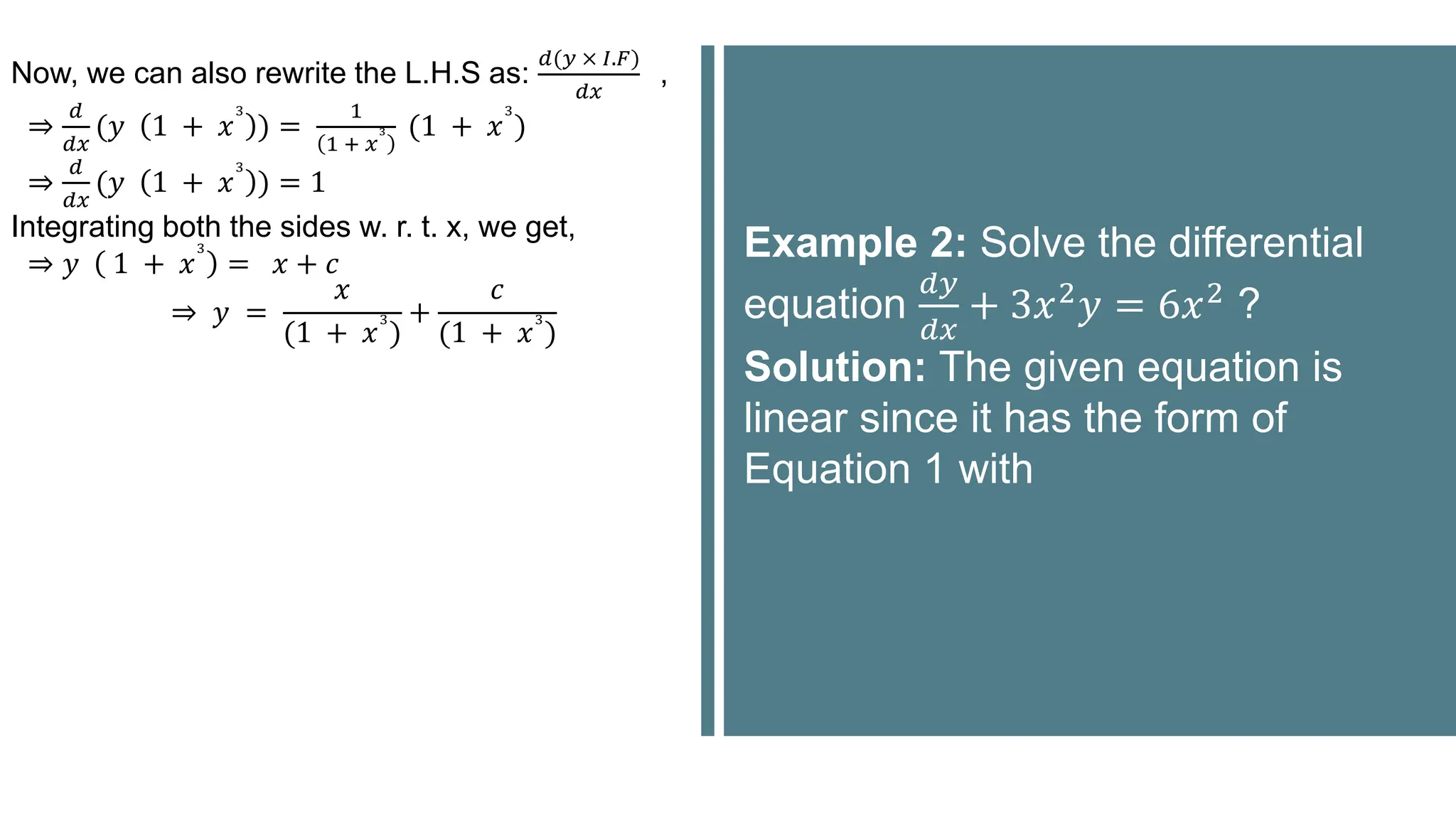
Now, we can also rewrite the L.H.S as:
𝑑(𝑦 × 𝐼.𝐹)
𝑑𝑥
,
⇒
𝑑
𝑑𝑥
(𝑦 1 + 𝑥
3
) =
1
1 + 𝑥
3 (1 + 𝑥
3
)
⇒
𝑑
𝑑𝑥
(𝑦 1 + 𝑥
3
) = 1
Integrating both the sides w. r. t. x, we get,
⇒ 𝑦 1 + 𝑥
3
= 𝑥 + 𝑐
⇒ 𝑦 =
𝑥
(1 + 𝑥
3
)
+
𝑐
(1 + 𝑥
3
)
Example 2: Solve the differential
equation
𝑑𝑦
𝑑𝑥
+ 3𝑥2𝑦 = 6𝑥2 ?
Solution: The given equation is
linear since it has the form of
Equation 1 with
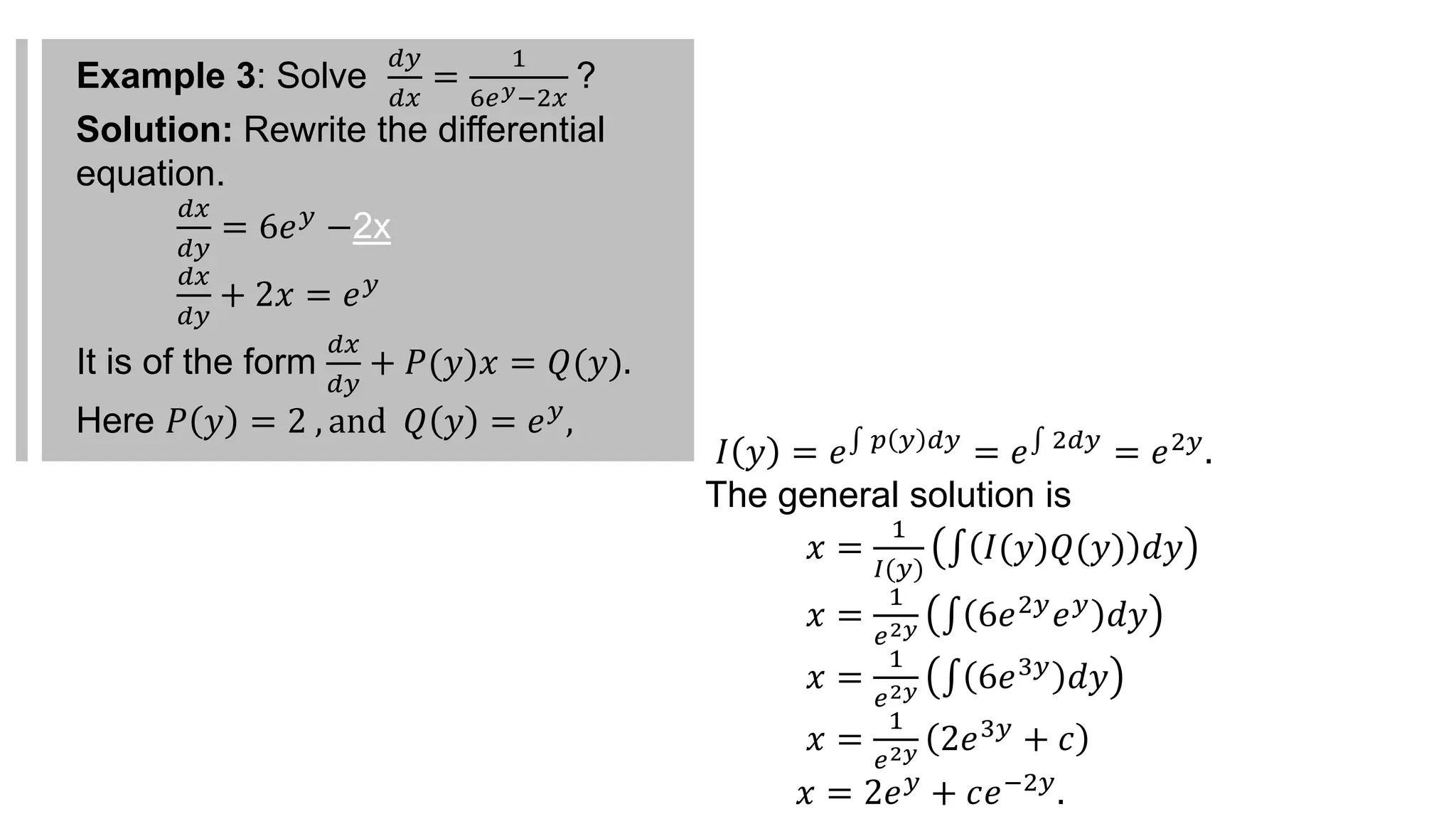
𝐼 𝑦 = 𝑒 𝑝 𝑦 𝑑𝑦
= 𝑒 2𝑑𝑦
= 𝑒2𝑦
.
The general solution is
𝑥 =
1
𝐼(𝑦)
𝐼(𝑦)𝑄(𝑦) 𝑑𝑦
𝑥 =
1
𝑒2𝑦 6𝑒2𝑦𝑒𝑦 𝑑𝑦
𝑥 =
1
𝑒2𝑦 6𝑒3𝑦
𝑑𝑦
𝑥 =
1
𝑒2𝑦 2𝑒3𝑦 + 𝑐
𝑥 = 2𝑒𝑦 + 𝑐𝑒−2𝑦.
Example 3: Solve
𝑑𝑦
𝑑𝑥
=
1
6𝑒𝑦−2𝑥
?
Solution: Rewrite the differential
equation.
𝑑𝑥
𝑑𝑦
= 6𝑒𝑦 −2x
𝑑𝑥
𝑑𝑦
+ 2𝑥 = 𝑒𝑦
It is of the form
𝑑𝑥
𝑑𝑦
+ 𝑃(𝑦)𝑥 = 𝑄(𝑦).
Here 𝑃 𝑦 = 2 , and 𝑄 𝑦 = 𝑒𝑦,
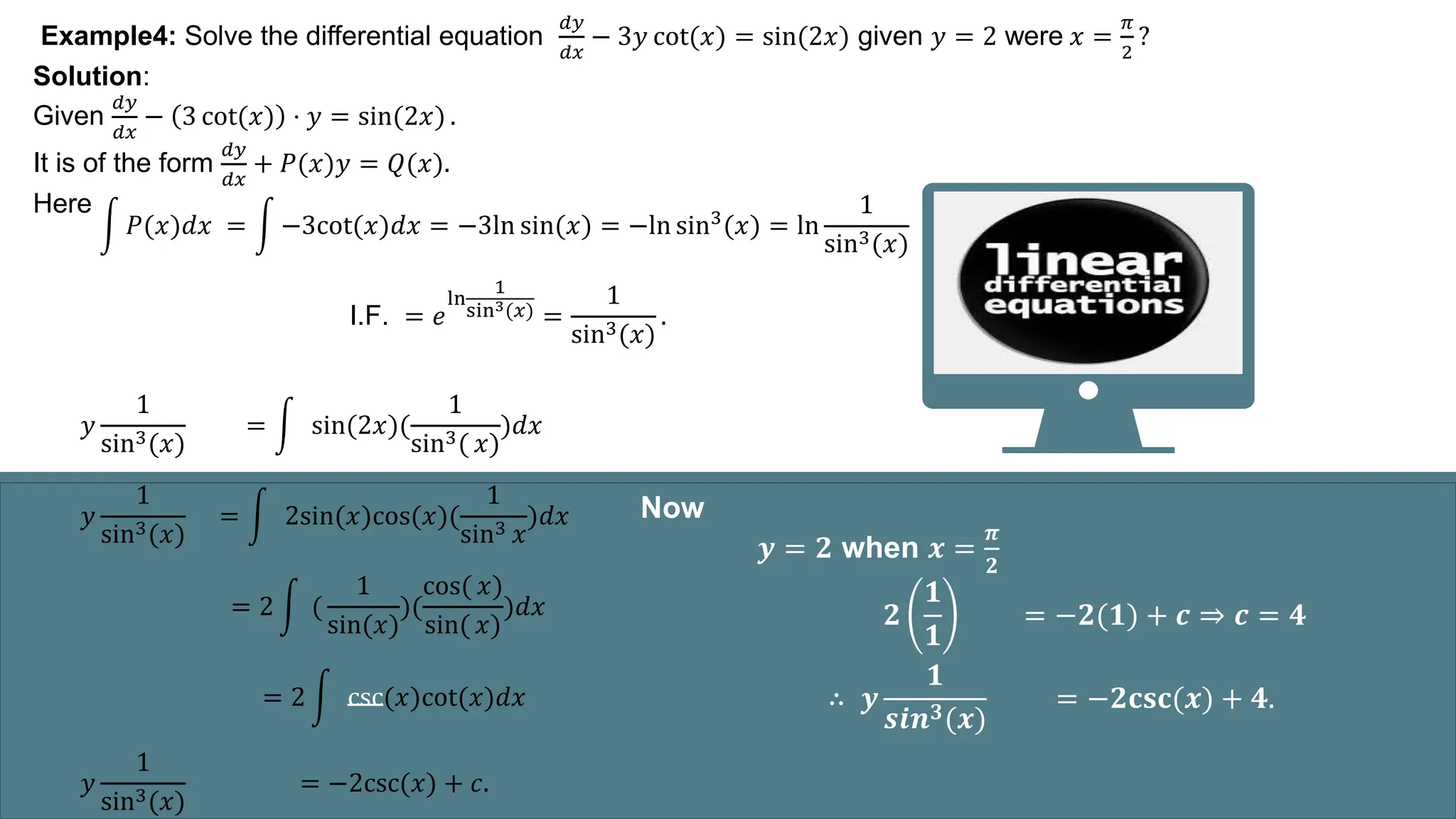
Example4: Solve the differential equation
𝑑𝑦
𝑑𝑥
− 3𝑦 cot(𝑥) = sin(2𝑥) given 𝑦 = 2 were 𝑥 =
𝜋
2
?
Solution:
Given
𝑑𝑦
𝑑𝑥
− 3 cot(𝑥) ⋅ 𝑦 = sin(2𝑥) .
It is of the form
𝑑𝑦
𝑑𝑥
+ 𝑃(𝑥)𝑦 = 𝑄(𝑥).
Here
𝑃(𝑥)𝑑𝑥 = −3cot(𝑥)𝑑𝑥 = −3ln sin(𝑥) = −ln sin3
(𝑥) = ln
1
sin3(𝑥)
I.F. = 𝑒
ln
1
sin3(𝑥) =
1
sin3(𝑥)
.
𝑦
1
sin3(𝑥)
= sin(2𝑥)(
1
sin3( 𝑥)
)𝑑𝑥
𝑦
1
sin3(𝑥)
= 2sin(𝑥)cos(𝑥)(
1
sin3 𝑥
)𝑑𝑥
= 2 (
1
sin(𝑥)
)(
cos( 𝑥)
sin( 𝑥)
)𝑑𝑥
= 2 csc(𝑥)cot(𝑥)𝑑𝑥
𝑦
1
sin3(𝑥)
= −2csc(𝑥) + 𝑐.
Now
𝒚 = 𝟐 when 𝒙 =
𝝅
𝟐
𝟐
𝟏
𝟏
= −𝟐(𝟏) + 𝒄 ⇒ 𝒄 = 𝟒
∴ 𝒚
𝟏
𝒔𝒊𝒏𝟑(𝒙)
= −𝟐𝐜𝐬𝐜(𝒙) + 𝟒.
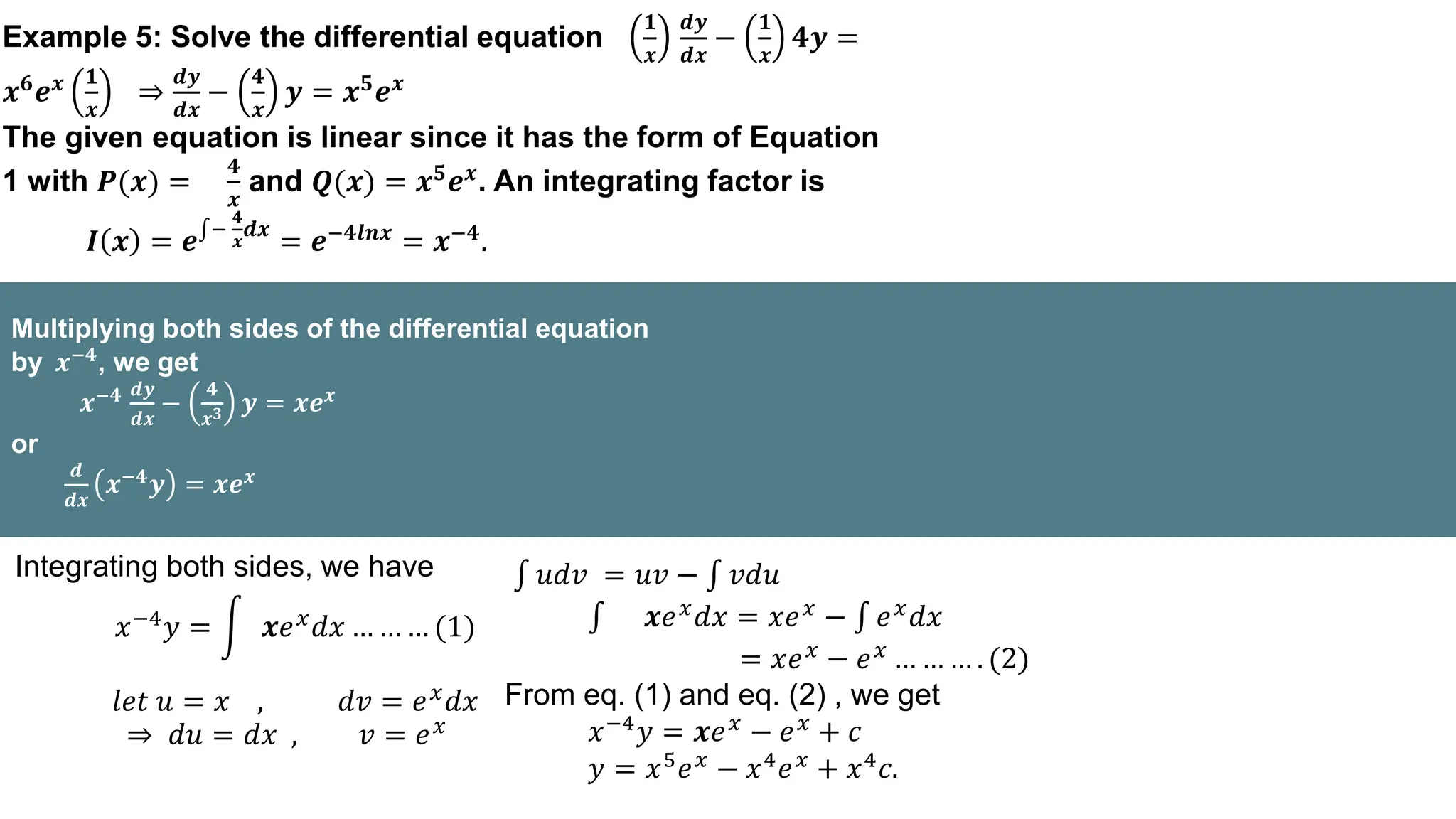
Example 5: Solve the differential equation
𝟏
𝒙
𝒅𝒚
𝒅𝒙
−
𝟏
𝒙
𝟒𝒚 =
𝒙𝟔𝒆𝒙 𝟏
𝒙
⇒
𝒅𝒚
𝒅𝒙
−
𝟒
𝒙
𝒚 = 𝒙𝟓𝒆𝒙
The given equation is linear since it has the form of Equation
1 with 𝑷(𝒙) = −
𝟒
𝒙
and 𝑸(𝒙) = 𝒙𝟓𝒆𝒙. An integrating factor is
𝑰 𝒙 = 𝒆 −
𝟒
𝒙
𝒅𝒙
= 𝒆−𝟒𝒍𝒏𝒙 = 𝒙−𝟒.
Multiplying both sides of the differential equation
by 𝒙−𝟒, we get
𝒙−𝟒 𝒅𝒚
𝒅𝒙
−
𝟒
𝒙𝟑 𝒚 = 𝒙𝒆𝒙
or
𝒅
𝒅𝒙
𝒙−𝟒
𝒚 = 𝒙𝒆𝒙
Integrating both sides, we have
𝑥−4𝑦 = 𝒙𝑒𝑥𝑑𝑥 … … … (1)
𝑙𝑒𝑡 𝑢 = 𝑥 , 𝑑𝑣 = 𝑒𝑥
𝑑𝑥
⇒ 𝑑𝑢 = 𝑑𝑥 , 𝑣 = 𝑒𝑥
𝑢𝑑𝑣 = 𝑢𝑣 − 𝑣𝑑𝑢
𝒙𝑒𝑥𝑑𝑥 = 𝑥𝑒𝑥 − 𝑒𝑥𝑑𝑥
= 𝑥𝑒𝑥 − 𝑒𝑥 … … … . (2)
From eq. (1) and eq. (2) , we get
𝑥−4𝑦 = 𝒙𝑒𝑥 − 𝑒𝑥 + 𝑐
𝑦 = 𝑥5𝑒𝑥 − 𝑥4𝑒𝑥 + 𝑥4𝑐.
S L U
O N I O
S
C C N
Understanding and solving first-order linear differential equations is fundamental
in mathematical modeling. The integrating factor method provides a systematic
approach to find solutions, making these equations valuable tools in analyzing
real-world phenomena. This report provides a brief overview of first-order linear
differential equations, their solution method, and practical applications.
Moreover, some examples are provided to more understand how to solve these
types of differential equations.
4. Reference
[1] Hartman, P. (2002). Ordinary differential equations. Society for Industrial
and Applied Mathematics.
[2] Arnold, V. I. (1992). Ordinary differential equations. Springer Science &
Business Media.
[3] Miller, R. K., & Michel, A. N. (2014). Ordinary differential equations.
Academic press.
[4] Hale, J. K. (2009). Ordinary differential equations. Courier Corporation.

LINEAR DIFFERENTIAL EQUATIONSLINEAR DIFFERENTIAL EQUATIONS .pptx

  • 1.
    LINEAR DIFFERENTIAL EQUATIONS Prepared By: BakhtiyarMohamad Ali Saadi Salim Ismael Supervised By: Dr. Karmina K. Ali Date: 28/1/2024 University of Zakho College of Science Department of Mathematics
  • 2.
  • 3.
    I n th i s p r o j e c t , a f i r s t - o r d e r l i n e a r d i f f e r e n t i a l e q u a t i o n i s s t u d i e d . T h e a p p l i c a t i o n s o f d i f f e r e n t i a l e q u a t i o n s a r e w r i t e . S o m e e x a m p l e s a n d h o w t o s o l v e t h e m a r e p r e s e n t e d i n t h i s p r o j e c t . Abstract
  • 4.
    Linearity: The dependentvariable (y) and its first derivative (y') appear only to the first power and are not multiplied together. Order: The highest derivative involved is the first derivative. Integrating Factor: In Mathematics, an integrating factor is a function used to solve differential equations. It is a function in which an ordinary differential equation can be multiplied to make the function integrable. It is usually applied to solve ordinary differential equations. General Solution: The complete set of solutions to a first-order linear differential equations. Here is the general form of a first-order linear differential equation: 𝒚′ + 𝒑 𝒙 𝒚 = 𝑸 𝒙 , Where 𝒚 is the unknown function. 𝑦′ is the derivative of 𝒚 with respect to 𝒙. 𝒑 𝒙 and 𝑸(𝒙) are known functions of 𝒙. 2. INTRODUCTION 2.1 Overview A first-order linear differential equation is an equation that relates an unknown function y of a variable x, its derivative y', and possibly other functions of x, in a specific way, and also can defined as the equations that are fundamental in many areas of science and engineering, such as population growth, heat transfer, and electrical circuits. They can be solved using a variety of methods, including separation of variables, integrating factors, and variation of parameters. First-order linear differential equations are a fundamental class of differential equations characterized by:
  • 5.
    Importance of thelinear differential equation: 1.Building blocks for higher-order linear differential equations. 2.Wide range of applications in science, engineering, and finance. 3.Provide a foundation for understanding more complex differential equations. Solving Techniques: Separation of variables (for homogeneous). Integrating factors (for non- homogeneous). There are two main types of first-order linear differential equations: 1- Homogeneous equations: These are equations in which the right-hand side is zero (Q(x) = 0). 2- Nonhomogeneous equations: These are equations in which the right-hand side is not zero (Q(x) ≠ 0).
  • 6.
    Applications of thelinear differential equation: Modeling population growth and decay Radioactive decay Chemical kinetics Electrical circuits Heat transfer
  • 7.
    2.2 Calculation The generalform of the first order of the linear differential equation in the dependent variable 𝑦 is : 𝑎0(𝑥)𝒚′ + 𝑎1(𝑥)𝑦 = 𝑎2(𝑥), where 𝑎0(𝑥) ≠ 0 , we get 𝒚′ + 𝑎1(𝑥) 𝑎0(𝑥) 𝑦 = 𝑎2(𝑥) 𝑎0(𝑥) ⇒ 𝒚′ + 𝑝 𝑥 𝑦 = 𝑄 𝑥 . (1) where 𝑝 𝑥 = 𝑎1(𝑥) 𝑎0(𝑥) 𝑎𝑛𝑑 𝑄 𝑥 = 𝑎2(𝑥) 𝑎0(𝑥) . Integrating factor will be a function 𝑓(𝑥) such that multiplying it to both sides of the equation 𝑓 𝑥 (𝑦′ + 𝑝 𝑥 𝑦) = 𝑓 𝑥 𝑄 𝑥 𝑓 𝑥 𝑦′ + 𝑓 𝑥 𝑝 𝑥 𝑦 = 𝑓 𝑥 𝑄 𝑥 𝑓 𝑥 𝑦′ + 𝑓 𝑥 𝑝 𝑥 𝑦 = 𝑓 𝑥 𝑦′ + 𝑓′ 𝑥 𝑦 𝑓 𝑥 𝑦′ + 𝑓 𝑥 𝑝 𝑥 𝑦 𝑑𝑥 = 𝑓 𝑥 𝑦 + 𝐶.
  • 8.
    This means thefunction 𝑓 should satisfy 𝑓′ 𝑥 = 𝑓 𝑥 𝑝 𝑥 , which is separable differential equation, this can be solved as: 𝑓′ 𝑥 𝑓 𝑥 𝑑𝑥 = 𝑝 𝑥 𝑑𝑥 ⇒ 𝑓′ 𝑥 𝑓 𝑥 𝑑𝑥 = 𝑝 𝑥 𝑑𝑥 ln 𝑓(𝑥) = 𝑝 𝑥 𝑑𝑥 ⇒ 𝑓 𝑥 = 𝑒 𝑝 𝑥 𝑑𝑥 . To solve the linear differential equation 𝒚′ + 𝑝 𝑥 𝑦 = 𝑄(𝑥), multiply both sides by the integrating factor 𝐼 𝑥 = 𝑒 𝑝 𝑥 𝑑𝑥 and integrate both sides, or 𝑦 = 1 𝐼(𝑥) 𝐼(𝑥)𝑄(𝑥) 𝑑𝑥 .
  • 9.
    Example 1: Solvethe LDE 𝑑𝑦 𝑑𝑥 = 1 1+𝑥3 − 3𝑥2 1+𝑥2 𝑦 ? Solution: The above-mentioned equation can be rewritten as, 𝑑𝑦 𝑑𝑥 + 3𝑥2 1+𝑥3 𝑦 = 1 1+𝑥3 . Comparing it with 𝑑𝑦 𝑑𝑥 + 𝑃(𝑥)𝑦 =Q(x) , we get 𝑃(𝑥) = 3𝑥2 1+𝑥3 , and 𝑄(𝑥) = 1 1+𝑥3 . Let’s figure out the integrating factor (I.F.) which is 𝑒 𝑃(𝑥)𝑑𝑥. I. 𝐹 = 𝑒 3𝑥2 1+𝑥3 𝑑𝑥 = 𝑒ln 1+𝑥3 ⇒𝐼. 𝐹. = 1 + 𝑥 3
  • 10.
    Now, we canalso rewrite the L.H.S as: 𝑑(𝑦 × 𝐼.𝐹) 𝑑𝑥 , ⇒ 𝑑 𝑑𝑥 (𝑦 1 + 𝑥 3 ) = 1 1 + 𝑥 3 (1 + 𝑥 3 ) ⇒ 𝑑 𝑑𝑥 (𝑦 1 + 𝑥 3 ) = 1 Integrating both the sides w. r. t. x, we get, ⇒ 𝑦 1 + 𝑥 3 = 𝑥 + 𝑐 ⇒ 𝑦 = 𝑥 (1 + 𝑥 3 ) + 𝑐 (1 + 𝑥 3 ) Example 2: Solve the differential equation 𝑑𝑦 𝑑𝑥 + 3𝑥2𝑦 = 6𝑥2 ? Solution: The given equation is linear since it has the form of Equation 1 with
  • 11.
    𝐼 𝑦 =𝑒 𝑝 𝑦 𝑑𝑦 = 𝑒 2𝑑𝑦 = 𝑒2𝑦 . The general solution is 𝑥 = 1 𝐼(𝑦) 𝐼(𝑦)𝑄(𝑦) 𝑑𝑦 𝑥 = 1 𝑒2𝑦 6𝑒2𝑦𝑒𝑦 𝑑𝑦 𝑥 = 1 𝑒2𝑦 6𝑒3𝑦 𝑑𝑦 𝑥 = 1 𝑒2𝑦 2𝑒3𝑦 + 𝑐 𝑥 = 2𝑒𝑦 + 𝑐𝑒−2𝑦. Example 3: Solve 𝑑𝑦 𝑑𝑥 = 1 6𝑒𝑦−2𝑥 ? Solution: Rewrite the differential equation. 𝑑𝑥 𝑑𝑦 = 6𝑒𝑦 −2x 𝑑𝑥 𝑑𝑦 + 2𝑥 = 𝑒𝑦 It is of the form 𝑑𝑥 𝑑𝑦 + 𝑃(𝑦)𝑥 = 𝑄(𝑦). Here 𝑃 𝑦 = 2 , and 𝑄 𝑦 = 𝑒𝑦,
  • 12.
    Example4: Solve thedifferential equation 𝑑𝑦 𝑑𝑥 − 3𝑦 cot(𝑥) = sin(2𝑥) given 𝑦 = 2 were 𝑥 = 𝜋 2 ? Solution: Given 𝑑𝑦 𝑑𝑥 − 3 cot(𝑥) ⋅ 𝑦 = sin(2𝑥) . It is of the form 𝑑𝑦 𝑑𝑥 + 𝑃(𝑥)𝑦 = 𝑄(𝑥). Here 𝑃(𝑥)𝑑𝑥 = −3cot(𝑥)𝑑𝑥 = −3ln sin(𝑥) = −ln sin3 (𝑥) = ln 1 sin3(𝑥) I.F. = 𝑒 ln 1 sin3(𝑥) = 1 sin3(𝑥) . 𝑦 1 sin3(𝑥) = sin(2𝑥)( 1 sin3( 𝑥) )𝑑𝑥 𝑦 1 sin3(𝑥) = 2sin(𝑥)cos(𝑥)( 1 sin3 𝑥 )𝑑𝑥 = 2 ( 1 sin(𝑥) )( cos( 𝑥) sin( 𝑥) )𝑑𝑥 = 2 csc(𝑥)cot(𝑥)𝑑𝑥 𝑦 1 sin3(𝑥) = −2csc(𝑥) + 𝑐. Now 𝒚 = 𝟐 when 𝒙 = 𝝅 𝟐 𝟐 𝟏 𝟏 = −𝟐(𝟏) + 𝒄 ⇒ 𝒄 = 𝟒 ∴ 𝒚 𝟏 𝒔𝒊𝒏𝟑(𝒙) = −𝟐𝐜𝐬𝐜(𝒙) + 𝟒.
  • 13.
    Example 5: Solvethe differential equation 𝟏 𝒙 𝒅𝒚 𝒅𝒙 − 𝟏 𝒙 𝟒𝒚 = 𝒙𝟔𝒆𝒙 𝟏 𝒙 ⇒ 𝒅𝒚 𝒅𝒙 − 𝟒 𝒙 𝒚 = 𝒙𝟓𝒆𝒙 The given equation is linear since it has the form of Equation 1 with 𝑷(𝒙) = − 𝟒 𝒙 and 𝑸(𝒙) = 𝒙𝟓𝒆𝒙. An integrating factor is 𝑰 𝒙 = 𝒆 − 𝟒 𝒙 𝒅𝒙 = 𝒆−𝟒𝒍𝒏𝒙 = 𝒙−𝟒. Multiplying both sides of the differential equation by 𝒙−𝟒, we get 𝒙−𝟒 𝒅𝒚 𝒅𝒙 − 𝟒 𝒙𝟑 𝒚 = 𝒙𝒆𝒙 or 𝒅 𝒅𝒙 𝒙−𝟒 𝒚 = 𝒙𝒆𝒙 Integrating both sides, we have 𝑥−4𝑦 = 𝒙𝑒𝑥𝑑𝑥 … … … (1) 𝑙𝑒𝑡 𝑢 = 𝑥 , 𝑑𝑣 = 𝑒𝑥 𝑑𝑥 ⇒ 𝑑𝑢 = 𝑑𝑥 , 𝑣 = 𝑒𝑥 𝑢𝑑𝑣 = 𝑢𝑣 − 𝑣𝑑𝑢 𝒙𝑒𝑥𝑑𝑥 = 𝑥𝑒𝑥 − 𝑒𝑥𝑑𝑥 = 𝑥𝑒𝑥 − 𝑒𝑥 … … … . (2) From eq. (1) and eq. (2) , we get 𝑥−4𝑦 = 𝒙𝑒𝑥 − 𝑒𝑥 + 𝑐 𝑦 = 𝑥5𝑒𝑥 − 𝑥4𝑒𝑥 + 𝑥4𝑐.
  • 14.
    S L U ON I O S C C N Understanding and solving first-order linear differential equations is fundamental in mathematical modeling. The integrating factor method provides a systematic approach to find solutions, making these equations valuable tools in analyzing real-world phenomena. This report provides a brief overview of first-order linear differential equations, their solution method, and practical applications. Moreover, some examples are provided to more understand how to solve these types of differential equations.
  • 15.
    4. Reference [1] Hartman,P. (2002). Ordinary differential equations. Society for Industrial and Applied Mathematics. [2] Arnold, V. I. (1992). Ordinary differential equations. Springer Science & Business Media. [3] Miller, R. K., & Michel, A. N. (2014). Ordinary differential equations. Academic press. [4] Hale, J. K. (2009). Ordinary differential equations. Courier Corporation.