Higher Order Differential Equation
&
Its Applications
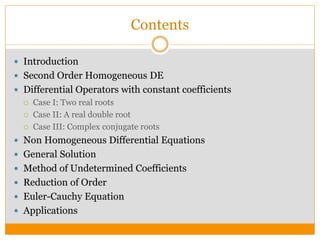
Contents
 Introduction
 Second Order Homogeneous DE
 Differential Operators with constant coefficients
 Case I: Two real roots
 Case II: A real double root
 Case III: Complex conjugate roots
 Non Homogeneous Differential Equations
 General Solution
 Method of Undetermined Coefficients
 Reduction of Order
 Euler-Cauchy Equation
 Applications
Introduction
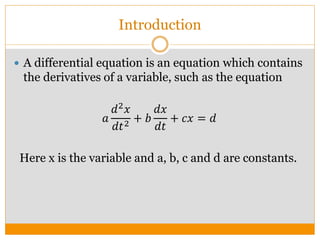
 A differential equation is an equation which contains
the derivatives of a variable, such as the equation
𝑎
𝑑2
𝑥
𝑑𝑡2
+ 𝑏
𝑑𝑥
𝑑𝑡
+ 𝑐𝑥 = 𝑑
Here x is the variable and a, b, c and d are constants.
Types of Differential Equations
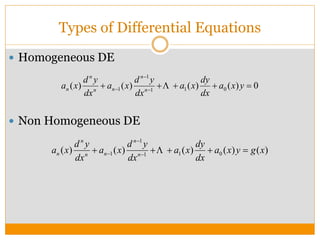
 Homogeneous DE
 Non Homogeneous DE
0)()()()( 011
1
1  

 yxa
dx
dy
xa
dx
yd
xa
dx
yd
xa n
n
nn
n
n 
)()()()()( 011
1
1 xgyxa
dx
dy
xa
dx
yd
xa
dx
yd
xa n
n
nn
n
n  

 
Second Order Homogeneous DE
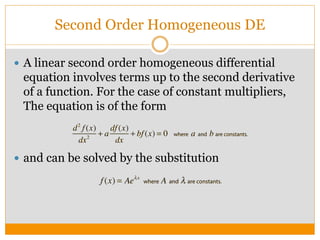
 A linear second order homogeneous differential
equation involves terms up to the second derivative
of a function. For the case of constant multipliers,
The equation is of the form
 and can be solved by the substitution
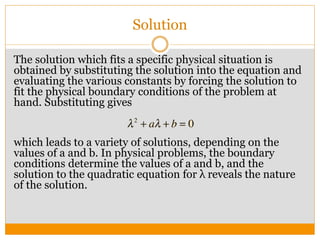
Solution
The solution which fits a specific physical situation is
obtained by substituting the solution into the equation and
evaluating the various constants by forcing the solution to
fit the physical boundary conditions of the problem at
hand. Substituting gives
which leads to a variety of solutions, depending on the
values of a and b. In physical problems, the boundary
conditions determine the values of a and b, and the
solution to the quadratic equation for λ reveals the nature
of the solution.
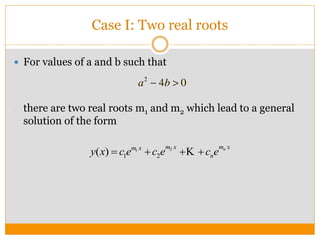
Case I: Two real roots
 For values of a and b such that
• there are two real roots m1 and m2 which lead to a general
solution of the form
21
1 2( ) nm x m xm x
ny x c e c e c e   K
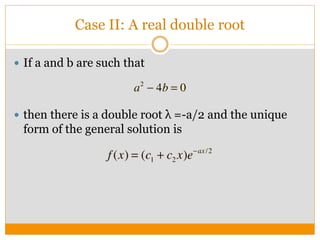
Case II: A real double root
 If a and b are such that
 then there is a double root λ =-a/2 and the unique
form of the general solution is
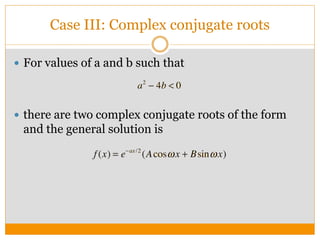
Case III: Complex conjugate roots
 For values of a and b such that
 there are two complex conjugate roots of the form
and the general solution is
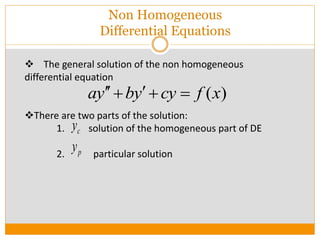
 The general solution of the non homogeneous
differential equation
There are two parts of the solution:
1. solution of the homogeneous part of DE
2. particular solution
( )ay by cy f x   
cy
py
Non Homogeneous
Differential Equations
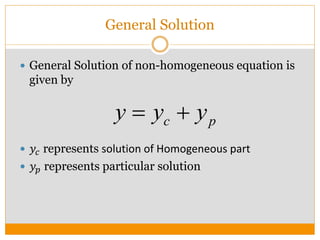
 General Solution of non-homogeneous equation is
given by
 𝑦𝑐 represents solution of Homogeneous part
 𝑦𝑝 represents particular solution
c py y y 
General Solution
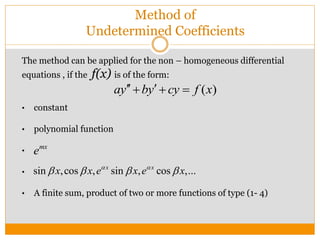
The method can be applied for the non – homogeneous differential
equations , if the f(x) is of the form:
• constant
• polynomial function
•
•
• A finite sum, product of two or more functions of type (1- 4)
( )ay by cy f x   
mx
e
sin ,cos , sin , cos ,...x x
x x e x e x 
   
Method of
Undetermined Coefficients
Reduction of Order
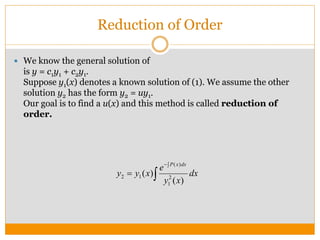
 We know the general solution of
is y = c1y1 + c2y1.
Suppose y1(x) denotes a known solution of (1). We assume the other
solution y2 has the form y2 = uy1.
Our goal is to find a u(x) and this method is called reduction of
order.


 dx
xy
e
xyy
dxxP
)(
)( 2
1
)(
12
Euler-Cauchy Equation
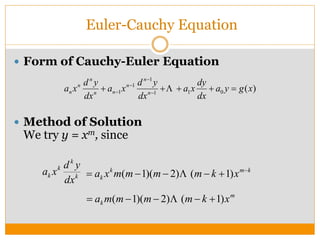
 Form of Cauchy-Euler Equation
 Method of Solution
We try y = xm, since
)(011
1
1
1 xgya
dx
dy
xa
dx
yd
xa
dx
yd
xa n
n
n
nn
n
n
n  


 
k
k
k
k
dx
yd
xa kmk
k xkmmmmxa 
 )1()2)(1( 
m
k xkmmmma )1()2)(1(  
Applications
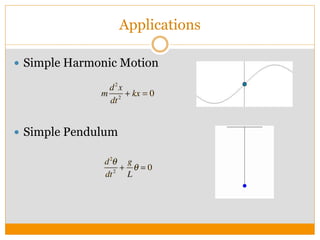
 Simple Harmonic Motion
 Simple Pendulum
Applications (Cont.)
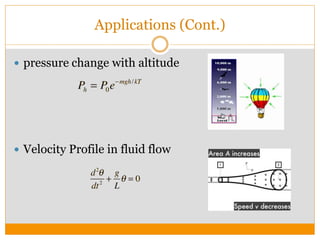
 pressure change with altitude
 Velocity Profile in fluid flow
Applications (Cont.)
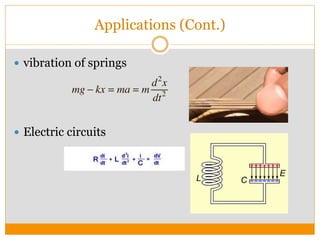
 vibration of springs
 Electric circuits
Applications (Cont.)
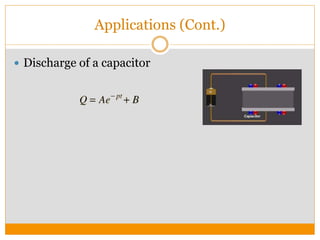
 Discharge of a capacitor
References
 http://hyperphysics.phy-astr.gsu.edu/hbase/diff2.html#c2
 http://tutorial.math.lamar.edu/Classes/DE/IntroHigherOrder.aspx
 http://hyperphysics.phy-astr.gsu.edu/hbase/diff.html
 https://www.math.ksu.edu/~blanki/SecondOrderODE.pdf
 http://www.mylespaul.com/forums/showthread.php?t=266222
THANK YOU

Higher order ODE with applications

  • 1.
    Higher Order DifferentialEquation & Its Applications
  • 2.
    Contents  Introduction  SecondOrder Homogeneous DE  Differential Operators with constant coefficients  Case I: Two real roots  Case II: A real double root  Case III: Complex conjugate roots  Non Homogeneous Differential Equations  General Solution  Method of Undetermined Coefficients  Reduction of Order  Euler-Cauchy Equation  Applications
  • 3.
    Introduction  A differentialequation is an equation which contains the derivatives of a variable, such as the equation 𝑎 𝑑2 𝑥 𝑑𝑡2 + 𝑏 𝑑𝑥 𝑑𝑡 + 𝑐𝑥 = 𝑑 Here x is the variable and a, b, c and d are constants.
  • 4.
    Types of DifferentialEquations  Homogeneous DE  Non Homogeneous DE 0)()()()( 011 1 1     yxa dx dy xa dx yd xa dx yd xa n n nn n n  )()()()()( 011 1 1 xgyxa dx dy xa dx yd xa dx yd xa n n nn n n     
  • 5.
    Second Order HomogeneousDE  A linear second order homogeneous differential equation involves terms up to the second derivative of a function. For the case of constant multipliers, The equation is of the form  and can be solved by the substitution
  • 6.
    Solution The solution whichfits a specific physical situation is obtained by substituting the solution into the equation and evaluating the various constants by forcing the solution to fit the physical boundary conditions of the problem at hand. Substituting gives which leads to a variety of solutions, depending on the values of a and b. In physical problems, the boundary conditions determine the values of a and b, and the solution to the quadratic equation for λ reveals the nature of the solution.
  • 7.
    Case I: Tworeal roots  For values of a and b such that • there are two real roots m1 and m2 which lead to a general solution of the form 21 1 2( ) nm x m xm x ny x c e c e c e   K
  • 8.
    Case II: Areal double root  If a and b are such that  then there is a double root λ =-a/2 and the unique form of the general solution is
  • 9.
    Case III: Complexconjugate roots  For values of a and b such that  there are two complex conjugate roots of the form and the general solution is
  • 10.
     The generalsolution of the non homogeneous differential equation There are two parts of the solution: 1. solution of the homogeneous part of DE 2. particular solution ( )ay by cy f x    cy py Non Homogeneous Differential Equations
  • 11.
     General Solutionof non-homogeneous equation is given by  𝑦𝑐 represents solution of Homogeneous part  𝑦𝑝 represents particular solution c py y y  General Solution
  • 12.
    The method canbe applied for the non – homogeneous differential equations , if the f(x) is of the form: • constant • polynomial function • • • A finite sum, product of two or more functions of type (1- 4) ( )ay by cy f x    mx e sin ,cos , sin , cos ,...x x x x e x e x      Method of Undetermined Coefficients
  • 13.
    Reduction of Order We know the general solution of is y = c1y1 + c2y1. Suppose y1(x) denotes a known solution of (1). We assume the other solution y2 has the form y2 = uy1. Our goal is to find a u(x) and this method is called reduction of order.    dx xy e xyy dxxP )( )( 2 1 )( 12
  • 14.
    Euler-Cauchy Equation  Formof Cauchy-Euler Equation  Method of Solution We try y = xm, since )(011 1 1 1 xgya dx dy xa dx yd xa dx yd xa n n n nn n n n       k k k k dx yd xa kmk k xkmmmmxa   )1()2)(1(  m k xkmmmma )1()2)(1(  
  • 15.
    Applications  Simple HarmonicMotion  Simple Pendulum
  • 16.
    Applications (Cont.)  pressurechange with altitude  Velocity Profile in fluid flow
  • 17.
    Applications (Cont.)  vibrationof springs  Electric circuits
  • 18.
  • 19.
    References  http://hyperphysics.phy-astr.gsu.edu/hbase/diff2.html#c2  http://tutorial.math.lamar.edu/Classes/DE/IntroHigherOrder.aspx http://hyperphysics.phy-astr.gsu.edu/hbase/diff.html  https://www.math.ksu.edu/~blanki/SecondOrderODE.pdf  http://www.mylespaul.com/forums/showthread.php?t=266222
  • 20.