DIFFERENTIAL EQUATIONS
DIFFERENTIAL
EQUATIONS
DIFFERENTIAL EQUATIONS
DIFFERENTIAL EQUATION
An equation involving one dependent variable, one or
more independent variables and the differential
coefficients (derivatives) of dependent variable
with respect to independent variables
is called a differential equation.
DIFFERENTIAL EQUATIONS
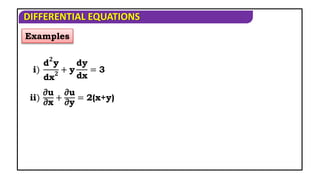
Examples
i)
d𝟐
y
dx𝟐
+ y
dy
dx
= 3
ii)
∂u
∂x
+
∂u
∂y
= 2(x+y)
DIFFERENTIAL EQUATIONS
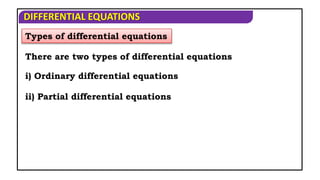
Types of differential equations
There are two types of differential equations
i) Ordinary differential equations
ii) Partial differential equations
DIFFERENTIAL EQUATIONS
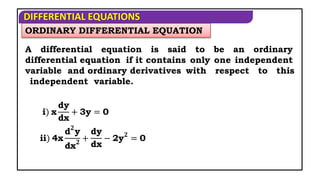
ORDINARY DIFFERENTIAL EQUATION
A differential equation is said to be an ordinary
differential equation if it contains only one independent
variable and ordinary derivatives with respect to this
independent variable.
i) x
dy
dx
+ 3y = 0
ii) 4x
d𝟐
y
dx𝟐 +
dy
dx
− 2y𝟐
= 0
DIFFERENTIAL EQUATIONS
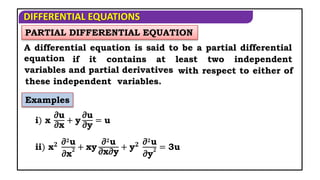
PARTIAL DIFFERENTIAL EQUATION
A differential equation is said to be a partial differential
equation if it contains at least two independent
variables and partial derivatives with respect to either of
these independent variables.
Examples
i) x
∂u
∂x
+ y
∂u
∂y
= u
ii) x𝟐 ∂𝟐u
∂x
𝟐 + xy
∂𝟐u
∂x∂y
+ y𝟐 ∂𝟐u
∂y
𝟐 = 3u
DIFFERENTIAL EQUATIONS
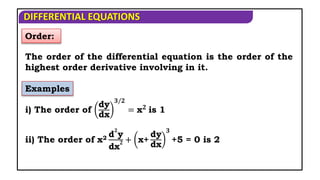
Order:
The order of the differential equation is the order of the
highest order derivative involving in it.
Examples
i) The order of
dy
dx
𝟑/𝟐
= x𝟐
is 1
ii) The order of x2 d
𝟐
y
dx
𝟐 + x+
dy
dx
𝟑
+5 = 0 is 2
DIFFERENTIAL EQUATIONS
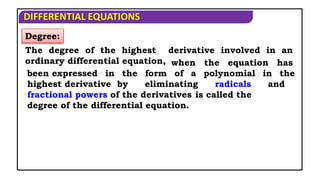
Degree:
The degree of the highest derivative involved in an
ordinary differential equation, when the equation has
been expressed in the form of a polynomial in the
highest derivative by eliminating radicals and
fractional powers of the derivatives is called the
degree of the differential equation.
DIFFERENTIAL EQUATIONS
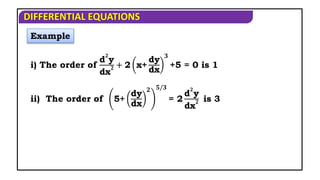
Example
i) The order of
d
𝟐
y
dx
𝟐 + 2 x+
dy
dx
𝟑
+5 = 0 is 1
ii) The order of 5+
dy
dx
𝟐 𝟓/𝟑
= 2
d
𝟐
y
dx
𝟐 is 3
DIFFERENTIAL EQUATIONS
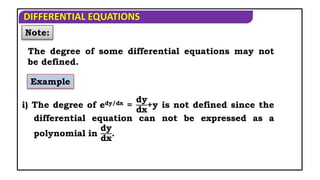
Note:
The degree of some differential equations may not
be defined.
Example
i) The degree of edy/dx =
dy
dx
+y is not defined since the
differential equation can not be expressed as a
polynomial in
dy
dx
.
DIFFERENTIAL EQUATIONS
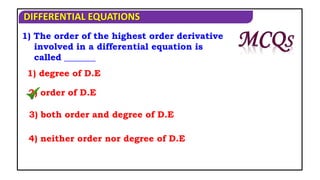
1) The order of the highest order derivative
involved in a differential equation is
called _______
1) degree of D.E
2) order of D.E
3) both order and degree of D.E
4) neither order nor degree of D.E
DIFFERENTIAL EQUATIONS
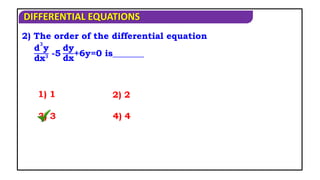
2) The order of the differential equation
d
𝟑
y
dx𝟑 -5
dy
dx
+6y=0 is_______
1) 1 2) 2
3) 3 4) 4
DIFFERENTIAL EQUATIONS
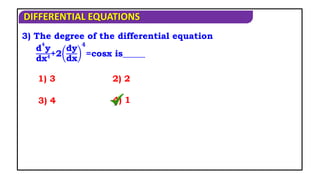
3) The degree of the differential equation
d
𝟒
y
dx𝟒+2
dy
dx
𝟒
=cosx is_____
1) 3 2) 2
3) 4 4) 1
DIFFERENTIAL EQUATIONS
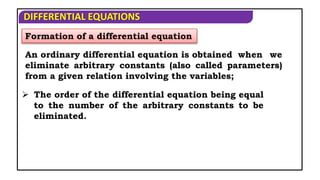
Formation of a differential equation
An ordinary differential equation is obtained when we
eliminate arbitrary constants (also called parameters)
from a given relation involving the variables;
 The order of the differential equation being equal
to the number of the arbitrary constants to be
eliminated.
DIFFERENTIAL EQUATIONS
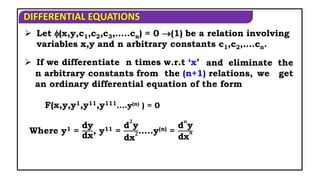
 Let (x,y,c1,c2,c3,…..cn) = 0 (1) be a relation involving
variables x,y and n arbitrary constants c1,c2,….cn.
 If we differentiate n times w.r.t ‘x’ and eliminate the
n arbitrary constants from the (n+1) relations, we get
an ordinary differential equation of the form
F(x,y,y1,y11,y111.…y(n) ) = 0
Where y1 =
dy
dx
, y11 =
d
𝟐
y
dx
𝟐…..y(n) =
d
𝒏
y
dx
𝒏
DIFFERENTIAL EQUATIONS
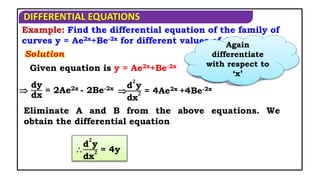
Example: Find the differential equation of the family of
curves y = Ae2x+Be-2x for different values of A and B.
Solution
Given equation is y = Ae2x+Be-2x

dy
dx
= 2Ae2x - 2Be-2x
Differentiate
with respect
to ‘x’
Again
differentiate
with respect to
‘x’

d
𝟐
y
dx
𝟐 = 4Ae2x +4Be-2x
Eliminate A and B from the above equations. We
obtain the differential equation

d
𝟐
y
dx
𝟐 = 4y
DIFFERENTIAL EQUATIONS
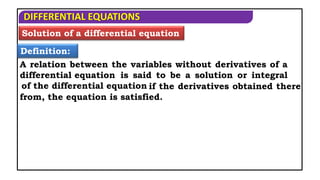
Solution of a differential equation
Definition:
A relation between the variables without derivatives of a
differential equation is said to be a solution or integral
of the differential equation if the derivatives obtained there
from, the equation is satisfied.
DIFFERENTIAL EQUATIONS
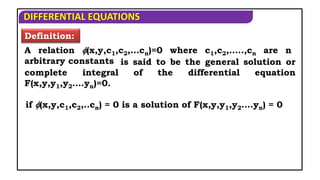
Definition:
A relation (x,y,c1,c2,…cn)=0 where c1,c2,…..,cn are n
arbitrary constants is said to be the general solution or
complete integral of the differential equation
F(x,y,y1,y2….yn)=0.
if (x,y,c1,c2,..cn) = 0 is a solution of F(x,y,y1,y2….yn) = 0
DIFFERENTIAL EQUATIONS
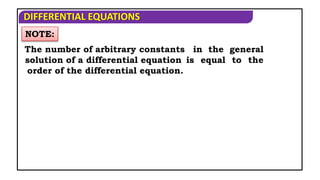
NOTE:
The number of arbitrary constants in the general
solution of a differential equation is equal to the
order of the differential equation.
DIFFERENTIAL EQUATIONS
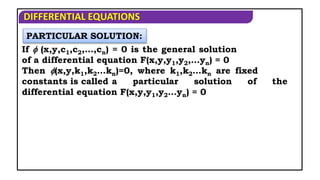
PARTICULAR SOLUTION:
If  (x,y,c1,c2,…,cn) = 0 is the general solution
of a differential equation F(x,y,y1,y2,…yn) = 0
Then (x,y,k1,k2…kn)=0, where k1,k2…kn are fixed
constants is called a particular solution of the
differential equation F(x,y,y1,y2…yn) = 0
DIFFERENTIAL EQUATIONS
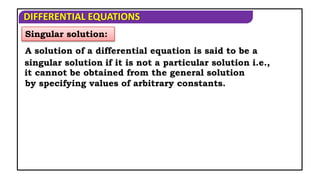
Singular solution:
A solution of a differential equation is said to be a
singular solution if it is not a particular solution i.e.,
it cannot be obtained from the general solution
by specifying values of arbitrary constants.

DIFFERENTIAL EQUATIONS
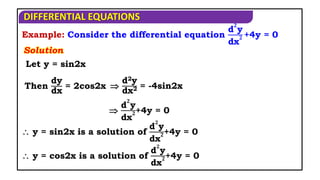
Example: Consider the differential equation
d
𝟐
y
dx
𝟐 +4y = 0
Solution
Let y = sin2x
Then
dy
dx
= 2cos2x

d
𝟐
y
dx
𝟐+4y = 0
 y = sin2x is a solution of
d
𝟐
y
dx
𝟐+4y = 0
 y = cos2x is a solution of
d
𝟐
y
dx
𝟐+4y = 0

d2y
dx2 = -4sin2x
DIFFERENTIAL EQUATIONS
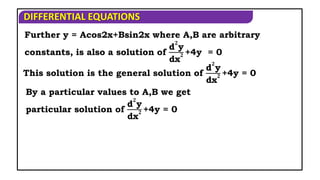
Further y = Acos2x+Bsin2x where A,B are arbitrary
constants, is also a solution of
d
𝟐
y
dx
𝟐 +4y = 0
This solution is the general solution of
d
𝟐
y
dx
𝟐 +4y = 0
By a particular values to A,B we get
particular solution of
d
𝟐
y
dx
𝟐 +4y = 0
DIFFERENTIAL EQUATIONS
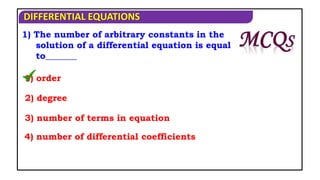
1) The number of arbitrary constants in the
solution of a differential equation is equal
to_______
1) order
2) degree
3) number of terms in equation
4) number of differential coefficients
DIFFERENTIAL EQUATIONS
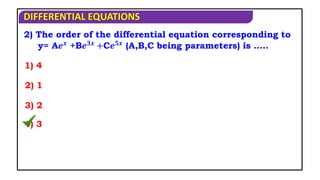
2) The order of the differential equation corresponding to
y= A𝒆𝒙
+B𝒆𝟑𝒙
+C𝒆𝟓𝒙
(A,B,C being parameters) is …..
1) 4
2) 1
3) 2
4) 3
DIFFERENTIAL EQUATIONS
Thank you…

Maths differential equation ppt

  • 1.
  • 2.
  • 3.
    DIFFERENTIAL EQUATIONS DIFFERENTIAL EQUATION Anequation involving one dependent variable, one or more independent variables and the differential coefficients (derivatives) of dependent variable with respect to independent variables is called a differential equation.
  • 4.
  • 5.
    DIFFERENTIAL EQUATIONS Types ofdifferential equations There are two types of differential equations i) Ordinary differential equations ii) Partial differential equations
  • 6.
    DIFFERENTIAL EQUATIONS ORDINARY DIFFERENTIALEQUATION A differential equation is said to be an ordinary differential equation if it contains only one independent variable and ordinary derivatives with respect to this independent variable. i) x dy dx + 3y = 0 ii) 4x d𝟐 y dx𝟐 + dy dx − 2y𝟐 = 0
  • 7.
    DIFFERENTIAL EQUATIONS PARTIAL DIFFERENTIALEQUATION A differential equation is said to be a partial differential equation if it contains at least two independent variables and partial derivatives with respect to either of these independent variables. Examples i) x ∂u ∂x + y ∂u ∂y = u ii) x𝟐 ∂𝟐u ∂x 𝟐 + xy ∂𝟐u ∂x∂y + y𝟐 ∂𝟐u ∂y 𝟐 = 3u
  • 8.
    DIFFERENTIAL EQUATIONS Order: The orderof the differential equation is the order of the highest order derivative involving in it. Examples i) The order of dy dx 𝟑/𝟐 = x𝟐 is 1 ii) The order of x2 d 𝟐 y dx 𝟐 + x+ dy dx 𝟑 +5 = 0 is 2
  • 9.
    DIFFERENTIAL EQUATIONS Degree: The degreeof the highest derivative involved in an ordinary differential equation, when the equation has been expressed in the form of a polynomial in the highest derivative by eliminating radicals and fractional powers of the derivatives is called the degree of the differential equation.
  • 10.
    DIFFERENTIAL EQUATIONS Example i) Theorder of d 𝟐 y dx 𝟐 + 2 x+ dy dx 𝟑 +5 = 0 is 1 ii) The order of 5+ dy dx 𝟐 𝟓/𝟑 = 2 d 𝟐 y dx 𝟐 is 3
  • 11.
    DIFFERENTIAL EQUATIONS Note: The degreeof some differential equations may not be defined. Example i) The degree of edy/dx = dy dx +y is not defined since the differential equation can not be expressed as a polynomial in dy dx .
  • 12.
    DIFFERENTIAL EQUATIONS 1) Theorder of the highest order derivative involved in a differential equation is called _______ 1) degree of D.E 2) order of D.E 3) both order and degree of D.E 4) neither order nor degree of D.E
  • 13.
    DIFFERENTIAL EQUATIONS 2) Theorder of the differential equation d 𝟑 y dx𝟑 -5 dy dx +6y=0 is_______ 1) 1 2) 2 3) 3 4) 4
  • 14.
    DIFFERENTIAL EQUATIONS 3) Thedegree of the differential equation d 𝟒 y dx𝟒+2 dy dx 𝟒 =cosx is_____ 1) 3 2) 2 3) 4 4) 1
  • 15.
  • 16.
    DIFFERENTIAL EQUATIONS Formation ofa differential equation An ordinary differential equation is obtained when we eliminate arbitrary constants (also called parameters) from a given relation involving the variables;  The order of the differential equation being equal to the number of the arbitrary constants to be eliminated.
  • 17.
    DIFFERENTIAL EQUATIONS  Let(x,y,c1,c2,c3,…..cn) = 0 (1) be a relation involving variables x,y and n arbitrary constants c1,c2,….cn.  If we differentiate n times w.r.t ‘x’ and eliminate the n arbitrary constants from the (n+1) relations, we get an ordinary differential equation of the form F(x,y,y1,y11,y111.…y(n) ) = 0 Where y1 = dy dx , y11 = d 𝟐 y dx 𝟐…..y(n) = d 𝒏 y dx 𝒏
  • 18.
    DIFFERENTIAL EQUATIONS Example: Findthe differential equation of the family of curves y = Ae2x+Be-2x for different values of A and B. Solution Given equation is y = Ae2x+Be-2x  dy dx = 2Ae2x - 2Be-2x Differentiate with respect to ‘x’ Again differentiate with respect to ‘x’  d 𝟐 y dx 𝟐 = 4Ae2x +4Be-2x Eliminate A and B from the above equations. We obtain the differential equation  d 𝟐 y dx 𝟐 = 4y
  • 19.
    DIFFERENTIAL EQUATIONS Solution ofa differential equation Definition: A relation between the variables without derivatives of a differential equation is said to be a solution or integral of the differential equation if the derivatives obtained there from, the equation is satisfied.
  • 20.
    DIFFERENTIAL EQUATIONS Definition: A relation(x,y,c1,c2,…cn)=0 where c1,c2,…..,cn are n arbitrary constants is said to be the general solution or complete integral of the differential equation F(x,y,y1,y2….yn)=0. if (x,y,c1,c2,..cn) = 0 is a solution of F(x,y,y1,y2….yn) = 0
  • 21.
    DIFFERENTIAL EQUATIONS NOTE: The numberof arbitrary constants in the general solution of a differential equation is equal to the order of the differential equation.
  • 22.
    DIFFERENTIAL EQUATIONS PARTICULAR SOLUTION: If (x,y,c1,c2,…,cn) = 0 is the general solution of a differential equation F(x,y,y1,y2,…yn) = 0 Then (x,y,k1,k2…kn)=0, where k1,k2…kn are fixed constants is called a particular solution of the differential equation F(x,y,y1,y2…yn) = 0
  • 23.
    DIFFERENTIAL EQUATIONS Singular solution: Asolution of a differential equation is said to be a singular solution if it is not a particular solution i.e., it cannot be obtained from the general solution by specifying values of arbitrary constants.
  • 24.
    DIFFERENTIAL EQUATIONS Example: Considerthe differential equation d 𝟐 y dx 𝟐 +4y = 0 Solution Let y = sin2x Then dy dx = 2cos2x  d 𝟐 y dx 𝟐+4y = 0  y = sin2x is a solution of d 𝟐 y dx 𝟐+4y = 0  y = cos2x is a solution of d 𝟐 y dx 𝟐+4y = 0  d2y dx2 = -4sin2x
  • 25.
    DIFFERENTIAL EQUATIONS Further y= Acos2x+Bsin2x where A,B are arbitrary constants, is also a solution of d 𝟐 y dx 𝟐 +4y = 0 This solution is the general solution of d 𝟐 y dx 𝟐 +4y = 0 By a particular values to A,B we get particular solution of d 𝟐 y dx 𝟐 +4y = 0
  • 26.
    DIFFERENTIAL EQUATIONS 1) Thenumber of arbitrary constants in the solution of a differential equation is equal to_______ 1) order 2) degree 3) number of terms in equation 4) number of differential coefficients
  • 27.
    DIFFERENTIAL EQUATIONS 2) Theorder of the differential equation corresponding to y= A𝒆𝒙 +B𝒆𝟑𝒙 +C𝒆𝟓𝒙 (A,B,C being parameters) is ….. 1) 4 2) 1 3) 2 4) 3
  • 28.