G.H. PATEL COLLEGE OF ENGG. AND
TECHNOLOGY
• SUB. NAME:- ORGANIC CHEMISTRY AND UNIT PROCESS
• SUB. CODE:- 2130501
• TOPIC NAME:- PETROLEUM REFINING,CRACKING AND
SYNTHETIC PETROL
• PREPARED BY:- VYOM PATODIYA(150110105033)
KRISHNA PESHIVADIYA(150110105034)
HARDIK PIPALIYA(150110105035)
BHAVIN POSHIYA(150110105036)
OVERVIEW:
• INTRODUCTION
• REFINING
• CRACKING
• TYPES OF CRACKING
• SYNTHETIC PETROL
• METHODS OF PRODUCING SYNTHETIC PETROL
•The primary uses of crude oil in the production of
fuel. A single barrel of crude oil can produces the
following components, which are listed by % of the
barrel they constitute:
42% Gasoline
22% Diesel
9% Jet Fuel
5% Fuel oil
4% Liquefied Petroleum gas
18% other products
Introduction:
REFINING:-
Petroleum refining refers to the process of
converting crude oil into useful products. Crude
oil is composed of hundreds of different
hydrocarbon molecules, which are separated
through the process of refining. The process is
divided into three basic steps:
•Separation
•Conversion
•Treatment
Distilation Column :-
CRACKING:-
•Cracking is the name given to breaking up large hydrocarbon
molecules into smaller and more useful bits. This is achieved by
using high pressure and temperature without a catalyst, or lower
temperature and pressure in the presence of a catalyst.
•The source of the large hydrocarbon molecules is often the
naphtha fraction or the gas oil fraction from the fraction
distillation of crude oil. These fractions are obtained from the
distillation process as liquids, but are re-vaporised before
cracking.
Cracking (cont…)
•There isn’t any single unique reaction happening in the
cracker. The hydrocarbon molecules are broken up in a
fairly random way to produce mixture of smaller
hydrocarbons, some of which have carbon-carbon double
bonds. One possible reaction involving the hydrocarbon
C15 H32 might be:
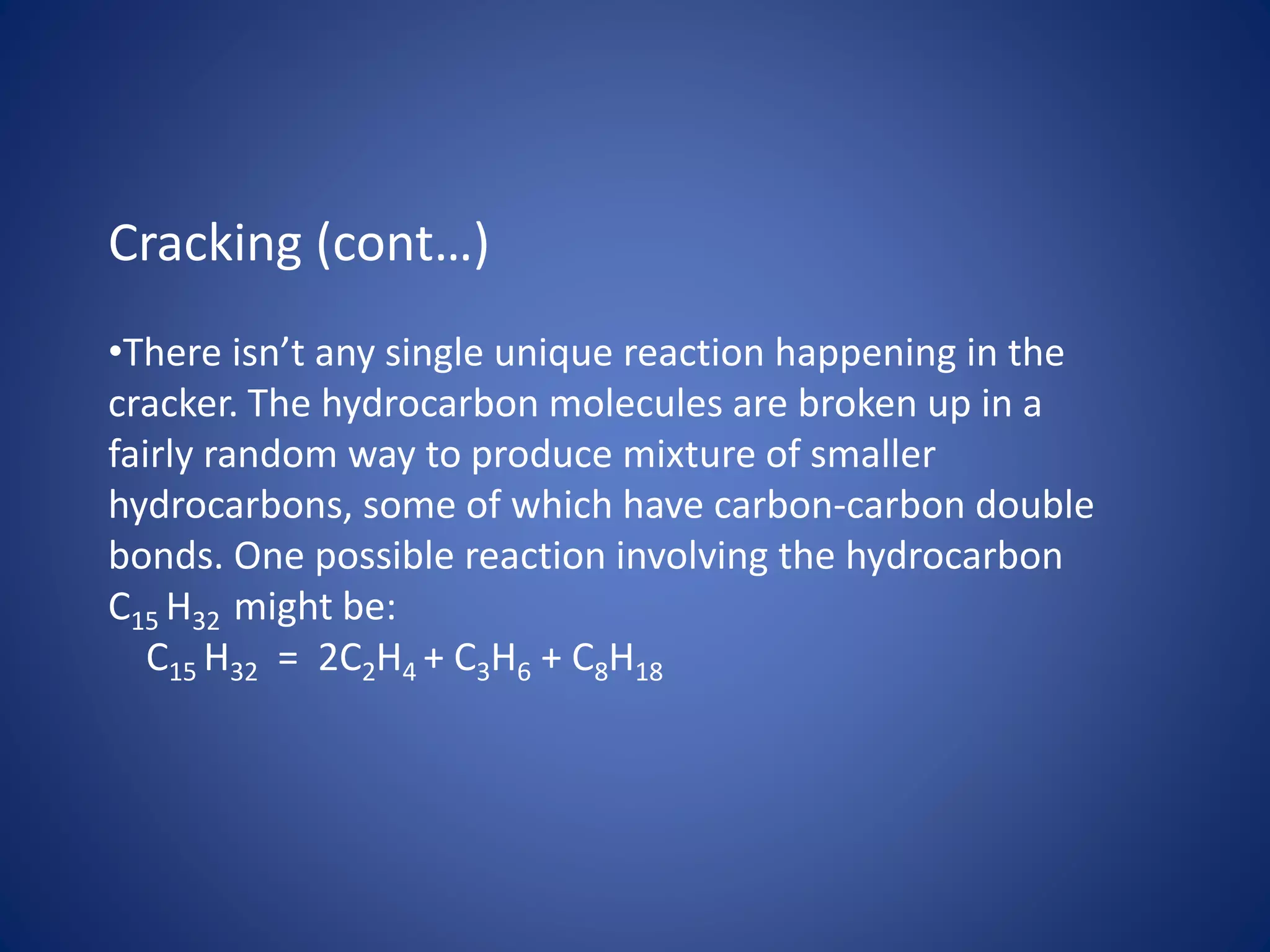
C15 H32 = 2C2H4 + C3H6 + C8H18
TYPE 0F CRACKING:-
1.)Catalytic Cracking
2.)Thermal Cracking
Catalytic Cracking:-
• Modern cracking uses Zeolites as the catalyst. These are
complex aluminosilicates, and are large lattices of
aluminium, silicon and oxygen atoms carrying a negative
charge. They are, of course, associated with positive ions
such as sodium ions. You may have come across a zeolite if
you know about ion exchange resins used in water
softeners.
•The alkane is brought into contact with the catalyst at a
temperature of about 500 C and moderately low pressures.
• The zeolites used in catalytic cracking are chosen to give high
percentages of hydrocarbons with between 5 and 10 carbon
atoms- particularly useful for petrol. It also produces high
proportions of branched alkanes and aromatic hydrocarbons like
benzene.
• The zeolite catalyst has sites which can remove a hydrogen from
an alkane together with the two electrons which bound it to the
carbon. That leaves the carbon atom with a positive charge. Ions
like this are called carbonium ions. Reorganisation of these leads to
various products of the reaction.
Thermal Cracking:-
•In thermal cracking high temperatures and pressures are
used to break the large hydrocarbons into smaller ones.
Thermal cracking gives mixtures of products containing high
proportions of hydrocarbons with double bonds- alkenes.
•Thermal cracking doesn’t go via ionic intermediates like
catalytic cracking. Instead, carbon-carbon bonds are broken
so that each carbon atom ends up with a single electron. In
other words, free radicals are formed.
SYNTHETIC PETROL:-
Introduction:-
•Synthetic fuel or Synfuel is a liquid fuel obtained from coal,
natural gas, oil shale, or biomass.
•It may also refer to fuels to fuels derived from other solids
such as plastic or rubber waste. It may also refer to gaseous
fuels produced in a similar way.
•Common use of the term synthetic fuel is to describe fuels
manufactured via Fischer Tropsch conversion, methanol to
gasoline conversion or direct coal liquefaction.
Method of producing Synthetic
Petrol:-
1. Polymerisation
2. Fischer- Tropsch method
3. Bergius process
Polymerisation:-
•In these method, smaller molecules of hydrocarbons
are combined to form heavier molecule resembling
gasoline. It is of two type:
1. Thermal Polymerisation
2. Catalytic Polymerisation
Thermal Polymerisation:-
•Thermal polymerisation is carried out at
temperature about 500-600 C and pressure about
70-350 kg/cm2
Catalytic Polymerisation:-
•It is carried out at a lower temperature of 150-
200 C, in a low pressure and in presence of
catalyst like phosphoric acid. The rate of reaction
is increased. The gasoline obtained is of improved
quality and posses high antiknock properties than
the gasoline obtained from thermal
polymerisation process.
Fischer- Tropsch Process:-
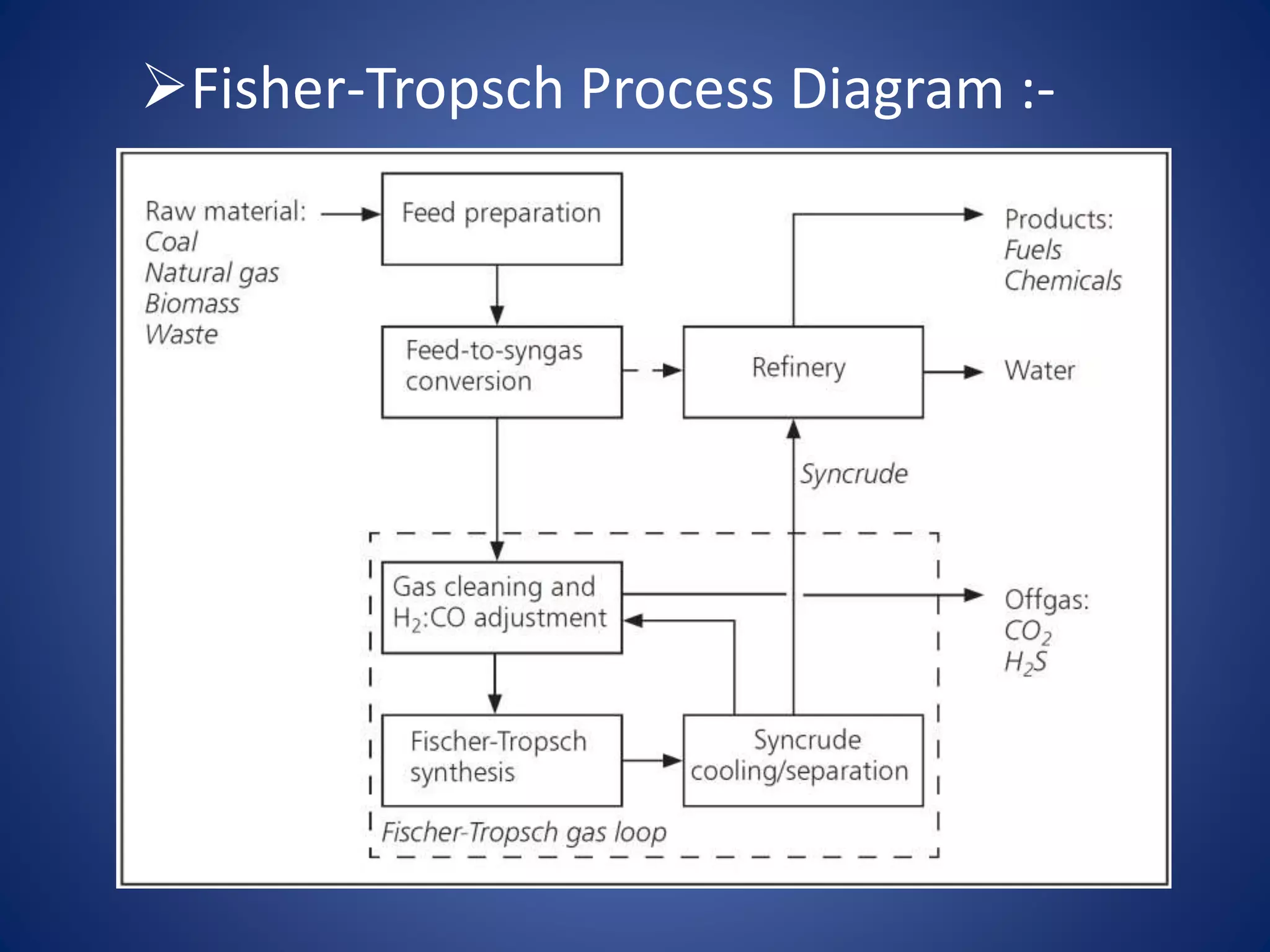
•The Fischer-Tropsch process is a collection of chemical reactions
that converts a mixture of carbon monoxide and hydrogen into
liquid hydrocarbons. The process, a key component of gas to
liquids technology, produces a synthetic lubrication oil and
synthetic fuel, typically from coal, natural gas or biomass. The F-T
process has received intermittent attention as a source of low
sulphur diesel fuel and to address the supply or cost of petroleum
derived hydrocarbon
• The water gas is varied with hydrogen and the combination is
purified by transitory from side to side Fe2O3 and then into a
mixture of Fe2O3+Na2CO3. The cleanse gas is dense to 5 to 25 atm
and then led from side to side a converter, which is preserve at a
temperature of 200-300 C.
The converter is provided with a catalyst bed consisting of a
mixture of 1000 parts cobalt, 5 parts thoria, 8 parts magnesia
and 200 parts keiselghur earth.
nCO + 2nH2 = CnH2n+ nH2O
nCO +(2n+1)H2 = CnH2n+2 + nH2O
The outcoming gaseous mixture is led to a condenser, where
the liquid crude oil is obtained, The crude oil is fractionated to
yield gasoline and heavy oil. The heavy oil is used for cracking
to get more gasoline.
Fisher-Tropsch Process Diagram :-
Bergius Process:-
•In these process, the finely powdered coal is competed keen on a
paste through heavy oil and a catalyst powder is mixed with it.
The paste is pumped along with hydrogen gas into the converter,
where the synthetic paste is heated to 400-450 C under a pressure
of 200-250 atm.
• During this process hydrogen combined with coal to form
saturated higher hydrocarbons, which experience additional
decay at superior temperature to acquiesce combination of lesser
hydrocarbons. The mix is led to a condenser, where the crude oil
is attained. The crude oil is then fractionated to yield:
Gasoline
Middle oil
Heavy oil
petroleum refining,crackin and synthetic petrol-ppt

petroleum refining,crackin and synthetic petrol-ppt

  • 1.
    G.H. PATEL COLLEGEOF ENGG. AND TECHNOLOGY • SUB. NAME:- ORGANIC CHEMISTRY AND UNIT PROCESS • SUB. CODE:- 2130501 • TOPIC NAME:- PETROLEUM REFINING,CRACKING AND SYNTHETIC PETROL • PREPARED BY:- VYOM PATODIYA(150110105033) KRISHNA PESHIVADIYA(150110105034) HARDIK PIPALIYA(150110105035) BHAVIN POSHIYA(150110105036)
  • 2.
    OVERVIEW: • INTRODUCTION • REFINING •CRACKING • TYPES OF CRACKING • SYNTHETIC PETROL • METHODS OF PRODUCING SYNTHETIC PETROL
  • 3.
    •The primary usesof crude oil in the production of fuel. A single barrel of crude oil can produces the following components, which are listed by % of the barrel they constitute: 42% Gasoline 22% Diesel 9% Jet Fuel 5% Fuel oil 4% Liquefied Petroleum gas 18% other products Introduction:
  • 4.
    REFINING:- Petroleum refining refersto the process of converting crude oil into useful products. Crude oil is composed of hundreds of different hydrocarbon molecules, which are separated through the process of refining. The process is divided into three basic steps: •Separation •Conversion •Treatment
  • 5.
  • 6.
    CRACKING:- •Cracking is thename given to breaking up large hydrocarbon molecules into smaller and more useful bits. This is achieved by using high pressure and temperature without a catalyst, or lower temperature and pressure in the presence of a catalyst. •The source of the large hydrocarbon molecules is often the naphtha fraction or the gas oil fraction from the fraction distillation of crude oil. These fractions are obtained from the distillation process as liquids, but are re-vaporised before cracking.
  • 7.
    Cracking (cont…) •There isn’tany single unique reaction happening in the cracker. The hydrocarbon molecules are broken up in a fairly random way to produce mixture of smaller hydrocarbons, some of which have carbon-carbon double bonds. One possible reaction involving the hydrocarbon C15 H32 might be: C15 H32 = 2C2H4 + C3H6 + C8H18
  • 8.
    TYPE 0F CRACKING:- 1.)CatalyticCracking 2.)Thermal Cracking
  • 9.
    Catalytic Cracking:- • Moderncracking uses Zeolites as the catalyst. These are complex aluminosilicates, and are large lattices of aluminium, silicon and oxygen atoms carrying a negative charge. They are, of course, associated with positive ions such as sodium ions. You may have come across a zeolite if you know about ion exchange resins used in water softeners. •The alkane is brought into contact with the catalyst at a temperature of about 500 C and moderately low pressures.
  • 10.
    • The zeolitesused in catalytic cracking are chosen to give high percentages of hydrocarbons with between 5 and 10 carbon atoms- particularly useful for petrol. It also produces high proportions of branched alkanes and aromatic hydrocarbons like benzene. • The zeolite catalyst has sites which can remove a hydrogen from an alkane together with the two electrons which bound it to the carbon. That leaves the carbon atom with a positive charge. Ions like this are called carbonium ions. Reorganisation of these leads to various products of the reaction.
  • 11.
    Thermal Cracking:- •In thermalcracking high temperatures and pressures are used to break the large hydrocarbons into smaller ones. Thermal cracking gives mixtures of products containing high proportions of hydrocarbons with double bonds- alkenes. •Thermal cracking doesn’t go via ionic intermediates like catalytic cracking. Instead, carbon-carbon bonds are broken so that each carbon atom ends up with a single electron. In other words, free radicals are formed.
  • 12.
    SYNTHETIC PETROL:- Introduction:- •Synthetic fuelor Synfuel is a liquid fuel obtained from coal, natural gas, oil shale, or biomass. •It may also refer to fuels to fuels derived from other solids such as plastic or rubber waste. It may also refer to gaseous fuels produced in a similar way. •Common use of the term synthetic fuel is to describe fuels manufactured via Fischer Tropsch conversion, methanol to gasoline conversion or direct coal liquefaction.
  • 13.
    Method of producingSynthetic Petrol:- 1. Polymerisation 2. Fischer- Tropsch method 3. Bergius process
  • 14.
    Polymerisation:- •In these method,smaller molecules of hydrocarbons are combined to form heavier molecule resembling gasoline. It is of two type: 1. Thermal Polymerisation 2. Catalytic Polymerisation
  • 15.
    Thermal Polymerisation:- •Thermal polymerisationis carried out at temperature about 500-600 C and pressure about 70-350 kg/cm2
  • 16.
    Catalytic Polymerisation:- •It iscarried out at a lower temperature of 150- 200 C, in a low pressure and in presence of catalyst like phosphoric acid. The rate of reaction is increased. The gasoline obtained is of improved quality and posses high antiknock properties than the gasoline obtained from thermal polymerisation process.
  • 17.
    Fischer- Tropsch Process:- •TheFischer-Tropsch process is a collection of chemical reactions that converts a mixture of carbon monoxide and hydrogen into liquid hydrocarbons. The process, a key component of gas to liquids technology, produces a synthetic lubrication oil and synthetic fuel, typically from coal, natural gas or biomass. The F-T process has received intermittent attention as a source of low sulphur diesel fuel and to address the supply or cost of petroleum derived hydrocarbon • The water gas is varied with hydrogen and the combination is purified by transitory from side to side Fe2O3 and then into a mixture of Fe2O3+Na2CO3. The cleanse gas is dense to 5 to 25 atm and then led from side to side a converter, which is preserve at a temperature of 200-300 C.
  • 18.
    The converter isprovided with a catalyst bed consisting of a mixture of 1000 parts cobalt, 5 parts thoria, 8 parts magnesia and 200 parts keiselghur earth. nCO + 2nH2 = CnH2n+ nH2O nCO +(2n+1)H2 = CnH2n+2 + nH2O The outcoming gaseous mixture is led to a condenser, where the liquid crude oil is obtained, The crude oil is fractionated to yield gasoline and heavy oil. The heavy oil is used for cracking to get more gasoline.
  • 19.
  • 20.
    Bergius Process:- •In theseprocess, the finely powdered coal is competed keen on a paste through heavy oil and a catalyst powder is mixed with it. The paste is pumped along with hydrogen gas into the converter, where the synthetic paste is heated to 400-450 C under a pressure of 200-250 atm. • During this process hydrogen combined with coal to form saturated higher hydrocarbons, which experience additional decay at superior temperature to acquiesce combination of lesser hydrocarbons. The mix is led to a condenser, where the crude oil is attained. The crude oil is then fractionated to yield: Gasoline Middle oil Heavy oil