EVOLUTION AND ADAPTATION
Factors Affecting Genetic Variation
Factors which increase variation
1: Mutations
• Permanent change to the nucleotide sequence,
genes or chromosomes of an organism
• May be positive, negative or neutral
• Main source of new alleles in a population
• May occur randomly or result from exposure to an
environmental stimuli (mutagen)
Factors which increase variation
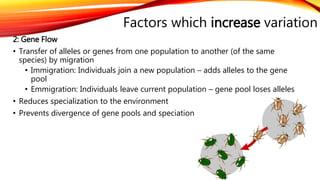
2: Gene Flow
• Transfer of alleles or genes from one population to another (of the same
species) by migration
• Immigration: Individuals join a new population – adds alleles to the gene
pool
• Emmigration: Individuals leave current population – gene pool loses alleles
• Reduces specialization to the environment
• Prevents divergence of gene pools and speciation
Factors which increase variation
3: Recombination
• Crossing Over: During meiosis sections of
homologous chromosomes align and swap
segments of genes
• Meiosis results in the production of gametes that
are genetically different from each other and the
parent
Factors which decrease variation
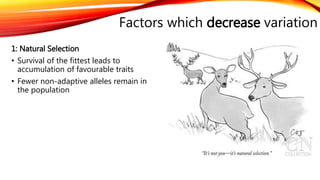
1: Natural Selection
• Survival of the fittest leads to
accumulation of favourable traits
• Fewer non-adaptive alleles remain in
the population
Factors which decrease variation
2: Genetic Drift
• Random change in the variation or allele frequency
of a population
• Most common in small populations
A) Bottleneck Effect
• Event drastically reduces population size
• Survivors are not necessarily “fittest” but live by
chance and pass on genes
• Bottleneck event: natural disaster, disease,
habitat destruction etc.
Factors which decrease variation
2: Genetic Drift cont’d
B) Founder Effect
• Few individuals leave original population and begin a new
population
• New population contains only alleles carried in by founders
Factors which decrease variation
3: Non-Random Mating
• Some individuals are more likely find a successful mating partner, therefore
more of their alleles will be present in subsequent generations
• Proximity – Easier to mate with nearby organisms
• Competition – “Fitter” organisms are more likely to out compete other
possible mating partners and pass on their traits
EVOLUTION AND ADAPTATION
Evolutionary Pathways
Evolutionary Pathways:
Convergent Evolution
• Occurs when unrelated organisms evolve similar traits in response to
similar selective pressures
• Produces analogous structures – structures with same function from
different evolutionary origins
Evolutionary Pathways:
Convergent Evolution
Example:
Dolphin (mammal) Shark (fish) Ichthyosaurus (reptile)
What were the selective pressures acting on each of these organisms that led to the evolution o
such similar body plans?
Evolutionary Pathways:
Convergent Evolution
Example:
Hawk (bird) Bat(mammal) Bee (insect)
What were the selective pressures acting on each of these organisms that led to the evolution o
such similar body plans?
Evolutionary Pathways:
Divergent Evolution
• Occurs when closely related organisms evolve
very different traits in response to diverse
selective pressures
• May be the result of disruptive selection
• Leads to speciation
• Produces homologous structures – structures
with different functions arising from a common
ancestor
Evolutionary Pathways:
Vestigial Structures
• Remnants of a structure that had a function in an ancestor
but no longer does in the evolved organism.
Examples:
• Appendix – used to be for digestion
• Tail bone
• Snake hips – pelvis bone but no legs
• Chickens have gene for teeth but no teeth

Factors affecting variation and evolutionary pathways

  • 1.
    EVOLUTION AND ADAPTATION FactorsAffecting Genetic Variation
  • 2.
    Factors which increasevariation 1: Mutations • Permanent change to the nucleotide sequence, genes or chromosomes of an organism • May be positive, negative or neutral • Main source of new alleles in a population • May occur randomly or result from exposure to an environmental stimuli (mutagen)
  • 3.
    Factors which increasevariation 2: Gene Flow • Transfer of alleles or genes from one population to another (of the same species) by migration • Immigration: Individuals join a new population – adds alleles to the gene pool • Emmigration: Individuals leave current population – gene pool loses alleles • Reduces specialization to the environment • Prevents divergence of gene pools and speciation
  • 5.
    Factors which increasevariation 3: Recombination • Crossing Over: During meiosis sections of homologous chromosomes align and swap segments of genes • Meiosis results in the production of gametes that are genetically different from each other and the parent
  • 6.
    Factors which decreasevariation 1: Natural Selection • Survival of the fittest leads to accumulation of favourable traits • Fewer non-adaptive alleles remain in the population
  • 7.
    Factors which decreasevariation 2: Genetic Drift • Random change in the variation or allele frequency of a population • Most common in small populations A) Bottleneck Effect • Event drastically reduces population size • Survivors are not necessarily “fittest” but live by chance and pass on genes • Bottleneck event: natural disaster, disease, habitat destruction etc.
  • 8.
    Factors which decreasevariation 2: Genetic Drift cont’d B) Founder Effect • Few individuals leave original population and begin a new population • New population contains only alleles carried in by founders
  • 9.
    Factors which decreasevariation 3: Non-Random Mating • Some individuals are more likely find a successful mating partner, therefore more of their alleles will be present in subsequent generations • Proximity – Easier to mate with nearby organisms • Competition – “Fitter” organisms are more likely to out compete other possible mating partners and pass on their traits
  • 11.
  • 12.
    Evolutionary Pathways: Convergent Evolution •Occurs when unrelated organisms evolve similar traits in response to similar selective pressures • Produces analogous structures – structures with same function from different evolutionary origins
  • 13.
    Evolutionary Pathways: Convergent Evolution Example: Dolphin(mammal) Shark (fish) Ichthyosaurus (reptile) What were the selective pressures acting on each of these organisms that led to the evolution o such similar body plans?
  • 14.
    Evolutionary Pathways: Convergent Evolution Example: Hawk(bird) Bat(mammal) Bee (insect) What were the selective pressures acting on each of these organisms that led to the evolution o such similar body plans?
  • 15.
    Evolutionary Pathways: Divergent Evolution •Occurs when closely related organisms evolve very different traits in response to diverse selective pressures • May be the result of disruptive selection • Leads to speciation • Produces homologous structures – structures with different functions arising from a common ancestor
  • 16.
    Evolutionary Pathways: Vestigial Structures •Remnants of a structure that had a function in an ancestor but no longer does in the evolved organism. Examples: • Appendix – used to be for digestion • Tail bone • Snake hips – pelvis bone but no legs • Chickens have gene for teeth but no teeth