CHARACTERISTICS OF LIFE
All living things change to fit
their environment
ADAPTATIONS!!!!!!!!
Inherited Characteristics
Why do tigers have stripes?
Why are bullfrogs green on the back and white
on the belly?
Why do giraffes have such a long neck?
Why do geese fly south for the winter?
Why do waterlilies float?
Why do some plants bear fruit?
All of these questions deal with
adaptations!!!
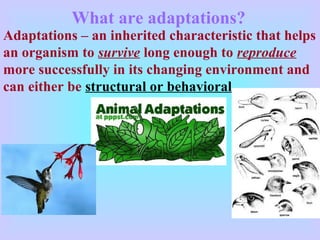
What are adaptations?
Adaptations – an inherited characteristic that helps
an organism to survive long enough to reproduce
more successfully in its changing environment and
can either be structural or behavioral.
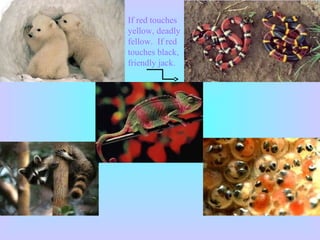
If red touches
yellow, deadly
fellow. If red
touches black,
friendly jack.
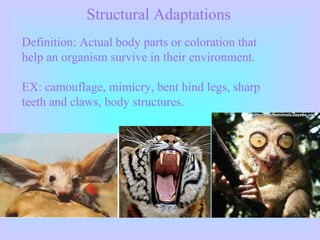
Structural Adaptations
Definition: Actual body parts or coloration that
help an organism survive in their environment.
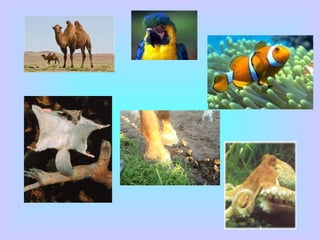
EX: camouflage, mimicry, bent hind legs, sharp
teeth and claws, body structures.
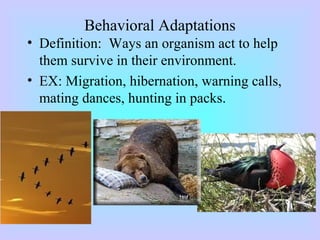
Behavioral Adaptations
• Definition: Ways an organism act to help
them survive in their environment.
• EX: Migration, hibernation, warning calls,
mating dances, hunting in packs.
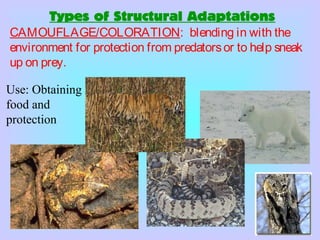
Types of Structural Adaptations
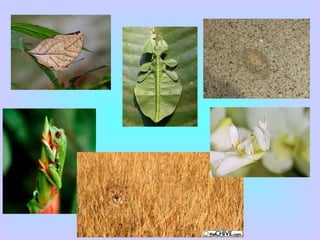
CAMOUFLAGE/COLORATION: blending in with the
environment for protection from predatorsor to help sneak
up on prey.
Use: Obtaining
food and
protection
Types of Structural Adaptations
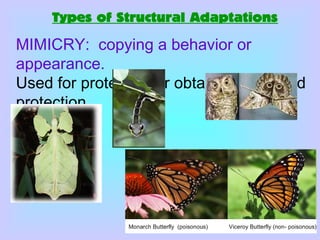
MIMICRY: copying a behavior or
appearance.
Used for protection or obtaining food and
protection.
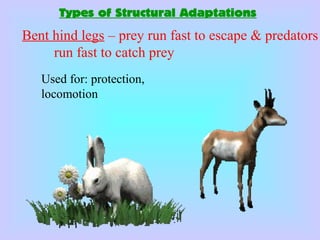
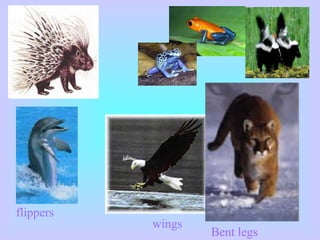
Bent hind legs – prey run fast to escape & predators
run fast to catch prey
Types of Structural Adaptations
Used for: protection,
locomotion
Types of Structural Adaptations
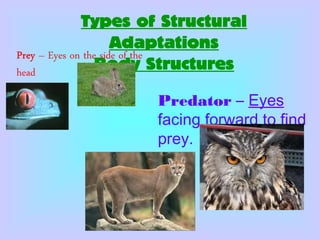
Types of Structural
Adaptations
Body Structures
Predator – Eyes
facing forward to find
prey.
flippers
wings
Bent legs
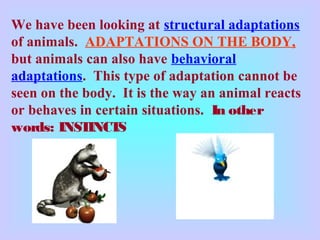
We have been looking at structural adaptations
of animals. ADAPTATIONS ON THE BODY,
but animals can also have behavioral
adaptations. This type of adaptation cannot be
seen on the body. It is the way an animal reacts
or behaves in certain situations. In other
words: INSTINCTS
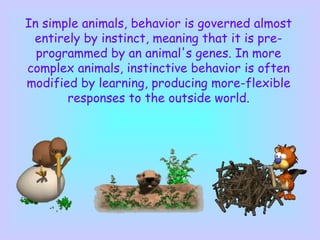
In simple animals, behavior is governed almost
entirely by instinct, meaning that it is pre-
programmed by an animal's genes. In more
complex animals, instinctive behavior is often
modified by learning, producing more-flexible
responses to the outside world.
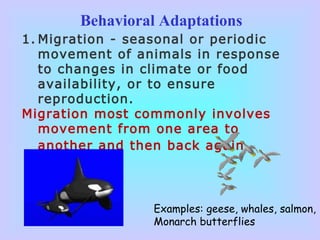
Behavioral Adaptations
1. Migration - seasonal or periodic
movement of animals in response
to changes in climate or food
availability, or to ensure
reproduction.
Migration most commonly involves
movement from one area to
another and then back again.
Examples: geese, whales, salmon,
Monarch butterflies
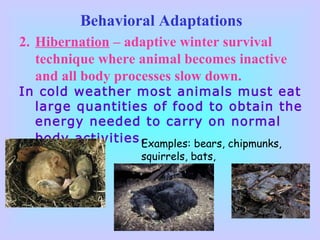
Behavioral Adaptations
2. Hibernation – adaptive winter survival
technique where animal becomes inactive
and all body processes slow down.
In cold weather most animals must eat
large quantities of food to obtain the
energy needed to carry on normal
body activities.Examples: bears, chipmunks,
squirrels, bats,
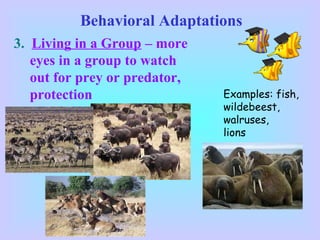
Behavioral Adaptations
3. Living in a Group – more
eyes in a group to watch
out for prey or predator,
protection Examples: fish,
wildebeest,
walruses,
lions
Behavioral Adaptations
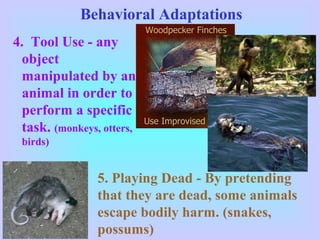
4. Tool Use - any
object
manipulated by an
animal in order to
perform a specific
task. (monkeys, otters,
birds)
5. Playing Dead - By pretending
that they are dead, some animals
escape bodily harm. (snakes,
possums)
Behavioral Adaptations
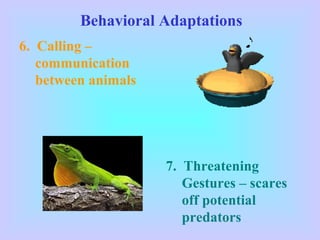
6. Calling –
communication
between animals
7. Threatening
Gestures – scares
off potential
predators
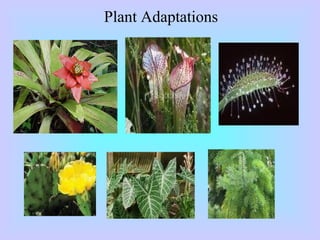
PLANT ADAPTATIONS
All living things adapt is a characteristic of life.
All 6 kingdoms adapt. Animals are not the only
organisms to adapt.
Structural Plant Adaptations
1. Structures - adaptations on the body:
2. Seeds – all seeds have adaptation to
better enable it to survive long enough
to plant itself and grow.
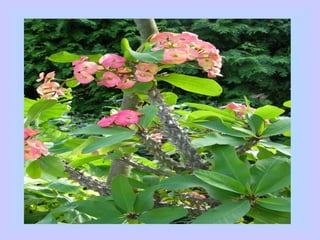
holdfasts, empty space for water storage, catch
animals for minerals, tallness, heartiness, thorns,
flexibility, floatation devices
Plant Adaptations
Protection – thorns, bad taste, poison,
coloration, spikes
Obtaining Food – All plants do
photosynthesis and make glucose in their
leaves. The larger the leaves the more
Sun they can capture.
Plant Adaptations
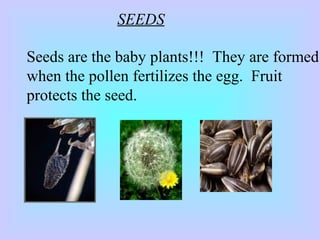
SEEDS
Seeds are the baby plants!!! They are formed
when the pollen fertilizes the egg. Fruit
protects the seed.
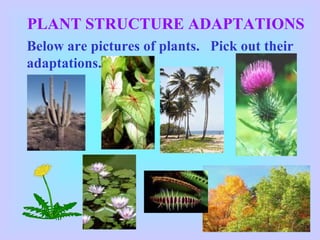
PLANT STRUCTURE ADAPTATIONS
Below are pictures of plants. Pick out their
adaptations.
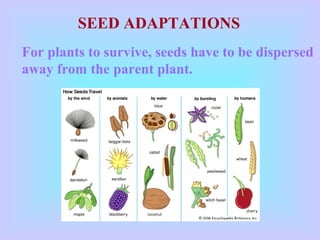
SEED ADAPTATIONS
For plants to survive, seeds have to be dispersed
away from the parent plant.
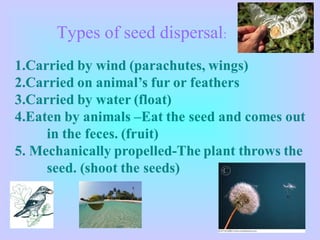
Types of seed dispersal:
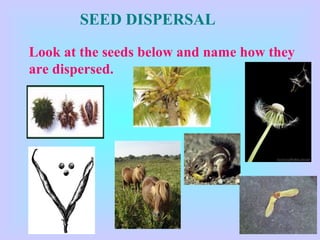
SEED DISPERSAL
Look at the seeds below and name how they
are dispersed.
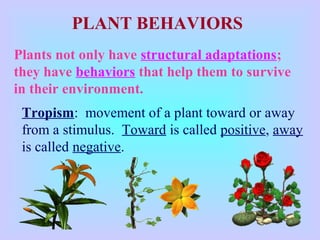
PLANT BEHAVIORS
Plants not only have structural adaptations;
they have behaviors that help them to survive
in their environment.
Tropism: movement of a plant toward or away
from a stimulus. Toward is called positive, away
is called negative.
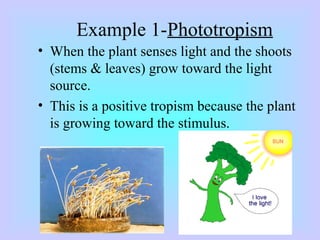
Example 1-Phototropism
• When the plant senses light and the shoots
(stems & leaves) grow toward the light
source.
• This is a positive tropism because the plant
is growing toward the stimulus.
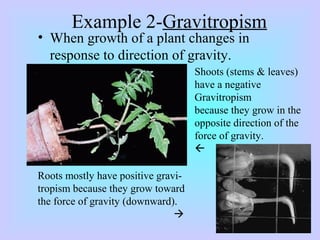
Example 2-Gravitropism
• When growth of a plant changes in
response to direction of gravity.
Shoots (stems & leaves)
have a negative
Gravitropism
because they grow in the
opposite direction of the
force of gravity.

Roots mostly have positive gravi-
tropism because they grow toward
the force of gravity (downward).

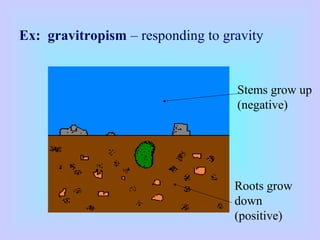
Ex: gravitropism – responding to gravity
Stems grow up
(negative)
Roots grow
down
(positive)
PLANT BEHAVIORAL ADAPTATIONS
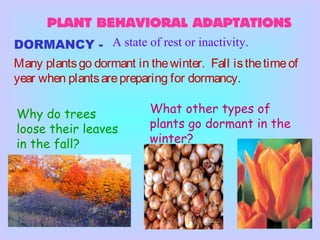
DORMANCY - A state of rest or inactivity.
Many plantsgo dormant in thewinter. Fall isthetimeof
year when plantsarepreparing for dormancy.
Why do trees
loose their leaves
in the fall?
What other types of
plants go dormant in the
winter?
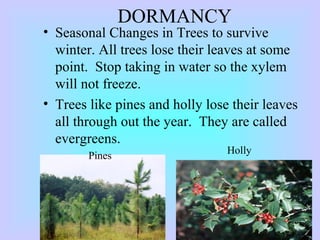
DORMANCY
• Seasonal Changes in Trees to survive
winter. All trees lose their leaves at some
point. Stop taking in water so the xylem
will not freeze.
• Trees like pines and holly lose their leaves
all through out the year. They are called
evergreens.
Pines
Holly
Adaptations ppt
Adaptations ppt
Adaptations ppt

Adaptations ppt

  • 1.
    CHARACTERISTICS OF LIFE Allliving things change to fit their environment ADAPTATIONS!!!!!!!!
  • 2.
    Inherited Characteristics Why dotigers have stripes? Why are bullfrogs green on the back and white on the belly? Why do giraffes have such a long neck? Why do geese fly south for the winter? Why do waterlilies float? Why do some plants bear fruit? All of these questions deal with adaptations!!!
  • 3.
    What are adaptations? Adaptations– an inherited characteristic that helps an organism to survive long enough to reproduce more successfully in its changing environment and can either be structural or behavioral.
  • 4.
    If red touches yellow,deadly fellow. If red touches black, friendly jack.
  • 5.
    Structural Adaptations Definition: Actualbody parts or coloration that help an organism survive in their environment. EX: camouflage, mimicry, bent hind legs, sharp teeth and claws, body structures.
  • 6.
    Behavioral Adaptations • Definition:Ways an organism act to help them survive in their environment. • EX: Migration, hibernation, warning calls, mating dances, hunting in packs.
  • 7.
    Types of StructuralAdaptations CAMOUFLAGE/COLORATION: blending in with the environment for protection from predatorsor to help sneak up on prey. Use: Obtaining food and protection
  • 9.
    Types of StructuralAdaptations MIMICRY: copying a behavior or appearance. Used for protection or obtaining food and protection.
  • 10.
    Bent hind legs– prey run fast to escape & predators run fast to catch prey Types of Structural Adaptations Used for: protection, locomotion
  • 11.
  • 12.
    Types of Structural Adaptations BodyStructures Predator – Eyes facing forward to find prey.
  • 13.
  • 15.
    We have beenlooking at structural adaptations of animals. ADAPTATIONS ON THE BODY, but animals can also have behavioral adaptations. This type of adaptation cannot be seen on the body. It is the way an animal reacts or behaves in certain situations. In other words: INSTINCTS
  • 16.
    In simple animals,behavior is governed almost entirely by instinct, meaning that it is pre- programmed by an animal's genes. In more complex animals, instinctive behavior is often modified by learning, producing more-flexible responses to the outside world.
  • 17.
    Behavioral Adaptations 1. Migration- seasonal or periodic movement of animals in response to changes in climate or food availability, or to ensure reproduction. Migration most commonly involves movement from one area to another and then back again. Examples: geese, whales, salmon, Monarch butterflies
  • 18.
    Behavioral Adaptations 2. Hibernation– adaptive winter survival technique where animal becomes inactive and all body processes slow down. In cold weather most animals must eat large quantities of food to obtain the energy needed to carry on normal body activities.Examples: bears, chipmunks, squirrels, bats,
  • 19.
    Behavioral Adaptations 3. Livingin a Group – more eyes in a group to watch out for prey or predator, protection Examples: fish, wildebeest, walruses, lions
  • 20.
    Behavioral Adaptations 4. ToolUse - any object manipulated by an animal in order to perform a specific task. (monkeys, otters, birds) 5. Playing Dead - By pretending that they are dead, some animals escape bodily harm. (snakes, possums)
  • 21.
    Behavioral Adaptations 6. Calling– communication between animals 7. Threatening Gestures – scares off potential predators
  • 22.
    PLANT ADAPTATIONS All livingthings adapt is a characteristic of life. All 6 kingdoms adapt. Animals are not the only organisms to adapt. Structural Plant Adaptations 1. Structures - adaptations on the body: 2. Seeds – all seeds have adaptation to better enable it to survive long enough to plant itself and grow. holdfasts, empty space for water storage, catch animals for minerals, tallness, heartiness, thorns, flexibility, floatation devices
  • 23.
    Plant Adaptations Protection –thorns, bad taste, poison, coloration, spikes Obtaining Food – All plants do photosynthesis and make glucose in their leaves. The larger the leaves the more Sun they can capture.
  • 24.
  • 26.
    SEEDS Seeds are thebaby plants!!! They are formed when the pollen fertilizes the egg. Fruit protects the seed.
  • 27.
    PLANT STRUCTURE ADAPTATIONS Beloware pictures of plants. Pick out their adaptations.
  • 28.
    SEED ADAPTATIONS For plantsto survive, seeds have to be dispersed away from the parent plant.
  • 29.
    Types of seeddispersal:
  • 30.
    SEED DISPERSAL Look atthe seeds below and name how they are dispersed.
  • 31.
    PLANT BEHAVIORS Plants notonly have structural adaptations; they have behaviors that help them to survive in their environment. Tropism: movement of a plant toward or away from a stimulus. Toward is called positive, away is called negative.
  • 32.
    Example 1-Phototropism • Whenthe plant senses light and the shoots (stems & leaves) grow toward the light source. • This is a positive tropism because the plant is growing toward the stimulus.
  • 33.
    Example 2-Gravitropism • Whengrowth of a plant changes in response to direction of gravity. Shoots (stems & leaves) have a negative Gravitropism because they grow in the opposite direction of the force of gravity.  Roots mostly have positive gravi- tropism because they grow toward the force of gravity (downward). 
  • 34.
    Ex: gravitropism –responding to gravity Stems grow up (negative) Roots grow down (positive)
  • 35.
    PLANT BEHAVIORAL ADAPTATIONS DORMANCY- A state of rest or inactivity. Many plantsgo dormant in thewinter. Fall isthetimeof year when plantsarepreparing for dormancy. Why do trees loose their leaves in the fall? What other types of plants go dormant in the winter?
  • 36.
    DORMANCY • Seasonal Changesin Trees to survive winter. All trees lose their leaves at some point. Stop taking in water so the xylem will not freeze. • Trees like pines and holly lose their leaves all through out the year. They are called evergreens. Pines Holly