Animal and Plant Adaptations  Unit 2: Genetics and Adaptation  SQA HIGHER BIOLOGY
Maintaining a Water Balance Plants The transpiration stream. Stomatal mechanism. Adaptations in xerophytes and hydrophytes. Animals Osmoregulation in freshwater fish and saltwater bony fish. Adaptations associated with salmon and eel migration. Water conservation in a desert mammal.
Water Balance in Plants Why do plants need to maintain a water balance? Why do plants need water? What is transpiration? How does water enter the root? What is root pressure? What is capillarity? Where does water exit the plant? Explain the cohesion-tension theory.
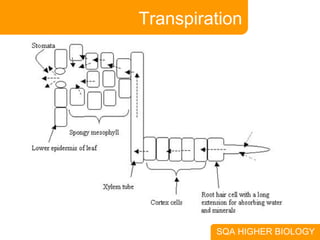
Transpiration
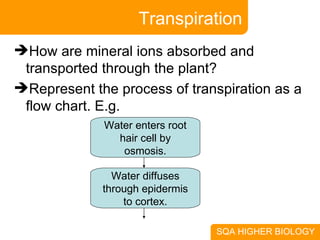
Transpiration How are mineral ions absorbed and transported through the plant? Represent the process of transpiration as a flow chart. E.g. Water enters root hair cell by osmosis. Water diffuses through epidermis to cortex.
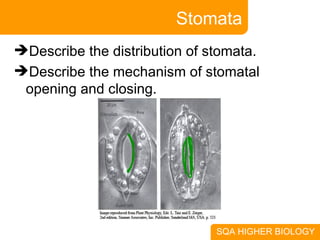
Stomata Describe the distribution of stomata. Describe the mechanism of stomatal opening and closing.
Investigating Stomata Investigating opening and closing of stomata using  Commelina communis Describe the method. What factors would need to be kept the same? Why is an average calculated? How accurate do you think this experiment is? Describe the expected results. What do these results tell you regarding the mechanism of stomatal opening and closing?
Disadvantage Outline the disadvantages of transpiration to plants.
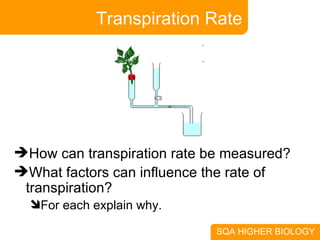
Transpiration Rate How can transpiration rate be measured? What factors can influence the rate of transpiration? For each explain why.
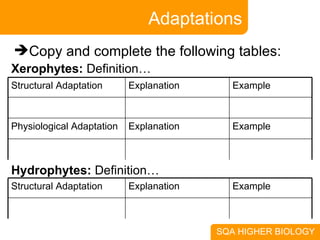
Adaptations Copy and complete the following tables: Xerophytes:  Definition… Hydrophytes:  Definition… Example Explanation Physiological Adaptation Example Explanation Structural Adaptation Example Explanation Structural Adaptation
Water Balance in Animals Define the term adaptation. How do adaptations come about? Outline the three types of adaptation. Structural Physiological Behavioural
Aquatic Animals What problems to aquatic animals face? What is osmoregulation? What particular problems to freshwater fish face? What particular problems to saltwater fish face?
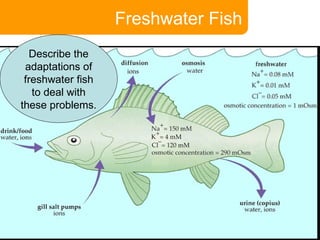
Freshwater Fish Describe the adaptations of freshwater fish to deal with these problems.
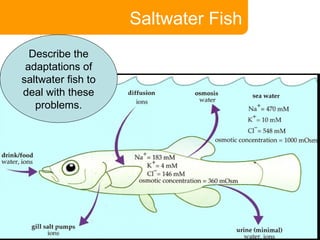
Saltwater Fish Describe the adaptations of saltwater fish to deal with these problems.
Aquatic Animals Why are the osmoregulation mechanisms of the Atlantic Salmon & Eel special? Summarise the life cycle of an Atlantic salmon as a flowchart. How do migratory fish alter their osmoregulation to suit the environment? What advantage does this adaptation convey to the organism?
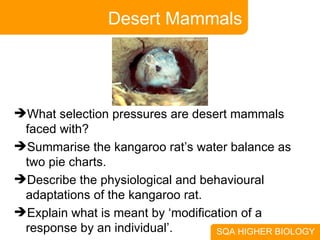
Desert Mammals What selection pressures are desert mammals faced with? Summarise the kangaroo rat’s water balance as two pie charts. Describe the physiological and behavioural adaptations of the kangaroo rat. Explain what is meant by ‘modification of a response by an individual’.

4. Adaptations

  • 1.
    Animal and PlantAdaptations Unit 2: Genetics and Adaptation SQA HIGHER BIOLOGY
  • 2.
    Maintaining a WaterBalance Plants The transpiration stream. Stomatal mechanism. Adaptations in xerophytes and hydrophytes. Animals Osmoregulation in freshwater fish and saltwater bony fish. Adaptations associated with salmon and eel migration. Water conservation in a desert mammal.
  • 3.
    Water Balance inPlants Why do plants need to maintain a water balance? Why do plants need water? What is transpiration? How does water enter the root? What is root pressure? What is capillarity? Where does water exit the plant? Explain the cohesion-tension theory.
  • 4.
  • 5.
    Transpiration How aremineral ions absorbed and transported through the plant? Represent the process of transpiration as a flow chart. E.g. Water enters root hair cell by osmosis. Water diffuses through epidermis to cortex.
  • 6.
    Stomata Describe thedistribution of stomata. Describe the mechanism of stomatal opening and closing.
  • 7.
    Investigating Stomata Investigatingopening and closing of stomata using Commelina communis Describe the method. What factors would need to be kept the same? Why is an average calculated? How accurate do you think this experiment is? Describe the expected results. What do these results tell you regarding the mechanism of stomatal opening and closing?
  • 8.
    Disadvantage Outline thedisadvantages of transpiration to plants.
  • 9.
    Transpiration Rate Howcan transpiration rate be measured? What factors can influence the rate of transpiration? For each explain why.
  • 10.
    Adaptations Copy andcomplete the following tables: Xerophytes: Definition… Hydrophytes: Definition… Example Explanation Physiological Adaptation Example Explanation Structural Adaptation Example Explanation Structural Adaptation
  • 11.
    Water Balance inAnimals Define the term adaptation. How do adaptations come about? Outline the three types of adaptation. Structural Physiological Behavioural
  • 12.
    Aquatic Animals Whatproblems to aquatic animals face? What is osmoregulation? What particular problems to freshwater fish face? What particular problems to saltwater fish face?
  • 13.
    Freshwater Fish Describethe adaptations of freshwater fish to deal with these problems.
  • 14.
    Saltwater Fish Describethe adaptations of saltwater fish to deal with these problems.
  • 15.
    Aquatic Animals Whyare the osmoregulation mechanisms of the Atlantic Salmon & Eel special? Summarise the life cycle of an Atlantic salmon as a flowchart. How do migratory fish alter their osmoregulation to suit the environment? What advantage does this adaptation convey to the organism?
  • 16.
    Desert Mammals Whatselection pressures are desert mammals faced with? Summarise the kangaroo rat’s water balance as two pie charts. Describe the physiological and behavioural adaptations of the kangaroo rat. Explain what is meant by ‘modification of a response by an individual’.