GENE FLOW
PRESENTERS:
DEPARTMENT OF ZOOLOGY
QAU-ISLAMABAD
■Marium Iqbal
■Tahira Bibi
■Hadia Khadija
■Minahil Maryum
■Maria Rasheed
GENE
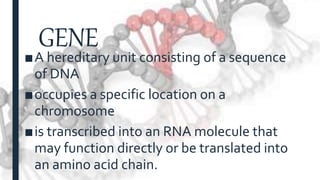
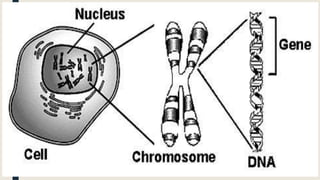
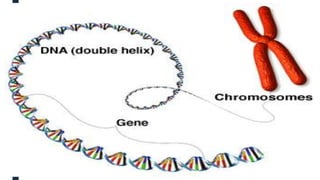
■A hereditary unit consisting of a sequence
of DNA
■occupies a specific location on a
chromosome
■is transcribed into an RNA molecule that
may function directly or be translated into
an amino acid chain.
Some Important Terms:
■ Evolution: Formation of complex organism from simple organism through
gradual changes or change in allelic or genic frequency in population is called
evolution.
■ Population Genetics: Study of genetic variation within populations and involve
the examination and modelling of changes in the frequencies of genes and
alleles in populations over space and time.
■ Alleles: Partners of a gene pair are called alleles.
■ Allele Frequency: Allele frequency or the gene frequency represents the
incidence of a gene variant in a population.
■ Gene Pool: All the genes and their different alleles that are present in a
population of a particular species of organisms.
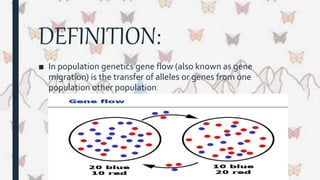
DEFINITION:
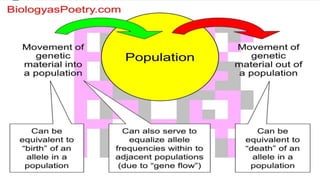
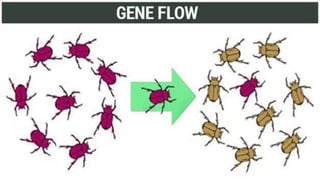
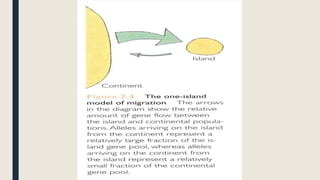
■ In population genetics gene flow (also known as gene
migration) is the transfer of alleles or genes from one
population other population.
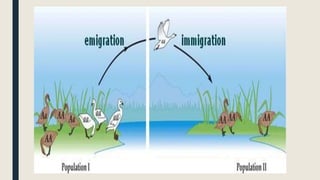
IMMIGRATION and EMMIGRATION:
■ IMMIGRATION:When new organisms join a
population, bring new alleles or changing frequencies.
■ EMMIGRATION:When members of a population leave
it, taking with them their genes.
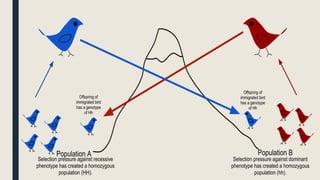
GENE FLOW may be defined as,
■ The alteration of the frequencies of alleles of a particular
genes in a population , resulting from interbreeding with
organisms from another population having different
frequencies.
■ Migration into or out of the population may be responsible for
a marked change in allele frequencies.
How allele frequency change or
remain constant?
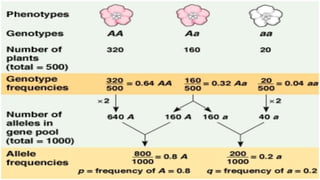
It can be well explained by Hardy
WeinbergTheorem.
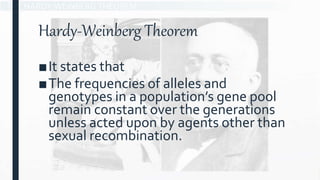
Hardy-Weinberg Theorem
■It states that
■The frequencies of alleles and
genotypes in a population’s gene pool
remain constant over the generations
unless acted upon by agents other than
sexual recombination.
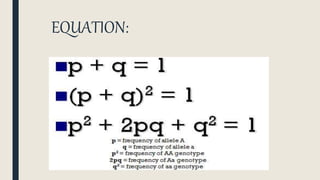
EQUATION:
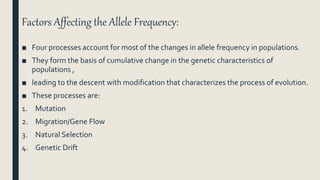
Factors Affecting the Allele Frequency:
■ Four processes account for most of the changes in allele frequency in populations.
■ They form the basis of cumulative change in the genetic characteristics of
populations ,
■ leading to the descent with modification that characterizes the process of evolution.
■ These processes are:
1. Mutation
2. Migration/Gene Flow
3. Natural Selection
4. Genetic Drift
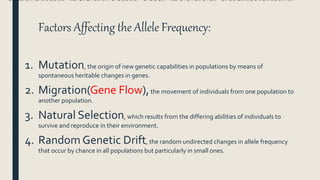
Factors Affecting the Allele Frequency:
1. Mutation, the origin of new genetic capabilities in populations by means of
spontaneous heritable changes in genes.
2. Migration(Gene Flow),the movement of individuals from one population to
another population.
3. Natural Selection, which results from the differing abilities of individuals to
survive and reproduce in their environment.
4. Random Genetic Drift, the random undirected changes in allele frequency
that occur by chance in all populations but particularly in small ones.
DEFINITION:
■ In population genetics gene flow (also known as gene
migration) is the transfer of alleles or genes from one
population to another population.
■ Migration into or out of the population may be responsible for
a marked change in allele frequencies.
What is SELECTION
PRESSURE?
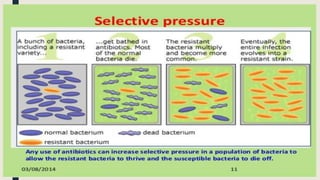
SELECTION PRESSURE:
■ The extent to which organisms possessing a particular
characteristic are either eliminated or favored by
environmental demands.
■ It indicates the degree of intensity of natural selection.
GENE FLOW
■ Mutation is not only the mechanism by which new
alleles enter a population.
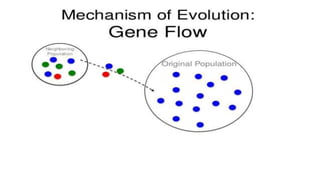
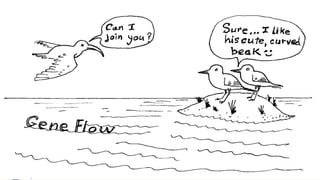
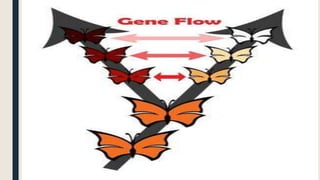
■ A population may receive alleles from a nearby
population in a process known as gene flow or
sometimes gene migration.
GENE FLOW
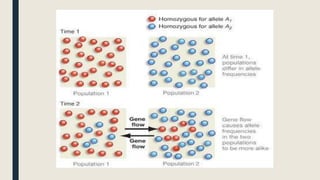
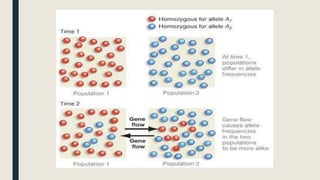
■ Gene flow may be between populations with
similar allele frequencies or between
populations with different allele frequencies.
■ In either case, gene flow results in some mixing
of the gene pools and
■ Slows further differentiation between the
populations.
EXAMPLES:
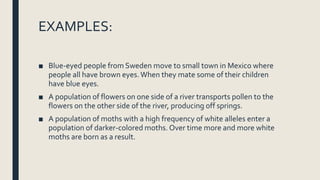
■ Blue-eyed people from Sweden move to small town in Mexico where
people all have brown eyes.When they mate some of their children
have blue eyes.
■ A population of flowers on one side of a river transports pollen to the
flowers on the other side of the river, producing off springs.
■ A population of moths with a high frequency of white alleles enter a
population of darker-colored moths. Over time more and more white
moths are born as a result.
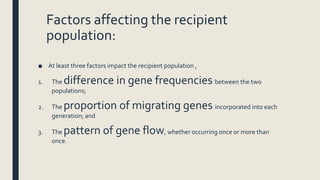
Factors affecting the recipient
population:
■ At least three factors impact the recipient population ,
1. The difference in gene frequencies between the two
populations;
2. The proportion of migrating genes incorporated into each
generation; and
3. The pattern of gene flow, whether occurring once or more than
once.
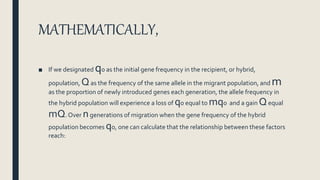
MATHEMATICALLY,
■ If we designated qo as the initial gene frequency in the recipient, or hybrid,
population, Qas the frequency of the same allele in the migrant population, and m
as the proportion of newly introduced genes each generation, the allele frequency in
the hybrid population will experience a loss of qo equal to mqo and a gain Qequal
mQ. Over ngenerations of migration when the gene frequency of the hybrid
population becomes qo, one can calculate that the relationship between these factors
reach:
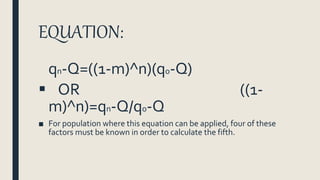
EQUATION:
qn-Q=((1-m)^n)(qo-Q)
 OR ((1-
m)^n)=qn-Q/qo-Q
■ For population where this equation can be applied, four of these
factors must be known in order to calculate the fifth.
CONSEQUENCES OF
GENE FLOW
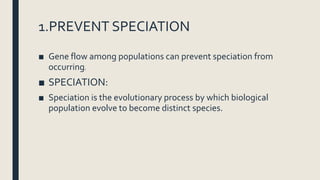
1.PREVENT SPECIATION
■ Gene flow among populations can prevent speciation from
occurring.
■ SPECIATION:
■ Speciation is the evolutionary process by which biological
population evolve to become distinct species.
2.SIMILARITY IN GENE POOL:
■ Gene flow tends to reduce variation among populations over
time.
■ Continued gene flow decreases diversity among populations,
causing gene pool to become similar.
3.Limits to natural selection
■ If natural selection favors certain alleles in some populations,
and different alleles in others, allele flow can oppose natural
selection and prevent the evolution of genetic forms suited to
each environment.
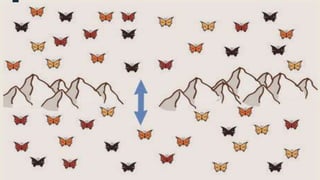
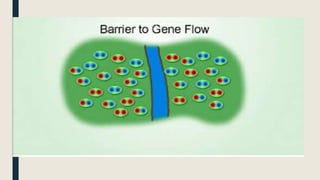
Barriers to gene flow
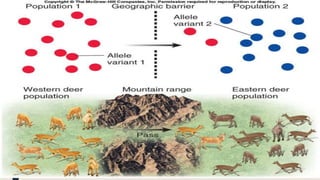
NATURAL BARRIERS:
Physical barriers are usually, but not always, natural.
They may include
 Impassable mountain ranges,
 oceans
 vast deserts.
ARTIFICIAL BARRIER:
■ In some cases they can be artificial, man made barriers, such as
■ the GREATWALL OF CHINA, which has hindered the gene flow of native
plant population.
■ Samples of the same species which grow on either side have been
shown to have developed genetic differences, because there is little to
no gene flow to provide recombination of the gene pools.
THE GREATWALL OF CHINA
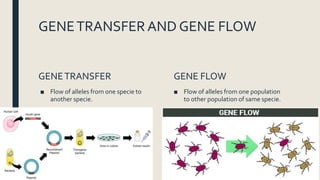
GENETRANSFERAND GENE FLOW
GENETRANSFER
■ Flow of alleles from one specie to
another specie.
GENE FLOW
■ Flow of alleles from one population
to other population of same specie.
THANKYOU FORYOUR
ATTENTION!
Do you have any QUESTION?

Gene flow

  • 2.
  • 3.
    PRESENTERS: DEPARTMENT OF ZOOLOGY QAU-ISLAMABAD ■MariumIqbal ■Tahira Bibi ■Hadia Khadija ■Minahil Maryum ■Maria Rasheed
  • 4.
    GENE ■A hereditary unitconsisting of a sequence of DNA ■occupies a specific location on a chromosome ■is transcribed into an RNA molecule that may function directly or be translated into an amino acid chain.
  • 7.
    Some Important Terms: ■Evolution: Formation of complex organism from simple organism through gradual changes or change in allelic or genic frequency in population is called evolution. ■ Population Genetics: Study of genetic variation within populations and involve the examination and modelling of changes in the frequencies of genes and alleles in populations over space and time. ■ Alleles: Partners of a gene pair are called alleles. ■ Allele Frequency: Allele frequency or the gene frequency represents the incidence of a gene variant in a population. ■ Gene Pool: All the genes and their different alleles that are present in a population of a particular species of organisms.
  • 8.
    DEFINITION: ■ In populationgenetics gene flow (also known as gene migration) is the transfer of alleles or genes from one population other population.
  • 9.
    IMMIGRATION and EMMIGRATION: ■IMMIGRATION:When new organisms join a population, bring new alleles or changing frequencies. ■ EMMIGRATION:When members of a population leave it, taking with them their genes.
  • 11.
    GENE FLOW maybe defined as, ■ The alteration of the frequencies of alleles of a particular genes in a population , resulting from interbreeding with organisms from another population having different frequencies. ■ Migration into or out of the population may be responsible for a marked change in allele frequencies.
  • 12.
    How allele frequencychange or remain constant? It can be well explained by Hardy WeinbergTheorem.
  • 13.
    Hardy-Weinberg Theorem ■It statesthat ■The frequencies of alleles and genotypes in a population’s gene pool remain constant over the generations unless acted upon by agents other than sexual recombination.
  • 14.
  • 16.
    Factors Affecting theAllele Frequency: ■ Four processes account for most of the changes in allele frequency in populations. ■ They form the basis of cumulative change in the genetic characteristics of populations , ■ leading to the descent with modification that characterizes the process of evolution. ■ These processes are: 1. Mutation 2. Migration/Gene Flow 3. Natural Selection 4. Genetic Drift
  • 17.
    Factors Affecting theAllele Frequency: 1. Mutation, the origin of new genetic capabilities in populations by means of spontaneous heritable changes in genes. 2. Migration(Gene Flow),the movement of individuals from one population to another population. 3. Natural Selection, which results from the differing abilities of individuals to survive and reproduce in their environment. 4. Random Genetic Drift, the random undirected changes in allele frequency that occur by chance in all populations but particularly in small ones.
  • 18.
    DEFINITION: ■ In populationgenetics gene flow (also known as gene migration) is the transfer of alleles or genes from one population to another population. ■ Migration into or out of the population may be responsible for a marked change in allele frequencies.
  • 20.
  • 21.
    SELECTION PRESSURE: ■ Theextent to which organisms possessing a particular characteristic are either eliminated or favored by environmental demands. ■ It indicates the degree of intensity of natural selection.
  • 24.
    GENE FLOW ■ Mutationis not only the mechanism by which new alleles enter a population. ■ A population may receive alleles from a nearby population in a process known as gene flow or sometimes gene migration.
  • 26.
    GENE FLOW ■ Geneflow may be between populations with similar allele frequencies or between populations with different allele frequencies. ■ In either case, gene flow results in some mixing of the gene pools and ■ Slows further differentiation between the populations.
  • 30.
    EXAMPLES: ■ Blue-eyed peoplefrom Sweden move to small town in Mexico where people all have brown eyes.When they mate some of their children have blue eyes. ■ A population of flowers on one side of a river transports pollen to the flowers on the other side of the river, producing off springs. ■ A population of moths with a high frequency of white alleles enter a population of darker-colored moths. Over time more and more white moths are born as a result.
  • 31.
    Factors affecting therecipient population: ■ At least three factors impact the recipient population , 1. The difference in gene frequencies between the two populations; 2. The proportion of migrating genes incorporated into each generation; and 3. The pattern of gene flow, whether occurring once or more than once.
  • 32.
    MATHEMATICALLY, ■ If wedesignated qo as the initial gene frequency in the recipient, or hybrid, population, Qas the frequency of the same allele in the migrant population, and m as the proportion of newly introduced genes each generation, the allele frequency in the hybrid population will experience a loss of qo equal to mqo and a gain Qequal mQ. Over ngenerations of migration when the gene frequency of the hybrid population becomes qo, one can calculate that the relationship between these factors reach:
  • 33.
    EQUATION: qn-Q=((1-m)^n)(qo-Q)  OR ((1- m)^n)=qn-Q/qo-Q ■For population where this equation can be applied, four of these factors must be known in order to calculate the fifth.
  • 34.
  • 35.
    1.PREVENT SPECIATION ■ Geneflow among populations can prevent speciation from occurring. ■ SPECIATION: ■ Speciation is the evolutionary process by which biological population evolve to become distinct species.
  • 37.
    2.SIMILARITY IN GENEPOOL: ■ Gene flow tends to reduce variation among populations over time. ■ Continued gene flow decreases diversity among populations, causing gene pool to become similar.
  • 40.
    3.Limits to naturalselection ■ If natural selection favors certain alleles in some populations, and different alleles in others, allele flow can oppose natural selection and prevent the evolution of genetic forms suited to each environment.
  • 41.
  • 42.
    NATURAL BARRIERS: Physical barriersare usually, but not always, natural. They may include  Impassable mountain ranges,  oceans  vast deserts.
  • 44.
    ARTIFICIAL BARRIER: ■ Insome cases they can be artificial, man made barriers, such as ■ the GREATWALL OF CHINA, which has hindered the gene flow of native plant population. ■ Samples of the same species which grow on either side have been shown to have developed genetic differences, because there is little to no gene flow to provide recombination of the gene pools.
  • 45.
  • 47.
    GENETRANSFERAND GENE FLOW GENETRANSFER ■Flow of alleles from one specie to another specie. GENE FLOW ■ Flow of alleles from one population to other population of same specie.
  • 49.