Types of Natural Selection
Think. Pair. Share.

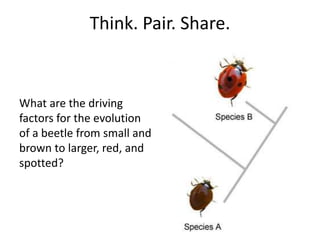
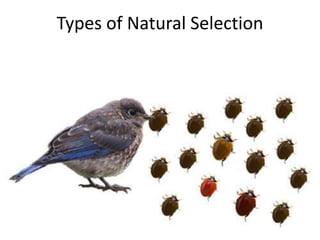
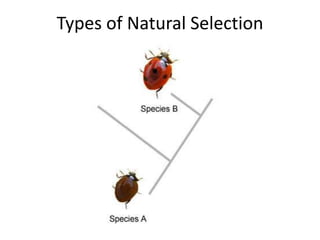
What are the driving
factors for the evolution
of a beetle from small and
brown to larger, red, and
spotted?
Types of Natural Selection

In some environments, a species may face one or
many selective pressures.
Types of Natural Selection
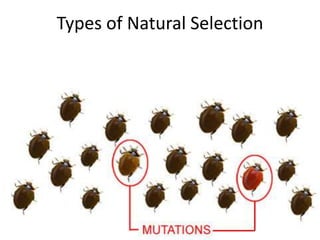
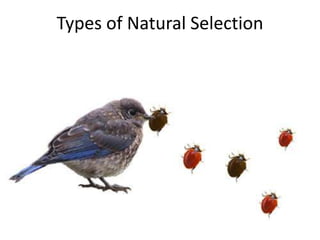
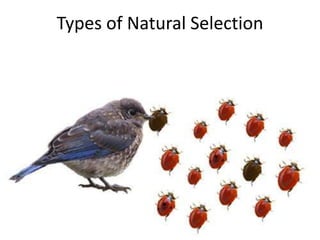
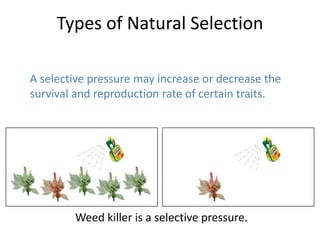
A selective pressure may increase or decrease the
survival and reproduction rate of certain traits.

Weed killer is a selective pressure.
Types of Natural Selection

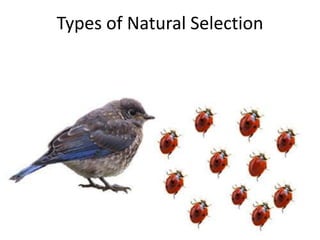
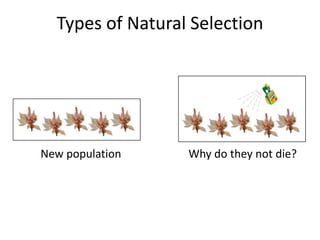
New population

Why do they not die?
Types of Natural Selection

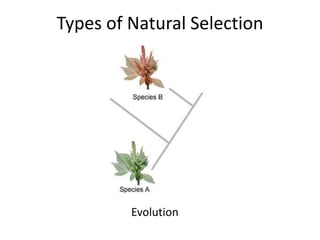
Evolution
Types of Natural Selection

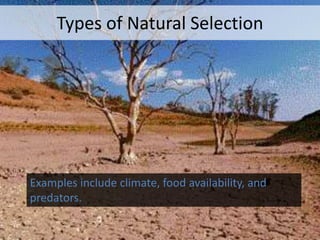
Examples include climate, food availability, and
predators.
Types of Natural Selection

There are 4 types of Natural Selection:
1) Directional Selection
2) Stabilizing Selection
3) Disruptive Selection
4) Sexual Selection
Types of Natural Selection
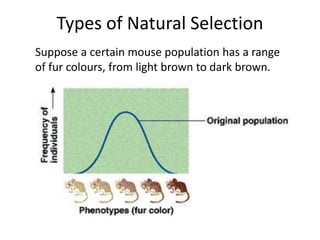
Suppose a certain mouse population has a range
of fur colours, from light brown to dark brown.
Directional Selection
1) Directional selection occurs when a selective
pressure favours an extreme variation of a trait.
Directional Selection
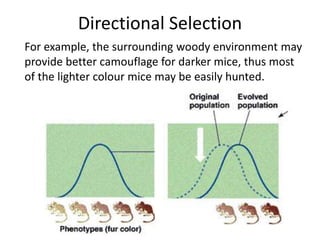
For example, the surrounding woody environment may
provide better camouflage for darker mice, thus most
of the lighter colour mice may be easily hunted.
Stabilizing Selection
2) Stabilizing selection occurs when a selective
pressure favours the average phenotype.
Stabilizing Selection
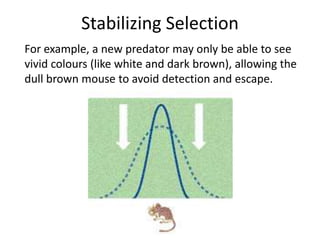
For example, a new predator may only be able to see
vivid colours (like white and dark brown), allowing the
dull brown mouse to avoid detection and escape.
Disruptive Selection
3) Disruptive selection favours extreme traits for
survival while the average phenotype declines.
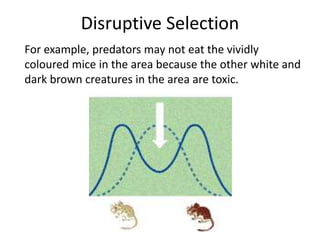
Disruptive Selection
For example, predators may not eat the vividly
coloured mice in the area because the other white and
dark brown creatures in the area are toxic.
Sexual Selection
4) Sexual selection favours traits that increase the
success for an organism to find a mate and reproduce.
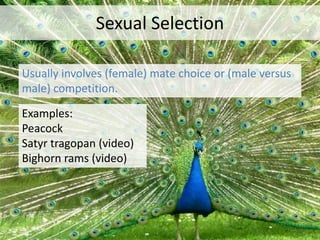
Sexual Selection
Usually involves (female) mate choice or (male versus
male) competition.
Examples:
Peacock
Satyr tragopan (video)
Bighorn rams (video)
Sexual Selection
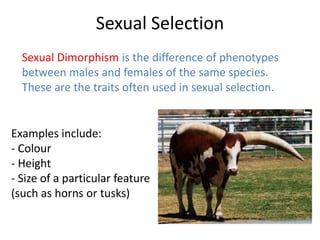
Sexual Dimorphism is the difference of phenotypes
between males and females of the same species.
These are the traits often used in sexual selection.

Examples include:
- Colour
- Height
- Size of a particular feature
(such as horns or tusks)
Sexual Selection
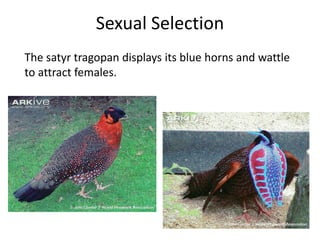
The satyr tragopan displays its blue horns and wattle
to attract females.

02c types of natural selection

Editor's Notes

  • #26 http://www.youtube.com/watch?v=zj8istSAMoYhttp://www.youtube.com/watch?v=7l79rgG9bDk