Ecological Genetics:
Adaptation
and
Natural Selection
Prepared by: Jaycris C. Agnes
“Survival of the
Fittest.”
Ecology is the
science of
adaptation.
Genetic variation is
the ingredient for
Natural Selection.
Mutation: inheritable changes in a gene or a chromosome
Gene mutation: (point mutation)
Chromosome mutation
 deletion, duplication, inversion, translocation
Genetic Recombination
Sexual reproduction
two individuals produce haploid gametes (egg or sperm) – that
combine to form a diploid cell or zygote.
Reassortment of genes provided by two parents in the offspring
Increases dramatically the variation within a population by
creating new combinations of existing genes.
Asexual reproduction: less variation (only mutation)
Sources of Genetic Variation
7-20-2014 Prepared By: Jaycris C. Agnes 5
Nature Selection as a Force of
Evolution
 What is Darwin’s Natural Selection?
The differential success (survival and
reproduction) of individuals within the
population that results from their
interaction with their environment.
“Survival of fitness, elimination of
‘inferior’ individual”
7-20-2014 Prepared By: Jaycris C. Agnes 6
 There is variation in populations. Variation is heritable.
 In every generation some organisms are more successful
at surviving and reproducing than others. Survival and
reproduction are not random, but are related to variation
among individuals. Organisms with best characteristics
are ‘naturally selected.’
If 2 conditions are met then the population will change from
one generation to the next. Evolution will occur.
Two Conditions in
Natural Selection
7-20-2014 Prepared By: Jaycris C. Agnes 7
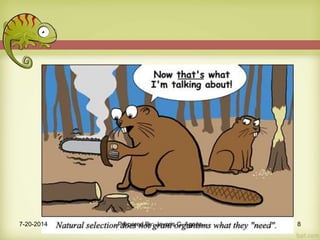
7-20-2014 Prepared By: Jaycris C. Agnes 8
Evolution by Natural Selection
The major factors affecting the organisms’ survival in
the system is Fitness.
Darwinian fitness: ability of an organism to survive
and reproduce in its environment.
Adaptation is a characteristic or trait of an
organism that increases its fitness relative to
individuals that do not possess it. It is an inherited
characteristic that increases the ability of an organism
to survive and reproduce.7-20-2014 Prepared By: Jaycris C. Agnes 9
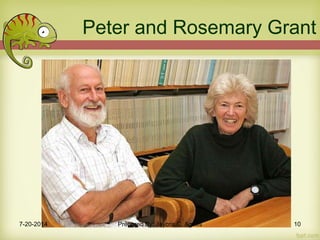
Peter and Rosemary Grant
7-20-2014 Prepared By: Jaycris C. Agnes 10
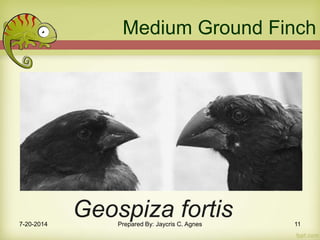
Geospiza fortis
Medium Ground Finch
7-20-2014 Prepared By: Jaycris C. Agnes 11
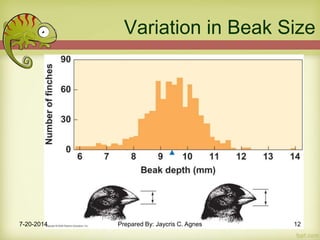
Variation in Beak Size
7-20-2014 Prepared By: Jaycris C. Agnes 12
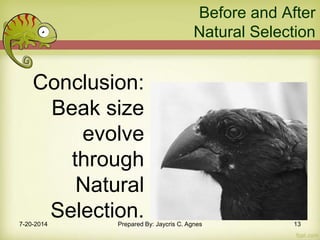
Before and After
Natural Selection
In 1978, there was a
severe drought, small
seeds declined more than
large seeds.
Small beak birds have
difficult to find seeds, and
suffered heavy mortality,
especially females.
Conclusion:
Beak size
evolve
through
Natural
Selection.7-20-2014 Prepared By: Jaycris C. Agnes 13
Types of Natural
Selection
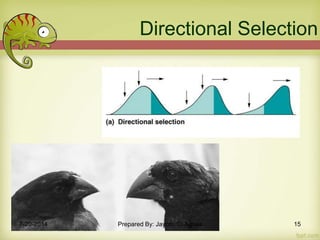
Directional Selection
7-20-2014 Prepared By: Jaycris C. Agnes 15
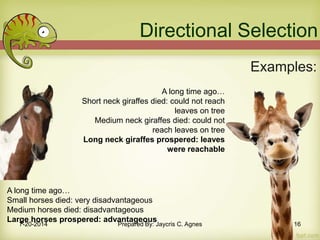
Directional Selection
Examples:
A long time ago…
Small horses died: very disadvantageous
Medium horses died: disadvantageous
Large horses prospered: advantageous
A long time ago…
Short neck giraffes died: could not reach
leaves on tree
Medium neck giraffes died: could not
reach leaves on tree
Long neck giraffes prospered: leaves
were reachable
7-20-2014 Prepared By: Jaycris C. Agnes 16
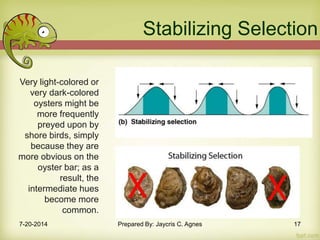
Very light-colored or
very dark-colored
oysters might be
more frequently
preyed upon by
shore birds, simply
because they are
more obvious on the
oyster bar; as a
result, the
intermediate hues
become more
common.
Stabilizing Selection
7-20-2014 Prepared By: Jaycris C. Agnes 17
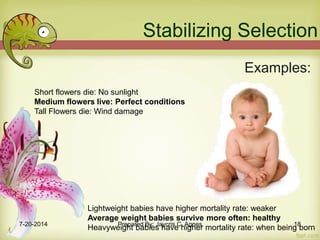
Stabilizing Selection
Examples:
Short flowers die: No sunlight
Medium flowers live: Perfect conditions
Tall Flowers die: Wind damage
Lightweight babies have higher mortality rate: weaker
Average weight babies survive more often: healthy
Heavyweight babies have higher mortality rate: when being born7-20-2014 Prepared By: Jaycris C. Agnes 18
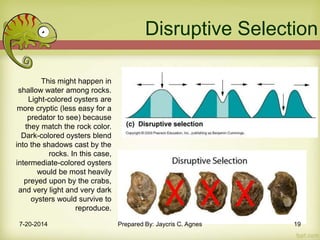
This might happen in
shallow water among rocks.
Light-colored oysters are
more cryptic (less easy for a
predator to see) because
they match the rock color.
Dark-colored oysters blend
into the shadows cast by the
rocks. In this case,
intermediate-colored oysters
would be most heavily
preyed upon by the crabs,
and very light and very dark
oysters would survive to
reproduce.
Disruptive Selection
7-20-2014 Prepared By: Jaycris C. Agnes 19
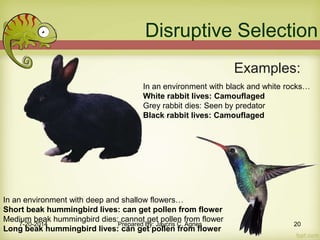
Disruptive Selection
Examples:
In an environment with black and white rocks…
White rabbit lives: Camouflaged
Grey rabbit dies: Seen by predator
Black rabbit lives: Camouflaged
In an environment with deep and shallow flowers…
Short beak hummingbird lives: can get pollen from flower
Medium beak hummingbird dies: cannot get pollen from flower
Long beak hummingbird lives: can get pollen from flower
7-20-2014 Prepared By: Jaycris C. Agnes 20
Five Causes of Evolution
• Mutations
• Gene flow - Emigration and immigration of
individuals (Flow of alleles)
• Genetic Drift – Changes in the gene pool of a
small population due to chance
• Nonrandom mating: (AA mates AA, Aa)
• Natural Selection
7-20-2014 Prepared By: Jaycris C. Agnes 21
Evolution is a change in
Gene Frequency
Evolution is a change of gene frequencies
within a population (or species) over time
Individuals do not evolve, populations evolve.
Focus on gene pool, collective.
But why do we see populations are still the
‘same’ over many generations?
7-20-2014 Prepared By: Jaycris C. Agnes 22
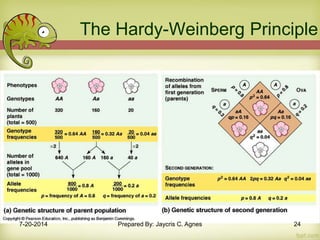
The Hardy-Weinberg Principle
The Hardy-Weinberg Principle:
Gene frequencies will remain the same in successive
generations of a sexually reproducing population if the
following five conditions hold:
– Random mating
– There is no mutation
– The population is very large
– There is no selection
– There is no migrations (isolated from other populations)
7-20-2014 Prepared By: Jaycris C. Agnes 23
The Hardy-Weinberg Principle
7-20-2014 Prepared By: Jaycris C. Agnes 24
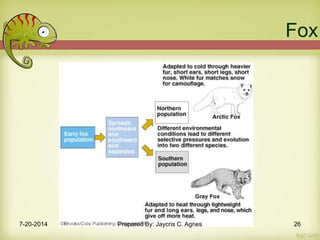
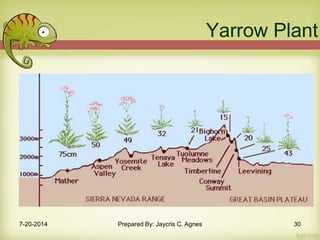
The variation in environmental conditions
often give rise to a corresponding variation
in morphological, physiological and
behavioral characteristics.
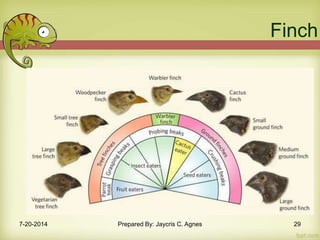
The process in which one species gives rise
to multiple species that exploit different
features of the environment, such as food or
habitats, is called Adaptive Radiation.
Genetic Differentiation &
Adaptive Radiation
7-20-2014 Prepared By: Jaycris C. Agnes 25
Fox
7-20-2014 Prepared By: Jaycris C. Agnes 26
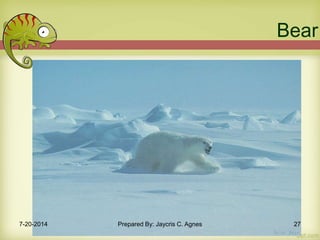
Bear
7-20-2014 Prepared By: Jaycris C. Agnes 27
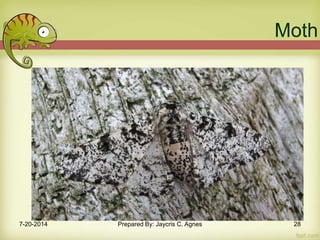
Moth
7-20-2014 Prepared By: Jaycris C. Agnes 28
Finch
7-20-2014 Prepared By: Jaycris C. Agnes 29
Yarrow Plant
7-20-2014 Prepared By: Jaycris C. Agnes 30
END.
7-20-2014 Prepared By: Jaycris C. Agnes 31

Ecological Genetics: Adaptation and Natural Selection

  • 1.
  • 2.
  • 3.
    Ecology is the scienceof adaptation.
  • 4.
    Genetic variation is theingredient for Natural Selection.
  • 5.
    Mutation: inheritable changesin a gene or a chromosome Gene mutation: (point mutation) Chromosome mutation  deletion, duplication, inversion, translocation Genetic Recombination Sexual reproduction two individuals produce haploid gametes (egg or sperm) – that combine to form a diploid cell or zygote. Reassortment of genes provided by two parents in the offspring Increases dramatically the variation within a population by creating new combinations of existing genes. Asexual reproduction: less variation (only mutation) Sources of Genetic Variation 7-20-2014 Prepared By: Jaycris C. Agnes 5
  • 6.
    Nature Selection asa Force of Evolution  What is Darwin’s Natural Selection? The differential success (survival and reproduction) of individuals within the population that results from their interaction with their environment. “Survival of fitness, elimination of ‘inferior’ individual” 7-20-2014 Prepared By: Jaycris C. Agnes 6
  • 7.
     There isvariation in populations. Variation is heritable.  In every generation some organisms are more successful at surviving and reproducing than others. Survival and reproduction are not random, but are related to variation among individuals. Organisms with best characteristics are ‘naturally selected.’ If 2 conditions are met then the population will change from one generation to the next. Evolution will occur. Two Conditions in Natural Selection 7-20-2014 Prepared By: Jaycris C. Agnes 7
  • 8.
    7-20-2014 Prepared By:Jaycris C. Agnes 8
  • 9.
    Evolution by NaturalSelection The major factors affecting the organisms’ survival in the system is Fitness. Darwinian fitness: ability of an organism to survive and reproduce in its environment. Adaptation is a characteristic or trait of an organism that increases its fitness relative to individuals that do not possess it. It is an inherited characteristic that increases the ability of an organism to survive and reproduce.7-20-2014 Prepared By: Jaycris C. Agnes 9
  • 10.
    Peter and RosemaryGrant 7-20-2014 Prepared By: Jaycris C. Agnes 10
  • 11.
    Geospiza fortis Medium GroundFinch 7-20-2014 Prepared By: Jaycris C. Agnes 11
  • 12.
    Variation in BeakSize 7-20-2014 Prepared By: Jaycris C. Agnes 12
  • 13.
    Before and After NaturalSelection In 1978, there was a severe drought, small seeds declined more than large seeds. Small beak birds have difficult to find seeds, and suffered heavy mortality, especially females. Conclusion: Beak size evolve through Natural Selection.7-20-2014 Prepared By: Jaycris C. Agnes 13
  • 14.
  • 15.
  • 16.
    Directional Selection Examples: A longtime ago… Small horses died: very disadvantageous Medium horses died: disadvantageous Large horses prospered: advantageous A long time ago… Short neck giraffes died: could not reach leaves on tree Medium neck giraffes died: could not reach leaves on tree Long neck giraffes prospered: leaves were reachable 7-20-2014 Prepared By: Jaycris C. Agnes 16
  • 17.
    Very light-colored or verydark-colored oysters might be more frequently preyed upon by shore birds, simply because they are more obvious on the oyster bar; as a result, the intermediate hues become more common. Stabilizing Selection 7-20-2014 Prepared By: Jaycris C. Agnes 17
  • 18.
    Stabilizing Selection Examples: Short flowersdie: No sunlight Medium flowers live: Perfect conditions Tall Flowers die: Wind damage Lightweight babies have higher mortality rate: weaker Average weight babies survive more often: healthy Heavyweight babies have higher mortality rate: when being born7-20-2014 Prepared By: Jaycris C. Agnes 18
  • 19.
    This might happenin shallow water among rocks. Light-colored oysters are more cryptic (less easy for a predator to see) because they match the rock color. Dark-colored oysters blend into the shadows cast by the rocks. In this case, intermediate-colored oysters would be most heavily preyed upon by the crabs, and very light and very dark oysters would survive to reproduce. Disruptive Selection 7-20-2014 Prepared By: Jaycris C. Agnes 19
  • 20.
    Disruptive Selection Examples: In anenvironment with black and white rocks… White rabbit lives: Camouflaged Grey rabbit dies: Seen by predator Black rabbit lives: Camouflaged In an environment with deep and shallow flowers… Short beak hummingbird lives: can get pollen from flower Medium beak hummingbird dies: cannot get pollen from flower Long beak hummingbird lives: can get pollen from flower 7-20-2014 Prepared By: Jaycris C. Agnes 20
  • 21.
    Five Causes ofEvolution • Mutations • Gene flow - Emigration and immigration of individuals (Flow of alleles) • Genetic Drift – Changes in the gene pool of a small population due to chance • Nonrandom mating: (AA mates AA, Aa) • Natural Selection 7-20-2014 Prepared By: Jaycris C. Agnes 21
  • 22.
    Evolution is achange in Gene Frequency Evolution is a change of gene frequencies within a population (or species) over time Individuals do not evolve, populations evolve. Focus on gene pool, collective. But why do we see populations are still the ‘same’ over many generations? 7-20-2014 Prepared By: Jaycris C. Agnes 22
  • 23.
    The Hardy-Weinberg Principle TheHardy-Weinberg Principle: Gene frequencies will remain the same in successive generations of a sexually reproducing population if the following five conditions hold: – Random mating – There is no mutation – The population is very large – There is no selection – There is no migrations (isolated from other populations) 7-20-2014 Prepared By: Jaycris C. Agnes 23
  • 24.
    The Hardy-Weinberg Principle 7-20-2014Prepared By: Jaycris C. Agnes 24
  • 25.
    The variation inenvironmental conditions often give rise to a corresponding variation in morphological, physiological and behavioral characteristics. The process in which one species gives rise to multiple species that exploit different features of the environment, such as food or habitats, is called Adaptive Radiation. Genetic Differentiation & Adaptive Radiation 7-20-2014 Prepared By: Jaycris C. Agnes 25
  • 26.
    Fox 7-20-2014 Prepared By:Jaycris C. Agnes 26
  • 27.
    Bear 7-20-2014 Prepared By:Jaycris C. Agnes 27
  • 28.
    Moth 7-20-2014 Prepared By:Jaycris C. Agnes 28
  • 29.
    Finch 7-20-2014 Prepared By:Jaycris C. Agnes 29
  • 30.
    Yarrow Plant 7-20-2014 PreparedBy: Jaycris C. Agnes 30
  • 31.
    END. 7-20-2014 Prepared By:Jaycris C. Agnes 31

Editor's Notes