
Theory of Evolution by Natural
Selection
Presented by – Lekhan Lodhi
Research scholar
Department of Zoology
Dr. H. S. Gour university Sagar ( M.P)
Darwin and His Theory of Evolution
by Natural Selection
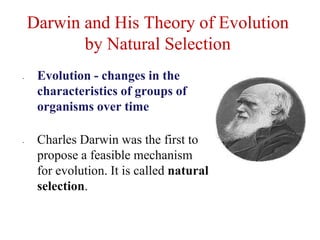
• Evolution - changes in the
characteristics of groups of
organisms over time
• Charles Darwin was the first to
propose a feasible mechanism
for evolution. It is called natural
selection.
What is a scientific theory?
Scientific Theory- an idea that is strongly supported by
evidence. It is generally accepted and used to explain many
observations.
*Remember: The word “theory” in everyday language and
in scientific language mean very different things.
In everyday language, people use the word theory to mean
a hypothesis or an educated guess.
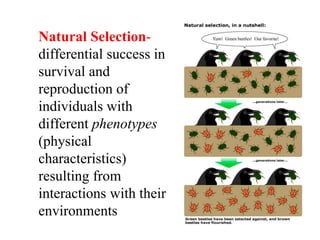
Natural Selection-
differential success in
survival and
reproduction of
individuals with
different phenotypes
(physical
characteristics)
resulting from
interactions with their
environments
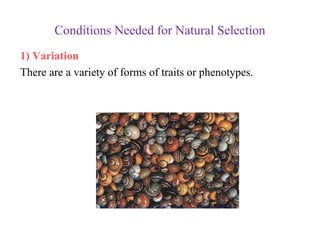
Conditions Needed for Natural Selection
1) Variation
There are a variety of forms of traits or phenotypes.
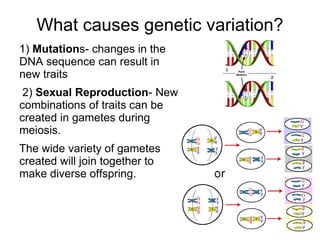
What causes genetic variation?
1) Mutations- changes in the
DNA sequence can result in
new traits
2) Sexual Reproduction- New
combinations of traits can be
created in gametes during
meiosis.
The wide variety of gametes
created will join together to
make diverse offspring.
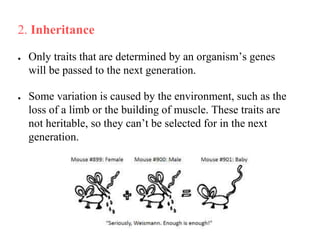
2. Inheritance
● Only traits that are determined by an organism’s genes
will be passed to the next generation.
● Some variation is caused by the environment, such as the
loss of a limb or the building of muscle. These traits are
not heritable, so they can’t be selected for in the next
generation.
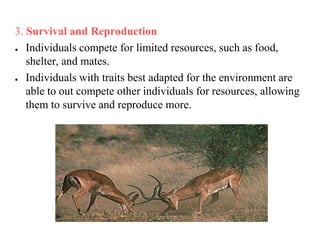
3. Survival and Reproduction
● Individuals compete for limited resources, such as food,
shelter, and mates.
● Individuals with traits best adapted for the environment are
able to out compete other individuals for resources, allowing
them to survive and reproduce more.
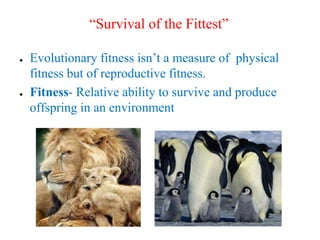
“Survival of the Fittest”
● Evolutionary fitness isn’t a measure of physical
fitness but of reproductive fitness.
● Fitness- Relative ability to survive and produce
offspring in an environment
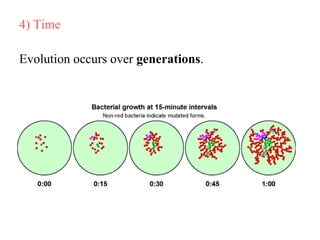
4) Time
Evolution occurs over generations.
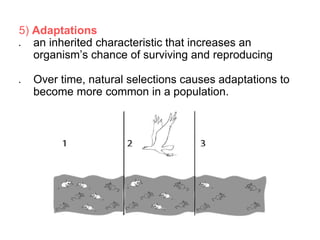
5) Adaptations
● an inherited characteristic that increases an
organism’s chance of surviving and reproducing
● Over time, natural selections causes adaptations to
become more common in a population.
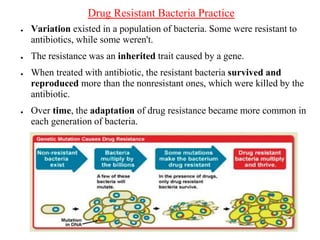
Drug Resistant Bacteria Practice
● Variation existed in a population of bacteria. Some were resistant to
antibiotics, while some weren't.
● The resistance was an inherited trait caused by a gene.
● When treated with antibiotic, the resistant bacteria survived and
reproduced more than the nonresistant ones, which were killed by the
antibiotic.
● Over time, the adaptation of drug resistance became more common in
each generation of bacteria.
Natural selection can lead to a variety of changes within a population.
These changes can be roughly grouped into three categories:
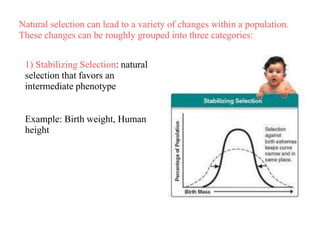
1) Stabilizing Selection: natural
selection that favors an
intermediate phenotype
Example: Birth weight, Human
height
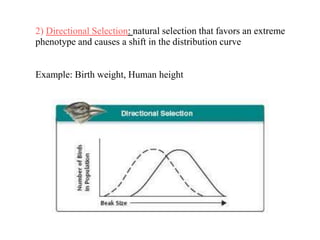
2) Directional Selection: natural selection that favors an extreme
phenotype and causes a shift in the distribution curve
Example: Birth weight, Human height
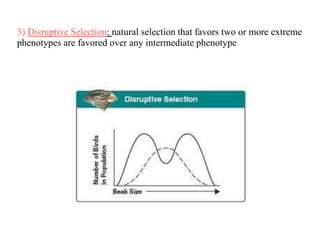
3) Disruptive Selection: natural selection that favors two or more extreme
phenotypes are favored over any intermediate phenotype
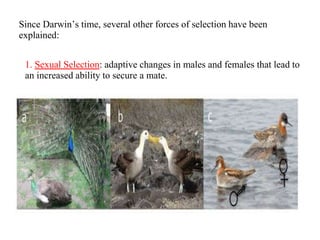
Since Darwin’s time, several other forces of selection have been
explained:
1. Sexual Selection: adaptive changes in males and females that lead to
an increased ability to secure a mate.
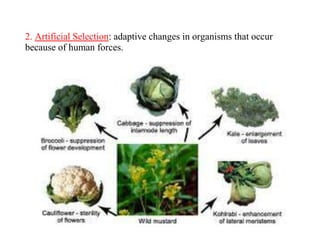
2. Artificial Selection: adaptive changes in organisms that occur
because of human forces.
Theory of evolution by natural selection

Theory of evolution by natural selection

  • 2.
    Theory of Evolutionby Natural Selection Presented by – Lekhan Lodhi Research scholar Department of Zoology Dr. H. S. Gour university Sagar ( M.P)
  • 3.
    Darwin and HisTheory of Evolution by Natural Selection • Evolution - changes in the characteristics of groups of organisms over time • Charles Darwin was the first to propose a feasible mechanism for evolution. It is called natural selection.
  • 4.
    What is ascientific theory? Scientific Theory- an idea that is strongly supported by evidence. It is generally accepted and used to explain many observations. *Remember: The word “theory” in everyday language and in scientific language mean very different things. In everyday language, people use the word theory to mean a hypothesis or an educated guess.
  • 5.
    Natural Selection- differential successin survival and reproduction of individuals with different phenotypes (physical characteristics) resulting from interactions with their environments
  • 6.
    Conditions Needed forNatural Selection 1) Variation There are a variety of forms of traits or phenotypes.
  • 7.
    What causes geneticvariation? 1) Mutations- changes in the DNA sequence can result in new traits 2) Sexual Reproduction- New combinations of traits can be created in gametes during meiosis. The wide variety of gametes created will join together to make diverse offspring.
  • 8.
    2. Inheritance ● Onlytraits that are determined by an organism’s genes will be passed to the next generation. ● Some variation is caused by the environment, such as the loss of a limb or the building of muscle. These traits are not heritable, so they can’t be selected for in the next generation.
  • 9.
    3. Survival andReproduction ● Individuals compete for limited resources, such as food, shelter, and mates. ● Individuals with traits best adapted for the environment are able to out compete other individuals for resources, allowing them to survive and reproduce more.
  • 10.
    “Survival of theFittest” ● Evolutionary fitness isn’t a measure of physical fitness but of reproductive fitness. ● Fitness- Relative ability to survive and produce offspring in an environment
  • 11.
    4) Time Evolution occursover generations.
  • 12.
    5) Adaptations ● aninherited characteristic that increases an organism’s chance of surviving and reproducing ● Over time, natural selections causes adaptations to become more common in a population.
  • 13.
    Drug Resistant BacteriaPractice ● Variation existed in a population of bacteria. Some were resistant to antibiotics, while some weren't. ● The resistance was an inherited trait caused by a gene. ● When treated with antibiotic, the resistant bacteria survived and reproduced more than the nonresistant ones, which were killed by the antibiotic. ● Over time, the adaptation of drug resistance became more common in each generation of bacteria.
  • 14.
    Natural selection canlead to a variety of changes within a population. These changes can be roughly grouped into three categories: 1) Stabilizing Selection: natural selection that favors an intermediate phenotype Example: Birth weight, Human height
  • 15.
    2) Directional Selection:natural selection that favors an extreme phenotype and causes a shift in the distribution curve Example: Birth weight, Human height
  • 16.
    3) Disruptive Selection:natural selection that favors two or more extreme phenotypes are favored over any intermediate phenotype
  • 17.
    Since Darwin’s time,several other forces of selection have been explained: 1. Sexual Selection: adaptive changes in males and females that lead to an increased ability to secure a mate.
  • 18.
    2. Artificial Selection:adaptive changes in organisms that occur because of human forces.