1. 1. Introduction to Evolution
2. 2.History of evolutionary
thought
3. Heredity
4. Variation
• 4.1 Mutation
• 4.2 Sex and recombination
• 4.3 Gene flow
5. Mechanisms
• 5.1 Natural selection
• 5.2 Biased mutation
• 5.3 Genetic drift
• 5.4 Genetic hitchhiking
• 5.5 Gene flow
6. Outcomes
• 6.1 Adaptation
• 6.2 Coevolution
• 6.3 Cooperation
• 6.4 Speciation
• 6.5 Extinction
7. Evolutionary history of life
• 7.1 Origin of life
• 7.2 Common descent
• 7.3 Evolution of life
8. Applications
9. Social and cultural responses
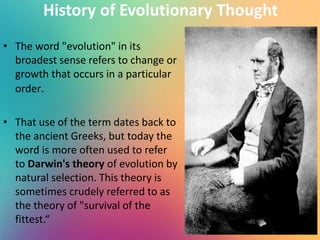
History of Evolutionary Thought
• The word "evolution" in its
broadest sense refers to change or
growth that occurs in a particular
order.
• That use of the term dates back to
the ancient Greeks, but today the
word is more often used to refer
to Darwin's theory of evolution by
natural selection. This theory is
sometimes crudely referred to as
the theory of "survival of the
fittest.“
•Greek and medieval references to "evolution" use it as a
descriptive term for a state of nature, in which everything in
nature has a certain order or purpose. This is a teleological
view of nature. For example, Aristotle classified all living
organisms hierarchically in his Greatscala naturae or Great
Chain of Being, with plants at the bottom, moving through
lesser animals, and on to humans at the pinnacle of creation,
each becoming progressively more perfect in form. It was the
medieval philosophers, such as Augustine who began to
incorporate teleological views of nature with religion: God is
the designer of all creatures, and everything has a purpose
and a place as ordained by Him.
Several views on Evolution
•Ancient Greek Views
•Medieval Views
•In Modern Philosophy
•In German Idealism
•Darwin’s View
•Spencer’s View
HEREDITY
•Evolution in organisms occurs through changes in heritable
traits—the inherited characteristics of an organism. In
humans, for example, eye colour is an inherited characteristic
and an individual might inherit the "brown-eye trait" from
one of their parents inherited traits are controlled by genes
and the complete set of genes within an organism's
genome (genetic material) is called its genotype.
•The complete set of observable traits that make up the
structure and behaviour of an organism is called its
phenotype. These traits come from the interaction of its
genotype with the environment.As a result, many aspects of
an organism's phenotype are not inherited
•Heritable traits are passed from one generation to
the next via DNA molecules, that encodes genetic
information
•Heritability may also occur at even larger scales.
•Other examples of heritability in evolution that
are not under the direct control of genes include
the inheritance of cultural traits
and symbiogenesis
Variation
• An individual organism's phenotype results from
both its genotype and the influence from the
environment it has lived in.
• A substantial part of the phenotypic variation in a
population is caused by genotypic variation.
• The modern evolutionary synthesis defines
evolution as the change over time in this genetic
variation.
• The frequency of one particular allele will become
more or less prevalent relative to other forms of
that gene. Variation disappears when a new allele
reaches the point of fixation—when it either
disappears from the population or replaces the
ancestral allele entirely.
• Natural selection will only cause evolution if
there is enough genetic variation in a
population.
• Before the discovery of Mendelian genetics,
one common hypothesis was blending
inheritance. But with blending inheritance,
genetic variance would be rapidly lost, making
evolution by natural selection implausible.
• The Hardy–Weinberg principle provides the
solution to how variation is maintained in a
population with Mendelian inheritance. The
frequencies of alleles (variations in a gene) will
remain constant in the absence of selection,
mutation, migration and genetic drift.
• Variation comes from mutations in the
genome, reshuffling of genes through sexual
reproduction and migration between
populations (gene flow).
• Despite the constant introduction of new
variation through mutation and gene flow,
most of the genome of a species is identical in
all individuals of that species.
• However, even relatively small differences in
genotype can lead to dramatic differences in
phenotype: for example, chimpanzees and
humans differ in only about 5% of their
genomes.
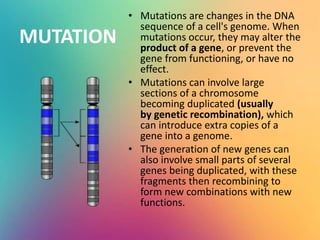
MUTATION
• Mutations are changes in the DNA
sequence of a cell's genome. When
mutations occur, they may alter the
product of a gene, or prevent the
gene from functioning, or have no
effect.
• Mutations can involve large
sections of a chromosome
becoming duplicated (usually
by genetic recombination), which
can introduce extra copies of a
gene into a genome.
• The generation of new genes can
also involve small parts of several
genes being duplicated, with these
fragments then recombining to
form new combinations with new
functions.
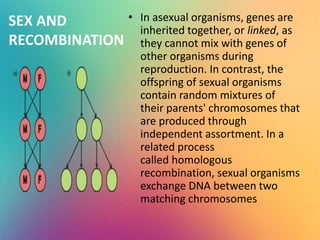
SEX AND
RECOMBINATION
• In asexual organisms, genes are
inherited together, or linked, as
they cannot mix with genes of
other organisms during
reproduction. In contrast, the
offspring of sexual organisms
contain random mixtures of
their parents' chromosomes that
are produced through
independent assortment. In a
related process
called homologous
recombination, sexual organisms
exchange DNA between two
matching chromosomes
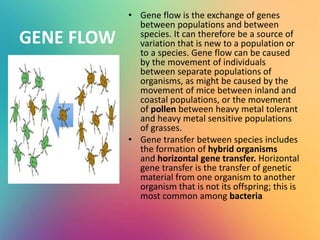
GENE FLOW
• Gene flow is the exchange of genes
between populations and between
species. It can therefore be a source of
variation that is new to a population or
to a species. Gene flow can be caused
by the movement of individuals
between separate populations of
organisms, as might be caused by the
movement of mice between inland and
coastal populations, or the movement
of pollen between heavy metal tolerant
and heavy metal sensitive populations
of grasses.
• Gene transfer between species includes
the formation of hybrid organisms
and horizontal gene transfer. Horizontal
gene transfer is the transfer of genetic
material from one organism to another
organism that is not its offspring; this is
most common among bacteria
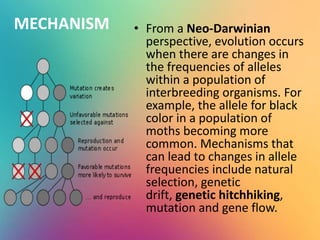
MECHANISM • From a Neo-Darwinian
perspective, evolution occurs
when there are changes in
the frequencies of alleles
within a population of
interbreeding organisms. For
example, the allele for black
color in a population of
moths becoming more
common. Mechanisms that
can lead to changes in allele
frequencies include natural
selection, genetic
drift, genetic hitchhiking,
mutation and gene flow.
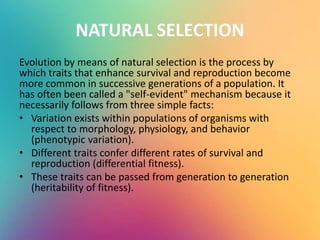
NATURAL SELECTION
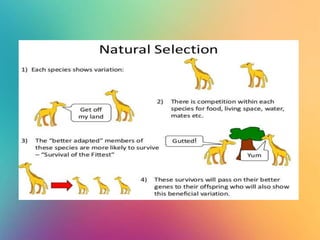
Evolution by means of natural selection is the process by
which traits that enhance survival and reproduction become
more common in successive generations of a population. It
has often been called a "self-evident" mechanism because it
necessarily follows from three simple facts:
• Variation exists within populations of organisms with
respect to morphology, physiology, and behavior
(phenotypic variation).
• Different traits confer different rates of survival and
reproduction (differential fitness).
• These traits can be passed from generation to generation
(heritability of fitness).
BIASED MUTATION
• In addition to being a major source of variation, mutation may also
function as a mechanism of evolution when there are different
probabilities at the molecular level for different mutations to
occur, a process known as mutation bias.
• If two genotypes, for example one with the nucleotide G and
another with the nucleotide A in the same position, have the same
fitness, but mutation from G to A happens more often than
mutation from A to G, then genotypes with A will tend to evolve.
• Different insertion vs. deletion mutation biases in
different taxa can lead to the evolution of different genome sizes.
Developmental or mutational biases have also been observed in
morphological evolution.For example, according to
the phenotype-first theory of evolution, mutations can eventually
cause the genetic assimilation of traits that were
previously induced by the environment.
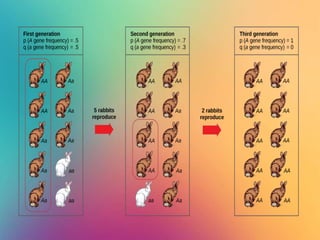
GENETIC DRIFT
• Genetic drift is the change in allele frequency from one generation
to the next that occurs because alleles are subject to sampling
error.
• As a result, when selective forces are absent or relatively weak,
allele frequencies tend to "drift" upward or downward randomly
(in a random walk).
• This drift halts when an allele eventually becomes fixed, either by
disappearing from the population, or replacing the other alleles
entirely.
• Genetic drift may therefore eliminate some alleles from a
population due to chance alone. Even in the absence of selective
forces, genetic drift can cause two separate populations that
began with the same genetic structure to drift apart into two
divergent populations with different sets of alleles.
.
Genetic hitchhiking
•Recombination allows alleles on the same strand of DNA to become
separated. However, the rate of recombination is low (approximately
two events per chromosome per generation).
• As a result, genes close together on a chromosome may not always
be shuffled away from each other and genes that are close together
tend to be inherited together, a phenomenon known as linkage. This
tendency is measured by finding how often two alleles occur
together on a single chromosome compared to expectations, which is
called their linkage disequilibrium.
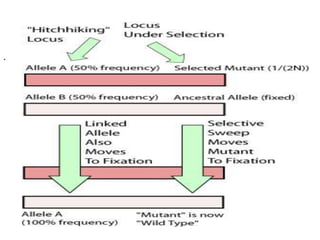
•A set of alleles that is usually inherited in a group is called
a haplotype,natural selection can drive a selective sweep that will
also cause the other alleles in the haplotype to become more
common in the population; this effect is called genetic hitchhiking .
.
.
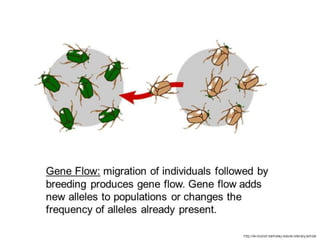
Gene flow
•Gene flow involves the exchange of genes between populations
and between species. The presence or absence of gene flow
fundamentally changes the course of evolution.
•Due to the complexity of organisms, any two completely
isolated populations will eventually evolve genetic
incompatibilities through neutral processes, as in the Bateson-
Dobzhansky-Muller model, even if both populations remain
essentially identical in terms of their adaptation to the
environment.
•If genetic differentiation between populations develops,
gene flow between populations can introduce traits or
alleles which are disadvantageous in the local population.
.
.
•This may lead to organisms within these populations evolving
mechanisms that prevent mating with genetically distant
populations, eventually resulting in the appearance of new species
• exchange of genetic information between individuals is
fundamentally important for the development of the biological
species concept.
During the development of the modern synthesis, Sewall Wright
developed his shifting balance theory, which regarded gene flow
between partially isolated populations as an important aspect of
adaptive evolution.However, recently there has been substantial
criticism of the importance of the shifting balance theory
.
•exchange of genetic information between individuals is
fundamentally important for the development of the biological
species concept.
•During the development of the modern synthesis, Sewall Wright
developed his shifting balance theory, which regarded gene flow
between partially isolated populations as an important aspect of
adaptive evolution. However, recently there has been substantial
criticism of the importance of the shifting balance theory
ADAPTATION
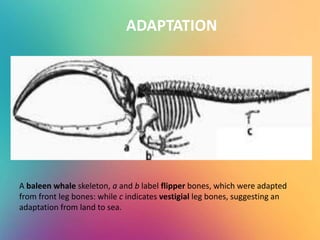
A baleen whale skeleton, a and b label flipper bones, which were adapted
from front leg bones: while c indicates vestigial leg bones, suggesting an
adaptation from land to sea.
•Adaptation is the process that makes organisms better suited to
their habitat.[Also, the term adaptation may refer to a trait that is
important for an organism's survival
• For example, the adaptation of horses' teeth to the grinding of
grass. By using the term adaptation for the evolutionary process
andadaptive trait for the product (the bodily part or function), the
two senses of the word may be distinguished.
•Adaptations are produced by natural selection
ADAPTATION
The following definitions are due to Theodosius Dobzhansky:
•Adaptation is the evolutionary process whereby an organism
becomes better able to live in its habitat or habitats.
•Adaptedness is the state of being adapted: the degree to which an
organism is able to live and reproduce in a given set of habitats.
•An adaptive trait is an aspect of the developmental pattern of the
organism which enables or enhances the probability of that organism
surviving and reproducing.
•Adaptation occurs through the gradual modification of existing
structures. Consequently, structures with similar internal
organisation may have different functions in related organisms. This
is the result of a single ancestral structure.
•many traits that appear to be simple adaptations are in
fact exaptations: structures originally adapted for one function, but
which coincidentally became somewhat useful for some other
function in the process
•One example is the African lizard Holaspis guentheri, which
developed an extremely flat head for hiding in crevices, as can be
seen by looking at its near relatives. However, in this species, the
head has become so flattened that it assists in gliding from tree to
tree—an exaptation.
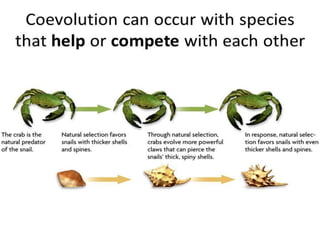
Coevolution
•In biology, coevolution occurs when changes in species' genetic
compositions reciprocally affect each other's evolution.
•An example is the production of tetrodotoxin in the rough-skinn
newt and the evolution of tetrodotoxin resistance in its predator,
the common garter snake. In this predator-prey pair,
an evolutionary arms race has produced high levels of toxin in
the newt and correspondingly high levels of toxin resistance in
the snake
•One more example
Coevolution
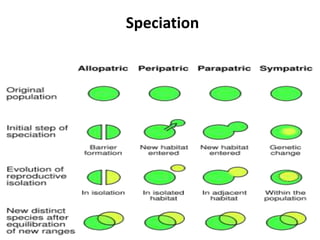
Speciation
Speciation
•Speciation is the process where a species diverges into two or more
descendant species.
•There are multiple ways to define the concept of "species." The
choice of definition is dependent on the particularities of the species
concerned.
•For example, some species concepts apply more readily toward
sexually reproducing organisms while others lend themselves better
toward asexual organisms
•Despite the diversity of various species concepts, these various
concepts can be placed into one of three broad philosophical
approaches: interbreeding, ecological and phylogenetic.
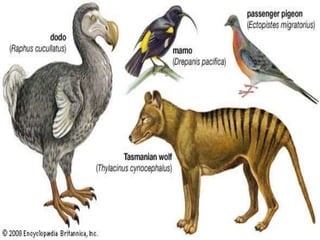
Extinction
Extinction is the end of an organism or of a group of organisms
(taxon), normally a species. The moment of extinction is generally
considered to be the death of the last individual of the species,
although the capacity to breed and recover may have been lost
before this point.
More than 99 percent of all species, amounting to over five billion
species, that ever lived on Earth are estimated to be extinct
Mass extinctions are relatively rare events; however, isolated
extinctions are quite common. Only recently have extinctions been
recorded and scientists have become alarmed at the current high
rate of extinctions
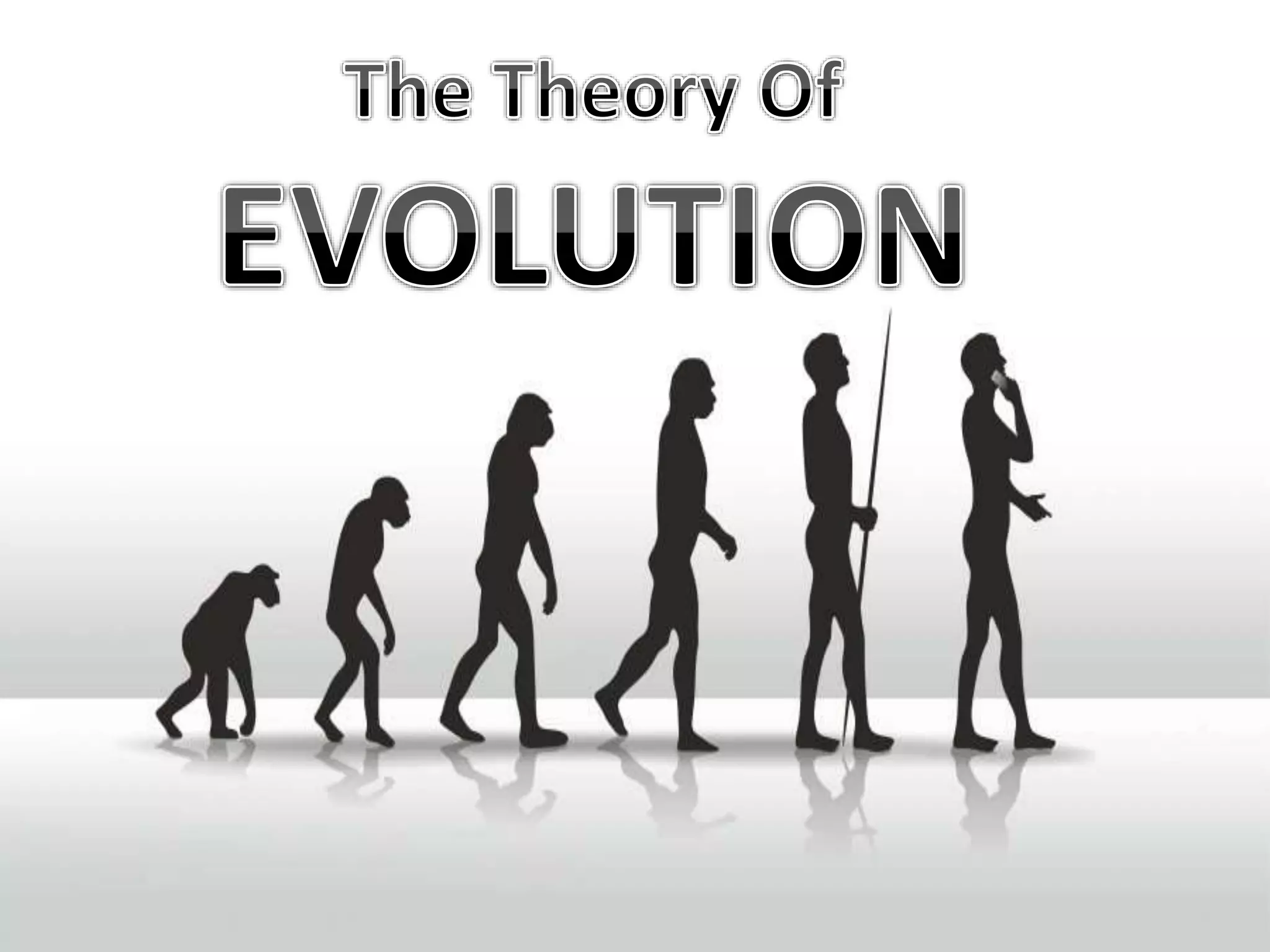
Evolution

Evolution

  • 2.
    1. 1. Introductionto Evolution 2. 2.History of evolutionary thought 3. Heredity 4. Variation • 4.1 Mutation • 4.2 Sex and recombination • 4.3 Gene flow 5. Mechanisms • 5.1 Natural selection • 5.2 Biased mutation • 5.3 Genetic drift • 5.4 Genetic hitchhiking • 5.5 Gene flow 6. Outcomes • 6.1 Adaptation • 6.2 Coevolution • 6.3 Cooperation • 6.4 Speciation • 6.5 Extinction 7. Evolutionary history of life • 7.1 Origin of life • 7.2 Common descent • 7.3 Evolution of life 8. Applications 9. Social and cultural responses
  • 5.
    History of EvolutionaryThought • The word "evolution" in its broadest sense refers to change or growth that occurs in a particular order. • That use of the term dates back to the ancient Greeks, but today the word is more often used to refer to Darwin's theory of evolution by natural selection. This theory is sometimes crudely referred to as the theory of "survival of the fittest.“
  • 6.
    •Greek and medievalreferences to "evolution" use it as a descriptive term for a state of nature, in which everything in nature has a certain order or purpose. This is a teleological view of nature. For example, Aristotle classified all living organisms hierarchically in his Greatscala naturae or Great Chain of Being, with plants at the bottom, moving through lesser animals, and on to humans at the pinnacle of creation, each becoming progressively more perfect in form. It was the medieval philosophers, such as Augustine who began to incorporate teleological views of nature with religion: God is the designer of all creatures, and everything has a purpose and a place as ordained by Him.
  • 7.
    Several views onEvolution •Ancient Greek Views •Medieval Views •In Modern Philosophy •In German Idealism •Darwin’s View •Spencer’s View
  • 8.
    HEREDITY •Evolution in organismsoccurs through changes in heritable traits—the inherited characteristics of an organism. In humans, for example, eye colour is an inherited characteristic and an individual might inherit the "brown-eye trait" from one of their parents inherited traits are controlled by genes and the complete set of genes within an organism's genome (genetic material) is called its genotype. •The complete set of observable traits that make up the structure and behaviour of an organism is called its phenotype. These traits come from the interaction of its genotype with the environment.As a result, many aspects of an organism's phenotype are not inherited
  • 9.
    •Heritable traits arepassed from one generation to the next via DNA molecules, that encodes genetic information •Heritability may also occur at even larger scales. •Other examples of heritability in evolution that are not under the direct control of genes include the inheritance of cultural traits and symbiogenesis
  • 10.
    Variation • An individualorganism's phenotype results from both its genotype and the influence from the environment it has lived in. • A substantial part of the phenotypic variation in a population is caused by genotypic variation. • The modern evolutionary synthesis defines evolution as the change over time in this genetic variation. • The frequency of one particular allele will become more or less prevalent relative to other forms of that gene. Variation disappears when a new allele reaches the point of fixation—when it either disappears from the population or replaces the ancestral allele entirely.
  • 11.
    • Natural selectionwill only cause evolution if there is enough genetic variation in a population. • Before the discovery of Mendelian genetics, one common hypothesis was blending inheritance. But with blending inheritance, genetic variance would be rapidly lost, making evolution by natural selection implausible. • The Hardy–Weinberg principle provides the solution to how variation is maintained in a population with Mendelian inheritance. The frequencies of alleles (variations in a gene) will remain constant in the absence of selection, mutation, migration and genetic drift.
  • 12.
    • Variation comesfrom mutations in the genome, reshuffling of genes through sexual reproduction and migration between populations (gene flow). • Despite the constant introduction of new variation through mutation and gene flow, most of the genome of a species is identical in all individuals of that species. • However, even relatively small differences in genotype can lead to dramatic differences in phenotype: for example, chimpanzees and humans differ in only about 5% of their genomes.
  • 13.
    MUTATION • Mutations arechanges in the DNA sequence of a cell's genome. When mutations occur, they may alter the product of a gene, or prevent the gene from functioning, or have no effect. • Mutations can involve large sections of a chromosome becoming duplicated (usually by genetic recombination), which can introduce extra copies of a gene into a genome. • The generation of new genes can also involve small parts of several genes being duplicated, with these fragments then recombining to form new combinations with new functions.
  • 14.
    SEX AND RECOMBINATION • Inasexual organisms, genes are inherited together, or linked, as they cannot mix with genes of other organisms during reproduction. In contrast, the offspring of sexual organisms contain random mixtures of their parents' chromosomes that are produced through independent assortment. In a related process called homologous recombination, sexual organisms exchange DNA between two matching chromosomes
  • 15.
    GENE FLOW • Geneflow is the exchange of genes between populations and between species. It can therefore be a source of variation that is new to a population or to a species. Gene flow can be caused by the movement of individuals between separate populations of organisms, as might be caused by the movement of mice between inland and coastal populations, or the movement of pollen between heavy metal tolerant and heavy metal sensitive populations of grasses. • Gene transfer between species includes the formation of hybrid organisms and horizontal gene transfer. Horizontal gene transfer is the transfer of genetic material from one organism to another organism that is not its offspring; this is most common among bacteria
  • 16.
    MECHANISM • Froma Neo-Darwinian perspective, evolution occurs when there are changes in the frequencies of alleles within a population of interbreeding organisms. For example, the allele for black color in a population of moths becoming more common. Mechanisms that can lead to changes in allele frequencies include natural selection, genetic drift, genetic hitchhiking, mutation and gene flow.
  • 17.
    NATURAL SELECTION Evolution bymeans of natural selection is the process by which traits that enhance survival and reproduction become more common in successive generations of a population. It has often been called a "self-evident" mechanism because it necessarily follows from three simple facts: • Variation exists within populations of organisms with respect to morphology, physiology, and behavior (phenotypic variation). • Different traits confer different rates of survival and reproduction (differential fitness). • These traits can be passed from generation to generation (heritability of fitness).
  • 19.
    BIASED MUTATION • Inaddition to being a major source of variation, mutation may also function as a mechanism of evolution when there are different probabilities at the molecular level for different mutations to occur, a process known as mutation bias. • If two genotypes, for example one with the nucleotide G and another with the nucleotide A in the same position, have the same fitness, but mutation from G to A happens more often than mutation from A to G, then genotypes with A will tend to evolve. • Different insertion vs. deletion mutation biases in different taxa can lead to the evolution of different genome sizes. Developmental or mutational biases have also been observed in morphological evolution.For example, according to the phenotype-first theory of evolution, mutations can eventually cause the genetic assimilation of traits that were previously induced by the environment.
  • 20.
    GENETIC DRIFT • Geneticdrift is the change in allele frequency from one generation to the next that occurs because alleles are subject to sampling error. • As a result, when selective forces are absent or relatively weak, allele frequencies tend to "drift" upward or downward randomly (in a random walk). • This drift halts when an allele eventually becomes fixed, either by disappearing from the population, or replacing the other alleles entirely. • Genetic drift may therefore eliminate some alleles from a population due to chance alone. Even in the absence of selective forces, genetic drift can cause two separate populations that began with the same genetic structure to drift apart into two divergent populations with different sets of alleles.
  • 22.
    . Genetic hitchhiking •Recombination allowsalleles on the same strand of DNA to become separated. However, the rate of recombination is low (approximately two events per chromosome per generation). • As a result, genes close together on a chromosome may not always be shuffled away from each other and genes that are close together tend to be inherited together, a phenomenon known as linkage. This tendency is measured by finding how often two alleles occur together on a single chromosome compared to expectations, which is called their linkage disequilibrium. •A set of alleles that is usually inherited in a group is called a haplotype,natural selection can drive a selective sweep that will also cause the other alleles in the haplotype to become more common in the population; this effect is called genetic hitchhiking .
  • 23.
  • 24.
    . Gene flow •Gene flowinvolves the exchange of genes between populations and between species. The presence or absence of gene flow fundamentally changes the course of evolution. •Due to the complexity of organisms, any two completely isolated populations will eventually evolve genetic incompatibilities through neutral processes, as in the Bateson- Dobzhansky-Muller model, even if both populations remain essentially identical in terms of their adaptation to the environment. •If genetic differentiation between populations develops, gene flow between populations can introduce traits or alleles which are disadvantageous in the local population.
  • 25.
  • 26.
    . •This may leadto organisms within these populations evolving mechanisms that prevent mating with genetically distant populations, eventually resulting in the appearance of new species • exchange of genetic information between individuals is fundamentally important for the development of the biological species concept. During the development of the modern synthesis, Sewall Wright developed his shifting balance theory, which regarded gene flow between partially isolated populations as an important aspect of adaptive evolution.However, recently there has been substantial criticism of the importance of the shifting balance theory
  • 27.
    . •exchange of geneticinformation between individuals is fundamentally important for the development of the biological species concept. •During the development of the modern synthesis, Sewall Wright developed his shifting balance theory, which regarded gene flow between partially isolated populations as an important aspect of adaptive evolution. However, recently there has been substantial criticism of the importance of the shifting balance theory
  • 28.
    ADAPTATION A baleen whaleskeleton, a and b label flipper bones, which were adapted from front leg bones: while c indicates vestigial leg bones, suggesting an adaptation from land to sea.
  • 29.
    •Adaptation is theprocess that makes organisms better suited to their habitat.[Also, the term adaptation may refer to a trait that is important for an organism's survival • For example, the adaptation of horses' teeth to the grinding of grass. By using the term adaptation for the evolutionary process andadaptive trait for the product (the bodily part or function), the two senses of the word may be distinguished. •Adaptations are produced by natural selection ADAPTATION
  • 30.
    The following definitionsare due to Theodosius Dobzhansky: •Adaptation is the evolutionary process whereby an organism becomes better able to live in its habitat or habitats. •Adaptedness is the state of being adapted: the degree to which an organism is able to live and reproduce in a given set of habitats. •An adaptive trait is an aspect of the developmental pattern of the organism which enables or enhances the probability of that organism surviving and reproducing.
  • 31.
    •Adaptation occurs throughthe gradual modification of existing structures. Consequently, structures with similar internal organisation may have different functions in related organisms. This is the result of a single ancestral structure. •many traits that appear to be simple adaptations are in fact exaptations: structures originally adapted for one function, but which coincidentally became somewhat useful for some other function in the process •One example is the African lizard Holaspis guentheri, which developed an extremely flat head for hiding in crevices, as can be seen by looking at its near relatives. However, in this species, the head has become so flattened that it assists in gliding from tree to tree—an exaptation.
  • 32.
    Coevolution •In biology, coevolutionoccurs when changes in species' genetic compositions reciprocally affect each other's evolution. •An example is the production of tetrodotoxin in the rough-skinn newt and the evolution of tetrodotoxin resistance in its predator, the common garter snake. In this predator-prey pair, an evolutionary arms race has produced high levels of toxin in the newt and correspondingly high levels of toxin resistance in the snake •One more example
  • 33.
  • 34.
  • 35.
    Speciation •Speciation is theprocess where a species diverges into two or more descendant species. •There are multiple ways to define the concept of "species." The choice of definition is dependent on the particularities of the species concerned. •For example, some species concepts apply more readily toward sexually reproducing organisms while others lend themselves better toward asexual organisms •Despite the diversity of various species concepts, these various concepts can be placed into one of three broad philosophical approaches: interbreeding, ecological and phylogenetic.
  • 36.
    Extinction Extinction is theend of an organism or of a group of organisms (taxon), normally a species. The moment of extinction is generally considered to be the death of the last individual of the species, although the capacity to breed and recover may have been lost before this point. More than 99 percent of all species, amounting to over five billion species, that ever lived on Earth are estimated to be extinct Mass extinctions are relatively rare events; however, isolated extinctions are quite common. Only recently have extinctions been recorded and scientists have become alarmed at the current high rate of extinctions