The exponential function is very important
in math because it is used to model many
real life situations.


◦ For example: population growth and
decay, compound interest, economics,
and much more.
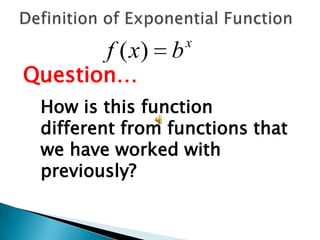
f ( x) b

x

Question…

How is this function
different from functions that
we have worked with
previously?
Answer:

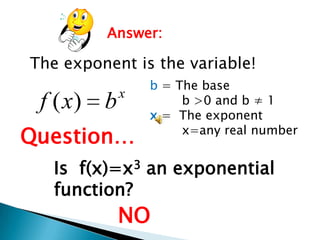
The exponent is the variable!

f ( x) b

x

Question…

b = The base
b >0 and b ≠ 1
x = The exponent
x=any real number

Is f(x)=x3 an exponential
function?

NO


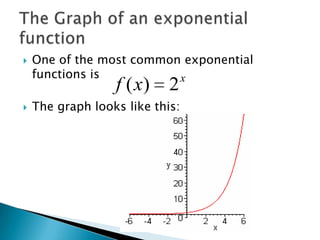
One of the most common exponential
functions is
x

f ( x)



2

The graph looks like this:
f ( x)

2

x

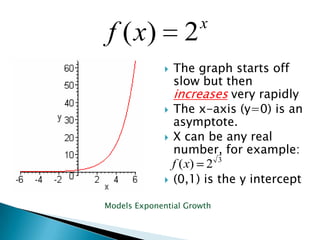
The graph starts off
slow but then
increases very rapidly
 The x-axis (y=0) is an
asymptote.
 X can be any real
number, for example:
f (x) 2 3
 (0,1) is the y intercept


Models Exponential Growth
Question…
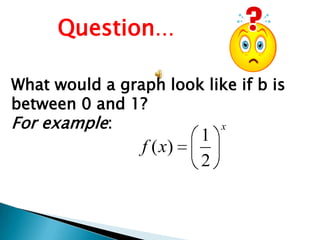
What would a graph look like if b is
between 0 and 1?
For example:
x

f ( x)

1
2
f ( x)

1
2

x







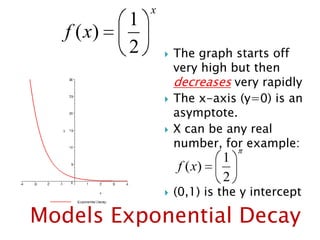
The graph starts off
very high but then
decreases very rapidly
The x-axis (y=0) is an
asymptote.
X can be any real
number, for example:

f (x)


1
2

(0,1) is the y intercept

Models Exponential Decay
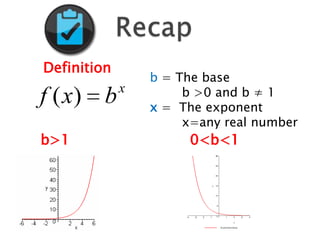
Definition

f ( x) b
b>1

x

b = The base
b >0 and b ≠ 1
x = The exponent
x=any real number

0<b<1


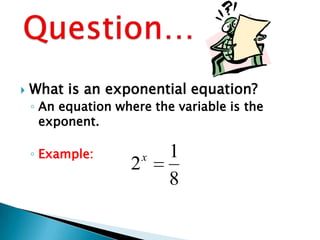
What is an exponential equation?
◦ An equation where the variable is the
exponent.
◦ Example:

2

x

1
8
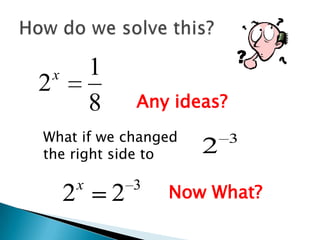
2

1
8

x

Any ideas?

What if we changed
the right side to

2

x

2

3

2

3

Now What?
x

2
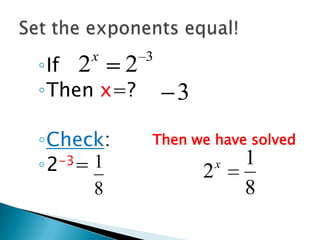
◦If 2
◦Then x=?
◦Check:
-3= 1
◦2
8

3

3
Then we have solved

2

x

1
8
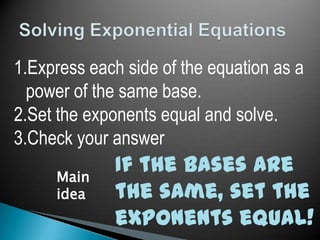
1.Express each side of the equation as a
power of the same base.
2.Set the exponents equal and solve.
3.Check your answer
Main
idea

If the bases are
the same, set the
exponents equal!


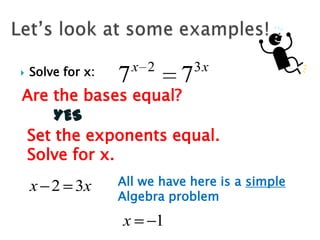
Solve for x:

7

x 2

7

3x

Are the bases equal?
YES
Set the exponents equal.
Solve for x.

x 2 3x

All we have here is a simple
Algebra problem

x

1
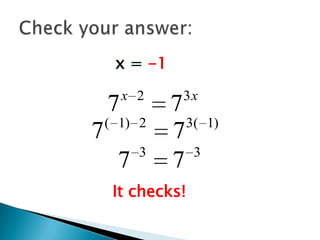
x = -1

7
7

x 2

( 1) 2

7

3

3x

7
3( 1)
7
3
7

It checks!


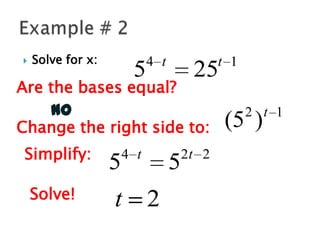
Solve for x:

5

4 t

t 1

25

Are the bases equal?
NO
Change the right side to:
Simplify:

Solve!

5

4 t

t

5

2

2t 2

2 t 1

(5 )
t=2
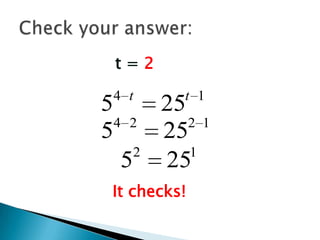
4 t

t 1

5
25
4 2
2 1
5
25
2
1
5 25
It checks!


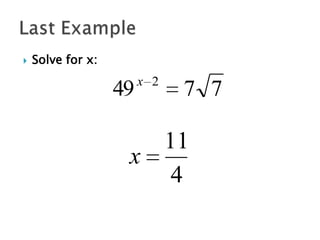
Solve for x:

49

x 2

7 7

11
x
4


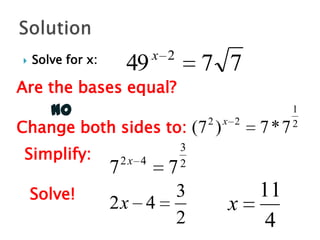
Solve for x:

49

x 2

7 7

Are the bases equal?
NO
2 x
Change both sides to: (7 )
Simplify:

Solve!

7

2x 4

2

7*7

3
2

7
3
2x 4
2

11
x
4

1
2
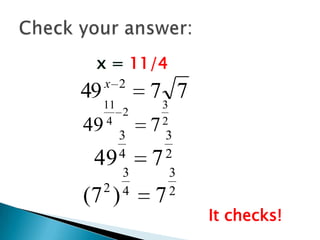
x = 11/4
x 2

49 11
49 4

2

3
4
3
2 4

73 7
7 23
2
3
2

49

7

(7 )

7

It checks!
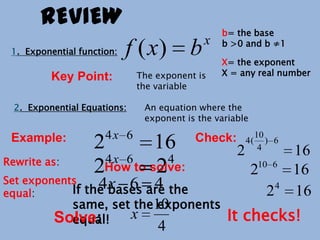
REVIEW
1. Exponential function:

f ( x) b

Key Point:
2. Exponential Equations:

Example:
Rewrite as:

x

The exponent is
the variable

b= the base
b >0 and b ≠1
X= the exponent
X = any real number

An equation where the
exponent is the variable

4x 6

2
16
4x 6
4
2How to solve:
2

Set exponents
4x 6 4
If the bases are the
equal:

Check:

same, set the10
exponents
x
Solve:
equal!

4

2

4(

10
) 6
4

10 6

2

2

4

16
16
16

It checks!
Homework:

Exponential
Equations
Worksheet

Exponential functions

  • 2.
    The exponential functionis very important in math because it is used to model many real life situations.  ◦ For example: population growth and decay, compound interest, economics, and much more.
  • 3.
    f ( x)b x Question… How is this function different from functions that we have worked with previously?
  • 4.
    Answer: The exponent isthe variable! f ( x) b x Question… b = The base b >0 and b ≠ 1 x = The exponent x=any real number Is f(x)=x3 an exponential function? NO
  • 5.
     One of themost common exponential functions is x f ( x)  2 The graph looks like this:
  • 6.
    f ( x) 2 x Thegraph starts off slow but then increases very rapidly  The x-axis (y=0) is an asymptote.  X can be any real number, for example: f (x) 2 3  (0,1) is the y intercept  Models Exponential Growth
  • 7.
    Question… What would agraph look like if b is between 0 and 1? For example: x f ( x) 1 2
  • 8.
    f ( x) 1 2 x    Thegraph starts off very high but then decreases very rapidly The x-axis (y=0) is an asymptote. X can be any real number, for example: f (x)  1 2 (0,1) is the y intercept Models Exponential Decay
  • 9.
    Definition f ( x)b b>1 x b = The base b >0 and b ≠ 1 x = The exponent x=any real number 0<b<1
  • 11.
     What is anexponential equation? ◦ An equation where the variable is the exponent. ◦ Example: 2 x 1 8
  • 12.
    2 1 8 x Any ideas? What ifwe changed the right side to 2 x 2 3 2 3 Now What?
  • 13.
    x 2 ◦If 2 ◦Then x=? ◦Check: -3=1 ◦2 8 3 3 Then we have solved 2 x 1 8
  • 14.
    1.Express each sideof the equation as a power of the same base. 2.Set the exponents equal and solve. 3.Check your answer Main idea If the bases are the same, set the exponents equal!
  • 15.
     Solve for x: 7 x2 7 3x Are the bases equal? YES Set the exponents equal. Solve for x. x 2 3x All we have here is a simple Algebra problem x 1
  • 16.
    x = -1 7 7 x2 ( 1) 2 7 3 3x 7 3( 1) 7 3 7 It checks!
  • 17.
     Solve for x: 5 4t t 1 25 Are the bases equal? NO Change the right side to: Simplify: Solve! 5 4 t t 5 2 2t 2 2 t 1 (5 )
  • 18.
    t=2 4 t t 1 5 25 42 2 1 5 25 2 1 5 25 It checks!
  • 19.
  • 20.
     Solve for x: 49 x2 7 7 Are the bases equal? NO 2 x Change both sides to: (7 ) Simplify: Solve! 7 2x 4 2 7*7 3 2 7 3 2x 4 2 11 x 4 1 2
  • 21.
    x = 11/4 x2 49 11 49 4 2 3 4 3 2 4 73 7 7 23 2 3 2 49 7 (7 ) 7 It checks!
  • 22.
    REVIEW 1. Exponential function: f( x) b Key Point: 2. Exponential Equations: Example: Rewrite as: x The exponent is the variable b= the base b >0 and b ≠1 X= the exponent X = any real number An equation where the exponent is the variable 4x 6 2 16 4x 6 4 2How to solve: 2 Set exponents 4x 6 4 If the bases are the equal: Check: same, set the10 exponents x Solve: equal! 4 2 4( 10 ) 6 4 10 6 2 2 4 16 16 16 It checks!
  • 23.