4.1 Inverse Functions
Chapter 4 Inverse, Exponential, and Logarithmic
Functions
Concepts & Objectives
 Inverse Functions
 Review composition of functions
 Identify 1-1 functions
 Find the inverse of a 1-1 function
Composition of Functions
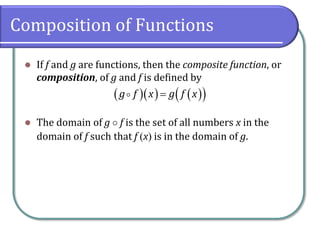
 If f and g are functions, then the composite function, or
composition, of g and f is defined by
 The domain of g  f is the set of all numbers x in the
domain of f such that f x is in the domain of g.
    
 

g f x g f x
Composition of Functions (cont.)
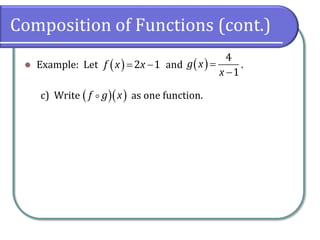
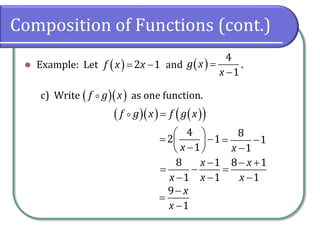
 Example: Let and .
c) Write as one function.
  
2 1
f x x  

4
1
g x
x
  
f g x
Composition of Functions (cont.)
 Example: Let and .
c) Write as one function.
  
2 1
f x x  

4
1
g x
x
  
f g x
    
 
f g x f g x

4
2 1
1
x
 
 
 

 
8
1
1
x
 

8 1 8 1
1 1 1
x x
x x x
  
  
  
9
1
x
x



One-to-One Functions
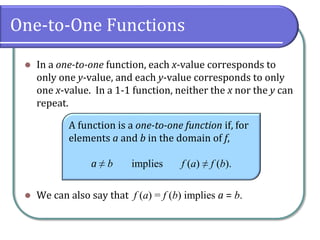
 In a one-to-one function, each x-value corresponds to
only one y-value, and each y-value corresponds to only
one x-value. In a 1-1 function, neither the x nor the y can
repeat.
 We can also say that f a = f b implies a = b.
A function is a one-to-one function if, for
elements a and b in the domain of f,
a ≠ b implies f a ≠ f b.
One-to-One Functions (cont.)
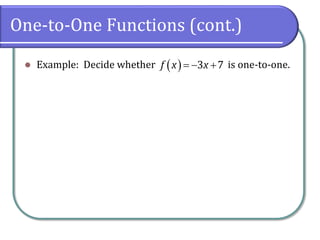
 Example: Decide whether is one-to-one.
   
3 7
f x x
One-to-One Functions (cont.)
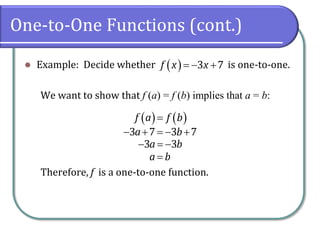
 Example: Decide whether is one-to-one.
We want to show that f a = f b implies that a = b:
Therefore, f is a one-to-one function.
   
3 7
f x x
   
f a f b

3 7 3 7
a b
    
3 3
a b
  
a b

One-to-One Functions (cont.)
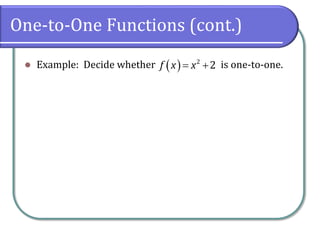
 Example: Decide whether is one-to-one.
  2
2
f x x
 
One-to-One Functions (cont.)
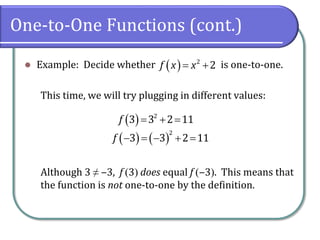
 Example: Decide whether is one-to-one.
This time, we will try plugging in different values:
Although 3 ≠ ‒3, f 3 does equal f ‒3. This means that
the function is not one-to-one by the definition.
  2
2
f x x
 
  2
3 3 2 11
f   
   
2
3 3 2 11
f     
One-to-One Functions (cont.)
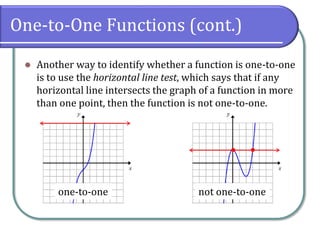
 Another way to identify whether a function is one-to-one
is to use the horizontal line test, which says that if any
horizontal line intersects the graph of a function in more
than one point, then the function is not one-to-one.


one-to-one not one-to-one
Inverse Functions
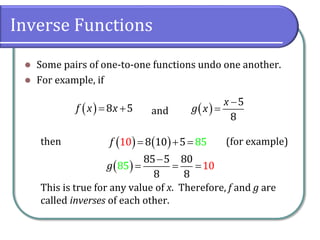
 Some pairs of one-to-one functions undo one another.
 For example, if
and
then (for example)
This is true for any value of x. Therefore, f and g are
called inverses of each other.
  8 5
f x x
   
5
8
x
g x


   
8 10 8
10 5 5
f   
 
85 5 80
8
8
8
10
5
g

  
Inverse Functions (cont.)
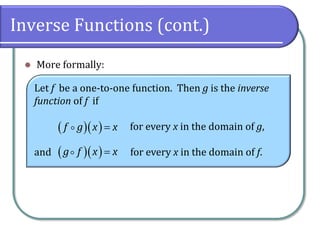
 More formally:
Let f be a one-to-one function. Then g is the inverse
function of f if
for every x in the domain of g,
and for every x in the domain of f.
  
f g x x

  
g f x x

Inverse Functions (cont.)
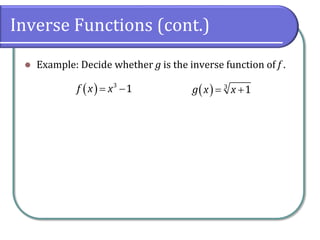
 Example: Decide whether g is the inverse function of f .
  3
1
f x x
    3
1
g x x
 
Inverse Functions (cont.)
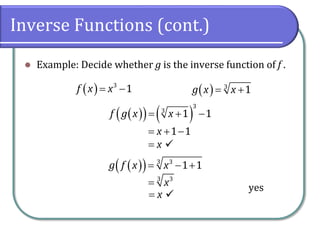
 Example: Decide whether g is the inverse function of f .
yes
  3
1
f x x
    3
1
g x x
 
 
   
3
3
1 1
f g x x
  
1 1
x
  
x

 
  3 3
1 1
g f x x
  
3 3
x

x

Inverse Functions (cont.)
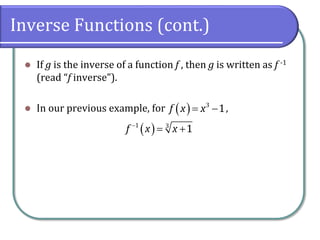
 If g is the inverse of a function f , then g is written as f -1
(read “f inverse”).
 In our previous example, for ,
  3
1
f x x
 
 
1 3
1
f x x

 
Finding Inverses
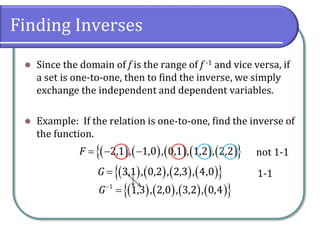
 Since the domain of f is the range of f -1 and vice versa, if
a set is one-to-one, then to find the inverse, we simply
exchange the independent and dependent variables.
 Example: If the relation is one-to-one, find the inverse of
the function.
         
 
2,1 , 1,0 , 0,1 , 1,2 , 2,2
F    not 1-1
       
 
3,1 , 0,2 , 2,3 , 4,0
G  1-1
       
 
1
1,3 , 2,0 , 3,2 , 0,4
G

Finding Inverses (cont.)
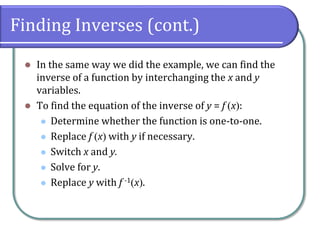
 In the same way we did the example, we can find the
inverse of a function by interchanging the x and y
variables.
 To find the equation of the inverse of y = f x:
 Determine whether the function is one-to-one.
 Replace f x with y if necessary.
 Switch x and y.
 Solve for y.
 Replace y with f -1x.
Finding Inverses (cont.)
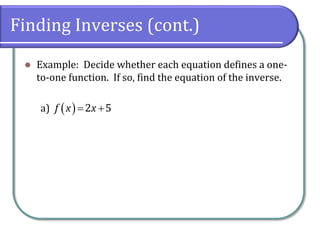
 Example: Decide whether each equation defines a one-
to-one function. If so, find the equation of the inverse.
a)   2 5
f x x
 
Finding Inverses (cont.)
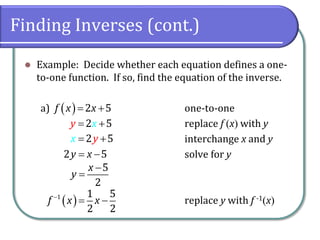
 Example: Decide whether each equation defines a one-
to-one function. If so, find the equation of the inverse.
a) one-to-one
replace f x with y
interchange x and y
solve for y
replace y with f -1x
  2 5
f x x
 
2 5
y x
 
2 5
x y
 
2 5
y x
 
5
2
x
y


 
1 1 5
2 2
f x x

 
Graphing Inverses
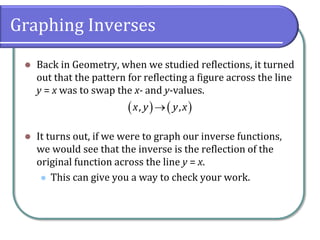
 Back in Geometry, when we studied reflections, it turned
out that the pattern for reflecting a figure across the line
y = x was to swap the x- and y-values.
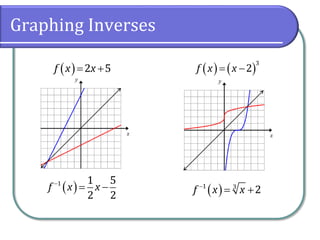
 It turns out, if we were to graph our inverse functions,
we would see that the inverse is the reflection of the
original function across the line y = x.
 This can give you a way to check your work.
   
, ,
x y y x

Graphing Inverses
  2 5
f x x
     
3
2
f x x
 
 
1 1 5
2 2
f x x

   
1 3
2
f x x

 
Classwork
 4.1 Assignment (College Algebra)
 Page 413: 42-50; page 384: 22-30; page 376: 112-116
 4.1 Classwork Check
 Quiz 3.6

4.1 Inverse Functions

  • 1.
    4.1 Inverse Functions Chapter4 Inverse, Exponential, and Logarithmic Functions
  • 2.
    Concepts & Objectives Inverse Functions  Review composition of functions  Identify 1-1 functions  Find the inverse of a 1-1 function
  • 3.
    Composition of Functions If f and g are functions, then the composite function, or composition, of g and f is defined by  The domain of g  f is the set of all numbers x in the domain of f such that f x is in the domain of g.         g f x g f x
  • 4.
    Composition of Functions(cont.)  Example: Let and . c) Write as one function.    2 1 f x x    4 1 g x x    f g x
  • 5.
    Composition of Functions(cont.)  Example: Let and . c) Write as one function.    2 1 f x x    4 1 g x x    f g x        f g x f g x  4 2 1 1 x          8 1 1 x    8 1 8 1 1 1 1 x x x x x          9 1 x x   
  • 6.
    One-to-One Functions  Ina one-to-one function, each x-value corresponds to only one y-value, and each y-value corresponds to only one x-value. In a 1-1 function, neither the x nor the y can repeat.  We can also say that f a = f b implies a = b. A function is a one-to-one function if, for elements a and b in the domain of f, a ≠ b implies f a ≠ f b.
  • 7.
    One-to-One Functions (cont.) Example: Decide whether is one-to-one.     3 7 f x x
  • 8.
    One-to-One Functions (cont.) Example: Decide whether is one-to-one. We want to show that f a = f b implies that a = b: Therefore, f is a one-to-one function.     3 7 f x x     f a f b  3 7 3 7 a b      3 3 a b    a b 
  • 9.
    One-to-One Functions (cont.) Example: Decide whether is one-to-one.   2 2 f x x  
  • 10.
    One-to-One Functions (cont.) Example: Decide whether is one-to-one. This time, we will try plugging in different values: Although 3 ≠ ‒3, f 3 does equal f ‒3. This means that the function is not one-to-one by the definition.   2 2 f x x     2 3 3 2 11 f        2 3 3 2 11 f     
  • 11.
    One-to-One Functions (cont.) Another way to identify whether a function is one-to-one is to use the horizontal line test, which says that if any horizontal line intersects the graph of a function in more than one point, then the function is not one-to-one.   one-to-one not one-to-one
  • 12.
    Inverse Functions  Somepairs of one-to-one functions undo one another.  For example, if and then (for example) This is true for any value of x. Therefore, f and g are called inverses of each other.   8 5 f x x     5 8 x g x       8 10 8 10 5 5 f      85 5 80 8 8 8 10 5 g    
  • 13.
    Inverse Functions (cont.) More formally: Let f be a one-to-one function. Then g is the inverse function of f if for every x in the domain of g, and for every x in the domain of f.    f g x x     g f x x 
  • 14.
    Inverse Functions (cont.) Example: Decide whether g is the inverse function of f .   3 1 f x x     3 1 g x x  
  • 15.
    Inverse Functions (cont.) Example: Decide whether g is the inverse function of f . yes   3 1 f x x     3 1 g x x         3 3 1 1 f g x x    1 1 x    x      3 3 1 1 g f x x    3 3 x  x 
  • 16.
    Inverse Functions (cont.) If g is the inverse of a function f , then g is written as f -1 (read “f inverse”).  In our previous example, for ,   3 1 f x x     1 3 1 f x x   
  • 17.
    Finding Inverses  Sincethe domain of f is the range of f -1 and vice versa, if a set is one-to-one, then to find the inverse, we simply exchange the independent and dependent variables.  Example: If the relation is one-to-one, find the inverse of the function.             2,1 , 1,0 , 0,1 , 1,2 , 2,2 F    not 1-1           3,1 , 0,2 , 2,3 , 4,0 G  1-1           1 1,3 , 2,0 , 3,2 , 0,4 G 
  • 18.
    Finding Inverses (cont.) In the same way we did the example, we can find the inverse of a function by interchanging the x and y variables.  To find the equation of the inverse of y = f x:  Determine whether the function is one-to-one.  Replace f x with y if necessary.  Switch x and y.  Solve for y.  Replace y with f -1x.
  • 19.
    Finding Inverses (cont.) Example: Decide whether each equation defines a one- to-one function. If so, find the equation of the inverse. a)   2 5 f x x  
  • 20.
    Finding Inverses (cont.) Example: Decide whether each equation defines a one- to-one function. If so, find the equation of the inverse. a) one-to-one replace f x with y interchange x and y solve for y replace y with f -1x   2 5 f x x   2 5 y x   2 5 x y   2 5 y x   5 2 x y     1 1 5 2 2 f x x   
  • 21.
    Graphing Inverses  Backin Geometry, when we studied reflections, it turned out that the pattern for reflecting a figure across the line y = x was to swap the x- and y-values.  It turns out, if we were to graph our inverse functions, we would see that the inverse is the reflection of the original function across the line y = x.  This can give you a way to check your work.     , , x y y x 
  • 22.
    Graphing Inverses  2 5 f x x       3 2 f x x     1 1 5 2 2 f x x      1 3 2 f x x   
  • 23.
    Classwork  4.1 Assignment(College Algebra)  Page 413: 42-50; page 384: 22-30; page 376: 112-116  4.1 Classwork Check  Quiz 3.6