Copyright © 2012 JOVIC G. RULLEPA
All Rights Reserved
Copyright © 2012 JOVIC G. RULLEPA
All Rights Reserved.
Objectives:
• Review polynomial function;
• Present real life examples of
rational function; and
• Define rational function.
Copyright © 2012 JOVIC G. RULLEPA
All Rights Reserved.
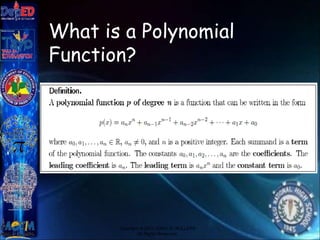
What is a Polynomial
Function?
Copyright © 2012 JOVIC G. RULLEPA
All Rights Reserved.
Copyright © 2012 JOVIC G. RULLEPA
All Rights Reserved
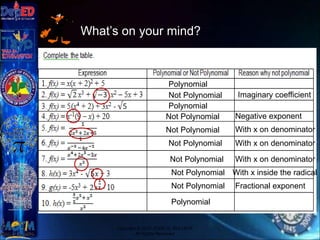
What’s on your mind?
Polynomial
Not Polynomial
Polynomial
Not Polynomial
Not Polynomial
Not Polynomial
Not Polynomial
Not Polynomial
Not Polynomial
Polynomial
With x on denominator
Imaginary coefficient
Negative exponent
With x on denominator
With x inside the radical
Fractional exponent
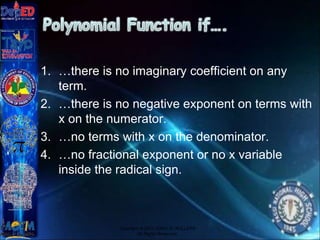
1. …there is no imaginary coefficient on any
term.
2. …there is no negative exponent on terms with
x on the numerator.
3. …no terms with x on the denominator.
4. …no fractional exponent or no x variable
inside the radical sign.
Copyright © 2012 JOVIC G. RULLEPA
All Rights Reserved.
1. The local barangay received a budget of PhP 100,000
to provide medical check ups for the children in the
barangay.
a. If the amount is to be allotted equally among all the
children in the barangay. Write an equation
representing the relationship of the allotted amount
per child (y-variable) versus the total number of
children (x-variable)
b. A philanthropist wants to supplement the budget
allotted for each child by providing an additional PhP
750 for each child in the barangay. If g(x) represents
this new amount allotted for each child, construct a
function representing this relationship.
Copyright © 2012 JOVIC G. RULLEPA
All Rights Reserved.
Copyright © 2012 JOVIC G. RULLEPA
All Rights Reserved
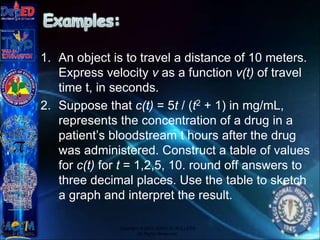
1. An object is to travel a distance of 10 meters.
Express velocity v as a function v(t) of travel
time t, in seconds.
2. Suppose that c(t) = 5t / (t2 + 1) in mg/mL,
represents the concentration of a drug in a
patient’s bloodstream t hours after the drug
was administered. Construct a table of values
for c(t) for t = 1,2,5, 10. round off answers to
three decimal places. Use the table to sketch
a graph and interpret the result.
Copyright © 2012 JOVIC G. RULLEPA
All Rights Reserved.
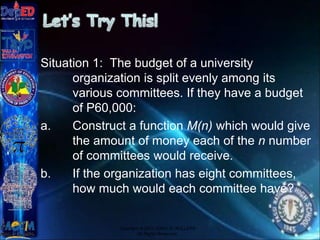
Situation 1: The budget of a university
organization is split evenly among its
various committees. If they have a budget
of P60,000:
a. Construct a function M(n) which would give
the amount of money each of the n number
of committees would receive.
b. If the organization has eight committees,
how much would each committee have?
Copyright © 2012 JOVIC G. RULLEPA
All Rights Reserved.
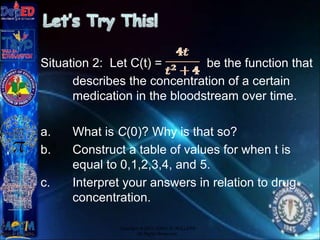
Situation 2: Let C(t) = be the function that
describes the concentration of a certain
medication in the bloodstream over time.
a. What is C(0)? Why is that so?
b. Construct a table of values for when t is
equal to 0,1,2,3,4, and 5.
c. Interpret your answers in relation to drug
concentration.
Copyright © 2012 JOVIC G. RULLEPA
All Rights Reserved.
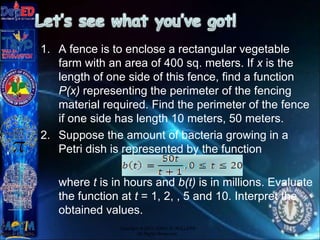
1. A fence is to enclose a rectangular vegetable
farm with an area of 400 sq. meters. If x is the
length of one side of this fence, find a function
P(x) representing the perimeter of the fencing
material required. Find the perimeter of the fence
if one side has length 10 meters, 50 meters.
2. Suppose the amount of bacteria growing in a
Petri dish is represented by the function
where t is in hours and b(t) is in millions. Evaluate
the function at t = 1, 2, , 5 and 10. Interpret the
obtained values.
Copyright © 2012 JOVIC G. RULLEPA
All Rights Reserved.
Copyright © 2012 JOVIC G. RULLEPA
All Rights Reserved.
Objectives:
• Distinguish rational functions,
rational equations and rational
inequalities.
Copyright © 2012 JOVIC G. RULLEPA
All Rights Reserved.
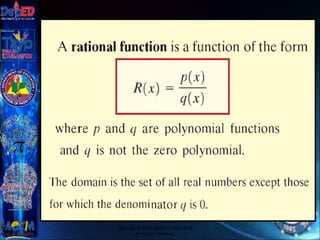
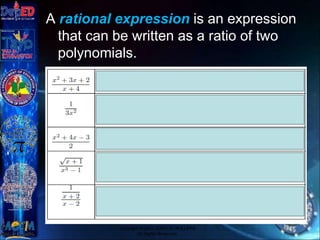
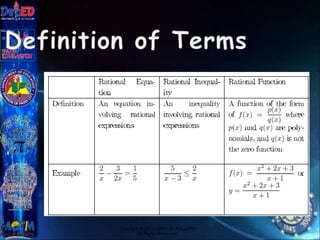
A rational expression is an expression
that can be written as a ratio of two
polynomials.
Copyright © 2012 JOVIC G. RULLEPA
All Rights Reserved.
Copyright © 2012 JOVIC G. RULLEPA
All Rights Reserved.
Copyright © 2012 JOVIC G. RULLEPA
All Rights Reserved.
Copyright © 2012 JOVIC G. RULLEPA
All Rights Reserved.
Copyright © 2012 JOVIC G. RULLEPA
All Rights Reserved.
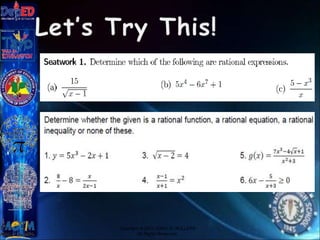
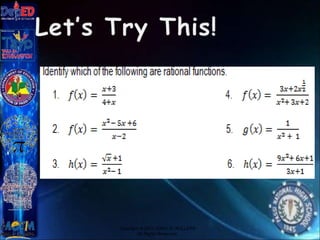
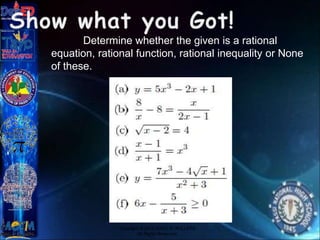
Determine whether the given is a rational
equation, rational function, rational inequality or None
of these.
Copyright © 2012 JOVIC G. RULLEPA
All Rights Reserved.
Objectives:
• Solve rational equations; and
• Solve problems involving
rational equations.
Copyright © 2012 JOVIC G. RULLEPA
All Rights Reserved.
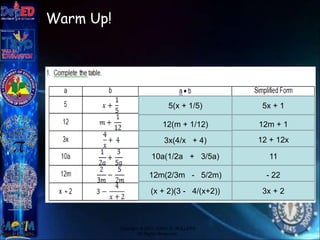
Warm Up!
Copyright © 2012 JOVIC G. RULLEPA
All Rights Reserved.
5(x + 1/5)
12(m + 1/12)
3x(4/x + 4)
10a(1/2a + 3/5a)
12m(2/3m - 5/2m)
(x + 2)(3 - 4/(x+2))
5x + 1
12m + 1
12 + 12x
11
- 22
3x + 2
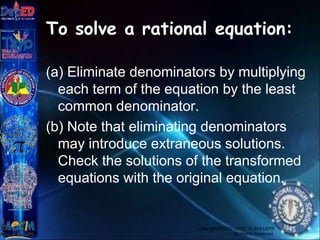
To solve a rational equation:
(a) Eliminate denominators by multiplying
each term of the equation by the least
common denominator.
(b) Note that eliminating denominators
may introduce extraneous solutions.
Check the solutions of the transformed
equations with the original equation.
Copyright © 2012 JOVIC G. RULLEPA
All Rights Reserved.
Answer:
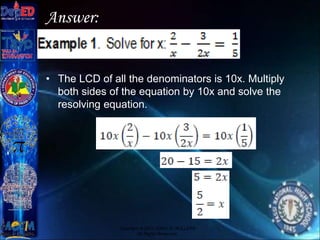
• The LCD of all the denominators is 10x. Multiply
both sides of the equation by 10x and solve the
resolving equation.
Copyright © 2012 JOVIC G. RULLEPA
All Rights Reserved.
Answer:
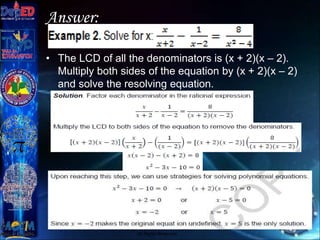
• The LCD of all the denominators is (x + 2)(x – 2).
Multiply both sides of the equation by (x + 2)(x – 2)
and solve the resolving equation.
Copyright © 2012 JOVIC G. RULLEPA
All Rights Reserved.
Bring It On!
Copyright © 2012 JOVIC G. RULLEPA
All Rights Reserved.
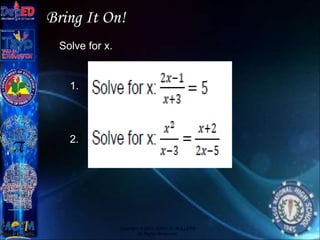
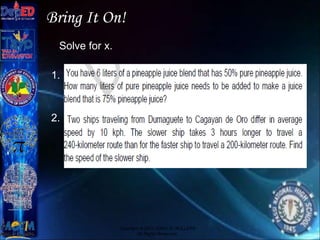
Solve for x.
1.
2.
Let’s Try This!
1. In an inter-barangay basketball league, the team
from Barangay Culiat has won 12 out of 25 games,
a winning percentage of 48%. How many games
should they win in a row to improve their win
percentage to 60%
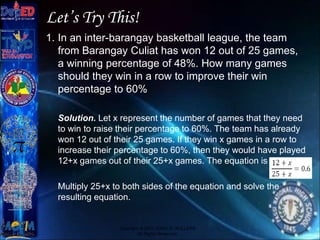
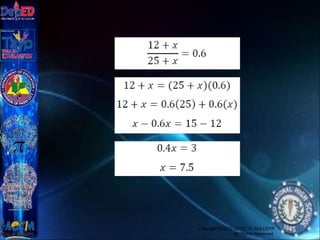
Solution. Let x represent the number of games that they need
to win to raise their percentage to 60%. The team has already
won 12 out of their 25 games. If they win x games in a row to
increase their percentage to 60%, then they would have played
12+x games out of their 25+x games. The equation is
Multiply 25+x to both sides of the equation and solve the
resulting equation.
Copyright © 2012 JOVIC G. RULLEPA
All Rights Reserved.
Copyright © 2012 JOVIC G. RULLEPA
All Rights Reserved.
Let’s Try This!
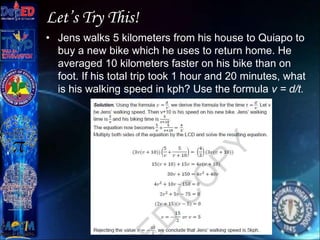
• Jens walks 5 kilometers from his house to Quiapo to
buy a new bike which he uses to return home. He
averaged 10 kilometers faster on his bike than on
foot. If his total trip took 1 hour and 20 minutes, what
is his walking speed in kph? Use the formula v = d/t.
Copyright © 2012 JOVIC G. RULLEPA
All Rights Reserved.
Bring It On!
Copyright © 2012 JOVIC G. RULLEPA
All Rights Reserved.
Solve for x.
1.
2.
Copyright © 2012 JOVIC G. RULLEPA
All Rights Reserved.
Objectives:
• Solve rational inequalities.
Copyright © 2012 JOVIC G. RULLEPA
All Rights Reserved.
Copyright © 2012 JOVIC G. RULLEPA
All Rights Reserved.
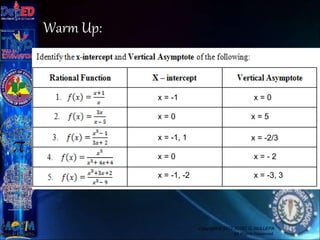
Warm Up:
x = -1 x = 0
x = 0 x = 5
x = -1, 1 x = -2/3
x = 0 x = - 2
x = -1, -2 x = -3, 3
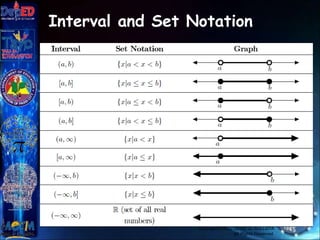
Interval and Set Notation
Copyright © 2012 JOVIC G. RULLEPA
All Rights Reserved.
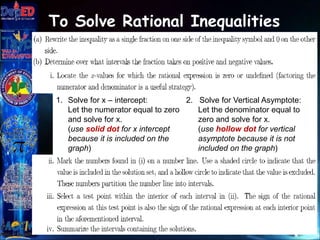
To Solve Rational Inequalities
Copyright © 2012 JOVIC G. RULLEPA
All Rights Reserved.
1. Solve for x – intercept:
Let the numerator equal to zero
and solve for x.
(use solid dot for x intercept
because it is included on the
graph)
2. Solve for Vertical Asymptote:
Let the denominator equal to
zero and solve for x.
(use hollow dot for vertical
asymptote because it is not
included on the graph)
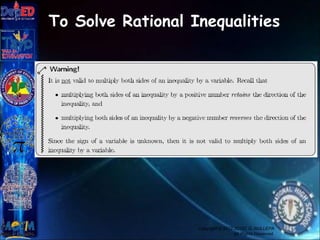
To Solve Rational Inequalities
Copyright © 2012 JOVIC G. RULLEPA
All Rights Reserved.
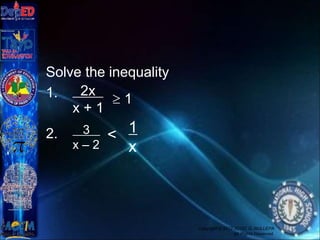
Solve the inequality
1.
2.
Copyright © 2012 JOVIC G. RULLEPA
All Rights Reserved.
2x
x + 1
 1
3
x – 2
< 1
x
Copyright © 2012 JOVIC G. RULLEPA
All Rights Reserved.
Objectives:
• Graph rational functions.
Copyright © 2012 JOVIC G. RULLEPA
All Rights Reserved.
Copyright © 2012 JOVIC G. RULLEPA
All Rights Reserved.
Mechanics of the game:
1. The game should be played by three groups. Each group
should have a team leader to lead the group.
2. The game starts by presenting the first question in random.
The first team to answer the question correctly will be given a
chance to choose the category of the next question and will be
given a time to answer depending on the value of the
question. Once the time is over, the other teams will be given
a chance to answer the said question.
3. Two consecutive chances will be given to every team who can
answer the questions simultaneously and on the third time,
the team will be given a chance to choose “play” or “pass”. If
they choose play, the team can go on in answering the next
questions but once they choose pass, the question will be
given to the other teams.
Copyright © 2012 JOVIC G. RULLEPA
All Rights Reserved.
4. If the team answered the three questions simultaneously, a
breaker question will be given by the game master to give
chance to other teams to answer the question.
5. If none of the team answered the question correctly, a tie-
breaker question will be given by the game master.
6. Once all the questions are revealed, a final jeopardy will be
given by the game master.
7. A team with a highest point will be declared a winner.
8. The accumulated points earned by each team corresponds
to the points to be given to each member of the team with 6
points higher for the representatives.
9. Time allocation for every question:
P100 to P300 ------------------------ 20 seconds
P400 to P500 ------------------------ 40 seconds
Final Jeopardy (P1000) ----------- Open time
Graphing Rational Functions:
1.Rewrite the rational function as a
factored form.
2.Find the Intercepts:
a. x-intercept.
Let y equal to zero and solve for x.
b. y-intercept.
Let x equal to zero and solve for y.
Copyright © 2012 JOVIC G. RULLEPA
All Rights Reserved.
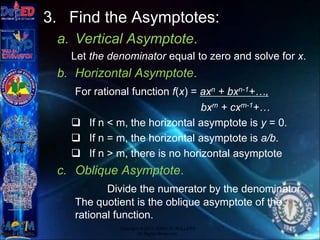
3. Find the Asymptotes:
a. Vertical Asymptote.
Let the denominator equal to zero and solve for x.
b. Horizontal Asymptote.
For rational function f(x) = axn + bxn-1+…,
bxm + cxm-1+…
 If n < m, the horizontal asymptote is y = 0.
 If n = m, the horizontal asymptote is a/b.
 If n > m, there is no horizontal asymptote
c. Oblique Asymptote.
Divide the numerator by the denominator.
The quotient is the oblique asymptote of the
rational function.
Copyright © 2012 JOVIC G. RULLEPA
All Rights Reserved.
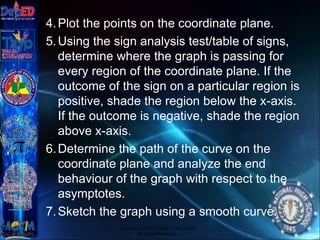
4.Plot the points on the coordinate plane.
5.Using the sign analysis test/table of signs,
determine where the graph is passing for
every region of the coordinate plane. If the
outcome of the sign on a particular region is
positive, shade the region below the x-axis.
If the outcome is negative, shade the region
above x-axis.
6.Determine the path of the curve on the
coordinate plane and analyze the end
behaviour of the graph with respect to the
asymptotes.
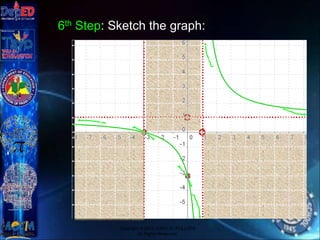
7.Sketch the graph using a smooth curve.
Copyright © 2012 JOVIC G. RULLEPA
All Rights Reserved.
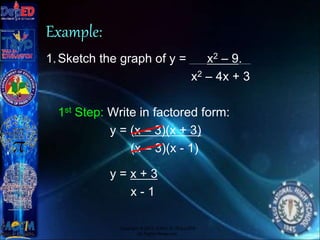
Example:
1.Sketch the graph of y = x2 – 9.
x2 – 4x + 3
1st Step: Write in factored form:
y = (x – 3)(x + 3)
(x – 3)(x - 1)
y = x + 3
x - 1
Copyright © 2012 JOVIC G. RULLEPA
All Rights Reserved.
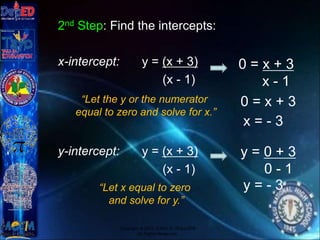
2nd Step: Find the intercepts:
x-intercept: y = (x + 3)
(x - 1)
y-intercept: y = (x + 3)
(x - 1)
Copyright © 2012 JOVIC G. RULLEPA
All Rights Reserved.
0 = x + 3
x - 1
0 = x + 3
x = - 3
y = 0 + 3
0 - 1
y = - 3
“Let the y or the numerator
equal to zero and solve for x.”
“Let x equal to zero
and solve for y.”
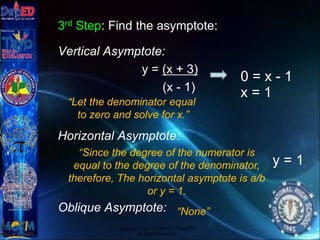
3rd Step: Find the asymptote:
Vertical Asymptote:
y = (x + 3)
(x - 1)
Horizontal Asymptote:
Oblique Asymptote:
Copyright © 2012 JOVIC G. RULLEPA
All Rights Reserved.
0 = x - 1
x = 1
y = 1
“Let the denominator equal
to zero and solve for x.”
“Since the degree of the numerator is
equal to the degree of the denominator,
therefore, The horizontal asymptote is a/b
or y = 1.
“None”
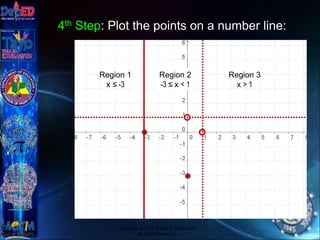
4th Step: Plot the points on a number line:
Copyright © 2012 JOVIC G. RULLEPA
All Rights Reserved.
Region 1
x ≤ -3
Region 2
-3 ≤ x < 1
Region 3
x > 1
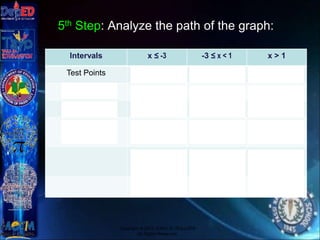
5th Step: Analyze the path of the graph:
Copyright © 2012 JOVIC G. RULLEPA
All Rights Reserved.
Intervals x ≤ -3 -3 ≤ x < 1 x > 1
Test Points x = -4 x = 0 x = 2
(x + 3) - + +
(x – 1) - - +
(x + 3)
(x – 1) (+) (-) (+)
The graph is passing
above
the x-axis
The graph is passing
below
the x-axis
The graph is passing
above
x-axis
Shade the region
below the x-axis
Shade the region
above the x-axis
Shade the region
below the x-axis
6th Step: Sketch the graph:
Copyright © 2012 JOVIC G. RULLEPA
All Rights Reserved.
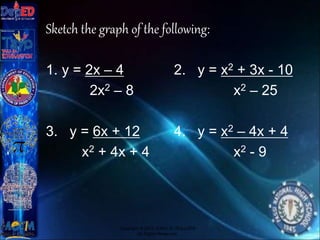
Sketch the graph of the following:
1. y = 2x – 4 2. y = x2 + 3x - 10
2x2 – 8 x2 – 25
3. y = 6x + 12 4. y = x2 – 4x + 4
x2 + 4x + 4 x2 - 9
Copyright © 2012 JOVIC G. RULLEPA
All Rights Reserved.
Copyright © 2012 JOVIC G. RULLEPA
All Rights Reserved.

Chapter 2: Rational Function

  • 1.
    Copyright © 2012JOVIC G. RULLEPA All Rights Reserved
  • 2.
    Copyright © 2012JOVIC G. RULLEPA All Rights Reserved.
  • 3.
    Objectives: • Review polynomialfunction; • Present real life examples of rational function; and • Define rational function. Copyright © 2012 JOVIC G. RULLEPA All Rights Reserved.
  • 4.
    What is aPolynomial Function? Copyright © 2012 JOVIC G. RULLEPA All Rights Reserved.
  • 5.
    Copyright © 2012JOVIC G. RULLEPA All Rights Reserved What’s on your mind? Polynomial Not Polynomial Polynomial Not Polynomial Not Polynomial Not Polynomial Not Polynomial Not Polynomial Not Polynomial Polynomial With x on denominator With x on denominator Imaginary coefficient Negative exponent With x on denominator With x inside the radical Fractional exponent
  • 6.
    1. …there isno imaginary coefficient on any term. 2. …there is no negative exponent on terms with x on the numerator. 3. …no terms with x on the denominator. 4. …no fractional exponent or no x variable inside the radical sign. Copyright © 2012 JOVIC G. RULLEPA All Rights Reserved.
  • 7.
    1. The localbarangay received a budget of PhP 100,000 to provide medical check ups for the children in the barangay. a. If the amount is to be allotted equally among all the children in the barangay. Write an equation representing the relationship of the allotted amount per child (y-variable) versus the total number of children (x-variable) b. A philanthropist wants to supplement the budget allotted for each child by providing an additional PhP 750 for each child in the barangay. If g(x) represents this new amount allotted for each child, construct a function representing this relationship. Copyright © 2012 JOVIC G. RULLEPA All Rights Reserved.
  • 8.
    Copyright © 2012JOVIC G. RULLEPA All Rights Reserved
  • 9.
    1. An objectis to travel a distance of 10 meters. Express velocity v as a function v(t) of travel time t, in seconds. 2. Suppose that c(t) = 5t / (t2 + 1) in mg/mL, represents the concentration of a drug in a patient’s bloodstream t hours after the drug was administered. Construct a table of values for c(t) for t = 1,2,5, 10. round off answers to three decimal places. Use the table to sketch a graph and interpret the result. Copyright © 2012 JOVIC G. RULLEPA All Rights Reserved.
  • 10.
    Situation 1: Thebudget of a university organization is split evenly among its various committees. If they have a budget of P60,000: a. Construct a function M(n) which would give the amount of money each of the n number of committees would receive. b. If the organization has eight committees, how much would each committee have? Copyright © 2012 JOVIC G. RULLEPA All Rights Reserved.
  • 11.
    Situation 2: LetC(t) = be the function that describes the concentration of a certain medication in the bloodstream over time. a. What is C(0)? Why is that so? b. Construct a table of values for when t is equal to 0,1,2,3,4, and 5. c. Interpret your answers in relation to drug concentration. Copyright © 2012 JOVIC G. RULLEPA All Rights Reserved.
  • 12.
    1. A fenceis to enclose a rectangular vegetable farm with an area of 400 sq. meters. If x is the length of one side of this fence, find a function P(x) representing the perimeter of the fencing material required. Find the perimeter of the fence if one side has length 10 meters, 50 meters. 2. Suppose the amount of bacteria growing in a Petri dish is represented by the function where t is in hours and b(t) is in millions. Evaluate the function at t = 1, 2, , 5 and 10. Interpret the obtained values. Copyright © 2012 JOVIC G. RULLEPA All Rights Reserved.
  • 13.
    Copyright © 2012JOVIC G. RULLEPA All Rights Reserved.
  • 14.
    Objectives: • Distinguish rationalfunctions, rational equations and rational inequalities. Copyright © 2012 JOVIC G. RULLEPA All Rights Reserved.
  • 15.
    A rational expressionis an expression that can be written as a ratio of two polynomials. Copyright © 2012 JOVIC G. RULLEPA All Rights Reserved.
  • 16.
    Copyright © 2012JOVIC G. RULLEPA All Rights Reserved.
  • 17.
    Copyright © 2012JOVIC G. RULLEPA All Rights Reserved.
  • 18.
    Copyright © 2012JOVIC G. RULLEPA All Rights Reserved.
  • 19.
    Copyright © 2012JOVIC G. RULLEPA All Rights Reserved. Determine whether the given is a rational equation, rational function, rational inequality or None of these.
  • 20.
    Copyright © 2012JOVIC G. RULLEPA All Rights Reserved.
  • 21.
    Objectives: • Solve rationalequations; and • Solve problems involving rational equations. Copyright © 2012 JOVIC G. RULLEPA All Rights Reserved.
  • 22.
    Warm Up! Copyright ©2012 JOVIC G. RULLEPA All Rights Reserved. 5(x + 1/5) 12(m + 1/12) 3x(4/x + 4) 10a(1/2a + 3/5a) 12m(2/3m - 5/2m) (x + 2)(3 - 4/(x+2)) 5x + 1 12m + 1 12 + 12x 11 - 22 3x + 2
  • 23.
    To solve arational equation: (a) Eliminate denominators by multiplying each term of the equation by the least common denominator. (b) Note that eliminating denominators may introduce extraneous solutions. Check the solutions of the transformed equations with the original equation. Copyright © 2012 JOVIC G. RULLEPA All Rights Reserved.
  • 24.
    Answer: • The LCDof all the denominators is 10x. Multiply both sides of the equation by 10x and solve the resolving equation. Copyright © 2012 JOVIC G. RULLEPA All Rights Reserved.
  • 25.
    Answer: • The LCDof all the denominators is (x + 2)(x – 2). Multiply both sides of the equation by (x + 2)(x – 2) and solve the resolving equation. Copyright © 2012 JOVIC G. RULLEPA All Rights Reserved.
  • 26.
    Bring It On! Copyright© 2012 JOVIC G. RULLEPA All Rights Reserved. Solve for x. 1. 2.
  • 27.
    Let’s Try This! 1.In an inter-barangay basketball league, the team from Barangay Culiat has won 12 out of 25 games, a winning percentage of 48%. How many games should they win in a row to improve their win percentage to 60% Solution. Let x represent the number of games that they need to win to raise their percentage to 60%. The team has already won 12 out of their 25 games. If they win x games in a row to increase their percentage to 60%, then they would have played 12+x games out of their 25+x games. The equation is Multiply 25+x to both sides of the equation and solve the resulting equation. Copyright © 2012 JOVIC G. RULLEPA All Rights Reserved.
  • 28.
    Copyright © 2012JOVIC G. RULLEPA All Rights Reserved.
  • 29.
    Let’s Try This! •Jens walks 5 kilometers from his house to Quiapo to buy a new bike which he uses to return home. He averaged 10 kilometers faster on his bike than on foot. If his total trip took 1 hour and 20 minutes, what is his walking speed in kph? Use the formula v = d/t. Copyright © 2012 JOVIC G. RULLEPA All Rights Reserved.
  • 30.
    Bring It On! Copyright© 2012 JOVIC G. RULLEPA All Rights Reserved. Solve for x. 1. 2.
  • 31.
    Copyright © 2012JOVIC G. RULLEPA All Rights Reserved.
  • 32.
    Objectives: • Solve rationalinequalities. Copyright © 2012 JOVIC G. RULLEPA All Rights Reserved.
  • 33.
    Copyright © 2012JOVIC G. RULLEPA All Rights Reserved. Warm Up: x = -1 x = 0 x = 0 x = 5 x = -1, 1 x = -2/3 x = 0 x = - 2 x = -1, -2 x = -3, 3
  • 34.
    Interval and SetNotation Copyright © 2012 JOVIC G. RULLEPA All Rights Reserved.
  • 35.
    To Solve RationalInequalities Copyright © 2012 JOVIC G. RULLEPA All Rights Reserved. 1. Solve for x – intercept: Let the numerator equal to zero and solve for x. (use solid dot for x intercept because it is included on the graph) 2. Solve for Vertical Asymptote: Let the denominator equal to zero and solve for x. (use hollow dot for vertical asymptote because it is not included on the graph)
  • 36.
    To Solve RationalInequalities Copyright © 2012 JOVIC G. RULLEPA All Rights Reserved.
  • 37.
    Solve the inequality 1. 2. Copyright© 2012 JOVIC G. RULLEPA All Rights Reserved. 2x x + 1  1 3 x – 2 < 1 x
  • 38.
    Copyright © 2012JOVIC G. RULLEPA All Rights Reserved.
  • 39.
    Objectives: • Graph rationalfunctions. Copyright © 2012 JOVIC G. RULLEPA All Rights Reserved.
  • 40.
    Copyright © 2012JOVIC G. RULLEPA All Rights Reserved. Mechanics of the game: 1. The game should be played by three groups. Each group should have a team leader to lead the group. 2. The game starts by presenting the first question in random. The first team to answer the question correctly will be given a chance to choose the category of the next question and will be given a time to answer depending on the value of the question. Once the time is over, the other teams will be given a chance to answer the said question. 3. Two consecutive chances will be given to every team who can answer the questions simultaneously and on the third time, the team will be given a chance to choose “play” or “pass”. If they choose play, the team can go on in answering the next questions but once they choose pass, the question will be given to the other teams.
  • 41.
    Copyright © 2012JOVIC G. RULLEPA All Rights Reserved. 4. If the team answered the three questions simultaneously, a breaker question will be given by the game master to give chance to other teams to answer the question. 5. If none of the team answered the question correctly, a tie- breaker question will be given by the game master. 6. Once all the questions are revealed, a final jeopardy will be given by the game master. 7. A team with a highest point will be declared a winner. 8. The accumulated points earned by each team corresponds to the points to be given to each member of the team with 6 points higher for the representatives. 9. Time allocation for every question: P100 to P300 ------------------------ 20 seconds P400 to P500 ------------------------ 40 seconds Final Jeopardy (P1000) ----------- Open time
  • 42.
    Graphing Rational Functions: 1.Rewritethe rational function as a factored form. 2.Find the Intercepts: a. x-intercept. Let y equal to zero and solve for x. b. y-intercept. Let x equal to zero and solve for y. Copyright © 2012 JOVIC G. RULLEPA All Rights Reserved.
  • 43.
    3. Find theAsymptotes: a. Vertical Asymptote. Let the denominator equal to zero and solve for x. b. Horizontal Asymptote. For rational function f(x) = axn + bxn-1+…, bxm + cxm-1+…  If n < m, the horizontal asymptote is y = 0.  If n = m, the horizontal asymptote is a/b.  If n > m, there is no horizontal asymptote c. Oblique Asymptote. Divide the numerator by the denominator. The quotient is the oblique asymptote of the rational function. Copyright © 2012 JOVIC G. RULLEPA All Rights Reserved.
  • 44.
    4.Plot the pointson the coordinate plane. 5.Using the sign analysis test/table of signs, determine where the graph is passing for every region of the coordinate plane. If the outcome of the sign on a particular region is positive, shade the region below the x-axis. If the outcome is negative, shade the region above x-axis. 6.Determine the path of the curve on the coordinate plane and analyze the end behaviour of the graph with respect to the asymptotes. 7.Sketch the graph using a smooth curve. Copyright © 2012 JOVIC G. RULLEPA All Rights Reserved.
  • 45.
    Example: 1.Sketch the graphof y = x2 – 9. x2 – 4x + 3 1st Step: Write in factored form: y = (x – 3)(x + 3) (x – 3)(x - 1) y = x + 3 x - 1 Copyright © 2012 JOVIC G. RULLEPA All Rights Reserved.
  • 46.
    2nd Step: Findthe intercepts: x-intercept: y = (x + 3) (x - 1) y-intercept: y = (x + 3) (x - 1) Copyright © 2012 JOVIC G. RULLEPA All Rights Reserved. 0 = x + 3 x - 1 0 = x + 3 x = - 3 y = 0 + 3 0 - 1 y = - 3 “Let the y or the numerator equal to zero and solve for x.” “Let x equal to zero and solve for y.”
  • 47.
    3rd Step: Findthe asymptote: Vertical Asymptote: y = (x + 3) (x - 1) Horizontal Asymptote: Oblique Asymptote: Copyright © 2012 JOVIC G. RULLEPA All Rights Reserved. 0 = x - 1 x = 1 y = 1 “Let the denominator equal to zero and solve for x.” “Since the degree of the numerator is equal to the degree of the denominator, therefore, The horizontal asymptote is a/b or y = 1. “None”
  • 48.
    4th Step: Plotthe points on a number line: Copyright © 2012 JOVIC G. RULLEPA All Rights Reserved. Region 1 x ≤ -3 Region 2 -3 ≤ x < 1 Region 3 x > 1
  • 49.
    5th Step: Analyzethe path of the graph: Copyright © 2012 JOVIC G. RULLEPA All Rights Reserved. Intervals x ≤ -3 -3 ≤ x < 1 x > 1 Test Points x = -4 x = 0 x = 2 (x + 3) - + + (x – 1) - - + (x + 3) (x – 1) (+) (-) (+) The graph is passing above the x-axis The graph is passing below the x-axis The graph is passing above x-axis Shade the region below the x-axis Shade the region above the x-axis Shade the region below the x-axis
  • 50.
    6th Step: Sketchthe graph: Copyright © 2012 JOVIC G. RULLEPA All Rights Reserved.
  • 51.
    Sketch the graphof the following: 1. y = 2x – 4 2. y = x2 + 3x - 10 2x2 – 8 x2 – 25 3. y = 6x + 12 4. y = x2 – 4x + 4 x2 + 4x + 4 x2 - 9 Copyright © 2012 JOVIC G. RULLEPA All Rights Reserved.
  • 52.
    Copyright © 2012JOVIC G. RULLEPA All Rights Reserved.