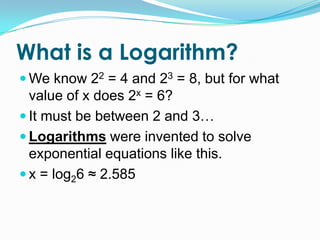
What is a Logarithm?
 We know 22 = 4 and 23 = 8, but for what
  value of x does 2x = 6?
 It must be between 2 and 3…
 Logarithms were invented to solve
  exponential equations like this.
 x = log26 ≈ 2.585
Logarithms with Base b
 Let b and y be positive numbers and b≠1.
 The logarithm of y with base b is written
 logby and is defined:
        logby = x if and only if bx = y
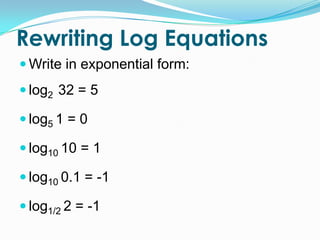
Rewriting Log Equations
 Write in exponential form:
 log2 32 = 5

 log5 1 = 0

 log10 10 = 1

 log10 0.1 = -1

 log1/2 2 = -1
Special Log Values
 For positive b such that b ≠ 1:
 Logarithm of 1: logb 1 = 0 since b0 = 1
 Logarithm of base b: logb b = 1 since b1 = b
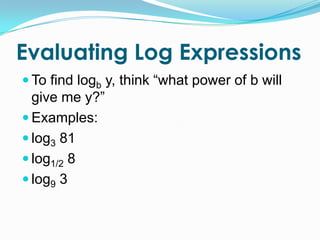
Evaluating Log Expressions
 To find logb y, think “what power of b will
  give me y?”
 Examples:
 log3 81
 log1/2 8
 log9 3
Your Turn!
 Evaluate each expression:

 log4 64

 log32 2
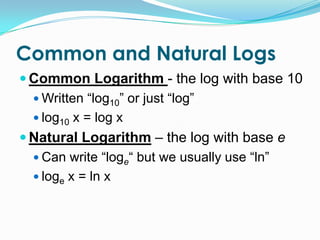
Common and Natural Logs
 Common Logarithm - the log with base 10
   Written “log10” or just “log”
   log10 x = log x
 Natural Logarithm – the log with base e
   Can write “loge“ but we usually use “ln”
   loge x = ln x
Evaluating Common and
Natural Logs
 Use “LOG” or “LN” key on calculator.
 Evaluate. Round to 3 decimal places.
 log 5
 ln 0.1
Evaluating Log Functions
 The slope s of a beach is related to the
 average diameter d (in mm) of the sand
 particles on the beach by this equation:
           s = 0.159 + 0.118 log d
 Find the slope of a beach if the average
 diameter of the sand particles is 0.25 mm.
Inverses
 The logarithmic function g(x) = logb x
  is the inverse of the exponential function
  f(x) = bx.
 Therefore:
  g(f(x)) = logb bx = x and f(g(x)) = blogb x = x
 This means they “undo” each other.
Using Inverse Properties
 Simplify:
 10logx

 log4 4x

 9log9 x

 log3 9x
Your Turn!
 Simplify:

 log5 125x

 5log5 x
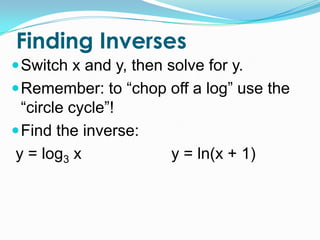
Finding Inverses
 Switch x and y, then solve for y.
 Remember: to “chop off a log” use the
  “circle cycle”!
 Find the inverse:
 y = log3 x             y = ln(x + 1)
Your Turn!
 Find the inverse.
 y = log8 x


 y = ln(x – 3)
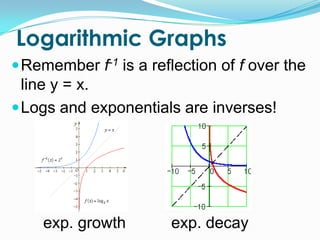
Logarithmic Graphs
 Remember f-1 is a reflection of f over the
  line y = x.
 Logs and exponentials are inverses!


    exp. growth        exp. decay
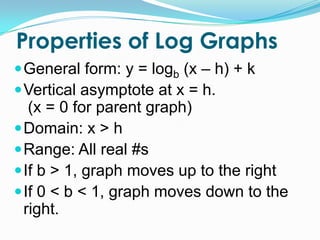
Properties of Log Graphs
 General form: y = logb (x – h) + k
 Vertical asymptote at x = h.
   (x = 0 for parent graph)
 Domain: x > h
 Range: All real #s
 If b > 1, graph moves up to the right
 If 0 < b < 1, graph moves down to the
  right.
To graph:
 Sketch parent graph (if needed).
   Always goes through (1, 0) and (b, 1)
   Choose one more point if needed.
   Don’t cross the y-axis!
 Shift using h and k.
   Be Careful: h is in () with the x, k is not
Examples:
 Graph. State the domain and range.
y = log1/3 x – 1


Domain:
Range:
 Graph. State the domain and range.
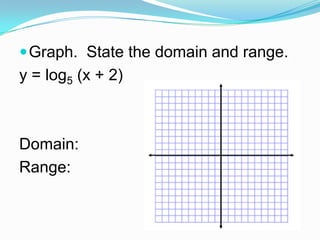
y = log5 (x + 2)


Domain:
Range:
Your Turn!
 Graph. State the domain and range.
y = log3 (x + 1)


Domain:
Range:

8.4 logarithmic functions

  • 2.
    What is aLogarithm?  We know 22 = 4 and 23 = 8, but for what value of x does 2x = 6?  It must be between 2 and 3…  Logarithms were invented to solve exponential equations like this.  x = log26 ≈ 2.585
  • 3.
    Logarithms with Baseb  Let b and y be positive numbers and b≠1.  The logarithm of y with base b is written logby and is defined: logby = x if and only if bx = y
  • 4.
    Rewriting Log Equations Write in exponential form:  log2 32 = 5  log5 1 = 0  log10 10 = 1  log10 0.1 = -1  log1/2 2 = -1
  • 5.
    Special Log Values For positive b such that b ≠ 1:  Logarithm of 1: logb 1 = 0 since b0 = 1  Logarithm of base b: logb b = 1 since b1 = b
  • 6.
    Evaluating Log Expressions To find logb y, think “what power of b will give me y?”  Examples:  log3 81  log1/2 8  log9 3
  • 7.
    Your Turn!  Evaluateeach expression:  log4 64  log32 2
  • 8.
    Common and NaturalLogs  Common Logarithm - the log with base 10  Written “log10” or just “log”  log10 x = log x  Natural Logarithm – the log with base e  Can write “loge“ but we usually use “ln”  loge x = ln x
  • 9.
    Evaluating Common and NaturalLogs  Use “LOG” or “LN” key on calculator.  Evaluate. Round to 3 decimal places.  log 5  ln 0.1
  • 10.
    Evaluating Log Functions The slope s of a beach is related to the average diameter d (in mm) of the sand particles on the beach by this equation: s = 0.159 + 0.118 log d Find the slope of a beach if the average diameter of the sand particles is 0.25 mm.
  • 11.
    Inverses  The logarithmicfunction g(x) = logb x is the inverse of the exponential function f(x) = bx.  Therefore: g(f(x)) = logb bx = x and f(g(x)) = blogb x = x  This means they “undo” each other.
  • 12.
    Using Inverse Properties Simplify:  10logx  log4 4x  9log9 x  log3 9x
  • 13.
    Your Turn!  Simplify: log5 125x  5log5 x
  • 14.
    Finding Inverses  Switchx and y, then solve for y.  Remember: to “chop off a log” use the “circle cycle”!  Find the inverse: y = log3 x y = ln(x + 1)
  • 15.
    Your Turn!  Findthe inverse.  y = log8 x  y = ln(x – 3)
  • 16.
    Logarithmic Graphs  Rememberf-1 is a reflection of f over the line y = x.  Logs and exponentials are inverses! exp. growth exp. decay
  • 17.
    Properties of LogGraphs  General form: y = logb (x – h) + k  Vertical asymptote at x = h. (x = 0 for parent graph)  Domain: x > h  Range: All real #s  If b > 1, graph moves up to the right  If 0 < b < 1, graph moves down to the right.
  • 18.
    To graph:  Sketchparent graph (if needed).  Always goes through (1, 0) and (b, 1)  Choose one more point if needed.  Don’t cross the y-axis!  Shift using h and k.  Be Careful: h is in () with the x, k is not
  • 19.
    Examples:  Graph. Statethe domain and range. y = log1/3 x – 1 Domain: Range:
  • 20.
     Graph. Statethe domain and range. y = log5 (x + 2) Domain: Range:
  • 21.
    Your Turn!  Graph.State the domain and range. y = log3 (x + 1) Domain: Range: