Solving Exponential Equations
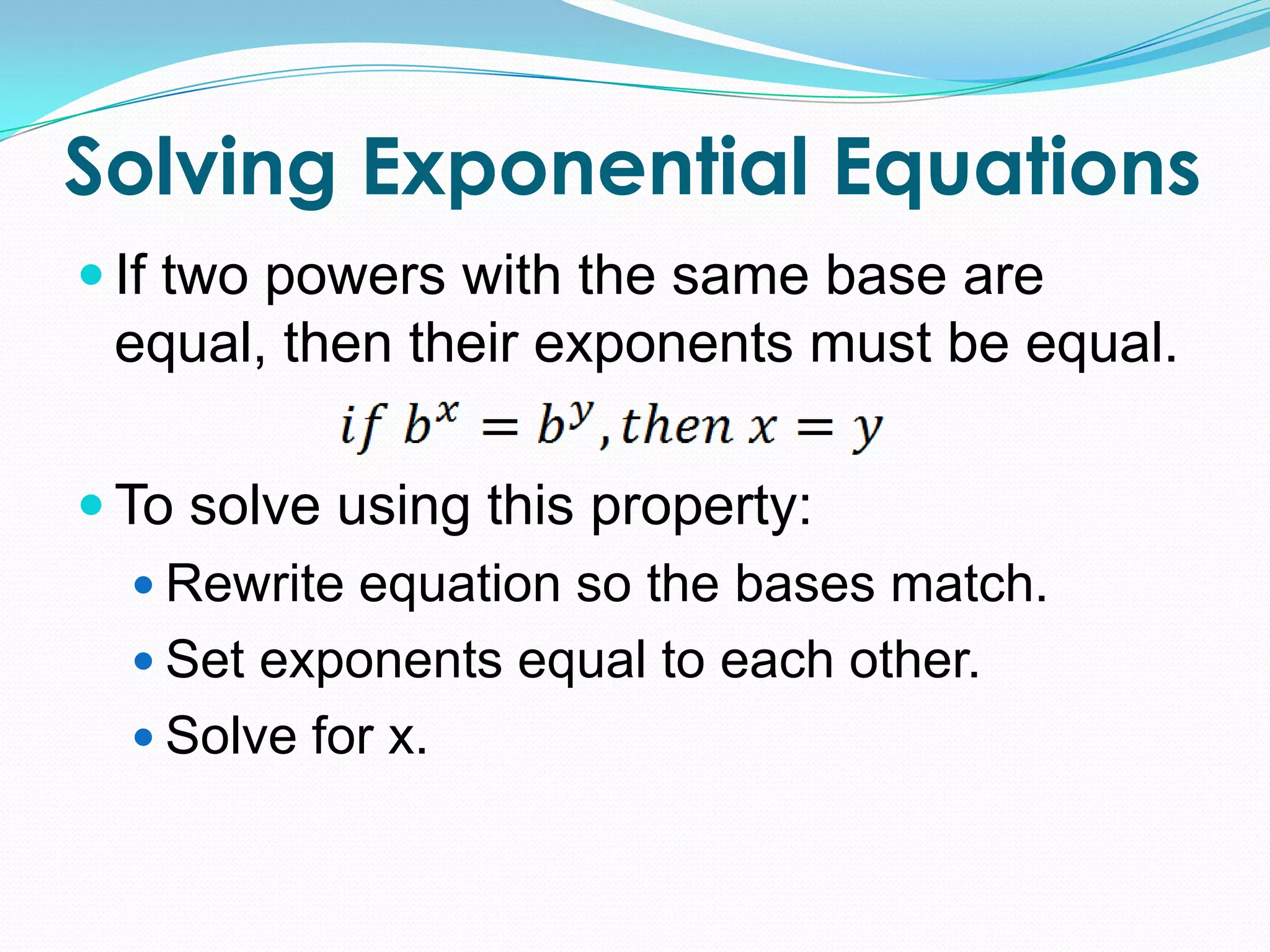
 If two powers with the same base are
 equal, then their exponents must be equal.

 To solve using this property:
    Rewrite equation so the bases match.
    Set exponents equal to each other.
    Solve for x.
Examples:
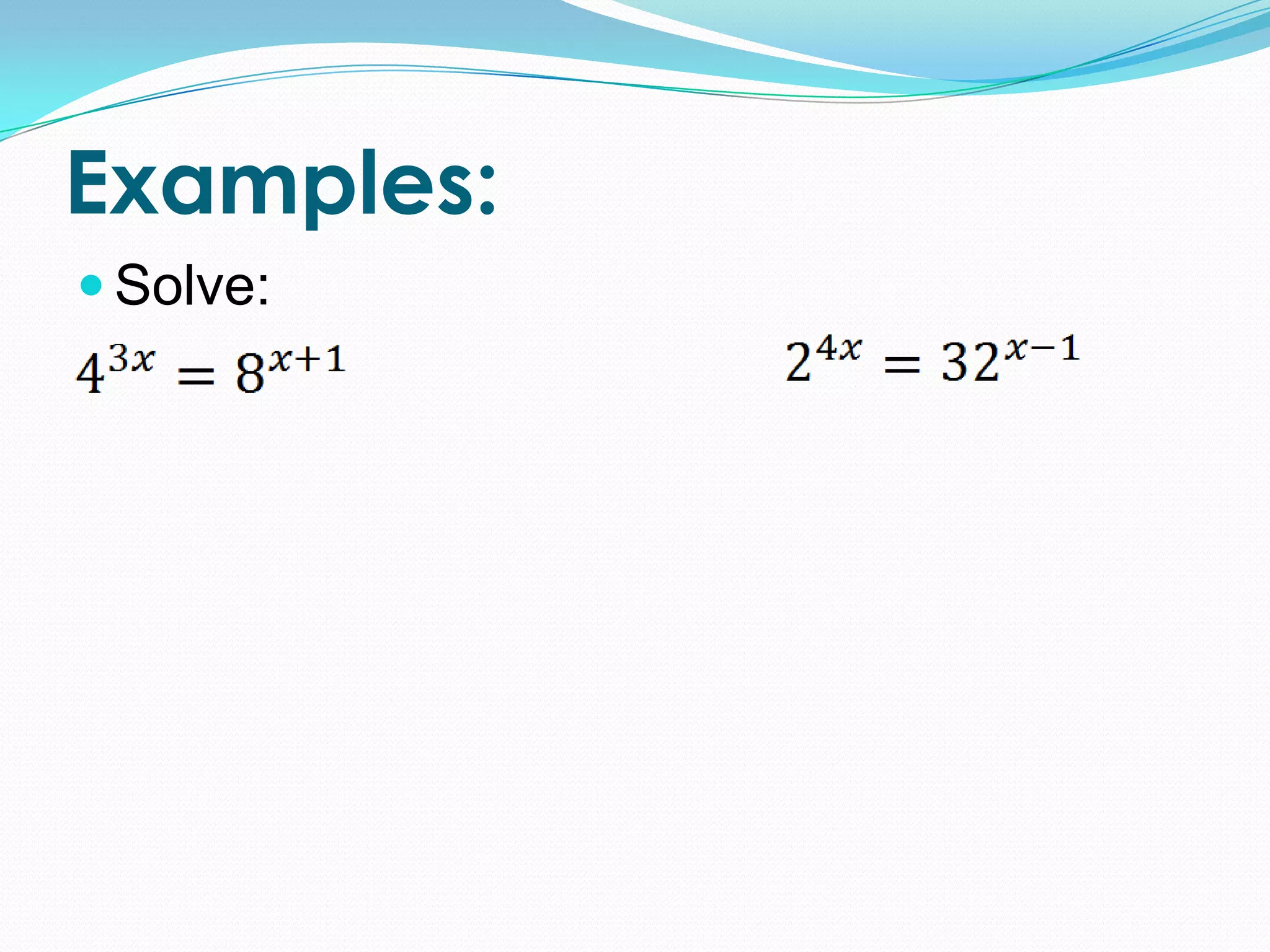
 Solve:
Your Turn!
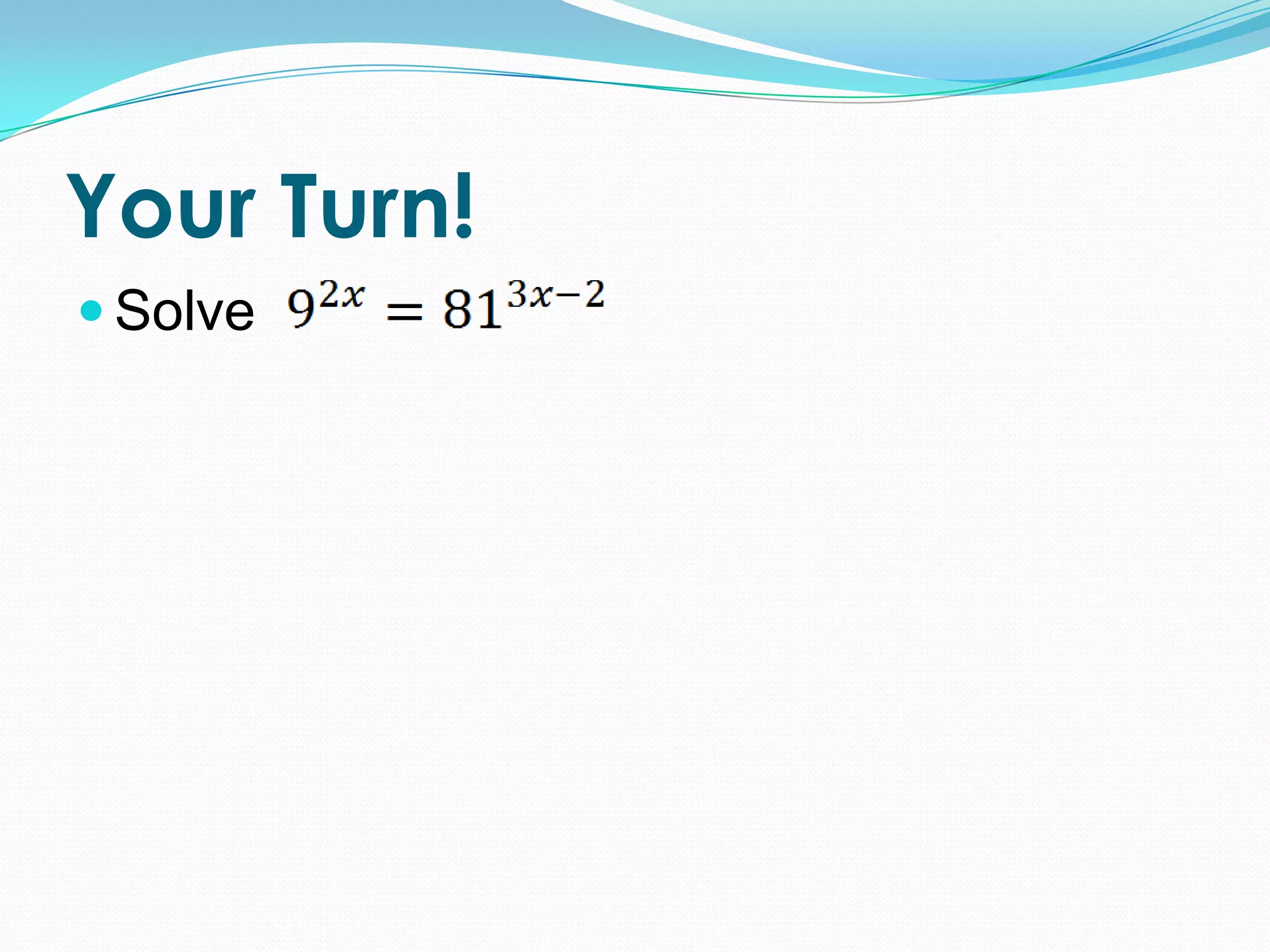
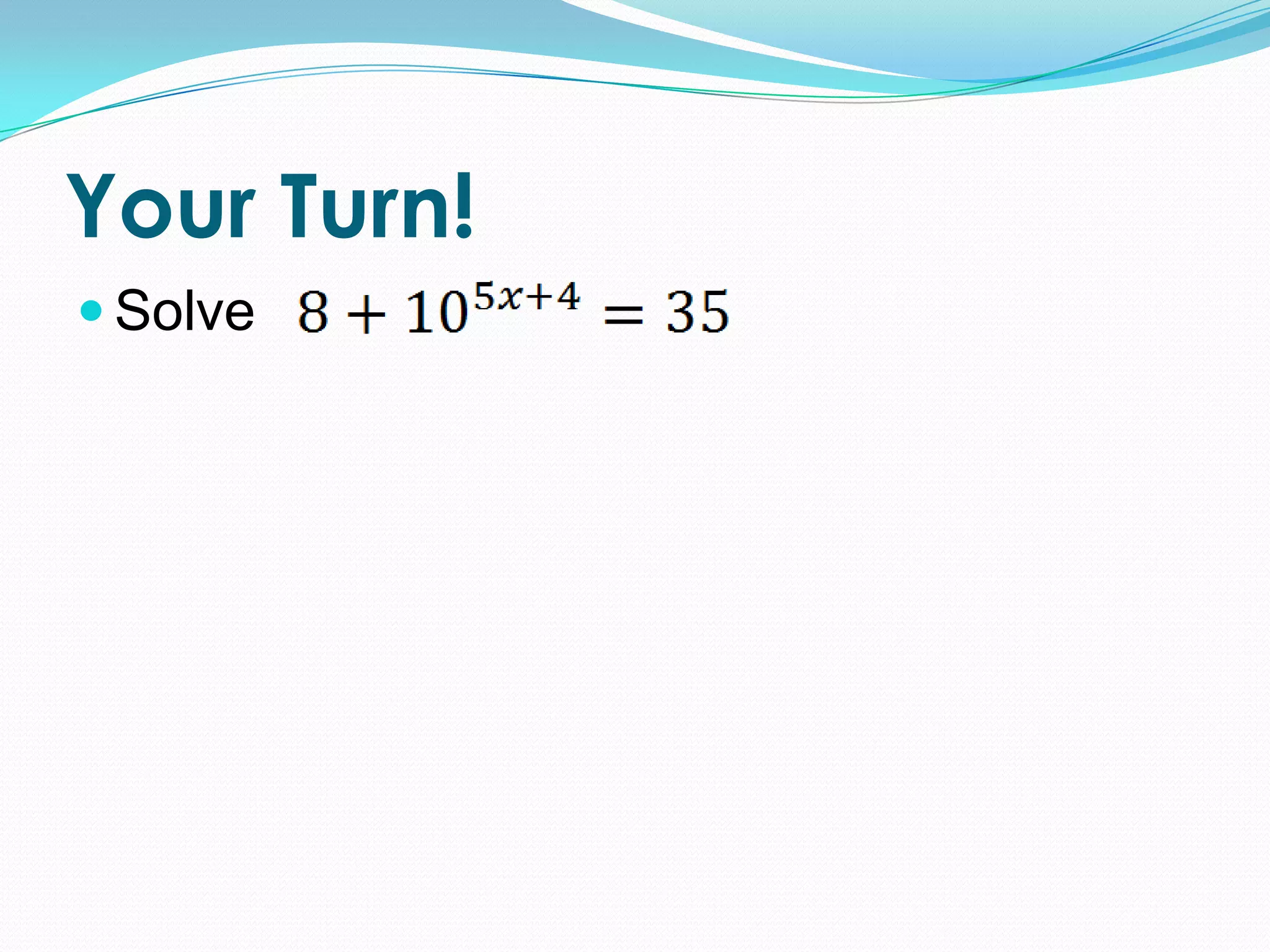
 Solve
Solving by Taking Logs
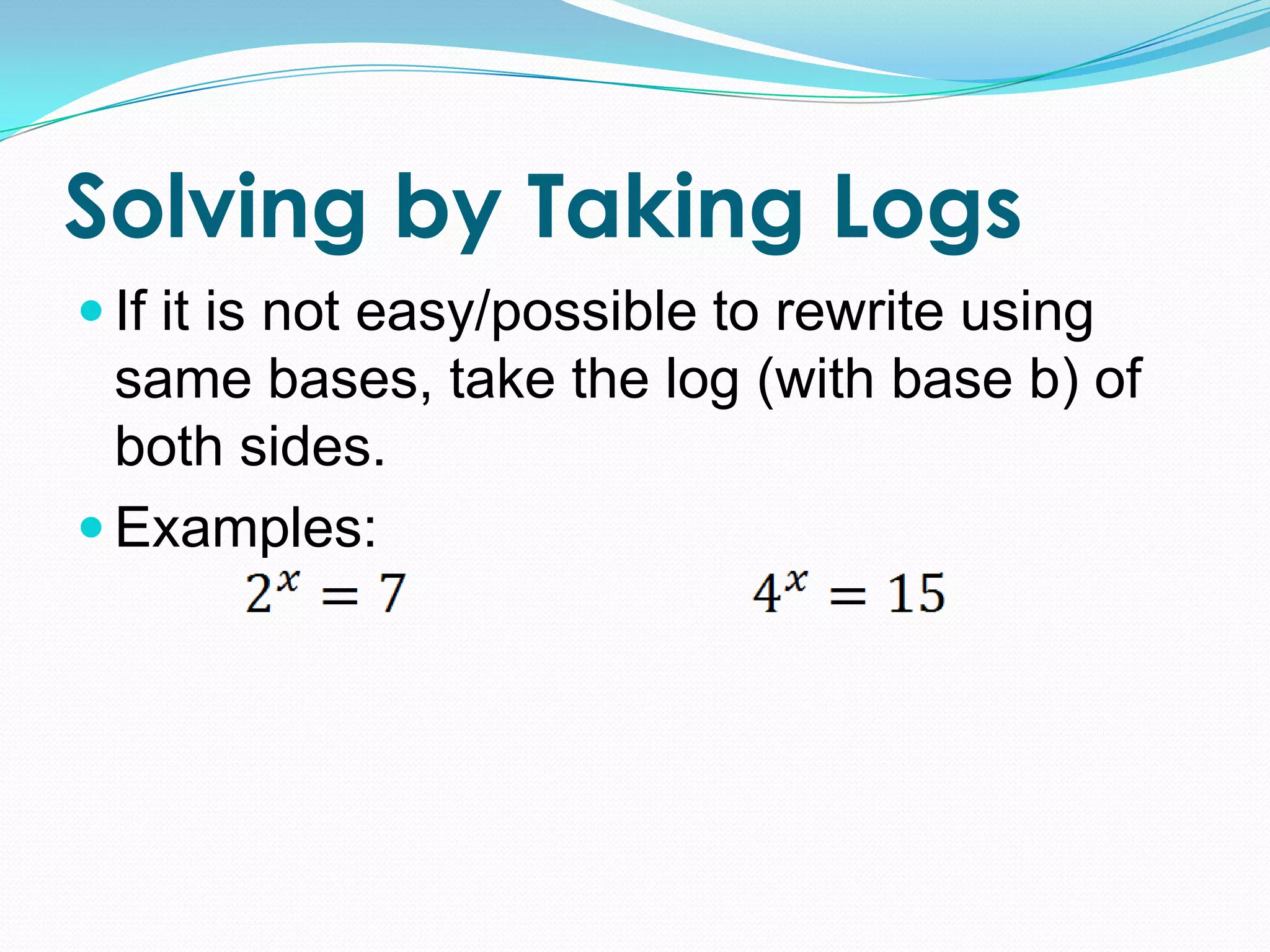
 If it is not easy/possible to rewrite using
  same bases, take the log (with base b) of
  both sides.
 Examples:
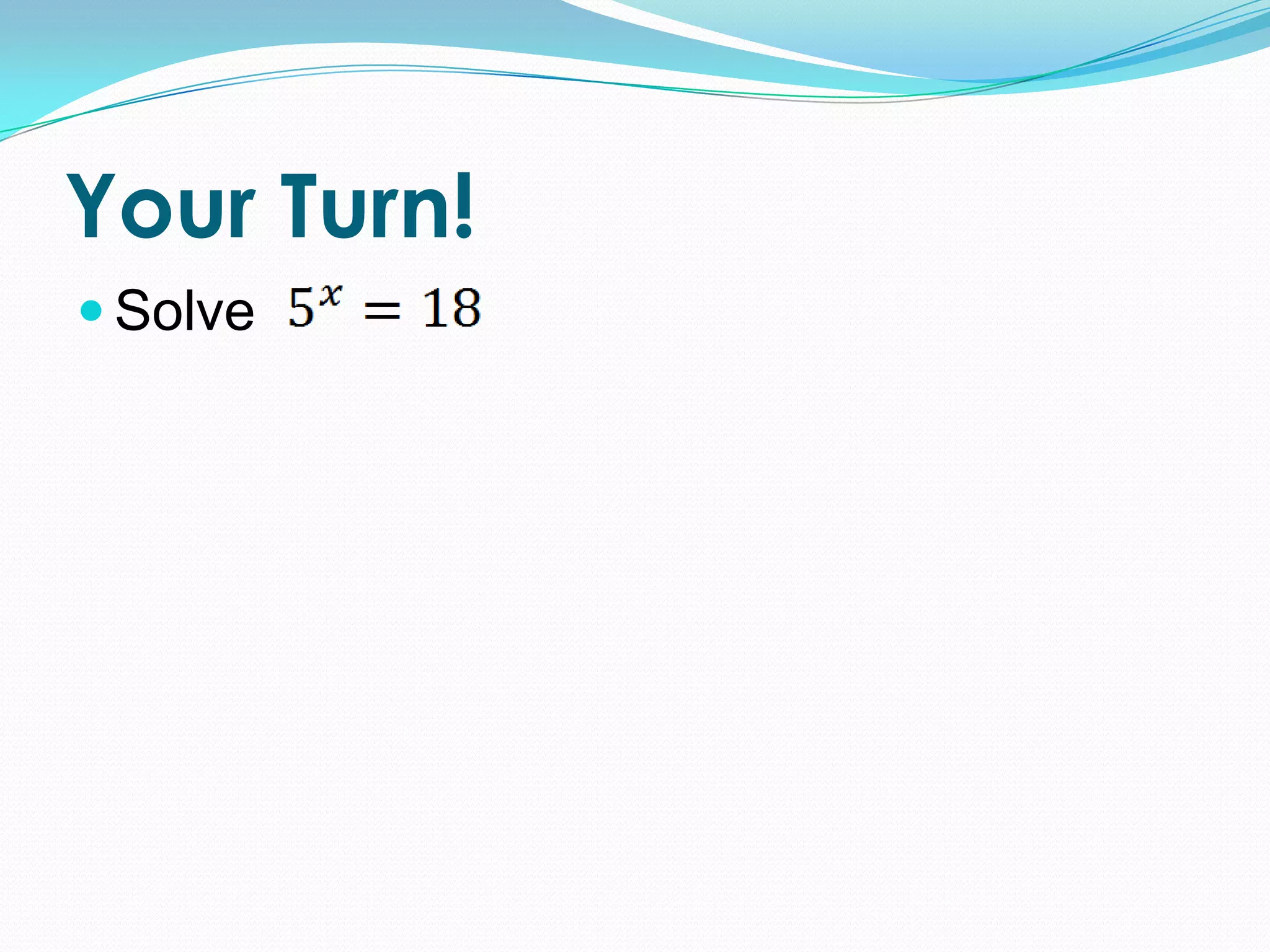
Your Turn!
 Solve
More Examples: Taking Logs
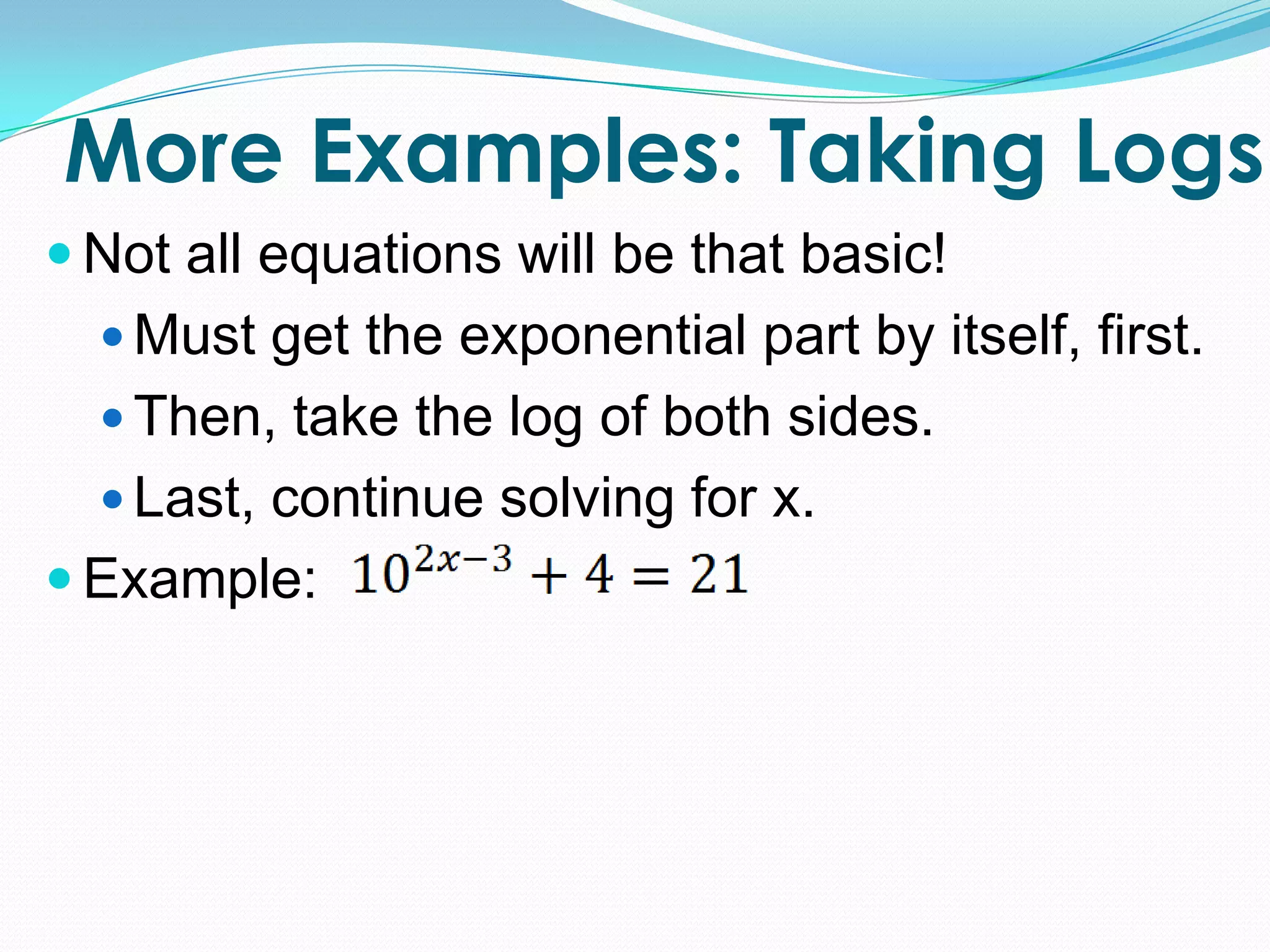
 Not all equations will be that basic!
   Must get the exponential part by itself, first.
   Then, take the log of both sides.
   Last, continue solving for x.
 Example:
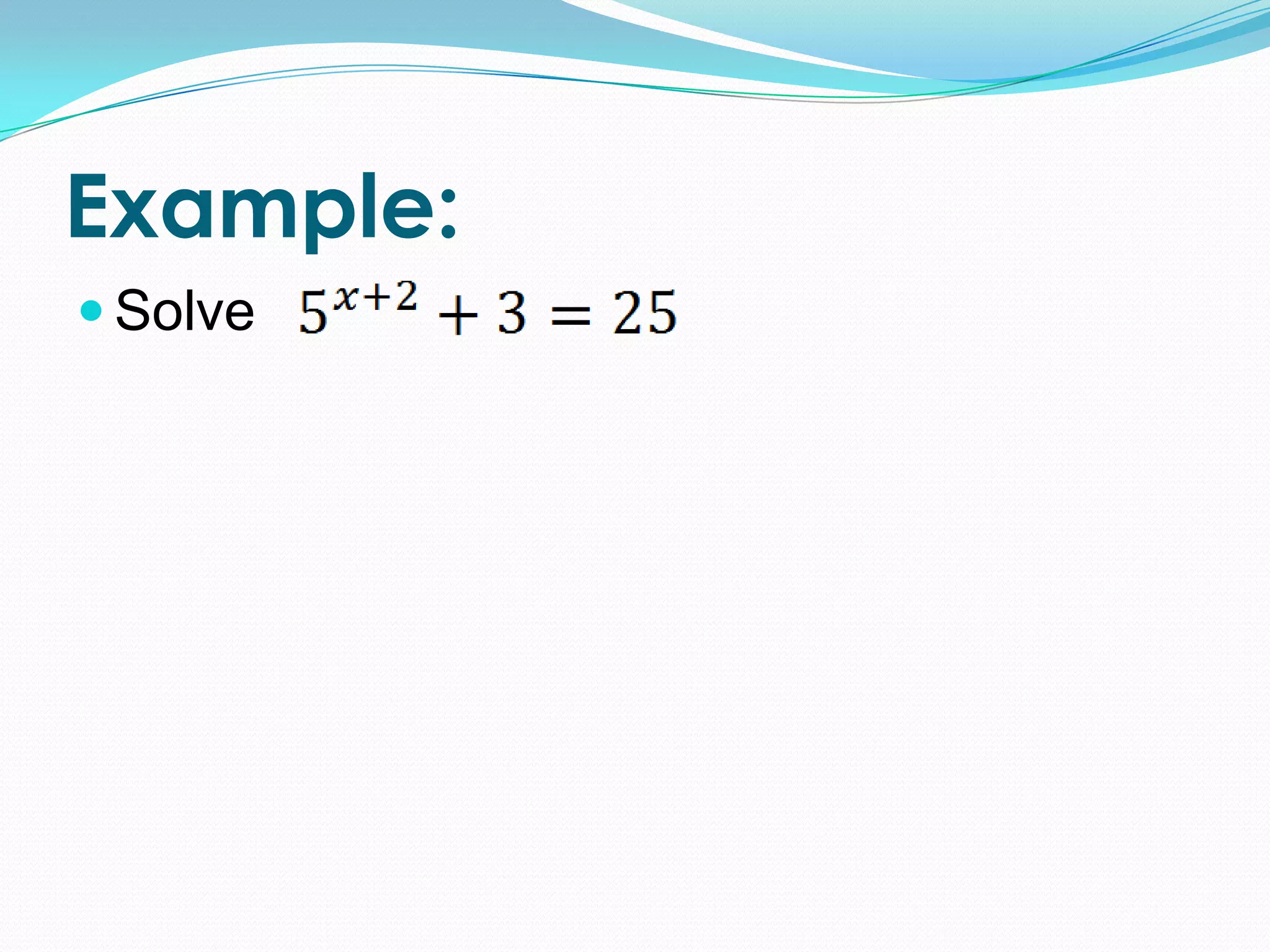
Example:
 Solve
Your Turn!
 Solve
Natural Base Exp. Equations
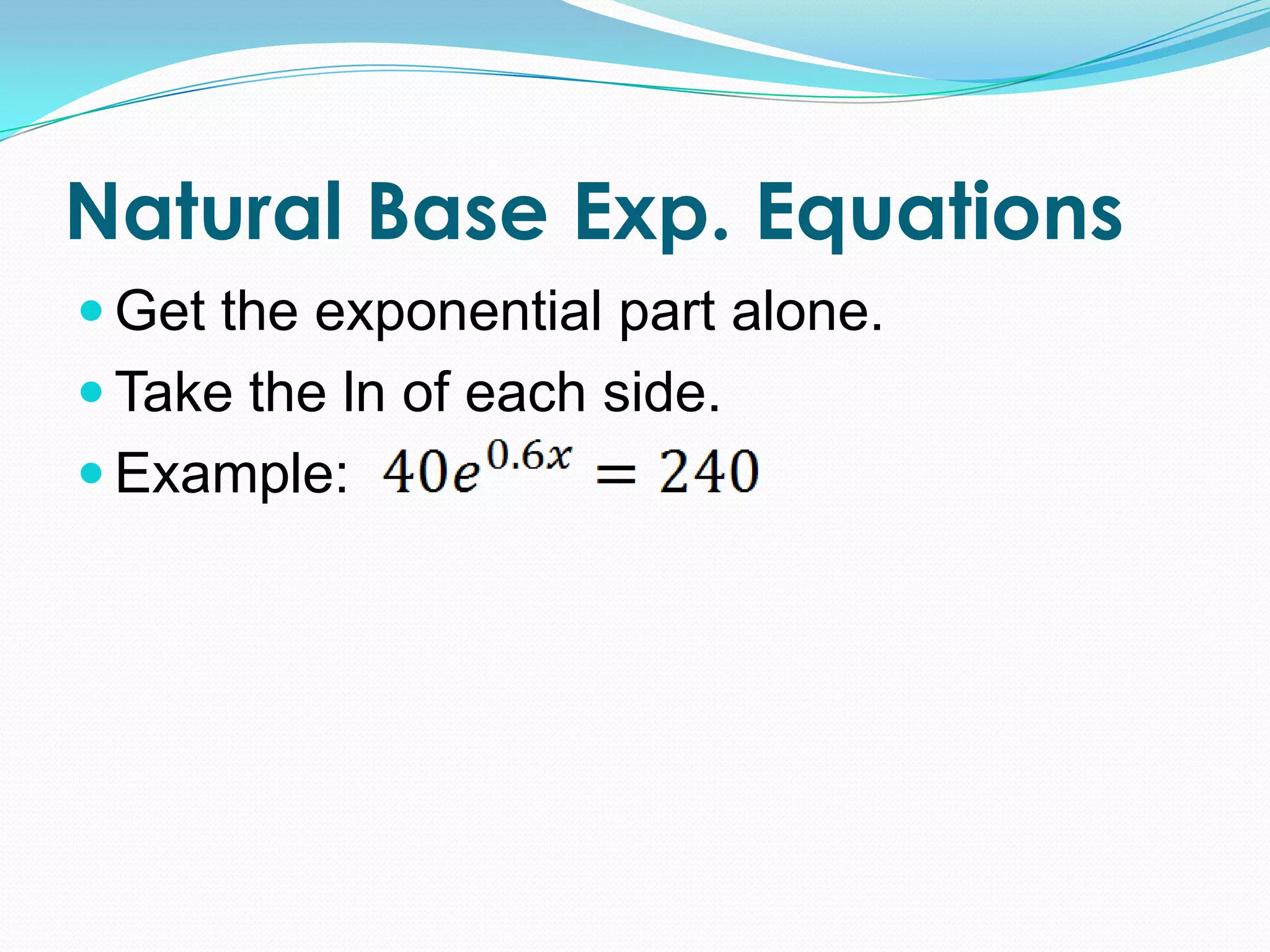
 Get the exponential part alone.
 Take the ln of each side.
 Example:
Exponential Models
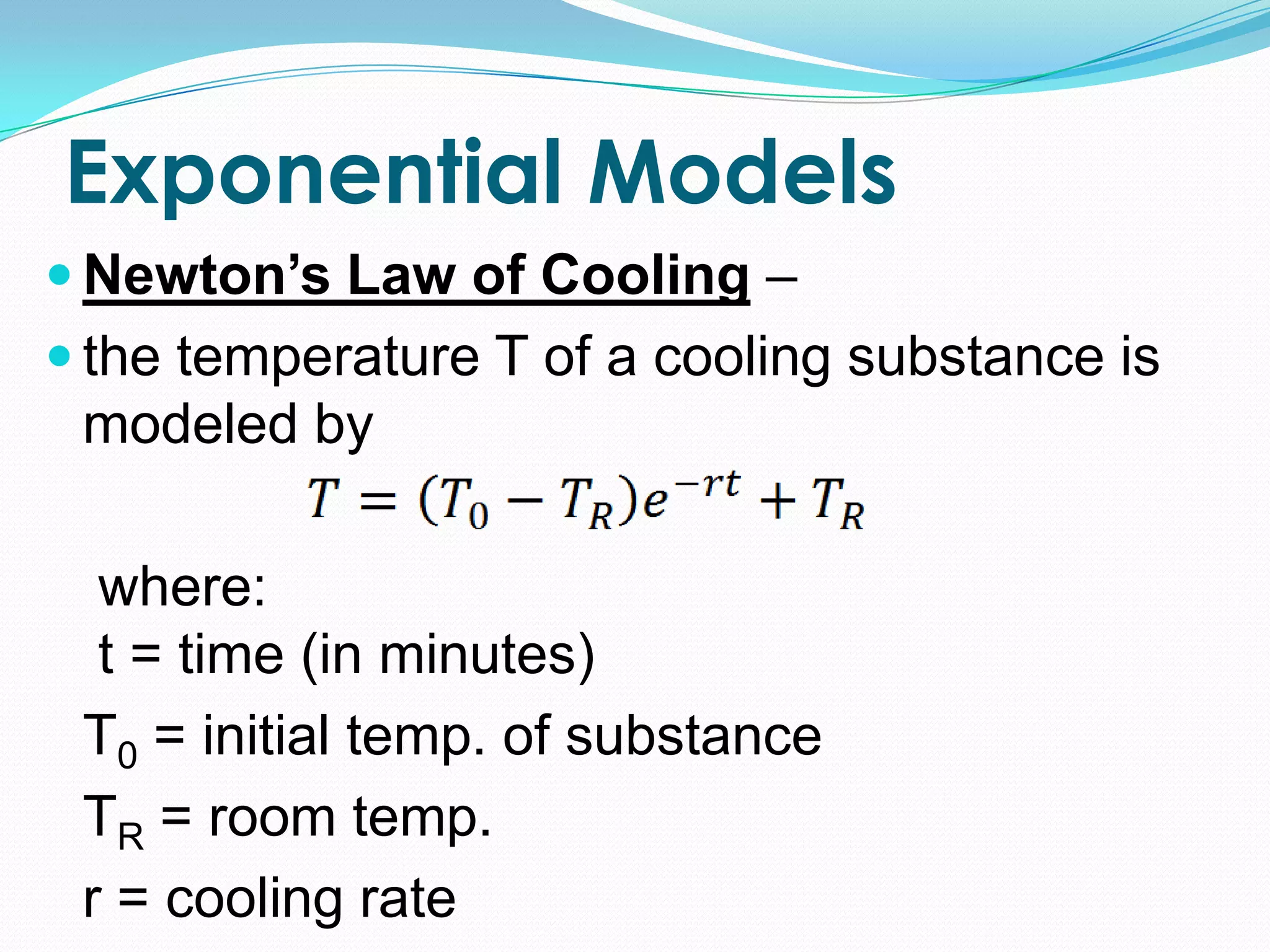
 Newton’s Law of Cooling –
 the temperature T of a cooling substance is
 modeled by

  where:
  t = time (in minutes)
 T0 = initial temp. of substance
 TR = room temp.
 r = cooling rate
Example:
 Your mom is making soup for dinner. When
 she takes it off the stove, it is 212ºF. The
 room temp. is 70ºF and the cooling rate of the
 soup is r = 0.046. How long will you have to
 wait to eat the soup at a safe temp. of 100ºF?
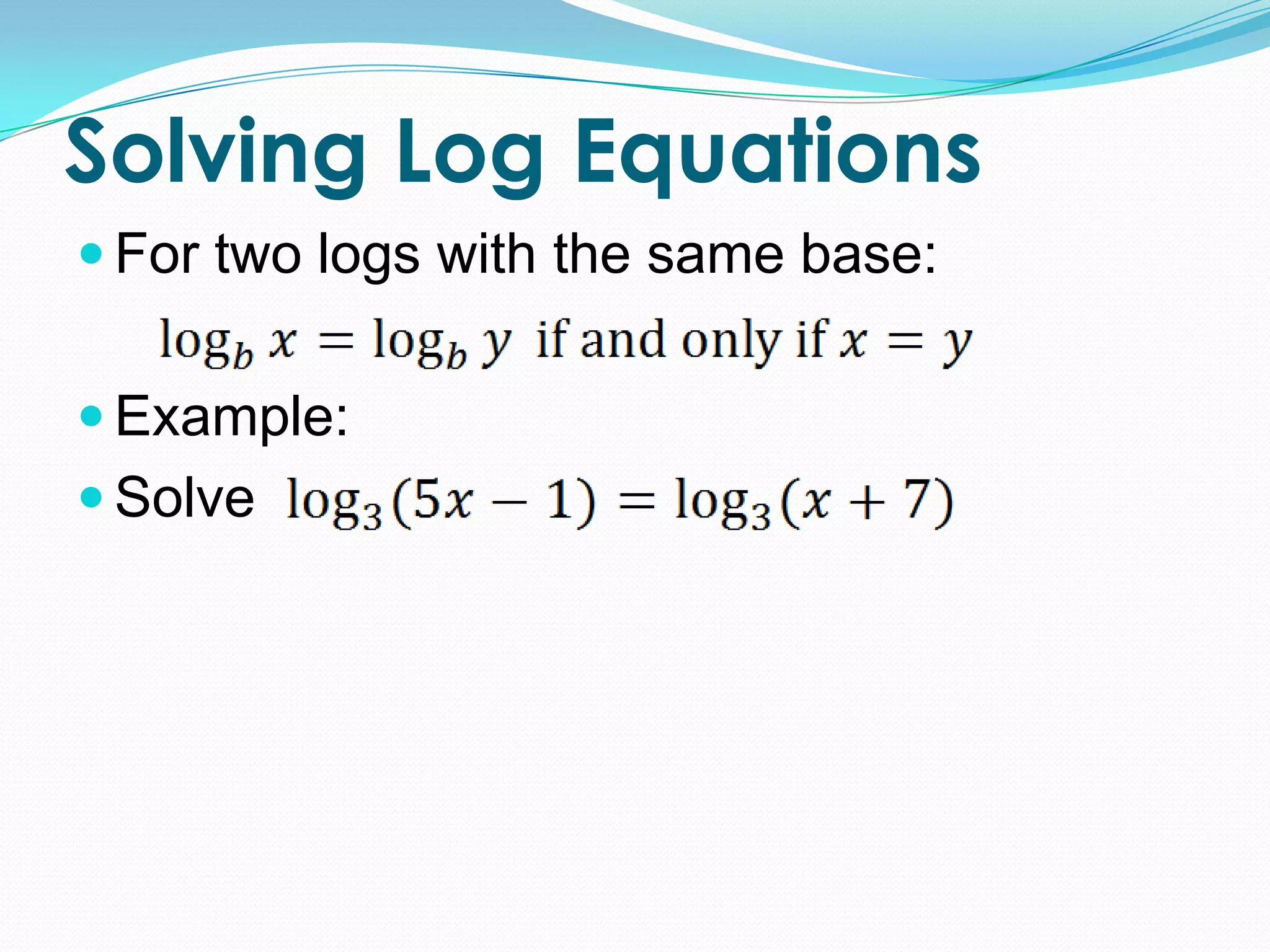
Solving Log Equations
 For two logs with the same base:


 Example:
 Solve
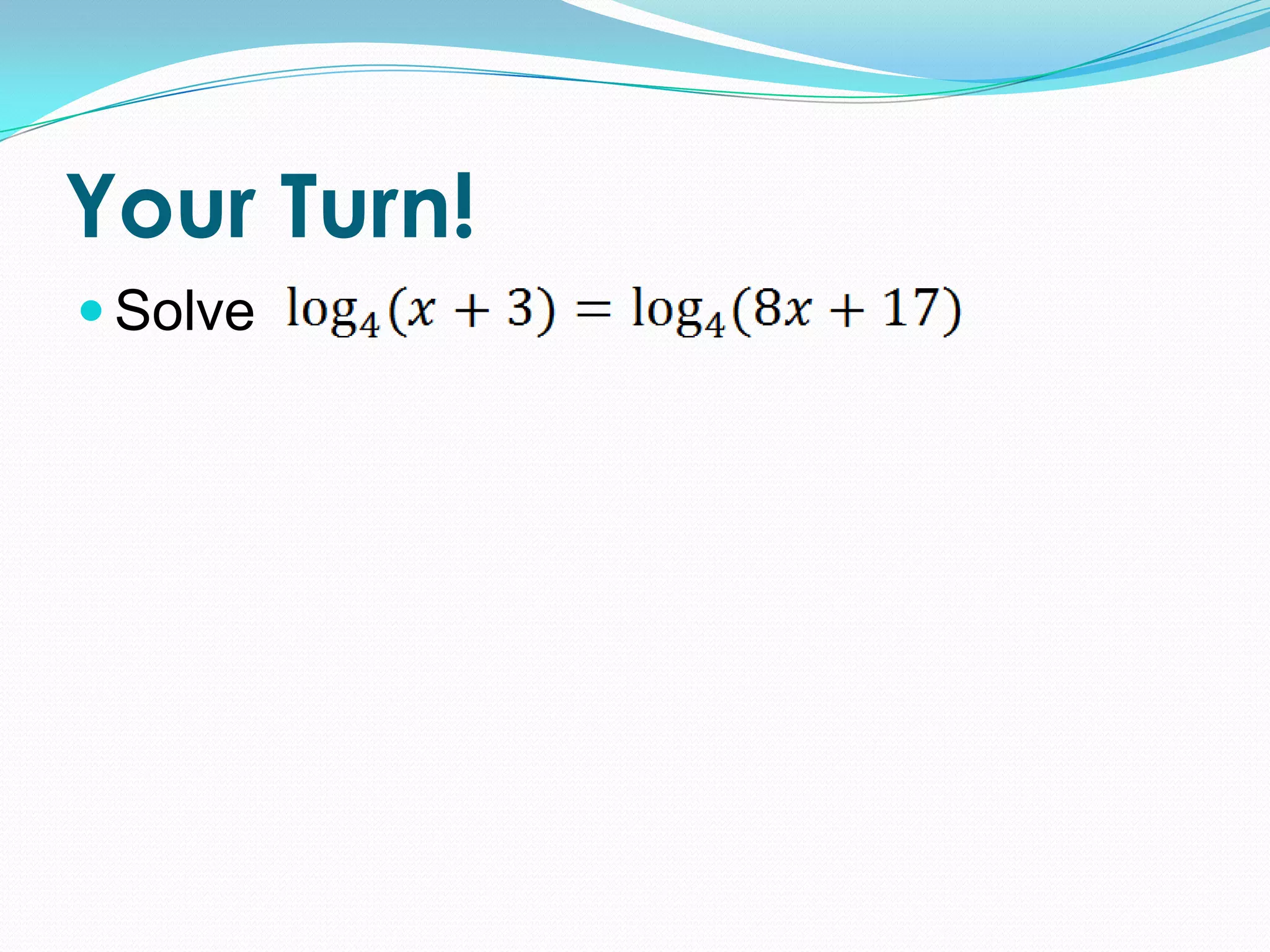
Your Turn!
 Solve
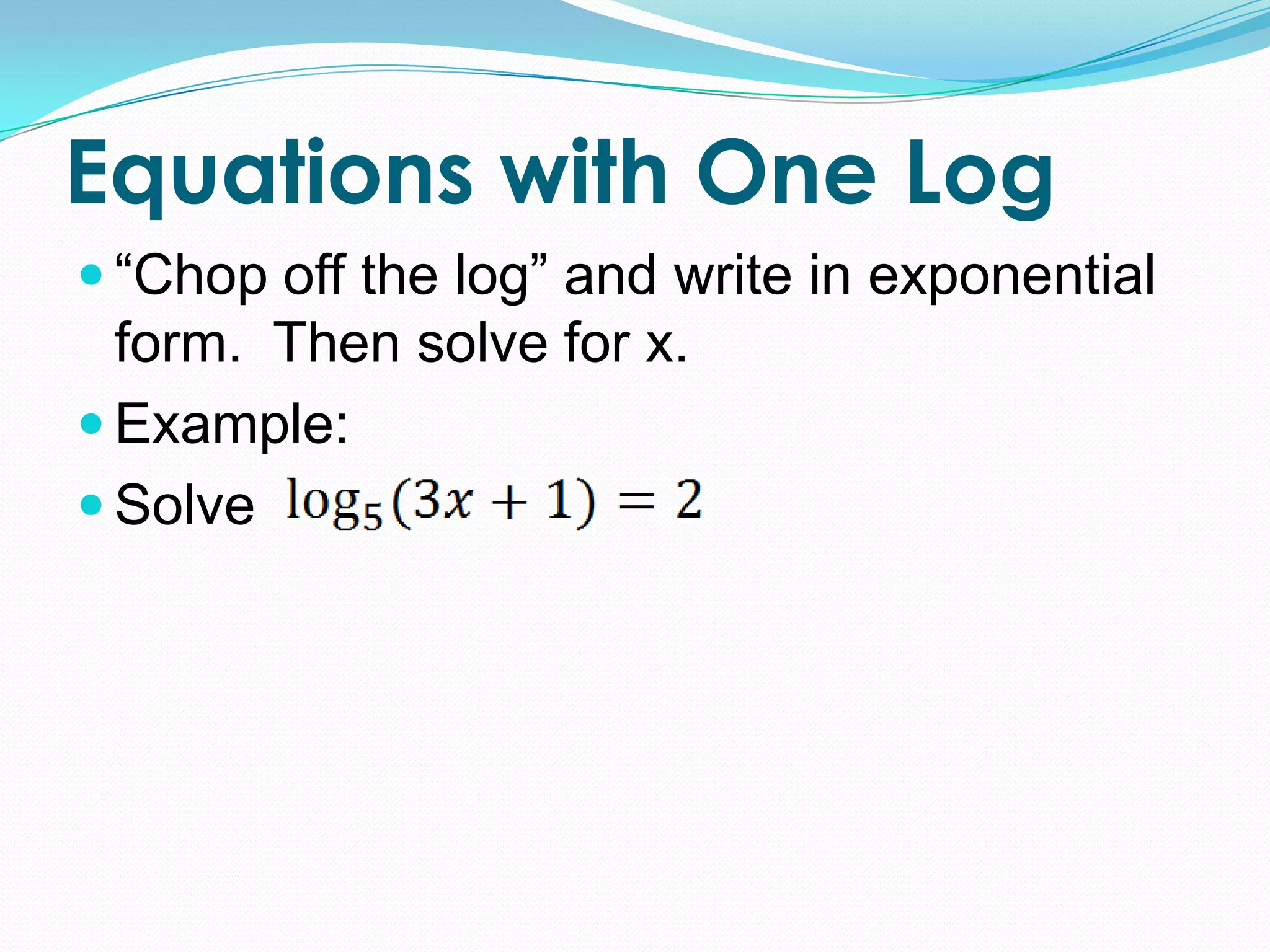
Equations with One Log
 “Chop off the log” and write in exponential
  form. Then solve for x.
 Example:
 Solve
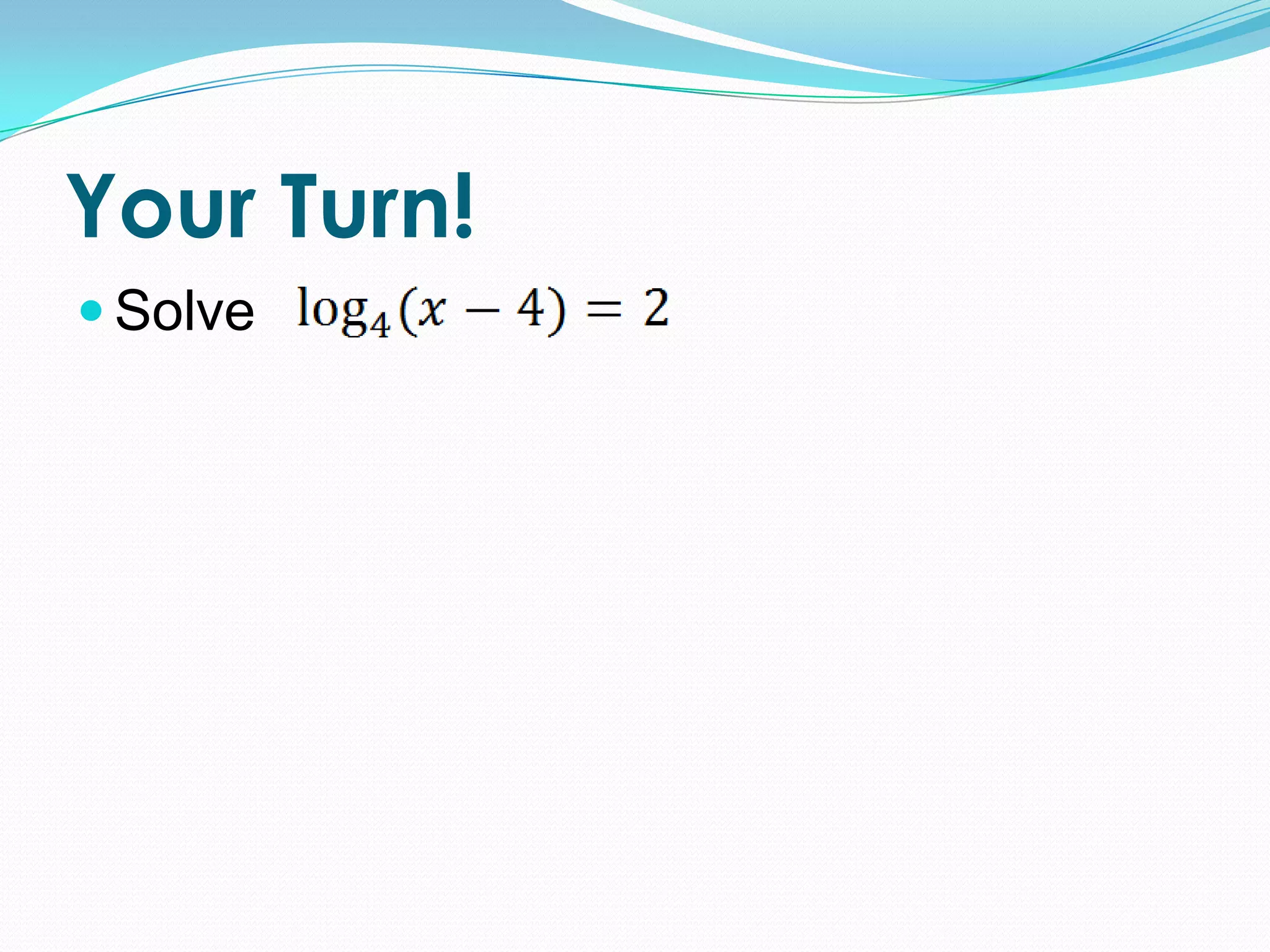
Your Turn!
 Solve
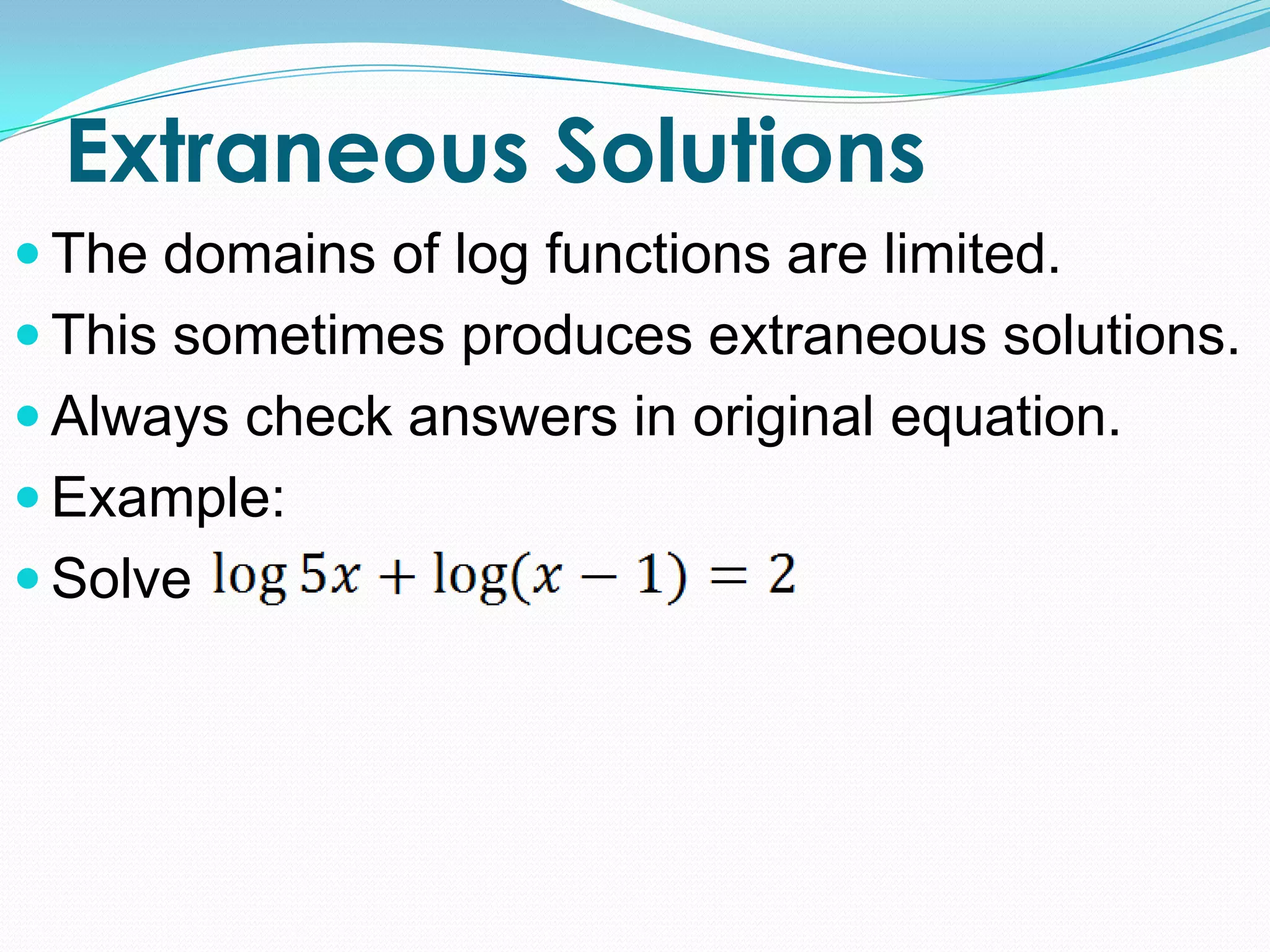
Extraneous Solutions
 The domains of log functions are limited.
 This sometimes produces extraneous solutions.
 Always check answers in original equation.
 Example:
 Solve
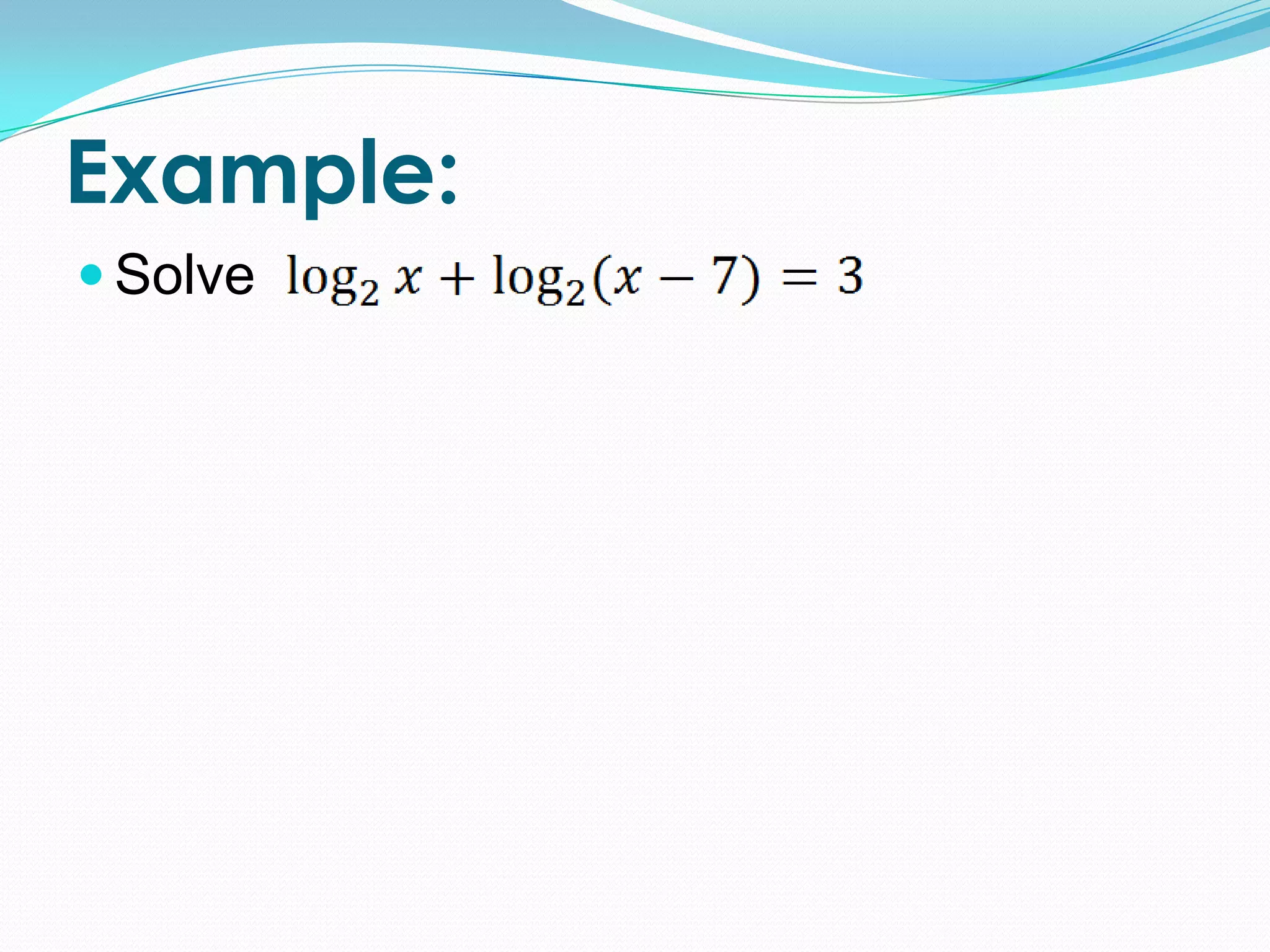
Example:
 Solve
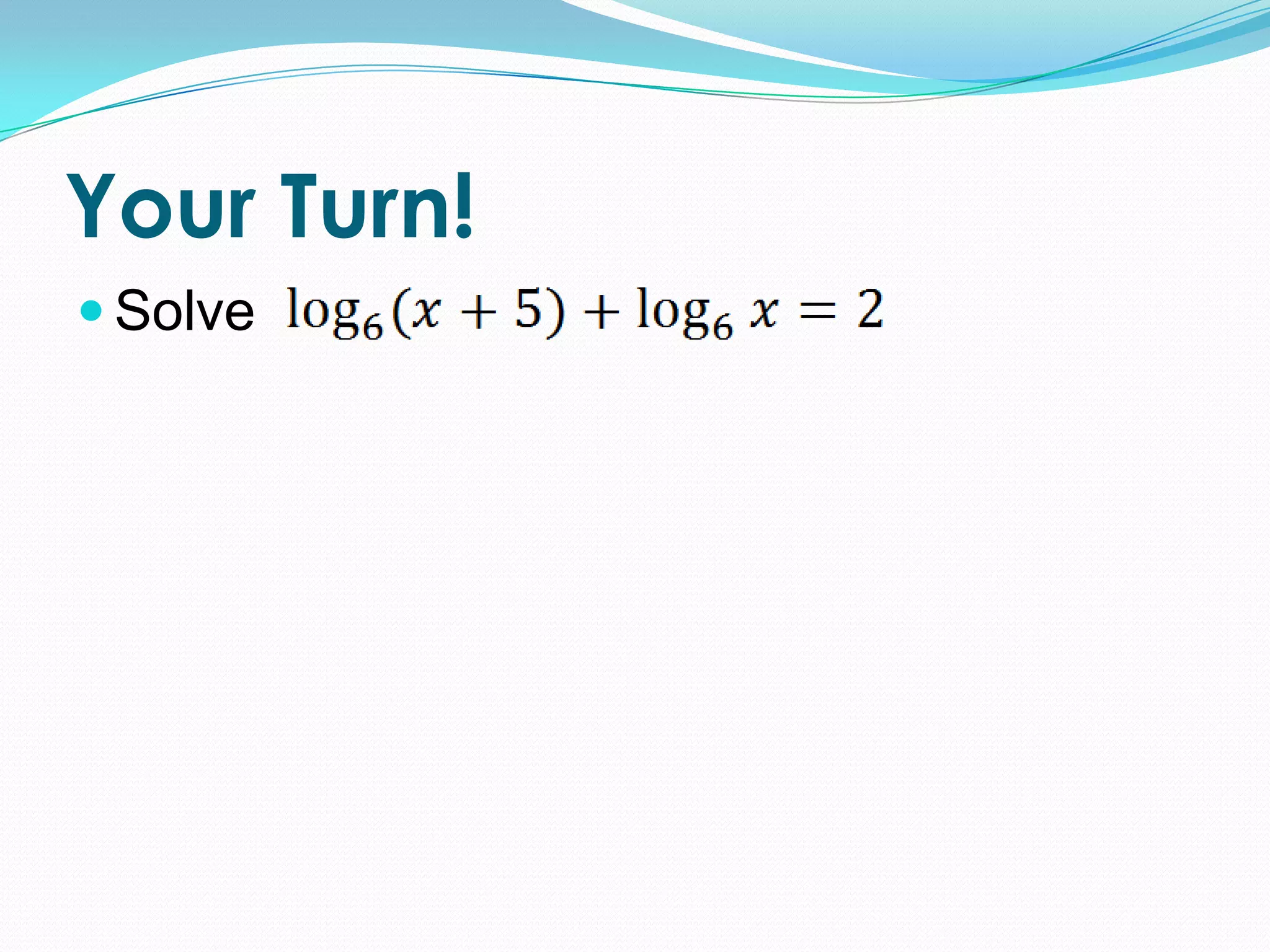
Your Turn!
 Solve

8.6 solving exponential and log equations