Linear & Exponential
Equations/Functions
Ms. Carter’s Algebra II
Before beginning let’s start with the basics and the important
things we SHOULD know about equations:
● Definition of an equation: a statement that the values
of two mathematical expressions are equal (indicated
by the sign =).
For example,
a=8 and 15=8+7 are both equations.
● Equations differ from expressions because they have
an equal sign equating the terms together.
● There are many different types of equations: linear,
exponential, quadratic, and the list goes on and on.
● These equations can also be used to create the
structure and backbone for some of our most
common functions.
Introduction
Consider an example,
I currently make $10 for every hour I work cleaning a
yard, how can we determine the amount of money I’ll
earn if I work 7 days a week, for 5 hours each day?
Is there a way in which we can find out my earnings per
day? For each week? Each month?
While this may seem like an easy example, we will
discover and interpret new methods on how to solve
this problem. During this unit, students will learn the
importance of functions and how they relate to our day
to day life.
Here’s whatwe’llbe learning!
Linear equations
● We will learn the key components of each form of linear equations.
● Students will connect their prior knowledge and use of equations to make sense of linear equations.
● Using that knowledge we will construct our own linear equations and functions.
Exponential equations
● Learn to identify the form of an exponential equation by its’ key components
● Learn about the most common exponential functions
● Students will demonstrate their knowledge of exponential equations and formulate their own
equations.
THESE
SHOULD BE A
REVIEW!!!
Linear
Equations/Functions:
Key Components
Slope
also known as m
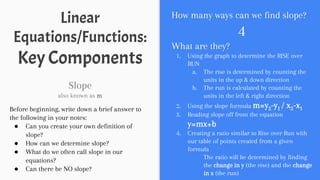
How many ways can we find slope?
4
What are they?
1. Using the graph to determine the RISE over
RUN
a. The rise is determined by counting the
units in the up & down direction
b. The run is calculated by counting the
units in the left & right direction
2. Using the slope formula m=y2-y1 / x2-x1
3. Reading slope off from the equation
y=mx+b
4. Creating a ratio similar to Rise over Run with
our table of points created from a given
formula
The ratio will be determined by finding
the change in y (the rise) and the change
in x (the run)
Before beginning, write down a brief answer to
the following in your notes:
● Can you create your own definition of
slope?
● How can we determine slope?
● What do we often call slope in our
equations?
● Can there be NO slope?
View this clip summarizing slope, and how
to find m using the Rise/Run method.
Y-intercept
also known as b
Recall that the y-intercept is the
point at which a line crosses
through the y-axis, when x=0.
How many ways can we find the y-
intercept?
2
Given a graph, and equation y=mx+b:
1. Look at the graph and read off the y-
intercept
2. Substitute a point, (x,y), into equation
and solve for b
Before beginning, write down a brief answer to
the following in your notes:
● What do you know about the y-intercept?
● Can you think of ways to find the y-
intercept of an equation?
Linear
Equations/Functions:
Key Components
Forms ofLinearEquations/Functions
➔ Standard Form
➔ Slope-Intercept Form
➔ Point-Slope Form
On our notes page, we will review
examples of EACH different form of
linear equations. This practice will be a
great resource and guide to our end of
the unit project.
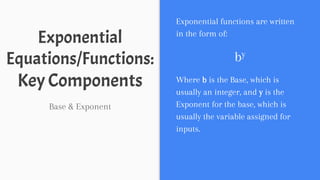
Exponential
Equations/Functions:
Key Components
Base & Exponent
Exponential functions are written
in the form of:
by
Where b is the Base, which is
usually an integer, and y is the
Exponent for the base, which is
usually the variable assigned for
inputs.
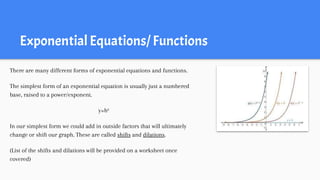
ExponentialEquations/ Functions
There are many different forms of exponential equations and functions.
The simplest form of an exponential equation is usually just a numbered
base, raised to a power/exponent.
y=bx
In our simplest form we could add in outside factors that will ultimately
change or shift our graph. These are called shifts and dilations.
(List of the shifts and dilations will be provided on a worksheet once
covered)
CommonExponentialFunctions
Exponential Growth Exponential Decay
● y=a(1-r)x
● b<1
● b= 1-r
● y=a(1+r)x
● b>1
● b= 1+r
● y=abx
● a is the y
intercept
● a is the initial
value
On our notes page, we will review examples of EACH different form of exponential equations. This
practice will be a great resource and guide to our end of the unit project.
What isthe difference betweena LINEARand
EXPONENTIALfunction?
Now that we have seen linear and exponential
functions on separate occasions, we will now learn to
distinguish their differences by viewing examples of
both together.
With that, I have created a small challenge for you
guys. The challenge/question: Linear or Exponential?
In this “challenge” we will further our learning by
understanding the differences between the two.
LINEAR OR EXPONENTIAL?
Turn to ___ page in your notes and complete the
following exercise.

Linear & Exponential Equations/Functions

  • 1.
  • 2.
    Before beginning let’sstart with the basics and the important things we SHOULD know about equations: ● Definition of an equation: a statement that the values of two mathematical expressions are equal (indicated by the sign =). For example, a=8 and 15=8+7 are both equations. ● Equations differ from expressions because they have an equal sign equating the terms together. ● There are many different types of equations: linear, exponential, quadratic, and the list goes on and on. ● These equations can also be used to create the structure and backbone for some of our most common functions. Introduction Consider an example, I currently make $10 for every hour I work cleaning a yard, how can we determine the amount of money I’ll earn if I work 7 days a week, for 5 hours each day? Is there a way in which we can find out my earnings per day? For each week? Each month? While this may seem like an easy example, we will discover and interpret new methods on how to solve this problem. During this unit, students will learn the importance of functions and how they relate to our day to day life.
  • 3.
    Here’s whatwe’llbe learning! Linearequations ● We will learn the key components of each form of linear equations. ● Students will connect their prior knowledge and use of equations to make sense of linear equations. ● Using that knowledge we will construct our own linear equations and functions. Exponential equations ● Learn to identify the form of an exponential equation by its’ key components ● Learn about the most common exponential functions ● Students will demonstrate their knowledge of exponential equations and formulate their own equations. THESE SHOULD BE A REVIEW!!!
  • 4.
    Linear Equations/Functions: Key Components Slope also knownas m How many ways can we find slope? 4 What are they? 1. Using the graph to determine the RISE over RUN a. The rise is determined by counting the units in the up & down direction b. The run is calculated by counting the units in the left & right direction 2. Using the slope formula m=y2-y1 / x2-x1 3. Reading slope off from the equation y=mx+b 4. Creating a ratio similar to Rise over Run with our table of points created from a given formula The ratio will be determined by finding the change in y (the rise) and the change in x (the run) Before beginning, write down a brief answer to the following in your notes: ● Can you create your own definition of slope? ● How can we determine slope? ● What do we often call slope in our equations? ● Can there be NO slope?
  • 5.
    View this clipsummarizing slope, and how to find m using the Rise/Run method.
  • 6.
    Y-intercept also known asb Recall that the y-intercept is the point at which a line crosses through the y-axis, when x=0. How many ways can we find the y- intercept? 2 Given a graph, and equation y=mx+b: 1. Look at the graph and read off the y- intercept 2. Substitute a point, (x,y), into equation and solve for b Before beginning, write down a brief answer to the following in your notes: ● What do you know about the y-intercept? ● Can you think of ways to find the y- intercept of an equation? Linear Equations/Functions: Key Components
  • 7.
    Forms ofLinearEquations/Functions ➔ StandardForm ➔ Slope-Intercept Form ➔ Point-Slope Form On our notes page, we will review examples of EACH different form of linear equations. This practice will be a great resource and guide to our end of the unit project.
  • 8.
    Exponential Equations/Functions: Key Components Base &Exponent Exponential functions are written in the form of: by Where b is the Base, which is usually an integer, and y is the Exponent for the base, which is usually the variable assigned for inputs.
  • 9.
    ExponentialEquations/ Functions There aremany different forms of exponential equations and functions. The simplest form of an exponential equation is usually just a numbered base, raised to a power/exponent. y=bx In our simplest form we could add in outside factors that will ultimately change or shift our graph. These are called shifts and dilations. (List of the shifts and dilations will be provided on a worksheet once covered)
  • 10.
    CommonExponentialFunctions Exponential Growth ExponentialDecay ● y=a(1-r)x ● b<1 ● b= 1-r ● y=a(1+r)x ● b>1 ● b= 1+r ● y=abx ● a is the y intercept ● a is the initial value On our notes page, we will review examples of EACH different form of exponential equations. This practice will be a great resource and guide to our end of the unit project.
  • 11.
    What isthe differencebetweena LINEARand EXPONENTIALfunction? Now that we have seen linear and exponential functions on separate occasions, we will now learn to distinguish their differences by viewing examples of both together. With that, I have created a small challenge for you guys. The challenge/question: Linear or Exponential? In this “challenge” we will further our learning by understanding the differences between the two. LINEAR OR EXPONENTIAL? Turn to ___ page in your notes and complete the following exercise.