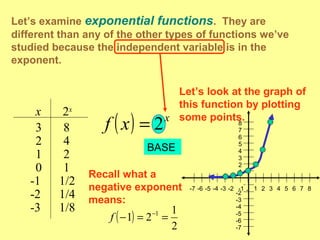
Let’s examine exponential functions. They are
different than any of the other types of functions we’ve
studied because the independent variable is in the
exponent.
( ) x
xf 2=
Let’s look at the graph of
this function by plotting
some points.x 2x
3 8
2 4
1 2
0 1
-1 1/2
-2 1/4
-3 1/8
2-7 -6 -5 -4 -3 -2 -1 1 5 730 4 6 8
7
1
2
3
4
5
6
8
-2
-3
-4
-5
-6
-7
( )
2
1
21 1
==− −
f
Recall what a
negative exponent
means:
BASE
( ) x
xf 2=
( ) x
xf 3=
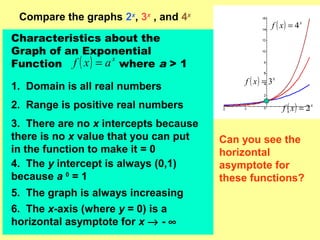
Compare the graphs 2x
, 3x
, and 4x
Characteristics about the
Graph of an Exponential
Function where a > 1( ) x
axf =
What is the
domain of an
exponential
function?
1. Domain is all real numbers
( ) x
xf 4=
What is the range
of an exponential
function?
2. Range is positive real numbers
What is the x
intercept of these
exponential
functions?
3. There are no x intercepts because
there is no x value that you can put
in the function to make it = 0
What is the y
intercept of these
exponential
functions?
4. The y intercept is always (0,1)
because a 0
= 1
5. The graph is always increasing
Are these
exponential
functions
increasing or
decreasing?
6. The x-axis (where y = 0) is a
horizontal asymptote for x → - ∞
Can you see the
horizontal
asymptote for
these functions?
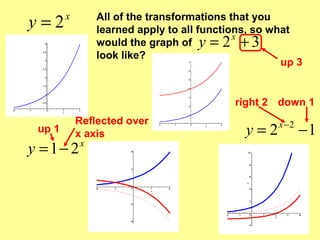
All of the transformations that you
learned apply to all functions, so what
would the graph of
look like?
x
y 2=
32 += x
y
up 3
x
y 21−=
up 1
Reflected over
x axis 12 2
−= −x
y
down 1right 2
x
y −
= 2
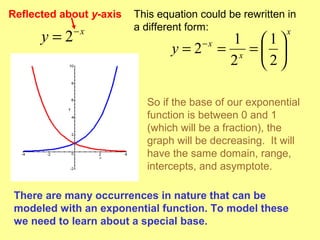
Reflected about y-axis This equation could be rewritten in
a different form: x
x
x
y 





=== −
2
1
2
1
2
So if the base of our exponential
function is between 0 and 1
(which will be a fraction), the
graph will be decreasing. It will
have the same domain, range,
intercepts, and asymptote.
There are many occurrences in nature that can be
modeled with an exponential function. To model these
we need to learn about a special base.
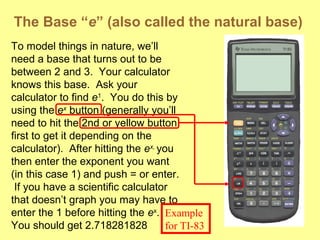
The Base “e” (also called the natural base)
To model things in nature, we’ll
need a base that turns out to be
between 2 and 3. Your calculator
knows this base. Ask your
calculator to find e1
. You do this by
using the ex
button (generally you’ll
need to hit the 2nd or yellow button
first to get it depending on the
calculator). After hitting the ex,
you
then enter the exponent you want
(in this case 1) and push = or enter.
If you have a scientific calculator
that doesn’t graph you may have to
enter the 1 before hitting the ex
.
You should get 2.718281828
Example
for TI-83
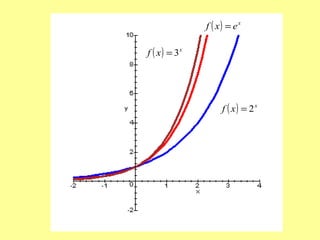
( ) x
xf 2=
( ) x
xf 3=
( ) x
exf =
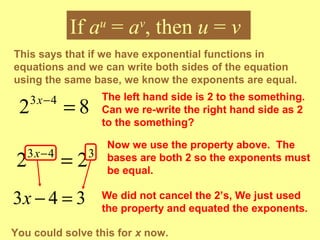
This says that if we have exponential functions in
equations and we can write both sides of the equation
using the same base, we know the exponents are equal.
If au
= av
, then u = v
82 43
=−x The left hand side is 2 to the something.
Can we re-write the right hand side as 2
to the something?
343
22 =−x
Now we use the property above. The
bases are both 2 so the exponents must
be equal.
343 =−x We did not cancel the 2’s, We just used
the property and equated the exponents.
You could solve this for x now.
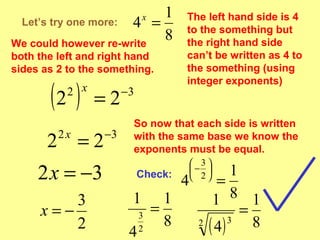
Let’s try one more:
8
1
4 =x The left hand side is 4
to the something but
the right hand side
can’t be written as 4 to
the something (using
integer exponents)
We could however re-write
both the left and right hand
sides as 2 to the something.
( ) 32
22 −
=
x
32
22 −
=x
So now that each side is written
with the same base we know the
exponents must be equal.
32 −=x
2
3
−=x
Check:
8
1
4 2
3
=






−
8
1
4
1
2
3
=
( ) 8
1
4
1
2 3
=
Acknowledgement
I wish to thank Shawna Haider from Salt Lake Community College, Utah
USA for her hard work in creating this PowerPoint.
www.slcc.edu
Shawna has kindly given permission for this resource to be downloaded
from www.mathxtc.com and for it to be modified to suit the Western
Australian Mathematics Curriculum.
Stephen Corcoran
Head of Mathematics
St Stephen’s School – Carramar
www.ststephens.wa.edu.au

Exponential functions

  • 2.
    Let’s examine exponentialfunctions. They are different than any of the other types of functions we’ve studied because the independent variable is in the exponent. ( ) x xf 2= Let’s look at the graph of this function by plotting some points.x 2x 3 8 2 4 1 2 0 1 -1 1/2 -2 1/4 -3 1/8 2-7 -6 -5 -4 -3 -2 -1 1 5 730 4 6 8 7 1 2 3 4 5 6 8 -2 -3 -4 -5 -6 -7 ( ) 2 1 21 1 ==− − f Recall what a negative exponent means: BASE
  • 3.
    ( ) x xf2= ( ) x xf 3= Compare the graphs 2x , 3x , and 4x Characteristics about the Graph of an Exponential Function where a > 1( ) x axf = What is the domain of an exponential function? 1. Domain is all real numbers ( ) x xf 4= What is the range of an exponential function? 2. Range is positive real numbers What is the x intercept of these exponential functions? 3. There are no x intercepts because there is no x value that you can put in the function to make it = 0 What is the y intercept of these exponential functions? 4. The y intercept is always (0,1) because a 0 = 1 5. The graph is always increasing Are these exponential functions increasing or decreasing? 6. The x-axis (where y = 0) is a horizontal asymptote for x → - ∞ Can you see the horizontal asymptote for these functions?
  • 4.
    All of thetransformations that you learned apply to all functions, so what would the graph of look like? x y 2= 32 += x y up 3 x y 21−= up 1 Reflected over x axis 12 2 −= −x y down 1right 2
  • 5.
    x y − = 2 Reflectedabout y-axis This equation could be rewritten in a different form: x x x y       === − 2 1 2 1 2 So if the base of our exponential function is between 0 and 1 (which will be a fraction), the graph will be decreasing. It will have the same domain, range, intercepts, and asymptote. There are many occurrences in nature that can be modeled with an exponential function. To model these we need to learn about a special base.
  • 6.
    The Base “e”(also called the natural base) To model things in nature, we’ll need a base that turns out to be between 2 and 3. Your calculator knows this base. Ask your calculator to find e1 . You do this by using the ex button (generally you’ll need to hit the 2nd or yellow button first to get it depending on the calculator). After hitting the ex, you then enter the exponent you want (in this case 1) and push = or enter. If you have a scientific calculator that doesn’t graph you may have to enter the 1 before hitting the ex . You should get 2.718281828 Example for TI-83
  • 7.
    ( ) x xf2= ( ) x xf 3= ( ) x exf =
  • 8.
    This says thatif we have exponential functions in equations and we can write both sides of the equation using the same base, we know the exponents are equal. If au = av , then u = v 82 43 =−x The left hand side is 2 to the something. Can we re-write the right hand side as 2 to the something? 343 22 =−x Now we use the property above. The bases are both 2 so the exponents must be equal. 343 =−x We did not cancel the 2’s, We just used the property and equated the exponents. You could solve this for x now.
  • 9.
    Let’s try onemore: 8 1 4 =x The left hand side is 4 to the something but the right hand side can’t be written as 4 to the something (using integer exponents) We could however re-write both the left and right hand sides as 2 to the something. ( ) 32 22 − = x 32 22 − =x So now that each side is written with the same base we know the exponents must be equal. 32 −=x 2 3 −=x Check: 8 1 4 2 3 =       − 8 1 4 1 2 3 = ( ) 8 1 4 1 2 3 =
  • 10.
    Acknowledgement I wish tothank Shawna Haider from Salt Lake Community College, Utah USA for her hard work in creating this PowerPoint. www.slcc.edu Shawna has kindly given permission for this resource to be downloaded from www.mathxtc.com and for it to be modified to suit the Western Australian Mathematics Curriculum. Stephen Corcoran Head of Mathematics St Stephen’s School – Carramar www.ststephens.wa.edu.au