Experimental Research
       designs
Concepts
•   Experiment: Lab or Field
•   Treatment
•   Treatment effects
•   Factor-independent variable
•   Blocking factor
Experimental Design
Examine possible cause and effect
  relationship among variables
To establish variable X causes variable Y,
  all three conditions should be met:
• Both X and Y should covary
• Time sequence X should precede Y
• No other factor should possibly change
  the dependent variable Y
Principles of Research Design
• Principle of Replication
• Principle of Randomization
• Principle of Local control
Informal Experimental Design

1. Quasi Experimental Design
2. Pretest and posttest Experimental Group
   Design ( caution: testing and
   instrumentation)
3. Post test only control design
4. Pretest posttest experimental and control
   group design
Validity
• External – Generalizability to other setting
• Internal- History, maturation effects,
  testing, instrumentation, selection bias etc
Quasi E.D.
• Experimental group treatment and
  measure effects
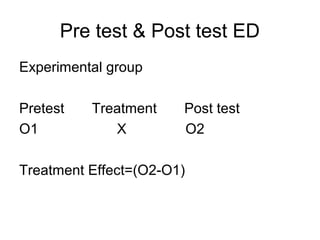
Pre test & Post test ED
Experimental group

Pretest   Treatment    Post test
O1           X         O2

Treatment Effect=(O2-O1)
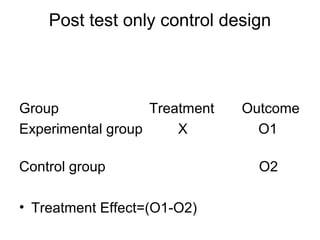
Post test only control design


Group              Treatment   Outcome
Experimental group     X         O1

Control group                    O2

• Treatment Effect=(O1-O2)
Pretest posttest experimental and
          control group design


Group                Pretest Treatment Posttest
Experimental group     O1        X       O2
Control group           O3               O4


Treatment Effect=[(O2-O1)-(O4-O3)]
Solomon Four-Group Design


Group                Pretest Treatment Posttest
Experimental           O1        X          O2
Control                 O3                  O4
Experimental                      X          O5
Control                                      O6
Treatment Effect E=O2-O1
                    =O2-O4
                    =O5-O6
                    =O5-O3
                    =[(O2-O1)-(O4-O3)]
* all Es are similar if cause and effect is highly valid
Double blind studies

• Researcher-subjects are unaware
• Drugs
Design a study to examine the
       following situation.
An organization would like to introduce one
 of two types of new manufacturing
 processes to increase to the productivity
 of the workers, and both involve heavy
 investment in expansive technology. The
 company wants to test the efficacy of each
 process in one of its small plants.
Formal E.D.
Completely Randomized
Randomized Block
Latin Square
Factorial

They are required to judge simultaneous
 effect of two or more variables on
 dependent variable.
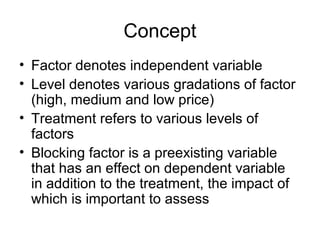
Concept
• Factor denotes independent variable
• Level denotes various gradations of factor
  (high, medium and low price)
• Treatment refers to various levels of
  factors
• Blocking factor is a preexisting variable
  that has an effect on dependent variable
  in addition to the treatment, the impact of
  which is important to assess
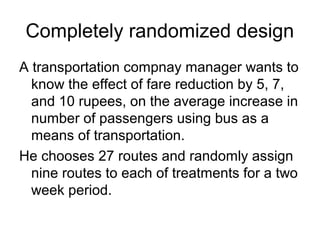
Completely randomized design
A transportation compnay manager wants to
  know the effect of fare reduction by 5, 7,
  and 10 rupees, on the average increase in
  number of passengers using bus as a
  means of transportation.
He chooses 27 routes and randomly assign
  nine routes to each of treatments for a two
  week period.
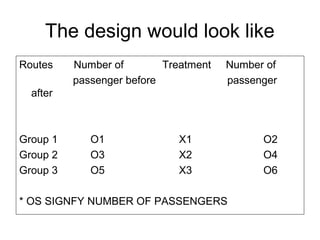
The design would look like
Routes    Number of        Treatment   Number of
          passenger before             passenger
  after


Group 1      O1              X1              O2
Group 2      O3              X2              O4
Group 3      O5              X3              O6

* OS SIGNFY NUMBER OF PASSENGERS
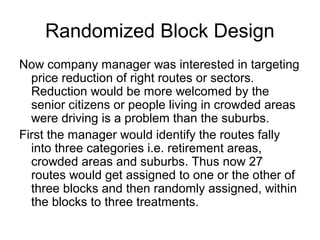
Randomized Block Design
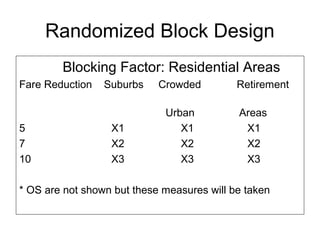
Now company manager was interested in targeting
  price reduction of right routes or sectors.
  Reduction would be more welcomed by the
  senior citizens or people living in crowded areas
  were driving is a problem than the suburbs.
First the manager would identify the routes fally
  into three categories i.e. retirement areas,
  crowded areas and suburbs. Thus now 27
  routes would get assigned to one or the other of
  three blocks and then randomly assigned, within
  the blocks to three treatments.
Randomized Block Design
        Blocking Factor: Residential Areas
Fare Reduction   Suburbs    Crowded         Retirement

                             Urban          Areas
5                 X1            X1           X1
7                 X2            X2           X2
10                X3            X3           X3

* OS are not shown but these measures will be taken
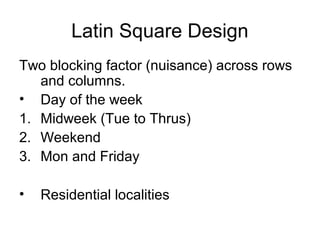
Latin Square Design
Two blocking factor (nuisance) across rows
   and columns.
• Day of the week
1. Midweek (Tue to Thrus)
2. Weekend
3. Mon and Friday

•   Residential localities
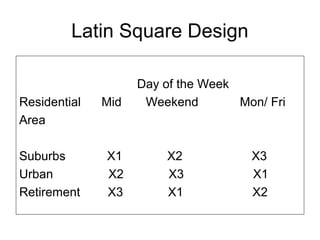
Latin Square Design

                    Day of the Week
Residential   Mid    Weekend        Mon/ Fri
Area

Suburbs       X1        X2            X3
Urban         X2        X3            X1
Retirement    X3        X1            X2
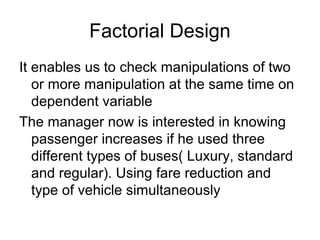
Factorial Design
It enables us to check manipulations of two
   or more manipulation at the same time on
   dependent variable
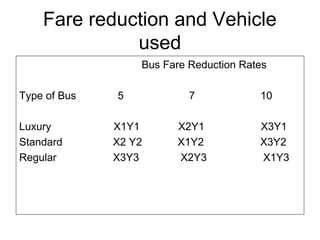
The manager now is interested in knowing
   passenger increases if he used three
   different types of buses( Luxury, standard
   and regular). Using fare reduction and
   type of vehicle simultaneously
Fare reduction and Vehicle
              used
                  Bus Fare Reduction Rates

Type of Bus   5            7            10

Luxury        X1Y1      X2Y1            X3Y1
Standard      X2 Y2     X1Y2            X3Y2
Regular       X3Y3      X2Y3            X1Y3
Any doubts?
 Thank you

Experimental design

  • 1.
  • 2.
    Concepts • Experiment: Lab or Field • Treatment • Treatment effects • Factor-independent variable • Blocking factor
  • 3.
    Experimental Design Examine possiblecause and effect relationship among variables To establish variable X causes variable Y, all three conditions should be met: • Both X and Y should covary • Time sequence X should precede Y • No other factor should possibly change the dependent variable Y
  • 4.
    Principles of ResearchDesign • Principle of Replication • Principle of Randomization • Principle of Local control
  • 5.
    Informal Experimental Design 1.Quasi Experimental Design 2. Pretest and posttest Experimental Group Design ( caution: testing and instrumentation) 3. Post test only control design 4. Pretest posttest experimental and control group design
  • 6.
    Validity • External –Generalizability to other setting • Internal- History, maturation effects, testing, instrumentation, selection bias etc
  • 7.
    Quasi E.D. • Experimentalgroup treatment and measure effects
  • 8.
    Pre test &Post test ED Experimental group Pretest Treatment Post test O1 X O2 Treatment Effect=(O2-O1)
  • 9.
    Post test onlycontrol design Group Treatment Outcome Experimental group X O1 Control group O2 • Treatment Effect=(O1-O2)
  • 10.
    Pretest posttest experimentaland control group design Group Pretest Treatment Posttest Experimental group O1 X O2 Control group O3 O4 Treatment Effect=[(O2-O1)-(O4-O3)]
  • 11.
    Solomon Four-Group Design Group Pretest Treatment Posttest Experimental O1 X O2 Control O3 O4 Experimental X O5 Control O6 Treatment Effect E=O2-O1 =O2-O4 =O5-O6 =O5-O3 =[(O2-O1)-(O4-O3)] * all Es are similar if cause and effect is highly valid
  • 12.
    Double blind studies •Researcher-subjects are unaware • Drugs
  • 13.
    Design a studyto examine the following situation. An organization would like to introduce one of two types of new manufacturing processes to increase to the productivity of the workers, and both involve heavy investment in expansive technology. The company wants to test the efficacy of each process in one of its small plants.
  • 14.
    Formal E.D. Completely Randomized RandomizedBlock Latin Square Factorial They are required to judge simultaneous effect of two or more variables on dependent variable.
  • 15.
    Concept • Factor denotesindependent variable • Level denotes various gradations of factor (high, medium and low price) • Treatment refers to various levels of factors • Blocking factor is a preexisting variable that has an effect on dependent variable in addition to the treatment, the impact of which is important to assess
  • 16.
    Completely randomized design Atransportation compnay manager wants to know the effect of fare reduction by 5, 7, and 10 rupees, on the average increase in number of passengers using bus as a means of transportation. He chooses 27 routes and randomly assign nine routes to each of treatments for a two week period.
  • 17.
    The design wouldlook like Routes Number of Treatment Number of passenger before passenger after Group 1 O1 X1 O2 Group 2 O3 X2 O4 Group 3 O5 X3 O6 * OS SIGNFY NUMBER OF PASSENGERS
  • 18.
    Randomized Block Design Nowcompany manager was interested in targeting price reduction of right routes or sectors. Reduction would be more welcomed by the senior citizens or people living in crowded areas were driving is a problem than the suburbs. First the manager would identify the routes fally into three categories i.e. retirement areas, crowded areas and suburbs. Thus now 27 routes would get assigned to one or the other of three blocks and then randomly assigned, within the blocks to three treatments.
  • 19.
    Randomized Block Design Blocking Factor: Residential Areas Fare Reduction Suburbs Crowded Retirement Urban Areas 5 X1 X1 X1 7 X2 X2 X2 10 X3 X3 X3 * OS are not shown but these measures will be taken
  • 20.
    Latin Square Design Twoblocking factor (nuisance) across rows and columns. • Day of the week 1. Midweek (Tue to Thrus) 2. Weekend 3. Mon and Friday • Residential localities
  • 21.
    Latin Square Design Day of the Week Residential Mid Weekend Mon/ Fri Area Suburbs X1 X2 X3 Urban X2 X3 X1 Retirement X3 X1 X2
  • 22.
    Factorial Design It enablesus to check manipulations of two or more manipulation at the same time on dependent variable The manager now is interested in knowing passenger increases if he used three different types of buses( Luxury, standard and regular). Using fare reduction and type of vehicle simultaneously
  • 23.
    Fare reduction andVehicle used Bus Fare Reduction Rates Type of Bus 5 7 10 Luxury X1Y1 X2Y1 X3Y1 Standard X2 Y2 X1Y2 X3Y2 Regular X3Y3 X2Y3 X1Y3
  • 24.