Experimental Research
Design
Anil Patidar
Assistant professor
MTIN, Charusat
Research design
• It is master plan specifying the methods
and procedures for following for collecting
and analyzing the needed information in a
research study
Types of Designs
• Types of experimental designs
– Pre-experimental
– Quasi-experimental
– True experimental
True Experimental
• True experimental research designs are
those where researchers have complete
control over the extraneous variables &
can predict confidently that the observed
effect on the dependable variable is only
due to the manipulation of the independent
variable
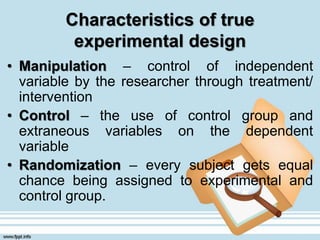
Characteristics of true
experimental design
• Manipulation – control of independent
variable by the researcher through treatment/
intervention
• Control – the use of control group and
extraneous variables on the dependent
variable
• Randomization – every subject gets equal
chance being assigned to experimental and
control group.
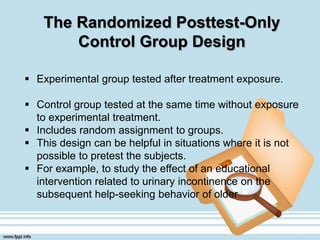
The Randomized Posttest-Only
Control Group Design
 Experimental group tested after treatment exposure.
 Control group tested at the same time without exposure
to experimental treatment.
 Includes random assignment to groups.
 This design can be helpful in situations where it is not
possible to pretest the subjects.
 For example, to study the effect of an educational
intervention related to urinary incontinence on the
subsequent help-seeking behavior of older
Example of a Randomized Posttest-
Only Control Group Design
The Randomized Pretest-
Posttest Control Group Design
• Experimental group tested before and
after treatment exposure
• Control group tested at same two times
without exposure to experimental
treatment
• Includes random assignment to groups.
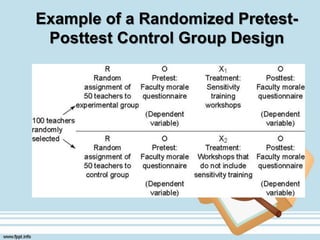
Example of a Randomized Pretest-
Posttest Control Group Design
The Randomized Solomon Four-
Group Design
 Combines pretest-posttest with control group
design and the posttest-only with control
group design.
 Does include random assignment.
 Weakness: requires a large sample.
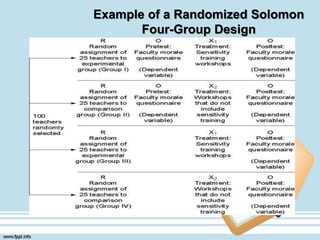
Example of a Randomized Solomon
Four-Group Design
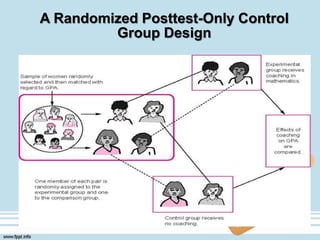
A Randomized Posttest-Only Control
Group Design
Factorial design
• involve two or more independent variables
with at least one independent variable
being manipulated by the researcher
two-by-two factorial design (four cells)
2 X 2
• This design is useful when there are more
than two independent variables, called
factors to be tested.
• For example, a researcher wants to
observe the effect of two different
protocols of mouth care on prevention of
VAP when performed at different
frequencies in a day.
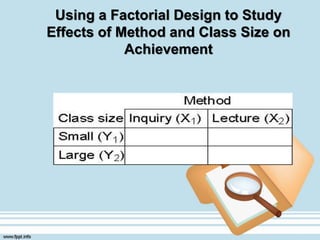
Using a Factorial Design to Study
Effects of Method and Class Size on
Achievement
Illustration of Interaction and No
Interaction in a 2 by 2 Factorial
Design
Example of a 4 by 2 Factorial Design
RANDOMIZED BLOCK
DESIGN
• Control of inherent differences between
experimental subjects & differences in
experimental conditions is one of the difficult
problems faced by researcher in biological
sciences.
• When there are a large number of
experimental comparison groups, the
randomized block design is used to bring
homogeneity among selected different
groups.
• This is simple method to reduce the
variability among the treatment groups by
a more homogeneous combination of the
subjects through randomized block design.
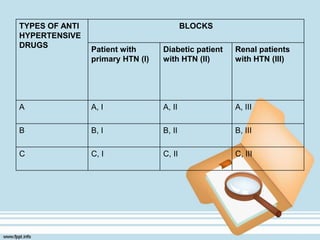
• For example, a researcher wants to
examine the effects of three different
antihypertensive drugs on patients with
hypertension.
• In this example, to ensure the
homogeneity among the subjects under
treatment, researcher randomly places the
subjects in homogeneous groups (blocks)
like patients with primary hypertension,
diabetic patients with hypertension, &
renal patients with hypertension
TYPES OF ANTI
HYPERTENSIVE
DRUGS
BLOCKS
Patient with
primary HTN (I)
Diabetic patient
with HTN (II)
Renal patients
with HTN (III)
A A, I A, II A, III
B B, I B, II B, III
C C, I C, II C, III
CROSSOVER DESIGN
• In this design, subjects are exposed to more than
one treatment, where subjects are randomly
assigned to different orders of treatment.
• It is also known as ‘repeat measures design’.
• This design is more efficient in establishing the
highest possible similarity among subjects
exposed to different conditions, where groups
compared obviously have equal distribution of
characteristics.
• Through crossover design is considered
as an extremely powerful research
design, sometimes it is not effective
because when subjects are exposed to
two different conditions, their responses of
the second condition maybe influenced by
their experience in the first condition
• For example, when we are comparing the
effectiveness of the chlorhexidine mouth care
protocol on group I & saline mouth care protocol
on the subjects of group II.
• Later, the treatment is swapped, where group I
receives the saline mouth care & group II
receives chlorhexidine. In such studies, subjects
serve as their own
GROUP Protocols of the mouth care
I Chlorhexidine ( saline
II saline chlorhexidine
Quasi – experimental Design
• Quasi-experimental research design involves the
manipulation of independent variable to observe to effect
on dependant variable, but it lacks at least one of the two
characteristics of the true experimental design;
randomization or a control group.
• Quasi-experimental designs are generally used to
establish the causality (effect of independent variable on
dependent variable) in situations where researchers are
not able to randomly assign the subjects to groups or for
various reasons no control group is available for an
experimental study.
MAIN CHARACTERISTICS…
• Manipulation of the independent variables to
observe the effects on the dependant variables.
• Lack of at least one of the two other essential
characteristics of the true experiment, i.e.
random assignment of subject or a control
group.
• Quasi-independent variables are used instead of
true independent variables. Where independent
variable is not manipulates incomplete controller
situations.
TYPES OF QUASI-
EXPERIMENTAL DESIGN
• Nonrandomized control group design
• Time-series design
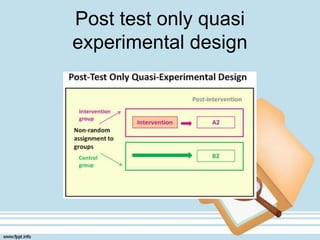
• Post test only quasi experimental design
NONRANDOMIZED CONTROL
GROUP DESIGN
• It is also known as the ‘nonequivalent control group
design’.
• This design is identical to the pretest-posttest control
group design, except there is no random assignment
of subjects in experimental & control groups.
• In this design, experimental & control groups are
selected without randomization, & dependent
variables are observed in experimental as well as
control groups before the intervention.
• Later, the experimental group receives
treatment & after that posttest observation
of dependant variables is carried out for
both the groups to assess the effect of
treatment on experiment group
Time-series design
• This design is useful when the experimenter
wants to measure the effects of a treatment over
a long period of time.
• The experimenter would continue to administer
the treatment& measure the effects a number of
times during the course of the experiment.
• Generally it is a single-subject research, in
which the researcher carries out an
experiment on an individual or on a small
number of individuals, by alternating
between administering & then withdrawing
the treatment to determine the
effectiveness of the intervention
Post test only quasi
experimental design
PRE EXPERIMENTAL RESEARCH
DESIGN
• This research design is considered very
weak, because the researcher has very
little control over the experiment
• TYPES OF PRE-EXPERIMENTAL
RESEARCH DESIGN:
– One-shot case design
– One-group pretest-posttest
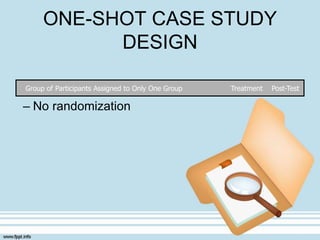
ONE-SHOT CASE STUDY
DESIGN
Group of Participants Assigned to Only One Group Treatment Post-Test
– No randomization
Group of Participants Assigned to Only One Group Pretest Treatment Post-Test
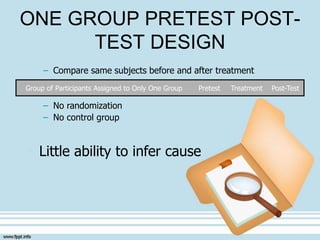
ONE GROUP PRETEST POST-
TEST DESIGN
• Little ability to infer cause
– Compare same subjects before and after treatment
– No randomization
– No control group
EXPERIMENTAL DESIGNS
Pre-
Experimental
Design
True
Experimental
Design
Quasi-
Experimental
Design
Presence of a control
group?
In some cases, but
usually not
Always Often
Random selection of
subjects from a
population?
No Yes No
Random assignment of
subjects to groups?
No Yes No
Random assignment of
treatments to groups?
No Yes No
Degree of control over
extraneous variables?
None Yes Some
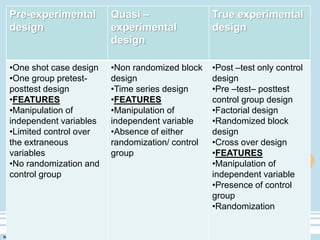
Pre-experimental
design
Quasi –
experimental
design
True experimental
design
•One shot case design
•One group pretest-
posttest design
•FEATURES
•Manipulation of
independent variables
•Limited control over
the extraneous
variables
•No randomization and
control group
•Non randomized block
design
•Time series design
•FEATURES
•Manipulation of
independent variable
•Absence of either
randomization/ control
group
•Post –test only control
design
•Pre –test– posttest
control group design
•Factorial design
•Randomized block
design
•Cross over design
•FEATURES
•Manipulation of
independent variable
•Presence of control
group
•Randomization

Experimental research Design

  • 1.
  • 2.
    Research design • Itis master plan specifying the methods and procedures for following for collecting and analyzing the needed information in a research study
  • 3.
    Types of Designs •Types of experimental designs – Pre-experimental – Quasi-experimental – True experimental
  • 4.
    True Experimental • Trueexperimental research designs are those where researchers have complete control over the extraneous variables & can predict confidently that the observed effect on the dependable variable is only due to the manipulation of the independent variable
  • 5.
    Characteristics of true experimentaldesign • Manipulation – control of independent variable by the researcher through treatment/ intervention • Control – the use of control group and extraneous variables on the dependent variable • Randomization – every subject gets equal chance being assigned to experimental and control group.
  • 6.
    The Randomized Posttest-Only ControlGroup Design  Experimental group tested after treatment exposure.  Control group tested at the same time without exposure to experimental treatment.  Includes random assignment to groups.  This design can be helpful in situations where it is not possible to pretest the subjects.  For example, to study the effect of an educational intervention related to urinary incontinence on the subsequent help-seeking behavior of older
  • 7.
    Example of aRandomized Posttest- Only Control Group Design
  • 8.
    The Randomized Pretest- PosttestControl Group Design • Experimental group tested before and after treatment exposure • Control group tested at same two times without exposure to experimental treatment • Includes random assignment to groups.
  • 9.
    Example of aRandomized Pretest- Posttest Control Group Design
  • 10.
    The Randomized SolomonFour- Group Design  Combines pretest-posttest with control group design and the posttest-only with control group design.  Does include random assignment.  Weakness: requires a large sample.
  • 11.
    Example of aRandomized Solomon Four-Group Design
  • 12.
    A Randomized Posttest-OnlyControl Group Design
  • 13.
    Factorial design • involvetwo or more independent variables with at least one independent variable being manipulated by the researcher two-by-two factorial design (four cells) 2 X 2
  • 14.
    • This designis useful when there are more than two independent variables, called factors to be tested. • For example, a researcher wants to observe the effect of two different protocols of mouth care on prevention of VAP when performed at different frequencies in a day.
  • 15.
    Using a FactorialDesign to Study Effects of Method and Class Size on Achievement
  • 16.
    Illustration of Interactionand No Interaction in a 2 by 2 Factorial Design
  • 17.
    Example of a4 by 2 Factorial Design
  • 18.
    RANDOMIZED BLOCK DESIGN • Controlof inherent differences between experimental subjects & differences in experimental conditions is one of the difficult problems faced by researcher in biological sciences. • When there are a large number of experimental comparison groups, the randomized block design is used to bring homogeneity among selected different groups.
  • 19.
    • This issimple method to reduce the variability among the treatment groups by a more homogeneous combination of the subjects through randomized block design.
  • 20.
    • For example,a researcher wants to examine the effects of three different antihypertensive drugs on patients with hypertension. • In this example, to ensure the homogeneity among the subjects under treatment, researcher randomly places the subjects in homogeneous groups (blocks) like patients with primary hypertension, diabetic patients with hypertension, & renal patients with hypertension
  • 21.
    TYPES OF ANTI HYPERTENSIVE DRUGS BLOCKS Patientwith primary HTN (I) Diabetic patient with HTN (II) Renal patients with HTN (III) A A, I A, II A, III B B, I B, II B, III C C, I C, II C, III
  • 22.
    CROSSOVER DESIGN • Inthis design, subjects are exposed to more than one treatment, where subjects are randomly assigned to different orders of treatment. • It is also known as ‘repeat measures design’. • This design is more efficient in establishing the highest possible similarity among subjects exposed to different conditions, where groups compared obviously have equal distribution of characteristics.
  • 23.
    • Through crossoverdesign is considered as an extremely powerful research design, sometimes it is not effective because when subjects are exposed to two different conditions, their responses of the second condition maybe influenced by their experience in the first condition
  • 24.
    • For example,when we are comparing the effectiveness of the chlorhexidine mouth care protocol on group I & saline mouth care protocol on the subjects of group II. • Later, the treatment is swapped, where group I receives the saline mouth care & group II receives chlorhexidine. In such studies, subjects serve as their own GROUP Protocols of the mouth care I Chlorhexidine ( saline II saline chlorhexidine
  • 25.
    Quasi – experimentalDesign • Quasi-experimental research design involves the manipulation of independent variable to observe to effect on dependant variable, but it lacks at least one of the two characteristics of the true experimental design; randomization or a control group. • Quasi-experimental designs are generally used to establish the causality (effect of independent variable on dependent variable) in situations where researchers are not able to randomly assign the subjects to groups or for various reasons no control group is available for an experimental study.
  • 26.
    MAIN CHARACTERISTICS… • Manipulationof the independent variables to observe the effects on the dependant variables. • Lack of at least one of the two other essential characteristics of the true experiment, i.e. random assignment of subject or a control group. • Quasi-independent variables are used instead of true independent variables. Where independent variable is not manipulates incomplete controller situations.
  • 27.
    TYPES OF QUASI- EXPERIMENTALDESIGN • Nonrandomized control group design • Time-series design • Post test only quasi experimental design
  • 28.
    NONRANDOMIZED CONTROL GROUP DESIGN •It is also known as the ‘nonequivalent control group design’. • This design is identical to the pretest-posttest control group design, except there is no random assignment of subjects in experimental & control groups. • In this design, experimental & control groups are selected without randomization, & dependent variables are observed in experimental as well as control groups before the intervention.
  • 29.
    • Later, theexperimental group receives treatment & after that posttest observation of dependant variables is carried out for both the groups to assess the effect of treatment on experiment group
  • 30.
    Time-series design • Thisdesign is useful when the experimenter wants to measure the effects of a treatment over a long period of time. • The experimenter would continue to administer the treatment& measure the effects a number of times during the course of the experiment.
  • 31.
    • Generally itis a single-subject research, in which the researcher carries out an experiment on an individual or on a small number of individuals, by alternating between administering & then withdrawing the treatment to determine the effectiveness of the intervention
  • 32.
    Post test onlyquasi experimental design
  • 33.
    PRE EXPERIMENTAL RESEARCH DESIGN •This research design is considered very weak, because the researcher has very little control over the experiment • TYPES OF PRE-EXPERIMENTAL RESEARCH DESIGN: – One-shot case design – One-group pretest-posttest
  • 34.
    ONE-SHOT CASE STUDY DESIGN Groupof Participants Assigned to Only One Group Treatment Post-Test – No randomization
  • 35.
    Group of ParticipantsAssigned to Only One Group Pretest Treatment Post-Test ONE GROUP PRETEST POST- TEST DESIGN • Little ability to infer cause – Compare same subjects before and after treatment – No randomization – No control group
  • 36.
    EXPERIMENTAL DESIGNS Pre- Experimental Design True Experimental Design Quasi- Experimental Design Presence ofa control group? In some cases, but usually not Always Often Random selection of subjects from a population? No Yes No Random assignment of subjects to groups? No Yes No Random assignment of treatments to groups? No Yes No Degree of control over extraneous variables? None Yes Some
  • 37.
    Pre-experimental design Quasi – experimental design True experimental design •Oneshot case design •One group pretest- posttest design •FEATURES •Manipulation of independent variables •Limited control over the extraneous variables •No randomization and control group •Non randomized block design •Time series design •FEATURES •Manipulation of independent variable •Absence of either randomization/ control group •Post –test only control design •Pre –test– posttest control group design •Factorial design •Randomized block design •Cross over design •FEATURES •Manipulation of independent variable •Presence of control group •Randomization