QUANTITATIVE RESEARCH
METHODOLOGIES
(Experimental Research)
EXPERIMENTAL RESEARCH
Best research
methodology to
establish cause-and-
effect relatonships
among variables
EXPERIMENTAL RESEARCH
Tests hypotheses
about cause-and-
effect
relationships.
EXPERIMENTAL RESEARCH
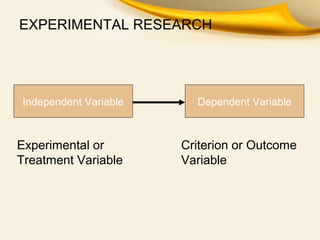
Dependent VariableIndependent Variable
Experimental or
Treatment Variable
Criterion or Outcome
Variable
Essential Characteristics of
Experimental Research
A. Comparison of groups
• 2 groups (experimental & control grps)
• experimental group receives treatment
• control group does not receive treatment
Essential Characteristics of
Experimental Research
B. Manipulation of the independent variable
• The independent variable may be
established as one form of the variable
versus another
Example: A study comparing the learning
by doing method with lecture method in
TLE.
Essential Characteristics of
Experimental Research
B. Manipulation of the independent variable
• The independent variable may be
established as the presence versus
absence of a particular form
Example: A study comparing the use of
DLP versus no DLP in teaching history.
Essential Characteristics of
Experimental Research
B. Manipulation of the independent variable
• The independent variable may be
established as varying degrees of the same
form
Example: A study comparing the effects of
different contact hours on students interest
in Mathematics.
Essential Characteristics of
Experimental Research
C. Randomization
• Subjects are randomly assigned to
groups.
• Random assignment:
- individual participants have the
chance of being assigned to any of the
two groups
- eliminates extraneous variables
3 things to remember about randomization
Randomization
1) takes place before the experiment begins
2) is a process of assigning or distributing
individuals to groups not a result of such
distribution
3) forms groups that are equivalent and
differ only by chance
GROUP DESIGNS IN
EXPERIMENTAL RESEARCH
Weak Experimental Designs
The One-Shot Case Study
A single group is exposed to treatment and
a dependent variable is observed
(measured) to assess the effect of the
treatment
Weak Experimental Designs
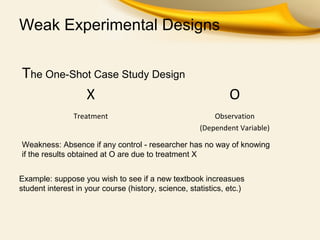
The One-Shot Case Study Design
X O
Treatment Observation
(Dependent Variable)
Example: suppose you wish to see if a new textbook increasues
student interest in your course (history, science, statistics, etc.)
Weakness: Absence if any control - researcher has no way of knowing
if the results obtained at O are due to treatment X
Weak Experimental Designs
The One-Group Pretest-Posttest Design
A single group is measured or observed
before and after the treatment.
Weak Experimental Designs
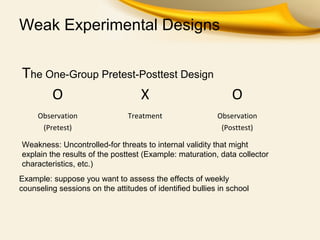
The One-Group Pretest-Posttest Design
O X O
Observation
(Pretest)
Treatment Observation
(Posttest)
Example: suppose you want to assess the effects of weekly
counseling sessions on the attitudes of identified bullies in school
Weakness: Uncontrolled-for threats to internal validity that might
explain the results of the posttest (Example: maturation, data collector
characteristics, etc.)
Weak Experimental Designs
The Static-Group Comparison Design
Two existing intact (static) groups are used
Also called nonequivalent control group
design
Weak Experimental Designs
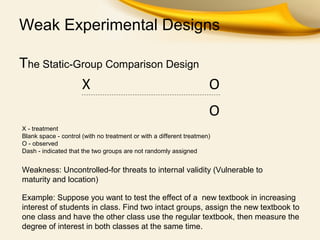
The Static-Group Comparison Design
X O
O
Example: Suppose you want to test the effect of a new textbook in increasing
interest of students in class. Find two intact groups, assign the new textbook to
one class and have the other class use the regular textbook, then measure the
degree of interest in both classes at the same time.
Weakness: Uncontrolled-for threats to internal validity (Vulnerable to
maturity and location)
X - treatment
Blank space - control (with no treatment or with a different treatmen)
O - observed
Dash - indicated that the two groups are not randomly assigned
Weak Experimental Designs
The Static-Group Pretest-Posttest
Design
Two existing intact (static) groups are used
Pretest is given to both groups
Pretest score is subtracted from posttest
score, permitting analysis of "gain or
change"
Weak Experimental Designs
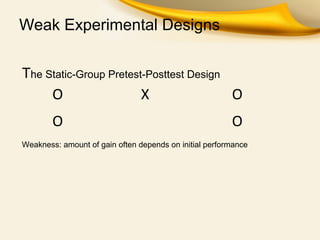
The Static-Group Pretest-Posttest Design
O X O
O O
Weakness: amount of gain often depends on initial performance
True Experimental Designs
Subjects are randomly assigned to
treatment and control groups.
True Experimental Designs
The Randomized Posttest-Only Control
Group Design
Involves two groups formed by random
assignment
One group receives treatment whike the
other does not, then both groups are
posttested
True Experimental Designs
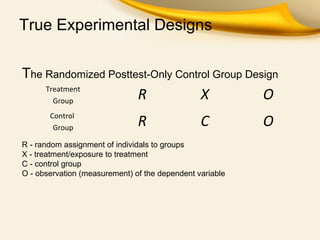
The Randomized Posttest-Only Control Group Design
Treatment
Group
R X O
Control
Group
R C O
R - random assignment of individals to groups
X - treatment/exposure to treatment
C - control group
O - observation (measurement) of the dependent variable
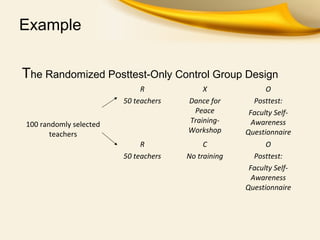
Example
The Randomized Posttest-Only Control Group Design
100 randomly selected
teachers
R
50 teachers
X
Dance for
Peace
Training-
Workshop
O
Posttest:
Faculty Self-
Awareness
Questionnaire
R
50 teachers
C
No training
O
Posttest:
Faculty Self-
Awareness
Questionnaire
True Experimental Designs
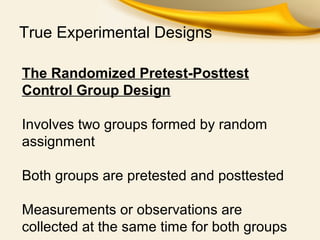
The Randomized Pretest-Posttest
Control Group Design
Involves two groups formed by random
assignment
Both groups are pretested and posttested
Measurements or observations are
collected at the same time for both groups
True Experimental Designs
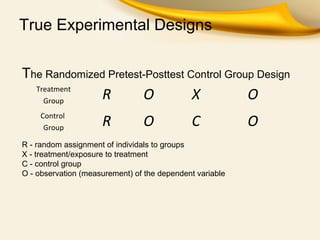
The Randomized Pretest-Posttest Control Group Design
Treatment
Group
R O X O
Control
Group
R O C O
R - random assignment of individals to groups
X - treatment/exposure to treatment
C - control group
O - observation (measurement) of the dependent variable
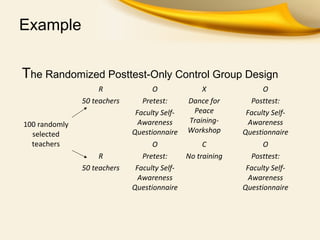
Example
The Randomized Posttest-Only Control Group Design
100 randomly
selected
teachers
R
50 teachers
O
Pretest:
Faculty Self-
Awareness
Questionnaire
X
Dance for
Peace
Training-
Workshop
O
Posttest:
Faculty Self-
Awareness
Questionnaire
R
50 teachers
O
Pretest:
Faculty Self-
Awareness
Questionnaire
C
No training
O
Posttest:
Faculty Self-
Awareness
Questionnaire
True Experimental Designs
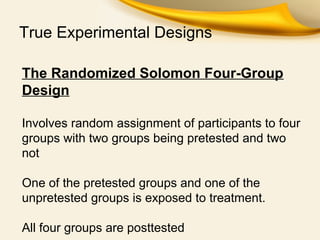
The Randomized Solomon Four-Group
Design
Involves random assignment of participants to four
groups with two groups being pretested and two
not
One of the pretested groups and one of the
unpretested groups is exposed to treatment.
All four groups are posttested
True Experimental Designs
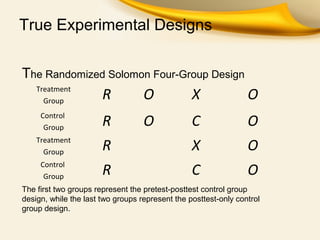
The Randomized Solomon Four-Group Design
Treatment
Group
R O X O
Control
Group
R O C O
Treatment
Group
R X O
Control
Group
R C O
The first two groups represent the pretest-posttest control group
design, while the last two groups represent the posttest-only control
group design.
Example
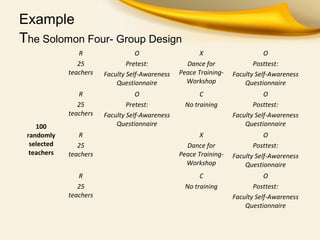
The Solomon Four- Group Design
100
randomly
selected
teachers
R
25
teachers
O
Pretest:
Faculty Self-Awareness
Questionnaire
X
Dance for
Peace Training-
Workshop
O
Posttest:
Faculty Self-Awareness
Questionnaire
R
25
teachers
O
Pretest:
Faculty Self-Awareness
Questionnaire
C
No training
O
Posttest:
Faculty Self-Awareness
Questionnaire
R
25
teachers
X
Dance for
Peace Training-
Workshop
O
Posttest:
Faculty Self-Awareness
Questionnaire
R
25
teachers
C
No training
O
Posttest:
Faculty Self-Awareness
Questionnaire
True Experimental Designs
Random Assignment with Matching
Pairs of individuals are matched on certain
variables (choice of variables to match is based
on previous research, theory and/or experience of
researcher)
Members of each matched pair are assigned to
the experimental and control groups at random.
True Experimental Designs
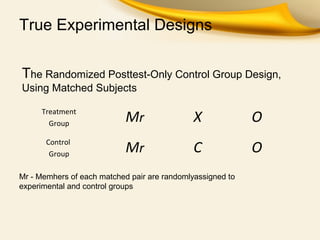
The Randomized Posttest-Only Control Group Design,
Using Matched Subjects
Treatment
Group
Mr X O
Control
Group
Mr C O
Mr - Memhers of each matched pair are randomlyassigned to
experimental and control groups
True Experimental Designs
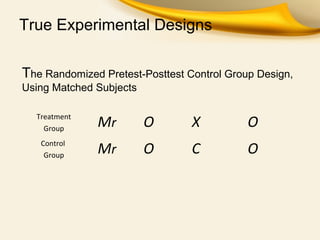
The Randomized Pretest-Posttest Control Group Design,
Using Matched Subjects
Treatment
Group
Mr O X O
Control
Group
Mr O C O
Quasi-Experimental Designs
No random assignment of
participants or subjects
Quasi-Experimental Designs
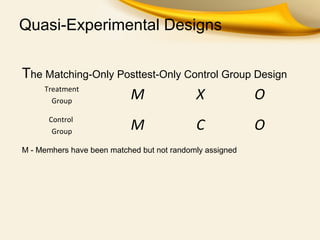
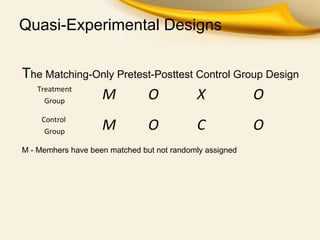
The Matching-Only Design
Participants (subjects) from intact groups are
matched.
Quasi-Experimental Designs
The Matching-Only Posttest-Only Control Group Design
Treatment
Group
M X O
Control
Group
M C O
M - Memhers have been matched but not randomly assigned
Quasi-Experimental Designs
The Matching-Only Pretest-Posttest Control Group Design
Treatment
Group
M O X O
Control
Group
M O C O
M - Memhers have been matched but not randomly assigned
Quasi-Experimental Designs
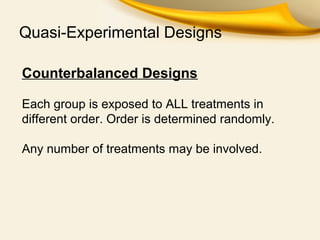
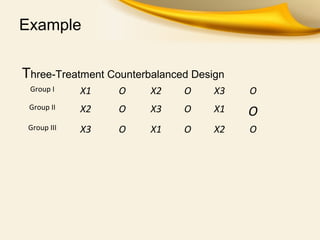
Counterbalanced Designs
Each group is exposed to ALL treatments in
different order. Order is determined randomly.
Any number of treatments may be involved.
Example
Three-Treatment Counterbalanced Design
Group I X1 O X2 O X3 O
Group II X2 O X3 O X1 O
Group III X3 O X1 O X2 O
Quasi-Experimental Designs
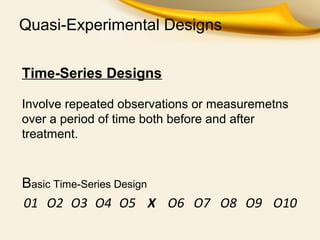
Time-Series Designs
Involve repeated observations or measuremetns
over a period of time both before and after
treatment.
01 O2 O3 O4 O5 X O6 O7 O8 O9 O10
Basic Time-Series Design
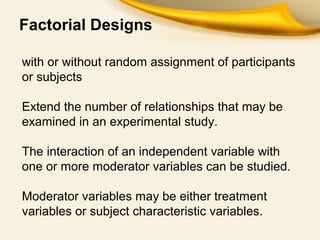
Factorial Designs
with or without random assignment of participants
or subjects
Extend the number of relationships that may be
examined in an experimental study.
The interaction of an independent variable with
one or more moderator variables can be studied.
Moderator variables may be either treatment
variables or subject characteristic variables.
Example
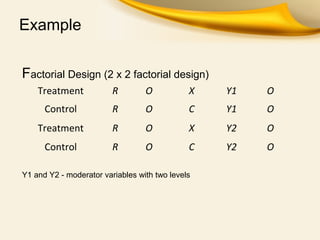
Factorial Design (2 x 2 factorial design)
Treatment R O X Y1 O
Control R O C Y1 O
Treatment R O X Y2 O
Control R O C Y2 O
Y1 and Y2 - moderator variables with two levels
Example
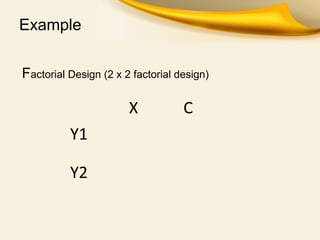
Factorial Design (2 x 2 factorial design)
X C
Y1
Y2
Example
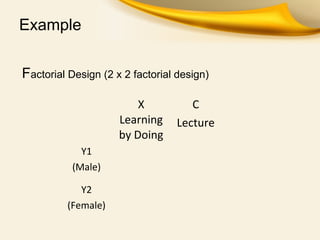
Factorial Design (2 x 2 factorial design)
X
Learning
by Doing
C
Lecture
Y1
(Male)
Y2
(Female)

Experimental research

  • 1.
  • 2.
    EXPERIMENTAL RESEARCH Best research methodologyto establish cause-and- effect relatonships among variables
  • 3.
    EXPERIMENTAL RESEARCH Tests hypotheses aboutcause-and- effect relationships.
  • 4.
    EXPERIMENTAL RESEARCH Dependent VariableIndependentVariable Experimental or Treatment Variable Criterion or Outcome Variable
  • 5.
    Essential Characteristics of ExperimentalResearch A. Comparison of groups • 2 groups (experimental & control grps) • experimental group receives treatment • control group does not receive treatment
  • 6.
    Essential Characteristics of ExperimentalResearch B. Manipulation of the independent variable • The independent variable may be established as one form of the variable versus another Example: A study comparing the learning by doing method with lecture method in TLE.
  • 7.
    Essential Characteristics of ExperimentalResearch B. Manipulation of the independent variable • The independent variable may be established as the presence versus absence of a particular form Example: A study comparing the use of DLP versus no DLP in teaching history.
  • 8.
    Essential Characteristics of ExperimentalResearch B. Manipulation of the independent variable • The independent variable may be established as varying degrees of the same form Example: A study comparing the effects of different contact hours on students interest in Mathematics.
  • 9.
    Essential Characteristics of ExperimentalResearch C. Randomization • Subjects are randomly assigned to groups. • Random assignment: - individual participants have the chance of being assigned to any of the two groups - eliminates extraneous variables
  • 10.
    3 things toremember about randomization Randomization 1) takes place before the experiment begins 2) is a process of assigning or distributing individuals to groups not a result of such distribution 3) forms groups that are equivalent and differ only by chance
  • 11.
  • 12.
    Weak Experimental Designs TheOne-Shot Case Study A single group is exposed to treatment and a dependent variable is observed (measured) to assess the effect of the treatment
  • 13.
    Weak Experimental Designs TheOne-Shot Case Study Design X O Treatment Observation (Dependent Variable) Example: suppose you wish to see if a new textbook increasues student interest in your course (history, science, statistics, etc.) Weakness: Absence if any control - researcher has no way of knowing if the results obtained at O are due to treatment X
  • 14.
    Weak Experimental Designs TheOne-Group Pretest-Posttest Design A single group is measured or observed before and after the treatment.
  • 15.
    Weak Experimental Designs TheOne-Group Pretest-Posttest Design O X O Observation (Pretest) Treatment Observation (Posttest) Example: suppose you want to assess the effects of weekly counseling sessions on the attitudes of identified bullies in school Weakness: Uncontrolled-for threats to internal validity that might explain the results of the posttest (Example: maturation, data collector characteristics, etc.)
  • 16.
    Weak Experimental Designs TheStatic-Group Comparison Design Two existing intact (static) groups are used Also called nonequivalent control group design
  • 17.
    Weak Experimental Designs TheStatic-Group Comparison Design X O O Example: Suppose you want to test the effect of a new textbook in increasing interest of students in class. Find two intact groups, assign the new textbook to one class and have the other class use the regular textbook, then measure the degree of interest in both classes at the same time. Weakness: Uncontrolled-for threats to internal validity (Vulnerable to maturity and location) X - treatment Blank space - control (with no treatment or with a different treatmen) O - observed Dash - indicated that the two groups are not randomly assigned
  • 18.
    Weak Experimental Designs TheStatic-Group Pretest-Posttest Design Two existing intact (static) groups are used Pretest is given to both groups Pretest score is subtracted from posttest score, permitting analysis of "gain or change"
  • 19.
    Weak Experimental Designs TheStatic-Group Pretest-Posttest Design O X O O O Weakness: amount of gain often depends on initial performance
  • 20.
    True Experimental Designs Subjectsare randomly assigned to treatment and control groups.
  • 21.
    True Experimental Designs TheRandomized Posttest-Only Control Group Design Involves two groups formed by random assignment One group receives treatment whike the other does not, then both groups are posttested
  • 22.
    True Experimental Designs TheRandomized Posttest-Only Control Group Design Treatment Group R X O Control Group R C O R - random assignment of individals to groups X - treatment/exposure to treatment C - control group O - observation (measurement) of the dependent variable
  • 23.
    Example The Randomized Posttest-OnlyControl Group Design 100 randomly selected teachers R 50 teachers X Dance for Peace Training- Workshop O Posttest: Faculty Self- Awareness Questionnaire R 50 teachers C No training O Posttest: Faculty Self- Awareness Questionnaire
  • 24.
    True Experimental Designs TheRandomized Pretest-Posttest Control Group Design Involves two groups formed by random assignment Both groups are pretested and posttested Measurements or observations are collected at the same time for both groups
  • 25.
    True Experimental Designs TheRandomized Pretest-Posttest Control Group Design Treatment Group R O X O Control Group R O C O R - random assignment of individals to groups X - treatment/exposure to treatment C - control group O - observation (measurement) of the dependent variable
  • 26.
    Example The Randomized Posttest-OnlyControl Group Design 100 randomly selected teachers R 50 teachers O Pretest: Faculty Self- Awareness Questionnaire X Dance for Peace Training- Workshop O Posttest: Faculty Self- Awareness Questionnaire R 50 teachers O Pretest: Faculty Self- Awareness Questionnaire C No training O Posttest: Faculty Self- Awareness Questionnaire
  • 27.
    True Experimental Designs TheRandomized Solomon Four-Group Design Involves random assignment of participants to four groups with two groups being pretested and two not One of the pretested groups and one of the unpretested groups is exposed to treatment. All four groups are posttested
  • 28.
    True Experimental Designs TheRandomized Solomon Four-Group Design Treatment Group R O X O Control Group R O C O Treatment Group R X O Control Group R C O The first two groups represent the pretest-posttest control group design, while the last two groups represent the posttest-only control group design.
  • 29.
    Example The Solomon Four-Group Design 100 randomly selected teachers R 25 teachers O Pretest: Faculty Self-Awareness Questionnaire X Dance for Peace Training- Workshop O Posttest: Faculty Self-Awareness Questionnaire R 25 teachers O Pretest: Faculty Self-Awareness Questionnaire C No training O Posttest: Faculty Self-Awareness Questionnaire R 25 teachers X Dance for Peace Training- Workshop O Posttest: Faculty Self-Awareness Questionnaire R 25 teachers C No training O Posttest: Faculty Self-Awareness Questionnaire
  • 30.
    True Experimental Designs RandomAssignment with Matching Pairs of individuals are matched on certain variables (choice of variables to match is based on previous research, theory and/or experience of researcher) Members of each matched pair are assigned to the experimental and control groups at random.
  • 31.
    True Experimental Designs TheRandomized Posttest-Only Control Group Design, Using Matched Subjects Treatment Group Mr X O Control Group Mr C O Mr - Memhers of each matched pair are randomlyassigned to experimental and control groups
  • 32.
    True Experimental Designs TheRandomized Pretest-Posttest Control Group Design, Using Matched Subjects Treatment Group Mr O X O Control Group Mr O C O
  • 33.
    Quasi-Experimental Designs No randomassignment of participants or subjects
  • 34.
    Quasi-Experimental Designs The Matching-OnlyDesign Participants (subjects) from intact groups are matched.
  • 35.
    Quasi-Experimental Designs The Matching-OnlyPosttest-Only Control Group Design Treatment Group M X O Control Group M C O M - Memhers have been matched but not randomly assigned
  • 36.
    Quasi-Experimental Designs The Matching-OnlyPretest-Posttest Control Group Design Treatment Group M O X O Control Group M O C O M - Memhers have been matched but not randomly assigned
  • 37.
    Quasi-Experimental Designs Counterbalanced Designs Eachgroup is exposed to ALL treatments in different order. Order is determined randomly. Any number of treatments may be involved.
  • 38.
    Example Three-Treatment Counterbalanced Design GroupI X1 O X2 O X3 O Group II X2 O X3 O X1 O Group III X3 O X1 O X2 O
  • 39.
    Quasi-Experimental Designs Time-Series Designs Involverepeated observations or measuremetns over a period of time both before and after treatment. 01 O2 O3 O4 O5 X O6 O7 O8 O9 O10 Basic Time-Series Design
  • 40.
    Factorial Designs with orwithout random assignment of participants or subjects Extend the number of relationships that may be examined in an experimental study. The interaction of an independent variable with one or more moderator variables can be studied. Moderator variables may be either treatment variables or subject characteristic variables.
  • 41.
    Example Factorial Design (2x 2 factorial design) Treatment R O X Y1 O Control R O C Y1 O Treatment R O X Y2 O Control R O C Y2 O Y1 and Y2 - moderator variables with two levels
  • 42.
    Example Factorial Design (2x 2 factorial design) X C Y1 Y2
  • 43.
    Example Factorial Design (2x 2 factorial design) X Learning by Doing C Lecture Y1 (Male) Y2 (Female)