Explanatory, Descriptive and Exploratory Research.pptx
Research can be classified in different ways such as by purpose, process, and outcomes. There are several types of research including exploratory research, descriptive research, and explanatory research. Exploratory research is conducted when little is known about a topic and aims to gain insights rather than test hypotheses. Descriptive research describes characteristics of a topic as it exists currently. Explanatory research builds on exploratory and descriptive research to understand phenomena by discovering causal relationships between variables and answering "why" questions. The goals, strengths, and weaknesses of each type of research are outlined.
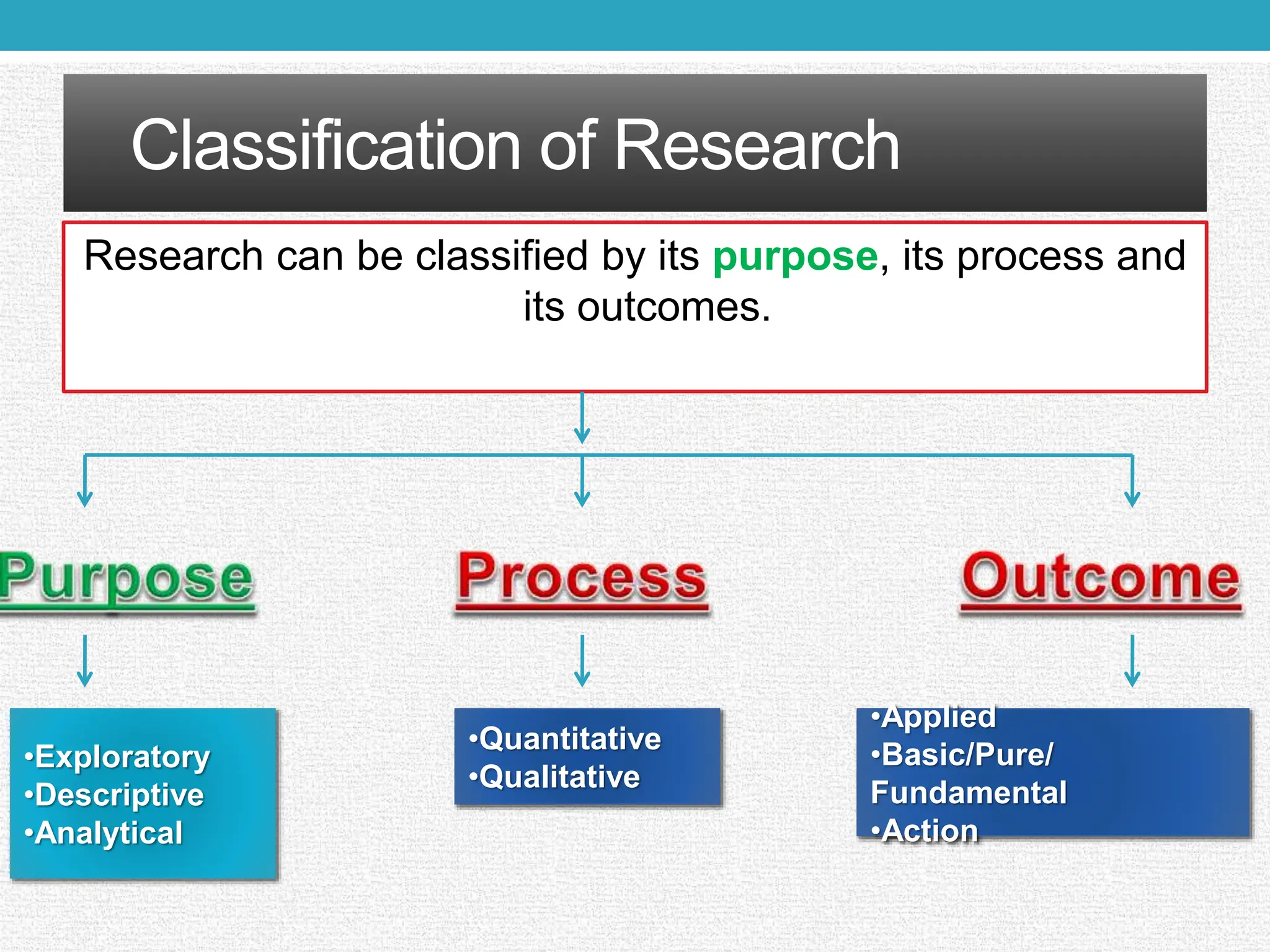
Research is classified by purpose, process, and outcomes: exploratory, descriptive, analytical, quantitative, qualitative, applied, basic/pure, and action.
Exploratory research seeks patterns and insights with no prior studies. It uses qualitative methods to develop questions for further investigation.
Exploratory research establishes causal relationships and provides predictions, aiding future decision-making.
Exploratory research is complex, resource-intensive, and potentially ethical concerns; findings have limited generalizability.
Descriptive research identifies characteristics of a phenomenon as is, often using ex post facto methods without controlling variables.
Surveys and observation are core methods. Strengths include detailed information, comparison abilities; weaknesses involve bias risks and no causation.
Explanatory research explains phenomena by discovering causal relationships; it builds on exploratory and descriptive research.
Explanatory research generates insights and flexibility in methods, identifying key research questions for deeper studies.
Limitations include low generalizability, subjectivity, and lack of causation establishment, focusing more on association.
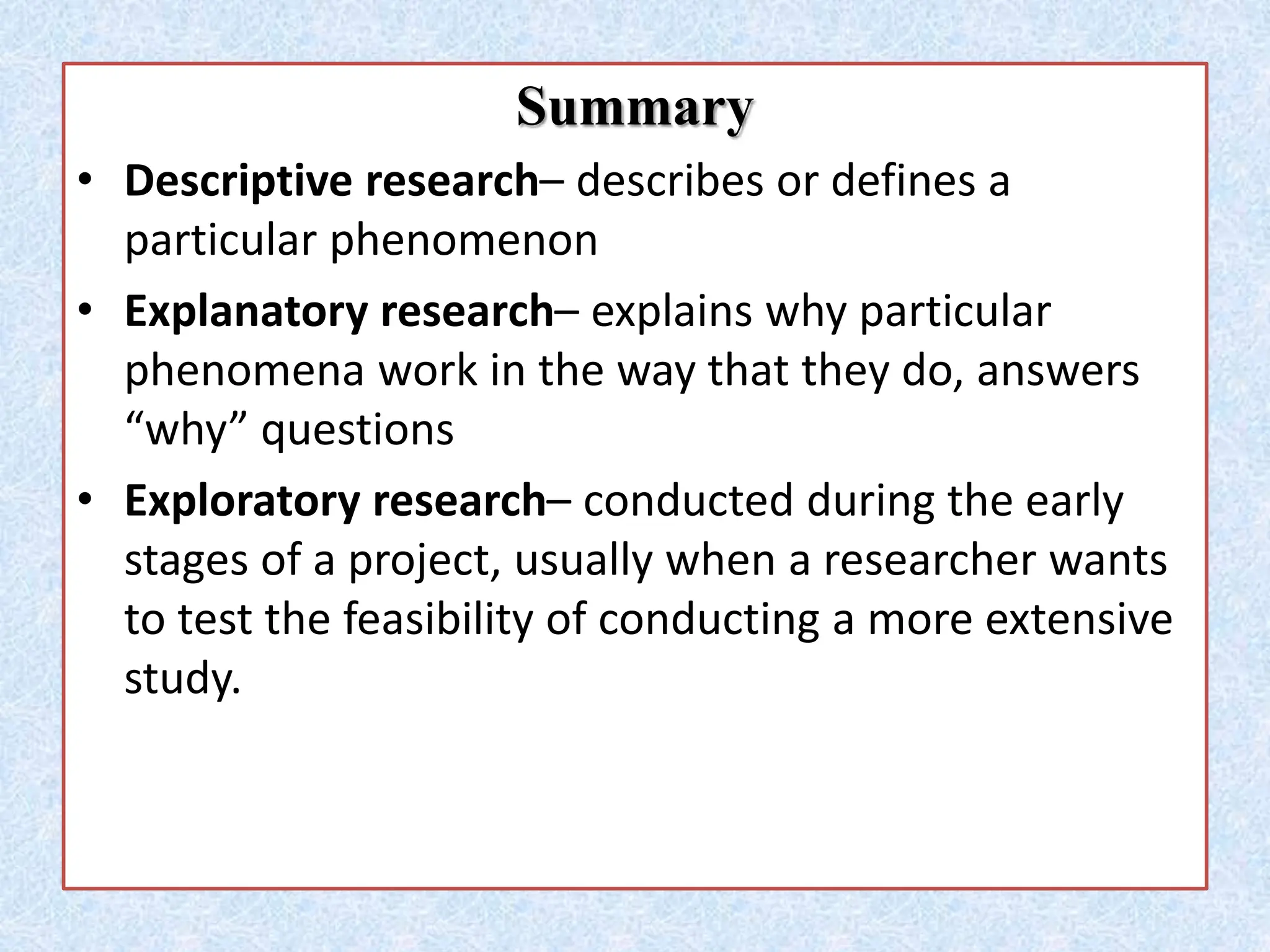
Descriptive research defines phenomena, explanatory research explains 'why', exploratory research explores feasibility.
Explanatory, Descriptive and Exploratory Research.pptx
1.
Classification of Research
Researchcan be classified by its purpose, its process and
its outcomes.
•Exploratory
•Descriptive
•Analytical
•Quantitative
•Qualitative
•Applied
•Basic/Pure/
Fundamental
•Action
2.
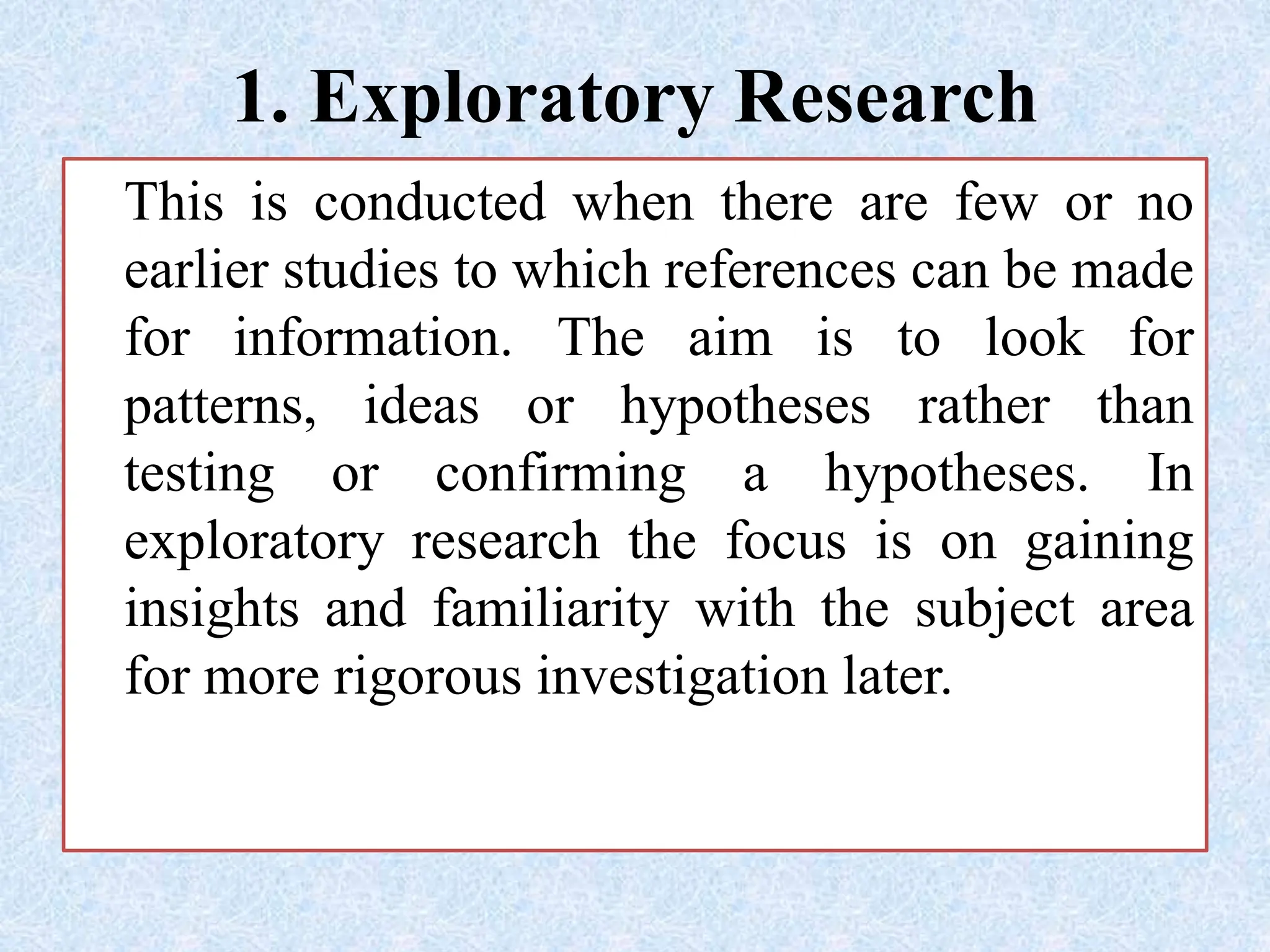
1. Exploratory Research
Thisis conducted when there are few or no
earlier studies to which references can be made
for information. The aim is to look for
patterns, ideas or hypotheses rather than
testing or confirming a hypotheses. In
exploratory research the focus is on gaining
insights and familiarity with the subject area
for more rigorous investigation later.
3.
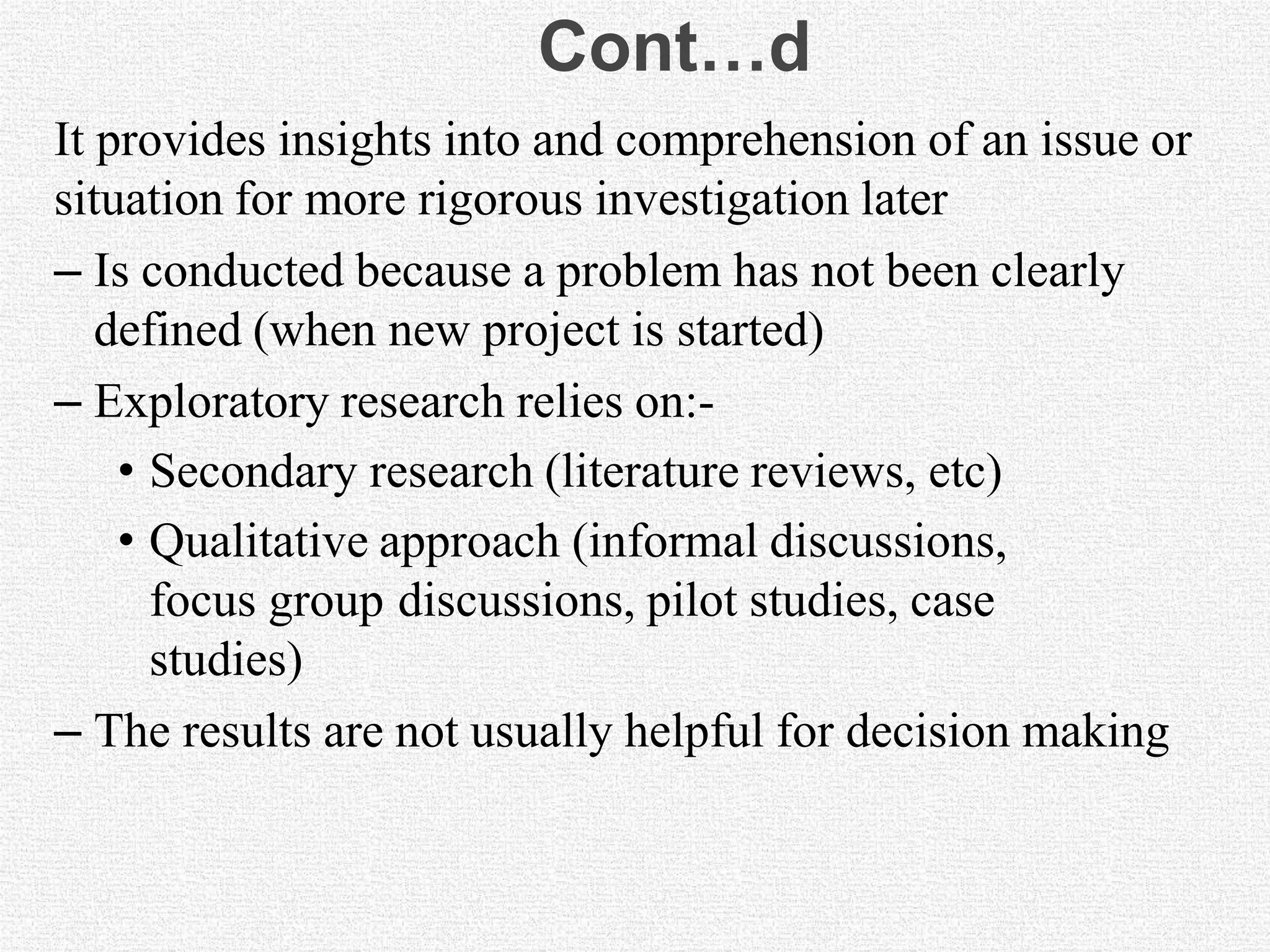
Cont…d
It provides insightsinto and comprehension of an issue or
situation for more rigorous investigation later
– Is conducted because a problem has not been clearly
defined (when new project is started)
– Exploratory research relies on:-
• Secondary research (literature reviews, etc)
• Qualitative approach (informal discussions,
focus group discussions, pilot studies, case
studies)
– The results are not usually helpful for decision making
4.
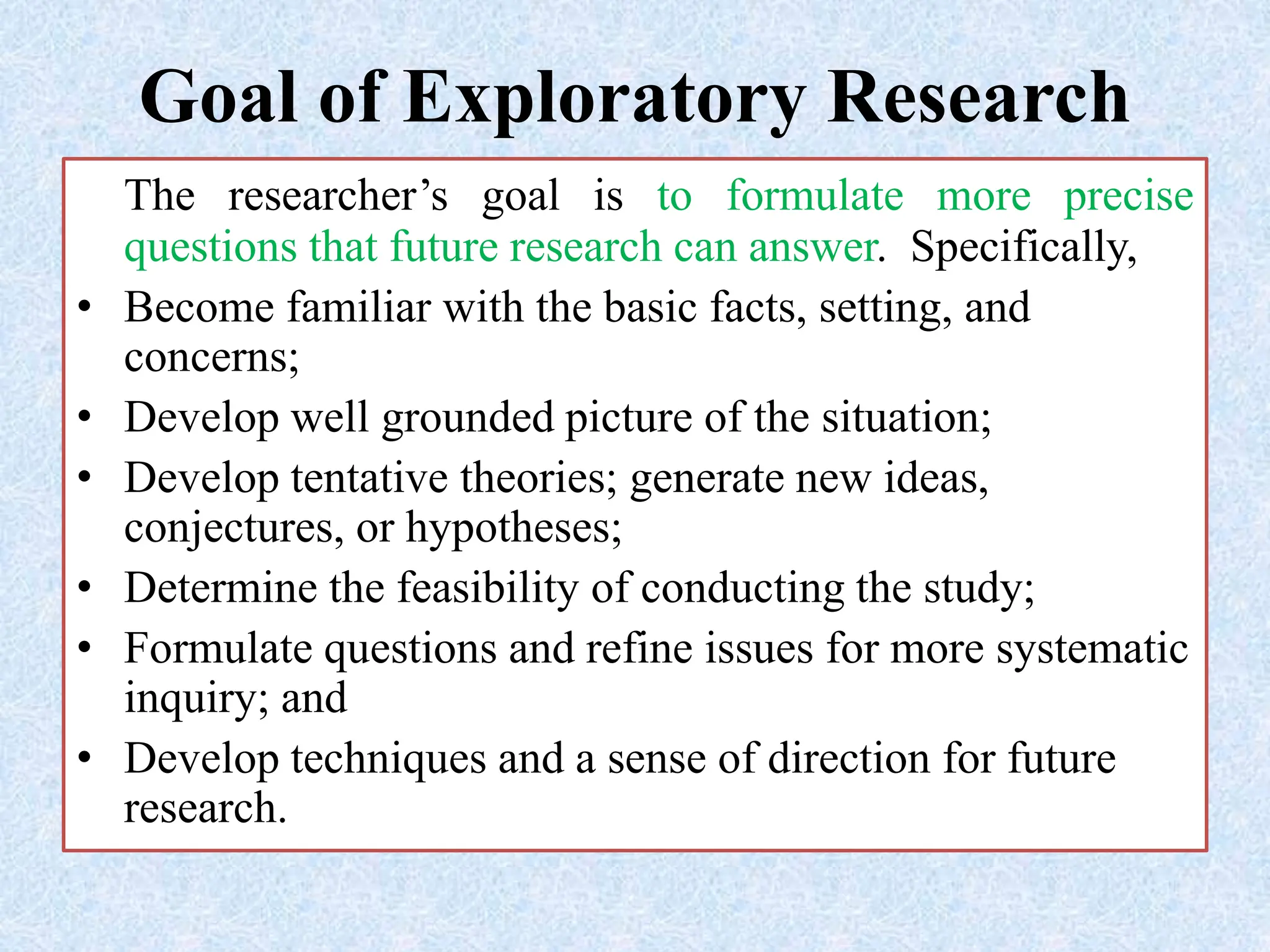
Goal of ExploratoryResearch
The researcher’s goal is to formulate more precise
questions that future research can answer. Specifically,
• Become familiar with the basic facts, setting, and
concerns;
• Develop well grounded picture of the situation;
• Develop tentative theories; generate new ideas,
conjectures, or hypotheses;
• Determine the feasibility of conducting the study;
• Formulate questions and refine issues for more systematic
inquiry; and
• Develop techniques and a sense of direction for future
research.
5.
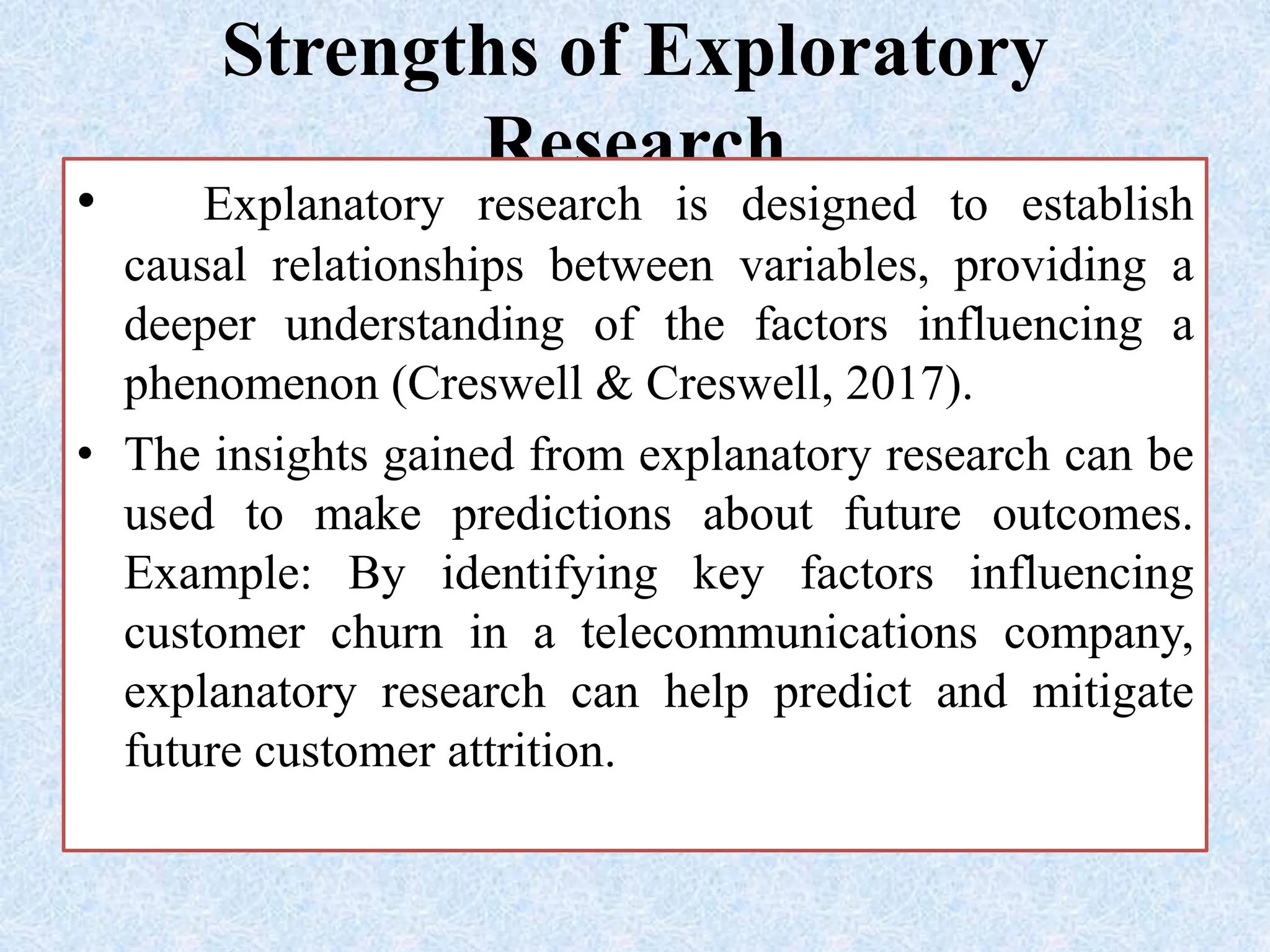
Strengths of Exploratory
Research
•Explanatory research is designed to establish
causal relationships between variables, providing a
deeper understanding of the factors influencing a
phenomenon (Creswell & Creswell, 2017).
• The insights gained from explanatory research can be
used to make predictions about future outcomes.
Example: By identifying key factors influencing
customer churn in a telecommunications company,
explanatory research can help predict and mitigate
future customer attrition.
6.
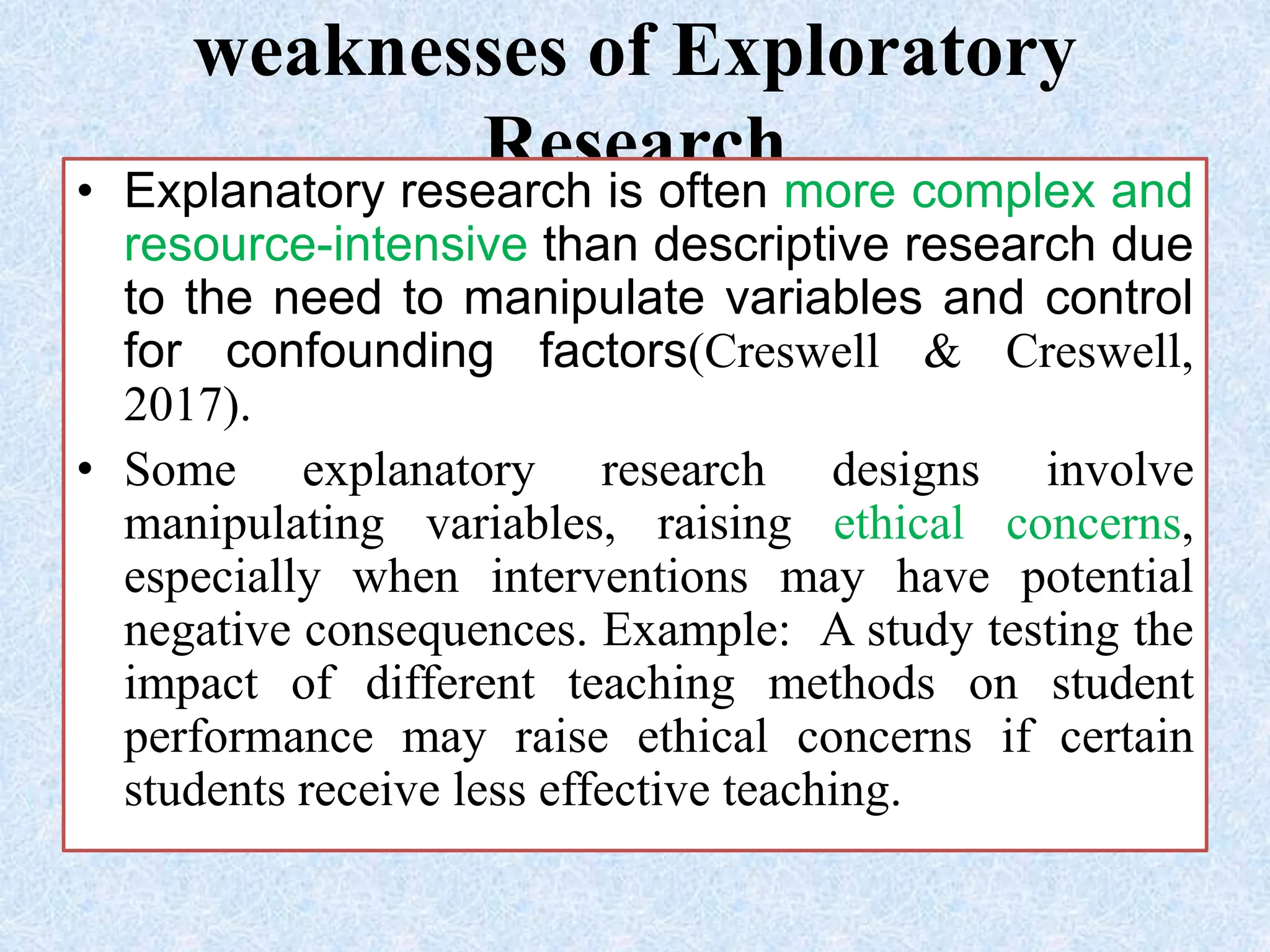
weaknesses of Exploratory
Research
•Explanatory research is often more complex and
resource-intensive than descriptive research due
to the need to manipulate variables and control
for confounding factors(Creswell & Creswell,
2017).
• Some explanatory research designs involve
manipulating variables, raising ethical concerns,
especially when interventions may have potential
negative consequences. Example: A study testing the
impact of different teaching methods on student
performance may raise ethical concerns if certain
students receive less effective teaching.
7.
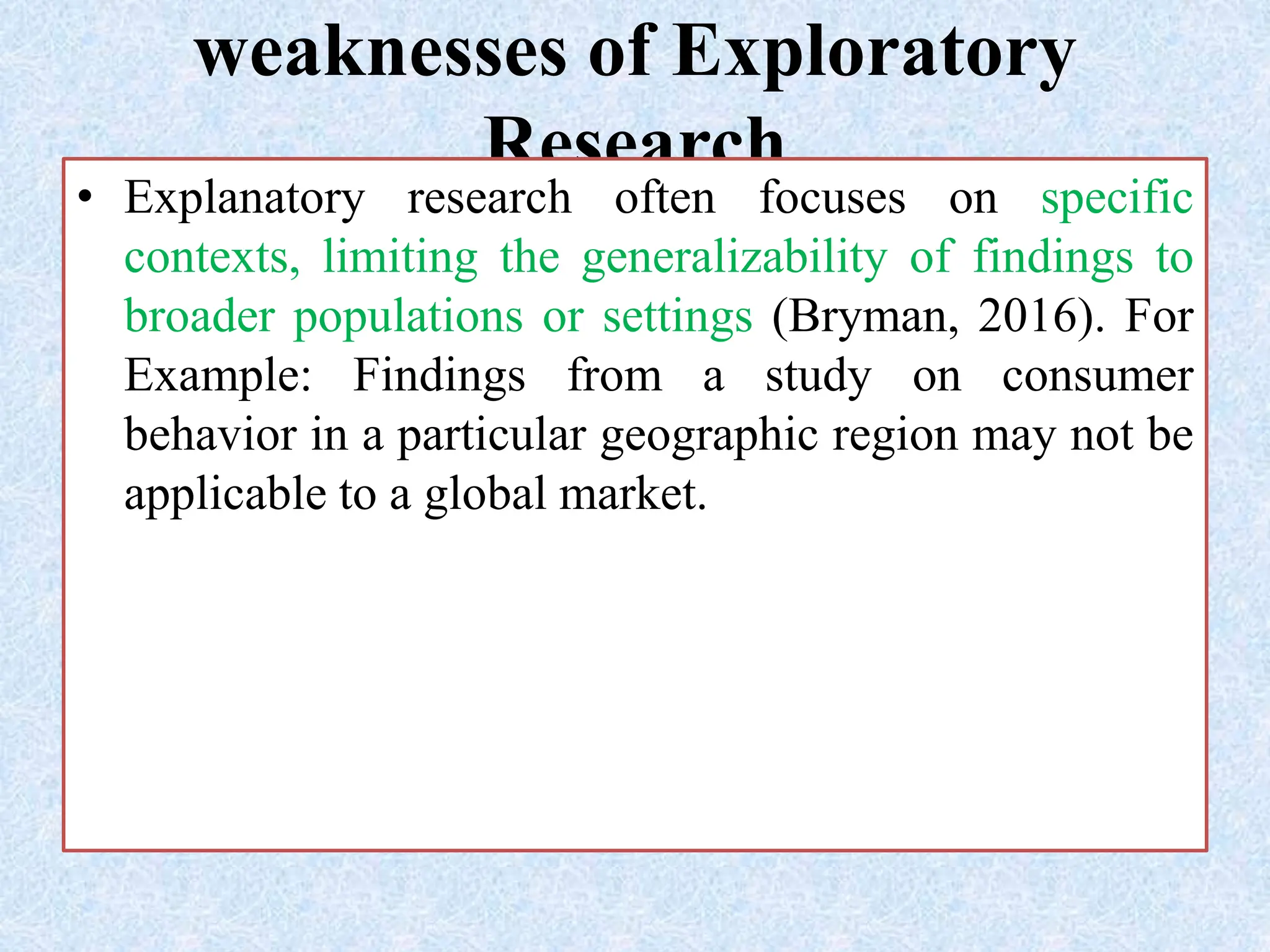
weaknesses of Exploratory
Research
•Explanatory research often focuses on specific
contexts, limiting the generalizability of findings to
broader populations or settings (Bryman, 2016). For
Example: Findings from a study on consumer
behavior in a particular geographic region may not be
applicable to a global market.
8.
2. Descriptive Research
Thisdescribe phenomenon as they exist. It is
used to identify and obtain information on the
characteristics of a particular issue.
The major purpose of descriptive research is
description of the state of affairs as it exists at
present.
in social sciences we quite often use the term Ex
post facto research for descriptive research
studies. The main characteristic of this method is
that the researcher has no control over the
variables; s/he can only report what has
happened or what is happening.
9.
Contd…..
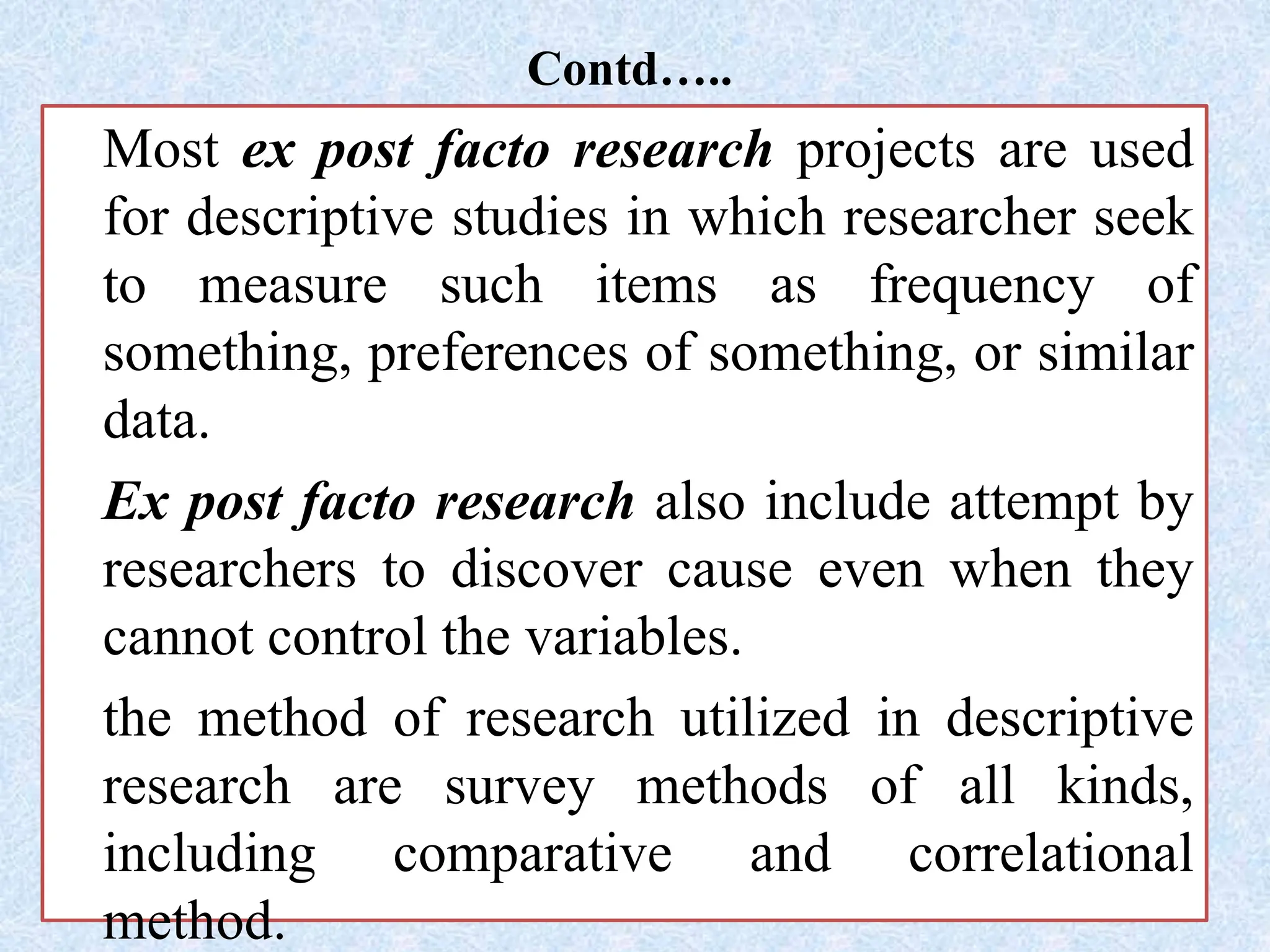
Most ex postfacto research projects are used
for descriptive studies in which researcher seek
to measure such items as frequency of
something, preferences of something, or similar
data.
Ex post facto research also include attempt by
researchers to discover cause even when they
cannot control the variables.
the method of research utilized in descriptive
research are survey methods of all kinds,
including comparative and correlational
method.
10.
Goals of DescriptiveResearch
• Describe the situation in terms of its characteristics i.e.
provide an accurate profile of a group;
• Give a verbal or numerical picture (%) of the situation;
• Present background information;
• Create a set of categories or classify the information;
• Clarify sequence, set of stages; and
• Focus on ‘who,’ ‘what,’ ‘when,’ ‘where,’ and ‘how’ but not
why?
• A great deal of social research is descriptive. Descriptive
researchers use most data gathering techniques –
surveys, field research, and content analysis.
11.
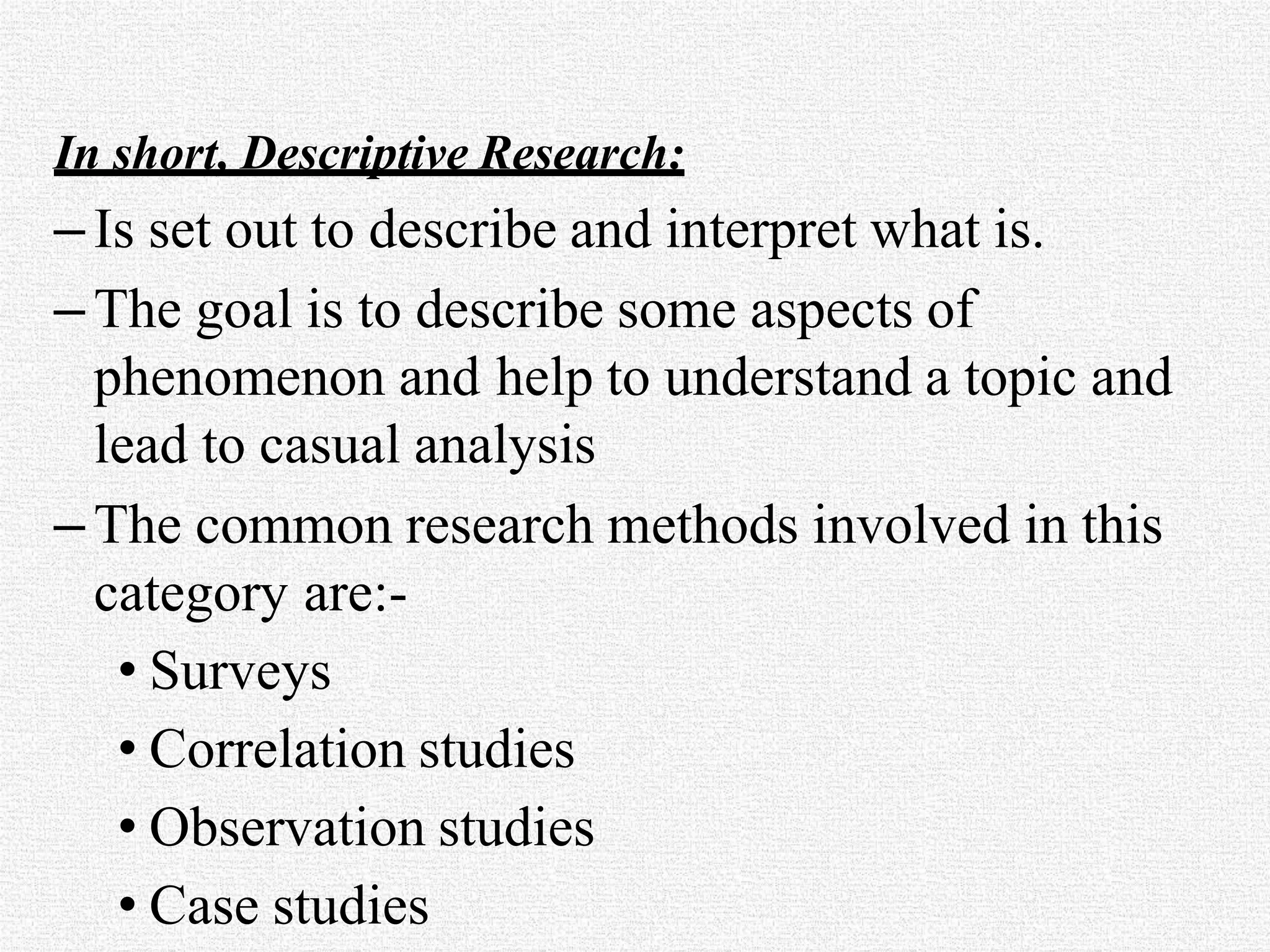
In short, DescriptiveResearch:
–Is set out to describe and interpret what is.
–The goal is to describe some aspects of
phenomenon and help to understand a topic and
lead to casual analysis
–The common research methods involved in this
category are:-
• Surveys
• Correlation studies
• Observation studies
• Case studies
12.
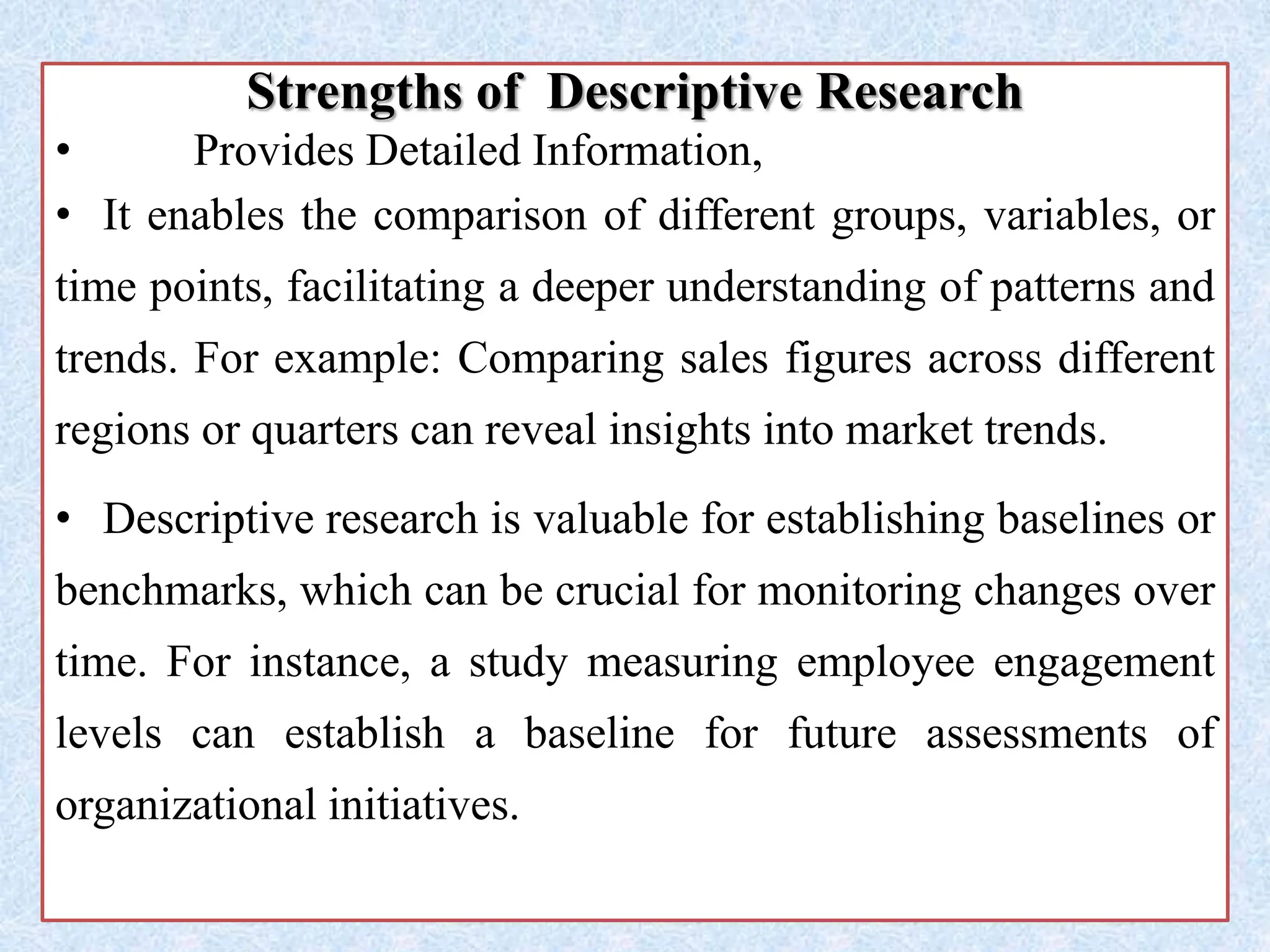
Strengths of DescriptiveResearch
• Provides Detailed Information,
• It enables the comparison of different groups, variables, or
time points, facilitating a deeper understanding of patterns and
trends. For example: Comparing sales figures across different
regions or quarters can reveal insights into market trends.
• Descriptive research is valuable for establishing baselines or
benchmarks, which can be crucial for monitoring changes over
time. For instance, a study measuring employee engagement
levels can establish a baseline for future assessments of
organizational initiatives.
13.
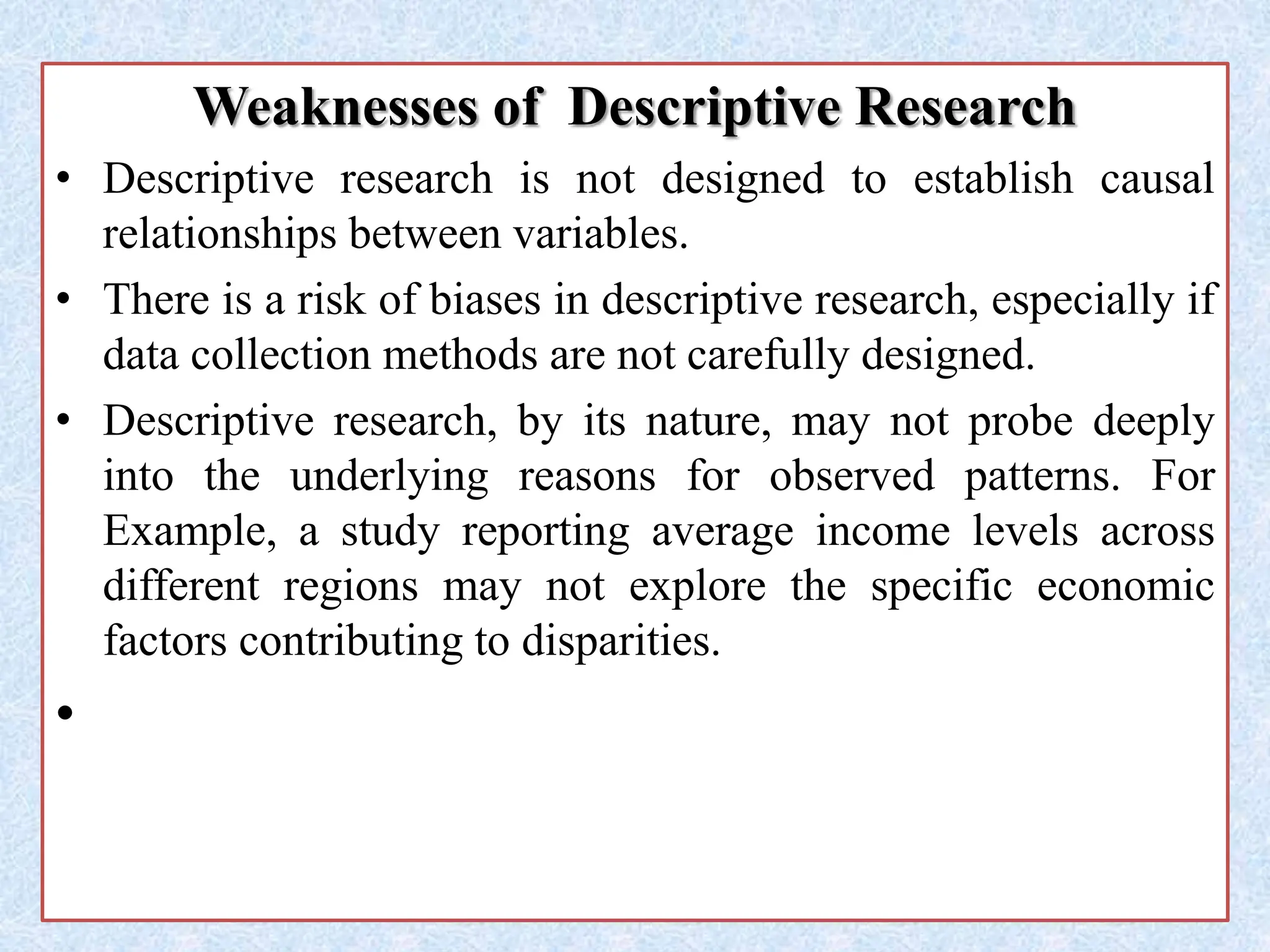
Weaknesses of DescriptiveResearch
• Descriptive research is not designed to establish causal
relationships between variables.
• There is a risk of biases in descriptive research, especially if
data collection methods are not carefully designed.
• Descriptive research, by its nature, may not probe deeply
into the underlying reasons for observed patterns. For
Example, a study reporting average income levels across
different regions may not explore the specific economic
factors contributing to disparities.
•
14.
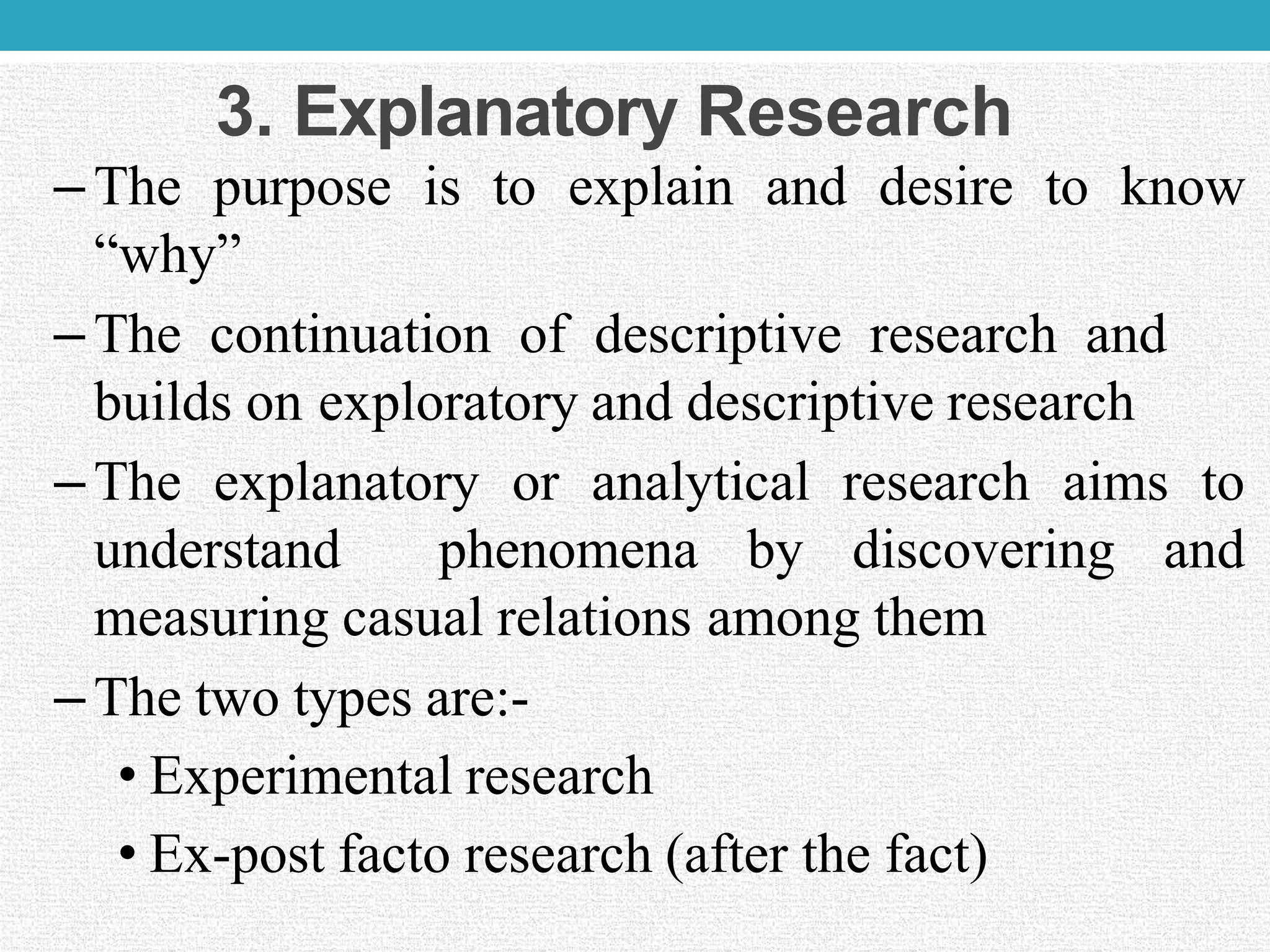
3. Explanatory Research
–Thepurpose is to explain and desire to know
“why”
–The continuation of descriptive research and
builds on exploratory and descriptive research
–The explanatory or analytical research aims to
understand phenomena by discovering and
measuring casual relations among them
–The two types are:-
• Experimental research
• Ex-post facto research (after the fact)
15.
Explanatory Research (contd…)
Thisis continuation of descriptive research.
The researcher goes beyond merely describing
the characteristics, to analyze and explain why
and how something is happening.
Thus, analytical research aims to understand
phenomenon by discovering and measuring
casual relationship among them.
In this research, the researcher has to use facts
or information already available, and analyze
these to make a critical evaluation of the
material.
16.
Goal of ExplanatoryResearch
• Explain things not just reporting. Why?
Elaborate and enrich a theory’s explanation.
• Determine which of several explanations is best.
• Determine the accuracy of the theory; test a
theory’s predictions or principle.
• Advance knowledge about underlying process.
• Build and elaborate a theory; elaborate and
enrich a theory’s predictions or principle.
• Extend a theory or principle to new areas, new
issues, new topics
• Provide evidence to support or refute an
explanation or prediction.
17.
Strengths of ExplanatoryResearch
i. Generates Insights: effective in generating
insights and understanding a phenomenon in
depth.
iii. Flexibility: The flexibility of exploratory
research allows researchers to adapt their
methods based on emerging findings.
iii. Identifies Research Questions: Exploratory
research aids in formulating key research
questions and hypotheses for subsequent
studies.
18.
Weaknesses of ExplanatoryResearch
i. Limited Generalizability:
• Due to its qualitative nature and often small sample sizes,
findings from exploratory research may lack generalizability
(Creswell & Creswell, 2017)
ii. Subjectivity
• iii. Lack of Causation: Exploratory research is not
designed to establish causation; it identifies associations
and patterns without proving cause-and-effect
relationships.
19.
Summary
• Descriptive research–describes or defines a
particular phenomenon
• Explanatory research– explains why particular
phenomena work in the way that they do, answers
“why” questions
• Exploratory research– conducted during the early
stages of a project, usually when a researcher wants
to test the feasibility of conducting a more extensive
study.





![[DSC Europe 25] Marija Vlajkovic & Andrea Radonjanin - Integration of AI tool...](https://cdn.slidesharecdn.com/ss_thumbnails/qf1jrglttoc3bm8s3aop-final-integration-of-ai-tools-251208151905-394f3a6a-thumbnail.jpg?width=640&height=640&fit=bounds)
![[DSC Europe 25] Boris Perkovic - Lost in performance.pptx](https://cdn.slidesharecdn.com/ss_thumbnails/uq5hrp7vsuahqkxzifux-1-251204082258-fd2ee09d-thumbnail.jpg?width=640&height=640&fit=bounds)
![[DSC Europe 25] Andy Cotgreave - Nothing is new in analytics.pptx](https://cdn.slidesharecdn.com/ss_thumbnails/mba4vzcurvoh5lfrd5zw-6-251205194645-341bbbbe-thumbnail.jpg?width=640&height=640&fit=bounds)


![[DSC Europe 25] Petar Zivanov - AI meets documents From chatbots to AI-powere...](https://cdn.slidesharecdn.com/ss_thumbnails/xer2bb6nrdc8pdpev0pc-8-251204082258-7c2fa4a1-thumbnail.jpg?width=640&height=640&fit=bounds)


