1
CHAPTER ONE
CONCEPTS OF RESEARCH: AN OVERVIEW
 Research is most frequently used terminology in different academic
and business institutions.
 Research as conscious and creative human activity involves
discovering and learning new things.
 Where there is a problem there is always a research.
 It is an essential tool for understanding the events and structures of
the social world.
 Research can mean different things to different people.
 People have defined research differently according to their perception.
2
1.1. Meaning of Research
 Research in common expression refers to a search for
knowledge.
 a scientific and systematic search for pertinent information
on a specific topic.
 an art of scientific investigation.
 The Advanced Learner’s Dictionary of Current English lays
down the meaning of research as “a careful investigation or
search for new facts in any branch of knowledge.”
3
 Research is a movement from the known to the unknown. It is
actually a voyage of discovery.
 the search for knowledge through objective and systematic method
of finding solution to a problem .
 systematic approach concerning generalization and the formulation
of a theory .
 systematic method consisting of articulating the problem,
formulating a hypothesis, collecting the facts or data, analyzing the
facts and reaching certain conclusions either in the form of
solutions(s) towards the concerned problem or in certain
generalizations for some theoretical formulation
4
The purpose of research is;
 to discover answers to questions through the application of
scientific procedures.
The main aim of research is;
 to find out the truth which is hidden and which has not been
discovered as yet.
Though each research study has its own specific purpose; here are
broad categories of research objectives;
1. To gain familiarity with a phenomenon or to achieve new
insights into it (known as exploratory research studies);
5
2. To describe accurately the characteristics of a particular
individual, situation or a group (studies with this object in
view are known as descriptive research studies);
3. To determine the frequency with which something occurs
or with which it is associated with something else (studies with
this object in view are known as diagnostic research studies);
4. To test a hypothesis of a causal relationship between
variables (such studies are known as hypothesis-testing
research studies).
6
1.2. Motivation of doing research
 Research is not a trouble-free duty rather it is time consuming, tiresome
and expensive undertaking.
The possible motives for doing research can be either one or a
combination of the following:
a. Desire to get degree with its consequential benefit.
 The graduate and postgraduate students are required to carry out
research project as a partial fulfillment to obtain their master and Ph.D.
Degree.
 Research is therefore, a prerequisite to complete one academic rank
study.
7
b. Desire to get respect and promotion (to own respect in society).
 In academic and research institutions publication is crucial for
promotion and academic rank.
 “Publish or perish” is a phrase commonly used in experienced
and well-established academic institutes.
c. Desire to face a challenge in solving the unsolved problem.
 Concern over a particular problem initiates a researcher.
d. Desire to get intellectual joy of doing some creative work.
 Doing or participation in some creative activity will give some
professional satisfaction to many individuals.
8
e. Directive of government.
 Government sometimes gives directives to its employees to
carry out a particular study and investigation for better
decision-making ground.
 Ideally any policy before implementation requires detail study
and analysis of its impact on different parts of the society.
f. Employment condition.
 Some employers set as criteria at least a publication in
international journal.
9
Research and scientific method
 Research methodology and technique are mostly different from
one science to another or can be different from research to
research.
 The philosophy common to all research methodology and
technique is called Scientific methods.
 People who engage in research work are not interested in
particular results;
 rather they are interested in the repeatability and validity of
results and their application to more complicated and general
solutions.
10
As Pearson (1968) put it, “the scientific method is one and the
same in the branches (science).
The scientific method is, thus, based on certain basic assumption;
1. It relies on empirical evidence;
2. It utilizes relevant concepts;
3. It is committed to only objective considerations;
4. It assumes ethical neutrality, i.e., it aims at nothing but making
only adequate and correct statements about population objects;
5. It results into probabilistic predictions;
11
6. Its methodology is made known to all concerned for critical
study. i.e use in testing the conclusions through replication;
7. It aims at formulating scientific theories.
Forms of scientific methods
There are six primary forms of scientific methods
1. Induction: the movement of knowledge from particular
facts to general rule or principle.
 To make generalization based on our knowledge from a
particular event or assessment.
12
2. Deduction: a movement in knowledge from a general rule to a
particular case.
3. Historical: historical method is a back ward movement in
knowledge to trace the cause of a phenomenon.
4. Comparative: This method is used for the analysis and comparison
of two contemporary (coexisting and present) phenomenon.
 It is always undertaken in order to discover new facts or relations.
 Studies of two government or political system
5. Structural: a study of what a things, what are its outline and
significant feature is a structural study (the composition of a thing)
 Anatomy is a structural study
13
6. Functional: in contrast to the structural method, functional
method studies the processes and their cause, that is, how and
why of a thing.
 Physiology is a good example
Types of Research
1. Descriptive vs. Analytical:
 Descriptive research includes surveys and fact-finding
enquiries of different kinds.
 The major purpose of descriptive research is description of
the state of affairs as it exists at present.
14
 In analytical research, the researcher has to use facts or information
already available, and analyze these to make a critical evaluation of the
material.
2. Applied vs. Fundamental:
 Research can either be applied (or action) research or fundamental
( basic or pure) research.
 Applied research aims at finding a solution for an immediate problem
facing a society or an industrial/business organization,
 the aim of applied research is to discover a solution for some pressing
practical problem
 fundamental research is mainly concerned with generalizations and
with the formulation of a theory.
15
 “Gathering knowledge for knowledge’s sake is termed as ‘pure’
or ‘basic’ research.
 Whereas
 basic research is directed towards finding information that has a
broad base of applications and thus, adds to the already existing
organized body of scientific knowledge.
3. Quantitative vs. Qualitative:
 Quantitative research is based on the measurement of quantity
or amount.
 It is applicable to issues those expressed in terms of quantity.
16
 Qualitative research, on the other hand, is concerned with
qualitative phenomenon, i.e., phenomena relating to or
involving quality or kind.
 Motivation Research’, an important type of qualitative
research.
 This type of research aims at, discovering the underlying
motives and desires, using in depth interviews for the purpose
 Qualitative research is especially important in the behavioral
sciences where the aim is to discover the underlying motives of
human behavior.
17
4. Conceptual Vs Empirical Research
a) Conceptual Research: related to abstract ideas or theories.
Commonly used by philosophers and thinkers.
b) Empirical Research: relies on experience or observation alone. It
is data based research coming up with conclusions which are capable
of being verified by observation or experiment.
The Systematic Process of Research
The research process consists of a number of closely related
activities. These activities/steps overlap continuously rather than
following a strictly prescribed sequence
18
1. Formulating the Research Problem:
 The first step in the research process is the choice of a suitable
problem for investigation.
 It takes place when there is a problematic situation and a need
to solve the problem.
 Sources of a research problem are
 one’s professional experience, theory, and professional
literature.
 Initially the problem may be stated in a broad general way and
then narrowed down to a specific research problem.
19
It determines
 the data which are to be collected,
 the characteristics of the data which are relevant,
 relations which are to be explored,
 the choice of techniques to be used in these explorations and the
form of the final report
2.Review of Literature:
 Making extensive literature survey connected with the problem.
 There are two types of review of literature. i.e conceptual or
theoretical and empirical.
20
 Conceptual literature is concerned with related concepts and theories.
 Empirical literature is about studies made earlier which are similar to
the one proposed
3. Formulation of Working Hypothesis:
 After extensive literature survey, researcher should state in clear
terms the working hypothesis or research questions
 It is tentative assumption made in order to draw out and test its
logical or empirical consequences.
 it provide focal point for research.
 Helps to guide the researcher by delimiting the area of research and
to keep him on the right truck.
21
 It also indicates the type of data required and the type of methods
of data analysis to be used.
4.Preparing the Research Design (Including Sample Design)
 This is stating the conceptual structures with in which research
would be conducted.
5. Collecting the Data (Execution):
 The researcher should select one of the methods of data collection
taking into consideration the nature of investigation, objective and
scope of the inquiry, financial resources, available time, and the
desired degree of accuracy.
22
In survey, data can be collected by any one or more of the
following ways:
i. By observation:
 It is a method data collection by way of investigator’s own
observation, without interviewing the respondents.
 But method is not suitable in inquiries of large samples
ii. Through personal interview
iii. Through telephone interviews: This method of collecting
information involves contacting the respondents on telephone
itself.
23
iv. By mailing of questionnaires
 Questionnaires are mailed to the respondents with a request to return
after completing the same.
6.Analysis of Data (Including Test of Hypothesis):
 The analysis of data requires a number of closely related operations
such as establishment of categories, the application of these categories
to raw data through coding, tabulation and then drawing statistical
inferences.
 The analytical techniques have to be appropriate and adequate.
7.Drawing Conclusions:
 This is making generalizations after the analyses have been made.
24
Characteristics of a Good Research
1. Good research is secured on a sound research question.
 A good research question is clear, focused, and feasible. It follows the
FINER criteria: Feasible, Interesting, Novel, Ethical, and Relevant.
Steps to write good research questions
1. Ask interesting questions
2. Choose the best question for research
3. Turn a research question into testable hypothesis
2. Good research follows a systematic, appropriate research
methodology.
 Research should follow a structured approach using qualitative,
quantitative, or mixed methods, depending on the study’s needs.
25
3. Good research acknowledges previous research on the topic.
 Good research builds on existing studies, ensuring no duplication and
providing a foundation for new knowledge.
4. Good research uses relevant, empirical data and proper data
analysis methods.
 Empirical data is data that has been collected by researchers themselves
through observation, experience, or experimentation.
 This is crucial in doing good research because empirical data is considered
objective, unbiased evidence.
5. Good research is representative and generalizable.
 The study's sample should represent the broader population, making its
findings applicable to other populations (generalizable).
26
6. Good research is guided by logic.
 Research is driven by logical reasoning to ensure consistency and meaningful
outcomes.
7. Good research has external validity.
If your research findings can be generalized to other situations or applied to a
broader context, your study has high external validity.
 There are two types of external validity for researchers to consider: population
validity and ecological validity.
8. Good research is replicable, reproducible, and transparent.
 Good research is replicable and transparent, allowing other researchers to verify
findings.
 Research is reproducible if researchers achieve reliable results using the same
data and methods of analysis.
27
9. Good research acknowledges its limitations and provides
suggestions for future research.
 Researchers should be aware of their study’s limitations and suggest areas for
future research.
10. Good research is ethical.
 Ethics are central to ensure honesty, objectivity, and respect for research
participants
 Some of the most common violations of research ethics include:
 Falsification This involves the manipulation or omission of data or findings.
 Fabrication This involves making up data or results and presenting these as
accurate.
 Plagiarism This refers to the use of another person’s work without giving due
credit.
28
CHAPTER TWO
DEFINING THE RESEARCH PROBLEM
 In research processes, the first step is identifying and
properly defining a research problem.
 The problem identified initially may be stated in broad
general way and then gradually the ambiguity will be
resolved.
 Problem formulation from the researcher point of view
represents translating the social and other problems in to
a research problem.
29
What is a Research problem?
A research problem, in general, refers to some difficulty, which a
researcher faces (experiences) in the context of both a theoretical or
practical situation and wants to obtain a solution for the same.
Research Problem: A situation or circumstance that requires
a solution to be described, explained, or predicted.
According to (Kothari 1990), research problem exist, if the
following conditions are met ;
1. There should be an individual (or group or organization), to
whom the problem can be attributed.
30
2. There must be at least two courses of action; say, C1 and
C2 that can be taken to solve the problem.
3. There must be at least two out comes, O1 and O2 of the
courses of action of which one should be preferred to the
other.
4. The courses of action available must provide some
chance of obtaining the objective, but they cannot provide
the same chance.
31
Components of the research problem
The problem consists of the following components
1.The decision-maker (which can be individual, organization, etc.,) who
has some difficulties or problem.
2.There must be some objectives (goals) to be attained. If one wants nothing
then, cannot have a problem.
 The objective of the decision-maker provides motivation to solve the
problem.
3.Alternative courses of action: There must be alternative means to achieve
the desired objective.
4. The environment (or context of the problem) to which the difficulty pertain.
32
2.1. Defining the Problem
Defining the research problem is crucial & hard part in research process.
 b/c there is a cause and effect issue.
 Defining (formulating ) research problem is the process of refining the
research ideas into research questions and objectives.
 Research problem formulation means translating and transforming the
selected research problem/topic/ideas into a scientifically researchable
question.
 There is a common say in research that “The problem clearly stated is
a problem half solved”.
 This signifies the importance of properly defining the problem.
33
A proper definition of research problem will helps to find
answers to question such as;
 What kind of data and information are relevant and
needed to be studied?
 What relationship is to be explored among variables?
 What technique has to be used to collect and analyze
data? And so forth
34
 Therefore, defining a research problem properly is a prerequisite
for any study and a very important step.
 Even it is more essential than its solution.
Techniques involved in defining a problem
 The research problem should be defined in a systematic manner.
It has a number of steps, which should be under taken one after
another.
i. Statement of problem in a general way
 In social science it is advisable to do some field observation and /
or preliminary survey (pilot survey).
35
ii. Understanding the nature of the problem:
 the next step is to understand clearly the nature and the origin of the
problem.
The best way of understanding the problem is:
 To discuss with those who first raised the problem in order to
know how the problem originally come in view.
 To discuss it with those who have a good knowledge of the
problem concerned or similar other problem.
iii. Survey the available literature.
 All available literature concerning the problem must be studied and
examined before defining research problem
36
Survey the available literature
 Enable to know the relevant theory in the area
 Provides patterns of the interpretation of data
 It links the study with the other
 It supplies frameworks within which concepts and variables
acquire special significance.
 Review research works undertaken on related problem
This is important especially to learn what data and other
material have been used and are available for operational
purpose
37
Generally, survey literature will enable to know
If there are certain gap in the theory
 Whether the existing theory applicable to the problem
and consistent with each other.
 Whether the findings of the research do or do not
consistent with the theoretical expectation.
 Indicating the type of difficulty that may be
encountered in the present study.
38
iv. Developing ideas through discussion:
 Discussion on a problem produces useful information.
 Making discussion with colleagues and others who have enough
experience in the same area. Such practice is called ‘experience survey”
v. Rephrasing the research problem (reformulation of the problem)
 It is narrowing and break down the problem into its component
variables and relationship. That is, problem should be expressed as:
a) a relationship between two or more variable
b) the problem should be stated either in question or hypothesis form.
Example : Is there a r/ship b/n employees' age and their productivity?
: Age has positive relationship with productivity
39
Points to be considered while redefining the research problem
 Technical terms and words should be clearly defined.
 Basic assumptions relating to the problem should be clearly
defined.
 The value of the investigation, i.e., the criteria for the
selection of the problem should be provided
 The suitability of the time period and the sources of data
must be considered by the researcher in defining the problem.
 The scope of the investigation must be mentioned in defining
the research problem.
40
Evaluation of the problem
 The feasibility of the problem has to be tested with
regard to personal suitability of the researcher and
social value of the problem.
 In short, the research problem should be evaluated in
terms of the following criteria:-
Is the problem researchable?
 the problem must be stated in researchable question that
can be answered empirically
41
Is the problem new?
 As much as possible, the research problem needs to be
new.
 One should not target his investigation to the problem
that had already been investigated by other
researchers.
 A researcher may repeat a study when he wants to verify
its conclusion or to extend the validity of its findings in
situation entirely different from the previous one.
42
Is the problem significant?
 It deals with the issue such as the purpose intended to
be achieved by that study, what new knowledge will it
add and what value will it has and also the knowledge
gab to be filled by the study.
 The findings should become a basis for theory
generalization.
43
Is the problem feasible?
 It would be examined from the point of view of the
researcher’s personal aspects as stated hereunder:-
 Researcher Competence: The problem should be in an
area in which the researcher qualified and competent.
 Interest and enthusiasm: The researcher has to make
sure that the problem really interests him/her.
 If the problem is chosen properly by observing these
points, the research will not be boring;
44
Financial consideration:
 Research is an expensive endeavor, which requires money to
invest.
 An estimate of finance required to do the research should be
clearly specified
Time requirement:
 Research should be undertaken within a given scope of time,
which was allocated, with careful analysis of the prevailing
situation.
45
Hypothesis and Research Question
Meaning of Hypothesis
 The word hypothesis consists of two words: Hypo + thesis =
Hypothesis.
 ‘Hypo’ means tentative or subject to the verification and
‘Thesis’ means statement about solution of a problem.
 The meaning of the term hypothesis is a tentative statement
about the solution of the problem.
 Hypothesis is called a leap into the dark.
 It is a brilliant guess about the solution of a problem.
46
Characteristics of hypothesis:
Hypothesis must possess the following
characteristics:
(i) Hypothesis should be clear and precise.
(ii) Hypothesis should be capable of being tested.
(iii) Hypothesis should state relationship between
variables, if it happens to be a relational hypothesis.
(iv) Hypothesis should be limited in scope and must
be specific.
47
Source of Hypothesis
1. Professional Experience: The day-to-day observation of the
relationship between different phenomena leads the researcher
to hypothesize a relationship
2. Past Research or Common beliefs: Hypothesis can also be
inspired by tracing past research.
3. Through direct analysis of data : Hypothesis may also be
generated through direct analysis of data in the field.
4. Technological and social changes: All such changes bring
about new problems for research.
48
Hypothesis and research questions
A hypothesis is a tentative prediction about the nature of the
relationship between two or more variables.
A hypothesis predict about what will happen in an experiment
Hypotheses are always held tentatively
A research question is simply a hypothesis stated in question form.
Useful if there is little previous research on the topic
Allows a researcher to conduct more open-ended inquiries.
A wider range of outcomes can be reported
May encourage excessive manipulation of findings or “fishing
expeditions
49
Elements in a hypothesis
1. Prediction
 Most hypotheses follow the format of "if/then" statements, it is also
acceptable to write a simple declarative statement like "Drinking
coffee in the morning will improve an employee's productivity."
2. Variables
 Generally there are two variables i.e Independent & Dependent
A simple example of hypothesis statement,
 Drinking coffee in the morning improves productivity. This involves
one independent variable (the cause) and one dependent
variable (the effect).
50
3. Group being studied
 The final element of a hypothesis is the subject or group you
want to study in your experiments and observations. In the
coffee hypothesis, for example, you are studying employees
who drink coffee.
How to develop a hypothesis
 Use these steps to develop a hypothesis:
1. Make an observation
 All hypotheses begin with an observation. Start by recognizing
a pattern or noticing the effect of a certain stimulus and
identifying what that information might mean
2. Ask a question
 Define the question that your hypothesis will try to answer.
 Once you ask the question, you can then make a prediction that potentially answers
it
3. Conduct some initial research
 While your initial answer to the question should be based on what is already known
about the topic.
4. Formulate your hypothesis
 After collecting background information and making a prediction based on your
question, plan a statement that lays out your variables, subjects and predicted
outcome.
5. Write a null hypothesis
After you’ve developed your initial hypothesis, it is important to restate it as a null
hypothesis, so that you can test it mathematically 51
7 main types of hypotheses and examples
•Depending on what you expect to find, your hypothesis will fall
into one or more of seven main categories. Keep in mind that the
same hypothesis might qualify as several different types.
1. Simple hypothesis
•A simple statement hypothesis states that your prediction is true
about the relationship between two variables: one independent
and one dependent. Example:
 Bringing vegetables to work every day for lunch will cause
you to lose weight.
52
2. Complex hypothesis
• A complex hypothesis states a relationship between more than two
variables. Example:
 Spending three hours or more on social media daily will negatively
affect children's mental health and productivity more than adults.
3. Null hypothesis
•A null hypothesis claims that the original hypothesis is false by
showing no relationship between the variables. Example:
 Employees do not have a preference for office temperature.
 Employees who write with a pen and paper write at the same rate
as employees who use a computer.
 Physical activity during the workday does not affect productivity.
53
4. Alternative hypothesis
•An alternative hypothesis is used in conjunction with a null hypothesis. It
states the opposite of the null hypothesis, so only one must be true. Examples
 Employees have a preference for office temperature.
 Employees who write with a pen and paper do not write at the same rate as
employees who use a computer.
 Physical activity during the workday affects’ productivity.
5. Logical hypothesis
•A logical hypothesis states a relationship between variables based on
reasoning but no actual evidence. Here are some examples of logical
hypotheses:
 A unicorn would have trouble scratching its horn when it itches.
 Dogs can’t survive without water.
54
6. Empirical hypothesis
•An empirical hypothesis, also known as a “working hypothesis,” is one
that is currently being tested. Unlike a logical hypothesis, it is based on
concrete data. Example:
 Drinking less reduces the number of employees’ bathroom breaks.
 Exposure to sunlight helps lettuces grow faster.
7. Statistical hypothesis
•A statistical hypothesis tests a sample of a group and then applies
statistical data to draw a conclusion about the entire group. Examples:
 In humans, the birth-gender ratio of males to females is 1.05 to 1.00.
 Approximately 2% of the world's population has natural red hair.
 60% of people talking on the phone while driving has been in at least
one car accident.
55
Errors In hypothesis testing
•In hypothesis testing, two kinds of errors are possible viz., Type I error and
Type II error.
•Type I error means rejection the null hypothesis when it happens to be
true. Type II error means accepting null hypothesis when it is false.
•The following tables being explain the type of error
For instance, the level of significance is 5%. It means that five cases
of out of 100 are rejecting the H0 which is true. It is possible to
reduce type I error by lowering down the level of significance.
56
Position of Hypothesis Null Hypothesis-Accept Null Hypothesis- Reject
H0 True Correct Decision Type: I Error
H1 False Type II Error Correct Decision
57
Points may be considered in selecting a research problem
 A subject that is overdone should not be normally chosen
 Too narrow or too vague problems should be avoided.
 The subject selected for research should be familiar and
feasible so that the related research material or source of
research is within one’s reach.
 The importance of the subject, the qualification and the
training of researcher, the cost, the time factor are the few
points that must be considered in selecting a problem.
58
CHAPTER THREE
RESEARCH PROPOSAL
 is the document written by a scientist or academic which describes
the ideas for an investigation on a certain topic.
 It outlines the process from beginning to end and may be used to
request financing for the project, certification for performing
certain parts of research of the experiment, or as a required task
before beginning a college dissertation.
 It is a work plan, outline, or draft plan.
 It indicates what will be done, why it will be done, how it will be
done, where it will be done, and what is the benefit of doing it
59
THE PURPOSE OF PROPOSALS
1. To present the problem to be researched and its importance.
2. To discuss the research efforts of others who have worked on
related problems.
3. To suggest the data necessary for solving the problem and how
the data will be gathered, treated, and interpreted.
Proposal is also useful both for sponsors and for researchers.
 For sponsors, it allows to assess the honesty of the purpose and
fitness of the researcher to undertake the project
 For the researcher, proposal helps to have a tentative work plan
60
GENERAL FORMAT OF RESEARCH PROPOSAL
 There is no single way of writing research proposals.
 There can be different formats for research proposals depending
on the funding organizations.
 Various organizations have their own styles and formats of writing
a proposal.
 However, the following proposal components are usually
important.
61
1. Cover page
 The cover page contains introductory information for the
proposal: the names of the proposed project (title), the author of
the proposal or principal investigator, and the institution.
 Some funding agencies have standardized cover pages that may
contain additional information.
2. Title
 It is one of the most important parts of a proposal.
 The title should use the fewest possible words that adequately
describe the content of the paper.
62
 In titles a researcher has to use specific, familiar, and short
words.
 Use of ‘waste words’ like ‘A study on …’, ‘An investigation on…’,
‘An observation on…’ should be avoided.
3. Background of the study
 This part of the research provides some general theoretical basis
or justifications for conducting a research.
 It tells to the reader from what perspective that the research is to
be conducted or the overall justification as to why it is needed to
conduct the study.
63
4. Statement of the problem
 Is the written description of the issue or set of issues that
would be addressed by the concerned research work.
 It may focus on literature-based disagreements concerning
the issue under investigation.
 The researcher is expected to state his problem clearly
without the use of phrase.
 Each word of the statement must be expressive, sharp, and
indispensable.
64
5. Research objectives
 This part addresses the purpose of the investigation
 The objectives flow naturally from the statement of
problem.
 It is best to list the objectives either in order of
importance or in general terms first, moving to specific
terms.
 The research objectives section is the basis for judging the
remainder of the proposal and, ultimately, the final report.
65
Six important guidelines developing research objectives are:
1. They should be presented briefly and concisely
2. They should be presented in logical sequence
3. They should be realistic ( achieved within the expected time frame
e.t.c
4. They should be phrased in operational terms (i.e., in a way that
brings the organization closer to its business objectives)
5. use of action verbs that are specific enough to be evaluated or
measured(e.g., assess, determine, compare, verify, calculate, describe)
6. They should be static once the study work begins (i.e., objectives
should not be moving targets)
66
6. Research hypothesis ( Questions)
 Research questions are interrogative
statements that focus on what variables or
concepts are to be described and what
relationships might exist among them.
 Research hypothesis is the formal statement of
the expected relationships among variables
67
7. Significance of the research
 This part shows the explicit benefits and the beneficiaries of the
results of the research being conducted.
 It states the importance or contribution that the study will have
for different bodies.
8. Delimitations (Scope) of the study
 This part indicates the scope (coverage) of the study.
 It should be delimited to manageable size.
 This should be done in relation to the area coverage as well as to
the treatment of the variables in the study.
68
9. Limitations of the study
 Under this part some constraints or difficulties that may have
influence on the results of study need to be indicated.
 This may be in relation to the weaknesses in the methodology,
lack of access to data, faulty instruments, sampling restrictions,
lack of recent literature in the area etc.
 Any restrictions or areas of the problem that will not be
addressed must be indicated.
69
10. Literature review
 It deals with review of recent research studies or industry reports
that act as a basis for the proposed study.
 the review of related literature should be start from a
comprehensive perspective, and moving to more specific studies
that are associated with problem.
 Starting with conceptual aspect and support it lastly with empirical
evidence
 Lastly close the literature review section by summarizing the
important aspects of the literature and interpreting them in terms
of the problem proposed to be studied
70
11. Methods (Methodology)
i. Method of sampling
 Justification for the choice of a particular sampling technique
and also the representative sample size
ii. Method of data collection
 the ways that the required data are obtained from the specified
sources and justification of its selection
iii. Method of analysis
 It deals with methods how data collected will be processed and
analyzed
71
iv. Method of presenting the outcome
 Sometimes it is worth to mention how the outcome of the
research will be presented to consumers (general public).
12. Work plan and Budget/logistics
Work plan (Time Schedule)
 It deals with the major phases of the project together with their
time tables.
 The phases may be questionnaire preparation, pre-testing, field
interviews, editing and coding, data analysis, and report
generation.
72
Budget requirement
 Budget breakdown has to be prepared for all activities.
 It may include the details of travel expenses, per diems, and
capital equipment purchase, and other costs together with
allowance for contingencies.
13. Reference (Bibliography/ Literature cited)
 All works cited in the proposal are listed either alphabetically or
numerically at the end of the document usually under the
heading of “References or Bibliography “
73
distinction between references and bibliography
• References: are lists of literature, which have been cited in the text
of a document
• Bibliography: includes also items, which were not cited but are
relevant to the document.
 There are several ways of making citation and recording
references. The two main systems of referring are:
A) Harvard System:
B) Vancouver System:
74
A) Harvard System:
This system uses author’s name, date, and page reference.
This system is used mainly in Anthropology, Social science
and business research.
In-text citation: each referencing style has different rules
(Pears and Shields, 2019)
Reference list: Pears, R. and Shields, G. (2019). Cite them
right: The essential referencing guide. 11th edn. London:
MacMillan.
75
B) Vancouver System:
 uses in-text number instead of an author, date, and page
reference.
 The same superscript or bracketed text number is given in
the text each time the source is sited.
 It is used in the applied science such as chemistry, physics
and mathematics.
In-text citation: Each referencing style has different rules (1).
Reference list: 1. Pears R, Shields G. Cite them right: The
essential referencing guide. 11th ed. London: MacMillan; 2019
76
i.) Citation
Citation under the Harvard system:
In an investigation conducted in large factories, Gibbs (1993)
reported that absenteeism was higher on the night shift than the
day
Citing more than one authors
A number of research studies have been conducted into the effect of
the recession on small business (Smith, 1984; Anderson, 1990;
Jones, 1995)…
77
ii. Referring or listing the cited works
A. Reference for books
Davidson, Alan. B. (1994), the Pursuit of Business, London, Chapman
& Halls
B. Reference for Journal article
Porter, Michael E. (1994), competitive advantage of nations, Harvard
Business Review, 68(2), pp. 73-83
C. Other references
It is possible to cite quote or paraphrase unpublished work if they
are relevant to the study.
78
Unpublished works are:
• Personal communication with experts (professionals).
• Unpublished data collected by other researchers
• Unpublished research works
• Public speeches
• Conferences discussion and the like
Appendix (Annex)
It is not mandatory to have this section; rather it is used in main research report.
issues to be included in appendix: ( Note: in research)
 Detail Questionnaires and interview schedules
 Detailed statistical procedures
79
CHAPTER FOUR
REVIEW OF RELATED LITERATURE
Definition of Literature Review
 is the documentation of a comprehensive review of the
published and unpublished work from secondary sources
of data in the areas of specific interest to the researcher.
 The literature review is an integral part of the entire
research process and makes a valuable contribution to
almost every operational step.
Working with literature
Working with
Literature
Find it! Manage it! Use it! Review it!
Knowing the
literature types
Reading
efficiently
Choosing your
research topic
Understanding the
lit review’s
purpose
Using available
resources
Keeping track
of references
Developing your
question Ensuring adequate
coverage
Honing your
search skills
Writing relevant
annotations
Arguing your
rationale
Informing your
work with
theory
Designing
method
Writing
purposefully
Working on
style and tone
A literature review has a number of
functions
Bring clarity and focus to your research problem
 Improve your methodology
Broaden your knowledge base in your research
area
Contextualise your findings
1-10
Bring clarity and focus to your research problem
• N.B. you cannot effectively start the literature review
search without an idea of the problem you wish to
investigate.
• The literature review can play an extremely important
role in shaping your research problem
• It also helps you to define the relationship between your
research problem and the body of knowledge in the area.
1-14
Improve your methodology
Explains you with the methodologies that have been
used by others to find answers to questions similar
to the one you are investigating.
Tells you if others have used procedures and
methods similar to the ones that you are proposing,
which procedures and methods worked well for
them and what pitfalls they have faced with them.
Broaden your knowledge base in your
research area
 Literature review ensures you read widely around the
subject area in which you are intend to conduct your
research study.
 It is important to know what other researchers have
found in regard to the same or similar questions, what
theories have been put forward and what gap exit in the
relevant body of knowledge
Contextualise your findings
Literature review helps identifying how your findings
compare with the existing body of knowledge.
How do answers to your questions compare with what
other have found?
What contribution have you been able to make to the
existing body of knowledge?
How your finding different from others?
Procedures for reviewing the literature
There are six steps involved in conducting a
literature review:
 Search for existing literature in your area of study;
 Review the literature selected;
 Develop a theoretical framework;
 Develop an Empirical Studies
 Develop a conceptual framework;
 Writing up the literature reviewed
1) Search for existing literature
Start with at least some idea of the broad subject area
of the problem you wish to investigate, in order to set
parameters for your search.
Next compile a bibliography for this broad area. There
are two sources that you can use to prepare a
bibliography:
 books;
 journals.
Notice
Be aware that sometimes a title does not provide
enough information to decide if a book/ journal is
going to be use.
Start with the latest issue, examine its contents page to
see if there is an article of relevance to your research
topic.
Start by reading the abstract. If it is relevant then
download and read.
2) Review the literature selected
Now that you have identified several books and
articles as useful, the next step is to start reading
them critically to pull together themes and
issues that are associated.
If you do not have a theoretical framework or
themes in mind to start with, use separate sheets of
paper for each article or book.
Cont.…
 Once you develop rough frameworks, slot the findings from the
material so far reviewed into that framework, using a separate
sheet of paper for each themes of that framework. As you read
further, go on slotting the information where it logically
belongs under the themes so far developed.
 Notice where there are significant differences of opinion among
researchers and give your opinion about the validity of these
differences.
 Ascertain the areas in which little or nothing is known-the gaps
that exist in the body of knowledge.
3) Develop a theoretical framework
As you start reading the literature, you will soon
discover that the problem you wish to investigate has
its roots in a number of theories that have been
developed from different perspectives.
Theoretical framework provides the underlying
theories and concepts that guide a study's design
and analysis.
4) Develop an Empirical framework
 Empirical study will elaborate the relevant previous
researches that is correlated with the methods used in
previous research to be used as the references to develop the
methods and solving the problems in this research.
 The theoretical review looks at existing theories (concepts or
whole), their relationships, extend the theories have been
studied and the establishment of new hypotheses. While
empirical literature review explores past studies in view of
attempting to answer specific research questions.
5) Develop a conceptual framework
 The conceptual framework developed from the theoretical
and empirical framework and concentrates, usually, on the
relationship between independent and dependent variables.
 A conceptual framework should describe the relationship
among components of the investigation. These
relationships should guide the researcher's methods of
approaching the study and inform both the data to be
collected and how those data should be analyzed.
Examples of conceptual framework
Conceptual Model
94
Complaint
Handling
Strategies
Satisfaction
with Service
Recovery
95
Complaint handling strategies
apology
explanation
compensation
Response speed
facilitation
Being courteous
Problem solving
effort
Satisfaction
with
complaint
handling
Examples of conceptual framework
96
Customer
satisfaction
Service
Quality
Customer
Loyalty
5) Writing up the literature reviewed
• While reading the literature for theoretical and empirical
background of your study, you will realize that certain themes have
emerged.
• List the main ones, converting them into subheadings. These
subheadings should be precise, descriptive of the theme in
question, and follow a logical progression.
• Now, under each subheading, record the main findings with
respect to the theme in question, highlighting the reasons for and
against an argument if they exist, and identifying gaps and issues.
Examples of Literature Surveys
Organizational effectiveness
 Organization theorists have defined organizational
effectiveness (OE) in various ways.
 OE has been described in terms of goals (Etzioni, 1960),
efficiency (Katz and Kahn,1966), resources acquisition
(Yuchtman and Seashore,1967). As Coutler (2002)
remarked, there is little consensus on how to
conceptualize, measure, or explain OE. 98
How to write references?
Book
Journal
Online document
Format for Citing References for Book
Author, A., & Author, B. (year). Title of book
(edition if not first). City: Publisher.
Book by a single author
Leshin, C.B. (1997). Management on the World
Wide Web. Englewood Cliffs, NJ: Prentice-Hall.
100
Cont.…
Author, A., & Author, B. (year). Title of book
(edition if not first). City: Publisher.
Book by more than one author
Cornett, M., Wiley, B.J., & Sankar, S. (1998). The
pleasures of nurturing (2nd
ed). London:
McMunster Publishing.
101
Format for Citing References for Journals
Journal Article
Author, A., & Author, B. (year). Title of article. Title of Journal,
volume number (issue number), page numbers.
 Barry, H. (1996). Cross-cultural research with matched pairs of
societies. Journal of Social Psychology, 79 (1), 25-33.
 Jeanquart, S., & Peluchette, J. (1997). Diversity in the workforce
and management models, Journal of Social Work Studies, 43, 72-85.
102
Format for Citing References for online
Referencing Electronic Sources
Author, A. (year, month day). Title of article. Title
of Newspaper. Retrieved from home page web
address
• Nader, C. (2009, June 19). Mental health issues
soar among children. The Age. Retrieved from
http://www.theage.com.au
CHAPTER FIVE: RESEARCH DESIGN
Research Method Vs Research Design
Research methods can be conceived as various processes, procedures, and tools
employed to collect and analyze research data. They are approaches used to execute
research plans. A research method is a research paradigm or philosophical framework
that research is based.
Research designs are the overall research structure of a study which help to ensure
that the data collected effectively answers the research question(s). Research designs
can be Descriptive (e.g., case-study, naturalistic observation, survey), Correlational
(e.g., case-control study, observational study), Experimental (e.g., field experiment,
controlled experiment, quasi experiment), Review (literature review, systematic
review), and Meta-analytic (meta-analysis) in nature.
104
105
Cont.….
MEANING OF RESEARCH DESIGN
 A research design is the arrangement of conditions for collection and
analysis of data in a manner that aims to combine relevance to the
research purpose with economy in procedure.
 is the conceptual structure within which research is conducted; it
constitutes the blueprint for the collection, measurement and analysis
of data.
 Decisions regarding what, where, when, how much, by what means
concerning an inquiry or a research study constitute a research design.
106
Definition of Research Design
 A research design is a framework for conducting research project.
 It specifies the details of the procedures necessary for obtaining the information
needed to solve research problems.
 A Research Design is the detailed blueprint used to guide a research study toward its
objectives.
 A research design is the plan or framework used to conduct a research study. It
involves outlining the overall approach and methods that will be used to collect
and analyze data in order to answer research questions or test hypotheses.
 A well-designed research study should have a clear and well-defined research
question, a detailed plan for collecting data, and a method for analyzing and
interpreting the results. A well-thought-out research design addresses all these
features.
107
Main points to be considered from the definition
 Research design requires the specification of procedures.
 These procedures involve decisions on what information to generate,
the data collection method, the measurement approach, the object to
be measured, and the way in which the data are to be analyzed.
 The data are to be collected to help identify or react to a problem or
opportunity.
 All data collected should eventually relate to decisions faced by
management.
 The information has value. Information acquires values as it helps
improve decisions
108
 The varying levels of accuracy of information can be
generated in response to the same problem.
Information accuracy is affected by the occurrence of a
number of potential errors.
 The goal of research design is not to generate the most
accurate information possible.
Rather, the objective is to generate the most valuable
information in relation to the cost of generating the
information.
109
 the design includes an outline of what the researcher will do from writing the
hypothesis and its operational implications to the final analysis of data.
 More explicitly, the design decisions happen to be in respect of:
(i) What is the study about?
(ii) Why is the study being made?
(iii) Where will the study be carried out?
(iv) What types of data is required?
(v) Where can the required data are found?
(vi) What will be the sample design?
(vii) What techniques of data collection will be used?
(viii) How will the data be analyzed?
(ix) In what style will the report be prepared?
Important Concepts Relating to Research Design
1. Dependent and independent variable:
If one variable depends upon or is consequence of the other variable, it
is termed as a dependent variable, and the variable that is antecedent
to the dependent variable is termed as an independent variable. Some
researchers use the terms causal or predictor as synonymous with
independent and resultant or criterion with dependent variables. For
instance, a researcher could examine the impact of heavy drinking of
alcohol on liver. In this analysis, heavy drinking of alcohol -
independent variable and the effect like liver disease -dependent
variable.
63 |
2. Extraneous variable: A variable which interferes the effect of the
relationship between the dependent and an independent variable is called
extraneous or intervening variable. It is an independent variable that is not
related to the purpose of the study, but may affect the dependent variable in
some way.
3. Control: One important characteristic of a good research design is to
minimize the influence or effect of extraneous variable(s). The technical term '
control' is used when we design the study to minimize the effects of
extraneous variables.
4. Confounded Relationship: When the dependent variable is not free from
the influence of extraneous variable(s), the relationship between the dependent
and independent variables is said to be confounded by an extraneous
variable(s).
64 |
5. Treatments: The different conditions under which experimental and
control groups are put are usually referred to as ' treatments. If we
want to determine through an experiment the comparative impact of
three varieties of fertilizers on the yield of wheat, in that case the
three varieties of fertilizer will be considered as three treatments.
6. Experiment: The process of examining the truth of a statistical
hypothesis, relating to some research problem, is known as an
experiment. If we want to determine the impact of a fertilizer on the
yield of a crop, it is a case of absolute experiment; but if we want to
determine the impact of one fertilizer as compared to the impact of
some other fertilizer, our experiment then will be termed as a
comparative experiment.
66 |
Research design elements
Research design elements include the following:
Clear purpose: The research question or hypothesis must be clearly
defined and focused.
Sampling: This includes decisions about sample size, sampling method,
and criteria for inclusion or exclusion. The approach varies for
different research design types.
Data collection: This research design element involves the process of
gathering data or information from the study participants or sources. It
includes decisions about what data to collect, how to collect it, and the
tools or instruments that will be used.
113
Data analysis: All research design types require analysis and interpretation of the
data collected. This research design element includes decisions about the statistical
tests or methods that will be used to analyze the data, as well as any potential
confounding variables or biases that may need to be addressed.
Type of research methodology: This includes decisions about the overall approach
for the study.
Time frame: An important research design element is the time frame, which
includes decisions about the duration of the study, the timeline for data collection
and analysis, and follow-up periods.
Ethical considerations: The research design must include decisions about ethical
considerations such as informed consent, confidentiality, and participant protection.
Resources: A good research design takes into account decisions about the budget,
staffing, and other resources needed to carry out the study.
114
Characteristics (Features) of research design
Some basic characteristics of research design are common to different research design
types. These characteristics of research design are as follows:
Neutrality: Right from the study assumptions to setting up the study, a neutral stance
must be maintained, free of pre-conceived notions. The researcher’s expectations or
beliefs should not color the findings or interpretation of the findings. Accordingly, a
good research design should address potential sources of bias and confounding
factors to be able to yield unbiased and neutral results.
Reliability: Reliability is one of the characteristics of research design that refers to
consistency in measurement over repeated measures and fewer random errors. A
reliable research design must allow for results to be consistent, with few errors due to
chance.
Validity: Validity refers to the minimization of nonrandom (systematic) errors. A good
research design must employ measurement tools that ensure validity of the results.
115
Cont.…
Generalizability: The outcome of the research design should be
applicable to a larger population and not just a small sample. A
generalized method means the study can be conducted on any part of a
population with similar accuracy.
Flexibility: A research design should allow for changes to be made to
the research plan as needed, based on the data collected and the
outcomes of the study
A well-planned research design is critical for conducting a scientifically
rigorous study that will generate neutral, reliable, valid, and
generalizable results. At the same time, it should allow some level of
flexibility. 116
117
The overall research design contains the following parts:
(a) the sampling design which deals with the method of selecting
items to be observed for the given study;
(b) the observational design which relates to the conditions under
which the observations are to be made;
(c) the statistical design which concerns with the question of how
many items are to be observed and how the information and data
gathered are to be analyzed; and
(d) the operational design which deals with the techniques by which
the procedures specified in the sampling, statistical and
observational designs can be carried out.
118
important features of a research design
 It is a plan that specifies the sources and types of information
relevant to the research problem.
 It is a strategy specifying which approach will be used for
gathering and analyzing the data.
 It also includes the time and cost budgets since most studies are
done under these two constraints
119
In general research design must, at least, contain:
a. a clear statement of the research problem;
b. procedures and techniques to be used for gathering
information;
c. the population to be studied; and
d. methods to be used in processing and analyzing data
120
Classification of Research Design
Research Design Can Be Classified Into Two:
1. Exploratory Research And
2. Conclusive Research.
A. Exploratory research
 is one type of research design, which has its primary objective the
provision of insights into and comprehension of the problem situation
confronting the researcher.
Exploratory studies can be done by interview and focus groups
Discussion.
121
This exploratory study will offer the needed preliminary information
for a full-fledged study on the matter, later.
Exploratory research could be used for any of the following
purposes:
1. Gain background information.
2. Formulate a problem or define a problem more precisely
3. Clarify problems and Develop hypothesis.
4. Establish priorities for further research
5. Identify alternative sources of action.
122
 Exploratory Research is most commonly unstructured, informal
research that is undertaken to gain background information
about the general nature of the research problem.
Methods of Conducting Exploratory Research
A variety of methods are available to conduct exploratory research.
These include:
1) Secondary Data Analysis
2) Experience surveys
3) Case Analysis
4) Focus groups
123
B. Conclusive Research.
 Research designed to assist the decision maker in determining,
evaluating, and selecting the best course of action to take in a
given situation.
 Is typically more formal and structured than exploratory research.
It is based on large, representative samples, and the data obtained
are subjected to quantitative analysis.
 The findings from the research are considered to be conclusive in
nature in that they are used as input into managerial decision-
making
124
Conclusive research can be Categorize into
A. Descriptive- Descriptive research design also
classified as:
1. Cross-sectional
2. Longitudinal
B. Causal (Explanatory)
A. Descriptive Research is a type of conclusive research
that has its major objective. It is the description of
something-usually characteristics or functions.
 It Provides answers to questions such as who, what,
where, when and how, as they are related to the research
problem.
 Typically, answers to these questions, are found in
secondary data or by conducting surveys
125
126
B. Causal Research (explanatory Research design) - A type of research
design where the major objective is to obtain evidence regarding cause
and effect or causal relationships.
 Causality may be thought of as understanding a phenomenon in terms
of conditional statements in the form of “if X, then Y.”
 These,” if -then” statements become manipulating variables of interest.
 If I spend more on advertising, then sales will rise.
 Its primary goal is to understand or to explain relationships.
 It uses correlations to study relationships between dimensions or
characteristics off individuals, groups, situations, or events.
 Explanatory research asks the “Why” question.
127
 Our desire to understand our world in terms of causal, if-then
statements is very difficult,
Example
 A causal study question:
Does smoking cause cancer?
 A correlation study question:
Are smoking and cancer related?
COOPERATIVE ACCOUNTING AND AUDITING GROUP
128
Group One
1.Biftu Tekilu
2. Dawit Dirirsa
3.Bodane Sintayo
4. Fikadu Negesa
5. Darartu Dirbaba
6. Desalegn kefle
Selected Title
1. THE ROLE OF LEADER SHIP STYLE ON EMPLOYEES’
PERFORMANCE (IN CASE OF GIBE DIDESSA FARMERS
COOPERATIVE UNION IN AMBO CITY)
2. LOAN AND ADVANCE MANAGEMENT SYSTEM IN
COMMERICIAL BANK OF ETHIOPIA (in Case Study in Ambo Branch).
(Selected)
Group Two
1. Bikila Dase???
2. Bontu Birasa ??
3. Habiba Mohamed
4. Jalel Haftamu
5. Jorjo Lachisa ???
6. Kulani Fufa
Selected Title
1. Assessment of financial performance in case of ambo city saving
and credit cooperative (Selected)
2. The role of leadership style on employee’s performance in case of
Haro Wenchi Farmers’ cooperative union in waliso City
Group Three
1. Rabia Geleto
2. Sudesi Mahamadsali
3. Tilahun Tadela
4. Tsion Abera
5. Tsioon Ababe
6 . Worku Sisay
Selected Title
(1) Strengthening Cooperative Governance: Implementing Robust
Accounting and Auditing Standards.
(2)_ Enhancing Financial Transparency: A Proposal for
Cooperative Accounting and Auditing Practices (Selected)
COOPERATIVE BUSINESS MANAGEMENT GROUP
129
Group One
1.osman
Muhammad
2.dame daba
3.jemal kemal
4.darartuu tamasgen
5.burtukaan Haylee
Selected Title
1, Assessment of Taxation and its impact on small business in case of
ambo town. (Selected)
2, Assessment of Inventory management system (a case study of
ambo town food complex shares company ?????)
Group Two
1. Jemal kasim
2.fireol Asfaw
3.endale mitikuu
4.berkat decho
5.fenet Tamena
Selected Title
1.BUDGET PREPARATION, ALLOCETION AND
IMPLEMENTATION
2. Factors Affecting the Growth of Primary Saving and Credit
Cooperative Societies…………………….
Group Three
1. Dagim dagefa
2.salamon mosisaa
3.Etenesh endale
4. Gamade fekadu
Selected Title
1.SOCIO-ECONOMIC FACTORS AFFECTING URBAN
PRIVATE INVESTMENT,,,,,,,,,,,,,,,,,,,,,,,,,,,,
2.CHALLENGES AND OPPORTUNITIES OF PRIVATE
INVESTMENT
130
CHAPTER SIX
SAMPLING DESIGN AND PROCEDURE
 A sample design is a definite plan for obtaining a sample from a given
population.
 It refers to the technique or the procedure the researcher would adopt
in selecting items for the sample.
 Sample design may as well lay down the number of items to be included
in the sample i.e., the size of the sample
 Some designs are relatively more precise and easier to apply than
others.
 Researcher must select/prepare a sample design which should be
reliable and appropriate for his research study.
131
CENSUS AND SAMPLE SURVEY
 All items in any field of inquiry constitute a ‘universe’ or a
‘population’.
 A complete enumeration of all items in the population is known
as a census inquiry.
 In such an inquiry, when all items are covered, no element of
chance is left and highest accuracy is obtained.
 This type of inquiry, however, involves a great deal of time,
money and energy.
 Undertaking a census survey, many times, is not possible.
132
 Sometimes it is possible to obtain sufficiently accurate results by
studying only a part of total population, technically called
samples.
 The process of selecting samples is called sampling technique.
 In sampling, however, the samples selected should be as
representative of the total population as possible in order to
produce a miniature cross-section.
 Sample design is determined before data are collected.
133
Basic Terminologies in Sampling
1. Population (Universe): The aggregate of all elements, sharing some
common set of characteristics that comprises the universe for the
purpose of research problem.
2. Target population: the specific complete group relevant to the
research group.
3. Population element: an individual member of a specific population.
4. Census: a complete enumeration of the elements of a population or
study objects.
5. Sample: a subgroup of the elements of the population selected for
participation in the study.
134
6. Sampling Frame: a representation of the elements of the target
population. It consists of a list or set of directions for identifying the target
population.
It's a subset of the population of interest, and is important for ensuring that
research results are valid and representative.
7. Representative Frame: a sample that reflects the population accurately so
that it is a sample size of the population.
8. Probability Sampling: a sampling procedure in which each element of the
population has a fixed probabilistic chance of being selected for the sample.
9. Non-Probability Sampling: sampling techniques that do not use chance
selection procedures, rather, they rely on the personal judgment of the
researcher.
135
10. Sampling With Replacement: a sampling technique in which an
element can be included in the sample more than once.
11. Sampling Without Replacement: a sampling technique in which
an element cannot be included in the sample more than once.
12. Sampling Units: a single element or group of elements subject to
selection in the sample.
13. Primary Sampling Unit (PSU): a unit selected in the first stage of
the sampling.
14. Secondary Sampling Unit (SSU): a unit selected in the second
stage of sampling.
15. Sample Size: The number of elements to be included in a study
136
16. Sampling Error:
 is one which occurs due to unrepresentativeness of the
sample selected for research.
17. Non-Sampling Error:
 is an error rises from human error, such as error in problem
identification, method or procedures used.
18. Non –Response:
 a source of non-sampling error that is particularly likely to
happen when individuals are being sampled.
137
BASIS FOR
COMPARISON
SAMPLING ERROR
NON-SAMPLING
ERROR
Meaning Sampling error is a type of
error, occurs due to the
sample selected does not
perfectly represents the
population of interest.
An error occurs due to
sources other than
sampling, while conducting
survey activities is known as
non sampling error.
Cause Deviation between sample
mean and population mean
Deficiency and analysis of
data
Type Random Random or Non-random
Occurs Only when sample is
selected.
Both in sample and census.
Sample size Possibility of error reduced
with the increase in sample
size.
It has nothing to do with the
sample size.
138
THE NEED FOR SAMPLING
 To save resource (time, finance, manpower, etc.) due to limitation to study
the whole population.
 Sampling provides much quicker results than census.
 Sampling is the only process possible if the population is finite/infinite.
 There is also an argument that the quality of a study is often better with
sampling than with a census.
STEPS IN SAMPLING DESIGN
1.Type of universe: The first step in developing any sample design is to
define the universe.
 The universe can be finite or infinite. Infinite universe, the number of
items is certain.
139
 Examples ,
 the population of a city, the number of workers in a factory, etc. finite
popn
 But in case of an infinite universe, the number of items is infinite.
 Examples
 listeners of a specific radio program
2. Sampling Unit:
 A decision has to be taken concerning a sampling unit before selecting
sample.
 Sampling unit may be a geographical one such as district, kebele, village,
etc., or a social unit such as family, school, etc., or it may be an
individual.
140
3. Source list
 It is sampling frame from which sample is to be drawn.
 It contains the names of all items of a universe (for finite
universe).
 A source list should be comprehensive (complete),
correct, reliable and appropriate
141
4. Size of sample
 This refers to the number of items to be selected from the
universe.
 The size of sample should neither be excessively large,
nor too small. It should be optimum.
 In order to decide on the size of the sample to be selected, a
researcher must take in to consideration the size of
population variance, the size of population, the
parameter of interest in the research study, and
budgetary constraint.
For finite universe, the following formula can be used
142
Example;
The sample size of the number of respondents was determined by Using Kothari (2004) sampling
design formula
The size of the respondent is n= (p*q*N*z2
)
(N-1)*e2
+z2
*p*q)
n= 0.10*0.90*3615*(1.96)2
______________________________
(3615-1)*(0.05)2
+ (1.96)2
*0.10*0.90
n=133
143
Where n = sample size of the respondents
N = Total population of the sample size (3615)
Z = 95% confidence interval under normal curve
(1.96)
e = acceptable error (0.05)
P and q are estimated of the proportion of the population to
be sampled
(p= 0.10 and q =0.90)
144
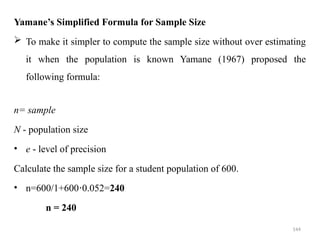
Yamane’s Simplified Formula for Sample Size
 To make it simpler to compute the sample size without over estimating
it when the population is known Yamane (1967) proposed the
following formula:
n= sample
N - population size
• e - level of precision
Calculate the sample size for a student population of 600.
• n=600/1+600 0.052=
⋅ 240
n = 240
The Formula to determine for infinite population
Cochran’s Sample Size Formula
 Used to compute an ideal sample size for a desired level of precision, it
is recommended to be used for studies with infinite populations
(Cochran, W.G. 1977)
Where,
 e: desired level of precision, the margin of error
 p: the fraction of the population (as percentage) that displays the
attribute
 z: the z-value, extracted from a z-table
145
Example,
For example, a large campus may have 25,000 students. We are interested in
finding the percentage of students who eat lunch at the campus dinner halls but we
do not have insider information. The question is how many students would we
need to ask that question to be able to determine, with reasonable confidence, what
percentage of students conform to the sought behavior. Given the lack of
information, we start by considering that 50% of the students eat lunch at the
school dining halls, which provides the largest variability. Then we consider a 95%
confidence level (leading to an αα=0.05) and a ±5% precision. From the z-tables,
the value for z is 1.96. Therefore, the theoretical sample would be:
n = 384.16 = 384
146
147
5.Parameters of interest
 In determining the sample design, one must consider the
question of the specific population parameters which are of
interest.
6.Budgetary constraint
 Cost considerations, from practical point of view, have a
major impact upon decisions relating to not only the size of
the sample but also to the type of sample.
 This fact can even lead to non-probability samples.
148
7. Sampling procedure
 Finally, deciding the type of sample and the technique to
be used in selecting the items for the sample.
 There are several sample designs out of which the
researcher must choose one for his study.
 Obviously, he must select the design which, for a given
sample size and for a given cost, has a smaller sampling
error.
149
CRITERIA FOR SELECTING A SAMPLING PROCEDURE
 analysis-the cost of collecting the data and the cost of an incorrect
inference resulting from the data.
 There are two causes of incorrect inferences namely systematic
bias and sampling error.
1. Systematic bias:
 Systematic bias results from errors in the sampling procedures, and
it cannot be reduced or eliminated by increasing the sample
size.
 However, the causes responsible for these errors can be detected
and corrected.
150
Usually, a systematic bias is the result of one or more of the
following factors:
i) Inappropriate sampling frame: If the sampling frame is
inappropriate i.e., a biased representation of the universe, it will
result in a systematic bias
ii) Defective measuring device: In survey work, systematic bias
can result if the questionnaire or the interviewer is biased.
 Similarly, if the physical measuring device is defective there
will be systematic bias in the data collected through such a
measuring device
151
iii. Non-respondents:
 If unable to sample all the individuals initially included in
the sample, there may arise a systematic bias.
v) Natural bias in the reporting of data
152
2. Sampling errors:
 Sampling errors are the random variations in the sample estimates
around the true population parameters.
 Sampling error decreases with the increase in the size of the sample,
and it happens to be of a smaller magnitude in case of homogeneous
population.
 Sampling error can be measured for a given sample design and size.
 The measurement of sampling error is usually called the ‘precision
of the sampling plan
 If we increase the sample size, the precision can be improved
153
 But more increasing sample size increases the cost of collecting
data and also enhances the systematic bias.
 Thus the effective way to increase precision is usually to select a
better sampling design which has a smaller sampling error for a
given sample size at a given cost.
1. Sample design should be a representative sample
 sample needs to closely match all the characteristics of the entire
population.
 If the sample used in an experiment is a representative sample
then it will help generalize the results from a small group to large
universe being studied.
154
2. Sample design should have small sampling error
 Sampling error is the error caused by taking a small sample
instead of the whole population for study.
 Sampling error refers to the discrepancy that may result from
judging all on the basis of a small number.
 Sampling error is reduced by selecting a large sample and by
using efficient sample design and estimation strategies.
3. Sample design should be economically viable
 The sampling should be done in such a way that it is within the
research budget and not too expensive to be replicated.
155
4. Sample design should have marginal systematic bias:
 Systematic bias results from errors in the sampling procedures
which cannot be reduced or eliminated by increasing the sample
size.
 The best bet for researchers is to detect the causes and correct
them.
5. Results obtained from the sample should be generalized and
applicable to the whole universe:
156
TYPES OF SAMPLE DESIGNS
 There are two types-Probability sampling and non-probability
sampling.
 Probability sampling is based on the concept of random selection,
whereas non-probability sampling is non-random selection
PROBABILITY SAMPLING TECHNIQUES
 Probability sampling is also known as random sampling or chance
sampling.
 Random sampling techniques can be divided in to simple random
sampling and complex random sampling.
157
I. Simple Random Sampling
 … Individuals are randomly drawn from the population at large.
 each unit in the universe has the same chance of being included
in the sample.
 It needs a ‘sampling frame’ or a ‘sampling unit’, i.e. complete and
up-to-date list of all members of the population.
 For a homogeneous type of population, simple random sampling is
reliable.
 Random sampling is considered as the best technique of selecting
a representative sample.
 The problem with this method is that it is time consuming.
158
Simple random sampling gives:
a) each element in the population an equal probability of getting
into the sample; and all choices are independent of one another
b) each possible sample combination has an equal probability of
being chosen.
 simple random sample from a finite population as a sample which
is chosen in such a way that each of the possible samples has the
same probability of being selected
 From a finite population consists of 4 elements (say a, b, c, d) i.e.
N=4.
 If a sample of n=2 is planned to be taken.
159
 Then there are possible distinct samples of the required size,
and they consist of the elements ab, ac, ad, bc, bd, and cd.
 If we choose one of these samples in such a way that each has a
probability 1/6 of being chosen, we will then call this a random
sample.
 Another method of selecting random samples is to use random
number tables.
 Random numbers are often tabulated on some standard books.
 Sampling is then just by picking numbers at random from the
table until the required sample size is obtained
160
II. Complex random sampling
it includes :
 Systematic sampling, Stratified sampling and Cluster sampling
(i) Systematic sampling
 is the sampling way to select every ith item on a list.
 An element of randomness is introduced into this kind of sampling by
using random numbers to pick up the unit with which to start.
The following steps will help:
- Assign a sequence number to each member of the population.
- Determine the skip interval by dividing the number of units in the
population by the sample size. I=P/S where I is skip interval, P is population
size, and S is sample size.
161
- Select a starting point in a random digit table (it must be between 1 and
I).
- include that item in a sample and select every ith item thereafter until
total sample has been selected.
 For example, if 20 samples taken from a population of 100 members,
skip interval will be 5 (i.e 100/20).
 The starting point must be selected randomly from the interval 1 to 5.
 Then every fifth item will be included in the sample.
 For example If 2 is taken as starting point , then the sample must
include members with sequence numbers of 2, 7, 12, 17, 22, 27, …,
97.
162
The advantage of this sampling technique
 the samples will spread evenly over the entire population.
 It is also an easier and less costly method of sampling and can be
conveniently used even in case of large populations.
However, if there is a hidden periodicity in the population,
systematic sampling will prove to be an inefficient method of
sampling.
163
(ii) Stratified sampling
 If a population from which a sample is to be drawn does not
constitute a homogeneous group, stratified sampling is
generally applied.
 In this case the population is divided into several subpopulations
(strata) that are individually more homogeneous than the total
population and then selecting items from each stratum to
constitute a sample.
 Stratified sampling results in a more reliable and detailed
information.
164
The basic steps for stratified sampling;
a)Dividing the population to be surveyed in to strata of similar
study units or into areas with which similar social, environmental,
or economic conditions exist.
b)Preparing a separate and complete list of the stratum and from
each stratum draw a separate random sample of study units using
these lists.
c)A similar survey is then done on the sample of study units in each
of the strata i.e. the same questionnaire is used.
165
The main advantages of stratified sampling are
(i) more reliable information is obtained for the same sample size
if the population is stratified
(ii) Comparisons between strata are easy.
 This is so because a separate but similar survey is done in each
stratum
Techniques of forming strata
i. Deciding how to form strata
 A strata is formed on the basis of common characteristic(s) of
the items to be put in each stratum.
166
 strata be formed in a way as to ensure homogeneous x-st within
each stratum and heterogeneous between the different strata.
 Strata are purposively formed usually based on past experience and
personal judgment of the researcher
ii. Determine the numbers of items be selected from each stratum
 For items selection from each stratum, simple random sampling or
Systematic sampling can be used based on the need
 For this proportional allocation method may be used
 i.e taking samples size from the different strata proportional to the
sizes of the strata.
167
That is, if Pi represents the proportion of population included in
stratum i, and n represents the total sample size, the number of
elements selected from stratum i is n.Pi.
 Suppose sample of size n=30 to be drawn from a population of
size N=800 which is divided into three strata of size N1=400,
N2=240, and N3=160.
 The sample size for stratum with N1=400 is n1=30(400/800)=15.
 The sample size for stratum with N2=240 is n2=30(240/800)=9.
 The sample size for stratum with N3=160 is n3=30(160/800)=6.
168
 In cases where strata differ not only in size but also in variability
and is considered reasonable to take larger samples from the
more variable strata and smaller samples from the less variable
strata, we can then account for both (differences in stratum size
and differences in stratum variability) by using disproportionate
sampling design by using the formula:
 Where denote the standard deviations for the ith stratum,
 Ni denote the size of the ith stratum, and
 ni denote the sample size of the ith stratum.
169
For example, assume a population is divided into three strata so that N1=5000, N2=2000, and
N3=3000.Respective standard deviations are .
5
,
18
,
15 3
2
1 

 

 How should a sample of size
n=84 be allocated to the three strata, if we want optimum allocation using disproportionate sampling
design?
The solution is 50
)
5
)(
3000
(
)
18
)(
2000
(
)
15
)(
5000
(
)
15
)(
5000
(
84
1 



n .
.
24
)
5
)(
3000
(
)
18
)(
2000
(
)
15
)(
5000
(
)
18
)(
2000
(
84
2 



n
10
)
5
)(
3000
(
)
18
)(
2000
(
)
15
)(
5000
(
)
5
)(
3000
(
84
3 



n
170
NB.
1. Each stratum, in stratified sampling, is homogeneous internally
and Heterogeneous with other strata.
2. The more strata used, the closer you come to maximizing inter
strata differences and minimizing intra stratum variances.
(iii) Cluster sampling:
 If the total area of interest happens to be a big one, a convenient
way in which a sample can be taken is to divide the area in to a
number of smaller non-overlapping areas and then to randomly
select a number of these smaller areas (clusters), with the ultimate
sample consisting of all units in these small areas or clusters.
171
Area sampling: If clusters happen to be some geographic
subdivisions, in that case cluster sampling is better known as area
sampling.
Multi-stage random sampling: Multi-stage sampling is a further
development of the principle of cluster sampling.
Sampling with probability proportional to the cluster size:
 In case the cluster sampling units do not have the same number
or approximately the same number of elements, it is considered
appropriate to use a random selection process where the
probability of each cluster being included in the sample is
proportional to the size of the cluster.
172
 For this purpose, we have to list the number of elements in each
cluster irrespective of the method of ordering the cluster.
 Then we must sample systematically the appropriate number of
elements from the cumulative totals.
For illustration, consider the following are the number of
departmental stores in 10 cities: 35, 17, 10, 32, 80, 18, 26, 19, 26,
and 57.
 If we want to select a sample of 8 stores, using cities as clusters
and selecting within clusters proportional to size, how many
stores from each city should be chosen? (Use a starting point of
8)
173
.
City number Numberof departmental stores Cumulative total Sample
1 35 35 8
2 17 52 48
3 10 62
4 32 94 88
5 80 174 128,
6 18 192 168
7 26 218 208
8 19 237
9 26 263 248
10 57 320 288
174
In the above example
 there are 320 departmental stores from which we have to select
a sample of 8 stores, the appropriate sampling interval is 40.
 As we have to use the starting point of 8, so we add successively
increments of 40 till 8 numbers have been selected.
 The numbers, thus, obtained are: 8, 48, 88, 128, 168, 208, 248,
and 288.
 Two stores should be selected randomly from city number 5 and
one each from city number 1, 2, 4, 7, 9, and 10.
175
NON-PROBABILITY SAMPLING TECHNIQUES
 While useful for many studies, non-probability sampling procedures
provide only a weak basis for generalization.
 In reality, the conclusions drawn from a study of a non-probability
sample are limited to that sample and cannot be used for further
generalization.
 the judgment of the organizers of the study plays an important part in
this sampling design.
 In such a design, personal element has a great chance of entering into
the selection of the sample.
 Sampling error in this type of sampling cannot be estimated and the
element of bias, great or small, is always there.
176
the major non-probability sampling techniques are;
a) Judgment (purposive) sampling:
 The researcher uses his judgment to select people that he feels
are representative of the population to have a particular
expertise or knowledge which makes them suitable.
b) Convenience (accidental) sampling :
 the most convenience population is chosen, which may be the
researchers friends, work colleagues or students from a nearby
college. This method is often used to save time and resources.
177
c) Quota sampling:
 The researcher selects a predetermined number of individuals
from different group (i.e. based on age, gender, etc).
 This is perhaps the most popular non-probability sampling
method used.
 Quota sampling is useful when a particular group or
characteristics is relatively rare in the population.
d) Referral Sampling:
 It is atechniques wherein respondents who are initially contacted
are asked to supply the names and addresses of members of the
target population
178
Yamane (1967) suggested simplified formula for calculation of sample size from a
population which is an alternative to Cochran’s formula when population size is
finite: According to him, for a 95% confidence level and p = 0.5, size of the sample
should be,
n = N/(1+N(e^2 ) )
Where, N is the population size and e is the level of precision.
Accordingly for population of size 570 with ±5 % precision, assuming 95%
confidence level
and p =0.5, the sample size will be;
n = N/(1+N(e^2))
n =570/(1+570( 〖 .05 〗 ^2)) =235
n = 235
179
CHAPTER SEVEN
SOURCES AND METHODS OF DATA COLLECTION
TYPES AND SOURCES OF DATA
 The task of data collection begins after a research problem has
been defined and research design framed well.
 Data are records of the actual state of some measurable aspect of
the universe at a particular point in time.
 In general, data can be quantitative (expressed in numerical
form) or qualitative (expressed in the form of verbal descriptions
rather than numbers).
180
 whether to collect quantitative or qualitative data, the following
factors need to be considered:
1. The purpose for which the data is required:
 quantitative data is necessary if one requires a high degree of
precision or wants to perform statistical analysis,
 while qualitative data is useful for providing a detailed or vivid
impression of the issue or characteristic concerned
181
2. The subject matter:
 some kinds of subject matter (eg. Production, export levels, prices,
imports, income, etc.) are relatively easily presented in numerical
form,
 while others (eg. Attitude to a new product, religious beliefs, etc)
tend to be more appropriately presented in qualitative form.
3. The method of data collection:
 the collection of quantitative data is based on statistically designed
survey procedures,
 while the collection of qualitative data relies primarily on detailed
observation or interview.
182
4. The method of data presentation:
 qualitative data can often be ‘translated’ into a quantitative form
if it can be ‘scaled’ in some way;
 for example, information on attitudes can be grouped into
categories (eg strongly agree, agree, neutral, disagree, strongly
disagree) which can then be subjected to statistical analysis.
Depending on the source, the type of data collected could be
 primary or
 secondary
183
a. Primary data
 are those which are collected afresh and for the first time, and
original in character.
 Its advantage is its relevance to the user, but it is also likely to be
expensive in time and money terms to collect.
B. Secondary data
 are those which have already been collected by someone else and
which have already been passed through the statistical process.
 this type of information is collected for any purpose but it may not
be up-to date.
 However, it is less expensive and less time-consuming to obtain.
184
A. PRIMARY DATA COLLECTION
Primary data can be collected through
 experimentation in experimental research or
 Surveys i.e sample surveys or census surveys.
i. An experiment is a special form of research, which sets out to
examine the relationship between two factors by manipulating one
whilst measuring changes in the other.
There are two types of experiments:
 Field experiments and laboratory experiments.
 experimentation is a means of obtaining data with relatively high
precision in measurement of the variables.
185
II. Survey
 refers to the method of securing information concerning a
phenomenon under study from all or a selected number of
respondents of the concerned universe.
Survey designs can be broadly divided into cross-sectional and
longitudinal designs.
A cross-sectional survey collects data at one time.
 The researcher can generalize findings from such one-shot studies
to the sampled population only at the time of the survey.
A longitudinal survey takes place over time with two or more data
collections and has the benefit of measuring change over time
186
These are types of longitudinal surveys:
i)A trend survey
 is a longitudinal survey in which a general population is studied over
time.
ii)A cohort survey
 is a longitudinal survey in which a specific population is studied over
time.
iii)A panel survey
 is a longitudinal survey in which the same sample is measured two or
more times.
The samples can represent either a specific or a general population.
187
Survey methods of primary data collection includes also
observation, interview, and questionnaires methods.
Data collection through questionnaire
 This method is popular, particularly in case of big inquiries.
 A questionnaire consists of a number of questions printed or
typed in a definite order on a form or set of forms.
 The questionnaire is mailed to respondents who are expected to
read and understand the questions and write down the reply in
the space meant for the purpose in the questionnaire itself
188
The advantage of this method are:
1. it is free from the bias of the interviewer; answers are in respondents’ own
words
2. respondents have adequate time to give well thought out answers
3. respondents who are not easily approachable can also be reached conveniently
Disadvantage of this system are :
1. it can be used only when respondents are educated and cooperating
2. the control over questionnaire may be lost once it is sent
3. There is inflexibility problem to amend it once questionnaires have been
dispatched
4. There is also possibility of ambiguous replies or omission of replies altogether
to certain questions
189
Schedules:
 is similar with questionnaire, with little d/ce
 schedules are being filled in by the enumerators who are specially
appointed for the purpose.
 These enumerators assist respondents to fill questions
 The steps is in the order the questions are listed and record the
replies in the space meant for the same.
Here, enumerators should be very carefully selected and trained to
perform the job well.
190
Essentials of a good questionnaire:
To be successful, questionnaire should be
 comparatively short and simple.
 proceed in logical sequence moving from easy to more difficult
questions.
 Personal questions should be left to the end.
 Technical terms and vague expressions capable of different
interpretations should be avoided.
 Questions may be dichotomous (yes or no answers), multiple choice
(alternative answers listed), or open-ended (inviting free response).
191
III. Observation method
 commonly used method of data collection especially, in
behavioral studies.
 It can be used both for cross checking information obtained using
other methods and for understanding processes which are
difficult to grasp in an interview context.
 useful when studying subjects who are not capable of giving
verbal reports of their feelings for one reason or another.
192
Advantages of observation method:
1. subjective bias is eliminated, if observation is done accurately
2. the information obtained relates to what is currently happening; it
is not complicated by either the past behavior or future
3. It is independent of respondents’ willingness to respond
Limitations:
1. expensive;
2. the information obtained is limited ;
3. Sometimes unforeseen factors may interfere with the
observational task.
193
Types of observation:
Structured observation:
 the observer has a clear definition of the units to be observed, the style of
recording the observed information
Non-structured observation:
Depending on the nature of the observer, observations classified into three
basic forms:
Secretive - where the subjects of the study are unaware that they are being
observed
Non-participant: where the subjects of the study are aware that they are being
observed but the observer takes no part in the behavior being observed.
Participant: when the subject and the observer interact
194
IV. Interview method
 involves presentation of oral-verbal stimuli and reply in terms of
oral-verbal responses.
 This method can be used through personal interviews and
through telephone interviews.
Personal interviews:
 This method requires a person (interviewer) asking questions in a
face-to-face contact to the interviewee.
195
Advantages of personal interviews:
1. More information and in greater depth can be obtained
2. The interviewer by his own skill can overcome the resistance, if any,
of the respondents
3. There is greater flexibility especially in case of unstructured
interviews
4. personal information can be obtained easily
5. samples can be controlled effectively as there arises no difficulty of
missing returns; non-response generally remains very low
6. the language of the interview can be adopted to the ability or
educational level of the person interviewed
196
Some of the weaknesses of the personal interview method:
1. It is very expensive, especially when large and widely spread
geographical sample is taken
2. The possibility of the bias of interviewer as well as that of the
respondent
3. Certain types of respondents may not be easily approachable (eg.
Important officials or executives, people in high income groups)
4. It is relatively more time consuming
For successful implementation of the interview method,
interviewers should be carefully selected, trained and briefed.
197
Telephone interviews:
 This method of collecting information consists in contacting respondents on
telephone itself.
Here are advantages of telephone interview are:
1. It is faster than other methods
2. It is cheaper than personal interview method; the cost per response is relatively low
3. No field staff is required
Disadvantage of telephone interview are:
1. Little time is given to respondents for considered answers
2. Surveys are restricted to respondents who have telephone facilities
3. It is not suitable for intensive surveys where comprehensive answers are required
4. Questions have to be short and to the point; probes are difficult to handle
198
B. COLLECTION OF SECONDARY DATA
 The use of existing data (secondary data) in a research activity is
termed as desk research simply because the person carrying it
out can usually gather such data without leaving his/her desk.
The following list includes Sources of Secondary data:
 Different Central Statistical Authority Publications;
 Different Publications by Regional Governments;
 Various publications by the different Ministries;
 Publications of the National Bank ;
 On-line and Electronic Data Bases
199
 Reports and publications of various associations, business
organizations, etc
 Various publications of international, multilateral and non-
governmental Organizations;
 Report of research scholars and consultants;
 Historical documents, archives, maps, letters, biographies,
autobiographies, diaries, textbooks, periodicals;
 Popular media (Newspapers, magazines, Radio and television).
200
Researcher must be very careful in using secondary data.
The researcher, before using secondary data, must see that they
possess the following characteristics:
1. Reliability of data:
 reliability can be tested by answering questions like who collected
them.
 What were the sources of data?
 What methods were used to collect them?
 At what time were they collected? How they were analyzed etc.
201
2. Suitability of data:
 Data must be evaluated whether they could serve for another
purpose other than the one for which they were collected.
 This should be seen in terms of definitions of various terms and
units of collection used at the time of collecting the data from
primary source originally.
Similarly, the object, scope and nature of the original inquiry must also
be studied.
3.Adequacy of data:
 This should be done in terms of area coverage, level of accuracy,
number of respondents, etc.
202
Selection of appropriate method for data collection
Factors those need to be considered,
1. Nature, scope and object of inquiry:
The method selected should be such that it suits the type of inquiry
that is to be conducted by the researcher.
It also use in deciding whether the data already available (secondary
data) are to be used or the data not yet available (primary data) are
to be collected.
2.Availability of funds:
If there is no enough funds, using cheaper method a must.
203
3. Time factor:
 The time thus, affects the selection of the method by which the
data are to be collected.
B/c some data collection methods take relatively more time, whereas
others take shorter time
4. Precision required:
 Precision required is yet another important factor to be considered
at the time of selecting the method of collection of data.
However, one must always remember that each method of data
collection has its uses and none is superior in all situations
204
CHAPTER EIGHT
DATA ANALYSIS
The data, after collection, has to be processed and analyzed in
accordance with the outline laid down for the purpose at the time
of developing the research proposal.
DATA PROCESSING OPERATIONS
Technically speaking, processing implies editing, coding,
classification and tabulation of collected data so that they are
amenable to analysis.
205
1) Editing
 Editing is a process of examining the collected raw data to detect
errors and omissions and to correct these when possible.
 Editing is done to assure that the data are accurate, consistent
with other facts gathered, uniformly entered, as complete as
possible and have been well arranged to facilitate coding and
tabulation.
 With regard to points or stages at which editing should be done,
one can talk of field editing and central editing.
206
 Field editing consists in the review of forms by the investigator for
completing what the interviewer (enumerator) has written in abbreviated
and/or in illegible form at the time of recording the respondents’ responses.
 This type of editing should be done as soon as possible after the interview,
preferably on every day or on the next day.
Central editing
 It takes place when all forms or questionnaires have been completed and
returned to the office.
 Editor(s) may correct the obvious errors such as an entry in the wrong place,
Example: entry recorded in months when it should have been recorded in
weeks, and the like.
207
2) Coding
 Coding refers to the process of assigning numerals or other
symbols to answers so that responses can be put into a limited
number of categories or classes.
 These classes must possess the characteristic of exhaustiveness
(there must be a class for every data item) and also that of
mutual exclusivity which means that a specific answer can be
placed in one and only one cell in a given category set.
 Coding is necessary for efficient analysis and through it several
replies may be reduced to a small number of classes which
contain the critical information required for analysis.
208
 Coding decisions should usually be taken at the designing stage of
the questionnaire. Likert scale
3) Classification
 Classification is the process of arranging data in groups or classes
on the basis of common characteristics, especially for studies with
large volume of raw data.
 Data having a common characteristic are placed in one class and in
this way the entire data get divided into a number of groups or
classes.
 Classification can be according to attributes based on descriptive
information (such as literacy, sex, honesty, etc.).
209
Example,
A researcher, based on attributes, can classify in to two classes, one class
consisting of items possessing the given attribute and the other class
consisting of items which do not possess the given attribute.
 Classification can also be according to class-intervals.
 Numerical characteristics relating to income, production, age, weight, etc.
can be classified based on class-intervals. For instance, persons whose
incomes, say, are within Br 201 to Br 400 can form one group; those whose
incomes are within Br 401 to Br 600 can form another group and so on.
 The difference between the two class limits is known as class magnitude.
The number of items which fall in a given class is known as the frequency
of the given class.
210
4) Tabulation
 tabulation is the process of summarizing raw data and displaying
the same in compact form for further analysis.
Tabulation is essential because of the following reasons:
i) It conserves space and reduces explanatory and descriptive
statement to a minimum
ii) It facilitates the process of comparison
iii) It facilitates the summation of items and the detection of errors
and omissions
iv) It provides a basis for various statistical computations
211
Some problems in processing
A) The problem concerning ‘Don’t know’ (or DK) responses:
 When the DK response group is small, it is of little significance.
 But when it is relatively big, it becomes a matter of major concern in which case
a question arises:
 Is the question which elicited DK response useless?
 The answer depends on two points namely; the respondent actually may not
know the answer or the researcher may fail in obtaining the appropriate
information.
 In the first case the concerned question is said to be alright and DK response is
taken as legitimate DK response.
 But in the second case, DK response is more likely to be a failure of the
questioning process.
212
B) Use of percentages
 Percentages are often used in data presentation
 simplify numbers, reducing all of them to a 0 to 100 range.
While using percentages, the following rules should be kept in view
by researchers:
 Two or more percentages must not be averaged unless each is
weighted by the group size from which it has been derived
213
DATA ANALYSIS
 is the computation of certain measures along with searching for
patterns of relationship that exist among data-groups.
 Analysis involves estimating the values of unknown parameters
of the population and testing of hypotheses for drawing
inferences.
 Analysis can be categorized as descriptive analysis and
inferential (statistical) analysis.
214
Descriptive analysis is largely the study of distribution of one
variable.
The characteristics of location, spread, and shape describe
distributions.
The common measures of;
 location, often called central tendency, include mean, median,
and mode.
 spread, alternatively called measures of dispersion, are variance,
standard deviation, and range.
 shape are skewness and kurtosis.
215
Inferential analysis
 Concern with estimation of population values and testing statistical
hypothesis.
correlation analysis and causal analysis.
Correlation analysis
 studies the joint variation of two or more variables for determining the
amount of correlation between two or more variables.
Causal (regression) analysis
 is concerned with the study of how one or more variables affect changes in
another variable.
 It is thus a study of functional relationships existing between two or more
variables.
216
Measurement Scales
Before analyzing data, it is important to identify the measurement scales of
the data type.
There are four basic measurement scales: nominal, ordinal, interval, and
ratio.
The most accepted basis for scaling has three characteristics;
1. Numbers are ordered. One number is less than, greater than, or equal to
another number.
2. Differences between numbers are ordered. The difference between any
pair of numbers is greater than, less than, or equal to the difference between
any other pair of numbers.
3. The number series has a unique origin indicated by the number zero.
217
Nominal Scales
 partition a set into categories that are mutually exclusive and
collectively exhaustive.
 The counting of members is the only possible arithmetic operation
 mode is preferable among the measure of central tendency.
 numbers uses to identify categories(labels only ) and have no
quantitative value.
 Nominal scales are the least powerful of the four types.
 They suggest no order or distance r/ship and have no arithmetic
origin. Examples can be respondents’ marital status, gender, etc.
218
Ordinal Scales
 It has the x-t of the nominal scale plus an indicator of order.
 The use of an ordinal scale implies a statement of ‘greater than’
or ‘less than’ (an equality statement is also acceptable) without
stating how much greater or less.
 Thus the real difference between ranks 1 and 2 may be more or
less than the difference between ranks 2 and 3.
 The appropriate measure of central tendency for ordinal scales is
the median.
 Examples of ordinal scales include opinion or preference scales.
219
Interval Scales
 It has the powers of nominal and ordinal scales plus one additional feature.
i. e the concept of equality
 the concept of equality of interval (the distance between 1 and 2 equals the
distance between 2 and 3).
 For interval scale, arithmetic mean of the measure of central tendency uses.
 Calendar time is such a scale.
 For example, the elapsed time between 4 and 6 A.M. equals the time between
5 and 7 A.M. One cannot say, however, 6 A.M is twice as late as 3 A.M.
because zero time is an arbitrary origin.
 Centigrade and Fahrenheit temperature scales are other examples of classical
interval scales
220
Ratio Scales
 Ratio scales incorporate all of the powers of the previous ones
plus the provision for absolute zero or origin.
 The ratio scale represents the actual amounts of a variable.
Multiplication and division can be used with this scale but not
with the other mentioned.
 Money values, population counts, distances, return rates, weight,
height, and area can be examples for ratio scales.
221
Type of scale Characteristics Basic empirical operation
Nominal No order, distance, or origin Determination of equality
Ordinal Order but no distance or unique
origin
Determination of greater or lesser values
Interval Both order and distance but no
unique origin
Determination of equality of intervals or
differences
Ratio Order, distance, and unique
origin
Determination of equality of ratios
222
223
I. CORRELATION ANALYSIS
In case of bivariate or multivariate populations, we often wish to
know the relation of the two and/or more variables in the data to one
another.
for example issue such as,
 whether the number of hours workers devote for leisure is
somewhat related to their income, to age, to sex, to education
level or to similar other factors.
 We may ask ‘Is there any association or correlation between the
two (or more) variables? If yes, of what degree?’
 These questions are answered by the use of correlation analysis.
224
Karl Pearson’s coefficient of correlation (or simple correlation):
 Is the most widely used method of measuring the degree of
relationship between two variables.
 It can be worked out as:
 Correlation coefficients reveal the magnitude and direction of
relationships. Pearson’s correlation coefficient varies over a range of
+1 through 0 to -1.
 The sign signifies the direction of relationship.
225
There are two basic assumptions for Pearson’s correlation
coefficient.
 The first is linearity. When r =0, no pattern is evident that could
be described with a single line. It is possible to find coefficients of
zero where the variables are highly related but in a non-linear
form.
 The second assumption is a bivariate normal distribution. That is,
the data are from a random sample of a population where the
two variables are normally distributed in a joint manner.
226
Spearman’s coefficient of correlation (or rank correlation)
 When the data are not available to use in numerical form but the
information is sufficient to rank the data as first, second, third,
and so forth, we quite often use the rank correlation method.
 In fact, the rank correlation coefficient is a measure of
correlation that exists between two sets of ranks.
For calculating rank correlation coefficient, rank the observations by
giving 1 for the highest value, 2 to the next highest value, and so
forth.
227
 If two or more values happen to be equal, then the average of
the ranks which should have been assigned to such values had
they been all different, is taken and the same rank is given to
concerning values.
 The next step is to record the difference between ranks (‘d’) for
each pair of observations, then square these differences to
obtain a total of such differences.
 Finally, Spearman’s rank correlation coefficient can be worked
out as
228
 The value of Spearman’s rank correlation coefficient will always
vary between -1 and 1, where 1 indicates a perfect positive
correlation and -1 indicates a perfect negative correlation.
II. REGRESSION ANALYSIS
 The statistical tool which help to estimate (or predict) the
unknown values of one variable from known values of another
variable is called regression.
 For example if we know that advertising and sales are correlated,
we may find out the expected amount of sales for a given
advertising expenditure or the required amount of expenditure
for attaining a given amount of sales.
229
If two variables x and y are taken,
The two regression lines as under.
a. Regression Equation of X on Y
b. Regression equation of Y on X
CHAPTER NINE
RESEARCH REPORT WRITING AND PRESENTATION
Purpose of Report Writing
 Research report is considered a major component of the
research study for the research task remains incomplete till
the report has been presented and/or written.
 Writing of report is the last step in a research study and
requires a set of skills somewhat different from those called
for in respect of the earlier stages of research.
• The following are the important purpose of the writing the
reports;
– Presenting the results
– Easy to understand the findings to all
– To take the modification in the research work
– Future reference
– Guidance to other researchers
– Formal completion
– Written evidence
– Finding new idea
Different Steps in Writing Report
• Research reports are the product of slow, painstaking,
accurate inductive work. The usual steps involved in writing
report are:
• (a) logical analysis of the subject-matter;
• (b) preparation of the final outline;
• (c) preparation of the rough draft;
• (d) rewriting and polishing;
• (e) preparation of the final bibliography; and
• (f) writing the final draft.
Example of the Preparation of the final bibliography
Kothari, C.R.(1978),Quantitative Techniques, New
Delhi, VikasPublishing House Pvt. Ltd..
• For magazines and newspapers the order may be as
under:
• 1. Name of the author, last name first.
• 2. Title of article, in quotation marks.
• 3. Name of periodical, underlined to indicate italics.
• 4. The volume or volume and number.
• 5. The date of the issue.
• 6. The pagination.
Layout of the Research Report
A comprehensive layout of the research report should comprise
 (A) preliminary pages;
 (B) the main text; and
 (C) the end matter. Let us deal with them separately.
(A) Preliminary Pages
In its preliminary pages the report should carry a tittle and date,
followed by acknowledgements in the form of ‘preface’ or
‘Foreword’.
Then there should be a table of contents followed by list of
tables and illustrations so that the decision-maker or anybody
interested in reading the report can easily locate the required
information in the report.
(B) Main Text
The main text provides the complete outline of the research
report along with all details. Each main section of the report
should begin on a new page.
The main text of the report should have the following sections:
 (i) Introduction;
 (ii) The results;
 (iii) findings and recommendations;
 (iv) the summary and
 (v) The implications drawn from the results;
(C) End Matter
At the end of the report,
 appendices should be enlisted in respect of all technical data
such as questionnaires, sample information, mathematical
derivations and the like ones; bibliography of sources
consulted should also be given.
 Index (an alphabetical listing of names, places and topics
along with the numbers of the pages in a book or report on
which they are mentioned or discussed)
Mechanics of Writing a Research Report
The footnotes:
Punctuation and abbreviations in footnotes: The first item after
the number in the footnote is the author’s name, given in the
normal signature order. This is followed by a comma. After the
comma, the title of the book is given: The title is followed by a
comma. Information concerning the edition is given next.
The place of publication is then state; it may be mentioned in an
abbreviated form, if the place happens to be a famous one
such N.Y. for New York, N.D. for New Delhi and so on
Use of statistics, charts and graphs:
Statistics are usually presented in the form of tables, charts, bars
and line-graphs and pictograms.
 Such presentation should be self explanatory and complete in
itself.
 It should be suitable and appropriate looking to the problem
at hand.
 Finally, statistical presentation should be neat and attractive.
The final draft: Revising and rewriting the rough draft of the
report should be done with great care before writing the final
draft. For the purpose, the researcher should put to himself
questions like:
 Are the sentences written in the report clear?
 Are they grammatically correct?
 Do they say what is meant?
PRESENTING THE RESULTS
The primary task in the research is the data presented in tabular
form should first be discussed and explained.
At the same time the researcher should avoid repeating the
whole data that the table contains.
While explaining the tables, it is always necessary to cite relevant
column numbers and row numbers for the convenience of the
readers.
The statistical materials presented in the tables should be
systematically checked for accuracy.
Besides explaining the tables, the researcher has to interpret the
data on the basis of evidences.
Such interpretation is the basis of generalization
Arrangement of ideas and the methodical and systematic
presentation is an aid to draw the attention and evoke the
interest of the readers. Heading should be specific, brief and
represent the content. Such headings and sub-headings call
the attention of readers as to the materials presented.
There must be uniformity and consistency in presentation of
 ideas,
 punctuation,
 capitalization,
 abbreviations,
 footnotes, quotations, acknowledgement and bibliography,
typical and summary from the beginning up to the end of the
paragraph, capitalization of key phrases and sentences will
make the presentation meaningful and

Research Methodology all chapters PPT.pptx

  • 1.
    1 CHAPTER ONE CONCEPTS OFRESEARCH: AN OVERVIEW  Research is most frequently used terminology in different academic and business institutions.  Research as conscious and creative human activity involves discovering and learning new things.  Where there is a problem there is always a research.  It is an essential tool for understanding the events and structures of the social world.  Research can mean different things to different people.  People have defined research differently according to their perception.
  • 2.
    2 1.1. Meaning ofResearch  Research in common expression refers to a search for knowledge.  a scientific and systematic search for pertinent information on a specific topic.  an art of scientific investigation.  The Advanced Learner’s Dictionary of Current English lays down the meaning of research as “a careful investigation or search for new facts in any branch of knowledge.”
  • 3.
    3  Research isa movement from the known to the unknown. It is actually a voyage of discovery.  the search for knowledge through objective and systematic method of finding solution to a problem .  systematic approach concerning generalization and the formulation of a theory .  systematic method consisting of articulating the problem, formulating a hypothesis, collecting the facts or data, analyzing the facts and reaching certain conclusions either in the form of solutions(s) towards the concerned problem or in certain generalizations for some theoretical formulation
  • 4.
    4 The purpose ofresearch is;  to discover answers to questions through the application of scientific procedures. The main aim of research is;  to find out the truth which is hidden and which has not been discovered as yet. Though each research study has its own specific purpose; here are broad categories of research objectives; 1. To gain familiarity with a phenomenon or to achieve new insights into it (known as exploratory research studies);
  • 5.
    5 2. To describeaccurately the characteristics of a particular individual, situation or a group (studies with this object in view are known as descriptive research studies); 3. To determine the frequency with which something occurs or with which it is associated with something else (studies with this object in view are known as diagnostic research studies); 4. To test a hypothesis of a causal relationship between variables (such studies are known as hypothesis-testing research studies).
  • 6.
    6 1.2. Motivation ofdoing research  Research is not a trouble-free duty rather it is time consuming, tiresome and expensive undertaking. The possible motives for doing research can be either one or a combination of the following: a. Desire to get degree with its consequential benefit.  The graduate and postgraduate students are required to carry out research project as a partial fulfillment to obtain their master and Ph.D. Degree.  Research is therefore, a prerequisite to complete one academic rank study.
  • 7.
    7 b. Desire toget respect and promotion (to own respect in society).  In academic and research institutions publication is crucial for promotion and academic rank.  “Publish or perish” is a phrase commonly used in experienced and well-established academic institutes. c. Desire to face a challenge in solving the unsolved problem.  Concern over a particular problem initiates a researcher. d. Desire to get intellectual joy of doing some creative work.  Doing or participation in some creative activity will give some professional satisfaction to many individuals.
  • 8.
    8 e. Directive ofgovernment.  Government sometimes gives directives to its employees to carry out a particular study and investigation for better decision-making ground.  Ideally any policy before implementation requires detail study and analysis of its impact on different parts of the society. f. Employment condition.  Some employers set as criteria at least a publication in international journal.
  • 9.
    9 Research and scientificmethod  Research methodology and technique are mostly different from one science to another or can be different from research to research.  The philosophy common to all research methodology and technique is called Scientific methods.  People who engage in research work are not interested in particular results;  rather they are interested in the repeatability and validity of results and their application to more complicated and general solutions.
  • 10.
    10 As Pearson (1968)put it, “the scientific method is one and the same in the branches (science). The scientific method is, thus, based on certain basic assumption; 1. It relies on empirical evidence; 2. It utilizes relevant concepts; 3. It is committed to only objective considerations; 4. It assumes ethical neutrality, i.e., it aims at nothing but making only adequate and correct statements about population objects; 5. It results into probabilistic predictions;
  • 11.
    11 6. Its methodologyis made known to all concerned for critical study. i.e use in testing the conclusions through replication; 7. It aims at formulating scientific theories. Forms of scientific methods There are six primary forms of scientific methods 1. Induction: the movement of knowledge from particular facts to general rule or principle.  To make generalization based on our knowledge from a particular event or assessment.
  • 12.
    12 2. Deduction: amovement in knowledge from a general rule to a particular case. 3. Historical: historical method is a back ward movement in knowledge to trace the cause of a phenomenon. 4. Comparative: This method is used for the analysis and comparison of two contemporary (coexisting and present) phenomenon.  It is always undertaken in order to discover new facts or relations.  Studies of two government or political system 5. Structural: a study of what a things, what are its outline and significant feature is a structural study (the composition of a thing)  Anatomy is a structural study
  • 13.
    13 6. Functional: incontrast to the structural method, functional method studies the processes and their cause, that is, how and why of a thing.  Physiology is a good example Types of Research 1. Descriptive vs. Analytical:  Descriptive research includes surveys and fact-finding enquiries of different kinds.  The major purpose of descriptive research is description of the state of affairs as it exists at present.
  • 14.
    14  In analyticalresearch, the researcher has to use facts or information already available, and analyze these to make a critical evaluation of the material. 2. Applied vs. Fundamental:  Research can either be applied (or action) research or fundamental ( basic or pure) research.  Applied research aims at finding a solution for an immediate problem facing a society or an industrial/business organization,  the aim of applied research is to discover a solution for some pressing practical problem  fundamental research is mainly concerned with generalizations and with the formulation of a theory.
  • 15.
    15  “Gathering knowledgefor knowledge’s sake is termed as ‘pure’ or ‘basic’ research.  Whereas  basic research is directed towards finding information that has a broad base of applications and thus, adds to the already existing organized body of scientific knowledge. 3. Quantitative vs. Qualitative:  Quantitative research is based on the measurement of quantity or amount.  It is applicable to issues those expressed in terms of quantity.
  • 16.
    16  Qualitative research,on the other hand, is concerned with qualitative phenomenon, i.e., phenomena relating to or involving quality or kind.  Motivation Research’, an important type of qualitative research.  This type of research aims at, discovering the underlying motives and desires, using in depth interviews for the purpose  Qualitative research is especially important in the behavioral sciences where the aim is to discover the underlying motives of human behavior.
  • 17.
    17 4. Conceptual VsEmpirical Research a) Conceptual Research: related to abstract ideas or theories. Commonly used by philosophers and thinkers. b) Empirical Research: relies on experience or observation alone. It is data based research coming up with conclusions which are capable of being verified by observation or experiment. The Systematic Process of Research The research process consists of a number of closely related activities. These activities/steps overlap continuously rather than following a strictly prescribed sequence
  • 18.
    18 1. Formulating theResearch Problem:  The first step in the research process is the choice of a suitable problem for investigation.  It takes place when there is a problematic situation and a need to solve the problem.  Sources of a research problem are  one’s professional experience, theory, and professional literature.  Initially the problem may be stated in a broad general way and then narrowed down to a specific research problem.
  • 19.
    19 It determines  thedata which are to be collected,  the characteristics of the data which are relevant,  relations which are to be explored,  the choice of techniques to be used in these explorations and the form of the final report 2.Review of Literature:  Making extensive literature survey connected with the problem.  There are two types of review of literature. i.e conceptual or theoretical and empirical.
  • 20.
    20  Conceptual literatureis concerned with related concepts and theories.  Empirical literature is about studies made earlier which are similar to the one proposed 3. Formulation of Working Hypothesis:  After extensive literature survey, researcher should state in clear terms the working hypothesis or research questions  It is tentative assumption made in order to draw out and test its logical or empirical consequences.  it provide focal point for research.  Helps to guide the researcher by delimiting the area of research and to keep him on the right truck.
  • 21.
    21  It alsoindicates the type of data required and the type of methods of data analysis to be used. 4.Preparing the Research Design (Including Sample Design)  This is stating the conceptual structures with in which research would be conducted. 5. Collecting the Data (Execution):  The researcher should select one of the methods of data collection taking into consideration the nature of investigation, objective and scope of the inquiry, financial resources, available time, and the desired degree of accuracy.
  • 22.
    22 In survey, datacan be collected by any one or more of the following ways: i. By observation:  It is a method data collection by way of investigator’s own observation, without interviewing the respondents.  But method is not suitable in inquiries of large samples ii. Through personal interview iii. Through telephone interviews: This method of collecting information involves contacting the respondents on telephone itself.
  • 23.
    23 iv. By mailingof questionnaires  Questionnaires are mailed to the respondents with a request to return after completing the same. 6.Analysis of Data (Including Test of Hypothesis):  The analysis of data requires a number of closely related operations such as establishment of categories, the application of these categories to raw data through coding, tabulation and then drawing statistical inferences.  The analytical techniques have to be appropriate and adequate. 7.Drawing Conclusions:  This is making generalizations after the analyses have been made.
  • 24.
    24 Characteristics of aGood Research 1. Good research is secured on a sound research question.  A good research question is clear, focused, and feasible. It follows the FINER criteria: Feasible, Interesting, Novel, Ethical, and Relevant. Steps to write good research questions 1. Ask interesting questions 2. Choose the best question for research 3. Turn a research question into testable hypothesis 2. Good research follows a systematic, appropriate research methodology.  Research should follow a structured approach using qualitative, quantitative, or mixed methods, depending on the study’s needs.
  • 25.
    25 3. Good researchacknowledges previous research on the topic.  Good research builds on existing studies, ensuring no duplication and providing a foundation for new knowledge. 4. Good research uses relevant, empirical data and proper data analysis methods.  Empirical data is data that has been collected by researchers themselves through observation, experience, or experimentation.  This is crucial in doing good research because empirical data is considered objective, unbiased evidence. 5. Good research is representative and generalizable.  The study's sample should represent the broader population, making its findings applicable to other populations (generalizable).
  • 26.
    26 6. Good researchis guided by logic.  Research is driven by logical reasoning to ensure consistency and meaningful outcomes. 7. Good research has external validity. If your research findings can be generalized to other situations or applied to a broader context, your study has high external validity.  There are two types of external validity for researchers to consider: population validity and ecological validity. 8. Good research is replicable, reproducible, and transparent.  Good research is replicable and transparent, allowing other researchers to verify findings.  Research is reproducible if researchers achieve reliable results using the same data and methods of analysis.
  • 27.
    27 9. Good researchacknowledges its limitations and provides suggestions for future research.  Researchers should be aware of their study’s limitations and suggest areas for future research. 10. Good research is ethical.  Ethics are central to ensure honesty, objectivity, and respect for research participants  Some of the most common violations of research ethics include:  Falsification This involves the manipulation or omission of data or findings.  Fabrication This involves making up data or results and presenting these as accurate.  Plagiarism This refers to the use of another person’s work without giving due credit.
  • 28.
    28 CHAPTER TWO DEFINING THERESEARCH PROBLEM  In research processes, the first step is identifying and properly defining a research problem.  The problem identified initially may be stated in broad general way and then gradually the ambiguity will be resolved.  Problem formulation from the researcher point of view represents translating the social and other problems in to a research problem.
  • 29.
    29 What is aResearch problem? A research problem, in general, refers to some difficulty, which a researcher faces (experiences) in the context of both a theoretical or practical situation and wants to obtain a solution for the same. Research Problem: A situation or circumstance that requires a solution to be described, explained, or predicted. According to (Kothari 1990), research problem exist, if the following conditions are met ; 1. There should be an individual (or group or organization), to whom the problem can be attributed.
  • 30.
    30 2. There mustbe at least two courses of action; say, C1 and C2 that can be taken to solve the problem. 3. There must be at least two out comes, O1 and O2 of the courses of action of which one should be preferred to the other. 4. The courses of action available must provide some chance of obtaining the objective, but they cannot provide the same chance.
  • 31.
    31 Components of theresearch problem The problem consists of the following components 1.The decision-maker (which can be individual, organization, etc.,) who has some difficulties or problem. 2.There must be some objectives (goals) to be attained. If one wants nothing then, cannot have a problem.  The objective of the decision-maker provides motivation to solve the problem. 3.Alternative courses of action: There must be alternative means to achieve the desired objective. 4. The environment (or context of the problem) to which the difficulty pertain.
  • 32.
    32 2.1. Defining theProblem Defining the research problem is crucial & hard part in research process.  b/c there is a cause and effect issue.  Defining (formulating ) research problem is the process of refining the research ideas into research questions and objectives.  Research problem formulation means translating and transforming the selected research problem/topic/ideas into a scientifically researchable question.  There is a common say in research that “The problem clearly stated is a problem half solved”.  This signifies the importance of properly defining the problem.
  • 33.
    33 A proper definitionof research problem will helps to find answers to question such as;  What kind of data and information are relevant and needed to be studied?  What relationship is to be explored among variables?  What technique has to be used to collect and analyze data? And so forth
  • 34.
    34  Therefore, defininga research problem properly is a prerequisite for any study and a very important step.  Even it is more essential than its solution. Techniques involved in defining a problem  The research problem should be defined in a systematic manner. It has a number of steps, which should be under taken one after another. i. Statement of problem in a general way  In social science it is advisable to do some field observation and / or preliminary survey (pilot survey).
  • 35.
    35 ii. Understanding thenature of the problem:  the next step is to understand clearly the nature and the origin of the problem. The best way of understanding the problem is:  To discuss with those who first raised the problem in order to know how the problem originally come in view.  To discuss it with those who have a good knowledge of the problem concerned or similar other problem. iii. Survey the available literature.  All available literature concerning the problem must be studied and examined before defining research problem
  • 36.
    36 Survey the availableliterature  Enable to know the relevant theory in the area  Provides patterns of the interpretation of data  It links the study with the other  It supplies frameworks within which concepts and variables acquire special significance.  Review research works undertaken on related problem This is important especially to learn what data and other material have been used and are available for operational purpose
  • 37.
    37 Generally, survey literaturewill enable to know If there are certain gap in the theory  Whether the existing theory applicable to the problem and consistent with each other.  Whether the findings of the research do or do not consistent with the theoretical expectation.  Indicating the type of difficulty that may be encountered in the present study.
  • 38.
    38 iv. Developing ideasthrough discussion:  Discussion on a problem produces useful information.  Making discussion with colleagues and others who have enough experience in the same area. Such practice is called ‘experience survey” v. Rephrasing the research problem (reformulation of the problem)  It is narrowing and break down the problem into its component variables and relationship. That is, problem should be expressed as: a) a relationship between two or more variable b) the problem should be stated either in question or hypothesis form. Example : Is there a r/ship b/n employees' age and their productivity? : Age has positive relationship with productivity
  • 39.
    39 Points to beconsidered while redefining the research problem  Technical terms and words should be clearly defined.  Basic assumptions relating to the problem should be clearly defined.  The value of the investigation, i.e., the criteria for the selection of the problem should be provided  The suitability of the time period and the sources of data must be considered by the researcher in defining the problem.  The scope of the investigation must be mentioned in defining the research problem.
  • 40.
    40 Evaluation of theproblem  The feasibility of the problem has to be tested with regard to personal suitability of the researcher and social value of the problem.  In short, the research problem should be evaluated in terms of the following criteria:- Is the problem researchable?  the problem must be stated in researchable question that can be answered empirically
  • 41.
    41 Is the problemnew?  As much as possible, the research problem needs to be new.  One should not target his investigation to the problem that had already been investigated by other researchers.  A researcher may repeat a study when he wants to verify its conclusion or to extend the validity of its findings in situation entirely different from the previous one.
  • 42.
    42 Is the problemsignificant?  It deals with the issue such as the purpose intended to be achieved by that study, what new knowledge will it add and what value will it has and also the knowledge gab to be filled by the study.  The findings should become a basis for theory generalization.
  • 43.
    43 Is the problemfeasible?  It would be examined from the point of view of the researcher’s personal aspects as stated hereunder:-  Researcher Competence: The problem should be in an area in which the researcher qualified and competent.  Interest and enthusiasm: The researcher has to make sure that the problem really interests him/her.  If the problem is chosen properly by observing these points, the research will not be boring;
  • 44.
    44 Financial consideration:  Researchis an expensive endeavor, which requires money to invest.  An estimate of finance required to do the research should be clearly specified Time requirement:  Research should be undertaken within a given scope of time, which was allocated, with careful analysis of the prevailing situation.
  • 45.
    45 Hypothesis and ResearchQuestion Meaning of Hypothesis  The word hypothesis consists of two words: Hypo + thesis = Hypothesis.  ‘Hypo’ means tentative or subject to the verification and ‘Thesis’ means statement about solution of a problem.  The meaning of the term hypothesis is a tentative statement about the solution of the problem.  Hypothesis is called a leap into the dark.  It is a brilliant guess about the solution of a problem.
  • 46.
    46 Characteristics of hypothesis: Hypothesismust possess the following characteristics: (i) Hypothesis should be clear and precise. (ii) Hypothesis should be capable of being tested. (iii) Hypothesis should state relationship between variables, if it happens to be a relational hypothesis. (iv) Hypothesis should be limited in scope and must be specific.
  • 47.
    47 Source of Hypothesis 1.Professional Experience: The day-to-day observation of the relationship between different phenomena leads the researcher to hypothesize a relationship 2. Past Research or Common beliefs: Hypothesis can also be inspired by tracing past research. 3. Through direct analysis of data : Hypothesis may also be generated through direct analysis of data in the field. 4. Technological and social changes: All such changes bring about new problems for research.
  • 48.
    48 Hypothesis and researchquestions A hypothesis is a tentative prediction about the nature of the relationship between two or more variables. A hypothesis predict about what will happen in an experiment Hypotheses are always held tentatively A research question is simply a hypothesis stated in question form. Useful if there is little previous research on the topic Allows a researcher to conduct more open-ended inquiries. A wider range of outcomes can be reported May encourage excessive manipulation of findings or “fishing expeditions
  • 49.
    49 Elements in ahypothesis 1. Prediction  Most hypotheses follow the format of "if/then" statements, it is also acceptable to write a simple declarative statement like "Drinking coffee in the morning will improve an employee's productivity." 2. Variables  Generally there are two variables i.e Independent & Dependent A simple example of hypothesis statement,  Drinking coffee in the morning improves productivity. This involves one independent variable (the cause) and one dependent variable (the effect).
  • 50.
    50 3. Group beingstudied  The final element of a hypothesis is the subject or group you want to study in your experiments and observations. In the coffee hypothesis, for example, you are studying employees who drink coffee. How to develop a hypothesis  Use these steps to develop a hypothesis: 1. Make an observation  All hypotheses begin with an observation. Start by recognizing a pattern or noticing the effect of a certain stimulus and identifying what that information might mean
  • 51.
    2. Ask aquestion  Define the question that your hypothesis will try to answer.  Once you ask the question, you can then make a prediction that potentially answers it 3. Conduct some initial research  While your initial answer to the question should be based on what is already known about the topic. 4. Formulate your hypothesis  After collecting background information and making a prediction based on your question, plan a statement that lays out your variables, subjects and predicted outcome. 5. Write a null hypothesis After you’ve developed your initial hypothesis, it is important to restate it as a null hypothesis, so that you can test it mathematically 51
  • 52.
    7 main typesof hypotheses and examples •Depending on what you expect to find, your hypothesis will fall into one or more of seven main categories. Keep in mind that the same hypothesis might qualify as several different types. 1. Simple hypothesis •A simple statement hypothesis states that your prediction is true about the relationship between two variables: one independent and one dependent. Example:  Bringing vegetables to work every day for lunch will cause you to lose weight. 52
  • 53.
    2. Complex hypothesis •A complex hypothesis states a relationship between more than two variables. Example:  Spending three hours or more on social media daily will negatively affect children's mental health and productivity more than adults. 3. Null hypothesis •A null hypothesis claims that the original hypothesis is false by showing no relationship between the variables. Example:  Employees do not have a preference for office temperature.  Employees who write with a pen and paper write at the same rate as employees who use a computer.  Physical activity during the workday does not affect productivity. 53
  • 54.
    4. Alternative hypothesis •Analternative hypothesis is used in conjunction with a null hypothesis. It states the opposite of the null hypothesis, so only one must be true. Examples  Employees have a preference for office temperature.  Employees who write with a pen and paper do not write at the same rate as employees who use a computer.  Physical activity during the workday affects’ productivity. 5. Logical hypothesis •A logical hypothesis states a relationship between variables based on reasoning but no actual evidence. Here are some examples of logical hypotheses:  A unicorn would have trouble scratching its horn when it itches.  Dogs can’t survive without water. 54
  • 55.
    6. Empirical hypothesis •Anempirical hypothesis, also known as a “working hypothesis,” is one that is currently being tested. Unlike a logical hypothesis, it is based on concrete data. Example:  Drinking less reduces the number of employees’ bathroom breaks.  Exposure to sunlight helps lettuces grow faster. 7. Statistical hypothesis •A statistical hypothesis tests a sample of a group and then applies statistical data to draw a conclusion about the entire group. Examples:  In humans, the birth-gender ratio of males to females is 1.05 to 1.00.  Approximately 2% of the world's population has natural red hair.  60% of people talking on the phone while driving has been in at least one car accident. 55
  • 56.
    Errors In hypothesistesting •In hypothesis testing, two kinds of errors are possible viz., Type I error and Type II error. •Type I error means rejection the null hypothesis when it happens to be true. Type II error means accepting null hypothesis when it is false. •The following tables being explain the type of error For instance, the level of significance is 5%. It means that five cases of out of 100 are rejecting the H0 which is true. It is possible to reduce type I error by lowering down the level of significance. 56 Position of Hypothesis Null Hypothesis-Accept Null Hypothesis- Reject H0 True Correct Decision Type: I Error H1 False Type II Error Correct Decision
  • 57.
    57 Points may beconsidered in selecting a research problem  A subject that is overdone should not be normally chosen  Too narrow or too vague problems should be avoided.  The subject selected for research should be familiar and feasible so that the related research material or source of research is within one’s reach.  The importance of the subject, the qualification and the training of researcher, the cost, the time factor are the few points that must be considered in selecting a problem.
  • 58.
    58 CHAPTER THREE RESEARCH PROPOSAL is the document written by a scientist or academic which describes the ideas for an investigation on a certain topic.  It outlines the process from beginning to end and may be used to request financing for the project, certification for performing certain parts of research of the experiment, or as a required task before beginning a college dissertation.  It is a work plan, outline, or draft plan.  It indicates what will be done, why it will be done, how it will be done, where it will be done, and what is the benefit of doing it
  • 59.
    59 THE PURPOSE OFPROPOSALS 1. To present the problem to be researched and its importance. 2. To discuss the research efforts of others who have worked on related problems. 3. To suggest the data necessary for solving the problem and how the data will be gathered, treated, and interpreted. Proposal is also useful both for sponsors and for researchers.  For sponsors, it allows to assess the honesty of the purpose and fitness of the researcher to undertake the project  For the researcher, proposal helps to have a tentative work plan
  • 60.
    60 GENERAL FORMAT OFRESEARCH PROPOSAL  There is no single way of writing research proposals.  There can be different formats for research proposals depending on the funding organizations.  Various organizations have their own styles and formats of writing a proposal.  However, the following proposal components are usually important.
  • 61.
    61 1. Cover page The cover page contains introductory information for the proposal: the names of the proposed project (title), the author of the proposal or principal investigator, and the institution.  Some funding agencies have standardized cover pages that may contain additional information. 2. Title  It is one of the most important parts of a proposal.  The title should use the fewest possible words that adequately describe the content of the paper.
  • 62.
    62  In titlesa researcher has to use specific, familiar, and short words.  Use of ‘waste words’ like ‘A study on …’, ‘An investigation on…’, ‘An observation on…’ should be avoided. 3. Background of the study  This part of the research provides some general theoretical basis or justifications for conducting a research.  It tells to the reader from what perspective that the research is to be conducted or the overall justification as to why it is needed to conduct the study.
  • 63.
    63 4. Statement ofthe problem  Is the written description of the issue or set of issues that would be addressed by the concerned research work.  It may focus on literature-based disagreements concerning the issue under investigation.  The researcher is expected to state his problem clearly without the use of phrase.  Each word of the statement must be expressive, sharp, and indispensable.
  • 64.
    64 5. Research objectives This part addresses the purpose of the investigation  The objectives flow naturally from the statement of problem.  It is best to list the objectives either in order of importance or in general terms first, moving to specific terms.  The research objectives section is the basis for judging the remainder of the proposal and, ultimately, the final report.
  • 65.
    65 Six important guidelinesdeveloping research objectives are: 1. They should be presented briefly and concisely 2. They should be presented in logical sequence 3. They should be realistic ( achieved within the expected time frame e.t.c 4. They should be phrased in operational terms (i.e., in a way that brings the organization closer to its business objectives) 5. use of action verbs that are specific enough to be evaluated or measured(e.g., assess, determine, compare, verify, calculate, describe) 6. They should be static once the study work begins (i.e., objectives should not be moving targets)
  • 66.
    66 6. Research hypothesis( Questions)  Research questions are interrogative statements that focus on what variables or concepts are to be described and what relationships might exist among them.  Research hypothesis is the formal statement of the expected relationships among variables
  • 67.
    67 7. Significance ofthe research  This part shows the explicit benefits and the beneficiaries of the results of the research being conducted.  It states the importance or contribution that the study will have for different bodies. 8. Delimitations (Scope) of the study  This part indicates the scope (coverage) of the study.  It should be delimited to manageable size.  This should be done in relation to the area coverage as well as to the treatment of the variables in the study.
  • 68.
    68 9. Limitations ofthe study  Under this part some constraints or difficulties that may have influence on the results of study need to be indicated.  This may be in relation to the weaknesses in the methodology, lack of access to data, faulty instruments, sampling restrictions, lack of recent literature in the area etc.  Any restrictions or areas of the problem that will not be addressed must be indicated.
  • 69.
    69 10. Literature review It deals with review of recent research studies or industry reports that act as a basis for the proposed study.  the review of related literature should be start from a comprehensive perspective, and moving to more specific studies that are associated with problem.  Starting with conceptual aspect and support it lastly with empirical evidence  Lastly close the literature review section by summarizing the important aspects of the literature and interpreting them in terms of the problem proposed to be studied
  • 70.
    70 11. Methods (Methodology) i.Method of sampling  Justification for the choice of a particular sampling technique and also the representative sample size ii. Method of data collection  the ways that the required data are obtained from the specified sources and justification of its selection iii. Method of analysis  It deals with methods how data collected will be processed and analyzed
  • 71.
    71 iv. Method ofpresenting the outcome  Sometimes it is worth to mention how the outcome of the research will be presented to consumers (general public). 12. Work plan and Budget/logistics Work plan (Time Schedule)  It deals with the major phases of the project together with their time tables.  The phases may be questionnaire preparation, pre-testing, field interviews, editing and coding, data analysis, and report generation.
  • 72.
    72 Budget requirement  Budgetbreakdown has to be prepared for all activities.  It may include the details of travel expenses, per diems, and capital equipment purchase, and other costs together with allowance for contingencies. 13. Reference (Bibliography/ Literature cited)  All works cited in the proposal are listed either alphabetically or numerically at the end of the document usually under the heading of “References or Bibliography “
  • 73.
    73 distinction between referencesand bibliography • References: are lists of literature, which have been cited in the text of a document • Bibliography: includes also items, which were not cited but are relevant to the document.  There are several ways of making citation and recording references. The two main systems of referring are: A) Harvard System: B) Vancouver System:
  • 74.
    74 A) Harvard System: Thissystem uses author’s name, date, and page reference. This system is used mainly in Anthropology, Social science and business research. In-text citation: each referencing style has different rules (Pears and Shields, 2019) Reference list: Pears, R. and Shields, G. (2019). Cite them right: The essential referencing guide. 11th edn. London: MacMillan.
  • 75.
    75 B) Vancouver System: uses in-text number instead of an author, date, and page reference.  The same superscript or bracketed text number is given in the text each time the source is sited.  It is used in the applied science such as chemistry, physics and mathematics. In-text citation: Each referencing style has different rules (1). Reference list: 1. Pears R, Shields G. Cite them right: The essential referencing guide. 11th ed. London: MacMillan; 2019
  • 76.
    76 i.) Citation Citation underthe Harvard system: In an investigation conducted in large factories, Gibbs (1993) reported that absenteeism was higher on the night shift than the day Citing more than one authors A number of research studies have been conducted into the effect of the recession on small business (Smith, 1984; Anderson, 1990; Jones, 1995)…
  • 77.
    77 ii. Referring orlisting the cited works A. Reference for books Davidson, Alan. B. (1994), the Pursuit of Business, London, Chapman & Halls B. Reference for Journal article Porter, Michael E. (1994), competitive advantage of nations, Harvard Business Review, 68(2), pp. 73-83 C. Other references It is possible to cite quote or paraphrase unpublished work if they are relevant to the study.
  • 78.
    78 Unpublished works are: •Personal communication with experts (professionals). • Unpublished data collected by other researchers • Unpublished research works • Public speeches • Conferences discussion and the like Appendix (Annex) It is not mandatory to have this section; rather it is used in main research report. issues to be included in appendix: ( Note: in research)  Detail Questionnaires and interview schedules  Detailed statistical procedures
  • 79.
    79 CHAPTER FOUR REVIEW OFRELATED LITERATURE Definition of Literature Review  is the documentation of a comprehensive review of the published and unpublished work from secondary sources of data in the areas of specific interest to the researcher.  The literature review is an integral part of the entire research process and makes a valuable contribution to almost every operational step.
  • 80.
    Working with literature Workingwith Literature Find it! Manage it! Use it! Review it! Knowing the literature types Reading efficiently Choosing your research topic Understanding the lit review’s purpose Using available resources Keeping track of references Developing your question Ensuring adequate coverage Honing your search skills Writing relevant annotations Arguing your rationale Informing your work with theory Designing method Writing purposefully Working on style and tone
  • 81.
    A literature reviewhas a number of functions Bring clarity and focus to your research problem  Improve your methodology Broaden your knowledge base in your research area Contextualise your findings 1-10
  • 82.
    Bring clarity andfocus to your research problem • N.B. you cannot effectively start the literature review search without an idea of the problem you wish to investigate. • The literature review can play an extremely important role in shaping your research problem • It also helps you to define the relationship between your research problem and the body of knowledge in the area. 1-14
  • 83.
    Improve your methodology Explainsyou with the methodologies that have been used by others to find answers to questions similar to the one you are investigating. Tells you if others have used procedures and methods similar to the ones that you are proposing, which procedures and methods worked well for them and what pitfalls they have faced with them.
  • 84.
    Broaden your knowledgebase in your research area  Literature review ensures you read widely around the subject area in which you are intend to conduct your research study.  It is important to know what other researchers have found in regard to the same or similar questions, what theories have been put forward and what gap exit in the relevant body of knowledge
  • 85.
    Contextualise your findings Literaturereview helps identifying how your findings compare with the existing body of knowledge. How do answers to your questions compare with what other have found? What contribution have you been able to make to the existing body of knowledge? How your finding different from others?
  • 86.
    Procedures for reviewingthe literature There are six steps involved in conducting a literature review:  Search for existing literature in your area of study;  Review the literature selected;  Develop a theoretical framework;  Develop an Empirical Studies  Develop a conceptual framework;  Writing up the literature reviewed
  • 87.
    1) Search forexisting literature Start with at least some idea of the broad subject area of the problem you wish to investigate, in order to set parameters for your search. Next compile a bibliography for this broad area. There are two sources that you can use to prepare a bibliography:  books;  journals.
  • 88.
    Notice Be aware thatsometimes a title does not provide enough information to decide if a book/ journal is going to be use. Start with the latest issue, examine its contents page to see if there is an article of relevance to your research topic. Start by reading the abstract. If it is relevant then download and read.
  • 89.
    2) Review theliterature selected Now that you have identified several books and articles as useful, the next step is to start reading them critically to pull together themes and issues that are associated. If you do not have a theoretical framework or themes in mind to start with, use separate sheets of paper for each article or book.
  • 90.
    Cont.…  Once youdevelop rough frameworks, slot the findings from the material so far reviewed into that framework, using a separate sheet of paper for each themes of that framework. As you read further, go on slotting the information where it logically belongs under the themes so far developed.  Notice where there are significant differences of opinion among researchers and give your opinion about the validity of these differences.  Ascertain the areas in which little or nothing is known-the gaps that exist in the body of knowledge.
  • 91.
    3) Develop atheoretical framework As you start reading the literature, you will soon discover that the problem you wish to investigate has its roots in a number of theories that have been developed from different perspectives. Theoretical framework provides the underlying theories and concepts that guide a study's design and analysis.
  • 92.
    4) Develop anEmpirical framework  Empirical study will elaborate the relevant previous researches that is correlated with the methods used in previous research to be used as the references to develop the methods and solving the problems in this research.  The theoretical review looks at existing theories (concepts or whole), their relationships, extend the theories have been studied and the establishment of new hypotheses. While empirical literature review explores past studies in view of attempting to answer specific research questions.
  • 93.
    5) Develop aconceptual framework  The conceptual framework developed from the theoretical and empirical framework and concentrates, usually, on the relationship between independent and dependent variables.  A conceptual framework should describe the relationship among components of the investigation. These relationships should guide the researcher's methods of approaching the study and inform both the data to be collected and how those data should be analyzed.
  • 94.
    Examples of conceptualframework Conceptual Model 94 Complaint Handling Strategies Satisfaction with Service Recovery
  • 95.
    95 Complaint handling strategies apology explanation compensation Responsespeed facilitation Being courteous Problem solving effort Satisfaction with complaint handling
  • 96.
    Examples of conceptualframework 96 Customer satisfaction Service Quality Customer Loyalty
  • 97.
    5) Writing upthe literature reviewed • While reading the literature for theoretical and empirical background of your study, you will realize that certain themes have emerged. • List the main ones, converting them into subheadings. These subheadings should be precise, descriptive of the theme in question, and follow a logical progression. • Now, under each subheading, record the main findings with respect to the theme in question, highlighting the reasons for and against an argument if they exist, and identifying gaps and issues.
  • 98.
    Examples of LiteratureSurveys Organizational effectiveness  Organization theorists have defined organizational effectiveness (OE) in various ways.  OE has been described in terms of goals (Etzioni, 1960), efficiency (Katz and Kahn,1966), resources acquisition (Yuchtman and Seashore,1967). As Coutler (2002) remarked, there is little consensus on how to conceptualize, measure, or explain OE. 98
  • 99.
    How to writereferences? Book Journal Online document
  • 100.
    Format for CitingReferences for Book Author, A., & Author, B. (year). Title of book (edition if not first). City: Publisher. Book by a single author Leshin, C.B. (1997). Management on the World Wide Web. Englewood Cliffs, NJ: Prentice-Hall. 100
  • 101.
    Cont.… Author, A., &Author, B. (year). Title of book (edition if not first). City: Publisher. Book by more than one author Cornett, M., Wiley, B.J., & Sankar, S. (1998). The pleasures of nurturing (2nd ed). London: McMunster Publishing. 101
  • 102.
    Format for CitingReferences for Journals Journal Article Author, A., & Author, B. (year). Title of article. Title of Journal, volume number (issue number), page numbers.  Barry, H. (1996). Cross-cultural research with matched pairs of societies. Journal of Social Psychology, 79 (1), 25-33.  Jeanquart, S., & Peluchette, J. (1997). Diversity in the workforce and management models, Journal of Social Work Studies, 43, 72-85. 102
  • 103.
    Format for CitingReferences for online Referencing Electronic Sources Author, A. (year, month day). Title of article. Title of Newspaper. Retrieved from home page web address • Nader, C. (2009, June 19). Mental health issues soar among children. The Age. Retrieved from http://www.theage.com.au
  • 104.
    CHAPTER FIVE: RESEARCHDESIGN Research Method Vs Research Design Research methods can be conceived as various processes, procedures, and tools employed to collect and analyze research data. They are approaches used to execute research plans. A research method is a research paradigm or philosophical framework that research is based. Research designs are the overall research structure of a study which help to ensure that the data collected effectively answers the research question(s). Research designs can be Descriptive (e.g., case-study, naturalistic observation, survey), Correlational (e.g., case-control study, observational study), Experimental (e.g., field experiment, controlled experiment, quasi experiment), Review (literature review, systematic review), and Meta-analytic (meta-analysis) in nature. 104
  • 105.
    105 Cont.…. MEANING OF RESEARCHDESIGN  A research design is the arrangement of conditions for collection and analysis of data in a manner that aims to combine relevance to the research purpose with economy in procedure.  is the conceptual structure within which research is conducted; it constitutes the blueprint for the collection, measurement and analysis of data.  Decisions regarding what, where, when, how much, by what means concerning an inquiry or a research study constitute a research design.
  • 106.
    106 Definition of ResearchDesign  A research design is a framework for conducting research project.  It specifies the details of the procedures necessary for obtaining the information needed to solve research problems.  A Research Design is the detailed blueprint used to guide a research study toward its objectives.  A research design is the plan or framework used to conduct a research study. It involves outlining the overall approach and methods that will be used to collect and analyze data in order to answer research questions or test hypotheses.  A well-designed research study should have a clear and well-defined research question, a detailed plan for collecting data, and a method for analyzing and interpreting the results. A well-thought-out research design addresses all these features.
  • 107.
    107 Main points tobe considered from the definition  Research design requires the specification of procedures.  These procedures involve decisions on what information to generate, the data collection method, the measurement approach, the object to be measured, and the way in which the data are to be analyzed.  The data are to be collected to help identify or react to a problem or opportunity.  All data collected should eventually relate to decisions faced by management.  The information has value. Information acquires values as it helps improve decisions
  • 108.
    108  The varyinglevels of accuracy of information can be generated in response to the same problem. Information accuracy is affected by the occurrence of a number of potential errors.  The goal of research design is not to generate the most accurate information possible. Rather, the objective is to generate the most valuable information in relation to the cost of generating the information.
  • 109.
    109  the designincludes an outline of what the researcher will do from writing the hypothesis and its operational implications to the final analysis of data.  More explicitly, the design decisions happen to be in respect of: (i) What is the study about? (ii) Why is the study being made? (iii) Where will the study be carried out? (iv) What types of data is required? (v) Where can the required data are found? (vi) What will be the sample design? (vii) What techniques of data collection will be used? (viii) How will the data be analyzed? (ix) In what style will the report be prepared?
  • 110.
    Important Concepts Relatingto Research Design 1. Dependent and independent variable: If one variable depends upon or is consequence of the other variable, it is termed as a dependent variable, and the variable that is antecedent to the dependent variable is termed as an independent variable. Some researchers use the terms causal or predictor as synonymous with independent and resultant or criterion with dependent variables. For instance, a researcher could examine the impact of heavy drinking of alcohol on liver. In this analysis, heavy drinking of alcohol - independent variable and the effect like liver disease -dependent variable. 63 |
  • 111.
    2. Extraneous variable:A variable which interferes the effect of the relationship between the dependent and an independent variable is called extraneous or intervening variable. It is an independent variable that is not related to the purpose of the study, but may affect the dependent variable in some way. 3. Control: One important characteristic of a good research design is to minimize the influence or effect of extraneous variable(s). The technical term ' control' is used when we design the study to minimize the effects of extraneous variables. 4. Confounded Relationship: When the dependent variable is not free from the influence of extraneous variable(s), the relationship between the dependent and independent variables is said to be confounded by an extraneous variable(s). 64 |
  • 112.
    5. Treatments: Thedifferent conditions under which experimental and control groups are put are usually referred to as ' treatments. If we want to determine through an experiment the comparative impact of three varieties of fertilizers on the yield of wheat, in that case the three varieties of fertilizer will be considered as three treatments. 6. Experiment: The process of examining the truth of a statistical hypothesis, relating to some research problem, is known as an experiment. If we want to determine the impact of a fertilizer on the yield of a crop, it is a case of absolute experiment; but if we want to determine the impact of one fertilizer as compared to the impact of some other fertilizer, our experiment then will be termed as a comparative experiment. 66 |
  • 113.
    Research design elements Researchdesign elements include the following: Clear purpose: The research question or hypothesis must be clearly defined and focused. Sampling: This includes decisions about sample size, sampling method, and criteria for inclusion or exclusion. The approach varies for different research design types. Data collection: This research design element involves the process of gathering data or information from the study participants or sources. It includes decisions about what data to collect, how to collect it, and the tools or instruments that will be used. 113
  • 114.
    Data analysis: Allresearch design types require analysis and interpretation of the data collected. This research design element includes decisions about the statistical tests or methods that will be used to analyze the data, as well as any potential confounding variables or biases that may need to be addressed. Type of research methodology: This includes decisions about the overall approach for the study. Time frame: An important research design element is the time frame, which includes decisions about the duration of the study, the timeline for data collection and analysis, and follow-up periods. Ethical considerations: The research design must include decisions about ethical considerations such as informed consent, confidentiality, and participant protection. Resources: A good research design takes into account decisions about the budget, staffing, and other resources needed to carry out the study. 114
  • 115.
    Characteristics (Features) ofresearch design Some basic characteristics of research design are common to different research design types. These characteristics of research design are as follows: Neutrality: Right from the study assumptions to setting up the study, a neutral stance must be maintained, free of pre-conceived notions. The researcher’s expectations or beliefs should not color the findings or interpretation of the findings. Accordingly, a good research design should address potential sources of bias and confounding factors to be able to yield unbiased and neutral results. Reliability: Reliability is one of the characteristics of research design that refers to consistency in measurement over repeated measures and fewer random errors. A reliable research design must allow for results to be consistent, with few errors due to chance. Validity: Validity refers to the minimization of nonrandom (systematic) errors. A good research design must employ measurement tools that ensure validity of the results. 115
  • 116.
    Cont.… Generalizability: The outcomeof the research design should be applicable to a larger population and not just a small sample. A generalized method means the study can be conducted on any part of a population with similar accuracy. Flexibility: A research design should allow for changes to be made to the research plan as needed, based on the data collected and the outcomes of the study A well-planned research design is critical for conducting a scientifically rigorous study that will generate neutral, reliable, valid, and generalizable results. At the same time, it should allow some level of flexibility. 116
  • 117.
    117 The overall researchdesign contains the following parts: (a) the sampling design which deals with the method of selecting items to be observed for the given study; (b) the observational design which relates to the conditions under which the observations are to be made; (c) the statistical design which concerns with the question of how many items are to be observed and how the information and data gathered are to be analyzed; and (d) the operational design which deals with the techniques by which the procedures specified in the sampling, statistical and observational designs can be carried out.
  • 118.
    118 important features ofa research design  It is a plan that specifies the sources and types of information relevant to the research problem.  It is a strategy specifying which approach will be used for gathering and analyzing the data.  It also includes the time and cost budgets since most studies are done under these two constraints
  • 119.
    119 In general researchdesign must, at least, contain: a. a clear statement of the research problem; b. procedures and techniques to be used for gathering information; c. the population to be studied; and d. methods to be used in processing and analyzing data
  • 120.
    120 Classification of ResearchDesign Research Design Can Be Classified Into Two: 1. Exploratory Research And 2. Conclusive Research. A. Exploratory research  is one type of research design, which has its primary objective the provision of insights into and comprehension of the problem situation confronting the researcher. Exploratory studies can be done by interview and focus groups Discussion.
  • 121.
    121 This exploratory studywill offer the needed preliminary information for a full-fledged study on the matter, later. Exploratory research could be used for any of the following purposes: 1. Gain background information. 2. Formulate a problem or define a problem more precisely 3. Clarify problems and Develop hypothesis. 4. Establish priorities for further research 5. Identify alternative sources of action.
  • 122.
    122  Exploratory Researchis most commonly unstructured, informal research that is undertaken to gain background information about the general nature of the research problem. Methods of Conducting Exploratory Research A variety of methods are available to conduct exploratory research. These include: 1) Secondary Data Analysis 2) Experience surveys 3) Case Analysis 4) Focus groups
  • 123.
    123 B. Conclusive Research. Research designed to assist the decision maker in determining, evaluating, and selecting the best course of action to take in a given situation.  Is typically more formal and structured than exploratory research. It is based on large, representative samples, and the data obtained are subjected to quantitative analysis.  The findings from the research are considered to be conclusive in nature in that they are used as input into managerial decision- making
  • 124.
    124 Conclusive research canbe Categorize into A. Descriptive- Descriptive research design also classified as: 1. Cross-sectional 2. Longitudinal B. Causal (Explanatory)
  • 125.
    A. Descriptive Researchis a type of conclusive research that has its major objective. It is the description of something-usually characteristics or functions.  It Provides answers to questions such as who, what, where, when and how, as they are related to the research problem.  Typically, answers to these questions, are found in secondary data or by conducting surveys 125
  • 126.
    126 B. Causal Research(explanatory Research design) - A type of research design where the major objective is to obtain evidence regarding cause and effect or causal relationships.  Causality may be thought of as understanding a phenomenon in terms of conditional statements in the form of “if X, then Y.”  These,” if -then” statements become manipulating variables of interest.  If I spend more on advertising, then sales will rise.  Its primary goal is to understand or to explain relationships.  It uses correlations to study relationships between dimensions or characteristics off individuals, groups, situations, or events.  Explanatory research asks the “Why” question.
  • 127.
    127  Our desireto understand our world in terms of causal, if-then statements is very difficult, Example  A causal study question: Does smoking cause cancer?  A correlation study question: Are smoking and cancer related?
  • 128.
    COOPERATIVE ACCOUNTING ANDAUDITING GROUP 128 Group One 1.Biftu Tekilu 2. Dawit Dirirsa 3.Bodane Sintayo 4. Fikadu Negesa 5. Darartu Dirbaba 6. Desalegn kefle Selected Title 1. THE ROLE OF LEADER SHIP STYLE ON EMPLOYEES’ PERFORMANCE (IN CASE OF GIBE DIDESSA FARMERS COOPERATIVE UNION IN AMBO CITY) 2. LOAN AND ADVANCE MANAGEMENT SYSTEM IN COMMERICIAL BANK OF ETHIOPIA (in Case Study in Ambo Branch). (Selected) Group Two 1. Bikila Dase??? 2. Bontu Birasa ?? 3. Habiba Mohamed 4. Jalel Haftamu 5. Jorjo Lachisa ??? 6. Kulani Fufa Selected Title 1. Assessment of financial performance in case of ambo city saving and credit cooperative (Selected) 2. The role of leadership style on employee’s performance in case of Haro Wenchi Farmers’ cooperative union in waliso City Group Three 1. Rabia Geleto 2. Sudesi Mahamadsali 3. Tilahun Tadela 4. Tsion Abera 5. Tsioon Ababe 6 . Worku Sisay Selected Title (1) Strengthening Cooperative Governance: Implementing Robust Accounting and Auditing Standards. (2)_ Enhancing Financial Transparency: A Proposal for Cooperative Accounting and Auditing Practices (Selected)
  • 129.
    COOPERATIVE BUSINESS MANAGEMENTGROUP 129 Group One 1.osman Muhammad 2.dame daba 3.jemal kemal 4.darartuu tamasgen 5.burtukaan Haylee Selected Title 1, Assessment of Taxation and its impact on small business in case of ambo town. (Selected) 2, Assessment of Inventory management system (a case study of ambo town food complex shares company ?????) Group Two 1. Jemal kasim 2.fireol Asfaw 3.endale mitikuu 4.berkat decho 5.fenet Tamena Selected Title 1.BUDGET PREPARATION, ALLOCETION AND IMPLEMENTATION 2. Factors Affecting the Growth of Primary Saving and Credit Cooperative Societies……………………. Group Three 1. Dagim dagefa 2.salamon mosisaa 3.Etenesh endale 4. Gamade fekadu Selected Title 1.SOCIO-ECONOMIC FACTORS AFFECTING URBAN PRIVATE INVESTMENT,,,,,,,,,,,,,,,,,,,,,,,,,,,, 2.CHALLENGES AND OPPORTUNITIES OF PRIVATE INVESTMENT
  • 130.
    130 CHAPTER SIX SAMPLING DESIGNAND PROCEDURE  A sample design is a definite plan for obtaining a sample from a given population.  It refers to the technique or the procedure the researcher would adopt in selecting items for the sample.  Sample design may as well lay down the number of items to be included in the sample i.e., the size of the sample  Some designs are relatively more precise and easier to apply than others.  Researcher must select/prepare a sample design which should be reliable and appropriate for his research study.
  • 131.
    131 CENSUS AND SAMPLESURVEY  All items in any field of inquiry constitute a ‘universe’ or a ‘population’.  A complete enumeration of all items in the population is known as a census inquiry.  In such an inquiry, when all items are covered, no element of chance is left and highest accuracy is obtained.  This type of inquiry, however, involves a great deal of time, money and energy.  Undertaking a census survey, many times, is not possible.
  • 132.
    132  Sometimes itis possible to obtain sufficiently accurate results by studying only a part of total population, technically called samples.  The process of selecting samples is called sampling technique.  In sampling, however, the samples selected should be as representative of the total population as possible in order to produce a miniature cross-section.  Sample design is determined before data are collected.
  • 133.
    133 Basic Terminologies inSampling 1. Population (Universe): The aggregate of all elements, sharing some common set of characteristics that comprises the universe for the purpose of research problem. 2. Target population: the specific complete group relevant to the research group. 3. Population element: an individual member of a specific population. 4. Census: a complete enumeration of the elements of a population or study objects. 5. Sample: a subgroup of the elements of the population selected for participation in the study.
  • 134.
    134 6. Sampling Frame:a representation of the elements of the target population. It consists of a list or set of directions for identifying the target population. It's a subset of the population of interest, and is important for ensuring that research results are valid and representative. 7. Representative Frame: a sample that reflects the population accurately so that it is a sample size of the population. 8. Probability Sampling: a sampling procedure in which each element of the population has a fixed probabilistic chance of being selected for the sample. 9. Non-Probability Sampling: sampling techniques that do not use chance selection procedures, rather, they rely on the personal judgment of the researcher.
  • 135.
    135 10. Sampling WithReplacement: a sampling technique in which an element can be included in the sample more than once. 11. Sampling Without Replacement: a sampling technique in which an element cannot be included in the sample more than once. 12. Sampling Units: a single element or group of elements subject to selection in the sample. 13. Primary Sampling Unit (PSU): a unit selected in the first stage of the sampling. 14. Secondary Sampling Unit (SSU): a unit selected in the second stage of sampling. 15. Sample Size: The number of elements to be included in a study
  • 136.
    136 16. Sampling Error: is one which occurs due to unrepresentativeness of the sample selected for research. 17. Non-Sampling Error:  is an error rises from human error, such as error in problem identification, method or procedures used. 18. Non –Response:  a source of non-sampling error that is particularly likely to happen when individuals are being sampled.
  • 137.
    137 BASIS FOR COMPARISON SAMPLING ERROR NON-SAMPLING ERROR MeaningSampling error is a type of error, occurs due to the sample selected does not perfectly represents the population of interest. An error occurs due to sources other than sampling, while conducting survey activities is known as non sampling error. Cause Deviation between sample mean and population mean Deficiency and analysis of data Type Random Random or Non-random Occurs Only when sample is selected. Both in sample and census. Sample size Possibility of error reduced with the increase in sample size. It has nothing to do with the sample size.
  • 138.
    138 THE NEED FORSAMPLING  To save resource (time, finance, manpower, etc.) due to limitation to study the whole population.  Sampling provides much quicker results than census.  Sampling is the only process possible if the population is finite/infinite.  There is also an argument that the quality of a study is often better with sampling than with a census. STEPS IN SAMPLING DESIGN 1.Type of universe: The first step in developing any sample design is to define the universe.  The universe can be finite or infinite. Infinite universe, the number of items is certain.
  • 139.
    139  Examples , the population of a city, the number of workers in a factory, etc. finite popn  But in case of an infinite universe, the number of items is infinite.  Examples  listeners of a specific radio program 2. Sampling Unit:  A decision has to be taken concerning a sampling unit before selecting sample.  Sampling unit may be a geographical one such as district, kebele, village, etc., or a social unit such as family, school, etc., or it may be an individual.
  • 140.
    140 3. Source list It is sampling frame from which sample is to be drawn.  It contains the names of all items of a universe (for finite universe).  A source list should be comprehensive (complete), correct, reliable and appropriate
  • 141.
    141 4. Size ofsample  This refers to the number of items to be selected from the universe.  The size of sample should neither be excessively large, nor too small. It should be optimum.  In order to decide on the size of the sample to be selected, a researcher must take in to consideration the size of population variance, the size of population, the parameter of interest in the research study, and budgetary constraint.
  • 142.
    For finite universe,the following formula can be used 142 Example; The sample size of the number of respondents was determined by Using Kothari (2004) sampling design formula The size of the respondent is n= (p*q*N*z2 ) (N-1)*e2 +z2 *p*q) n= 0.10*0.90*3615*(1.96)2 ______________________________ (3615-1)*(0.05)2 + (1.96)2 *0.10*0.90 n=133
  • 143.
    143 Where n =sample size of the respondents N = Total population of the sample size (3615) Z = 95% confidence interval under normal curve (1.96) e = acceptable error (0.05) P and q are estimated of the proportion of the population to be sampled (p= 0.10 and q =0.90)
  • 144.
    144 Yamane’s Simplified Formulafor Sample Size  To make it simpler to compute the sample size without over estimating it when the population is known Yamane (1967) proposed the following formula: n= sample N - population size • e - level of precision Calculate the sample size for a student population of 600. • n=600/1+600 0.052= ⋅ 240 n = 240
  • 145.
    The Formula todetermine for infinite population Cochran’s Sample Size Formula  Used to compute an ideal sample size for a desired level of precision, it is recommended to be used for studies with infinite populations (Cochran, W.G. 1977) Where,  e: desired level of precision, the margin of error  p: the fraction of the population (as percentage) that displays the attribute  z: the z-value, extracted from a z-table 145
  • 146.
    Example, For example, alarge campus may have 25,000 students. We are interested in finding the percentage of students who eat lunch at the campus dinner halls but we do not have insider information. The question is how many students would we need to ask that question to be able to determine, with reasonable confidence, what percentage of students conform to the sought behavior. Given the lack of information, we start by considering that 50% of the students eat lunch at the school dining halls, which provides the largest variability. Then we consider a 95% confidence level (leading to an αα=0.05) and a ±5% precision. From the z-tables, the value for z is 1.96. Therefore, the theoretical sample would be: n = 384.16 = 384 146
  • 147.
    147 5.Parameters of interest In determining the sample design, one must consider the question of the specific population parameters which are of interest. 6.Budgetary constraint  Cost considerations, from practical point of view, have a major impact upon decisions relating to not only the size of the sample but also to the type of sample.  This fact can even lead to non-probability samples.
  • 148.
    148 7. Sampling procedure Finally, deciding the type of sample and the technique to be used in selecting the items for the sample.  There are several sample designs out of which the researcher must choose one for his study.  Obviously, he must select the design which, for a given sample size and for a given cost, has a smaller sampling error.
  • 149.
    149 CRITERIA FOR SELECTINGA SAMPLING PROCEDURE  analysis-the cost of collecting the data and the cost of an incorrect inference resulting from the data.  There are two causes of incorrect inferences namely systematic bias and sampling error. 1. Systematic bias:  Systematic bias results from errors in the sampling procedures, and it cannot be reduced or eliminated by increasing the sample size.  However, the causes responsible for these errors can be detected and corrected.
  • 150.
    150 Usually, a systematicbias is the result of one or more of the following factors: i) Inappropriate sampling frame: If the sampling frame is inappropriate i.e., a biased representation of the universe, it will result in a systematic bias ii) Defective measuring device: In survey work, systematic bias can result if the questionnaire or the interviewer is biased.  Similarly, if the physical measuring device is defective there will be systematic bias in the data collected through such a measuring device
  • 151.
    151 iii. Non-respondents:  Ifunable to sample all the individuals initially included in the sample, there may arise a systematic bias. v) Natural bias in the reporting of data
  • 152.
    152 2. Sampling errors: Sampling errors are the random variations in the sample estimates around the true population parameters.  Sampling error decreases with the increase in the size of the sample, and it happens to be of a smaller magnitude in case of homogeneous population.  Sampling error can be measured for a given sample design and size.  The measurement of sampling error is usually called the ‘precision of the sampling plan  If we increase the sample size, the precision can be improved
  • 153.
    153  But moreincreasing sample size increases the cost of collecting data and also enhances the systematic bias.  Thus the effective way to increase precision is usually to select a better sampling design which has a smaller sampling error for a given sample size at a given cost. 1. Sample design should be a representative sample  sample needs to closely match all the characteristics of the entire population.  If the sample used in an experiment is a representative sample then it will help generalize the results from a small group to large universe being studied.
  • 154.
    154 2. Sample designshould have small sampling error  Sampling error is the error caused by taking a small sample instead of the whole population for study.  Sampling error refers to the discrepancy that may result from judging all on the basis of a small number.  Sampling error is reduced by selecting a large sample and by using efficient sample design and estimation strategies. 3. Sample design should be economically viable  The sampling should be done in such a way that it is within the research budget and not too expensive to be replicated.
  • 155.
    155 4. Sample designshould have marginal systematic bias:  Systematic bias results from errors in the sampling procedures which cannot be reduced or eliminated by increasing the sample size.  The best bet for researchers is to detect the causes and correct them. 5. Results obtained from the sample should be generalized and applicable to the whole universe:
  • 156.
    156 TYPES OF SAMPLEDESIGNS  There are two types-Probability sampling and non-probability sampling.  Probability sampling is based on the concept of random selection, whereas non-probability sampling is non-random selection PROBABILITY SAMPLING TECHNIQUES  Probability sampling is also known as random sampling or chance sampling.  Random sampling techniques can be divided in to simple random sampling and complex random sampling.
  • 157.
    157 I. Simple RandomSampling  … Individuals are randomly drawn from the population at large.  each unit in the universe has the same chance of being included in the sample.  It needs a ‘sampling frame’ or a ‘sampling unit’, i.e. complete and up-to-date list of all members of the population.  For a homogeneous type of population, simple random sampling is reliable.  Random sampling is considered as the best technique of selecting a representative sample.  The problem with this method is that it is time consuming.
  • 158.
    158 Simple random samplinggives: a) each element in the population an equal probability of getting into the sample; and all choices are independent of one another b) each possible sample combination has an equal probability of being chosen.  simple random sample from a finite population as a sample which is chosen in such a way that each of the possible samples has the same probability of being selected  From a finite population consists of 4 elements (say a, b, c, d) i.e. N=4.  If a sample of n=2 is planned to be taken.
  • 159.
    159  Then thereare possible distinct samples of the required size, and they consist of the elements ab, ac, ad, bc, bd, and cd.  If we choose one of these samples in such a way that each has a probability 1/6 of being chosen, we will then call this a random sample.  Another method of selecting random samples is to use random number tables.  Random numbers are often tabulated on some standard books.  Sampling is then just by picking numbers at random from the table until the required sample size is obtained
  • 160.
    160 II. Complex randomsampling it includes :  Systematic sampling, Stratified sampling and Cluster sampling (i) Systematic sampling  is the sampling way to select every ith item on a list.  An element of randomness is introduced into this kind of sampling by using random numbers to pick up the unit with which to start. The following steps will help: - Assign a sequence number to each member of the population. - Determine the skip interval by dividing the number of units in the population by the sample size. I=P/S where I is skip interval, P is population size, and S is sample size.
  • 161.
    161 - Select astarting point in a random digit table (it must be between 1 and I). - include that item in a sample and select every ith item thereafter until total sample has been selected.  For example, if 20 samples taken from a population of 100 members, skip interval will be 5 (i.e 100/20).  The starting point must be selected randomly from the interval 1 to 5.  Then every fifth item will be included in the sample.  For example If 2 is taken as starting point , then the sample must include members with sequence numbers of 2, 7, 12, 17, 22, 27, …, 97.
  • 162.
    162 The advantage ofthis sampling technique  the samples will spread evenly over the entire population.  It is also an easier and less costly method of sampling and can be conveniently used even in case of large populations. However, if there is a hidden periodicity in the population, systematic sampling will prove to be an inefficient method of sampling.
  • 163.
    163 (ii) Stratified sampling If a population from which a sample is to be drawn does not constitute a homogeneous group, stratified sampling is generally applied.  In this case the population is divided into several subpopulations (strata) that are individually more homogeneous than the total population and then selecting items from each stratum to constitute a sample.  Stratified sampling results in a more reliable and detailed information.
  • 164.
    164 The basic stepsfor stratified sampling; a)Dividing the population to be surveyed in to strata of similar study units or into areas with which similar social, environmental, or economic conditions exist. b)Preparing a separate and complete list of the stratum and from each stratum draw a separate random sample of study units using these lists. c)A similar survey is then done on the sample of study units in each of the strata i.e. the same questionnaire is used.
  • 165.
    165 The main advantagesof stratified sampling are (i) more reliable information is obtained for the same sample size if the population is stratified (ii) Comparisons between strata are easy.  This is so because a separate but similar survey is done in each stratum Techniques of forming strata i. Deciding how to form strata  A strata is formed on the basis of common characteristic(s) of the items to be put in each stratum.
  • 166.
    166  strata beformed in a way as to ensure homogeneous x-st within each stratum and heterogeneous between the different strata.  Strata are purposively formed usually based on past experience and personal judgment of the researcher ii. Determine the numbers of items be selected from each stratum  For items selection from each stratum, simple random sampling or Systematic sampling can be used based on the need  For this proportional allocation method may be used  i.e taking samples size from the different strata proportional to the sizes of the strata.
  • 167.
    167 That is, ifPi represents the proportion of population included in stratum i, and n represents the total sample size, the number of elements selected from stratum i is n.Pi.  Suppose sample of size n=30 to be drawn from a population of size N=800 which is divided into three strata of size N1=400, N2=240, and N3=160.  The sample size for stratum with N1=400 is n1=30(400/800)=15.  The sample size for stratum with N2=240 is n2=30(240/800)=9.  The sample size for stratum with N3=160 is n3=30(160/800)=6.
  • 168.
    168  In caseswhere strata differ not only in size but also in variability and is considered reasonable to take larger samples from the more variable strata and smaller samples from the less variable strata, we can then account for both (differences in stratum size and differences in stratum variability) by using disproportionate sampling design by using the formula:  Where denote the standard deviations for the ith stratum,  Ni denote the size of the ith stratum, and  ni denote the sample size of the ith stratum.
  • 169.
    169 For example, assumea population is divided into three strata so that N1=5000, N2=2000, and N3=3000.Respective standard deviations are . 5 , 18 , 15 3 2 1       How should a sample of size n=84 be allocated to the three strata, if we want optimum allocation using disproportionate sampling design? The solution is 50 ) 5 )( 3000 ( ) 18 )( 2000 ( ) 15 )( 5000 ( ) 15 )( 5000 ( 84 1     n . . 24 ) 5 )( 3000 ( ) 18 )( 2000 ( ) 15 )( 5000 ( ) 18 )( 2000 ( 84 2     n 10 ) 5 )( 3000 ( ) 18 )( 2000 ( ) 15 )( 5000 ( ) 5 )( 3000 ( 84 3     n
  • 170.
    170 NB. 1. Each stratum,in stratified sampling, is homogeneous internally and Heterogeneous with other strata. 2. The more strata used, the closer you come to maximizing inter strata differences and minimizing intra stratum variances. (iii) Cluster sampling:  If the total area of interest happens to be a big one, a convenient way in which a sample can be taken is to divide the area in to a number of smaller non-overlapping areas and then to randomly select a number of these smaller areas (clusters), with the ultimate sample consisting of all units in these small areas or clusters.
  • 171.
    171 Area sampling: Ifclusters happen to be some geographic subdivisions, in that case cluster sampling is better known as area sampling. Multi-stage random sampling: Multi-stage sampling is a further development of the principle of cluster sampling. Sampling with probability proportional to the cluster size:  In case the cluster sampling units do not have the same number or approximately the same number of elements, it is considered appropriate to use a random selection process where the probability of each cluster being included in the sample is proportional to the size of the cluster.
  • 172.
    172  For thispurpose, we have to list the number of elements in each cluster irrespective of the method of ordering the cluster.  Then we must sample systematically the appropriate number of elements from the cumulative totals. For illustration, consider the following are the number of departmental stores in 10 cities: 35, 17, 10, 32, 80, 18, 26, 19, 26, and 57.  If we want to select a sample of 8 stores, using cities as clusters and selecting within clusters proportional to size, how many stores from each city should be chosen? (Use a starting point of 8)
  • 173.
    173 . City number Numberofdepartmental stores Cumulative total Sample 1 35 35 8 2 17 52 48 3 10 62 4 32 94 88 5 80 174 128, 6 18 192 168 7 26 218 208 8 19 237 9 26 263 248 10 57 320 288
  • 174.
    174 In the aboveexample  there are 320 departmental stores from which we have to select a sample of 8 stores, the appropriate sampling interval is 40.  As we have to use the starting point of 8, so we add successively increments of 40 till 8 numbers have been selected.  The numbers, thus, obtained are: 8, 48, 88, 128, 168, 208, 248, and 288.  Two stores should be selected randomly from city number 5 and one each from city number 1, 2, 4, 7, 9, and 10.
  • 175.
    175 NON-PROBABILITY SAMPLING TECHNIQUES While useful for many studies, non-probability sampling procedures provide only a weak basis for generalization.  In reality, the conclusions drawn from a study of a non-probability sample are limited to that sample and cannot be used for further generalization.  the judgment of the organizers of the study plays an important part in this sampling design.  In such a design, personal element has a great chance of entering into the selection of the sample.  Sampling error in this type of sampling cannot be estimated and the element of bias, great or small, is always there.
  • 176.
    176 the major non-probabilitysampling techniques are; a) Judgment (purposive) sampling:  The researcher uses his judgment to select people that he feels are representative of the population to have a particular expertise or knowledge which makes them suitable. b) Convenience (accidental) sampling :  the most convenience population is chosen, which may be the researchers friends, work colleagues or students from a nearby college. This method is often used to save time and resources.
  • 177.
    177 c) Quota sampling: The researcher selects a predetermined number of individuals from different group (i.e. based on age, gender, etc).  This is perhaps the most popular non-probability sampling method used.  Quota sampling is useful when a particular group or characteristics is relatively rare in the population. d) Referral Sampling:  It is atechniques wherein respondents who are initially contacted are asked to supply the names and addresses of members of the target population
  • 178.
    178 Yamane (1967) suggestedsimplified formula for calculation of sample size from a population which is an alternative to Cochran’s formula when population size is finite: According to him, for a 95% confidence level and p = 0.5, size of the sample should be, n = N/(1+N(e^2 ) ) Where, N is the population size and e is the level of precision. Accordingly for population of size 570 with ±5 % precision, assuming 95% confidence level and p =0.5, the sample size will be; n = N/(1+N(e^2)) n =570/(1+570( 〖 .05 〗 ^2)) =235 n = 235
  • 179.
    179 CHAPTER SEVEN SOURCES ANDMETHODS OF DATA COLLECTION TYPES AND SOURCES OF DATA  The task of data collection begins after a research problem has been defined and research design framed well.  Data are records of the actual state of some measurable aspect of the universe at a particular point in time.  In general, data can be quantitative (expressed in numerical form) or qualitative (expressed in the form of verbal descriptions rather than numbers).
  • 180.
    180  whether tocollect quantitative or qualitative data, the following factors need to be considered: 1. The purpose for which the data is required:  quantitative data is necessary if one requires a high degree of precision or wants to perform statistical analysis,  while qualitative data is useful for providing a detailed or vivid impression of the issue or characteristic concerned
  • 181.
    181 2. The subjectmatter:  some kinds of subject matter (eg. Production, export levels, prices, imports, income, etc.) are relatively easily presented in numerical form,  while others (eg. Attitude to a new product, religious beliefs, etc) tend to be more appropriately presented in qualitative form. 3. The method of data collection:  the collection of quantitative data is based on statistically designed survey procedures,  while the collection of qualitative data relies primarily on detailed observation or interview.
  • 182.
    182 4. The methodof data presentation:  qualitative data can often be ‘translated’ into a quantitative form if it can be ‘scaled’ in some way;  for example, information on attitudes can be grouped into categories (eg strongly agree, agree, neutral, disagree, strongly disagree) which can then be subjected to statistical analysis. Depending on the source, the type of data collected could be  primary or  secondary
  • 183.
    183 a. Primary data are those which are collected afresh and for the first time, and original in character.  Its advantage is its relevance to the user, but it is also likely to be expensive in time and money terms to collect. B. Secondary data  are those which have already been collected by someone else and which have already been passed through the statistical process.  this type of information is collected for any purpose but it may not be up-to date.  However, it is less expensive and less time-consuming to obtain.
  • 184.
    184 A. PRIMARY DATACOLLECTION Primary data can be collected through  experimentation in experimental research or  Surveys i.e sample surveys or census surveys. i. An experiment is a special form of research, which sets out to examine the relationship between two factors by manipulating one whilst measuring changes in the other. There are two types of experiments:  Field experiments and laboratory experiments.  experimentation is a means of obtaining data with relatively high precision in measurement of the variables.
  • 185.
    185 II. Survey  refersto the method of securing information concerning a phenomenon under study from all or a selected number of respondents of the concerned universe. Survey designs can be broadly divided into cross-sectional and longitudinal designs. A cross-sectional survey collects data at one time.  The researcher can generalize findings from such one-shot studies to the sampled population only at the time of the survey. A longitudinal survey takes place over time with two or more data collections and has the benefit of measuring change over time
  • 186.
    186 These are typesof longitudinal surveys: i)A trend survey  is a longitudinal survey in which a general population is studied over time. ii)A cohort survey  is a longitudinal survey in which a specific population is studied over time. iii)A panel survey  is a longitudinal survey in which the same sample is measured two or more times. The samples can represent either a specific or a general population.
  • 187.
    187 Survey methods ofprimary data collection includes also observation, interview, and questionnaires methods. Data collection through questionnaire  This method is popular, particularly in case of big inquiries.  A questionnaire consists of a number of questions printed or typed in a definite order on a form or set of forms.  The questionnaire is mailed to respondents who are expected to read and understand the questions and write down the reply in the space meant for the purpose in the questionnaire itself
  • 188.
    188 The advantage ofthis method are: 1. it is free from the bias of the interviewer; answers are in respondents’ own words 2. respondents have adequate time to give well thought out answers 3. respondents who are not easily approachable can also be reached conveniently Disadvantage of this system are : 1. it can be used only when respondents are educated and cooperating 2. the control over questionnaire may be lost once it is sent 3. There is inflexibility problem to amend it once questionnaires have been dispatched 4. There is also possibility of ambiguous replies or omission of replies altogether to certain questions
  • 189.
    189 Schedules:  is similarwith questionnaire, with little d/ce  schedules are being filled in by the enumerators who are specially appointed for the purpose.  These enumerators assist respondents to fill questions  The steps is in the order the questions are listed and record the replies in the space meant for the same. Here, enumerators should be very carefully selected and trained to perform the job well.
  • 190.
    190 Essentials of agood questionnaire: To be successful, questionnaire should be  comparatively short and simple.  proceed in logical sequence moving from easy to more difficult questions.  Personal questions should be left to the end.  Technical terms and vague expressions capable of different interpretations should be avoided.  Questions may be dichotomous (yes or no answers), multiple choice (alternative answers listed), or open-ended (inviting free response).
  • 191.
    191 III. Observation method commonly used method of data collection especially, in behavioral studies.  It can be used both for cross checking information obtained using other methods and for understanding processes which are difficult to grasp in an interview context.  useful when studying subjects who are not capable of giving verbal reports of their feelings for one reason or another.
  • 192.
    192 Advantages of observationmethod: 1. subjective bias is eliminated, if observation is done accurately 2. the information obtained relates to what is currently happening; it is not complicated by either the past behavior or future 3. It is independent of respondents’ willingness to respond Limitations: 1. expensive; 2. the information obtained is limited ; 3. Sometimes unforeseen factors may interfere with the observational task.
  • 193.
    193 Types of observation: Structuredobservation:  the observer has a clear definition of the units to be observed, the style of recording the observed information Non-structured observation: Depending on the nature of the observer, observations classified into three basic forms: Secretive - where the subjects of the study are unaware that they are being observed Non-participant: where the subjects of the study are aware that they are being observed but the observer takes no part in the behavior being observed. Participant: when the subject and the observer interact
  • 194.
    194 IV. Interview method involves presentation of oral-verbal stimuli and reply in terms of oral-verbal responses.  This method can be used through personal interviews and through telephone interviews. Personal interviews:  This method requires a person (interviewer) asking questions in a face-to-face contact to the interviewee.
  • 195.
    195 Advantages of personalinterviews: 1. More information and in greater depth can be obtained 2. The interviewer by his own skill can overcome the resistance, if any, of the respondents 3. There is greater flexibility especially in case of unstructured interviews 4. personal information can be obtained easily 5. samples can be controlled effectively as there arises no difficulty of missing returns; non-response generally remains very low 6. the language of the interview can be adopted to the ability or educational level of the person interviewed
  • 196.
    196 Some of theweaknesses of the personal interview method: 1. It is very expensive, especially when large and widely spread geographical sample is taken 2. The possibility of the bias of interviewer as well as that of the respondent 3. Certain types of respondents may not be easily approachable (eg. Important officials or executives, people in high income groups) 4. It is relatively more time consuming For successful implementation of the interview method, interviewers should be carefully selected, trained and briefed.
  • 197.
    197 Telephone interviews:  Thismethod of collecting information consists in contacting respondents on telephone itself. Here are advantages of telephone interview are: 1. It is faster than other methods 2. It is cheaper than personal interview method; the cost per response is relatively low 3. No field staff is required Disadvantage of telephone interview are: 1. Little time is given to respondents for considered answers 2. Surveys are restricted to respondents who have telephone facilities 3. It is not suitable for intensive surveys where comprehensive answers are required 4. Questions have to be short and to the point; probes are difficult to handle
  • 198.
    198 B. COLLECTION OFSECONDARY DATA  The use of existing data (secondary data) in a research activity is termed as desk research simply because the person carrying it out can usually gather such data without leaving his/her desk. The following list includes Sources of Secondary data:  Different Central Statistical Authority Publications;  Different Publications by Regional Governments;  Various publications by the different Ministries;  Publications of the National Bank ;  On-line and Electronic Data Bases
  • 199.
    199  Reports andpublications of various associations, business organizations, etc  Various publications of international, multilateral and non- governmental Organizations;  Report of research scholars and consultants;  Historical documents, archives, maps, letters, biographies, autobiographies, diaries, textbooks, periodicals;  Popular media (Newspapers, magazines, Radio and television).
  • 200.
    200 Researcher must bevery careful in using secondary data. The researcher, before using secondary data, must see that they possess the following characteristics: 1. Reliability of data:  reliability can be tested by answering questions like who collected them.  What were the sources of data?  What methods were used to collect them?  At what time were they collected? How they were analyzed etc.
  • 201.
    201 2. Suitability ofdata:  Data must be evaluated whether they could serve for another purpose other than the one for which they were collected.  This should be seen in terms of definitions of various terms and units of collection used at the time of collecting the data from primary source originally. Similarly, the object, scope and nature of the original inquiry must also be studied. 3.Adequacy of data:  This should be done in terms of area coverage, level of accuracy, number of respondents, etc.
  • 202.
    202 Selection of appropriatemethod for data collection Factors those need to be considered, 1. Nature, scope and object of inquiry: The method selected should be such that it suits the type of inquiry that is to be conducted by the researcher. It also use in deciding whether the data already available (secondary data) are to be used or the data not yet available (primary data) are to be collected. 2.Availability of funds: If there is no enough funds, using cheaper method a must.
  • 203.
    203 3. Time factor: The time thus, affects the selection of the method by which the data are to be collected. B/c some data collection methods take relatively more time, whereas others take shorter time 4. Precision required:  Precision required is yet another important factor to be considered at the time of selecting the method of collection of data. However, one must always remember that each method of data collection has its uses and none is superior in all situations
  • 204.
    204 CHAPTER EIGHT DATA ANALYSIS Thedata, after collection, has to be processed and analyzed in accordance with the outline laid down for the purpose at the time of developing the research proposal. DATA PROCESSING OPERATIONS Technically speaking, processing implies editing, coding, classification and tabulation of collected data so that they are amenable to analysis.
  • 205.
    205 1) Editing  Editingis a process of examining the collected raw data to detect errors and omissions and to correct these when possible.  Editing is done to assure that the data are accurate, consistent with other facts gathered, uniformly entered, as complete as possible and have been well arranged to facilitate coding and tabulation.  With regard to points or stages at which editing should be done, one can talk of field editing and central editing.
  • 206.
    206  Field editingconsists in the review of forms by the investigator for completing what the interviewer (enumerator) has written in abbreviated and/or in illegible form at the time of recording the respondents’ responses.  This type of editing should be done as soon as possible after the interview, preferably on every day or on the next day. Central editing  It takes place when all forms or questionnaires have been completed and returned to the office.  Editor(s) may correct the obvious errors such as an entry in the wrong place, Example: entry recorded in months when it should have been recorded in weeks, and the like.
  • 207.
    207 2) Coding  Codingrefers to the process of assigning numerals or other symbols to answers so that responses can be put into a limited number of categories or classes.  These classes must possess the characteristic of exhaustiveness (there must be a class for every data item) and also that of mutual exclusivity which means that a specific answer can be placed in one and only one cell in a given category set.  Coding is necessary for efficient analysis and through it several replies may be reduced to a small number of classes which contain the critical information required for analysis.
  • 208.
    208  Coding decisionsshould usually be taken at the designing stage of the questionnaire. Likert scale 3) Classification  Classification is the process of arranging data in groups or classes on the basis of common characteristics, especially for studies with large volume of raw data.  Data having a common characteristic are placed in one class and in this way the entire data get divided into a number of groups or classes.  Classification can be according to attributes based on descriptive information (such as literacy, sex, honesty, etc.).
  • 209.
    209 Example, A researcher, basedon attributes, can classify in to two classes, one class consisting of items possessing the given attribute and the other class consisting of items which do not possess the given attribute.  Classification can also be according to class-intervals.  Numerical characteristics relating to income, production, age, weight, etc. can be classified based on class-intervals. For instance, persons whose incomes, say, are within Br 201 to Br 400 can form one group; those whose incomes are within Br 401 to Br 600 can form another group and so on.  The difference between the two class limits is known as class magnitude. The number of items which fall in a given class is known as the frequency of the given class.
  • 210.
    210 4) Tabulation  tabulationis the process of summarizing raw data and displaying the same in compact form for further analysis. Tabulation is essential because of the following reasons: i) It conserves space and reduces explanatory and descriptive statement to a minimum ii) It facilitates the process of comparison iii) It facilitates the summation of items and the detection of errors and omissions iv) It provides a basis for various statistical computations
  • 211.
    211 Some problems inprocessing A) The problem concerning ‘Don’t know’ (or DK) responses:  When the DK response group is small, it is of little significance.  But when it is relatively big, it becomes a matter of major concern in which case a question arises:  Is the question which elicited DK response useless?  The answer depends on two points namely; the respondent actually may not know the answer or the researcher may fail in obtaining the appropriate information.  In the first case the concerned question is said to be alright and DK response is taken as legitimate DK response.  But in the second case, DK response is more likely to be a failure of the questioning process.
  • 212.
    212 B) Use ofpercentages  Percentages are often used in data presentation  simplify numbers, reducing all of them to a 0 to 100 range. While using percentages, the following rules should be kept in view by researchers:  Two or more percentages must not be averaged unless each is weighted by the group size from which it has been derived
  • 213.
    213 DATA ANALYSIS  isthe computation of certain measures along with searching for patterns of relationship that exist among data-groups.  Analysis involves estimating the values of unknown parameters of the population and testing of hypotheses for drawing inferences.  Analysis can be categorized as descriptive analysis and inferential (statistical) analysis.
  • 214.
    214 Descriptive analysis islargely the study of distribution of one variable. The characteristics of location, spread, and shape describe distributions. The common measures of;  location, often called central tendency, include mean, median, and mode.  spread, alternatively called measures of dispersion, are variance, standard deviation, and range.  shape are skewness and kurtosis.
  • 215.
    215 Inferential analysis  Concernwith estimation of population values and testing statistical hypothesis. correlation analysis and causal analysis. Correlation analysis  studies the joint variation of two or more variables for determining the amount of correlation between two or more variables. Causal (regression) analysis  is concerned with the study of how one or more variables affect changes in another variable.  It is thus a study of functional relationships existing between two or more variables.
  • 216.
    216 Measurement Scales Before analyzingdata, it is important to identify the measurement scales of the data type. There are four basic measurement scales: nominal, ordinal, interval, and ratio. The most accepted basis for scaling has three characteristics; 1. Numbers are ordered. One number is less than, greater than, or equal to another number. 2. Differences between numbers are ordered. The difference between any pair of numbers is greater than, less than, or equal to the difference between any other pair of numbers. 3. The number series has a unique origin indicated by the number zero.
  • 217.
    217 Nominal Scales  partitiona set into categories that are mutually exclusive and collectively exhaustive.  The counting of members is the only possible arithmetic operation  mode is preferable among the measure of central tendency.  numbers uses to identify categories(labels only ) and have no quantitative value.  Nominal scales are the least powerful of the four types.  They suggest no order or distance r/ship and have no arithmetic origin. Examples can be respondents’ marital status, gender, etc.
  • 218.
    218 Ordinal Scales  Ithas the x-t of the nominal scale plus an indicator of order.  The use of an ordinal scale implies a statement of ‘greater than’ or ‘less than’ (an equality statement is also acceptable) without stating how much greater or less.  Thus the real difference between ranks 1 and 2 may be more or less than the difference between ranks 2 and 3.  The appropriate measure of central tendency for ordinal scales is the median.  Examples of ordinal scales include opinion or preference scales.
  • 219.
    219 Interval Scales  Ithas the powers of nominal and ordinal scales plus one additional feature. i. e the concept of equality  the concept of equality of interval (the distance between 1 and 2 equals the distance between 2 and 3).  For interval scale, arithmetic mean of the measure of central tendency uses.  Calendar time is such a scale.  For example, the elapsed time between 4 and 6 A.M. equals the time between 5 and 7 A.M. One cannot say, however, 6 A.M is twice as late as 3 A.M. because zero time is an arbitrary origin.  Centigrade and Fahrenheit temperature scales are other examples of classical interval scales
  • 220.
    220 Ratio Scales  Ratioscales incorporate all of the powers of the previous ones plus the provision for absolute zero or origin.  The ratio scale represents the actual amounts of a variable. Multiplication and division can be used with this scale but not with the other mentioned.  Money values, population counts, distances, return rates, weight, height, and area can be examples for ratio scales.
  • 221.
    221 Type of scaleCharacteristics Basic empirical operation Nominal No order, distance, or origin Determination of equality Ordinal Order but no distance or unique origin Determination of greater or lesser values Interval Both order and distance but no unique origin Determination of equality of intervals or differences Ratio Order, distance, and unique origin Determination of equality of ratios
  • 222.
  • 223.
    223 I. CORRELATION ANALYSIS Incase of bivariate or multivariate populations, we often wish to know the relation of the two and/or more variables in the data to one another. for example issue such as,  whether the number of hours workers devote for leisure is somewhat related to their income, to age, to sex, to education level or to similar other factors.  We may ask ‘Is there any association or correlation between the two (or more) variables? If yes, of what degree?’  These questions are answered by the use of correlation analysis.
  • 224.
    224 Karl Pearson’s coefficientof correlation (or simple correlation):  Is the most widely used method of measuring the degree of relationship between two variables.  It can be worked out as:  Correlation coefficients reveal the magnitude and direction of relationships. Pearson’s correlation coefficient varies over a range of +1 through 0 to -1.  The sign signifies the direction of relationship.
  • 225.
    225 There are twobasic assumptions for Pearson’s correlation coefficient.  The first is linearity. When r =0, no pattern is evident that could be described with a single line. It is possible to find coefficients of zero where the variables are highly related but in a non-linear form.  The second assumption is a bivariate normal distribution. That is, the data are from a random sample of a population where the two variables are normally distributed in a joint manner.
  • 226.
    226 Spearman’s coefficient ofcorrelation (or rank correlation)  When the data are not available to use in numerical form but the information is sufficient to rank the data as first, second, third, and so forth, we quite often use the rank correlation method.  In fact, the rank correlation coefficient is a measure of correlation that exists between two sets of ranks. For calculating rank correlation coefficient, rank the observations by giving 1 for the highest value, 2 to the next highest value, and so forth.
  • 227.
    227  If twoor more values happen to be equal, then the average of the ranks which should have been assigned to such values had they been all different, is taken and the same rank is given to concerning values.  The next step is to record the difference between ranks (‘d’) for each pair of observations, then square these differences to obtain a total of such differences.  Finally, Spearman’s rank correlation coefficient can be worked out as
  • 228.
    228  The valueof Spearman’s rank correlation coefficient will always vary between -1 and 1, where 1 indicates a perfect positive correlation and -1 indicates a perfect negative correlation. II. REGRESSION ANALYSIS  The statistical tool which help to estimate (or predict) the unknown values of one variable from known values of another variable is called regression.  For example if we know that advertising and sales are correlated, we may find out the expected amount of sales for a given advertising expenditure or the required amount of expenditure for attaining a given amount of sales.
  • 229.
    229 If two variablesx and y are taken, The two regression lines as under. a. Regression Equation of X on Y b. Regression equation of Y on X
  • 230.
    CHAPTER NINE RESEARCH REPORTWRITING AND PRESENTATION Purpose of Report Writing  Research report is considered a major component of the research study for the research task remains incomplete till the report has been presented and/or written.  Writing of report is the last step in a research study and requires a set of skills somewhat different from those called for in respect of the earlier stages of research.
  • 231.
    • The followingare the important purpose of the writing the reports; – Presenting the results – Easy to understand the findings to all – To take the modification in the research work – Future reference – Guidance to other researchers – Formal completion – Written evidence – Finding new idea
  • 232.
    Different Steps inWriting Report • Research reports are the product of slow, painstaking, accurate inductive work. The usual steps involved in writing report are: • (a) logical analysis of the subject-matter; • (b) preparation of the final outline; • (c) preparation of the rough draft; • (d) rewriting and polishing; • (e) preparation of the final bibliography; and • (f) writing the final draft.
  • 233.
    Example of thePreparation of the final bibliography Kothari, C.R.(1978),Quantitative Techniques, New Delhi, VikasPublishing House Pvt. Ltd.. • For magazines and newspapers the order may be as under: • 1. Name of the author, last name first. • 2. Title of article, in quotation marks. • 3. Name of periodical, underlined to indicate italics. • 4. The volume or volume and number. • 5. The date of the issue. • 6. The pagination.
  • 234.
    Layout of theResearch Report A comprehensive layout of the research report should comprise  (A) preliminary pages;  (B) the main text; and  (C) the end matter. Let us deal with them separately.
  • 235.
    (A) Preliminary Pages Inits preliminary pages the report should carry a tittle and date, followed by acknowledgements in the form of ‘preface’ or ‘Foreword’. Then there should be a table of contents followed by list of tables and illustrations so that the decision-maker or anybody interested in reading the report can easily locate the required information in the report.
  • 236.
    (B) Main Text Themain text provides the complete outline of the research report along with all details. Each main section of the report should begin on a new page. The main text of the report should have the following sections:  (i) Introduction;  (ii) The results;  (iii) findings and recommendations;  (iv) the summary and  (v) The implications drawn from the results;
  • 237.
    (C) End Matter Atthe end of the report,  appendices should be enlisted in respect of all technical data such as questionnaires, sample information, mathematical derivations and the like ones; bibliography of sources consulted should also be given.  Index (an alphabetical listing of names, places and topics along with the numbers of the pages in a book or report on which they are mentioned or discussed)
  • 238.
    Mechanics of Writinga Research Report The footnotes: Punctuation and abbreviations in footnotes: The first item after the number in the footnote is the author’s name, given in the normal signature order. This is followed by a comma. After the comma, the title of the book is given: The title is followed by a comma. Information concerning the edition is given next. The place of publication is then state; it may be mentioned in an abbreviated form, if the place happens to be a famous one such N.Y. for New York, N.D. for New Delhi and so on
  • 239.
    Use of statistics,charts and graphs: Statistics are usually presented in the form of tables, charts, bars and line-graphs and pictograms.  Such presentation should be self explanatory and complete in itself.  It should be suitable and appropriate looking to the problem at hand.  Finally, statistical presentation should be neat and attractive.
  • 240.
    The final draft:Revising and rewriting the rough draft of the report should be done with great care before writing the final draft. For the purpose, the researcher should put to himself questions like:  Are the sentences written in the report clear?  Are they grammatically correct?  Do they say what is meant?
  • 241.
    PRESENTING THE RESULTS Theprimary task in the research is the data presented in tabular form should first be discussed and explained. At the same time the researcher should avoid repeating the whole data that the table contains. While explaining the tables, it is always necessary to cite relevant column numbers and row numbers for the convenience of the readers.
  • 242.
    The statistical materialspresented in the tables should be systematically checked for accuracy. Besides explaining the tables, the researcher has to interpret the data on the basis of evidences. Such interpretation is the basis of generalization Arrangement of ideas and the methodical and systematic presentation is an aid to draw the attention and evoke the interest of the readers. Heading should be specific, brief and represent the content. Such headings and sub-headings call the attention of readers as to the materials presented.
  • 243.
    There must beuniformity and consistency in presentation of  ideas,  punctuation,  capitalization,  abbreviations,  footnotes, quotations, acknowledgement and bibliography, typical and summary from the beginning up to the end of the paragraph, capitalization of key phrases and sentences will make the presentation meaningful and