
Dr. Mitali Gupta
Dr. Ambedkar Institute of Management Studies &
Research
Measures of Central
Tendency
 A measure of central tendency is a single value that
attempts to describe a set of data by identifying the
central position within that set of data. As such,
measures of central tendency are sometimes called
measures of central location.
Definition
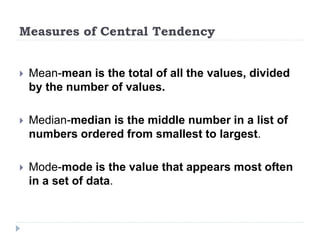
Measures of Central Tendency
 Mean-mean is the total of all the values, divided
by the number of values.
 Median-median is the middle number in a list of
numbers ordered from smallest to largest.
 Mode-mode is the value that appears most often
in a set of data.
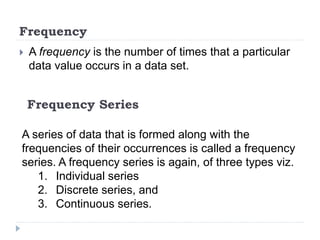
Frequency
 A frequency is the number of times that a particular
data value occurs in a data set.
A series of data that is formed along with the
frequencies of their occurrences is called a frequency
series. A frequency series is again, of three types viz.
1. Individual series
2. Discrete series, and
3. Continuous series.
Frequency Series
Mean
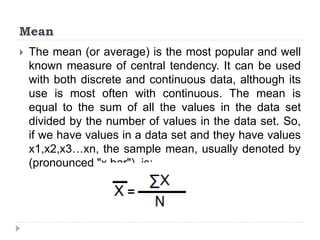
 The mean (or average) is the most popular and well
known measure of central tendency. It can be used
with both discrete and continuous data, although its
use is most often with continuous. The mean is
equal to the sum of all the values in the data set
divided by the number of values in the data set. So,
if we have values in a data set and they have values
x1,x2,x3…xn, the sample mean, usually denoted by
(pronounced "x bar"), is:
Merits of Arithmetic Mean:
 1. It is a mathematical mean.
 2. It is easy to calculate.
 3. It is always definite.
 4. It establishes a simple relation among the values
of data series.
Demerits of Arithmetic Mean:
 1. It cannot be determined by simple visual
observation of data.
 2. It cannot be presented by chart or graph.
 3. It is not suitable for qualitative studies.
 4. Sometimes it does not show representation of
series.
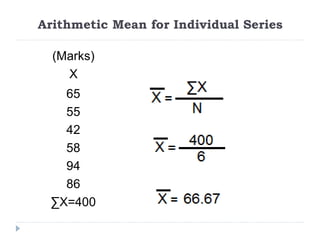
Arithmetic Mean for Individual Series
(Marks)
X
65
55
42
58
94
86
∑X=400
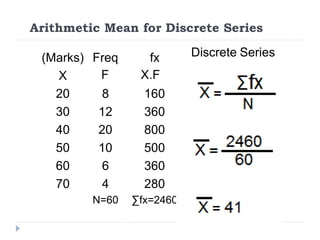
Arithmetic Mean for Discrete Series
(Marks) Freq fx
X F X.F
20 8 160
30 12 360
40 20 800
50 10 500
60 6 360
70 4
N=60
280
∑fx=2460
Discrete Series
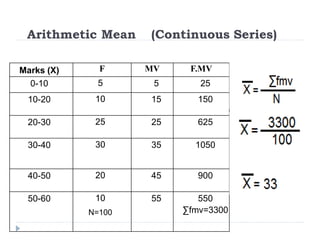
Arithmetic Mean (Continuous Series)
Marks (X) F MV F.MV
0-10 5 5 25
10-20 10 15 150
20-30 25 25 625
30-40 30 35 1050
40-50 20 45 900
50-60 10
N=100
55 550
∑fmv=3300
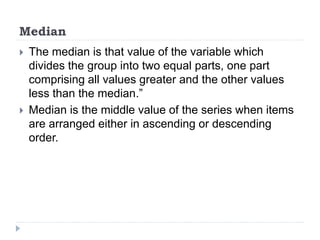
Median
 The median is that value of the variable which
divides the group into two equal parts, one part
comprising all values greater and the other values
less than the median.”
 Median is the middle value of the series when items
are arranged either in ascending or descending
order.
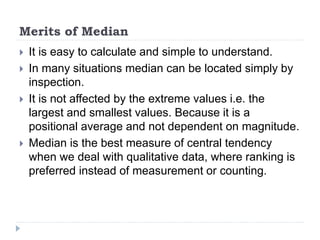
Merits of Median
 It is easy to calculate and simple to understand.
 In many situations median can be located simply by
inspection.
 It is not affected by the extreme values i.e. the
largest and smallest values. Because it is a
positional average and not dependent on magnitude.
 Median is the best measure of central tendency
when we deal with qualitative data, where ranking is
preferred instead of measurement or counting.
Demerits
 It is not based on all the observations of the series.
 It is not capable of further algebraic treatment like
mean, geometric mean and harmonic mean.
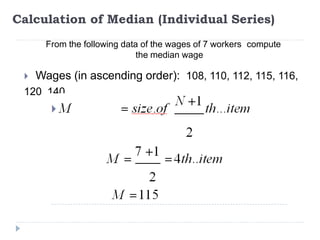
Calculation of Median (Individual Series)
 Wages (in ascending order): 108, 110, 112, 115, 116,
120, 140
From the following data of the wages of 7 workers compute
the median wage
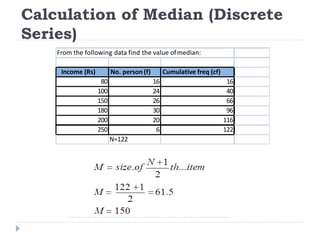
Calculation of Median (Discrete
Series)
From the following data find the value ofmedian:
Income (Rs) No. person (f) Cumulative freq (cf)
80 16 16
100 24 40
150 26 66
180 30 96
200 20 116
250 6 122
N=122
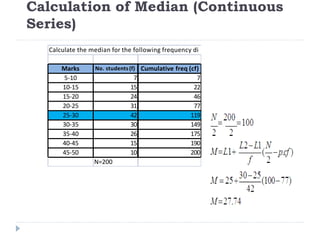
Calculation of Median (Continuous
Series)
Calculate the median for the following frequency di
Marks No. students(f) Cumulative freq (cf)
5-10 7 7
10-15 15 22
15-20 24 46
20-25 31 77
25-30 42 119
30-35 30 149
35-40 26 175
40-45 15 190
45-50 10 200
N=200
Mode
 The mode is the number that appears most
frequently in a set. A set of numbers may have one
mode, more than one mode, or no mode at all.
Merits of Mode
 It is easy to understand and simple to calculate.
 It is not affected by extremely large or small values.
 It can be located just by inspection in ungrouped
data
 It can be located graphically.
Demerits of Mode
 It is not well defined.
 It is not based on all the values.
 It is stable for large values so it will not be well
defined if the data consists of a small number of
values.
 It is not capable of further mathematical treatment.
Calculation of Mode (Individual
Series)
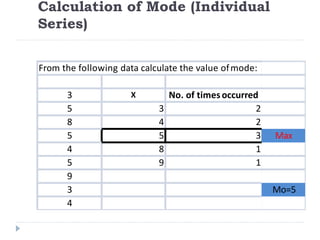
From the following data calculate the value ofmode:
3 X No. of timesoccurred
5 3 2
8 4 2
5 5 3 Max
4 8 1
5 9 1
9
3 Mo=5
4
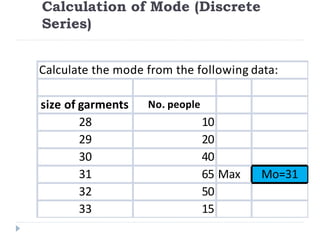
Calculation of Mode (Discrete
Series)
Calculate the mode from the following data:
size of garments No. people
28 10
29 20
30 40
31 65 Max Mo=31
32 50
33 15
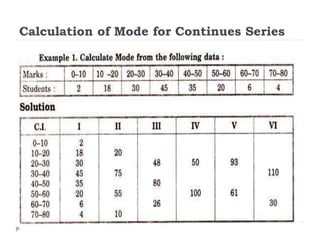
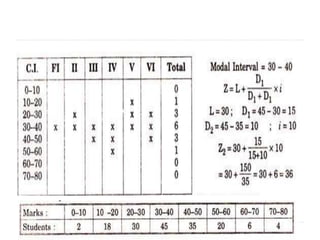
Calculation of Mode for Continues Series
THANK
YOU

mean median mode

  • 1.
    Dr. Mitali Gupta Dr.Ambedkar Institute of Management Studies & Research Measures of Central Tendency
  • 2.
     A measureof central tendency is a single value that attempts to describe a set of data by identifying the central position within that set of data. As such, measures of central tendency are sometimes called measures of central location. Definition
  • 3.
    Measures of CentralTendency  Mean-mean is the total of all the values, divided by the number of values.  Median-median is the middle number in a list of numbers ordered from smallest to largest.  Mode-mode is the value that appears most often in a set of data.
  • 4.
    Frequency  A frequencyis the number of times that a particular data value occurs in a data set. A series of data that is formed along with the frequencies of their occurrences is called a frequency series. A frequency series is again, of three types viz. 1. Individual series 2. Discrete series, and 3. Continuous series. Frequency Series
  • 5.
    Mean  The mean(or average) is the most popular and well known measure of central tendency. It can be used with both discrete and continuous data, although its use is most often with continuous. The mean is equal to the sum of all the values in the data set divided by the number of values in the data set. So, if we have values in a data set and they have values x1,x2,x3…xn, the sample mean, usually denoted by (pronounced "x bar"), is:
  • 6.
    Merits of ArithmeticMean:  1. It is a mathematical mean.  2. It is easy to calculate.  3. It is always definite.  4. It establishes a simple relation among the values of data series.
  • 7.
    Demerits of ArithmeticMean:  1. It cannot be determined by simple visual observation of data.  2. It cannot be presented by chart or graph.  3. It is not suitable for qualitative studies.  4. Sometimes it does not show representation of series.
  • 8.
    Arithmetic Mean forIndividual Series (Marks) X 65 55 42 58 94 86 ∑X=400
  • 9.
    Arithmetic Mean forDiscrete Series (Marks) Freq fx X F X.F 20 8 160 30 12 360 40 20 800 50 10 500 60 6 360 70 4 N=60 280 ∑fx=2460 Discrete Series
  • 10.
    Arithmetic Mean (ContinuousSeries) Marks (X) F MV F.MV 0-10 5 5 25 10-20 10 15 150 20-30 25 25 625 30-40 30 35 1050 40-50 20 45 900 50-60 10 N=100 55 550 ∑fmv=3300
  • 11.
    Median  The medianis that value of the variable which divides the group into two equal parts, one part comprising all values greater and the other values less than the median.”  Median is the middle value of the series when items are arranged either in ascending or descending order.
  • 12.
    Merits of Median It is easy to calculate and simple to understand.  In many situations median can be located simply by inspection.  It is not affected by the extreme values i.e. the largest and smallest values. Because it is a positional average and not dependent on magnitude.  Median is the best measure of central tendency when we deal with qualitative data, where ranking is preferred instead of measurement or counting.
  • 13.
    Demerits  It isnot based on all the observations of the series.  It is not capable of further algebraic treatment like mean, geometric mean and harmonic mean.
  • 14.
    Calculation of Median(Individual Series)  Wages (in ascending order): 108, 110, 112, 115, 116, 120, 140 From the following data of the wages of 7 workers compute the median wage
  • 15.
    Calculation of Median(Discrete Series) From the following data find the value ofmedian: Income (Rs) No. person (f) Cumulative freq (cf) 80 16 16 100 24 40 150 26 66 180 30 96 200 20 116 250 6 122 N=122
  • 16.
    Calculation of Median(Continuous Series) Calculate the median for the following frequency di Marks No. students(f) Cumulative freq (cf) 5-10 7 7 10-15 15 22 15-20 24 46 20-25 31 77 25-30 42 119 30-35 30 149 35-40 26 175 40-45 15 190 45-50 10 200 N=200
  • 17.
    Mode  The modeis the number that appears most frequently in a set. A set of numbers may have one mode, more than one mode, or no mode at all.
  • 18.
    Merits of Mode It is easy to understand and simple to calculate.  It is not affected by extremely large or small values.  It can be located just by inspection in ungrouped data  It can be located graphically.
  • 19.
    Demerits of Mode It is not well defined.  It is not based on all the values.  It is stable for large values so it will not be well defined if the data consists of a small number of values.  It is not capable of further mathematical treatment.
  • 20.
    Calculation of Mode(Individual Series) From the following data calculate the value ofmode: 3 X No. of timesoccurred 5 3 2 8 4 2 5 5 3 Max 4 8 1 5 9 1 9 3 Mo=5 4
  • 21.
    Calculation of Mode(Discrete Series) Calculate the mode from the following data: size of garments No. people 28 10 29 20 30 40 31 65 Max Mo=31 32 50 33 15
  • 22.
    Calculation of Modefor Continues Series
  • 24.