Ethical Issues in Research
Dr. Kshitija Gandhi
PHD, MPHIL, MCOM,MBA,UGC NET
Vice Principal
Pratibha College of
Commerce and Computer studies
What is Ethics?
•Ethics are broadly the set of
rules, written and unwritten,
that govern our expectations
of our own and others’
behaviour.
Research
Ethics are
important
 It helps to expand knowledge.
 It supports the values required for collaborative work,
such as mutual respect and fairness. This is essential
because scientific research depends on collaboration
between researchers and groups.
 They mean that researchers can be held accountable
for their actions.
 Many researchers are supported by public money, and
regulations on conflicts of interest, misconduct, and
research involving humans or animals are necessary to
ensure that money is spent appropriately.
 It ensures that the public can trust research.
 It supports important social and moral values, such as
the principle of doing no harm to others.
• Source: Resnick, D. B. (2015) What is Ethics in
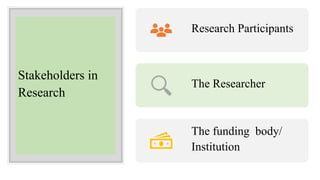
Stakeholders in
Research
Research Participants
The Researcher
The funding body/
Institution
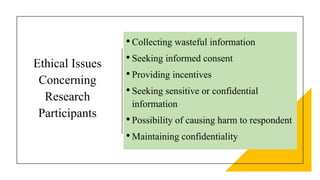
Ethical Issues
Concerning
Research
Participants
•Collecting wasteful information
•Seeking informed consent
•Providing incentives
•Seeking sensitive or confidential
information
•Possibility of causing harm to respondent
•Maintaining confidentiality
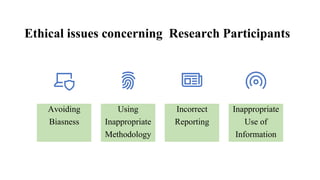
Ethical issues concerning Research Participants
Avoiding
Biasness
Using
Inappropriate
Methodology
Incorrect
Reporting
Inappropriate
Use of
Information
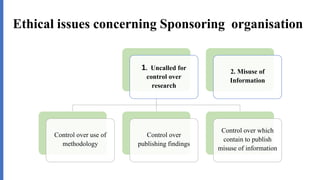
Ethical issues concerning Sponsoring organisation
1. Uncalled for
control over
research
Control over use of
methodology
Control over
publishing findings
Control over which
contain to publish
misuse of information
2. Misuse of
Information
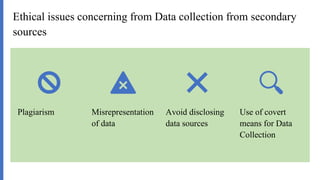
Ethical issues concerning from Data collection from secondary
sources
Plagiarism Misrepresentation
of data
Avoid disclosing
data sources
Use of covert
means for Data
Collection
Codes of Ethics
• Government agencies who fund or commission research often
publish codes of conduct for researchers, or codes of ethics.
• For example, the US National Institutes of Health (NIH) and
Food and Drug Administration (FDA) both publish ethical codes.
Some ethical codes may have the force of law behind them,
while others may simply be advisable.
• Be aware that even if you do nothing illegal, doing
something unethical may end your research career.
Objectivity
• It is expected to avoid bias in
any aspect of research
• It may be
• esign
• Data analysis
• Interpretation
• Peer review.
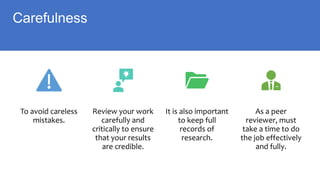
Carefulness
To avoid careless
mistakes.
Review your work
carefully and
critically to ensure
that your results
are credible.
It is also important
to keep full
records of
research.
As a peer
reviewer, must
take a time to do
the job effectively
and fully.
Openness
It should prepare to share data
and results, along with any new
tools that you have developed
Publish the findings that helps
to further knowledge and
advance science.
Open to criticism and new ideas.
Respect for Intellectual Property
Plagiarize
never plagiarize, or
copy, other people’s
work and try to pass
it off as your own.
Ask
Always ask for
permission before
using other people’s
tools or methods,
unpublished data or
results. Not doing so
is plagiarism.
Respect
Respect copyrights
and patents,
together with other
forms of intellectual
property, and always
acknowledge
contributions to
your research.
Acknowledge
If in doubt,
acknowledge, to
avoid any risk of
plagiarism.
Confidentialit
y
Respect anything that
has been provided in
confidence.
Follow guidelines on
protection of sensitive
information such as
patient records.
Responsible Publication
Publish to advance to state of
research and knowledge, and not
just to advance your career.
Do not publish anything that is not
new, or that duplicates someone
else’s work.
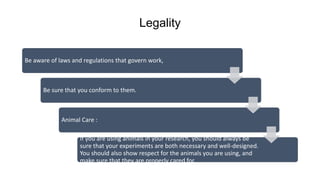
Legality
Be aware of laws and regulations that govern work,
Be sure that you conform to them.
Animal Care :
If you are using animals in your research, you should always be
sure that your experiments are both necessary and well-designed.
You should also show respect for the animals you are using, and
make sure that they are properly cared for.
Human Subjects Protection
• If your research involves people, you should make sure that you
reduce any possible harm to the minimum, and maximise the
benefits both to participants and other people.
• This means, for example, that you should not expose people to
more tests than are strictly necessary to fulfil your research
aims. You should always respect human rights, including the
right to privacy and autonomy. You may need to take particular
care with vulnerable groups, which include, but are not limited
to, children, older people, and those with learning difficulties.
• Source: Resnick, D. B. (2015) What is Ethics in Research and
Why is it Important? List adapted from Shamoo A and Resnik D.
2015. Responsible Conduct of Research, 3rd ed. (New York:
Oxford University Press).
• The Role of the Ethics Committee
• Beneficence (doing good) Research should only be carried out if some
sort of benefit or good can be derived from it, (i.e. contribution to
knowledge or improved service/treatment). Therefore the question of
whether or not a research project is worth undertaking should always
be uppermost in the mind of the researcher. If no benefit can be
derived, then the project is unethical.
• Autonomy (self-rule) Researchers have an obligation to disclose
information at a level that participants can understand so that they
can either refuse or agree to participate. In essence, autonomy is
concerned with the concept of informed consent whereby people
who agree to take part in a study know what they are agreeing to and
authorise the researcher to collect information without any form of
coercion.
• Non-maleficence (do no harm) The principle of non-maleficence
places an obligation on researchers not to harm others or expose
people to unnecessary risks. Harm can come in many forms, from
blows to self-esteem to ‘looking bad’ to others, to loss of funding or
earnings, to boredom, frustration, or time wasting. It is good practice
to assume that every research project will involve some form of harm
and to consider in advance how best to deal with it.
• Justice (Fairness) This principle implies that everyone should be
treated fairly and equally
• Veracity (truth telling) This principle concerns truth telling whereby
the researcher is required to provide comprehensive and accurate
information in a manner that enhances understanding. For example,
if the researcher says that a questionnaire will take 10 minutes to
complete then the questionnaire should take 10 minutes and not 15
minutes. Researchers should always be honest with participants and
keep any promises made.
• Privacy: Privacy concerns the respect for limited access to another
person, be it physically, emotionally or cognitively. For example,
although participants grant access to their thoughts and feelings
when they agree to participate, they do not agree to unlimited
access. Therefore they have always got the right to decline to talk
about certain issues or to answer specific questions
• Confidentiality is an extension of privacy but relates specifically to the
agreements made between the researcher and participants about
what can and cannot be done with information collected over a
course of a project. In most cases this will be determined and
subjected to the legal constraints outlined in the Data Protection Act
1998.

ethical issues in research

  • 1.
    Ethical Issues inResearch Dr. Kshitija Gandhi PHD, MPHIL, MCOM,MBA,UGC NET Vice Principal Pratibha College of Commerce and Computer studies
  • 2.
    What is Ethics? •Ethicsare broadly the set of rules, written and unwritten, that govern our expectations of our own and others’ behaviour.
  • 3.
    Research Ethics are important  Ithelps to expand knowledge.  It supports the values required for collaborative work, such as mutual respect and fairness. This is essential because scientific research depends on collaboration between researchers and groups.  They mean that researchers can be held accountable for their actions.  Many researchers are supported by public money, and regulations on conflicts of interest, misconduct, and research involving humans or animals are necessary to ensure that money is spent appropriately.  It ensures that the public can trust research.  It supports important social and moral values, such as the principle of doing no harm to others. • Source: Resnick, D. B. (2015) What is Ethics in
  • 4.
    Stakeholders in Research Research Participants TheResearcher The funding body/ Institution
  • 5.
    Ethical Issues Concerning Research Participants •Collecting wastefulinformation •Seeking informed consent •Providing incentives •Seeking sensitive or confidential information •Possibility of causing harm to respondent •Maintaining confidentiality
  • 6.
    Ethical issues concerningResearch Participants Avoiding Biasness Using Inappropriate Methodology Incorrect Reporting Inappropriate Use of Information
  • 7.
    Ethical issues concerningSponsoring organisation 1. Uncalled for control over research Control over use of methodology Control over publishing findings Control over which contain to publish misuse of information 2. Misuse of Information
  • 8.
    Ethical issues concerningfrom Data collection from secondary sources Plagiarism Misrepresentation of data Avoid disclosing data sources Use of covert means for Data Collection
  • 9.
    Codes of Ethics •Government agencies who fund or commission research often publish codes of conduct for researchers, or codes of ethics. • For example, the US National Institutes of Health (NIH) and Food and Drug Administration (FDA) both publish ethical codes. Some ethical codes may have the force of law behind them, while others may simply be advisable. • Be aware that even if you do nothing illegal, doing something unethical may end your research career.
  • 10.
    Objectivity • It isexpected to avoid bias in any aspect of research • It may be • esign • Data analysis • Interpretation • Peer review.
  • 11.
    Carefulness To avoid careless mistakes. Reviewyour work carefully and critically to ensure that your results are credible. It is also important to keep full records of research. As a peer reviewer, must take a time to do the job effectively and fully.
  • 12.
    Openness It should prepareto share data and results, along with any new tools that you have developed Publish the findings that helps to further knowledge and advance science. Open to criticism and new ideas.
  • 13.
    Respect for IntellectualProperty Plagiarize never plagiarize, or copy, other people’s work and try to pass it off as your own. Ask Always ask for permission before using other people’s tools or methods, unpublished data or results. Not doing so is plagiarism. Respect Respect copyrights and patents, together with other forms of intellectual property, and always acknowledge contributions to your research. Acknowledge If in doubt, acknowledge, to avoid any risk of plagiarism.
  • 14.
    Confidentialit y Respect anything that hasbeen provided in confidence. Follow guidelines on protection of sensitive information such as patient records.
  • 15.
    Responsible Publication Publish toadvance to state of research and knowledge, and not just to advance your career. Do not publish anything that is not new, or that duplicates someone else’s work.
  • 16.
    Legality Be aware oflaws and regulations that govern work, Be sure that you conform to them. Animal Care : If you are using animals in your research, you should always be sure that your experiments are both necessary and well-designed. You should also show respect for the animals you are using, and make sure that they are properly cared for.
  • 17.
    Human Subjects Protection •If your research involves people, you should make sure that you reduce any possible harm to the minimum, and maximise the benefits both to participants and other people. • This means, for example, that you should not expose people to more tests than are strictly necessary to fulfil your research aims. You should always respect human rights, including the right to privacy and autonomy. You may need to take particular care with vulnerable groups, which include, but are not limited to, children, older people, and those with learning difficulties.
  • 18.
    • Source: Resnick,D. B. (2015) What is Ethics in Research and Why is it Important? List adapted from Shamoo A and Resnik D. 2015. Responsible Conduct of Research, 3rd ed. (New York: Oxford University Press). • The Role of the Ethics Committee
  • 22.
    • Beneficence (doinggood) Research should only be carried out if some sort of benefit or good can be derived from it, (i.e. contribution to knowledge or improved service/treatment). Therefore the question of whether or not a research project is worth undertaking should always be uppermost in the mind of the researcher. If no benefit can be derived, then the project is unethical.
  • 23.
    • Autonomy (self-rule)Researchers have an obligation to disclose information at a level that participants can understand so that they can either refuse or agree to participate. In essence, autonomy is concerned with the concept of informed consent whereby people who agree to take part in a study know what they are agreeing to and authorise the researcher to collect information without any form of coercion.
  • 24.
    • Non-maleficence (dono harm) The principle of non-maleficence places an obligation on researchers not to harm others or expose people to unnecessary risks. Harm can come in many forms, from blows to self-esteem to ‘looking bad’ to others, to loss of funding or earnings, to boredom, frustration, or time wasting. It is good practice to assume that every research project will involve some form of harm and to consider in advance how best to deal with it.
  • 25.
    • Justice (Fairness)This principle implies that everyone should be treated fairly and equally
  • 26.
    • Veracity (truthtelling) This principle concerns truth telling whereby the researcher is required to provide comprehensive and accurate information in a manner that enhances understanding. For example, if the researcher says that a questionnaire will take 10 minutes to complete then the questionnaire should take 10 minutes and not 15 minutes. Researchers should always be honest with participants and keep any promises made.
  • 27.
    • Privacy: Privacyconcerns the respect for limited access to another person, be it physically, emotionally or cognitively. For example, although participants grant access to their thoughts and feelings when they agree to participate, they do not agree to unlimited access. Therefore they have always got the right to decline to talk about certain issues or to answer specific questions
  • 28.
    • Confidentiality isan extension of privacy but relates specifically to the agreements made between the researcher and participants about what can and cannot be done with information collected over a course of a project. In most cases this will be determined and subjected to the legal constraints outlined in the Data Protection Act 1998.

Editor's Notes

  • #3 Branch of philosophy that deals with professional codes of conduct to the collection , analysis, reporting and publication of information about research subjects.
  • #11 For example, you should never recommend as a peer reviewer someone you know, or who you have worked with, and you should try to ensure that no groups are inadvertently excluded from your research. This also means that you need to disclose any personal or financial interests that may affect your research.