HYPOTHESIS
PRESENTED TO
PROF.Dr .Saraswathy mam
GCN PRESENTED BY
Naveen kumar C N
1st Year M Sc(N)
GCN
INTRODUCTIO
NHypothesis is an important & integral component of modern scientific
research.
Formulation of Hypothesis plays an important part in the growth of
knowledge in science.
It is regarded as an important mental tool & considered as the
principal instrument in research.
Its main function is to suggest new experiments & observation.
The focused specification of a research problem is articulated in the
form of Hypothesis.
The purpose or goal of a study is to guide the development of the
objectives, questions or outcomes.
MEANING
Term derived from Greek word
“HYPOTITHENAI”
• HYPO ——“to put under or to suppose”
• THESIS ——“proposal”
DEFINITION• “Hypothesis is an conjectural statement of the relation between two or
more variables”.
Kerlinger
•“It is a tentative generalization, the validity of which remains to be
tested”.
Lundburg
•“Hypothesis are single tentative guesses, good hunches assumed for use
in devising theory or planning experiments intended to be given a direct
experimental test when possible”.
Eric Roger
• “Hypothesis is a formal statement that presents the expected
relationship between an independent & dependent variables”.
Creswell
PURPOSE• Guides/gives direction to the study/investigation.
•Defines facts that are relevant & not relevant.
•Suggest which form of research design is likely to be the most
appropriate.
•Provides a framework for organizing the conclusions of the
findings.
•Limits the research to specific area.
•Offers explanation for the relationship between those variables
that can be empirically tested.
•Furnishes proof that the researcher has sufficient background
knowledge to unable her/him to make suggestions in order to
extend existing knowledge.
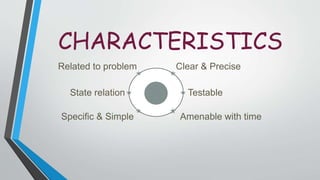
CHARACTERISTICS
Clear & Precise
Testable
Amenable with time
Related to problem
State relation
Specific & Simple
SOURCETHEORY
•It gives clues to research by stating what is known.
•Logical detection from theory leads to new hypothesis.
OBSERVATION
•Direct observation is useful for deriving hypothesis.
INTUTION & PERSONAL EXPERIENCE
•Nurses can derive many hypothesis from clinical experience.
•All knowledge begins with experience & its a source of hypothesis.
RESULT OF PREVIOUS STUDIES
•Its useful in order to replicate or test the present result.
CONTINUITY OF RESEARCH
•Continuity of research in the same field itself is an important
source of hypothesis.
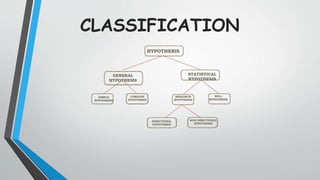
CLASSIFICATION
HYPOTHESIS
GENERAL
HYPOTHESIS
STATISTICAL
HYPOTHESIS
SIMPLE
HYPOTHESIS
RESEARCH
HYPOTHESIS
COMPLEX
HYPOTHESIS
NULL
HYPOTHESIS
DIRECTIONAL
HYPOTHESIS
NON-DIRECTIONAL
HYPOTHESIS
SIMPLE HYPOTHESIS
•A simple hypothesis concerns the relationship
between an independent & dependent variable.
•A simple is also called Bivariate hypothesis.
•Example: The lower the level of Hb, the higher is the
infection among postpartum women
COMPLEX HYPOTHESIS
•A Complex hypothesis concerns a relationship where two or
more independent variables or both are being examined in the
same study.
•A complex hypothesis is also Multivariate hypothesis.
•A hypothesis is either supported totally or not supported.
•Example : Satisfaction is higher among patients who are older &
dwelling in rural area, than those who are younger & dwelling in
urban area.
NULL HYPOTHESIS (H o)
•It is used for statistical testing & for interpreting
statistical outcomes.
•It is used when the researcher believes there is no
relationship between the two variables & when
theoretical or empirical information is inadequate to
state a research hypothesis.
•It is non-directional by nature.
•Example : There is no relationship between smoking &
incidence of coronary artery disease.
RESEARCH HYPOTHESIS
•Research hypothesis states the expected relationship between
variables.
•The research hypothesis is also known as scientific, substantive
& theoretical hypothesis.
•This will be helpful for understanding what the researcher
expects to find after analyzing the data.
•It is directional by nature or it can be descriptive, relational &
casual.
•Example : There is a relationship between smoking & incidence
of lung cancer.
DIRECTIONAL HYPOTHESIS
•The hypothesis which stipulates the direction of the
expected difference or relationship.
•Directional hypothesis is a statement is conjuncture
where the two variables of the study are expressed as
having some relationship in certain direction.
•Example : There will be a positive relationship between
extra coaching & academic achievement.
NON DIRECTIONAL HYPOTHESIS
•A research hypothesis which does not specify the
direction of expected difference or relationship is
non-directional hypothesis.
•In this case the difference can be in any direction.
•Example : There will be a difference in adaptability
of fathers & mothers towards rearing of their
children.
CRITERIA
• Written in a declarative sentence.
• Written in the present tense.
• Reflect the problem statement or purpose
statement.
• Be empirically tested.
• Contains variables.
• Contains the population.
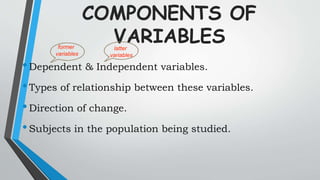
COMPONENTS OF
VARIABLES
•Dependent & Independent variables.
•Types of relationship between these variables.
•Direction of change.
•Subjects in the population being studied.
former
variables
latter
variables
TESTING
• It is defined as the
formal procedures that
statiscians use to test
whether a hypothesis
can be accepted or not.
• They are procedure for
making rational
decisions about the
reality of effects.
BASIC CONCEPT OF
HYPOTHESIS
•The null & alternative hypothesis.
•Choosing the relevant test & appropriate probability distribution.
•It depends on the following :
•Size of the sample.
•Whether the population standard deviation is known or not.
•Choosing the critical value :
•Significance level.
•Degree of freedom.
•One or two tailed test.
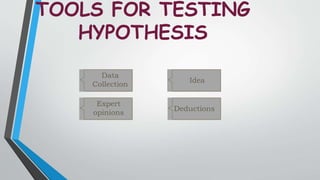
TOOLS FOR TESTING
HYPOTHESIS
Data
Collection
Idea
Expert
opinions
Deductions
HYPOTHESIS TESTING
(procedure)
•Stating the hypothesis (Null or Research).
•Setting the criteria for a decision.
•Data collection.
•Evaluate the null hypothesis(accept or
reject the null hypothesis, based on the
results on analysis)
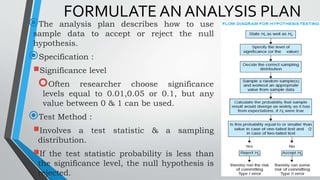
FORMULATE AN ANALYSIS PLAN
The analysis plan describes how to use
sample data to accept or reject the null
hypothesis.
Specification :
Significance level
Often researcher choose significance
levels equal to 0.01,0.05 or 0.1, but any
value between 0 & 1 can be used.
Test Method :
Involves a test statistic & a sampling
distribution.
If the test statistic probability is less than
the significance level, the null hypothesis is
rejected.
ERRORS•Type i :
•Occurs when the null hypothesis (Ho) is wrongly
rejected.
•Example : When the two drugs produce different effects
when in fact there was no difference between them.
•Type ii :
•Occurs when the null hypothesis (Ho) is not rejected
when it is in fact false.
•Example : When the two drugs produce the same effect,
that is there is no difference between the two drugs on
average, when in fact they produce different ones.
ASSUMPTIONS
INTRODUCTION
•An assumption is a realistic expectation which is something that
we believe to be true.
•However , no adequate evidence exists to support this belief.
•It doesn't have empirical evidence to support.
•Provide a basic to develop theories & research instrument &
therefore influence the development & implementation of
research process.
•Principles those are accepted as being true based on logic or
reason, but without proof or verification.
•Statements that are considered true, even though they have not
been scientifically testing.
DEFINITION
•It is any important fact presumed to be true but
not actually verified. It does not need testing,
unlike the hypothesis.
Gay
Example : That the interviewee answered the
interview questions accurately.
ASSUMPTIONS NEEDED TO
CONDUCT A RESEARCH
• Some of the common sense assumptions may be
developed to conduct a particular study.
• Example : Prevalence of coronary artery disease is
more common among urban people as compared to
rural people.
USES
•Assumption are foundation for research studies.
•Assumptions are good source of research topic.
•They provide the research with basis ideas
regarding research.
•They are helpful to develop theories & research
instrument for the research project which will
enhance the implementation of research process.
CHARACTERISTICS
•They are universally accepted.
•They are theories applicable to a particular field
of study.
•They refer to the finding of previous related
researchers.
ASSUMPTIONS MADE IN
NURSING
“Health professional view health care in different manner
than a lay-person”.
“The nursing process is the best way of conceptualizing
nursing process”.
“Stress should be avoided”.
“Human biological & chemical factors show less variation
than cultural & societal factor”.
“Counseling reduces anxiety of parents undergoing surgery”.
“Balanced diet will increase the resistance for children”.
TYPES
• Universal Assumption
• Based on Theory
• Conduct a Research
• Warranted research
• Unwarranted Research
UNIVERSAL ASSUMPTION :
•Assumed to be true by a large part of the society, but testing
such assumptions is not always possible.
•Example : There is a supernatural power which governs this
universe.
THEORY BASED ASSUMPTION :
•Research project can be based on nursing theories.
•Example : A study based on Pender’s health promotion model
will use theory based assumption.
•Individual characteristics & experiences.
•Behavior specific cognition & effects.
•Behavior outcomes.
CONDUCT A RESEARCH :
•Some assumptions may be developed to conduct a
particular study.
•Example : “Childhood obesity is more private
schools as compared to govt schools”.
“Prevalence of communicable disease is
more common in rural area compared to urban
areas or locality”.
WARRANTED ASSUMPTION :
•Research findings or observations are stated along
with assumption.
•Example : “Regular physical activity reduce BMI”.
UNWARRANTED ASSUMPTION :
•These are presented without any support of
research findings.
•Example : “Mental diseases are cured by holistic
healing”.
LIMITATIONS
THEORITICAL LIMITATION :
•They restrict the ability of research findings
by generalize specific theoretical concepts in
study.
•Also limits the study of variables through
operational definitions.
METHODOLOGICAL LIMITATION :
Unrepresentative sample
Weak design
Single sitting
Limited control over extraneous variables
Poor implementation of treatment protocol
Research tool with limited reliability &
validity
Poor data collection procedure
Ineffective use of statistical analysis
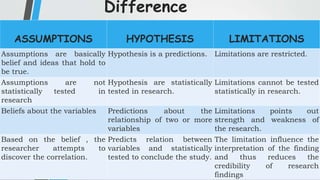
Difference
ASSUMPTIONS HYPOTHESIS LIMITATIONS
Assumptions are basically
belief and ideas that hold to
be true.
Hypothesis is a predictions. Limitations are restricted.
Assumptions are not
statistically tested in
research
Hypothesis are statistically
tested in research.
Limitations cannot be tested
statistically in research.
Beliefs about the variables Predictions about the
relationship of two or more
variables
Limitations points out
strength and weakness of
the research.
Based on the belief , the
researcher attempts to
discover the correlation.
Predicts relation between
variables and statistically
tested to conclude the study.
The limitation influence the
interpretation of the finding
and thus reduces the
credibility of research
findings
SUMMARY
• A hypothesis is an explanation about the relationship between
the two variables (dependent & independent).
• Research questions & hypothesis becomes “sign post” for
explaining the purpose of the study & guiding the research.
• There are different types of hypothesis
• Simple
• Complex
• Null hypothesis
• Alternative
• Research hypothesis can either be non-directional
or directional. There exists a hypothesis that is
opposite of the positively stated as null hypothesis.
• Thus to conclude it would be fitting to say
“hypothesis is perhaps the most powerful tool, man
has invented to achieve dependable knowledge”.
• Research findings of the investigation will either
support or fail to support the hypothesis.
• If a theoretical, the theory is also supported in a descriptive
study hypothesis is not necessary, yet research questions are
posed.
• Assumptions and Limitations affect the inferences from the
study.
• Assumption generally refer to
• Characteristics of the data.
• Distributions
• Correlation trends.
• Variable type.
• Violating these assumptions can lead to drastically invalid
results, though this often depends on sample size and other
considerations.
CONCLUSIONS
• Hypothesis plays a vital role in the research process but
still a question remains. “Is a hypothesis always
necessary”.
• Most research that can be classified as descriptive
proceeds without an explicit hypothesis.
• Descriptive research, i.e. research that aims predominantly
at describing phenomena rather than explaining them, is
very common in the emerging field of nursing research.
• Examples of descriptive investigations include surveys of
the health needs of elderly citizens, studies of the coping
patterns of mothers of handicapped children and surveys
of the nutritional status of low income pre-school children.
• This type of study is often extremely important in laying a
foundation for later research.
• When a field is new, it may be quite difficult to provide
adequate justification for the development of explanatory
hypothesis because of a dearth of facts or previous
findings. Thus, there are some studies of descriptive nature
for which hypothesis may not be required.
• However, initial efforts to investigate phenomena are
usually strengthened by the formulations of hypothesis.
EXCERCISE
A study to assess pregnancy related problems and
practices adopted by primigravida women in a selected
clinic at Bangalore.
OBJECTIVE :
• To identify the physiological and psychological problems
related to pregnancy.
• To identify the practices adopted in antenatal women.
• To find the association between the score of practice
adopted towards pregnancy related problems and selected
demographic variable.
ASSUMPTIONS :
• The study assumes that :
• Primigravid women experience problem during
pregnancy.
• Women will adopt some practice to reduce pregnancy
related problems.
HYPOTHESIS :
• There will be a significant association between scores
practice adopted towards pregnancy related problems and
selected demographic variable.
A study to assess the knowledge, attitude and practice of
lifestyle modification among hypertensive patients at selected
hospitals in Bangalore.
OBJECTIVES :
• To assess the attitude of hypertensive patients regarding
lifestyle modification.
• To assess the knowledge of hypertensive patients regarding
lifestyle modification.
• To assess the practice of hypertensive patients regarding
lifestyle modification.
• To associate the knowledge of hypertensive patients with there
demographic variables(Age, Sex, Education, Occupation,
Income, Family history, Diet pattern)
HYPOTHESIS :
• H0-There is no significant relation ship between knowledge
attitude and practice regarding life style modification
among hypertensive patients
• H1-There is significant difference between knowledge and
attitude regarding prevention of hypertension
• H2- There is significant difference between knowledge and
practice regarding prevention of hypertension
• H3- There is significant difference between attitude and
practice regarding prevention of hypertension
• H4- There is significant difference between knowledge and
attitude regarding prevention of hypertension
ASSUMPTION :
• The study based on the following assumptions
• Hypertensive patients have inadequate knowledge regarding
practice about prevention and Control of hypertension
• Knowledge about life style modifications helps in reduction of
hypertension and to better Prevention
• Patients are the best conveyors of information to other patients
and to family
• To find out the selected demographic variables.
• Adopting lifestyle modification can prevent complication of
hypertension
• Adopting lifestyle modification can prevent complication of
hypertension
A descriptive study to assess the knowledge of antenatal
mothers regarding nutritional anemia in selected rural area
at Bangalore .
OBJECTIVES :
• To assess the knowledge of Antenatal mothers regarding
nutritional anemia and its prevention.
• To find the awareness regarding right nutritional
requirement for expectant mothers.
• To plan and implement structured awareness program
regarding Anemia and its prevention.
• To find out the association between the knowledge of
Antenatal mothers regarding Anemia and its prevention with
selected socio-demographic variables.
HYPOTHESIS :
• H1:- The mean post test knowledge scores of antenatal
mothers who have undergone the structured awareness
program regarding Nutritional Anemia and its prevention
will be significantly higher than their mean pre test
knowledge scores.
• H2:-There will be significant association between the
mean pre test knowledge scores of antenatal mothers
regarding Nutritional Anemia and its prevention with
selected socio- demographic variables.
ASSUMPTIONS :
• The study is based on the following assumptions:
• Antenatal Mothers may be willing to co-operate and
participate in the study.
• The Antenatal mothers have interest to know about
Nutritional Anemia and its prevention.
• The audio visual aids may enhance the knowledge of
antenatal mothers regarding Nutritional Anemia and its
prevention.
A study to assess the effectiveness of structured teaching
programme on knowledge regarding burping of newborns among
primi-gravida mothers at selected hospitals Bangalore
OBJECTIVES :
• To assess the existing knowledge score of primi-gravida mothers
regarding burping of newborns at selected hospitals.
• To assess the post test knowledge score of primi-gravida mothers
regarding burping of newborns at selected hospitals.
• To compare the post test knowledge score with pre test knowledge
score of primi-gravida mothers regarding burping of newborns at
selected hospitals.
• To find association between the pre test knowledge score with
selected demographic variables of primi-gravida mother.
ASSUMPTIONS :
• A1: The primi-gravida mothers may have some knowledge
regarding burping of newborns at selected hospitals.
• A2: The demographic factors may have the influence on
knowledge level regarding burping of newborns.
• A3: The structured teaching program regarding burping of
newborns may improve the knowledge, which may bring
about changes in health practices of primi-gravida mothers
than informal teaching.
HYPOTHESIS :
• H1: There will be a significant difference between pre and
post test knowledge score of primi-gravida mothers
regarding burping of newborns at selected hospitals.
• H2: There will be a significant association found between
the pre test knowledge score with selected demographic
variables of primi-gravida mothers.
A study to assess the knowledge of Adults regarding swine
flu and its prevention in selected urban area at Bangalore.
OBJECTIVES :
• To assess the knowledge of adults regarding swine flu and
its prevention.
• To find the association between the knowledge scores of
adults regarding swine flu and its prevention with selected
demographic variables.
• To develop an information booklet based on their level of
knowledge on swine flu and its prevention.
HYPOTHESIS :
• H1 - There is a significant relationship between the
knowledge of adults on swine flu and its prevention with
selected demographic variables.
Assumption :
• 1. Adults may not have adequate knowledge regarding
swine flu and its prevention.
• 2. Adults demographic characteristic may have
association with their knowledge regarding swine flu and
its prevention.
• 3. Information booklet on swine flu and its prevention
may improve their knowledge regarding swine flu and its
prevention.
BIBILOGRAPHY
• F.N.Kerlinger, 1986 “Nursing Research Principles &
Methods” CBS Publications pp 16-28,198.
• F.N.Kerlinger, 1956 “The Language of Approach
Science” CBS Publications .
• Denise.F.Polite “Nursing Research” Lippioncott &
Wiiliams Publications 2nd edition pp
119,121,124,126,133,134.
• Denise.F.Polite & Bernadette.P.Hungles, “Nursing
Research Principles & Methods”. Lipioncott &
Williams Publications 6th Editions pp 61-70.
• Janet Houser “Nursing Research” 1st Edition 2011
Jones & Bartler Publications pp 124,443,442.
• B.T.Basavanthappa “Nursing Research” 1998 Jaypee
Publications VIVA.
• Dr.Bincy.R “Nursing Research” 2012 VIVA Publications
pp 65-75.
• Kothari.C.R. 2009 “Research Methodology Methods &
Techniques”,2nd New Delhi, New Age International Ltd
Publishers.
Hypothesis

Hypothesis

  • 1.
    HYPOTHESIS PRESENTED TO PROF.Dr .Saraswathymam GCN PRESENTED BY Naveen kumar C N 1st Year M Sc(N) GCN
  • 2.
    INTRODUCTIO NHypothesis is animportant & integral component of modern scientific research. Formulation of Hypothesis plays an important part in the growth of knowledge in science. It is regarded as an important mental tool & considered as the principal instrument in research. Its main function is to suggest new experiments & observation. The focused specification of a research problem is articulated in the form of Hypothesis. The purpose or goal of a study is to guide the development of the objectives, questions or outcomes.
  • 3.
    MEANING Term derived fromGreek word “HYPOTITHENAI” • HYPO ——“to put under or to suppose” • THESIS ——“proposal”
  • 4.
    DEFINITION• “Hypothesis isan conjectural statement of the relation between two or more variables”. Kerlinger •“It is a tentative generalization, the validity of which remains to be tested”. Lundburg •“Hypothesis are single tentative guesses, good hunches assumed for use in devising theory or planning experiments intended to be given a direct experimental test when possible”. Eric Roger • “Hypothesis is a formal statement that presents the expected relationship between an independent & dependent variables”. Creswell
  • 5.
    PURPOSE• Guides/gives directionto the study/investigation. •Defines facts that are relevant & not relevant. •Suggest which form of research design is likely to be the most appropriate. •Provides a framework for organizing the conclusions of the findings. •Limits the research to specific area. •Offers explanation for the relationship between those variables that can be empirically tested. •Furnishes proof that the researcher has sufficient background knowledge to unable her/him to make suggestions in order to extend existing knowledge.
  • 6.
    CHARACTERISTICS Clear & Precise Testable Amenablewith time Related to problem State relation Specific & Simple
  • 7.
    SOURCETHEORY •It gives cluesto research by stating what is known. •Logical detection from theory leads to new hypothesis. OBSERVATION •Direct observation is useful for deriving hypothesis. INTUTION & PERSONAL EXPERIENCE •Nurses can derive many hypothesis from clinical experience. •All knowledge begins with experience & its a source of hypothesis.
  • 8.
    RESULT OF PREVIOUSSTUDIES •Its useful in order to replicate or test the present result. CONTINUITY OF RESEARCH •Continuity of research in the same field itself is an important source of hypothesis.
  • 9.
  • 10.
    SIMPLE HYPOTHESIS •A simplehypothesis concerns the relationship between an independent & dependent variable. •A simple is also called Bivariate hypothesis. •Example: The lower the level of Hb, the higher is the infection among postpartum women
  • 11.
    COMPLEX HYPOTHESIS •A Complexhypothesis concerns a relationship where two or more independent variables or both are being examined in the same study. •A complex hypothesis is also Multivariate hypothesis. •A hypothesis is either supported totally or not supported. •Example : Satisfaction is higher among patients who are older & dwelling in rural area, than those who are younger & dwelling in urban area.
  • 12.
    NULL HYPOTHESIS (Ho) •It is used for statistical testing & for interpreting statistical outcomes. •It is used when the researcher believes there is no relationship between the two variables & when theoretical or empirical information is inadequate to state a research hypothesis. •It is non-directional by nature. •Example : There is no relationship between smoking & incidence of coronary artery disease.
  • 13.
    RESEARCH HYPOTHESIS •Research hypothesisstates the expected relationship between variables. •The research hypothesis is also known as scientific, substantive & theoretical hypothesis. •This will be helpful for understanding what the researcher expects to find after analyzing the data. •It is directional by nature or it can be descriptive, relational & casual. •Example : There is a relationship between smoking & incidence of lung cancer.
  • 14.
    DIRECTIONAL HYPOTHESIS •The hypothesiswhich stipulates the direction of the expected difference or relationship. •Directional hypothesis is a statement is conjuncture where the two variables of the study are expressed as having some relationship in certain direction. •Example : There will be a positive relationship between extra coaching & academic achievement.
  • 15.
    NON DIRECTIONAL HYPOTHESIS •Aresearch hypothesis which does not specify the direction of expected difference or relationship is non-directional hypothesis. •In this case the difference can be in any direction. •Example : There will be a difference in adaptability of fathers & mothers towards rearing of their children.
  • 16.
    CRITERIA • Written ina declarative sentence. • Written in the present tense. • Reflect the problem statement or purpose statement. • Be empirically tested. • Contains variables. • Contains the population.
  • 17.
    COMPONENTS OF VARIABLES •Dependent &Independent variables. •Types of relationship between these variables. •Direction of change. •Subjects in the population being studied. former variables latter variables
  • 18.
    TESTING • It isdefined as the formal procedures that statiscians use to test whether a hypothesis can be accepted or not. • They are procedure for making rational decisions about the reality of effects.
  • 19.
    BASIC CONCEPT OF HYPOTHESIS •Thenull & alternative hypothesis. •Choosing the relevant test & appropriate probability distribution. •It depends on the following : •Size of the sample. •Whether the population standard deviation is known or not. •Choosing the critical value : •Significance level. •Degree of freedom. •One or two tailed test.
  • 20.
  • 21.
    HYPOTHESIS TESTING (procedure) •Stating thehypothesis (Null or Research). •Setting the criteria for a decision. •Data collection. •Evaluate the null hypothesis(accept or reject the null hypothesis, based on the results on analysis)
  • 22.
    FORMULATE AN ANALYSISPLAN The analysis plan describes how to use sample data to accept or reject the null hypothesis. Specification : Significance level Often researcher choose significance levels equal to 0.01,0.05 or 0.1, but any value between 0 & 1 can be used. Test Method : Involves a test statistic & a sampling distribution. If the test statistic probability is less than the significance level, the null hypothesis is rejected.
  • 23.
    ERRORS•Type i : •Occurswhen the null hypothesis (Ho) is wrongly rejected. •Example : When the two drugs produce different effects when in fact there was no difference between them. •Type ii : •Occurs when the null hypothesis (Ho) is not rejected when it is in fact false. •Example : When the two drugs produce the same effect, that is there is no difference between the two drugs on average, when in fact they produce different ones.
  • 24.
  • 25.
    INTRODUCTION •An assumption isa realistic expectation which is something that we believe to be true. •However , no adequate evidence exists to support this belief. •It doesn't have empirical evidence to support. •Provide a basic to develop theories & research instrument & therefore influence the development & implementation of research process. •Principles those are accepted as being true based on logic or reason, but without proof or verification. •Statements that are considered true, even though they have not been scientifically testing.
  • 26.
    DEFINITION •It is anyimportant fact presumed to be true but not actually verified. It does not need testing, unlike the hypothesis. Gay Example : That the interviewee answered the interview questions accurately.
  • 27.
    ASSUMPTIONS NEEDED TO CONDUCTA RESEARCH • Some of the common sense assumptions may be developed to conduct a particular study. • Example : Prevalence of coronary artery disease is more common among urban people as compared to rural people.
  • 28.
    USES •Assumption are foundationfor research studies. •Assumptions are good source of research topic. •They provide the research with basis ideas regarding research. •They are helpful to develop theories & research instrument for the research project which will enhance the implementation of research process.
  • 29.
    CHARACTERISTICS •They are universallyaccepted. •They are theories applicable to a particular field of study. •They refer to the finding of previous related researchers.
  • 30.
    ASSUMPTIONS MADE IN NURSING “Healthprofessional view health care in different manner than a lay-person”. “The nursing process is the best way of conceptualizing nursing process”. “Stress should be avoided”. “Human biological & chemical factors show less variation than cultural & societal factor”. “Counseling reduces anxiety of parents undergoing surgery”. “Balanced diet will increase the resistance for children”.
  • 31.
    TYPES • Universal Assumption •Based on Theory • Conduct a Research • Warranted research • Unwarranted Research
  • 32.
    UNIVERSAL ASSUMPTION : •Assumedto be true by a large part of the society, but testing such assumptions is not always possible. •Example : There is a supernatural power which governs this universe. THEORY BASED ASSUMPTION : •Research project can be based on nursing theories. •Example : A study based on Pender’s health promotion model will use theory based assumption. •Individual characteristics & experiences. •Behavior specific cognition & effects. •Behavior outcomes.
  • 33.
    CONDUCT A RESEARCH: •Some assumptions may be developed to conduct a particular study. •Example : “Childhood obesity is more private schools as compared to govt schools”. “Prevalence of communicable disease is more common in rural area compared to urban areas or locality”.
  • 34.
    WARRANTED ASSUMPTION : •Researchfindings or observations are stated along with assumption. •Example : “Regular physical activity reduce BMI”. UNWARRANTED ASSUMPTION : •These are presented without any support of research findings. •Example : “Mental diseases are cured by holistic healing”.
  • 35.
  • 36.
    THEORITICAL LIMITATION : •Theyrestrict the ability of research findings by generalize specific theoretical concepts in study. •Also limits the study of variables through operational definitions.
  • 37.
    METHODOLOGICAL LIMITATION : Unrepresentativesample Weak design Single sitting Limited control over extraneous variables Poor implementation of treatment protocol Research tool with limited reliability & validity Poor data collection procedure Ineffective use of statistical analysis
  • 38.
    Difference ASSUMPTIONS HYPOTHESIS LIMITATIONS Assumptionsare basically belief and ideas that hold to be true. Hypothesis is a predictions. Limitations are restricted. Assumptions are not statistically tested in research Hypothesis are statistically tested in research. Limitations cannot be tested statistically in research. Beliefs about the variables Predictions about the relationship of two or more variables Limitations points out strength and weakness of the research. Based on the belief , the researcher attempts to discover the correlation. Predicts relation between variables and statistically tested to conclude the study. The limitation influence the interpretation of the finding and thus reduces the credibility of research findings
  • 39.
    SUMMARY • A hypothesisis an explanation about the relationship between the two variables (dependent & independent). • Research questions & hypothesis becomes “sign post” for explaining the purpose of the study & guiding the research. • There are different types of hypothesis • Simple • Complex • Null hypothesis • Alternative
  • 40.
    • Research hypothesiscan either be non-directional or directional. There exists a hypothesis that is opposite of the positively stated as null hypothesis. • Thus to conclude it would be fitting to say “hypothesis is perhaps the most powerful tool, man has invented to achieve dependable knowledge”. • Research findings of the investigation will either support or fail to support the hypothesis.
  • 41.
    • If atheoretical, the theory is also supported in a descriptive study hypothesis is not necessary, yet research questions are posed. • Assumptions and Limitations affect the inferences from the study. • Assumption generally refer to • Characteristics of the data. • Distributions • Correlation trends. • Variable type. • Violating these assumptions can lead to drastically invalid results, though this often depends on sample size and other considerations.
  • 42.
    CONCLUSIONS • Hypothesis playsa vital role in the research process but still a question remains. “Is a hypothesis always necessary”. • Most research that can be classified as descriptive proceeds without an explicit hypothesis. • Descriptive research, i.e. research that aims predominantly at describing phenomena rather than explaining them, is very common in the emerging field of nursing research. • Examples of descriptive investigations include surveys of the health needs of elderly citizens, studies of the coping patterns of mothers of handicapped children and surveys of the nutritional status of low income pre-school children.
  • 43.
    • This typeof study is often extremely important in laying a foundation for later research. • When a field is new, it may be quite difficult to provide adequate justification for the development of explanatory hypothesis because of a dearth of facts or previous findings. Thus, there are some studies of descriptive nature for which hypothesis may not be required. • However, initial efforts to investigate phenomena are usually strengthened by the formulations of hypothesis.
  • 44.
    EXCERCISE A study toassess pregnancy related problems and practices adopted by primigravida women in a selected clinic at Bangalore. OBJECTIVE : • To identify the physiological and psychological problems related to pregnancy. • To identify the practices adopted in antenatal women. • To find the association between the score of practice adopted towards pregnancy related problems and selected demographic variable.
  • 45.
    ASSUMPTIONS : • Thestudy assumes that : • Primigravid women experience problem during pregnancy. • Women will adopt some practice to reduce pregnancy related problems. HYPOTHESIS : • There will be a significant association between scores practice adopted towards pregnancy related problems and selected demographic variable.
  • 46.
    A study toassess the knowledge, attitude and practice of lifestyle modification among hypertensive patients at selected hospitals in Bangalore. OBJECTIVES : • To assess the attitude of hypertensive patients regarding lifestyle modification. • To assess the knowledge of hypertensive patients regarding lifestyle modification. • To assess the practice of hypertensive patients regarding lifestyle modification. • To associate the knowledge of hypertensive patients with there demographic variables(Age, Sex, Education, Occupation, Income, Family history, Diet pattern)
  • 47.
    HYPOTHESIS : • H0-Thereis no significant relation ship between knowledge attitude and practice regarding life style modification among hypertensive patients • H1-There is significant difference between knowledge and attitude regarding prevention of hypertension • H2- There is significant difference between knowledge and practice regarding prevention of hypertension • H3- There is significant difference between attitude and practice regarding prevention of hypertension • H4- There is significant difference between knowledge and attitude regarding prevention of hypertension
  • 48.
    ASSUMPTION : • Thestudy based on the following assumptions • Hypertensive patients have inadequate knowledge regarding practice about prevention and Control of hypertension • Knowledge about life style modifications helps in reduction of hypertension and to better Prevention • Patients are the best conveyors of information to other patients and to family • To find out the selected demographic variables. • Adopting lifestyle modification can prevent complication of hypertension • Adopting lifestyle modification can prevent complication of hypertension
  • 49.
    A descriptive studyto assess the knowledge of antenatal mothers regarding nutritional anemia in selected rural area at Bangalore . OBJECTIVES : • To assess the knowledge of Antenatal mothers regarding nutritional anemia and its prevention. • To find the awareness regarding right nutritional requirement for expectant mothers. • To plan and implement structured awareness program regarding Anemia and its prevention. • To find out the association between the knowledge of Antenatal mothers regarding Anemia and its prevention with selected socio-demographic variables.
  • 50.
    HYPOTHESIS : • H1:-The mean post test knowledge scores of antenatal mothers who have undergone the structured awareness program regarding Nutritional Anemia and its prevention will be significantly higher than their mean pre test knowledge scores. • H2:-There will be significant association between the mean pre test knowledge scores of antenatal mothers regarding Nutritional Anemia and its prevention with selected socio- demographic variables.
  • 51.
    ASSUMPTIONS : • Thestudy is based on the following assumptions: • Antenatal Mothers may be willing to co-operate and participate in the study. • The Antenatal mothers have interest to know about Nutritional Anemia and its prevention. • The audio visual aids may enhance the knowledge of antenatal mothers regarding Nutritional Anemia and its prevention.
  • 52.
    A study toassess the effectiveness of structured teaching programme on knowledge regarding burping of newborns among primi-gravida mothers at selected hospitals Bangalore OBJECTIVES : • To assess the existing knowledge score of primi-gravida mothers regarding burping of newborns at selected hospitals. • To assess the post test knowledge score of primi-gravida mothers regarding burping of newborns at selected hospitals. • To compare the post test knowledge score with pre test knowledge score of primi-gravida mothers regarding burping of newborns at selected hospitals. • To find association between the pre test knowledge score with selected demographic variables of primi-gravida mother.
  • 53.
    ASSUMPTIONS : • A1:The primi-gravida mothers may have some knowledge regarding burping of newborns at selected hospitals. • A2: The demographic factors may have the influence on knowledge level regarding burping of newborns. • A3: The structured teaching program regarding burping of newborns may improve the knowledge, which may bring about changes in health practices of primi-gravida mothers than informal teaching.
  • 54.
    HYPOTHESIS : • H1:There will be a significant difference between pre and post test knowledge score of primi-gravida mothers regarding burping of newborns at selected hospitals. • H2: There will be a significant association found between the pre test knowledge score with selected demographic variables of primi-gravida mothers.
  • 55.
    A study toassess the knowledge of Adults regarding swine flu and its prevention in selected urban area at Bangalore. OBJECTIVES : • To assess the knowledge of adults regarding swine flu and its prevention. • To find the association between the knowledge scores of adults regarding swine flu and its prevention with selected demographic variables. • To develop an information booklet based on their level of knowledge on swine flu and its prevention.
  • 56.
    HYPOTHESIS : • H1- There is a significant relationship between the knowledge of adults on swine flu and its prevention with selected demographic variables.
  • 57.
    Assumption : • 1.Adults may not have adequate knowledge regarding swine flu and its prevention. • 2. Adults demographic characteristic may have association with their knowledge regarding swine flu and its prevention. • 3. Information booklet on swine flu and its prevention may improve their knowledge regarding swine flu and its prevention.
  • 58.
    BIBILOGRAPHY • F.N.Kerlinger, 1986“Nursing Research Principles & Methods” CBS Publications pp 16-28,198. • F.N.Kerlinger, 1956 “The Language of Approach Science” CBS Publications . • Denise.F.Polite “Nursing Research” Lippioncott & Wiiliams Publications 2nd edition pp 119,121,124,126,133,134. • Denise.F.Polite & Bernadette.P.Hungles, “Nursing Research Principles & Methods”. Lipioncott & Williams Publications 6th Editions pp 61-70.
  • 59.
    • Janet Houser“Nursing Research” 1st Edition 2011 Jones & Bartler Publications pp 124,443,442. • B.T.Basavanthappa “Nursing Research” 1998 Jaypee Publications VIVA. • Dr.Bincy.R “Nursing Research” 2012 VIVA Publications pp 65-75. • Kothari.C.R. 2009 “Research Methodology Methods & Techniques”,2nd New Delhi, New Age International Ltd Publishers.